

Selective incorporation of proteinaceous over nonproteinaceous cationic amino acids in model prebiotic oligomerization reactions
Open accessThe DOI matches its Crossref record; 87 of the 88 references it cites were found in a registry or an index.
Abstract
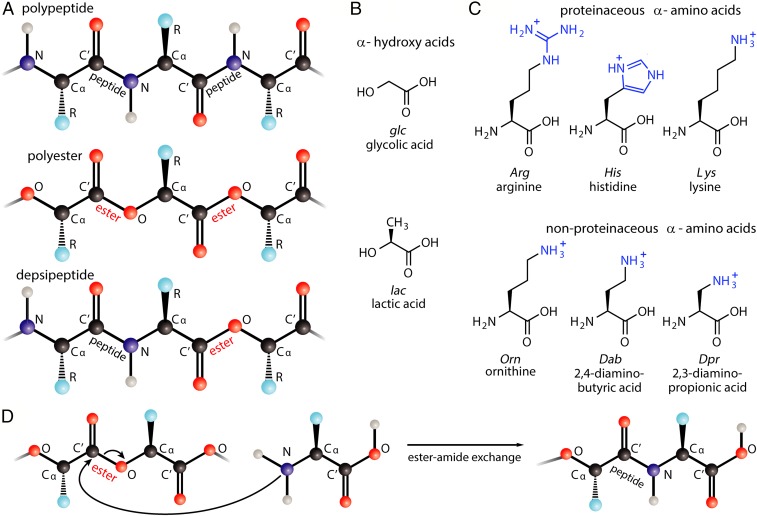
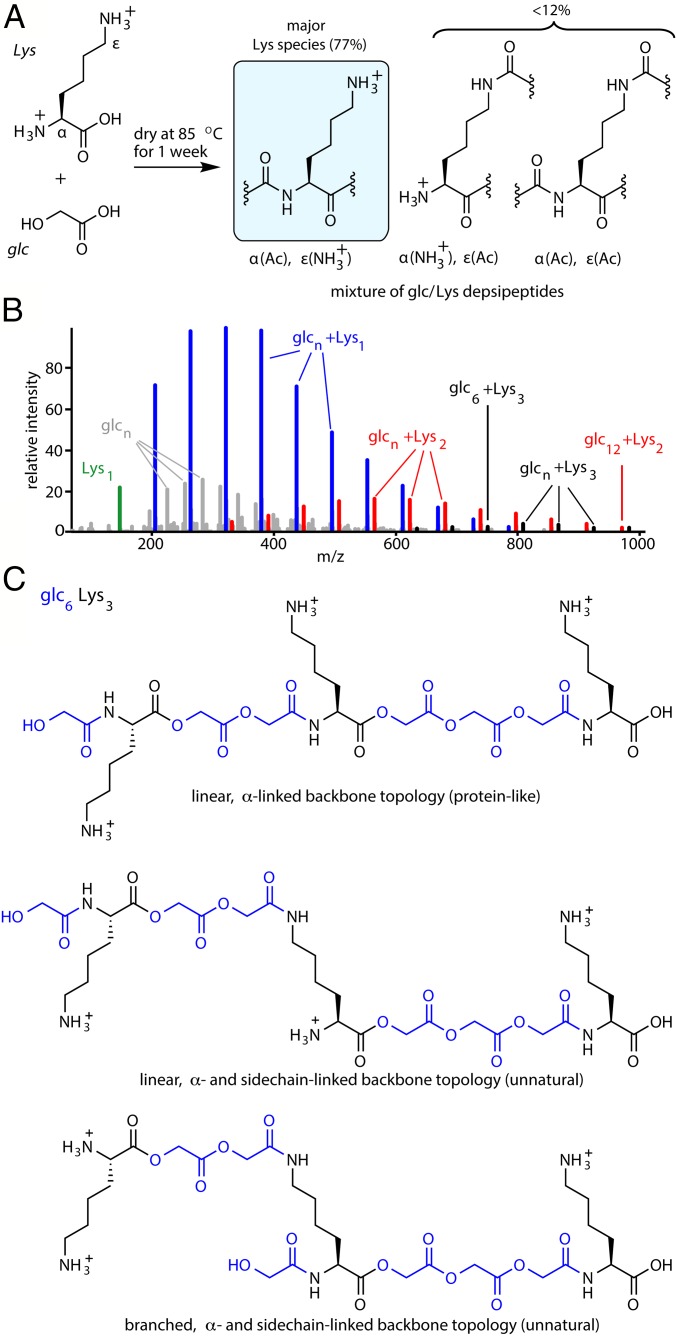
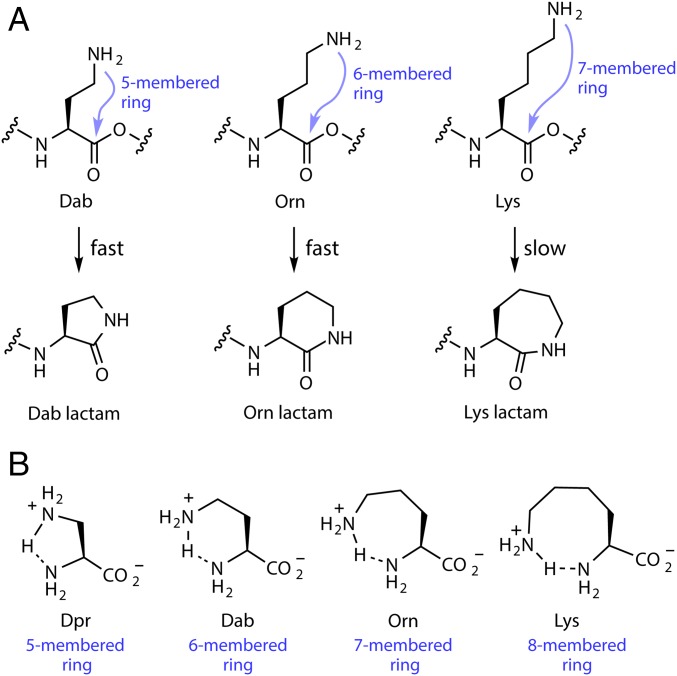
Significance: One of the long-standing questions in origins-of-life research centers on how the proteinaceous side chains and the protein backbone were selected during the earliest phases of evolution. Here we have studied oligomerization reactions of a group of positively charged amino acids, both proteinaceous and nonproteinaceous. Amino acids spontaneously oligomerized without the use of enzymes or activating agents, under mild, hydroxy acid-catalyzed, dry-down conditions. We observed that the proteinaceous amino acids oligomerized more extensively and with greater preference for reactivity through their α-amine compared with nonproteinaceous amino acids, forming predominantly linear, protein-like backbone topologies. These findings provide a purely chemical basis for selection of the positively charged amino acids found in today’s proteins.
Overview
The claims and statistics of this paper haven’t been checked yet.
Free: it reads the open-access text and checks the first 5 claims that cite a source we can check. Create a free account to check every claim.
Integrity signals
Registry
Cites
Statistics
Figures
Verification
Claims the paper makes
The claims and statistics of this paper haven’t been checked yet.
Free: it reads the open-access text and checks the first 5 claims that cite a source we can check. Create a free account to check every claim.
Claims other papers make about this one
Each is checked against this paper’s own text: does it say what the citing paper says it does?
The source backs part of the claim, not all of it — or backs it for a different population, condition or comparison.
In the citing paper
“A specific example is the greater reactivity of proteinaceous amino acids when compared to their non-proteinaceous counterparts, which naturally selects from oligomers of the former [206].”
From The Future of Origin of Life Research: Bridging Decades-Old Divisions (2020) · cites this paper as [206]
Experimental — accuracy not yet measured
Self-check
Percentages, sums and reported differences re-computed from the paper’s own numbers.
The self-check needs the paper’s full text.
Citations
Cites
A Production of Amino Acids Under Possible Primitive Earth Conditions
Miller, S. L. (1953) · Science · doi:10.1126/science.117.3046.528 · Cited by 3,522 · cited 5×
“Our results provide an empirical chemical basis for the selection of proteinaceous cationic amino acids over these nonproteinaceous amino acids on early Earth.”
Influential(1987) · Comparative Biochemistry and Physiology Part A: Physiology · doi:10.1016/0300-9629(87)90411-7 · Cited by 2,958
Prebiotic chemistry and the origin of the RNA world.
Leslie E., O. (2004) · Critical Reviews in Biochemistry and Molecular Biology · doi:10.1080/10409230490460765 · Cited by 1,124
Common origins of RNA, protein and lipid precursors in a cyanosulfidic protometabolism
Patel, B. H., Percivalle, C., Ritson, D. J., Duffy, C. D., & Sutherland, J. D. (2015) · Nature Chemistry · doi:10.1038/nchem.2202 · Cited by 949 · cited 4×
“Lys, Arg, and His are considered less prebiotically plausible, even though Lys has been found in meteorites (31, 32) and prebiotic routes have been proposed for production of both Arg and His (33, 34).”
InfluentialHigh Resolution Structure of the Large Ribosomal Subunit from a Mesophilic Eubacterium
Harms, J., Schluenzen, F., Zarivach, R., Bashan, A., Gat, S., Agmon, I., Bartels, H., Franceschi, F., & Yonath, A. (2001) · Cell · doi:10.1016/s0092-8674(01)00546-3 · Cited by 901
Racemic amino acids from the ultraviolet photolysis of interstellar ice analogues
Bernstein, M. P., Dworkin, J. P., Sandford, S. A., Cooper, G. W., & Allamandola, L. J. (2002) · Nature · doi:10.1038/416401a · Cited by 785
Converging roles of caspases in inflammasome activation, cell death and innate immunity
Man, S. M., & Kanneganti, T.-D. (2016) · Nature Reviews Immunology · doi:10.1038/nri.2015.7 · Cited by 701
Short peptides self-assemble to produce catalytic amyloids
Rufo, C. M., Moroz, Y. S., Moroz, O. V., Stöhr, J., Smith, T. A., Hu, X., DeGrado, W. F., & Korendovych, I. V. (2014) · Nature Chemistry · doi:10.1038/nchem.1894 · Cited by 663
RNA evolution and the origins of life
Joyce, G. F. (1989) · Nature · doi:10.1038/338217a0 · Cited by 658
Just, T., Oparin, A. I., & Morgulis, S. (1938) · American Midland Naturalist · doi:10.2307/2420646 · Cited by 622
Cited by
Items 101–139 of 139
Robust Synthesis of Prebiotic Precursors in Drying Reactions of Amino Acids and Keto Acids
Marland, E., Lipson, G., Edri, R., Cohen, O., Guzmán-Martínez, A., Shalev, O., Salván, C. M., & Frenkel‐Pinter, M. (2025) · ChemSystemsChem · doi:10.1002/syst.202500018 · Cited by 2
Self-citationHow did the Proteome Emerge From Pre-biotic Chemistry?
Carter, C. W. (2022) · Royal Society of Chemistry eBooks · doi:10.1039/9781839164798-00317 · Cited by 3
The First Nucleic Acid Strands May Have Grown on Peptides via Primeval Reverse Translation
Tozzi, A., & Mazzeo, M. (2023) · Acta Biotheoretica · doi:10.1007/s10441-023-09474-6 · Cited by 3
“Further, possible amino acids ancestors like depsipeptides produce polypeptides during dry-down cycles under mild conditions (Frenkel-Pinter et al. 2019).”
BackgroundWang, C.-H., Jhang, Y.-Y., & Yu, S. (2025) · RSC Advances · doi:10.1039/d4ra08607d · Cited by 2
From Amino Acids to Peptides before the Coming of Ribosomes
Leqraa, N., & Vallée, Y. (2022) · Royal Society of Chemistry eBooks · doi:10.1039/9781839164798-00177 · Cited by 2
Thermodynamic and kinetic selection in evolving chemical mixturesPreprint
Capera-Aragones, P., Matange, K., Rajaei, V., Williams, L. D., & Frenkel‐Pinter, M. (2023) · ChemRxiv · doi:10.26434/chemrxiv-2023-b3glp · Cited by 2
Self-citationCoenzyme-Protein Interactions since Early LifePreprint
Sánchez-Rocha, A. C., Makarov, M., Pravda, L., Novotný, M., & Hlouchová, K. (2024) · eLife · doi:10.7554/elife.94174.2 · Cited by 2
On the Origin of Life on Earth: The Nanozymes Hypothesis, and More
Jin, Y. (2025) · Research · doi:10.34133/research.1025 · Cited by 3
“This opinion may have been confirmed as scientists recently discovered that amino acids can spontaneously link up to form protein-like chains when completely dry [ 42 ], and such reactions are easier to achieve for the 20 amino acids found in today’s natural proteins.”
Ezerzer, Y., Hiregange, D., Bashan, A., Yonath, A., & Frenkel‐Pinter, M. (2026) · BioCosmos · doi:10.2478/biocosmos-2026-0002 · Cited by 1
“…Hud, and colleagues has shown the selective incorporation of proteinogenic over non-proteinogenic cationic amino acids into depsipeptides under drying conditions, providing evidence that modern biochemical building blocks could have been enriched through purely chemical selection mechanisms (44).”
Self-citationBlanco, Y., Naskar, S., Aguilera, Á., Fernández-Algar, M., Happe, T., & Briones, C. (2026) · Astrobiology · doi:10.1177/15311074261474801 · Cited by 1
“…served as cofactors for ribo-zymes involved in both RNA-dependent RNA replication and the catalysis of early metabolic pathways, within the context of the RNA world hypothesis (Gilbert, 1986) in its current formulation (Ruiz-Mirazo et al., 2014; Frenkel-Pinter et al., 2019; Kutlu et al., 2024).”
Functional abiotic metabolite assembly hypothesis for the early events in the origin of life
Chakraborty, P., Yuan, C., Levkovich, S. A., Bar‐Yosef, D. L., Yan, X., & Gazit, E. (2026) · Nature Communications · doi:10.1038/s41467-026-77921-2 · Cited by 1
On the Origin of Genetically Coded Protein Synthesis
Коваленко, С. П. (2021) · Russian Journal of Bioorganic Chemistry · doi:10.1134/s1068162021060121 · Cited by 1
Chemical Evolution ReimaginedPreprint
Frenkel‐Pinter, M., Matange, K., Rajaei, V., Costner, J. T., Robertson, A., Kim, J. S., Petrov, A. S., Bowman, J. C., & Williams, L. D. (2022) · ChemRxiv · doi:10.26434/chemrxiv-2022-s3cr2 · Cited by 3
Self-citationChemical Evolution ReimaginedPreprint
Frenkel‐Pinter, M., Matange, K., Rajaei, V., Costner, J. T., Robertson, A., Kim, J. S., Petrov, A. S., Bowman, J. C., & Williams, L. D. (2022) · ChemRxiv · doi:10.26434/chemrxiv-2022-s3cr2-v2 · Cited by 1
Self-citationOrigins of Life: Chemistry and EvolutionPreprint
Matange, K., Rajaei, V., Schuster, G. B., Hud, N. V., Menor-Salván, C. A., Capera-Aragones, P., Frenkel‐Pinter, M., & Williams, L. D. (2023) · ChemRxiv · doi:10.26434/chemrxiv-2023-1jrcq-v2 · Cited by 1
Self-citationThe Interplay Between Logical Phenomena and the Cognitive System of the MindPreprint
Azar, K. H. (2024) · arXiv (Cornell University) · doi:10.48550/arxiv.2401.09465 · Cited by 1
On the Origin of Life: Coevolution between RNA and Peptide
Tagami, S. (2021) · Seibutsu Butsuri · doi:10.2142/biophys.61.232
Of Aliens and Exoplanets: Why the search for life, probably, requires the search for waterPreprint
Modirrousta‐Galian, D., & Maddalena, G. (2021) · arXiv (Cornell University) · doi:10.48550/arxiv.2104.01683
Meringer, M., Casañola‐Martín, G. M., Rasulev, B., & Cleaves, H. J. (2024) · International Journal of Molecular Sciences · doi:10.3390/ijms252212343
Author response: Coenzyme-protein interactions since early life
Sánchez-Rocha, A. C., Makarov, M., Pravda, L., Novotný, M., & Hlouchová, K. (2025) · eLife · doi:10.7554/elife.94174.3.sa3
Jones, C. K., Leung, M., Tu, C., Ebadirad, S., Marshall, N. L., Tan, L., & Lyons, T. W. (2025) · Elsevier eBooks · doi:10.1016/b978-0-323-95547-8.00003-3
Non-random Distributions of the Canonical Amino Acids in Chemistry Space
Mayer-Bacon, C. (2023) · Maryland Shared Open Access Repository (USMAI Consortium) · doi:10.13016/m2v9tv-agrh
Prebiotic oligomerization of amino acids: A step in molecular evolution toward biological complexity
Vargas-García, A., & Heredia, A. (2026) · Biosystems · doi:10.1016/j.biosystems.2026.105773
Emergence de biopolymères de complexite contrôlée dans les scénarios d'origine de la vie
Bedoin, L. (2021) · theses.fr (ABES) · doi:10.70675/47bd74e4z758cz47fez905bzbd34a3e1534d
Growth and invasion of peptides and nucleic acids inside lipidic giant vesicles
Lopez, A. (2023) · theses.fr (ABES) · doi:10.70675/f789a8f4zd042z46eazb952zd0e91eabb323
Prebiotic Organic Chemistry of Diketopiperazines
Ohata, J. (2026) · Asian Journal of Organic Chemistry · doi:10.1002/ajoc.70395
The challenge of distinguishing living from non-living entities
Azar, K. H. (2026) · Theory in Biosciences · doi:10.1007/s12064-026-00481-y · Cited by 1
Molecular war and peace: the concurrent path to antibiosis and antibiotic resistance
Baquero, F., Cantón, R., Herencias, C., Gama, J., & Coque, T. M. (2026) · Frontiers in Microbiology · doi:10.3389/fmicb.2026.1851874
Gravity as a Physical Selector of Chemical Evolution and the Origin of Life
Roth, B., Kirschning, A., & Zeilinger, C. (2026) · Physics of Life Reviews · doi:10.1016/j.plrev.2026.06.008
Metal ions affect abiotic sugar oligomerization reactions
Akulenko, D., Edri, R., & Frenkel‐Pinter, M. (2026) · Communications Chemistry · doi:10.1038/s42004-026-02129-w
Self-citationHydroxy acid conjugation to lipids increases structural and hydrolytic stability
Edri, R., Fisher, S., Levi‐Kalisman, Y., & Frenkel‐Pinter, M. (2026) · Nature Communications · doi:10.1038/s41467-026-75192-5
“HAs such as glycolic acid and lactic acid have been found to facilitate peptide bond formation via ester-amide exchange under wet-dry cycling and drying reactions 54,55 .”
Self-citationPrebiotic cationic amino acids support formation of an ancient protein foldPreprint
Yagi, S., Padhi, A. K., Bhagat, K., Zhang, K. Y. J., & Tagami, S. (2026) · bioRxiv (Cold Spring Harbor Laboratory) · doi:10.64898/2026.07.28.741362
“In contrast, when these non-proteogenic amino acids are activated for polymerization–for example, as adenylated or nitrile intermediates–they become highly prone to rapid intramolecular lactamization even at neutral pH, which hinders further peptide polymerization 13,32–34 .”
Lefebvre, M., Chahinian, H., Lleshaj, A., Roumaillac-Sargsyan, A., Yahi, N., & Fantini, J. (2026) · The Journal of Membrane Biology · doi:10.1007/s00232-026-00399-y
“…system is therefore consistent with a model in which polyamines constituted the earliest cationic membrane-interacting agents, subsequently replaced by increasingly specific cat - ionic proto-proteins as the genetic code expanded to encode lysine and arginine residues (Frenkel-Pinter et al. 2019).”
Computational modeling of an RNA-peptide worldPreprint
Sahakyan, H., Wolf, Y. I., & Koonin, E. V. (2026) · bioRxiv (Cold Spring Harbor Laboratory) · doi:10.64898/2026.09.21.753249
Protoribosomal condensate formation across cationic chemistriesPreprint
Codispoti, S., Giacobelli, V. G., Friček, M., Verner, V., Nováková, J., Mašek, M., Bokac, A., Kryštůfek, R., Souček, R., Kolář, M., et al. (2026) · bioRxiv (Cold Spring Harbor Laboratory) · doi:10.64898/2026.09.29.755306
“Experimental models of prebiotic peptide synthesis similarly produce highly diverse sequence populations rather than one predominant product(35).”
Switching ATP‐Forming Phosphoryl‐Transfer Chemistry With a Restricted Set of Amino Acids
Yagi, S., Dasgupta, S., Tagami, S., & Akanuma, S. (2026) · Angewandte Chemie International Edition · doi:10.1002/anie.2166480
Switching ATP‐Forming Phosphoryl‐Transfer Chemistry With a Restricted Set of Amino Acids
Yagi, S., Dasgupta, S., Tagami, S., & Akanuma, S. (2026) · Angewandte Chemie · doi:10.1002/ange.2166480
Computational modeling of an RNA-peptide worldPreprint
Koonin, E. V., Sahakyan, H., & Wolf, Y. I. (2026) · Research Square · doi:10.21203/rs.3.rs-11119075/v1
Xie, G., Zhou, Q., Wang, R., & Huang, H. (2026) · Journal of Molecular Structure · doi:10.1016/j.molstruc.2026.148048
Metadata
- Authors
- Frenkel-Pinter, M., Haynes, J. W., C, M., Petrov, A. S., Burcar, B. T., Krishnamurthy, R., Hud, N. V., Leman, L. J., & Williams, L. D.
- Affiliations
- National Science Foundation (NSF)–National Aeronautics and Space Administration (NASA) Center for Chemical Evolution, Atlanta, GA 30332;
- Georgia Institute of Technology (US)
- Scripps Research Institute (US)
- Corresponding author
- Leman, Luke J.
- ORCID
- Venue
- Proceedings of the National Academy of Sciences
- Publisher
- National Academy of Sciences
- Published
- 2019-07-29
- Volume
- 116
- Issue
- 33
- Pages
- 16338-16346
- ISSN
- 0027-8424 (ISSN-L)
- 1091-6490
- PMC
- PMC6697887
- OpenAlex
- W2964861802
- Cited by
- 128
- References
- 88
- Citations by year
- 2026: 13 · 2025: 14 · 2024: 20 · 2023: 17 · 2022: 19 · 2021: 26 · 2020: 17 · 2019: 2
- FWCI
- 8.54
- Type
- journal article
- Language
- en
- Open access
- hybrid
- doi.org
- Licence
- Locations
- Proceedings of the National Academy of Sciences (publishedVersion, cc-by-nc-nd)
- Europe PMC (PubMed Central) (publishedVersion, cc-by-nc-nd)
- PubMed Central (publishedVersion, cc-by-nc-nd)
- PubMed (publishedVersion)
- eScholarship (California Digital Library) (submittedVersion)
- eScholarship (California Digital Library) (submittedVersion, cc-by-nc-nd)
- Funders
- National Science Foundation (1504217)
- National Aeronautics and Space Administration (CHE-1504217)
- Division of Chemistry (CHE-1504217, 1504217)
- Topics
- Physical Sciences › Physics and Astronomy › Astronomy and Astrophysics › Origins and Evolution of Life
- Life Sciences › Biochemistry, Genetics and Molecular Biology › Molecular Biology › RNA and protein synthesis mechanisms
- Life Sciences › Biochemistry, Genetics and Molecular Biology › Genetics › Evolution and Genetic Dynamics
- Keywords
- basic amino acids, depsipeptides, origin of life, lysine analogs, ornithine, 2,4-diaminobutyric acid, 2,3-diaminopropionic acid, lactams, electrostatic interactions, early Earth
- MeSH terms
- Origin of Life, Amino Acids, Aminobutyrates, Cations, DNA-Binding Proteins, Peptides, Proteins, beta-Alanine, RNA-Binding Proteins, Depsipeptides, Static Electricity
About these checks
Registry, retraction, Cites and statistics results are computed, not judged, with one exception: a printed reference that no index lists is read once by a model before it counts as a citation error. Claims are extracted by a model and kept only when their quote appears verbatim in the text; each cited source is then checked, with a model’s help, for whether it says what the claim relies on. Those verdicts can be wrong — read the claim’s quote and the cited source before relying on one.
Statistics and arithmetic are recomputed, not judged.
Confidence bands are shown only for fields calibrated on our annotated test set. None is calibrated yet, so no band is shown.
What counts as a claim ›How we measure confidence ›How we check this ›
Are you an author, or do you see a problem with this page? Request a review
Data sources
Bibliographic data: Semantic Scholar, OpenAlex, Crossref.
Contains information from the Semantic Scholar Academic Graph Datasets, made available under the ODC Attribution License (ODC-BY 1.0).
Semantic Scholar’s data is described in: Kinney, R., et al. (2023). The Semantic Scholar Open Data Platform. arXiv:2301.10140.
