

The DOI matches its Crossref record; 41 of the 44 references it cites were found in a registry or an index.
Universals and variations in moral decisions made in 42 countries by 70,000 participants
Open accessAbstract
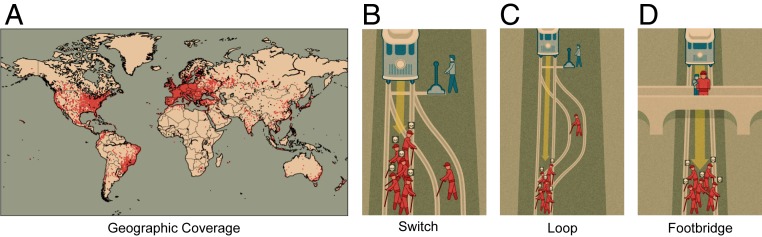
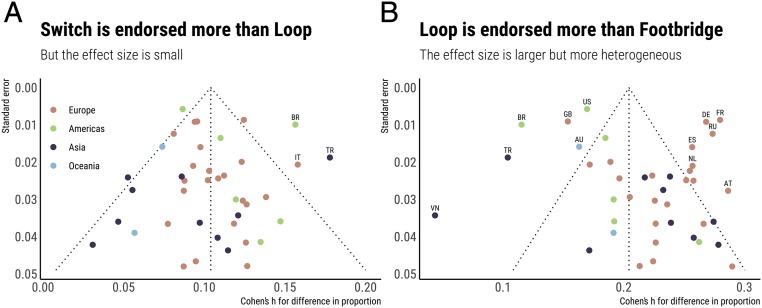
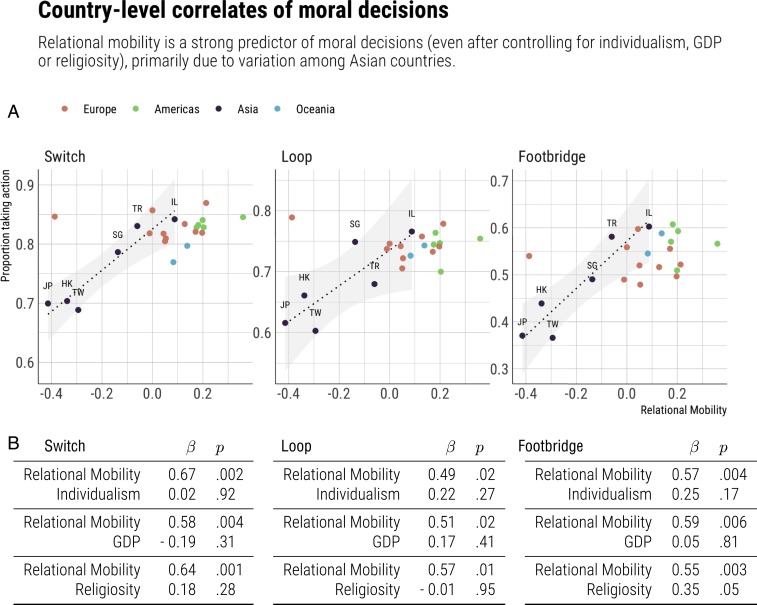
When do people find it acceptable to sacrifice one life to save many? Cross-cultural studies suggested a complex pattern of universals and variations in the way people approach this question, but data were often based on small samples from a small number of countries outside of the Western world. Here we analyze responses to three sacrificial dilemmas by 70,000 participants in 10 languages and 42 countries. In every country, the three dilemmas displayed the same qualitative ordering of sacrifice acceptability, suggesting that this ordering is best explained by basic cognitive processes rather than cultural norms. The quantitative acceptability of each sacrifice, however, showed substantial country-level variations. We show that low relational mobility (where people are more cautious about not alienating their current social partners) is strongly associated with the rejection of sacrifices for the greater good (especially for Eastern countries), which may be explained by the signaling value of this rejection. We make our dataset fully available as a public resource for researchers studying universals and variations in human morality.
Overview
The claims and statistics of this paper haven’t been checked yet.
Run the check — free, no account needed. It reads the open-access text and checks the sources it cites.
Integrity signals
Registry
Cites
Statistics
Figures

Verification
Claims the paper makes
The claims and statistics of this paper haven’t been checked yet.
Run the check — free, no account needed. It reads the open-access text and checks the sources it cites.
Claims other papers make about this one
Each is checked against this paper’s own text: does it say what the citing paper says it does?
In the citing paper
“Ethics should ensure the design of AI technologies for human flourishing around the world [192,193], but this is a very complex matter given that, as the work of Awad et al. [194,195] clearly demonstrates, universally valid and accepted ethical principles do not exist.”
From The sustainability of artificial intelligence: an urbanistic viewpoint from the lens of smart and sustainable cities (2020) · cites this paper as [195]
Self-check
Percentages, sums and reported differences re-computed from the paper’s own numbers.
The self-check needs the paper’s full text.
Citations
Cites
“Economic man” in cross-cultural perspective: behavioral experiments in 15 small-scale societies
Henrich, J., Boyd, R., Bowles, S., Camerer, C., Fehr, E., Gintis, H., McElreath, R., Alvard, M., Barr, A., Ensminger, J., et al. (2005) · Behavioral and Brain Sciences · doi:10.1017/s0140525x05000142 · Cited by 1,898
Awad, E., Dsouza, S., Kim, R., Schulz, J., Henrich, J., Shariff, A., Bonnefon, J.-F., & Rahwan, I. (2018) · Nature · doi:10.1038/s41586-018-0637-6 · Cited by 1,859 · cited 1×
“While the Moral Machine website was primarily designed to explore the ethics of self-driving cars (13), it also offered a “Classic” mode, where visitors made decisions about the traditional Switch, Loop, and Footbridge variants of the trolley problem; these are the data that we report in this article.”
Self-citationThe Problem of Abortion and the Doctrine of the Double Effect
Foot, P. (2002) · Oxford University Press eBooks · doi:10.1093/0199252866.003.0002 · Cited by 1,374
Thomson, J. J. (1985) · The Yale Law Journal · doi:10.2307/796133 · Cited by 1,315
The Role of Conscious Reasoning and Intuition in Moral Judgment
Cushman, F. A., Young, L., & HAUSER, M. D. (2006) · Psychological Science · doi:10.1111/j.1467-9280.2006.01834.x · Cited by 1,061
Many Labs 2: Investigating variation in replicability across samples and settings
Klein, R. A., Vianello, M., Hasselman, F., Adams, B. G., Adams, R. B., Alper, S., Aveyard, M., Axt, J. R., Babalola, M. T., Bahník, Š., et al. (2018) · Advances in Methods and Practices in Psychological Science · doi:10.1177/2515245918810225 · Cited by 944
Universal moral grammar: theory, evidence and the future
Mikhail, J. (2007) · Trends in Cognitive Sciences · doi:10.1016/j.tics.2006.12.007 · Cited by 923
Pushing moral buttons: The interaction between personal force and intention in moral judgment
Greene, J. D., Cushman, F. A., Stewart, L. E., Kelly Lowenberg, C., Nystrom, L. E., & Cohen, J. D. (2009) · Cognition · doi:10.1016/j.cognition.2009.02.001 · Cited by 677
A Dissociation Between Moral Judgments and Justifications
HAUSER, M., CUSHMAN, F., YOUNG, L., KANG‐XING JIN, R., & MIKHAIL, J. (2007) · Mind & Language · doi:10.1111/j.1468-0017.2006.00297.x · Cited by 666
16. The Problem of Abortion and the Doctrine of the Double Effect
Foot, P. (1994) · Fordham University Press eBooks · doi:10.1515/9780823295968-019 · Cited by 454
Cited by
Sorted by citations
Yigitcanlar, T., & Cugurullo, F. (2020) · Sustainability · doi:10.3390/su12208548 · Cited by 337
Beyond WEIRD: A review of the last decade and a look ahead to the global laboratory of the future
Apicella, C. L., Norenzayan, A., & Henrich, J. (2020) · Evolution and Human Behavior · doi:10.1016/j.evolhumbehav.2020.07.015 · Cited by 302
Evaluating CloudResearch’s Approved Group as a solution for problematic data quality on MTurk
Hauser, D., Moss, A. J., Rosenzweig, C., Jaffe, S. N., Robinson, J., & Litman, L. (2022) · Behavior Research Methods · doi:10.3758/s13428-022-01999-x · Cited by 299
Cultural Psychology: Beyond East and West
Kitayama, S., & Salvador, C. E. (2023) · Annual Review of Psychology · doi:10.1146/annurev-psych-021723-063333 · Cited by 249
ChatGPT’s inconsistent moral advice influences users’ judgment
Krügel, S., Ostermaier, A., & Uhl, M. (2023) · Scientific Reports · doi:10.1038/s41598-023-31341-0 · Cited by 183
A Causal Framework for Cross-Cultural Generalizability
Deffner, D., Rohrer, J. M., & McElreath, R. L. (2022) · Advances in Methods and Practices in Psychological Science · doi:10.1177/25152459221106366 · Cited by 152
Global evidence of expressed sentiment alterations during the COVID-19 pandemic
Wang, J., Fan, Y., Palacios, J., Chai, Y., Guetta-Jeanrenaud, N., Obradovich, N., Zhou, C., & Zheng, S. (2022) · Nature Human Behaviour · doi:10.1038/s41562-022-01312-y · Cited by 140
Moral dilemmas and trust in leaders during a global health crisis
Everett, J. A. C., Colombatto, C., Awad, E., Boggio, P. S., Bos, B., Brady, W. J., Chawla, M., Chituc, V., Chung, D., Drupp, M. A., et al. (2021) · Nature Human Behaviour · doi:10.1038/s41562-021-01156-y · Cited by 81
Self-citationBagó, B., Kovács, M., Protzko, J., Nagy, T., Kekecs, Z., Pálfi, B., Adamkovic, M., Adamus, S., Albalooshi, S., Albayrak‐Aydemir, N., et al. (2022) · Nature Human Behaviour · doi:10.1038/s41562-022-01319-5 · Cited by 91
Leveraging social cognition to promote effective climate change mitigation
Boon-Falleur, M., Grandin, A., Baumard, N., & Chevallier, C. (2022) · Nature Climate Change · doi:10.1038/s41558-022-01312-w · Cited by 78
Delegation to artificial intelligence can increase dishonest behaviour
Köbis, N., Rahwan, Z., Rilla, R., Supriyatno, B. I., Bersch, C., Ajaj, T., Bonnefon, J., & Rahwan, I. (2025) · Nature · doi:10.1038/s41586-025-09505-x · Cited by 80
Self-citationUnderstanding Markets with Socially Responsible Consumers
Kaufmann, M., Andre, P., & Kőszegi, B. (2024) · The Quarterly Journal of Economics · doi:10.1093/qje/qjae009 · Cited by 66
Serious Games and AI: Challenges and Opportunities for Computational Social Science
Pérez, J., Castro, M., & López, G. (2023) · IEEE Access · doi:10.1109/access.2023.3286695 · Cited by 61
Knowledge of cultural moral norms in large language models
Ramezani, A., & Xu, Y. (2023) · Proceedings of the 61st Annual Meeting of the Association for Computational Linguistics (Volume 1: Long Papers) · doi:10.18653/v1/2023.acl-long.26 · Cited by 54
Deontology and Utilitarianism in Real Life: A Set of Moral Dilemmas Based on Historic Events
Körner, A., & Deutsch, R. (2022) · Personality and Social Psychology Bulletin · doi:10.1177/01461672221103058 · Cited by 53
NLPositionality: Characterizing Design Biases of Datasets and Models
Santy, S., Liang, J. T., Bras, R. J. L., Reinecke, K., & Sap, M. (2023) · Proceedings of the conference - Association for Computational Linguistics. Meeting · doi:10.18653/v1/2023.acl-long.505 · Cited by 74
Can large language models help augment English psycholinguistic datasets?
Trott, S. (2024) · Behavior Research Methods · doi:10.3758/s13428-024-02337-z · Cited by 58
Komatsu, T., Malle, B. F., & Scheutz, M. (2021) · Proceedings of the 2021 ACM/IEEE International Conference on Human-Robot Interaction · doi:10.1145/3434073.3444672 · Cited by 43
Broad cross-national public support for accelerated COVID-19 vaccine trial designs
Broockman, D., Kalla, J., Guerrero, A., Budolfson, M. B., Eyal, N., Jewell, N. P., Magalhães, M. D. A. F. M., & Sekhon, J. S. (2020) · Vaccine · doi:10.1016/j.vaccine.2020.11.072 · Cited by 41
Investigating machine moral judgement through the Delphi experiment
Jiang, L., Hwang, J. D., Bhagavatula, C., Bras, R. J. L., Liang, J. T., Levine, S., Dodge, J., Sakaguchi, K., Forbes, M., Hessel, J., et al. (2025) · Nature Machine Intelligence · doi:10.1038/s42256-024-00969-6 · Cited by 58
Fears about artificial intelligence across 20 countries and six domains of application.
Dong, M., Conway, J. R., Bonnefon, J., Shariff, A., & Rahwan, I. (2024) · American Psychologist · doi:10.1037/amp0001454 · Cited by 48
Self-citationAI safety: state of the field through quantitative lens
Juric, M., Sandic, A., & Brčić, M. (2020) · International Convention on Information and Communication Technology, Electronics and Microelectronics · doi:10.23919/mipro48935.2020.9245153 · Cited by 41
Ghasemaghaei, M., & Kordzadeh, N. (2024) · Information Systems Journal · doi:10.1111/isj.12572 · Cited by 39
Sznycer, D., Sell, A. N., & Dumont, A. (2021) · Evolution and Human Behavior · doi:10.1016/j.evolhumbehav.2021.11.007 · Cited by 37
Are There Cross‐Cultural Legal Principles? Modal Reasoning Uncovers Procedural Constraints on Law
Hannikainen, I. R., Tobia, K. P., de Almeida, G. D. F. C. F., Donelson, R., Dranseika, V., Kneer, M., Strohmaier, N., Bystranowski, P., Dolinina, K., Janik, B., et al. (2021) · Cognitive Science · doi:10.1111/cogs.13024 · Cited by 37
Artificial intelligence, ethics, and intergenerational responsibility
Klockmann, V., von Schenk, A., & Villeval, M. C. (2022) · Journal of Economic Behavior & Organization · doi:10.1016/j.jebo.2022.09.010 · Cited by 36
An evolutionary contractualist theory of moralityPreprint
André, J., Fitouchi, L., Debove, S., & Baumard, N. (2022) · PsyArXiv (OSF Preprints) · doi:10.31234/osf.io/2hxgu · Cited by 37
The social psychology of everyday life
Hofmann, W., & Grigoryan, L. K. (2023) · Advances in experimental social psychology · doi:10.1016/bs.aesp.2023.06.001 · Cited by 30
Trolleys, triage and Covid-19: the role of psychological realism in sacrificial dilemmas
Kneer, M., & Hannikainen, I. R. (2021) · Cognition & Emotion · doi:10.1080/02699931.2021.1964940 · Cited by 29
Sznycer, D. (2022) · Evolution and Human Behavior · doi:10.1016/j.evolhumbehav.2022.06.002 · Cited by 28
Bruno, G., Spoto, A., Lotto, L., Cellini, N., Cutini, S., & Sarlo, M. (2023) · Motivation and Emotion · doi:10.1007/s11031-023-10024-3 · Cited by 26
Morality in the anthropocene: The perversion of compassion and punishment in the online world
Robertson, C. E., Shariff, A., & Bavel, J. J. V. (2024) · PNAS Nexus · doi:10.1093/pnasnexus/pgae193 · Cited by 28
Self-citationAre Emotions Natural Kinds After All? Rethinking the Issue of Response Coherence
Sznycer, D., & Cohen, A. S. (2021) · Evolutionary Psychology · doi:10.1177/14747049211016009 · Cited by 24
Towards Moral Machines: A Discussion with Michael Anderson and Susan Leigh Anderson
Anderson, M., Anderson, S., Gounaris, A., & Kosteletos, G. (2021) · Conatus · doi:10.12681/cjp.26832 · Cited by 26
Ethics 4.0: Ethical Dilemmas in Healthcare Mediated by Social Robots
Soares, A., Piçarra, N., Giger, J., Oliveira, R., & Arriaga, P. (2023) · International Journal of Social Robotics · doi:10.1007/s12369-023-00983-5 · Cited by 21
Psychopathic Traits and Utilitarian Moral Judgment Revisited
Paruzel‐Czachura, M., & Farny, Z. (2023) · Personality and Social Psychology Bulletin · doi:10.1177/01461672231169105 · Cited by 22
Social dominance orientation: The motivational basis of intergroup inequality
Ho, A. K., Kteily, N., Sheehy-Skeffington, J. A., & Thomsen, L. (2025) · Advances in experimental social psychology · doi:10.1016/bs.aesp.2025.04.003 · Cited by 19
Quantum choice models: A flexible new approach for understanding moral decision-making
Hancock, T. O., Broekaert, J., Hess, S., & Choudhury, C. F. (2020) · Journal of Choice Modelling · doi:10.1016/j.jocm.2020.100235 · Cited by 19
Are There Cross-Cultural Legal Principles? Modal Reasoning Uncovers Procedural Constraints on LawPreprint
Hannikainen, I. R., Tobia, K. P., Almeida, G., Donelson, R., Dranseika, V., Kneer, M., Strohmaier, N., Bystranowski, P., Dolinina, K., Janik, B., et al. (2021) · PsyArXiv (OSF Preprints) · doi:10.31234/osf.io/c2ytm · Cited by 19
An Evaluation of Cross-Cultural Adaptations of Social Cognition Testing: A Systematic Review
Bourdage, R., Narme, P., Neeskens, R., Papma, J. M., & Franzen, S. (2023) · Neuropsychology Review · doi:10.1007/s11065-023-09616-0 · Cited by 18
Breakdown of utilitarian moral judgement after basolateral amygdala damage
van Honk, J., Terburg, D., Montoya, E. R., Grafman, J. H., Stein, D. J., & Morgan, B. E. (2022) · Proceedings of the National Academy of Sciences · doi:10.1073/pnas.2119072119 · Cited by 18
Qian, Y., Takimoto, Y., Wang, L., & Yasumura, A. (2023) · Current Psychology · doi:10.1007/s12144-023-04662-6 · Cited by 19
The shallow of your smile: the ethics of expressive vocal deep-fakes
Guerouaou, N., Vaïva, G., & Aucouturier, J. (2021) · Philosophical Transactions of the Royal Society B Biological Sciences · doi:10.1098/rstb.2021.0083 · Cited by 17
Hashimoto, H., Maeda, K., & Matsumura, K. (2022) · Frontiers in Psychology · doi:10.3389/fpsyg.2022.795732 · Cited by 17
How Institutions Shape Morality
Dari‐Mattiacci, G., & Fabbri, M. (2021) · The Journal of Law Economics and Organization · doi:10.1093/jleo/ewab016 · Cited by 15
Machines and humans in sacrificial moral dilemmas: Required similarly but judged differently?
Chu, Y., & Liu, P. (2023) · Cognition · doi:10.1016/j.cognition.2023.105575 · Cited by 14
If the Objective is Herd Immunity, on Whom Should it be Built?
Gollier, C. (2020) · Environmental and Resource Economics · doi:10.1007/s10640-020-00504-2 · Cited by 14
Does Moral Code have a Moral Code? Probing Delphi’s Moral Philosophy
Fraser, K., Kiritchenko, S., & Balkır, E. (2022) · Workshop on Trustworthy Natural Language Processing (TrustNLP) · doi:10.18653/v1/2022.trustnlp-1.3 · Cited by 14
Identifying AI Hazards and Responsibility Gaps
Cummings, M. L. (2025) · IEEE Access · doi:10.1109/access.2025.3552200 · Cited by 13
Roets, A., Bostyn, D. H., keersmaecker, J. D., Haesevoets, T., Assche, J. V., & Hiel, A. V. (2020) · Scientific Reports · doi:10.1038/s41598-020-70199-4 · Cited by 13
Winking, J., & Koster, J. (2021) · PLoS ONE · doi:10.1371/journal.pone.0249345 · Cited by 14
Hadza hunter-gatherers are not deontologists and do not prefer deontologists as social partners
Smith, K. M., & Apicella, C. L. (2022) · Journal of Experimental Social Psychology · doi:10.1016/j.jesp.2022.104314 · Cited by 13
The social psychology of everyday life
(1993) · Choice Reviews Online · doi:10.5860/choice.30-4092 · Cited by 13
HUMAN FACTORS AND ERGONOMICS IN DESIGN OF A3: AUTOMATION, AUTONOMY, AND ARTIFICIAL INTELLIGENCE
Sawyer, B. D., Miller, D., Canham, M., & Karwowski, W. (2021) · Wiley eBooks · doi:10.1002/9781119636113.ch52 · Cited by 13
Rehren, P. (2024) · Frontiers in Psychology · doi:10.3389/fpsyg.2024.1388966 · Cited by 13
Polarized Citizen Preferences for the Ethical Allocation of Scarce Medical Resources in 20 Countries
Awad, E., Bagó, B., Bonnefon, J., Christakis, N. A., Rahwan, I., & Shariff, A. (2022) · MDM Policy & Practice · doi:10.1177/23814683221113573 · Cited by 12
Self-citationJustice-making institutions and the ancestral logic of conflict
Sznycer, D., Sell, A. N., & Williams, K. E. G. (2023) · Evolution and Human Behavior · doi:10.1016/j.evolhumbehav.2022.12.003 · Cited by 14
The influence of culture on wise reasoning in the context of self-friend conflict and its mechanism
WEI, X., & WANG, F. (2021) · Acta Psychologica Sinica · doi:10.3724/sp.j.1041.2021.01244 · Cited by 11
Kirova, A., Tang, Y., & Conway, P. J. (2023) · PLoS ONE · doi:10.1371/journal.pone.0287789 · Cited by 12
Why All Evolutionary Psychological Theories Must be Tested in WEIRD Societies
Satoshi Kanazawa, A. (2024) · Evolutionary Psychological Science · doi:10.1007/s40806-024-00383-6 · Cited by 12
Structural Validity Evidence for the Oxford Utilitarianism Scale Across 15 Languages
Oshiro, B., McAuliffe, W. H. B., Luong, R., Santos, A. C., Findor, A., Kuzminska, A. O., Lantian, A., Özdoğru, A. A., Aczél, B., Dinić, B. M., et al. (2024) · Psychological Test Adaptation and Development · doi:10.1027/2698-1866/a000061 · Cited by 11
The Oxford Utilitarianism Scale: Psychometric properties of a French adaptation (OUS-Fr)
Carron, R., Blanc, N., Anders, R., & Brigaud, E. (2023) · Behavior Research Methods · doi:10.3758/s13428-023-02250-x · Cited by 12
An Eastern Look at a Western Dilemma: Cross-Cultural Differences in Action-Balanced Trolley Dilemmas
Xu, X., Bostyn, D. H., Ren, X., & Roets, A. (2024) · Social Psychological and Personality Science · doi:10.1177/19485506241289459 · Cited by 10
Morality on the road: Should machine drivers be more utilitarian than human drivers?
Liu, P., Chu, Y., Zhai, S., Zhang, T., & Awad, E. (2024) · Cognition · doi:10.1016/j.cognition.2024.106011 · Cited by 10
Self-citationLiu, Y., Dai, C., & Cao, Y. (2025) · Current Psychology · doi:10.1007/s12144-025-07585-6 · Cited by 12
Comfort with varying levels of human supervision in self-driving cars: Determining factors in Europe
Kaszás, D., & Roberts, A. C. (2022) · International Journal of Transportation Science and Technology · doi:10.1016/j.ijtst.2022.08.001 · Cited by 10
Automated Kantian Ethics: A Faithful Implementation
Singh, L. (2022) · Lecture notes in computer science · doi:10.1007/978-3-031-15791-2_16 · Cited by 10
Understanding Passenger Acceptance of Autonomous Vehicles Through the Prism of the Trolley Dilemma
Ng, Y.-L. (2023) · International Journal of Human-Computer Interaction · doi:10.1080/10447318.2022.2163347 · Cited by 10
Sorokowski, P., Kowal, M., Hussain, S., Haideri, R. A., Misiak, M., Chatzipentidis, K., Mahmut, M. K., Małecki, W., Dąbrowski, J., Frąckowiak, T., et al. (2023) · Ethics & Behavior · doi:10.1080/10508422.2023.2248327 · Cited by 13
Voting Sustains Intergenerational Cooperation, Even When the Tipping Point Threshold is Ambiguous
Balmford, B., Marino, M., & Hauser, O. (2023) · Environmental and Resource Economics · doi:10.1007/s10640-023-00817-y · Cited by 10
Foreign-language effects in cross-cultural behavioral research: Evidence from the Tanzanian Hadza
Stibbard‐Hawkes, D. N. E., Abarbanell, L., Mabulla, I. A., Endeko, E. S., Legare, C. H., & Apicella, C. L. (2024) · PNAS Nexus · doi:10.1093/pnasnexus/pgae218 · Cited by 12
Artificial Intelligence, Ethics, and Intergenerational ResponsibilityPreprint
Klockmann, V., von Schenk, A., & Villeval, M. C. (2021) · SSRN Electronic Journal · doi:10.2139/ssrn.4002578 · Cited by 10
Diversity in Psychological Research Activities: Quantitative Approach With Topic Modeling
Otsuka, S., Ueda, Y., & Saiki, J. (2021) · Frontiers in Psychology · doi:10.3389/fpsyg.2021.773916 · Cited by 9
The Bots Ruining Social Science Are Not Bots at All
Jaffe, S. N., Aj, M., Hartman, R., Rosenzweig, C., Gautam, R., Robinson, J., & Litman, L. (2026) · Perspectives on Psychological Science · doi:10.1177/17456916251404872 · Cited by 9
Knowledge diffusion and morality: Why do we freely share valuable information with Strangers?
Ayoubi, C., & Thurm, B. (2022) · Journal of Economics & Management Strategy · doi:10.1111/jems.12496 · Cited by 9
Making moral decisions with artificial agents as advisors. A fNIRS study
Fabre, E. F., Mouratille, D., Bonnemains, V., Palmiotti, G. P., & Causse, M. (2024) · Computers in Human Behavior Artificial Humans · doi:10.1016/j.chbah.2024.100096 · Cited by 11
What is Morality? Narrow and Broad Definition
Paruzel‐Czachura, M. (2023) · Psychological Inquiry · doi:10.1080/1047840x.2023.2248855 · Cited by 13
Individual and Environmental Correlates of Adolescents’ Moral Decision-Making in Moral Dilemmas
Bacchini, D., Angelis, G. D., Dragone, M., Esposito, C., & Affuso, G. (2021) · Frontiers in Psychology · doi:10.3389/fpsyg.2021.770891 · Cited by 9
McGrath, Q. P., Hevner, A. R., & de Vreede, G. (2025) · IEEE Transactions on Engineering Management · doi:10.1109/tem.2025.3565221 · Cited by 10
Xu, Z., Sengar, N., Chen, T., Chung, H., & Oviedo-Trespalacios, Ó. (2025) · Travel Behaviour and Society · doi:10.1016/j.tbs.2025.101039 · Cited by 11
Gyevnár, B., Droop, S., Quillien, T., Cohen, S. B., Bramley, N. R., Lucas, C. G., & Albrecht, S. V. (2025) · CHI Conference on Human Factors in Computing Systems · doi:10.1145/3706598.3713509 · Cited by 13
Receiving Robot’s Advice: Does It Matter When and for What?
Straßmann, C., Eimler, S. C., Arntz, A., Grewe, A., Kowalczyk, C., & Sommer, S. (2020) · Lecture notes in computer science · doi:10.1007/978-3-030-62056-1_23 · Cited by 8
Individual attitudes towards moral costs and benefits drive responses to moral dilemmas
Rosas, A., Hannikainen, I. R., Lam, J. K. H., & Aguiar, F. (2023) · European Journal of Social Psychology · doi:10.1002/ejsp.2935 · Cited by 7
Zhan, H. K., & Wan, D. (2024) · World Electric Vehicle Journal · doi:10.3390/wevj15090404 · Cited by 7
Oliveira, N., Li, J., Khalvati, K., Barragan, R. C., Reinecke, K., Meltzoff, A. N., & Rao, R. P. N. (2025) · PLoS ONE · doi:10.1371/journal.pone.0337914 · Cited by 11
Bostyn, D. H., Roets, A., & Conway, P. J. (2021) · Social Psychological and Personality Science · doi:10.1177/19485506211027031 · Cited by 7
Navarro, M. D. F., Pascual‐Soler, M., Berríos-Riquelme, J., Gómez-Frías, R., & Caamaño-Rocha, L. (2021) · The Spanish Journal of Psychology · doi:10.1017/sjp.2021.39 · Cited by 7
An Exploratory Diagnosis of Artificial Intelligence Risks for a Responsible Governance.
Teixeira, S., Rodrigues, J. C., Veloso, B., & da Gama, J. M. P. (2022) · International Conference on Theory and Practice of Electronic Governance · doi:10.1145/3560107.3560298 · Cited by 8
Ends versus Means: Kantians, Utilitarians, and Moral Decisions
Bénabou, R., Falk, A., & Henkel, L. (2024) · National Bureau of Economic Research · doi:10.3386/w32073 · Cited by 7
Takimoto, Y., & Nabeshima, T. (2022) · AJOB Empirical Bioethics · doi:10.1080/23294515.2022.2160511 · Cited by 6
Cohen, D. J., Quinlan, P. T., & Liu, X. (2023) · Social Psychological and Personality Science · doi:10.1177/19485506231199527 · Cited by 6
Religion as a natural laboratory for understanding human behavior
Moon, J. W. (2024) · Archive for the Psychology of Religion · doi:10.1177/00846724241255131 · Cited by 8
Clarifying ethical stances in conservation: a trolley problem thought experiment
Latombe, G., Arbieu, U., Bacher, S., Canessa, S., Courchamp, F., Dullinger, S., Essl, F., Glaser, M., Jarić, I., Lenzner, B., et al. (2025) · BioScience · doi:10.1093/biosci/biaf052 · Cited by 7
Evolution is the source, and the undoing, of natural law
Patrick, C. (2023) · Evolution and Human Behavior · doi:10.1016/j.evolhumbehav.2023.01.002 · Cited by 6
Dharmaratne, A. T., Ting, F. F., & Abaei, G. (2022) · Springer eBooks · doi:10.1007/978-981-19-4383-6_10 · Cited by 6
Normality and the Treatment-Enhancement Distinction
Martín, D., Rueda, J., Earp, B. D., & Hannikainen, I. R. (2023) · Neuroethics · doi:10.1007/s12152-023-09519-0 · Cited by 6
Ono, S., Okazaki, Y., Kanetsuna, K., & Mizumoto, M. (2023) · IEEE Access · doi:10.1109/access.2023.3320041 · Cited by 6
Experimental Metaphysics: Causation
Henne, P. (2023) · De Gruyter eBooks · doi:10.1515/9783110716931-007 · Cited by 6
Pro-environmental Behavior and Morality: An Economic Model with Heterogeneous PreferencesPreprint
Ayoubi, C., & Thurm, B. (2020) · SSRN Electronic Journal · doi:10.31219/osf.io/w8afg · Cited by 6
Winking, J., & Koster, J. (2020) · doi:10.31234/osf.io/g6tc4 · Cited by 8
Metadata
- Authors
- Awad, E., Dsouza, S., Shariff, A., Rahwan, I., & Bonnefon, J.-F.
- Affiliations
- University of Exeter (GB)
- MIT Media Lab (US)
- University of British Columbia (CA)
- Max Planck Institute for Human Development (DE)
- Centre National de la Recherche Scientifique (FR)
- Corresponding author
- Awad, Edmond
- Shariff, Azim
- Rahwan, Iyad
- Bonnefon, Jean-François
- Venue
- Proceedings of the National Academy of Sciences
- Publisher
- National Academy of Sciences
- Published
- 2020-01-21
- Volume
- 117
- Issue
- 5
- Pages
- 2332-2337
- ISSN
- 0027-8424 (ISSN-L)
- 1091-6490
- PMC
- PMC7007553
- OpenAlex
- W3000950628
- Cited by
- 261
- References
- 44
- Citations by year
- 2026: 25 · 2025: 36 · 2024: 44 · 2023: 60 · 2022: 41 · 2021: 37 · 2020: 17
- FWCI
- 20.81
- Type
- journal article
- Language
- en
- Open access
- hybrid
- doi.org
- Licence
- Locations
- Proceedings of the National Academy of Sciences (publishedVersion, cc-by)
- Europe PMC (PubMed Central) (publishedVersion, cc-by)
- PubMed Central (publishedVersion, cc-by)
- PubMed (publishedVersion)
- Open Research Exeter (University of Exeter) (publishedVersion, cc-by)
- HAL (submittedVersion, cc-by)
- DSpace@MIT (Massachusetts Institute of Technology) (submittedVersion, cc-by-nc)
- Figshare (submittedVersion, cc-by)
- Toulouse 1 Capitole Publications (Université Toulouse I Capitole) (submittedVersion)
- MPG.PuRe (Max Planck Society) (submittedVersion, other-oa)
- Funders
- Agence Nationale de la Recherche (ANR-17-EURE-0010, ANR-19-P3IA-0004)
- Topics
- Life Sciences › Neuroscience › Cognitive Neuroscience › Psychology of Moral and Emotional Judgment
- Social Sciences › Psychology › Social Psychology › Cultural Differences and Values
- Social Sciences › Economics, Econometrics and Finance › Economics and Econometrics › Experimental Behavioral Economics Studies
- Keywords
- ethical decision-making, sacrificial dilemmas, trolley problem, moral intuitions, cross-cultural variation, relational mobility, signaling, East-West differences
- MeSH terms
- Cognition, Cross-Cultural Comparison, Decision Making, Humans, Morals, Surveys and Questionnaires, Social Mobility, Ethical Theory
About these checks
Registry, retraction, Cites and statistics results are computed, not judged, with one exception: a printed reference that no index lists is read once by a model before it counts as a citation error. Claims are extracted by a model and kept only when their quote appears verbatim in the text; each cited source is then checked, with a model’s help, for whether it says what the claim relies on. Those verdicts can be wrong — read the claim’s quote and the cited source before relying on one.
Statistics and arithmetic are recomputed, not judged.
Confidence bands are shown only for fields calibrated on our annotated test set. None is calibrated yet, so no band is shown.
What counts as a claim ›How we measure confidence ›How we check this ›
Are you an author, or do you see a problem with this page? Request a review
