

The DOI matches its Crossref record; 41 of the 44 references it cites were found in a registry or an index.
Universals and variations in moral decisions made in 42 countries by 70,000 participants
Open accessAbstract
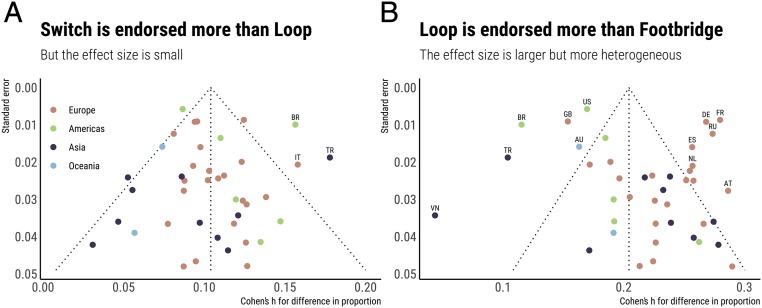
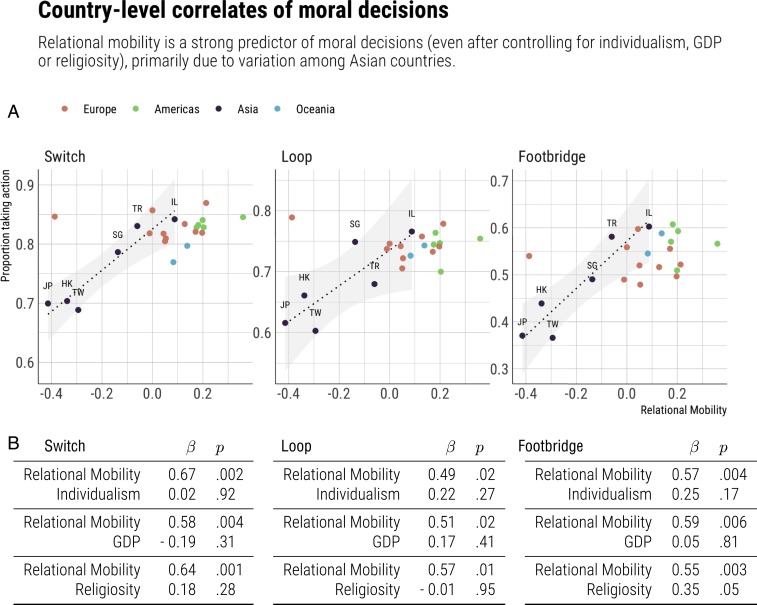
When do people find it acceptable to sacrifice one life to save many? Cross-cultural studies suggested a complex pattern of universals and variations in the way people approach this question, but data were often based on small samples from a small number of countries outside of the Western world. Here we analyze responses to three sacrificial dilemmas by 70,000 participants in 10 languages and 42 countries. In every country, the three dilemmas displayed the same qualitative ordering of sacrifice acceptability, suggesting that this ordering is best explained by basic cognitive processes rather than cultural norms. The quantitative acceptability of each sacrifice, however, showed substantial country-level variations. We show that low relational mobility (where people are more cautious about not alienating their current social partners) is strongly associated with the rejection of sacrifices for the greater good (especially for Eastern countries), which may be explained by the signaling value of this rejection. We make our dataset fully available as a public resource for researchers studying universals and variations in human morality.
Overview
The claims and statistics of this paper haven’t been checked yet.
Run the check — free, no account needed. It reads the open-access text and checks the sources it cites.
Integrity signals
Registry
Cites
Statistics
Figures

Verification
Claims the paper makes
The claims and statistics of this paper haven’t been checked yet.
Run the check — free, no account needed. It reads the open-access text and checks the sources it cites.
Claims other papers make about this one
Each is checked against this paper’s own text: does it say what the citing paper says it does?
In the citing paper
“Ethics should ensure the design of AI technologies for human flourishing around the world [192,193], but this is a very complex matter given that, as the work of Awad et al. [194,195] clearly demonstrates, universally valid and accepted ethical principles do not exist.”
From The sustainability of artificial intelligence: an urbanistic viewpoint from the lens of smart and sustainable cities (2020) · cites this paper as [195]
Self-check
Percentages, sums and reported differences re-computed from the paper’s own numbers.
The self-check needs the paper’s full text.
Citations
Cites
“Economic man” in cross-cultural perspective: behavioral experiments in 15 small-scale societies
Henrich, J., Boyd, R., Bowles, S., Camerer, C., Fehr, E., Gintis, H., McElreath, R., Alvard, M., Barr, A., Ensminger, J., et al. (2005) · Behavioral and Brain Sciences · doi:10.1017/s0140525x05000142 · Cited by 1,898
Awad, E., Dsouza, S., Kim, R., Schulz, J., Henrich, J., Shariff, A., Bonnefon, J.-F., & Rahwan, I. (2018) · Nature · doi:10.1038/s41586-018-0637-6 · Cited by 1,859 · cited 1×
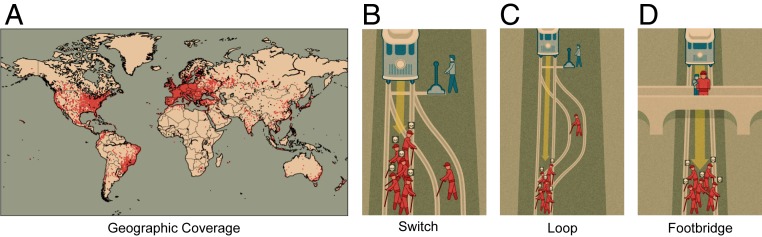
“While the Moral Machine website was primarily designed to explore the ethics of self-driving cars (13), it also offered a “Classic” mode, where visitors made decisions about the traditional Switch, Loop, and Footbridge variants of the trolley problem; these are the data that we report in this article.”
Self-citationThe Problem of Abortion and the Doctrine of the Double Effect
Foot, P. (2002) · Oxford University Press eBooks · doi:10.1093/0199252866.003.0002 · Cited by 1,374
Thomson, J. J. (1985) · The Yale Law Journal · doi:10.2307/796133 · Cited by 1,315
The Role of Conscious Reasoning and Intuition in Moral Judgment
Cushman, F. A., Young, L., & HAUSER, M. D. (2006) · Psychological Science · doi:10.1111/j.1467-9280.2006.01834.x · Cited by 1,061
Many Labs 2: Investigating variation in replicability across samples and settings
Klein, R. A., Vianello, M., Hasselman, F., Adams, B. G., Adams, R. B., Alper, S., Aveyard, M., Axt, J. R., Babalola, M. T., Bahník, Š., et al. (2018) · Advances in Methods and Practices in Psychological Science · doi:10.1177/2515245918810225 · Cited by 944
Universal moral grammar: theory, evidence and the future
Mikhail, J. (2007) · Trends in Cognitive Sciences · doi:10.1016/j.tics.2006.12.007 · Cited by 923
Pushing moral buttons: The interaction between personal force and intention in moral judgment
Greene, J. D., Cushman, F. A., Stewart, L. E., Kelly Lowenberg, C., Nystrom, L. E., & Cohen, J. D. (2009) · Cognition · doi:10.1016/j.cognition.2009.02.001 · Cited by 677
A Dissociation Between Moral Judgments and Justifications
HAUSER, M., CUSHMAN, F., YOUNG, L., KANG‐XING JIN, R., & MIKHAIL, J. (2007) · Mind & Language · doi:10.1111/j.1468-0017.2006.00297.x · Cited by 666
16. The Problem of Abortion and the Doctrine of the Double Effect
Foot, P. (1994) · Fordham University Press eBooks · doi:10.1515/9780823295968-019 · Cited by 454
Beyond sacrificial harm: a two-dimensional model of utilitarian psychology
Kahane, G., Everett, J. A. C., Earp, B. D., Caviola, L., Faber, N. S., Crockett, M. J., & Savulescu, J. (2018) · Psychological Review · doi:10.1037/rev0000093 · Cited by 434
Thomson, R., Yuki, M., Talhelm, T., Schug, J. R., Kito, M., Ayanian, A. H., Becker, J. C., Becker, M., Chiu, C., Choi, H., et al. (2018) · Proceedings of the National Academy of Sciences · doi:10.1073/pnas.1713191115 · Cited by 401
Kahane, G., Everett, J. A. C., Earp, B. D., Farias, M., & Savulescu, J. (2014) · Cognition · doi:10.1016/j.cognition.2014.10.005 · Cited by 351
Small-scale societies exhibit fundamental variation in the role of intentions in moral judgment
Barrett, H. C., Bolyanatz, A., Crittenden, A. N., Fessler, D. M. T., Fitzpatrick, S., Gurven, M., Henrich, J., Kanovský, M., Kushnick, G., Pisor, A. C., et al. (2016) · Proceedings of the National Academy of Sciences · doi:10.1073/pnas.1522070113 · Cited by 338
Inference of trustworthiness from intuitive moral judgments.
Everett, J. A. C., Pizarro, D. A., & Crockett, M. J. (2016) · Journal of Experimental Psychology: General · doi:10.1037/xge0000165 · Cited by 317
Bostyn, D. H., Sevenhant, S., & Roets, A. (2018) · Psychological Science · doi:10.1177/0956797617752640 · Cited by 308
The Law of Primitive Man: A Study in Comparative Legal Dynamics
Black, C. L., & Hoebel, E. A. (1955) · Columbia Law Review · doi:10.2307/1119572 · Cited by 238
Cultural Adaptations to Environmental Variability: An Evolutionary Account of East–West Differences
Chang, L., Mak, M. C. K., Li, T., Wu, B. P., Chen, B., & Lu, H. J. (2010) · Educational Psychology Review · doi:10.1007/s10648-010-9149-0 · Cited by 223
Relational mobility: A socioecological approach to personal relationships.
Yuki, M., & Schug, J. R. (2012) · American Psychological Association eBooks · doi:10.1037/13489-007 · Cited by 199
Conway, P. J., Goldstein-Greenwood, J., Polacek, D. A., & Greene, J. D. (2018) · Cognition · doi:10.1016/j.cognition.2018.04.018 · Cited by 193
Patterns of Moral Judgment Derive From Nonmoral Psychological Representations
Cushman, F., & Young, L. (2011) · Cognitive Science · doi:10.1111/j.1551-6709.2010.01167.x · Cited by 179
Cultural differences in responses to real-life and hypothetical trolley problems
Gold, N., Colman, A. M., & Pulford, B. D. (2014) · Judgment and Decision Making · doi:10.1017/s193029750000499x · Cited by 171
Schug, J. R., Yuki, M., Horikawa, H., & Takemura, K. N. (2009) · Asian Journal Of Social Psychology · doi:10.1111/j.1467-839x.2009.01277.x · Cited by 170
Culture and the quest for universal principles in moral reasoning
Sachdeva, S. S., Singh, P., & Medin, D. L. (2011) · International Journal of Psychology · doi:10.1080/00207594.2011.568486 · Cited by 127
Weighing outcome vs. intent across societies: How cultural models of mind shape moral reasoning
McNamara, R. A., Willard, A. K., Ara Norenzayan, A., & Henrich, J. (2018) · Cognition · doi:10.1016/j.cognition.2018.09.008 · Cited by 125
Moore, A., Lee, N. Y. L., Clark, B. A., & Conway, A. R. A. (2011) · Judgment and Decision Making · doi:10.1017/s193029750000139x · Cited by 86
A Review and Systematization of the Trolley Problem
Bruers, S., & Braeckman, J. (2013) · Philosophia · doi:10.1007/s11406-013-9507-5 · Cited by 84
Sociocultural Influences on Moral Judgments: East–West, Male–Female, and Young–Old
Arutyunova, K. R., Alexandrov, Y. I., & HAUSER, M. D. (2016) · Frontiers in Psychology · doi:10.3389/fpsyg.2016.01334 · Cited by 78
Sacco, D. F., Brown, M., Lustgraaf, C. J. N., & Hugenberg, K. (2016) · Evolutionary Psychological Science · doi:10.1007/s40806-016-0080-6 · Cited by 78
Lou, N. M., & Li, L. M. W. (2016) · Personality and Individual Differences · doi:10.1016/j.paid.2016.12.004 · Cited by 75
Chinese and Westerners Respond Differently to the Trolley Dilemmas
Ahlenius, H., & Tännsjö, T. (2012) · Journal of Cognition and Culture · doi:10.1163/15685373-12342073 · Cited by 69
An Asymmetric Moral Conformity Effect
Bostyn, D. H., & Roets, A. (2016) · Social Psychological and Personality Science · doi:10.1177/1948550616671999 · Cited by 63
Pressing questions in the study of psychological and behavioral diversity
Hruschka, D. J., Medin, D. L., Rogoff, B., & Henrich, J. (2018) · Proceedings of the National Academy of Sciences · doi:10.1073/pnas.1814733115 · Cited by 63
Is utilitarian sacrifice becoming more morally permissible?
Hannikainen, I. R., Machery, É., & Cushman, F. A. (2017) · Cognition · doi:10.1016/j.cognition.2017.09.013 · Cited by 58
Greene, J. D. (2016) · A Companion to Experimental Philosophy · doi:10.1002/9781118661666.ch11 · Cited by 48
Plunkett, D., & Greene, J. D. (2019) · Psychological Science · doi:10.1177/0956797619827914 · Cited by 38
Relational Mobility Increases Social (but Not Other) Risk Propensity
Li, L. M. W., Hamamura, T., & Adams, G. (2015) · Journal of Behavioral Decision Making · doi:10.1002/bdm.1894 · Cited by 37
Is the Prohibition of Homicide Universal? Evidence from Comparative Criminal Law
Mikhail, J. (2009) · bepress Legal Repository · Cited by 23
Kagan, S. (2015) · Oxford University Press eBooks · doi:10.1093/acprof:oso/9780190247157.003.0006 · Cited by 12
The Doctrine of Double Effect and the Trolley Problem
Kaufman, W. R. P. (2015) · The Journal of Value Inquiry · doi:10.1007/s10790-014-9479-0 · Cited by 8
Hoebel, E. A. (2009) · Harvard University Press eBooks · doi:10.2307/j.ctv322v463 · Cited by 8
Cited by
Sorted by citations
Yigitcanlar, T., & Cugurullo, F. (2020) · Sustainability · doi:10.3390/su12208548 · Cited by 337
Beyond WEIRD: A review of the last decade and a look ahead to the global laboratory of the future
Apicella, C. L., Norenzayan, A., & Henrich, J. (2020) · Evolution and Human Behavior · doi:10.1016/j.evolhumbehav.2020.07.015 · Cited by 302
Evaluating CloudResearch’s Approved Group as a solution for problematic data quality on MTurk
Hauser, D., Moss, A. J., Rosenzweig, C., Jaffe, S. N., Robinson, J., & Litman, L. (2022) · Behavior Research Methods · doi:10.3758/s13428-022-01999-x · Cited by 299
Cultural Psychology: Beyond East and West
Kitayama, S., & Salvador, C. E. (2023) · Annual Review of Psychology · doi:10.1146/annurev-psych-021723-063333 · Cited by 249
ChatGPT’s inconsistent moral advice influences users’ judgment
Krügel, S., Ostermaier, A., & Uhl, M. (2023) · Scientific Reports · doi:10.1038/s41598-023-31341-0 · Cited by 183
Metadata
- Authors
- Awad, E., Dsouza, S., Shariff, A., Rahwan, I., & Bonnefon, J.-F.
- Affiliations
- University of Exeter (GB)
- MIT Media Lab (US)
- University of British Columbia (CA)
- Max Planck Institute for Human Development (DE)
- Centre National de la Recherche Scientifique (FR)
- Corresponding author
- Awad, Edmond
- Shariff, Azim
- Rahwan, Iyad
- Bonnefon, Jean-François
- Venue
- Proceedings of the National Academy of Sciences
- Publisher
- National Academy of Sciences
- Published
- 2020-01-21
- Volume
- 117
- Issue
- 5
- Pages
- 2332-2337
- ISSN
- 0027-8424 (ISSN-L)
- 1091-6490
- PMC
- PMC7007553
- OpenAlex
- W3000950628
- Cited by
- 261
- References
- 44
- Citations by year
- 2026: 25 · 2025: 36 · 2024: 44 · 2023: 60 · 2022: 41 · 2021: 37 · 2020: 17
- FWCI
- 20.81
- Type
- journal article
- Language
- en
- Open access
- hybrid
- doi.org
- Licence
- Locations
- Proceedings of the National Academy of Sciences (publishedVersion, cc-by)
- Europe PMC (PubMed Central) (publishedVersion, cc-by)
- PubMed Central (publishedVersion, cc-by)
- PubMed (publishedVersion)
- Open Research Exeter (University of Exeter) (publishedVersion, cc-by)
- HAL (submittedVersion, cc-by)
- DSpace@MIT (Massachusetts Institute of Technology) (submittedVersion, cc-by-nc)
- Figshare (submittedVersion, cc-by)
- Toulouse 1 Capitole Publications (Université Toulouse I Capitole) (submittedVersion)
- MPG.PuRe (Max Planck Society) (submittedVersion, other-oa)
- Funders
- Agence Nationale de la Recherche (ANR-17-EURE-0010, ANR-19-P3IA-0004)
- Topics
- Life Sciences › Neuroscience › Cognitive Neuroscience › Psychology of Moral and Emotional Judgment
- Social Sciences › Psychology › Social Psychology › Cultural Differences and Values
- Social Sciences › Economics, Econometrics and Finance › Economics and Econometrics › Experimental Behavioral Economics Studies
- Keywords
- ethical decision-making, sacrificial dilemmas, trolley problem, moral intuitions, cross-cultural variation, relational mobility, signaling, East-West differences
- MeSH terms
- Cognition, Cross-Cultural Comparison, Decision Making, Humans, Morals, Surveys and Questionnaires, Social Mobility, Ethical Theory
About these checks
Registry, retraction, Cites and statistics results are computed, not judged, with one exception: a printed reference that no index lists is read once by a model before it counts as a citation error. Claims are extracted by a model and kept only when their quote appears verbatim in the text; each cited source is then checked, with a model’s help, for whether it says what the claim relies on. Those verdicts can be wrong — read the claim’s quote and the cited source before relying on one.
Statistics and arithmetic are recomputed, not judged.
Confidence bands are shown only for fields calibrated on our annotated test set. None is calibrated yet, so no band is shown.
What counts as a claim ›How we measure confidence ›How we check this ›
Are you an author, or do you see a problem with this page? Request a review
