

The DOI matches its Crossref record; 41 of the 44 references it cites were found in a registry or an index.
Universals and variations in moral decisions made in 42 countries by 70,000 participants
Open accessAbstract
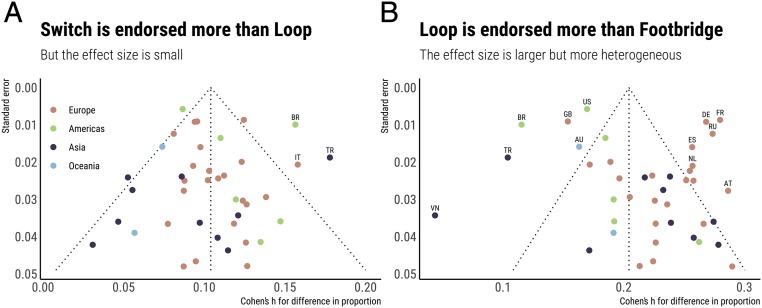
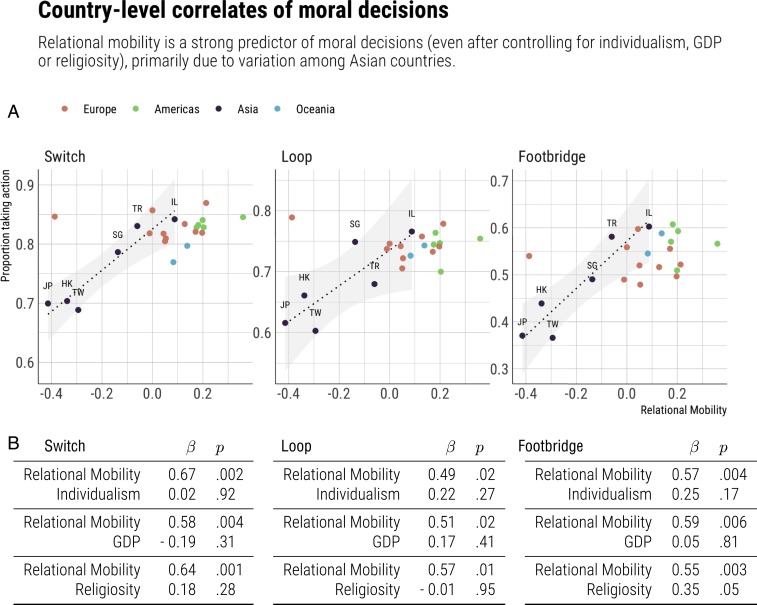
When do people find it acceptable to sacrifice one life to save many? Cross-cultural studies suggested a complex pattern of universals and variations in the way people approach this question, but data were often based on small samples from a small number of countries outside of the Western world. Here we analyze responses to three sacrificial dilemmas by 70,000 participants in 10 languages and 42 countries. In every country, the three dilemmas displayed the same qualitative ordering of sacrifice acceptability, suggesting that this ordering is best explained by basic cognitive processes rather than cultural norms. The quantitative acceptability of each sacrifice, however, showed substantial country-level variations. We show that low relational mobility (where people are more cautious about not alienating their current social partners) is strongly associated with the rejection of sacrifices for the greater good (especially for Eastern countries), which may be explained by the signaling value of this rejection. We make our dataset fully available as a public resource for researchers studying universals and variations in human morality.
Overview
The claims and statistics of this paper haven’t been checked yet.
Run the check — free, no account needed. It reads the open-access text and checks the sources it cites.
Integrity signals
Registry
Cites
Statistics
Figures

Verification
Claims the paper makes
The claims and statistics of this paper haven’t been checked yet.
Run the check — free, no account needed. It reads the open-access text and checks the sources it cites.
Claims other papers make about this one
Each is checked against this paper’s own text: does it say what the citing paper says it does?
In the citing paper
“Ethics should ensure the design of AI technologies for human flourishing around the world [192,193], but this is a very complex matter given that, as the work of Awad et al. [194,195] clearly demonstrates, universally valid and accepted ethical principles do not exist.”
From The sustainability of artificial intelligence: an urbanistic viewpoint from the lens of smart and sustainable cities (2020) · cites this paper as [195]
Self-check
Percentages, sums and reported differences re-computed from the paper’s own numbers.
The self-check needs the paper’s full text.
Citations
Cites
“Economic man” in cross-cultural perspective: behavioral experiments in 15 small-scale societies
Henrich, J., Boyd, R., Bowles, S., Camerer, C., Fehr, E., Gintis, H., McElreath, R., Alvard, M., Barr, A., Ensminger, J., et al. (2005) · Behavioral and Brain Sciences · doi:10.1017/s0140525x05000142 · Cited by 1,898
Awad, E., Dsouza, S., Kim, R., Schulz, J., Henrich, J., Shariff, A., Bonnefon, J.-F., & Rahwan, I. (2018) · Nature · doi:10.1038/s41586-018-0637-6 · Cited by 1,859 · cited 1×
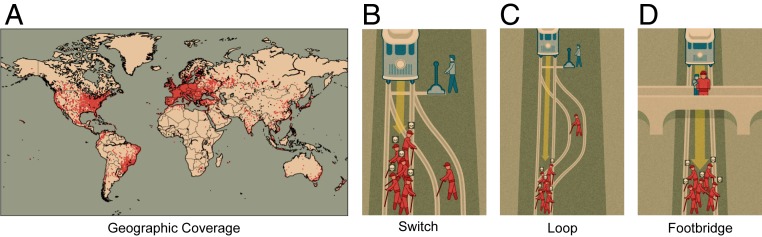
“While the Moral Machine website was primarily designed to explore the ethics of self-driving cars (13), it also offered a “Classic” mode, where visitors made decisions about the traditional Switch, Loop, and Footbridge variants of the trolley problem; these are the data that we report in this article.”
Self-citationThe Problem of Abortion and the Doctrine of the Double Effect
Foot, P. (2002) · Oxford University Press eBooks · doi:10.1093/0199252866.003.0002 · Cited by 1,374
Thomson, J. J. (1985) · The Yale Law Journal · doi:10.2307/796133 · Cited by 1,315
The Role of Conscious Reasoning and Intuition in Moral Judgment
Cushman, F. A., Young, L., & HAUSER, M. D. (2006) · Psychological Science · doi:10.1111/j.1467-9280.2006.01834.x · Cited by 1,061
Many Labs 2: Investigating variation in replicability across samples and settings
Klein, R. A., Vianello, M., Hasselman, F., Adams, B. G., Adams, R. B., Alper, S., Aveyard, M., Axt, J. R., Babalola, M. T., Bahník, Š., et al. (2018) · Advances in Methods and Practices in Psychological Science · doi:10.1177/2515245918810225 · Cited by 944
Universal moral grammar: theory, evidence and the future
Mikhail, J. (2007) · Trends in Cognitive Sciences · doi:10.1016/j.tics.2006.12.007 · Cited by 923
Pushing moral buttons: The interaction between personal force and intention in moral judgment
Greene, J. D., Cushman, F. A., Stewart, L. E., Kelly Lowenberg, C., Nystrom, L. E., & Cohen, J. D. (2009) · Cognition · doi:10.1016/j.cognition.2009.02.001 · Cited by 677
A Dissociation Between Moral Judgments and Justifications
HAUSER, M., CUSHMAN, F., YOUNG, L., KANG‐XING JIN, R., & MIKHAIL, J. (2007) · Mind & Language · doi:10.1111/j.1468-0017.2006.00297.x · Cited by 666
16. The Problem of Abortion and the Doctrine of the Double Effect
Foot, P. (1994) · Fordham University Press eBooks · doi:10.1515/9780823295968-019 · Cited by 454
Cited by
Sorted by citations
Items 101–200 of 257
Moral dilemmas and trust in leaders during a global health crisisPreprint
Everett, J. A. C., Colombatto, C., Awad, E., Boggio, P. S., Bos, B., Brady, W. J., Chawla, M., Chituc, V., Chung, D., Drupp, M. A., et al. (2021) · doi:10.31234/osf.io/mzswb · Cited by 6
Self-citationCouto, C., Pilati, R., & Kakinohana, R. K. (2025) · Cross-Cultural Research · doi:10.1177/10693971251325292 · Cited by 6
The Consequentialist Scale: Translation and Empirical Investigation in a Greek Sample
Kosteletos, G., Ζιώγα, Ι., Protopapadakis, E. D., Panayiotou, A. G., Kontoangelos, K. A., & Papageorgiou, C. (2022) · Heliyon · doi:10.1016/j.heliyon.2023.e18386 · Cited by 5
Intuitive Theories and the Cultural Evolution of Morality
Crockett, M. J., Kim, J. S., & Shin, Y. S. (2024) · Current Directions in Psychological Science · doi:10.1177/09637214241245412 · Cited by 6
Laws about bodily damage originate from shared intuitions about the value of body parts
Wee, Y. N., Sznycer, D., & Krems, J. A. (2025) · Science Advances · doi:10.1126/sciadv.ads3688 · Cited by 5
Maksimenko, V., Li, X., Kim, E.-J., & Bansal, P. (2025) · Transportation Research Part C Emerging Technologies · doi:10.1016/j.trc.2025.105284 · Cited by 5
When tainted money should fund public goods: fundraising professional and public moral preferences
Rahwan, Z., & Leuker, C. (2023) · PNAS Nexus · doi:10.1093/pnasnexus/pgad285 · Cited by 5
Lee, H., Pickett, J. T., Graham, A., Cullen, F. T., Jonson, C. L., Haner, M., & Sloan, M. M. (2024) · Journal of Experimental Criminology · doi:10.1007/s11292-024-09610-3 · Cited by 5
Disparity in attitudes regarding assisted dying among physicians and the general public in Japan
Takimoto, Y., & Nabeshima, T. (2025) · BMC Medical Ethics · doi:10.1186/s12910-025-01166-9 · Cited by 5
Wait, did I do that? Effects of previous decisions on moral decision‐making
Frechen, N., & Brouwer, S. M. (2022) · Journal of Behavioral Decision Making · doi:10.1002/bdm.2279 · Cited by 5
Claessens, S., Kyritsis, T., & Atkinson, Q. D. (2020) · Proceedings of the National Academy of Sciences · doi:10.1073/pnas.2005012117 · Cited by 5
Artificial Intelligence, Ethics, and Intergenerational ResponsibilityPreprint
Series, G. W. P., Klockmann, V., von Schenk, A., & Villeval, M. C. (2021) · SSRN Electronic Journal · doi:10.2139/ssrn.3853827 · Cited by 5
NLPositionality: Characterizing Design Biases of Datasets and Models
Santy, S., Liang, J. T., Bras, R. L., Reinecke, K., & Sap, M. (2023) · arXiv · doi:10.48550/arxiv.2306.01943 · Cited by 31
Иджитканлар, Т., & Кугурульо, Ф. (2022) · Городские исследования и практики · doi:10.17323/usp71202235-64 · Cited by 4
Why moral judgements change across variations of trolley‐like problems
Cohen, D. J., & Quinlan, P. T. (2025) · British Journal of Psychology · doi:10.1111/bjop.12782 · Cited by 5
Horita, Y., & Yamazaki, M. (2023) · Japanese Psychological Research · doi:10.1111/jpr.12451 · Cited by 4
Three Shortcomings of the Trolley Method of Moral Philosophy
Crain, G. (2023) · Journal of Ethics and Social Philosophy · doi:10.26556/jesp.v26i2.2317 · Cited by 5
Is It Fair to Kill One to Save Five? How Just World Beliefs Shape Sacrificial Moral Decision-making
Conway, P. J., Dawtry, R. J., Lam, J. K. H., & Gheorghiu, A. I. (2024) · Personality and Social Psychology Bulletin · doi:10.1177/01461672241287815 · Cited by 4
Can Experimental Political Philosophers be Modest in their Aims?
Lippert‐Rasmussen, K. (2024) · Res Publica · doi:10.1007/s11158-024-09677-9 · Cited by 4
Verification of the Japanese Version of Greene’s Moral Dilemma Task’s Validity and Reliability
Takimoto, Y., & Yasumura, A. (2023) · Psych · doi:10.3390/psych5010017 · Cited by 4
Preschoolers use the means-ends structure of intention to make moral judgmentsPreprint
Levine, S., & Leslie, A. M. (2020) · doi:10.31234/osf.io/np9a5 · Cited by 4
Are There Cross-Cultural Legal Principles? Modal Reasoning Uncovers Procedural Constraints on LawPreprint
Hannikainen, I. R., Tobia, K. P., Almeida, G., Donelson, R., Dranseika, V., Kneer, M., Strohmaier, N., Bystranowski, P., Dolinina, K., Janik, B., et al. (2021) · SSRN Electronic Journal · doi:10.2139/ssrn.3864374 · Cited by 4
The Prospects and Challenges of Measuring MoralityPreprint
Sun, J., & Schwitzgebel, E. (2023) · PsyArXiv (OSF Preprints) · doi:10.31234/osf.io/nhvz9 · Cited by 4
Hao, C., & Lewis, R. L. (2024) · Cognitive Psychology · doi:10.1016/j.cogpsych.2024.101672 · Cited by 3
Fair allocation of resources in the moral dilemma of triage
Keßler, P., & Krumpal, I. (2025) · Frontiers in Sociology · doi:10.3389/fsoc.2025.1570940 · Cited by 3
Digital pathways beyond Western-centric participants
Awad, E. (2025) · Behavior Research Methods · doi:10.3758/s13428-025-02751-x · Cited by 4
Self-citationJustification optional: ChatGPT’s advice can still influence human judgments about moral dilemmas
Krügel, S., Ostermaier, A., & Uhl, M. (2026) · AI and Ethics · doi:10.1007/s43681-026-01005-6 · Cited by 3
Requirements engineering for moral considerations in algorithmic systems : RE’20 Conference Keynote
Dechesne, F. (2020) · IEEE International Requirements Engineering Conference (RE) · doi:10.1109/re48521.2020.00010 · Cited by 3
Time course of effective connectivity associated with perspective taking in utterance comprehension
Tokimoto, S., & Tokimoto, N. (2023) · Frontiers in Human Neuroscience · doi:10.3389/fnhum.2023.1179230 · Cited by 3
Landy, J. F., Lemli, B. A., Shah, P., Perry, A. D., & Sager, R. (2024) · Cognition · doi:10.1016/j.cognition.2024.105919 · Cited by 3
Éticas falibles para máquinas (in)falibles
Vallverdú, J., & Lázare, S. (2021) · Arbor · doi:10.3989/arbor.2021.800003 · Cited by 3
Confidence in research findings depends on theory
Gal, D., Sternthal, B., & Calder, B. J. (2024) · Behavioral and Brain Sciences · doi:10.1017/s0140525x23002261 · Cited by 3
Kurshan, E. (2024) · International Journal of Semantic Computing · doi:10.1142/s1793351x24300073 · Cited by 8
Social Media Influencers and Politics
Makse, H. A., & Zava, M. (2024) · Understanding complex systems · doi:10.1007/978-3-031-78058-5_2 · Cited by 3
1.2 Werte: Was können ethische Ansätze für eine werteorientierte Digitalisierung leisten?
Grimm, P. (2021) · Digitale Gesellschaft · doi:10.14361/9783839456590-003 · Cited by 3
The shallow of your smile: The ethics of expressive vocal deepfakesPreprint
Guerouaou, N., Vaïva, G., & Aucouturier, J. (2021) · doi:10.31234/osf.io/whd4b · Cited by 3
Should My Agent Lie for Me? Public Moral Perspectives on Deceptive AI
Sarkadi, Ş., Mei, P., & Awad, E. (2024) · Lecture notes in computer science · doi:10.1007/978-3-031-56255-6_9 · Cited by 2
Self-citationCultural Differences in Effect Sizes of the Color-Word Stroop Test: A Meta-Analytic Study
Otsuka, S., Ueda, Y., & Saiki, J. (2025) · Journal of Cross-Cultural Psychology · doi:10.1177/00220221251389109 · Cited by 2
Kalambay, P., Hossain, A., & Das, S. (2026) · Transportation Research Part F Traffic Psychology and Behaviour · doi:10.1016/j.trf.2026.103553 · Cited by 2
Moral intuition is moral but not objective
Yuan, X., & Chang, L. I. U. (2021) · Advances in Psychological Science · doi:10.3724/sp.j.1042.2021.02083 · Cited by 3
In Defence of Ethics and the Law in AI Governance: The Case of Computer Vision
Završník, A. (2023) · Critical criminological perspectives · doi:10.1007/978-3-031-19149-7_5 · Cited by 2
Protohistory: Unending intuitions
Odeyemi, I. (2023) · Metaphilosophy · doi:10.1111/meta.12663 · Cited by 2
Bart, V. K. E., Sharavdorj, E., Boldbaatar, E., Munkhnasan, D., & Rieger, M. (2024) · Journal of Cultural Cognitive Science · doi:10.1007/s41809-024-00141-x · Cited by 2
Adolescents Are More Utilitarian Than Adults in Group Moral Decision‐Making
Jiang, Y., Zhang, W., Wan, Y., Gummerum, M., & Zhu, L. (2024) · PsyCh Journal · doi:10.1002/pchj.821 · Cited by 2
Duarte, E. K., de Freitas, E. P., Bellalta, B., & Vinel, A. V. (2025) · IEEE Vehicular Networking Conference (VNC) · doi:10.1109/vnc64509.2025.11054145 · Cited by 2
Sharan, N. N., Peter, J., & van Straten, C. L. (2025) · International Journal of Social Robotics · doi:10.1007/s12369-025-01293-8 · Cited by 2
A THREE-LEVEL APPROACH TO UNDERSTAND CULTURAL VARIABILITY AND THE EVOLUTION OF HUMAN ATTENTION
Ueda, Y., Otsuka, S., & Saiki, J. (2021) · PSYCHOLOGIA · doi:10.2117/psysoc.2021-b015 · Cited by 2
Zur Bewertung ethischer Gedankenexperimente – „Intuitionspumpen“ vs. Ansatz des „rationalen Wollens“
Schwartz, M. (2022) · Zeitschrift für Praktische Philosophie · doi:10.22613/zfpp/8.2.14 · Cited by 2
Driving Behavior and Decision Mechanisms in Emergency Conditions
Lyu, Y., Sun, Y., Zhang, T., Kong, D., Lv, Z., Liu, Y., & Gao, Z. (2022) · World Electric Vehicle Journal · doi:10.3390/wevj13040062 · Cited by 2
Singh, L. (2022) · Proceedings of the AAAI/ACM Conference on AI Ethics and Society · doi:10.1145/3514094.3539527 · Cited by 2
Thought Experiments in Design Ethics
Buwert, P., & Sinclair, M. A. (2024) · Temes de disseny · doi:10.46467/tdd40.2024.54-73 · Cited by 2
La meritocracia quiebra ante la corrupción: los moralistas y los otrosPreprint
Núñez, M. (2022) · doi:10.31235/osf.io/r6q2c · Cited by 2
Human values: A cognitive perspectivePreprint
Sznycer, D. (2021) · PsyArXiv (OSF Preprints) · doi:10.31234/osf.io/mkde7 · Cited by 2
Online Platforms Provide Access to Valid Eastern SamplesPreprint
Wang, L., Gao, R., Jung, M. H., Hung, I. W., & Nelson, L. D. (2025) · SSRN Electronic Journal · doi:10.2139/ssrn.5488129 · Cited by 2
Do analytic philosophers in China think differently? A survey and comparative study
Wu, S., Xu, J., Zhan, H. K., Wang, R., Wang, Y., Huang, J., You, J., & Jing, Z. (2024) · Asian Journal of Philosophy · doi:10.1007/s44204-024-00138-x · Cited by 1
Introduction: Exploring Chinese Ethical and Legal Perspectives on Automated Vehicles
Ding, C., & Fan, R. (2025) · Springer eBooks · doi:10.1007/978-981-96-1277-2_1 · Cited by 1
Brandt, E., Lam, J. K. H., & Conway, P. J. (2025) · Journal of Applied Social Psychology · doi:10.1111/jasp.70018 · Cited by 1
Development of beliefs about censorship
Anderson, R. A., Heck, I. A., Young, K. L., & Kinzler, K. D. (2023) · Cognition · doi:10.1016/j.cognition.2023.105500 · Cited by 1
Social Cognition of Moral Judgment
Conway, P. J. (2024) · Oxford University Press eBooks · doi:10.1093/oxfordhb/9780197763414.013.27 · Cited by 1
Artificial intelligence, distributional fairness, and pivotality
Klockmann, V., von Schenk, A., & Villeval, M. C. (2025) · European Economic Review · doi:10.1016/j.euroecorev.2025.105098 · Cited by 1
Out-group/in-group personal moral dilemmas in the Kogi worldview
Cáceres, R. G. A., & Serrano, J. F. M. (2025) · Journal of Cultural Cognitive Science · doi:10.1007/s41809-025-00190-w · Cited by 1
Kasaki, M. (2021) · Journal of the Robotics Society of Japan · doi:10.7210/jrsj.39.22 · Cited by 1
Isufi, S., Poje, K., Vukobratovic, I., & Brčić, M. (2022) · Philosophies · doi:10.3390/philosophies7060134 · Cited by 1
Moral Context Matters: A study of Adolescents’ Moral Judgment towards Robots
Tacci, A. L., Manzi, F., Dio, C. D., Marchetti, A., Riva, G., & Massaro, D. (2023) · International Conference on Affective Computing and Intelligent Interaction Workshops and Demos (ACIIW) · doi:10.1109/aciiw59127.2023.10388182 · Cited by 1
A spiking neuron model of moral judgment in trolley dilemmas
Gothard, T., & Davies, J. (2024) · Scientific Reports · doi:10.1038/s41598-024-68024-3 · Cited by 1
Jiang, X., & Harvey, N. (2025) · Frontiers in Psychology · doi:10.3389/fpsyg.2025.1448153 · Cited by 1
Game theory for autonomous AI systems in corporate governance.
Romanova, A. (2025) · Dependability · doi:10.21683/1729-2646-2025-25-2-50-58 · Cited by 1
Metanormativity: solving questions of moral and empirical uncertainty
Corrêa, N. K., & Oliveira, N. F. D. (2020) · ethic - An international Journal for Moral Phylosophy · doi:10.5007/1677-2954.2020v19n3p790 · Cited by 1
Conceptualizing Media CSR Communication: Responsible Contributions to the (Global) Public Sphere?
Karmasin, M. (2023) · CSR, sustainability, ethics & governance · doi:10.1007/978-3-031-18976-0_2 · Cited by 1
Zahedi, L., Larijani, B. A., Javadi, M., Aawani, S., Jafari, S. A., Joodaki, K., Rashidpouraie, R., & Tehrani, S. S. (2023) · Journal of Medical Ethics and History of Medicine · doi:10.18502/jmehm.v16i3.12972 · Cited by 2
Awad, E., Dsouza, S., Shariff, A., Rahwan, I., & Bonnefon, J. (2020) · Proceedings of the National Academy of Sciences · doi:10.1073/pnas.2007044117 · Cited by 1
Self-citationArtificial Intelligence, Ethics, and PivotalityPreprint
Klockmann, V., von Schenk, A., & Villeval, M. C. (2022) · SSRN Electronic Journal · doi:10.2139/ssrn.4003065 · Cited by 1
Bostyn, D. H., Roets, A., & CONWAY, P. P. (2021) · PsyArXiv (OSF Preprints) · doi:10.31234/osf.io/psd47 · Cited by 1
Rotella, A., Jung, J., Chinn, C., & Barclay, P. (2023) · PsyArXiv (OSF Preprints) · doi:10.31234/osf.io/tmhe9 · Cited by 2
Brandt, E., & Conway, P. J. (2023) · SSRN Electronic Journal · doi:10.2139/ssrn.4607975 · Cited by 1
ChatGPT's Advice Drives Moral Judgments With or Without JustificationPreprint
Krügel, S., Ostermaier, A., & Uhl, M. (2025) · SSRN Electronic Journal · doi:10.2139/ssrn.5016056 · Cited by 2
Kinosada, Y., Furukawa, Y., Wakai, T., & Nakashima, K. (2025) · doi:10.31234/osf.io/vnfdx_v2 · Cited by 1
Oxytocin restores context-specific hyperaltruistic preference
Zhang, H., Ni, Y., & Li, J. (2024) · eLife · doi:10.7554/elife.102756.3 · Cited by 1
Heuristic-Based Weak Learning for Automated Decision-MakingPreprint
Steed, R., & Williams, B. (2020) · arXiv (Cornell University) · doi:10.48550/arxiv.2005.02342
Artificial Intelligence, Ethics, and Intergenerational ResponsibilityPreprint
Klockmann, V., von Schenk, A., & Villeval, M. C. (2021) · SSRN Electronic Journal · doi:10.2139/ssrn.3848485 · Cited by 1
Artificial Intelligence, Ethics, and Diffused PivotalityPreprint
Klockmann, V., von Schenk, A., & Villeval, M. C. (2021) · SSRN Electronic Journal · doi:10.2139/ssrn.3848495
‚Infodemics‘: Der Umgang mit Informationen in Pandemiezeiten aus ethischer Perspektive
Wäscher, S., Nguyen, T., & Biller‐Andorno, N. (2021) · Springer eBooks · doi:10.1007/978-3-662-63530-8_13
Mizumoto, M., Ono, S., Okazaki, Y., & Kanetsuna, K. (2021) · doi:10.36227/techrxiv.16688941.v1
Ono, S., Okazaki, Y., Kanetsuna, K., & Mizumoto, M. (2021) · doi:10.36227/techrxiv.16688941
Artificial Intelligence, Ethics, and Diffused PivotalityPreprint
Series, G. W. P., Klockmann, V., von Schenk, A., & Villeval, M. C. (2021) · SSRN Electronic Journal · doi:10.2139/ssrn.3853829
Lee, K. J. J. (2022) · DR-NTU (Nanyang Technological University) · doi:10.32657/10356/156813
The shallow of your smile: The ethics of expressive vocal deepfakesPreprint
Guerouaou, N., Vaïva, G., & Aucouturier, J. (2021) · doi:10.31234/osf.io/myu8h
Reacting to Wrong-Doers: Harm Leads to Partner Control and Impurity to Partner ChoicePreprint
Myers, S., & Sanborn, A. N. (2022) · PsyArXiv (OSF Preprints) · doi:10.31234/osf.io/bfwk7
马, 飞. (2022) · Advances in Psychology · doi:10.12677/ap.2022.126239
Juan Carlos Marulanda, H. (2022) · eDiss (Georg-August-Universität Göttingen) · doi:10.53846/goediss-9430
Mizumoto, M., Ono, S., Okazaki, Y., & Kanetsuna, K. (2022) · doi:10.36227/techrxiv.16688941.v2
The Trolley Problem and the Ethics of Autonomous Vehicles in the Eyes of the Public
Inoue, A., Shimizu, K., Udagawa, D., & Wakamatsu, Y. (2022) · Oxford University Press eBooks · doi:10.1093/oso/9780197639191.003.0005
Can Life Be Quantified?A Survey on Medical Students Based on Ethic DilemmaPreprint
Ren, H., Zhao, T., Jiang, Z., Shi, L., & Cai, Y. (2022) · Research Square · doi:10.21203/rs.3.rs-2076716/v1
Mahlmann, M. (2023) · Cambridge University Press eBooks · doi:10.1017/9781316875520.014
Homo indifferencus: Effects of unavailable options on preference construction
Polman, E., & Stough, R. A. (2023) · Journal of Behavioral Decision Making · doi:10.1002/bdm.2326
‘Infodemics’: Dealing with Information in Pandemic Times from an Ethical Perspective
Wäscher, S., Nguyen, T., & Biller‐Andorno, N. (2023) · Springer eBooks · doi:10.1007/978-3-662-66872-6_13
Mizumoto, M., Ono, S., Okazaki, Y., & Kanetsuna, K. (2023) · doi:10.36227/techrxiv.16688941.v3
Dilemma or False Dilemma: A Sequence of Steps to Avoid the Trolley
Schollmeyer, J. (2023) · IFIP advances in information and communication technology · doi:10.1007/978-3-031-42532-5_42
Some statistical challenges in automated driving systems
Caballero, W. N., Insua, D. R., & Naveiro, R. (2023) · Applied Stochastic Models in Business and Industry · doi:10.1002/asmb.2820
Metadata
- Authors
- Awad, E., Dsouza, S., Shariff, A., Rahwan, I., & Bonnefon, J.-F.
- Affiliations
- University of Exeter (GB)
- MIT Media Lab (US)
- University of British Columbia (CA)
- Max Planck Institute for Human Development (DE)
- Centre National de la Recherche Scientifique (FR)
- Corresponding author
- Awad, Edmond
- Shariff, Azim
- Rahwan, Iyad
- Bonnefon, Jean-François
- Venue
- Proceedings of the National Academy of Sciences
- Publisher
- National Academy of Sciences
- Published
- 2020-01-21
- Volume
- 117
- Issue
- 5
- Pages
- 2332-2337
- ISSN
- 0027-8424 (ISSN-L)
- 1091-6490
- PMC
- PMC7007553
- OpenAlex
- W3000950628
- Cited by
- 261
- References
- 44
- Citations by year
- 2026: 25 · 2025: 36 · 2024: 44 · 2023: 60 · 2022: 41 · 2021: 37 · 2020: 17
- FWCI
- 20.81
- Type
- journal article
- Language
- en
- Open access
- hybrid
- doi.org
- Licence
- Locations
- Proceedings of the National Academy of Sciences (publishedVersion, cc-by)
- Europe PMC (PubMed Central) (publishedVersion, cc-by)
- PubMed Central (publishedVersion, cc-by)
- PubMed (publishedVersion)
- Open Research Exeter (University of Exeter) (publishedVersion, cc-by)
- HAL (submittedVersion, cc-by)
- DSpace@MIT (Massachusetts Institute of Technology) (submittedVersion, cc-by-nc)
- Figshare (submittedVersion, cc-by)
- Toulouse 1 Capitole Publications (Université Toulouse I Capitole) (submittedVersion)
- MPG.PuRe (Max Planck Society) (submittedVersion, other-oa)
- Funders
- Agence Nationale de la Recherche (ANR-17-EURE-0010, ANR-19-P3IA-0004)
- Topics
- Life Sciences › Neuroscience › Cognitive Neuroscience › Psychology of Moral and Emotional Judgment
- Social Sciences › Psychology › Social Psychology › Cultural Differences and Values
- Social Sciences › Economics, Econometrics and Finance › Economics and Econometrics › Experimental Behavioral Economics Studies
- Keywords
- ethical decision-making, sacrificial dilemmas, trolley problem, moral intuitions, cross-cultural variation, relational mobility, signaling, East-West differences
- MeSH terms
- Cognition, Cross-Cultural Comparison, Decision Making, Humans, Morals, Surveys and Questionnaires, Social Mobility, Ethical Theory
About these checks
Registry, retraction, Cites and statistics results are computed, not judged, with one exception: a printed reference that no index lists is read once by a model before it counts as a citation error. Claims are extracted by a model and kept only when their quote appears verbatim in the text; each cited source is then checked, with a model’s help, for whether it says what the claim relies on. Those verdicts can be wrong — read the claim’s quote and the cited source before relying on one.
Statistics and arithmetic are recomputed, not judged.
Confidence bands are shown only for fields calibrated on our annotated test set. None is calibrated yet, so no band is shown.
What counts as a claim ›How we measure confidence ›How we check this ›
Are you an author, or do you see a problem with this page? Request a review
