

The European Union Emissions Trading System reduced CO 2 emissions despite low prices
Open accessThe DOI matches its Crossref record; 49 of the 49 references it cites were found in a registry or an index.
Abstract
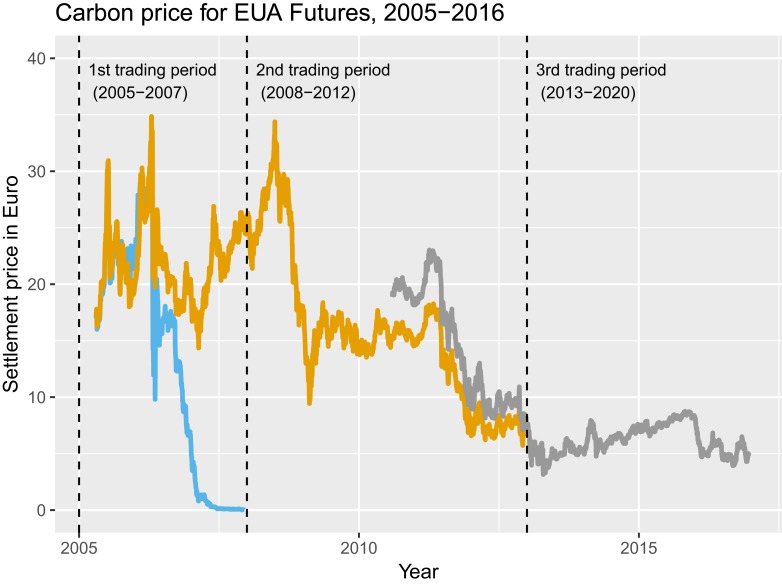
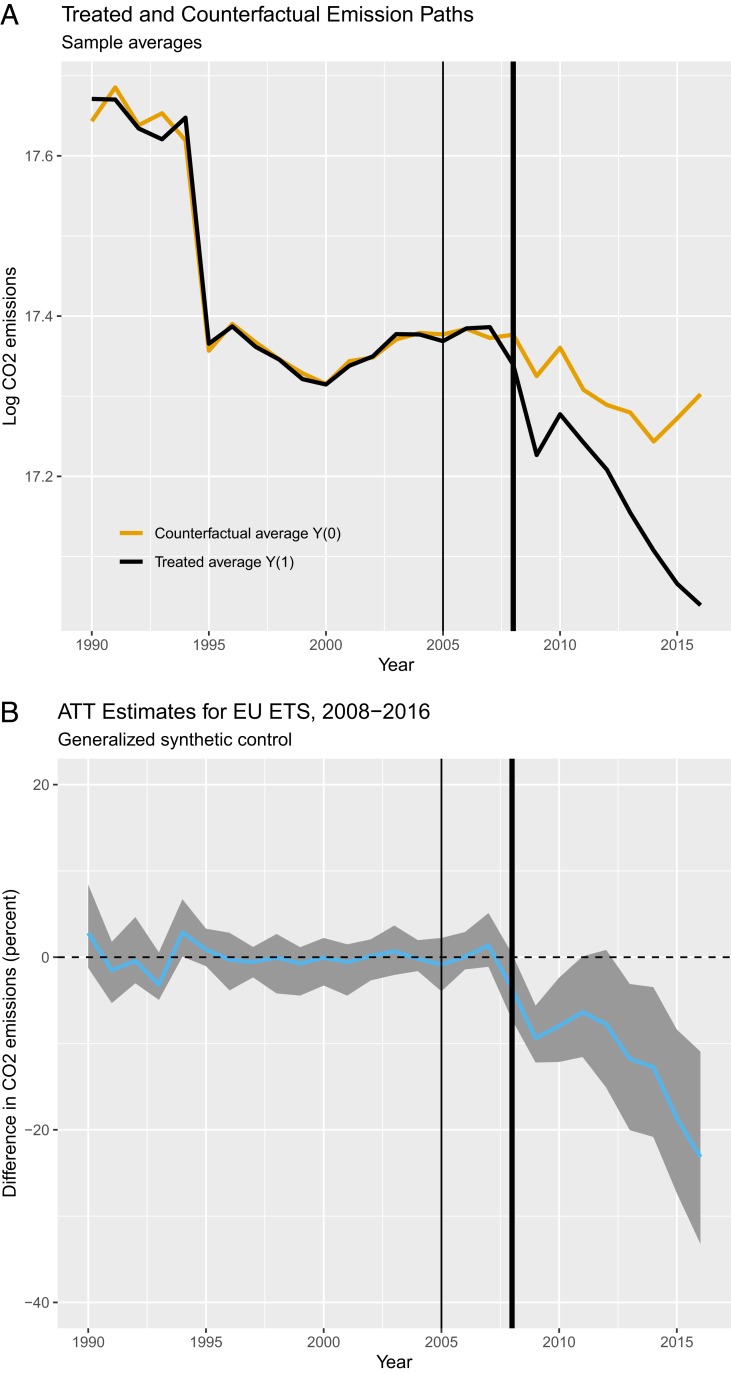
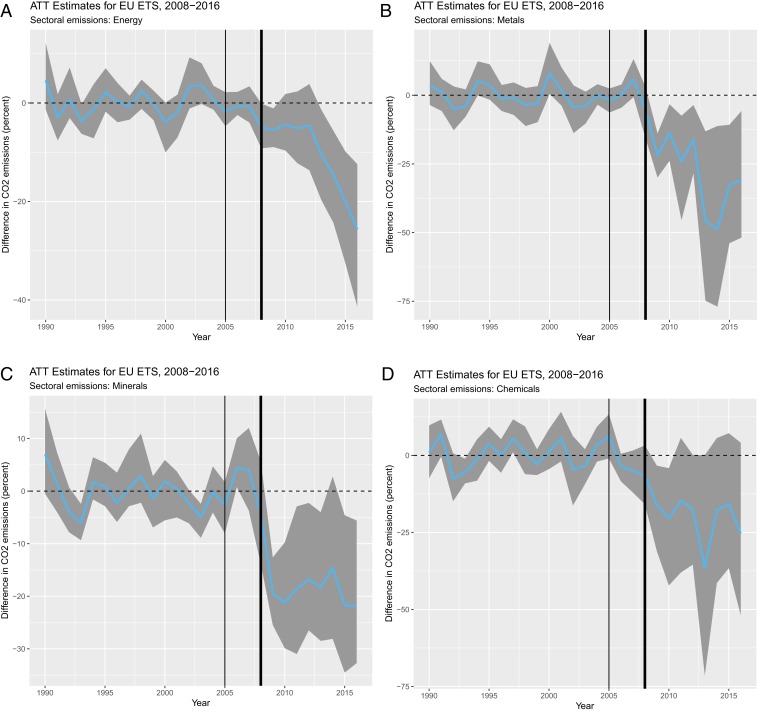
International carbon markets are an appealing and increasingly popular tool to regulate carbon emissions. By putting a price on carbon, carbon markets reshape incentives faced by firms and reduce the value of emissions. How effective are carbon markets? Observers have tended to infer their effectiveness from market prices. The general belief is that a carbon market needs a high price in order to reduce emissions. As a result, many observers remain skeptical of initiatives such as the European Union Emissions Trading System (EU ETS), whose price remained low (compared to the social cost of carbon). In this paper, we assess whether the EU ETS reduced C O 2 emissions despite low prices. We motivate our study by documenting that a carbon market can be effective if it is a credible institution that can plausibly become more stringent in the future. In such a case, firms might cut emissions even though market prices are low. In fact, low prices can be a signal that the demand for carbon permits weakens. Thus, low prices are compatible with successful carbon markets. To assess whether the EU ETS reduced carbon emissions even as permits were cheap, we estimate counterfactual carbon emissions using an original sectoral emissions dataset. We find that the EU ETS saved about 1.2 billion tons of C O 2 between 2008 and 2016 (3.8%) relative to a world without carbon markets, or almost half of what EU governments promised to reduce under their Kyoto Protocol commitments. Emission reductions in sectors covered under the EU ETS were higher.
Overview
The claims and statistics of this paper haven’t been checked yet.
Free: it reads the open-access text and checks the first 5 claims that cite a source we can check. Create a free account to check every claim.
Integrity signals
Registry
Cites
Statistics
Figures
Verification
Claims the paper makes
The claims and statistics of this paper haven’t been checked yet.
Free: it reads the open-access text and checks the first 5 claims that cite a source we can check. Create a free account to check every claim.
Claims other papers make about this one
Each is checked against this paper’s own text: does it say what the citing paper says it does?
The source backs part of the claim, not all of it — or backs it for a different population, condition or comparison.
In the citing paper
“ETS-related policies on emission control have been generally considered to have a positive effect on both reducing emissions and promoting the presence of carbon sinks”
From The first compliance cycle of China's National Emissions Trading Scheme: insights and implications (2022) · cites this paper as [5]
Experimental — accuracy not yet measuredThe source backs part of the claim, not all of it — or backs it for a different population, condition or comparison.
In the citing paper
“The finding is consistent with two previous studies on China’s regional ETSs,35,39 and the comparison of the industry-based RGGI and the EU ETS with the service-based Tokyo ETS shows similar result,55,57,59”
From Carbon Abatement and Leakage in China's Regional Carbon Emission Trading (2024) · cites this paper as [57]
Experimental — accuracy not yet measuredThe cited source says what the claim attributes to it.
In the citing paper
“This performance is far below that (19–24%) of the Regional Greenhouse Gas Initiative (RGGI),55,56 nearing that (7–12%) of the European Union Emissions Trading System (EU ETS),57,58 almost equals to that (5–7%) of the Tokyo ETS,59,60 and being superior to the California ETS.61,62”
From Carbon Abatement and Leakage in China's Regional Carbon Emission Trading (2024) · cites this paper as [57]
Self-check
Percentages, sums and reported differences re-computed from the paper’s own numbers.
The self-check needs the paper’s full text.
Citations
Cites
Abadie, A., Diamond, A., & Hainmueller, J. (2010) · Journal of the American Statistical Association · doi:10.1198/jasa.2009.ap08746 · Cited by 5,513
Comparative Politics and the Synthetic Control Method
Abadie, A., Diamond, A., & Hainmueller, J. (2015) · American Journal of Political Science · doi:10.1111/ajps.12116 · Cited by 2,406
Comparative Politics and the Synthetic Control MethodPreprint
Abadie, A., Diamond, A., & Hainmueller, J. (2014) · SSRN Electronic Journal · doi:10.2139/ssrn.1950298 · Cited by 2,217
Panel Data Models With Interactive Fixed Effects
(2009) · Econometrica · doi:10.3982/ecta6135 · Cited by 1,690 · cited 2×
“The interactive fixed effects finally capture unobserved time-varying confounding from, for instance, different effects of the 2007/2008 financial crisis on European economies and their emissions (48).”
BackgroundMethodGrowth in emission transfers via international trade from 1990 to 2008
Peters, G. P., Minx, J. C., Weber, C. L., & Edenhofer, O. (2011) · Proceedings of the National Academy of Sciences · doi:10.1073/pnas.1006388108 · Cited by 1,599
Revisiting the social cost of carbon
Nordhaus, W. D. (2017) · Proceedings of the National Academy of Sciences · doi:10.1073/pnas.1609244114 · Cited by 1,366 · cited 1×
“First, the importance of carbon pricing has often been studied through the lens of integrated assessment models (36, 37).”
BackgroundEnvironmental Policy and Directed Technological Change: Evidence from the European Carbon Market
Calel, R., & Dechezleprêtre, A. (2016) · Review of Economics and Statistics · doi:10.1162/rest_a_00470 · Cited by 1,147
Generalized Synthetic Control Method: Causal Inference with Interactive Fixed Effects Models
Xu, Y. (2017) · Political Analysis · doi:10.1017/pan.2016.2 · Cited by 938 · cited 3×
“However, to evaluate policies, such as the EU ETS, which are introduced in multiple countries simultaneously, we instead resort to the generalized synthetic control method (15).”
BackgroundMethodInfluentialWarming the World: Economic Models of Global Warming
Nordhaus, W. D., & Boyer, J. (2000) · The MIT Press eBooks · doi:10.7551/mitpress/7158.001.0001 · Cited by 845 · cited 1×
“First, the importance of carbon pricing has often been studied through the lens of integrated assessment models (36, 37).”
BackgroundAbadie, A., Diamond, A., & Hainmueller, J. (2007) · National Bureau of Economic Research · doi:10.3386/t0335 · Cited by 815
Research works printed but not linked: 2
- Wagner U. J., Muûls M., Martin R., Colmer J., “ The causal effects of the European Union emissions trading scheme: Evidence from French manufacturing plants. (2014). http://conference.iza.org/conference_files/EnvEmpl2014/martin_r7617.pdf. Accessed 23 September 2019.
- Pretick S., Wagner U. J., The impact of carbon trading on industry: Evidence from German manufacturing firms in Kiel Working Papers No. 1912 (Kiel Institute for World Economy, 2014). https://papers.ssrn.com/sol3/papers.cfm?abstract_id=2389800. Accessed 15 August 2019.
Cited by
Items 101–200 of 698
Laporta, L., Domingos, T., & Marta-Pedroso, C. (2021) · Land Use Policy · doi:10.1016/j.landusepol.2021.105712 · Cited by 34
Nexus Between Trading Non-Green Products and Environment: Introducing Non-Green Trade Openness Index
Can, M., OLUÇ, İ., Sturm, B., GÜZEL, İ., Gavurová, B., & Popp, J. (2022) · Frontiers in Environmental Science · doi:10.3389/fenvs.2022.950453 · Cited by 33
Economic Trends in the Transition into a Circular Bioeconomy
Kircher, M. (2022) · Journal of risk and financial management · doi:10.3390/jrfm15020044 · Cited by 34
Lilliestam, J., Patt, A., & Bersalli, G. (2022) · Environmental and Resource Economics · doi:10.1007/s10640-022-00708-8 · Cited by 32
“The one study investigating later years, Bayer and Aklin (2020), find that the EU ETS reduced EU emissions by 3.8%, due to an emission reduction of 11.5% in the trading sectors in 2008–2016 compared to a world without the EU ETS.”
BackgroundMethodInfluentialUnderstanding the climate responsibility associated with elections
Wynes, S., Motta, M., & Donner, S. D. (2021) · One Earth · doi:10.1016/j.oneear.2021.02.008 · Cited by 32
Fang, X., & Liu, M. (2024) · Journal of Environmental Planning and Management · doi:10.1080/09640568.2024.2370541 · Cited by 31
“Bayer and Aklin (2020), Sun, Shen, and Zhou (2023) also found that the carbon emissions market trading system has a significant positive effect on GTI.”
Biancalani, F., Gnecco, G., Metulini, R., & Riccaboni, M. (2024) · Scientific Reports · doi:10.1038/s41598-024-70260-6 · Cited by 31
Do carbon emissions trading pilot policies contribute to urban green transportation development?
Zhang, C., Wu, S., Huang, M., Skitmore, M., Yao, W., & Lu, X. (2025) · Transportation Research Part D Transport and Environment · doi:10.1016/j.trd.2025.104654 · Cited by 31
Airlines’ eco-productivity changes and the European Union Emissions Trading System
Nguyen, M. T., Yu, M., & Lirn, T.-C. (2021) · Transportation Research Part D Transport and Environment · doi:10.1016/j.trd.2021.103100 · Cited by 31
Can China’s carbon emissions trading scheme achieve a double dividend?
Ma, Q., Yan, G., Ren, X., & Ren, X. (2022) · Environmental Science and Pollution Research · doi:10.1007/s11356-022-19453-y · Cited by 31
Peng, Z., Lu, W., & Webster, C. J. (2022) · Resources Conservation and Recycling · doi:10.1016/j.resconrec.2022.106607 · Cited by 31
Across the Boards: Explaining Firm Support for Climate Policy
Lerner, M., & Osgood, I. (2022) · British Journal of Political Science · doi:10.1017/s0007123422000497 · Cited by 31
“In emphasizing the social ties between firms, our analysis complements existing explanations that emphasize market forces and economic ties among firms to explain corporate climate actions (see, for example, Bayer and Aklin 2020; Cory, Lerner, and Osgood 2021).”
BackgroundCarbon Farming: Bridging Technology Development with Policy Goals
Kyriakarakos, G., Petropoulos, T., Marinoudi, V., Berruto, R., & Bochtis, D. (2024) · Sustainability · doi:10.3390/su16051903 · Cited by 32
“A study prepared for DG Clima in 2016 stated % of the covered projects and 73% of the potential 2013–2020 certified emission reductions (CERs) supply have a low likelihood of ensuring environmental integrity (i.e., ensuring that emission reductions are additional and not over-estimated). that “…”
The European Union Emissions Trading System might yield large co-benefits from pollution reduction
Basaglia, P., Grunau, J., & Drupp, M. A. (2024) · Proceedings of the National Academy of Sciences · doi:10.1073/pnas.2319908121 · Cited by 30
Exploring the influencing factors of carbon neutralization in Chinese manufacturing enterprises
Zhu, J., Dou, Z., Yan, X., Yu, L., & Lu, Y. (2022) · Environmental Science and Pollution Research · doi:10.1007/s11356-022-21386-5 · Cited by 30
“For example, Bayer and Aklin (2020) used a generalized comprehensive control method to evaluate the effectiveness of an ETS in the EU.”
The joint impact of the carbon market on carbon emissions, energy mix, and copollutants
Zheng, Y., Tan, R., & Zhang, B. (2023) · Environmental Research Letters · doi:10.1088/1748-9326/acca98 · Cited by 30
“We demonstrate that China’s CET pilot policy is effective in reducing plant CO2 emissions in the early trading stage (2014–2016), despite a low carbon price and low liquidity (Bayer and Aklin 2020, Cui et al 2021).”
BackgroundAli, M., Seraj, M., Alper, E., Türsoy, T., & Uktamov, K. F. (2023) · Environmental Science and Pollution Research · doi:10.1007/s11356-023-29308-9 · Cited by 30
“Several European countries have replaced outdated coal-fired power plants, which incurred significant retrofit expenses, with cleaner gas-fired power plants (coal phase-out status, 20211; Wynn & Coghe, 2017; Date et al., 2019; Bayer & Aklin, 2020).”
BackgroundShifting concerns for the EU ETS: are carbon prices becoming too high?
Gerlagh, R., Heijmans, R. J. R. K., & Einar Rosendahl, K. (2022) · Environmental Research Letters · doi:10.1088/1748-9326/ac63d6 · Cited by 29
“The European Union’s Emission Trading System (EU ETS) is the flagship EU climate policy, covering roughly half of the EU’s CO2 emissions (Bayer and Aklin 2020).”
BackgroundCarbon emission trading schemes induces technology transfer: Evidence from China
Cai, H., Wang, Z., Zhang, Z., & Xu, X. (2023) · Energy Policy · doi:10.1016/j.enpol.2023.113595 · Cited by 29
Wang, X., Jin, W., Xu, B., & Wang, K. (2025) · Journal of Futures Markets · doi:10.1002/fut.22565 · Cited by 29
Do Carbon Emission Trading Schemes Promote the Green Transition of Enterprises? Evidence from China
Xu, S., Pan, W., & Wen, D. (2023) · Sustainability · doi:10.3390/su15086333 · Cited by 28
“One topic is to evaluate the efficiency of the construction of CETS, such as the effectiveness of carbon prices [25,26], the controllability of transaction costs [27], and the rationality of quota allocation [28,29].”
Impacts of the pilot policy for carbon emissions trading on pollution reduction in China
Fu, X. (2024) · Journal of Cleaner Production · doi:10.1016/j.jclepro.2024.142878 · Cited by 27
Carbon pricing and the elasticity of CO2 emissions
Rafaty, R., Dolphin, G., & Pretis, F. (2025) · Energy Economics · doi:10.1016/j.eneco.2025.108298 · Cited by 26
Steiner, B., Münch, C., Beckmann, M., & von der Gracht, H. A. (2024) · Supply Chain Management An International Journal · doi:10.1108/scm-06-2024-0372 · Cited by 26
Sınırda Karbon Düzenleme Mekanizmasının Türkiye - AB-27 Dış Ticaret İlişkisi Üzerine Olası Etkisi
KOÇ, B. E., & Kaynak, S. (2023) · Verimlilik dergisi · doi:10.51551/verimlilik.1166045 · Cited by 26
Wu, H., Yue, Q., Guo, P., & Xu, X. (2024) · Applied Energy · doi:10.1016/j.apenergy.2024.124443 · Cited by 26
Subsidized renewables’ adverse effect on energy storage and carbon pricing as a potential remedy
Liebensteiner, M., Haxhimusa, A., & Naumann, F. (2022) · Renewable and Sustainable Energy Reviews · doi:10.1016/j.rser.2022.112990 · Cited by 26
“Since Pigou’s seminal work in 1920 [11], neoclassical economics views carbon pricing as an efficient (and thus first-best) solution to greenhouse-gas emissions, with some recent empirical studies [12; 13] supporting this notion.”
BackgroundDetecting Greenwashing: A Natural Language Processing Literature SurveyPreprint
Calamai, T., Balalau, O., Guenedal, T. L., & Suchanek, F. M. (2025) · arXiv (Cornell University) · doi:10.48550/arxiv.2502.07541 · Cited by 26
The first compliance cycle of China's National Emissions Trading Scheme: insights and implications
Li, J., Yao, Y., & Wang, X. (2022) · Carbon Neutrality · doi:10.1007/s43979-022-00035-3 · Cited by 25
Zhang, J., & Wei, Y. (2024) · China Finance Review International · doi:10.1108/cfri-02-2024-0056 · Cited by 25
Dimitriou, D., & Karagkouni, A. G. (2022) · Frontiers in Sustainability · doi:10.3389/frsus.2022.916038 · Cited by 25
“” To be eligible for emission credits under the EU ETS, all airlines operating in Europe—both European and non-European—are required to monitor, report, and verify for accessible translations of the previous emissions, in addition to surrendering allowances against those emissions (Bayer and Aklin, 2020).”
BackgroundYang, S., Bai, Y., Alatalo, J. M., Shi, Y., & Yang, Z. (2024) · Ecological Indicators · doi:10.1016/j.ecolind.2024.112211 · Cited by 25
The green paradox of time dimension: From pilot to national carbon emission trading system in China
Ge, X., Li, Y., & Yang, H. (2024) · Environmental Impact Assessment Review · doi:10.1016/j.eiar.2024.107642 · Cited by 26
Policies and sustainable energy transition in the global environment: Challenges for Latin America
Barragán-Ocaña, A., Cecilio-Ayala, E., Silva-Borjas, P., Ruiz, J. A. C., & Hernandez-Cardona, E.-Y. (2025) · Heliyon · doi:10.1016/j.heliyon.2025.e42295 · Cited by 25
Policy interactions and electricity generation sector CO2 emissions: A quasi-experimental analysis
Tello, W. P. (2024) · Energy Policy · doi:10.1016/j.enpol.2024.114434 · Cited by 24
Müller, N., & Teixido-Figueras, J. J. (2021) · Climate Policy · doi:10.1080/14693062.2020.1870914 · Cited by 25
“Similarly, Bayer and Aklin (2020) show that EU ETS countries would have emitted more than 1 billion additional tons of CO2 between 2008 and 2016 had the EU ETS not been implemented.”
When and Under What Conditions Does an Emission Trading Scheme Become Cost Effective?
Zhang, H., Zhang, L., & Zhang, N. (2024) · The Energy Journal · doi:10.5547/01956574.45.2.hzha · Cited by 25
“Although with different cap stringency and allocation practices across nations, existing studies have demonstrated the promising co-benefits due to the implementation of ETS (Bayer and Aklin, 2020; Calel and Dechezleprêtre, 2016; Teixidó et al., 2019).”
BackgroundShi, W., Zhang, Y., & Liu, J. (2024) · IEEE Transactions on Engineering Management · doi:10.1109/tem.2024.3450523 · Cited by 25
“Still, the carbon market performance will shape the ongoing effect of the CET mechanism [14], [15], [16].”
BackgroundCarbon pricing and COVID-19: Policy changes, challenges and design options in OECD and G20 countries
Nachtigall, D., Ellis, J., & Errendal, S. (2022) · OECD environment working papers · doi:10.1787/8f030bcc-en · Cited by 24
Carbon Abatement and Leakage in China's Regional Carbon Emission Trading
Jiang, J., Ye, B., Zeng, Z., Yang, X., Sun, Z., Shao, S., Feng, K., & Tan, X. (2024) · Environmental Science & Technology · doi:10.1021/acs.est.4c04738 · Cited by 23
Liu, H., Chen, Q., & Song, Y. (2025) · Economic Analysis and Policy · doi:10.1016/j.eap.2025.06.047 · Cited by 23
Enhancing Soil Organic Carbon Sequestration in Agriculture: Plans and Policies
Dinesh, G. K., Sinduja, M., Priyanka, B., Sathya, V., Karthika, S., Meena, R. S., & Prasad, S. (2022) · Springer eBooks · doi:10.1007/978-981-19-6179-3_4 · Cited by 23
Kazi, M.-K., & Hasan, M. M. F. (2023) · Computers & Chemical Engineering · doi:10.1016/j.compchemeng.2023.108478 · Cited by 23
Assessing Criticisms of Carbon Pricing
van den Bergh, J. C. J. M., & Botzen, W. J. W. (2024) · International Review of Environmental and Resource Economics · doi:10.1561/101.00000172 · Cited by 23
Heiaas, A. M. (2021) · Review of Business and Economics Studies · doi:10.26794/2308-944x-2021-9-1-84-120 · Cited by 23
“As mentioned previously, Bayer and Aklin (2020) focus on the impact of EU ETS on CO2 emissions at the sector and country levels.”
BackgroundMethodInfluentialBorelli, D., Devia, F., Schenone, C., Silenzi, F., Sollai, F., & Tagliafico, L. A. (2023) · Energy Sustainable Development/Energy for sustainable development · doi:10.1016/j.esd.2023.01.008 · Cited by 22
Hui, Z., & Choi, C. H. (2024) · Asian-Pacific Economic Literature · doi:10.1111/apel.12418 · Cited by 22
Oh, I., Yoo, W., & Kim, K.-H. (2020) · International Journal of Environmental Research and Public Health · doi:10.3390/ijerph17134762 · Cited by 22
The Role of Coal in a Sustainable Energy Mix for India: A Wide-Angle View
Mohanty, M., & Sarkar, R. (2023) · Routledge eBooks · doi:10.4324/9781003433088 · Cited by 22
Pollution Permits and Financing Costs
Antoniou, F., Delis, M. D., Ongena, S. R. G., & Tsoumas, C. (2024) · Journal of money credit and banking · doi:10.1111/jmcb.13241 · Cited by 21
Sæther, S. R. (2021) · Economic Analysis and Policy · doi:10.1016/j.eap.2021.06.011 · Cited by 21
Giraldo, J. L., Rodríguez‐Crespo, E., & Salazar-Elena, J. C. (2022) · Journal of Cleaner Production · doi:10.1016/j.jclepro.2022.133700 · Cited by 21
Zhou, C., Li, Y., & Wu, C. (2024) · Energy Efficiency · doi:10.1007/s12053-024-10232-x · Cited by 20
“Bayer and Aklin (2020) determined that the European Union’s (EU) carbon emissions trading system reduced approximately 1.2 billion tons of CO 2 emissions between 2008 and 2016.”
InfluentialThe green bonus of tax incentives: Evidence from China
Wu, Q., Wang, Y., Jinxi, W., & Shen, G. (2024) · Journal of Economic Behavior & Organization · doi:10.1016/j.jebo.2024.106740 · Cited by 21
From carbon policy to consumer prices: The economic impact of carbon caps in the Euro Area
Morão, H. (2025) · Energy Economics · doi:10.1016/j.eneco.2024.108175 · Cited by 20
When the Metaverse Meets Carbon Neutrality: Ongoing Efforts and DirectionsPreprint
Liu, F., Pei, Q., Chen, S., Yuan, Y., Wang, L., & Mühlhäuser, M. (2023) · arXiv (Cornell University) · doi:10.48550/arxiv.2301.10235 · Cited by 20
“The EU ETS has already been proved to be effective and achieves up to 3.8% of EU-wide emission reduction between 2008 and 2016 based on an estimation compared to carbon emissions without the EU ETS [200].”
BackgroundInfluentialSen, K. K., Hosan, S., Karmaker, S. C., Chapman, A. J., & Saha, B. B. (2025) · Sustainable Futures · doi:10.1016/j.sftr.2025.100825 · Cited by 20
The effectiveness of carbon emission trading system: Evidence from China's regional markets
Li, Y., & Zhao, J. (2025) · Journal of Development Economics · doi:10.1016/j.jdeveco.2025.103631 · Cited by 20
Kukah, A. S. K., Xiaohua, J., Osei‐Kyei, R., & Perera, S. (2024) · Journal of Facilities Management · doi:10.1108/jfm-08-2023-0094 · Cited by 19
Zhang, Y., Shi, W., & Liu, J.-Y. (2024) · International Review of Financial Analysis · doi:10.1016/j.irfa.2024.103703 · Cited by 19
Beyond energy: incentivizing decarbonization through the circular economy
Sen, A., Napoli, C., & Meini, L. (2021) · Oxford University Research Archive (ORA) (University of Oxford) · doi:10.5287/ora-gpe6nv9y0 · Cited by 19
Bayer, P. J. (2023) · The Journal of Politics · doi:10.1086/724963 · Cited by 18
“…emissions and boosting an annual market value of US$215 billion in 2019 (Carbon Pulse 2020), the scheme is by far the largest carbon pricing policy worldwide and has recently also been shown to help reduce emissions despite widespread skepticism about its effectiveness (Bayer and Aklin 2020).”
Self-citationLi, Y., Wang, X., Wang, Y., Peng, J., & Chen, S. (2024) · International Journal of Energy Research · doi:10.1155/2024/6771192 · Cited by 18
Hooper, R., Goyal, N., Blok, K., & Scholten, L. (2024) · Policy Sciences · doi:10.1007/s11077-024-09548-3 · Cited by 18
Green fourth-party logistics network design under carbon cap-and-trade policy
Zhang, Y., Huang, M., Wu, Y., Cao, Z., Yuan, L., Zhang, J., & Wang, X. (2025) · International Journal of Production Economics · doi:10.1016/j.ijpe.2025.109540 · Cited by 18
The impact of a carbon tax implementation on non-CO2gas emissions: the case of Japan
Mortha, A., Hesary, F. T., & Vo, X. V. (2021) · Australasian Journal of Environmental Management · doi:10.1080/14486563.2021.1991498 · Cited by 18
Global Externalities, Local Policies, and Firm Selection
Ahlvik, L., & Liski, M. (2022) · Journal of the European Economic Association · doi:10.1093/jeea/jvac001 · Cited by 18
A VaR-Based Methodology for Assessing Carbon Price Risk across European Union Economic Sectors
Bulai, V.-C., Horobeț, A. L., Popovici, O. C., Belaşcu, L., & Dumitrescu, S. A. (2021) · Energies · doi:10.3390/en14248424 · Cited by 18
“[4] insisted that low carbon prices are compatible with”
BackgroundInfluentialJiang, K., Wang, D., Xu, L., & Wang, F. (2024) · Socio-Economic Planning Sciences · doi:10.1016/j.seps.2024.102033 · Cited by 17
Vehicle-routing problem for low-carbon cold chain logistics based on the idea of cost–benefit
Liu, Y., Tao, F., & Zhu, R. (2025) · Complex & Intelligent Systems · doi:10.1007/s40747-024-01756-x · Cited by 18
“This is consistent with the conclusion presented in Bayer and Aklin [41].”
CO2 emissions market and renewable energy, are they linked? The case of the EU ETS
Perdiguero, J., & Sanz, À. (2025) · Energy Economics · doi:10.1016/j.eneco.2025.108648 · Cited by 17
Mission accomplished? A post-assessment of EU ETS impact on power sector emissions reduction
ESLAHI, M., Cretì, A., & Sanin, M. E. (2025) · Ecological Economics · doi:10.1016/j.ecolecon.2025.108784 · Cited by 17
“When it comes to the effectiveness assessment of carbon markets, carbon price is regularly the touchstone of choice where low prices are, explicitly or implicitly, associated with ineffectiveness (Bayer & Aklin, 2020).”
InfluentialYang, G., Wang, Q., Kuwahara, Y., Wang, L., Deng, H., & Yamashita, H. (2023) · Journal of environmental chemical engineering · doi:10.1016/j.jece.2023.110439 · Cited by 17
Development of carbon finance in China based on the hybrid MCDM method
Wu, S., & Niu, R. (2024) · Humanities and Social Sciences Communications · doi:10.1057/s41599-023-02558-1 · Cited by 17
Carbon Pricing and the Elasticity of Co2 EmissionsPreprint
Rafaty, R., Dolphin, G., & Pretis, F. (2022) · SSRN Electronic Journal · doi:10.2139/ssrn.4188459 · Cited by 18
Price elasticity of CO2 emissions in China: A machine learning approach
Lei, H., Xue, M., Liu, H., & Ye, J. (2023) · Sustainable Production and Consumption · doi:10.1016/j.spc.2023.01.005 · Cited by 16
The EU emissions trading system and airline low-carbon transition: A game-theoretic approach
Pang, S., & Chen, M. (2023) · Journal of Air Transport Management · doi:10.1016/j.jairtraman.2023.102407 · Cited by 16
Examining the representativeness heuristic and anchoring effects in China's carbon markets
Zhou, X., Gao, Y., Wang, P., & Zhu, B. (2023) · Journal of Cleaner Production · doi:10.1016/j.jclepro.2023.139079 · Cited by 16
Assessing the effectiveness of emissions trading schemes: evidence from China
Wu, X., Qiu, W., & Guo, S. (2023) · Climate Policy · doi:10.1080/14693062.2023.2282481 · Cited by 16
“Nevertheless, Bayer and Aklin (2020) pointed out that even with a low carbon price, the EU ETS can still reduce CO 2 emissions as long as credible signals are provided to emitting entities.”
BackgroundEconomy-wide impacts of socio-politically driven net-zero energy systems in europe
Mayer, J., Süsser, D., Pickering, B., Bachner, G., & Sanvito, F. D. (2024) · Energy · doi:10.1016/j.energy.2024.130425 · Cited by 16
Sun, H., Zhang, X., & Luo, C. (2025) · Energies · doi:10.3390/en18133401 · Cited by 16
Pan, D., Zhang, C., Zhu, D., Ji, Y., & Cao, W. (2021) · Finance research letters · doi:10.1016/j.frl.2021.102626 · Cited by 16
Progress and notions of progress in sustainable finance
Johnstone, S., Long, F. J., & Azhar, A. B. (2022) · Journal of Sustainable Finance & Investment · doi:10.1080/20430795.2022.2148816 · Cited by 16
Du, Y., Liu, H., Huang, H., Zhang, J., & Wang, Y. (2024) · Sustainable Futures · doi:10.1016/j.sftr.2024.100303 · Cited by 16
Accelerating the EU’s green transition
Borowiecki, M., Giménez, J. C., Giovannelli, F., & Vanni, F. (2023) · OECD Economics Department working papers · doi:10.1787/bed2b6df-en · Cited by 16
Environmentalism, a flirt with eco-authoritarianism and the robustness of ordoliberalism
Enninga, J. (2023) · Constitutional Political Economy · doi:10.1007/s10602-023-09406-z · Cited by 15
“Political fear that the EU ETS appears toothless, led policymaker to ignore certainty criteria and buy up certificates ignoring the CO 2 savings that occurred even in a low-price environment caused by the decision of firms to reduce emissions instead of buying certificates (Bayer and Aklin, 2020).”
Shi, W., Zhang, Y., & Liu, J. (2024) · Energy Economics · doi:10.1016/j.eneco.2024.108005 · Cited by 16
Calel, R. A., Dechezleprêtre, A., & Venmans, F. (2025) · Climate Policy · doi:10.1080/14693062.2025.2464699 · Cited by 15
“There are estimates of the EU ETS’s effect on emissions (Anderson & Di Maria, 2011; Bayer & Aklin, 2020; Dechezleprêtre et al., 2023; Ellerman & Buchner, 2008), on employment (Anger & Oberndorfer, 2008; Chan et al., 2013), on investment (Lo¨fgren et al., 2013), and on innovation (Calel, 2020; Calel…”
Nikolaidis, P., & Poullikkas, A. (2022) · Sustainability · doi:10.3390/su141710800 · Cited by 15
The Moral Limits of Market-Based Mechanisms: An Application to the International Maritime Sector
Monios, J. (2022) · Journal of Business Ethics · doi:10.1007/s10551-022-05256-1 · Cited by 15
Shao, W., Yang, K. Q., & Jin, Z. (2023) · Frontiers in Energy Research · doi:10.3389/fenrg.2022.895539 · Cited by 15
Kukah, A. S. K., Jin, X., Osei‐Kyei, R., & Perera, S. (2023) · Computing in construction · doi:10.35490/ec3.2023.255 · Cited by 16
AVRUPA YEŞİL MUTABAKAT I 55’E UYUM: TÜRK LOJİSTİK SEKTÖRÜ ÜZERİNE İNCELEME
ATAKAN, G., Garip, B., Karataş, A., & Tunahan, H. (2023) · Ankara Avrupa Calismalari Dergisi · doi:10.32450/aacd.1327083 · Cited by 15
Carbon Leakage Within Firm Ownership Networks
Cui, J., Wang, C., Wang, Z., Zhang, J., & Zheng, Y. (2023) · Journal of the Association of Environmental and Resource Economists · doi:10.1086/743175 · Cited by 15
Feng, R., Xu, X., Yu, Z., & Lin, Q. (2023) · Journal of Cleaner Production · doi:10.1016/j.jclepro.2023.138965 · Cited by 15
Saleeb, H. M. I., El‐Rifaie, A. M., Youssef, A. A. F., Mohamed, S. A., & Kassem, R. (2025) · Sustainability · doi:10.3390/su17062408 · Cited by 14
Izah, S. C., Ogwu, M. C., & Hait, M. (2025) · Environmental science and engineering · doi:10.1007/978-3-031-81966-7_7 · Cited by 14
Reforming justice under a security crisis: The case of the criminal justice reform in Mexico
Cepeda-Francese, C. A., & Ramírez-Álvarez, A. A. (2022) · World Development · doi:10.1016/j.worlddev.2022.106148 · Cited by 14
The impact of carbon policy news on the national energy industry
Morão, H. (2024) · Energy Economics · doi:10.1016/j.eneco.2024.107596 · Cited by 14
A defense of usable climate mitigation science: how science can contribute to social movements
Drake, H. F., & Henderson, G. L. (2022) · Climatic Change · doi:10.1007/s10584-022-03347-6 · Cited by 14
“While far from enough, the modest mitigation to date would certainly have been even less in a counterfactual world without any basic climate science—and is demonstrably less than in a world without any unilateral climate policies (Bayer and Aklin 2020; Lepissier and Mildenberger 2021).”
Background
Metadata
- Authors
- Bayer, P., & Aklin, M.
- Affiliations
- University of Strathclyde (GB)
- University of Pittsburgh (US)
- Corresponding author
- Bayer, Patrick
- Venue
- Proceedings of the National Academy of Sciences
- Publisher
- National Academy of Sciences
- Published
- 2020-04-06
- Volume
- 117
- Issue
- 16
- Pages
- 8804-8812
- ISSN
- 0027-8424 (ISSN-L)
- 1091-6490
- PMC
- PMC7183178
- OpenAlex
- W3014509841
- Cited by
- 545
- References
- 48
- Citations by year
- 2026: 93 · 2025: 119 · 2024: 93 · 2023: 89 · 2022: 83 · 2021: 54 · 2020: 11
- FWCI
- 50.35
- Type
- journal article
- Language
- en
- Open access
- hybrid
- doi.org
- Licence
- Locations
- Proceedings of the National Academy of Sciences (publishedVersion, cc-by)
- PubMed Central (publishedVersion, cc-by)
- PubMed (publishedVersion)
- ENLIGHTEN (Jurnal Bimbingan dan Konseling Islam) (submittedVersion, cc-by-sa)
- Strathprints: The University of Strathclyde institutional repository (University of Strathclyde) (submittedVersion)
- Infoscience (Ecole Polytechnique Fédérale de Lausanne) (submittedVersion, cc-by-nc-nd)
- Funders
- British Academy (SG171349)
- Topics
- Social Sciences › Economics, Econometrics and Finance › Economics and Econometrics › Climate Change Policy and Economics
- Social Sciences › Economics, Econometrics and Finance › Economics and Econometrics › Energy, Environment, Economic Growth
- Physical Sciences › Energy › Renewable Energy, Sustainability and the Environment › Renewable energy and sustainable power systems
- Keywords
- EU Emissions Trading System, carbon pricing, emissions trading, CO2 emission reduction, carbon permits, institutional credibility, climate policy effectiveness
About these checks
Registry, retraction, Cites and statistics results are computed, not judged, with one exception: a printed reference that no index lists is read once by a model before it counts as a citation error. Claims are extracted by a model and kept only when their quote appears verbatim in the text; each cited source is then checked, with a model’s help, for whether it says what the claim relies on. Those verdicts can be wrong — read the claim’s quote and the cited source before relying on one.
Statistics and arithmetic are recomputed, not judged.
Confidence bands are shown only for fields calibrated on our annotated test set. None is calibrated yet, so no band is shown.
What counts as a claim ›How we measure confidence ›How we check this ›
Are you an author, or do you see a problem with this page? Request a review
Data sources
Bibliographic data: Semantic Scholar, OpenAlex, Crossref.
Contains information from the Semantic Scholar Academic Graph Datasets, made available under the ODC Attribution License (ODC-BY 1.0).
Semantic Scholar’s data is described in: Kinney, R., et al. (2023). The Semantic Scholar Open Data Platform. arXiv:2301.10140.
