

The European Union Emissions Trading System reduced CO 2 emissions despite low prices
Open accessThe DOI matches its Crossref record; 49 of the 49 references it cites were found in a registry or an index.
Abstract
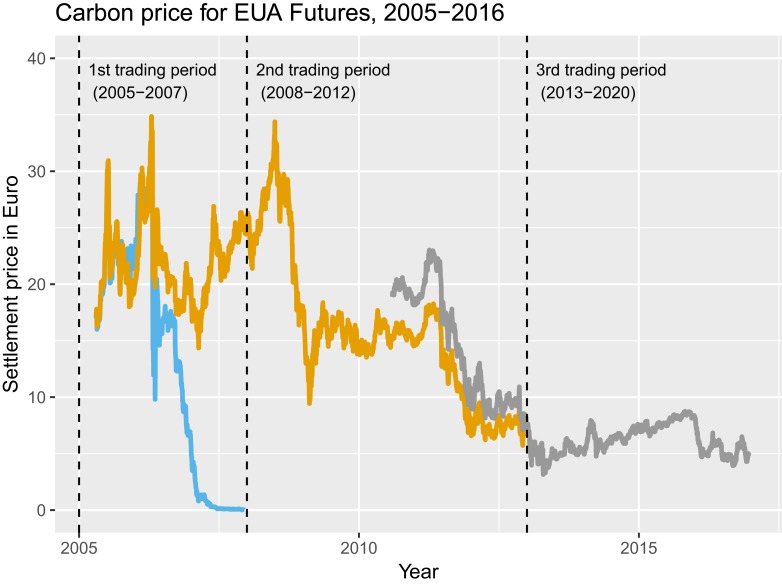
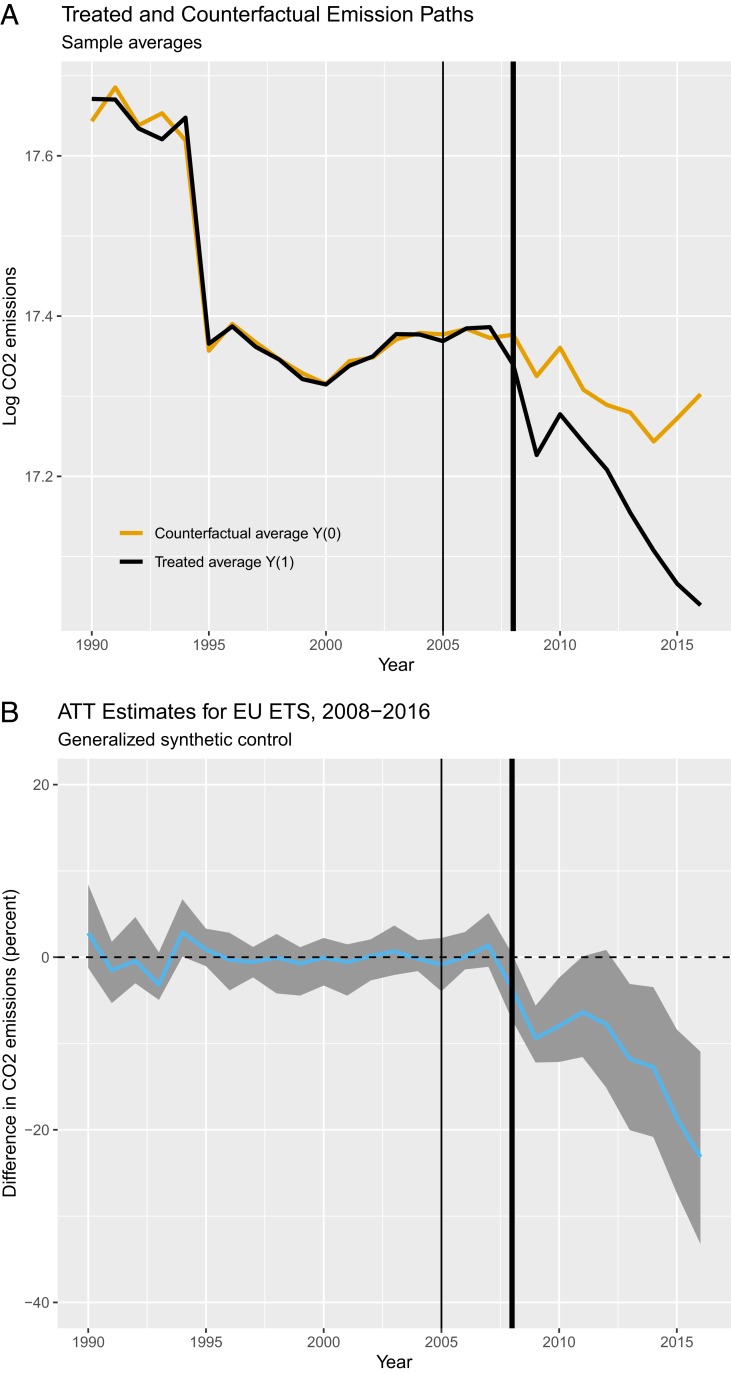
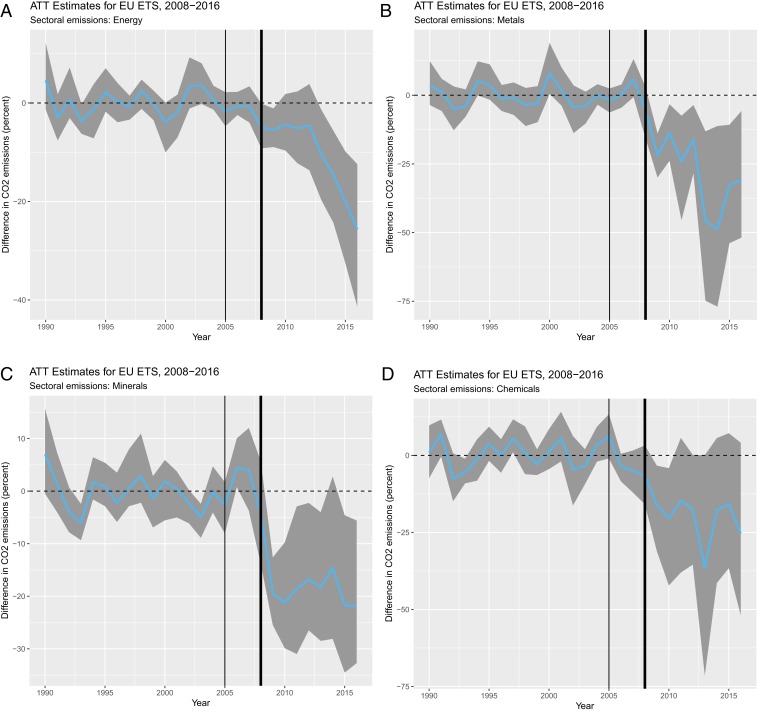
International carbon markets are an appealing and increasingly popular tool to regulate carbon emissions. By putting a price on carbon, carbon markets reshape incentives faced by firms and reduce the value of emissions. How effective are carbon markets? Observers have tended to infer their effectiveness from market prices. The general belief is that a carbon market needs a high price in order to reduce emissions. As a result, many observers remain skeptical of initiatives such as the European Union Emissions Trading System (EU ETS), whose price remained low (compared to the social cost of carbon). In this paper, we assess whether the EU ETS reduced C O 2 emissions despite low prices. We motivate our study by documenting that a carbon market can be effective if it is a credible institution that can plausibly become more stringent in the future. In such a case, firms might cut emissions even though market prices are low. In fact, low prices can be a signal that the demand for carbon permits weakens. Thus, low prices are compatible with successful carbon markets. To assess whether the EU ETS reduced carbon emissions even as permits were cheap, we estimate counterfactual carbon emissions using an original sectoral emissions dataset. We find that the EU ETS saved about 1.2 billion tons of C O 2 between 2008 and 2016 (3.8%) relative to a world without carbon markets, or almost half of what EU governments promised to reduce under their Kyoto Protocol commitments. Emission reductions in sectors covered under the EU ETS were higher.
Overview
The claims and statistics of this paper haven’t been checked yet.
Free: it reads the open-access text and checks the first 5 claims that cite a source we can check. Create a free account to check every claim.
Integrity signals
Registry
Cites
Statistics
Figures
Verification
Claims the paper makes
The claims and statistics of this paper haven’t been checked yet.
Free: it reads the open-access text and checks the first 5 claims that cite a source we can check. Create a free account to check every claim.
Claims other papers make about this one
Each is checked against this paper’s own text: does it say what the citing paper says it does?
The source backs part of the claim, not all of it — or backs it for a different population, condition or comparison.
In the citing paper
“ETS-related policies on emission control have been generally considered to have a positive effect on both reducing emissions and promoting the presence of carbon sinks”
From The first compliance cycle of China's National Emissions Trading Scheme: insights and implications (2022) · cites this paper as [5]
Experimental — accuracy not yet measuredThe source backs part of the claim, not all of it — or backs it for a different population, condition or comparison.
In the citing paper
“The finding is consistent with two previous studies on China’s regional ETSs,35,39 and the comparison of the industry-based RGGI and the EU ETS with the service-based Tokyo ETS shows similar result,55,57,59”
From Carbon Abatement and Leakage in China's Regional Carbon Emission Trading (2024) · cites this paper as [57]
Experimental — accuracy not yet measuredThe cited source says what the claim attributes to it.
In the citing paper
“This performance is far below that (19–24%) of the Regional Greenhouse Gas Initiative (RGGI),55,56 nearing that (7–12%) of the European Union Emissions Trading System (EU ETS),57,58 almost equals to that (5–7%) of the Tokyo ETS,59,60 and being superior to the California ETS.61,62”
From Carbon Abatement and Leakage in China's Regional Carbon Emission Trading (2024) · cites this paper as [57]
Self-check
Percentages, sums and reported differences re-computed from the paper’s own numbers.
The self-check needs the paper’s full text.
Citations
Cites
Abadie, A., Diamond, A., & Hainmueller, J. (2010) · Journal of the American Statistical Association · doi:10.1198/jasa.2009.ap08746 · Cited by 5,513
Comparative Politics and the Synthetic Control Method
Abadie, A., Diamond, A., & Hainmueller, J. (2015) · American Journal of Political Science · doi:10.1111/ajps.12116 · Cited by 2,406
Comparative Politics and the Synthetic Control MethodPreprint
Abadie, A., Diamond, A., & Hainmueller, J. (2014) · SSRN Electronic Journal · doi:10.2139/ssrn.1950298 · Cited by 2,217
Panel Data Models With Interactive Fixed Effects
(2009) · Econometrica · doi:10.3982/ecta6135 · Cited by 1,690 · cited 2×
“The interactive fixed effects finally capture unobserved time-varying confounding from, for instance, different effects of the 2007/2008 financial crisis on European economies and their emissions (48).”
BackgroundMethodGrowth in emission transfers via international trade from 1990 to 2008
Peters, G. P., Minx, J. C., Weber, C. L., & Edenhofer, O. (2011) · Proceedings of the National Academy of Sciences · doi:10.1073/pnas.1006388108 · Cited by 1,599
Revisiting the social cost of carbon
Nordhaus, W. D. (2017) · Proceedings of the National Academy of Sciences · doi:10.1073/pnas.1609244114 · Cited by 1,366 · cited 1×
“First, the importance of carbon pricing has often been studied through the lens of integrated assessment models (36, 37).”
BackgroundEnvironmental Policy and Directed Technological Change: Evidence from the European Carbon Market
Calel, R., & Dechezleprêtre, A. (2016) · Review of Economics and Statistics · doi:10.1162/rest_a_00470 · Cited by 1,147
Generalized Synthetic Control Method: Causal Inference with Interactive Fixed Effects Models
Xu, Y. (2017) · Political Analysis · doi:10.1017/pan.2016.2 · Cited by 938 · cited 3×
“However, to evaluate policies, such as the EU ETS, which are introduced in multiple countries simultaneously, we instead resort to the generalized synthetic control method (15).”
BackgroundMethodInfluentialWarming the World: Economic Models of Global Warming
Nordhaus, W. D., & Boyer, J. (2000) · The MIT Press eBooks · doi:10.7551/mitpress/7158.001.0001 · Cited by 845 · cited 1×
“First, the importance of carbon pricing has often been studied through the lens of integrated assessment models (36, 37).”
BackgroundAbadie, A., Diamond, A., & Hainmueller, J. (2007) · National Bureau of Economic Research · doi:10.3386/t0335 · Cited by 815
Research works printed but not linked: 2
- Wagner U. J., Muûls M., Martin R., Colmer J., “ The causal effects of the European Union emissions trading scheme: Evidence from French manufacturing plants. (2014). http://conference.iza.org/conference_files/EnvEmpl2014/martin_r7617.pdf. Accessed 23 September 2019.
- Pretick S., Wagner U. J., The impact of carbon trading on industry: Evidence from German manufacturing firms in Kiel Working Papers No. 1912 (Kiel Institute for World Economy, 2014). https://papers.ssrn.com/sol3/papers.cfm?abstract_id=2389800. Accessed 15 August 2019.
Cited by
Items 301–400 of 698
Álvarez‐Díez, S., Baixauli‐Soler, J. S., Reina, G. L., & Rey, D. R.-L. (2025) · Journal of commodity markets · doi:10.1016/j.jcomm.2025.100511 · Cited by 6
Kukah, A. S. K., Jin, X., Osei‐Kyei, R., & Perera, S. (2025) · Sustainability · doi:10.3390/su172210342 · Cited by 6
Zhang, M., Dong, X., Yin, X., & Wang, C. (2025) · Finance research letters · doi:10.1016/j.frl.2025.108151 · Cited by 6
Teng, M., Ji, D., Han, C., & Liu, P. (2024) · International Journal of Environmental Research · doi:10.1007/s41742-024-00693-4 · Cited by 6
“However, carbon emissions continue to rise, reaching unprecedented levels (Bayer and Aklin 2020; Li et al. 2020c; Verma et al. 2024; Yu et al. 2019).”
Li, Y., Ni, S., Tang, X., Xie, S., & Wang, P. (2024) · Sustainability · doi:10.3390/su162310747 · Cited by 6
Liu, D., Wang, L., Lin, S., & Tang, Z. (2025) · Mathematics · doi:10.3390/math13030455 · Cited by 6
Long, S., Shan, X., & Liao, Z. (2025) · Emerging Markets Finance and Trade · doi:10.1080/1540496x.2025.2458077 · Cited by 6
“Previous studies have primarily explored the impacts of CETP on realizing carbon emission reduction to evaluate the effectiveness of policies (Bayer and Aklin 2020; Jotzo et al. 2018; Weng et al. 2022; Zhang et al. 2020).”
Regional emission dynamics in the phases of the EU Emissions Trading System
E., M. A. D., & Mandel, A. (2025) · Physica A Statistical Mechanics and its Applications · doi:10.1016/j.physa.2025.130680 · Cited by 6
Zhu, D., Tao, X., & Meibo, H. (2023) · Sustainability · doi:10.3390/su15054440 · Cited by 6
Emission trading and overlapping environmental support: Installation-level evidence from the EU ETS
Mulier, K., Ovaere, M., & Stimpfle, L. (2024) · Econstor (Econstor) · Cited by 6
Italian firms’ trading behavior in the European carbon market
Nardone, C., Pittiglio, R., & Reganati, F. (2025) · Economia Politica · doi:10.1007/s40888-025-00358-1 · Cited by 5
“Recent research has demonstrated its efficacy in reducing emissions (Bayer & Aklin, 2020; Colmer et al., 2023; Dechezleprêtre et al., 2023; Wagner & Petrick, 2014) and its positive influence on the economic performance of companies regulated by the EU ETS (D’Arcangelo et al., 2022; Dechezleprêtre…”
Shuyue, 王. W., Haocheng, W., Hao, S., Chen, X., & Xiaoyi, W. (2025) · Environment Development and Sustainability · doi:10.1007/s10668-025-06171-x · Cited by 5
Zheng, H., Zhuang, S., & Zhang, T. (2025) · PLoS ONE · doi:10.1371/journal.pone.0322548 · Cited by 5
Under what conditions and why is carbon pricing effective? A realist synthesis of ex-post evidence
Döbbeling-Hildebrandt, N., Danilenko, D., Lamb, W. F., & Minx, J. C. (2025) · Environmental Research Letters · doi:10.1088/1748-9326/ae03d8 · Cited by 5
“Firms can also try to avoid policies by relocating their production and associated emissions to other juris-dictions or facilities not subject to the policy [54, 57–59, 63, 67, 68, 84, 95–97, 112, 115–117].”
Nimjerdi, A. H., Nimjerdi, A. H., Rahsepar, M., Ghaziani, M. M., & Sajadifar, S. (2026) · Sustainable Futures · doi:10.1016/j.sftr.2026.102014 · Cited by 5
Effectiveness of market incentives in China’s National Emission Trading Scheme
Lyu, C., Wang, K., Shi, X., Cai, B., & Yan, G. (2025) · Structural Change and Economic Dynamics · doi:10.1016/j.strueco.2025.12.011 · Cited by 5
Suharman, H., Nisa, F., Pramesti, R. F., & Handoyo, S. (2026) · Sustainable Development · doi:10.1002/sd.70680 · Cited by 5
Carbon pricing effects on renewables: Evidence from California's electricity market
Dilek, G., Teixidó, J. J. C., & Serrano, M. (2026) · Energy Economics · doi:10.1016/j.eneco.2026.109174 · Cited by 5
Martín-Ortega, J., Bookbinder, R., & Cohen, J. B. (2026) · People and Nature · doi:10.1002/pan3.70288 · Cited by 5
“Similarly, the European Trading Scheme only led (between 2008 and 2016) to a reduction of 3.8% of the EU's emissions (Bayer & Aklin, 2020 ).”
InfluentialGuo, Z., Sun, S., Chen, X., Fan, P., Dong, L., & Qian, X. (2026) · Environment Development and Sustainability · doi:10.1007/s10668-026-07431-0 · Cited by 5
United Nations Environment Programme (2026) · United Nations Environment Programme eBooks · doi:10.59117/20.500.11822/50038 · Cited by 5
Zhang, X., Liu, X., Zhang, Z., Tang, R., Zhang, T., & Yao, J. (2024) · Sustainability · doi:10.3390/su16198681 · Cited by 5
The euro area carbon bond premium
de Jonge, M., Broeders, D. W. G. A., & Rijsbergen, D. R. (2025) · European Journal of Finance · doi:10.1080/1351847x.2025.2558112 · Cited by 5
“Furthermore, we contribute to the growing empirical literature on the functioning and financial implications of the EU ETS (e.g.Bayer and Aklin 2020; Dechezleprêtre, Nachtigall, and Venmans 2023; Marin, Marino, and Pellegrin 2018).”
Loh, J. Y. Y., & Kherani, N. P. (2020) · Physical Chemistry Chemical Physics · doi:10.1039/d0cp03217d · Cited by 5
A note on carbon taxes and trade spillovers within Europe
Chakraborty, S. K., D’Amato, A., & Mazzanti, M. (2023) · Frontiers in Environmental Economics · doi:10.3389/frevc.2023.1197592 · Cited by 5
Can an energy-consuming rights trading system control environmental inequality?
Zhang, Y., Zhao, Z., Teng, Z., & Wang, J. (2024) · Energy & Environment · doi:10.1177/0958305x241300423 · Cited by 5
Energy transition, financial markets and EU interventionism: lessons from the Ukraine crisis
Bayer, P. J., Crippa, L., & Genovese, F. (2025) · Political Science Research and Methods · doi:10.1017/psrm.2025.10054 · Cited by 5
Self-citationClimate-Smart Soil Management: Prospect and Challenges in Indian Scenario
Mukherjee, A. K., & Batabyal, K. (2021) · Springer eBooks · doi:10.1007/978-981-16-0917-6_42 · Cited by 5
Voluntary carbon markets in ASEAN: challenges and opportunities for scaling up
Rosales, R., Elnahass, M., Beliino, P., Heubaum, H. L., Lim, P., Lemaistre, P., Siman, K., & Sjögersten, S. (2021) · SOAS Research Online (SOAS University of London) · doi:10.25561/113218 · Cited by 5
Zwar, C., Edenhofer, J., Ruzelyte, V., Edmondson, D. L., & Flachsland, C. (2023) · Publication Database PIK (Potsdam Institute for Climate Impact Research (PIK)) · Cited by 5
The Impact of Low-Carbon Pilot Policy on Carbon Emissions: Evidence from 212 Chinese Cities
Ju, X., Lu, Y., Akhtar, R., Li, J., & Li, L. (2025) · Polish Journal of Environmental Studies · doi:10.15244/pjoes/193912 · Cited by 4
Wu, D., Li, K., & Yang, C. (2025) · Sustainability · doi:10.3390/su17198951 · Cited by 4
Concaro, C., Bompard, E. F., Grosso, D., Montemagni, G., & Viviani, A. (2025) · Renewable and Sustainable Energy Reviews · doi:10.1016/j.rser.2025.116398 · Cited by 4
Effective climate policies for ‘all seasons’: novel evidence from 40 countries
Fernández‐i‐Marín, X., Hinterleitner, M., Knill, C., & Steinebach, Y. (2026) · Climate Policy · doi:10.1080/14693062.2025.2598684 · Cited by 4
Lyu, C., Wang, K., Cai, B., & Xian, Y. (2026) · iScience · doi:10.1016/j.isci.2026.115424 · Cited by 4
“9,12,65 Accordingly, following the CN ETS classification scheme, we divide the sample into four categories and employ a dynamic effects model (Equation 19) to identify emission reduction effects across different unit types and years (Figure 3).”
Reduction effect of carbon markets: A case study of the Beijing-Tianjin-Hebei region of China
Weng, Z., Liu, T., & Cheng, C. (2022) · Frontiers in Environmental Science · doi:10.3389/fenvs.2022.1013708 · Cited by 4
“The European Union officially launched a carbon market in 2005 and became the first region to use market mechanisms to implement the Paris Agreement’s carbon reduction targets (Redmond and Convery, 2015; Bayer and Aklin, 2020).”
BackgroundClimate Policy Diffusion Across US States
Das, M., Linsenmeier, M., & Schwerhoff, G. (2024) · Energy Economics · doi:10.1016/j.eneco.2026.109531 · Cited by 4
“Bayer and Aklin (2020) investigate the effect of the EU-ETS on emissions in Europe between 2008 and 2016, a time when the price in the EU-ETS was still low.”
Carbon Credits and Sustainable Aquaculture: Pathway to a Greener Future
Nathaniel, T. P., Bhatt, S., Gokulnath, S. R., Vasanthakumaran, K., Solomon, J. J., Naveen, S. K., Selvarani, B. J., Akhila, S., Gupta, S., & Varghese, T. (2024) · Springer eBooks · doi:10.1007/978-3-031-75830-0_14 · Cited by 4
Shukla, A., Srivastava, A., Yadav, S. K., Yaqub, A., Singh, J., & Singh, R. B. (2025) · Macromolecular Symposia · doi:10.1002/masy.202400103 · Cited by 4
Gretszel, P., Gurgul, H., Lach, Ł., & Schleicher, S. (2021) · Managerial Economics · doi:10.7494/manage.2020.21.2.99 · Cited by 4
“…(2011), Borghesi and Flori (2018), Cañón-de-Francia and Garcés-Ayerbe (2019), Lin, et al. (2019), Wildgrub et al. (2019), Verde et al. (2019), Bayer and Aklin (2020), Bruyn et al. (2020), among others) this paper provides results of a very first thorough empirical analysis of the detailed…”
BackgroundSupply-chain sustainability under the EU system of carbon pricing and trading
Siudek, T., & Zawojska, A. (2022) · Ekonomika i Organizacja Logistyki · doi:10.22630/eiol.2022.7.3.23 · Cited by 4
Zhuo, C., Liu, Y., Dai, L., & Deng, Y. X. (2024) · Land · doi:10.3390/land13111762 · Cited by 4
Gomółka, K., & Kasprzak, P. (2024) · Economics and Environment · doi:10.34659/eis.2024.90.3.844 · Cited by 4
Scientometric review of emissions trading systems (ETS) research worldwide
Kukah, A. S. K., Jin, X., Osei‐Kyei, R., & Perera, S. (2024) · International Journal of Environmental Science and Technology · doi:10.1007/s13762-024-06240-0 · Cited by 4
“CET has been implemented in varying sectors and countries worldwide (Bayer and Aklin 2020).”
Chiappari, M., Scotti, F., & Flori, A. (2024) · Economics Letters · doi:10.1016/j.econlet.2024.112132 · Cited by 4
Twumasi, Y. A., Merem, E. C., Ning, Z., Yeboah, H. B., Loh, P. M., Namwamba, J. B., Osei, J. D., Ferchaud, V. A., Anokye, M., Armah, R. N. D., et al. (2024) · Low Carbon Economy · doi:10.4236/lce.2024.154004 · Cited by 4
Strategic innovation in energy supply chains: Bridging efficiency and sustainability
Okoduwa, E. D., & Giwah, M. L. (2024) · World Journal of Advanced Engineering Technology and Sciences · doi:10.30574/wjaets.2024.13.1.0409 · Cited by 4
Xu, B., Dong, D., & Chen, Z. (2025) · Atmospheric Pollution Research · doi:10.1016/j.apr.2025.102596 · Cited by 4
Climate and Energy Politics in Canada and Germany: Dealing with Fossil Fuel Legacies
Schott, S., & Schreurs, M. A. (2021) · The Canadian Journal of European and Russian Studies · doi:10.22215/cjers.v14i2.2766 · Cited by 4
“Despite the low prices on carbon resulting from initial design flaws, according to one assessment (Bayer and Aklin 2020), the ETS saved the EU about 1.2 billion tonnes of CO2 between 2008 and 2016, equating to reductions of 3.8 percent of total EU-wide emissions compared to a scenario without an…”
BackgroundInfluentialInternalizing CO2-Equivalent Emissions Issued From Agricultural Activities
Dragicevic, A. Z. (2021) · Frontiers in Climate · doi:10.3389/fclim.2021.714334 · Cited by 4
“And we know that carbon markets often produce prices that are deemed too low relative to the social cost of carbon (Bayer and Aklin, 2020).”
BackgroundEU ETS Market Expectations and Rational Bubbles
Wegener, C., Kruse, R., & Klein, T. (2026) · Journal of money credit and banking · doi:10.1111/jmcb.70068 · Cited by 4
Guglyuvatyy, E. (2022) · Springer eBooks · doi:10.1007/978-981-19-0742-5_2 · Cited by 4
Blockchain for Decarbonization
Bin, C. Y., Yang, W., & Wang, X. (2022) · Lecture notes in energy · doi:10.1007/978-3-030-86215-2_7 · Cited by 4
Fiscalité environnementale (LIEPP Working Paper, n°165)Preprint
Grislain-Letrémy, C., & Mauroux, A. (2024) · HAL · doi:10.25647/liepp.wp.165 · Cited by 4
Wei, J., & Chen, J. (2023) · Polish Journal of Environmental Studies · doi:10.15244/pjoes/172763 · Cited by 3
“…European carbon market, or what could also be called European carbon emissions trading system (EU-ETS), has become the world’s largest and most mature carbon trading market since it was established in 2005 [6-7], and the performance of CAP in the EU-ETS has long been a focus of scholarly research.”
BackgroundFelici, G., Corsi, G., Fabbri, S., Niero, M., & Lavagnolo, M. C. (2025) · Sustainability · doi:10.3390/su17188186 · Cited by 3
Hu, Y., Deng, Y., & Jiao, Z. (2025) · Journal of risk and financial management · doi:10.3390/jrfm18090511 · Cited by 3
Shaker, Y., Law, J. W., Botterud, A., & Mallapragada, D. S. (2026) · Environmental Research Energy · doi:10.1088/2753-3751/ae58ad · Cited by 3
Wang, Y., Li, H., Wang, Z., & Luo, Y. (2025) · Journal of Cleaner Production · doi:10.1016/j.jclepro.2025.147105 · Cited by 3
Kömürcüoğlu, E. D., & Kömürcüoğlu, Ö. F. (2026) · Sustainable Development · doi:10.1002/sd.71193 · Cited by 3
Hingne, A., Agarwal, V., Gupta, S., Nath, M., & Kulkarni, T. (2023) · doi:10.46830/wrirpt.20.00097 · Cited by 3
Xin-gang, Z., Xu, X., Wenjie, L., Hu, S., & Chen, H. (2025) · Journal of Renewable and Sustainable Energy · doi:10.1063/5.0235309 · Cited by 3
Hosseini, S. A., Grimaccia, F., Niccolai, A., Lorenzo, M., & Casamatta, F. (2024) · International Conference on Signal Processing and Intelligent Systems (ICSPIS) · doi:10.1109/icspis65223.2024.10931097 · Cited by 3
“In recent years, the Carbon Emission Allowance (CEA) market has gained significant attention due to its critical role in regulating carbon emissions and fostering sustainability efforts worldwide [1].”
A broader view of carbon pricing: The role of general energy taxes in emission reductions
Stepanov, I., & Albrecht, J. (2025) · Energy and Climate Change · doi:10.1016/j.egycc.2025.100214 · Cited by 3
A coordination failure between EU climate policies exemplified by the North Sea energy island
Kruse-Andersen, P. K., & Jacobsen, M. S. (2023) · Climate Policy · doi:10.1080/14693062.2023.2287074 · Cited by 3
“Empirical evidence shows that the system reduced carbon emissions even at low price levels (e.g. Bayer & Aklin, 2020), while the system did not have a signi fi cant impact on economic performance (Dechezleprêtre et al., 2023).”
BackgroundEU ETS effects on emissions of European Union industries
Madaleno, M., Meireles, M., & Robaina, M. (2022) · Repositório do ISCTE-IUL · Cited by 3
Aligning Green Finance With Climate Governance: Strategies for Mitigating Global Warming
Pandey, A. (2025) · IGI Global eBooks · doi:10.4018/979-8-3373-1310-8.ch007 · Cited by 3
Zhang, J., & Zhang, M. (2020) · International Conference on Mechanical, Control and Computer Engineering (ICMCCE) · doi:10.1109/icmcce51767.2020.00391 · Cited by 3
Robust interactive fixed effects
Boudt, K., & Heyndels, E. (2022) · Econometrics and Statistics · doi:10.1016/j.ecosta.2022.01.002 · Cited by 3
Limits of carbon pricing in a climate-changing world
Gonçalves, V. K., & Vecchia, V. D. (2022) · Revista Direito e Práxis · doi:10.1590/2179-8966/2021/55342 · Cited by 3
Escolano, V. A., & Padilla, E. (2023) · Energy Sources Part B Economics Planning and Policy · doi:10.1080/15567249.2023.2189332 · Cited by 3
“While the emission trading system helped to decarbonize the economy (Baranzini et al. 2017; Bayer and Aklin 2020), partly through the increase of gas share, it should now help to accelerate the complete substitution of fossil fuels by renewable energy sources.”
BackgroundMajumdarr, S., Jindal, A., Srivastava, S., & Garg, V. (2023) · Routledge eBooks · doi:10.4324/9781003433088-20 · Cited by 3
Šamarinec, D., Sedlar, D. K., Smajla, I., & Jukić, L. V. (2021) · Rudarsko-geološko-naftni zbornik · doi:10.17794/rgn.2021.4.14 · Cited by 3
“Due to European emission restrictions, mainly from coal-fired power plants, many member states have started to replace coal-fired power plants, with cleaner gas-fired power plants (Wynn and Coghe, 2017; Bayer and Aklin, 2020).”
BackgroundStudy of environmental regulation on industrial energy conservation and emission reduction
Ruoting, Z. (2023) · Journal of King Saud University - Science · doi:10.1016/j.jksus.2023.102920 · Cited by 3
CO2 capture using solid sorbents: Fundamental aspects, mechanistic insights and recent advancesPreprint
Dunstan, M. T., Donat, F., Bork, A. H., Grey, C. P., & Müller, C. R. (2021) · Engineering Archive (engrXiv) · doi:10.31224/osf.io/y654z · Cited by 3
The Effects of the EU ETS on Pollution Abatement InvestmentsPreprint
Goerger, A. (2021) · SSRN Electronic Journal · doi:10.2139/ssrn.3798397 · Cited by 3
Effectiveness of Carbon Pricing Policy: The Case of Nordic CountriesPreprint
TANIL, E., Karakaş, M., & Kalabak, A. Y. (2023) · Research Square · doi:10.21203/rs.3.rs-3131634/v1 · Cited by 3
Time Horizons and Emissions TradingPreprint
Heijmans, R. J. R. K., & Engström, M. (2024) · SSRN Electronic Journal · doi:10.2139/ssrn.4703701 · Cited by 3
Unlocking doing well by doing good: A sustainable and ethical operations perspective
Wang, J. X., Zhang, W., & Ma, J. (2024) · Elsevier eBooks · doi:10.1016/b978-0-443-28993-4.00014-7 · Cited by 3
Explicit InstructionPreprint
Holden, R. T., & Martinenghi, F. I. (2025) · SSRN Electronic Journal · doi:10.2139/ssrn.5097078 · Cited by 3
Pricing Pollution: Asset-Pricing Implications of the EU Emissions Trading SystemPreprint
Joop Huij, A., Laurs, D., Stork, P. A., & Zwinkels, R. C. J. (2025) · SSRN Electronic Journal · doi:10.2139/ssrn.5145959 · Cited by 3
Chapter 6. Climate governance: Political, legal, economic and societal aspects
Brad, A., Ennöckl, D., & Kettner, C. (2025) · doi:10.1553/aar2-ch6 · Cited by 3
SALGUERO, R. A. F. (2025) · arXiv (Cornell University) · doi:10.48550/arxiv.2512.06887 · Cited by 3
“ETS, such as the EU ETS, have also shown positive results, although historical overallocation of permits and low prices limited effectiveness; more recent reforms like the Market Stability Reserve (MSR) aim to address these issues (Bayer & Aklin, 2020).”
Resistance of Adhesive Joints Made with Flame-Retardant Industrial Adhesives
Łyczkowska, K., Rams, B., Miara, D., & Janusz, A. (2025) · JOM · doi:10.1007/s11837-025-07695-3 · Cited by 2
Chen, X., Hou, Y., He, J., & Shang, H. (2025) · Energy · doi:10.1016/j.energy.2025.139399 · Cited by 2
Review and data analysis of coal-fired power plant coupled with low-carbon fuel technologies
Zhang, R., Cao, Y., & Khesa, N. (2025) · Fuel · doi:10.1016/j.fuel.2025.137669 · Cited by 2
Does stringent climate policy decouple economic growth from greenhouse gas emissions?
Thombs, R. P., & Jorgenson, A. K. (2025) · Social Forces · doi:10.1093/sf/soaf217 · Cited by 2
Yan, K., & Lin, B. (2026) · Energy Economics · doi:10.1016/j.eneco.2026.109160 · Cited by 2
Drünert, F., Rahmat, Y., Fleischmann, B., & Dietrich, R. (2026) · Glass Europe · doi:10.52825/glass-europe.v4i.2861 · Cited by 2
“Market participants can purchase these allowances, creating an effective incentive to limit emissions [6].”
Xiong, S., Wang, Y., Wang, Y., & Wei, Y. (2026) · Energy · doi:10.1016/j.energy.2026.140611 · Cited by 2
Tian, M.-H., Hu, Y.-J., Tao, Y., & Wang, H. (2026) · Energy · doi:10.1016/j.energy.2026.141050 · Cited by 2
Pathways to EU decarbonization: the role of green investment and R&D activity
Kwilinski, A. S., Lyulyov, O. V., & Pimonenko, T. (2026) · Sustainability Science · doi:10.1007/s11625-026-01852-6 · Cited by 2
“Furthermore, CO 2 emissions are applied in European policy and academic research as a metric for assessing decar-bonization performance (Bayer and Aklin 2020 ; Teixidó et al. 2019 ; Cabinova et al. 2024 ; Sohail et al. 2024).”
Emissions abatement under a rate-based emissions trading system: facility-level evidence from China
Quan, Y., Tan‐Soo, J., Duan, M., & Cai, B. (2026) · Journal of Public Economics · doi:10.1016/j.jpubeco.2026.105797 · Cited by 2
Keh, C.-G., Tan, Y.-T., Tang, S.-E., & Gan, P.-T. (2024) · Journal of Tourism Hospitality and Environment Management · doi:10.35631/jthem.936002 · Cited by 2
Swiss Climate Change Law: International and European Context
Hänni, J. F., & Ma, T. (2021) · Springer eBooks · doi:10.1007/978-3-030-80787-0_2 · Cited by 2
Xu, S., Cheng, H. L., Zhang, M., Guo, K., Liu, Q., & Gao, Y. (2022) · Sustainability · doi:10.3390/su142416989 · Cited by 2
The ‘Thin Law’ of Plastic Regulation and a Proposal for a Regional or Global Waste Tariff
Telesetsky, A. (2023) · Cambridge University Press eBooks · doi:10.1017/9781009253741.009 · Cited by 2
Zhao, S., Liu, L., Zhao, P., Wang, X., Zhang, C., & Wang, S. (2023) · Energy Sources Part A Recovery Utilization and Environmental Effects · doi:10.1080/15567036.2023.2257143 · Cited by 2
“Given the importance of carbon emission reduction, many scholars have paid attention to the ETS from the aspects of emission reduction levels (Hu et al. 2020), price targets (Bayer and Aklin 2020; Narassimhan et al. 2018), covered industries (Petrick and Wagner 2014) and so on.”
BackgroundTian, J., Fu, S., Peng, J., Fu, S., & Chen, S. (2023) · Environmental Science and Pollution Research · doi:10.1007/s11356-023-31611-4 · Cited by 2
“Apart from technological advancements, market-driven emissions trading schemes, such as carbon trading systems, have been widely recognized and implemented in Western countries (Anderson and Di Maria 2011; Bayer and Aklin 2020).”
Impact of Policy on Solar PV Supply for ASEAN and Beyond
Best, R., Nepal, R., & Phoumin, H. (2024) · Economics, law, and institutions in Asia Pacific · doi:10.1007/978-981-99-8239-4_12 · Cited by 2
Metadata
- Authors
- Bayer, P., & Aklin, M.
- Affiliations
- University of Strathclyde (GB)
- University of Pittsburgh (US)
- Corresponding author
- Bayer, Patrick
- Venue
- Proceedings of the National Academy of Sciences
- Publisher
- National Academy of Sciences
- Published
- 2020-04-06
- Volume
- 117
- Issue
- 16
- Pages
- 8804-8812
- ISSN
- 0027-8424 (ISSN-L)
- 1091-6490
- PMC
- PMC7183178
- OpenAlex
- W3014509841
- Cited by
- 545
- References
- 48
- Citations by year
- 2026: 93 · 2025: 119 · 2024: 93 · 2023: 89 · 2022: 83 · 2021: 54 · 2020: 11
- FWCI
- 50.35
- Type
- journal article
- Language
- en
- Open access
- hybrid
- doi.org
- Licence
- Locations
- Proceedings of the National Academy of Sciences (publishedVersion, cc-by)
- PubMed Central (publishedVersion, cc-by)
- PubMed (publishedVersion)
- ENLIGHTEN (Jurnal Bimbingan dan Konseling Islam) (submittedVersion, cc-by-sa)
- Strathprints: The University of Strathclyde institutional repository (University of Strathclyde) (submittedVersion)
- Infoscience (Ecole Polytechnique Fédérale de Lausanne) (submittedVersion, cc-by-nc-nd)
- Funders
- British Academy (SG171349)
- Topics
- Social Sciences › Economics, Econometrics and Finance › Economics and Econometrics › Climate Change Policy and Economics
- Social Sciences › Economics, Econometrics and Finance › Economics and Econometrics › Energy, Environment, Economic Growth
- Physical Sciences › Energy › Renewable Energy, Sustainability and the Environment › Renewable energy and sustainable power systems
- Keywords
- EU Emissions Trading System, carbon pricing, emissions trading, CO2 emission reduction, carbon permits, institutional credibility, climate policy effectiveness
About these checks
Registry, retraction, Cites and statistics results are computed, not judged, with one exception: a printed reference that no index lists is read once by a model before it counts as a citation error. Claims are extracted by a model and kept only when their quote appears verbatim in the text; each cited source is then checked, with a model’s help, for whether it says what the claim relies on. Those verdicts can be wrong — read the claim’s quote and the cited source before relying on one.
Statistics and arithmetic are recomputed, not judged.
Confidence bands are shown only for fields calibrated on our annotated test set. None is calibrated yet, so no band is shown.
What counts as a claim ›How we measure confidence ›How we check this ›
Are you an author, or do you see a problem with this page? Request a review
Data sources
Bibliographic data: Semantic Scholar, OpenAlex, Crossref.
Contains information from the Semantic Scholar Academic Graph Datasets, made available under the ODC Attribution License (ODC-BY 1.0).
Semantic Scholar’s data is described in: Kinney, R., et al. (2023). The Semantic Scholar Open Data Platform. arXiv:2301.10140.
