

The European Union Emissions Trading System reduced CO 2 emissions despite low prices
Open accessThe DOI matches its Crossref record; 49 of the 49 references it cites were found in a registry or an index.
Abstract
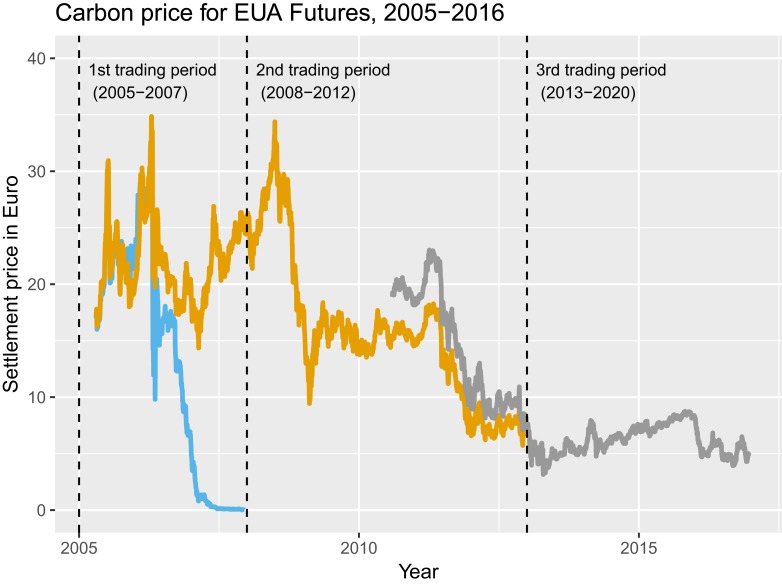
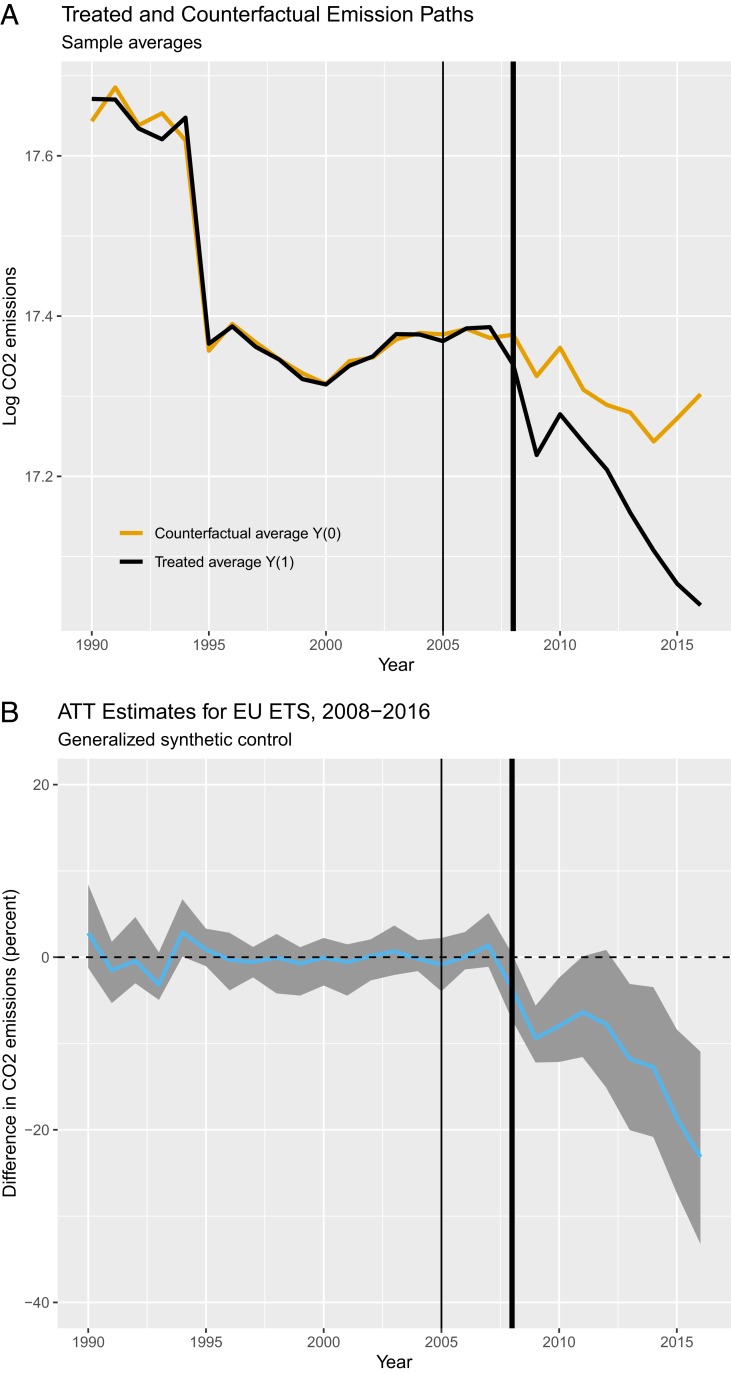
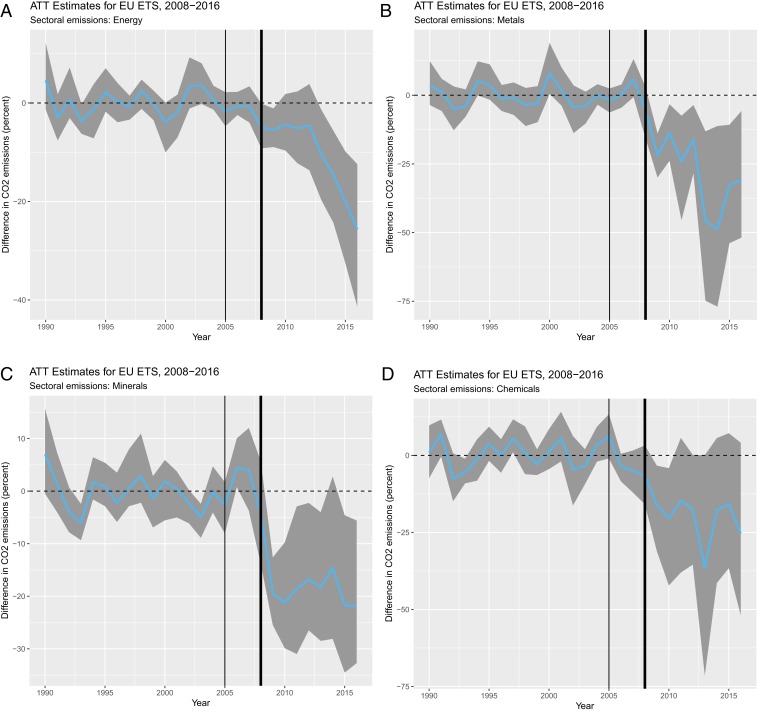
International carbon markets are an appealing and increasingly popular tool to regulate carbon emissions. By putting a price on carbon, carbon markets reshape incentives faced by firms and reduce the value of emissions. How effective are carbon markets? Observers have tended to infer their effectiveness from market prices. The general belief is that a carbon market needs a high price in order to reduce emissions. As a result, many observers remain skeptical of initiatives such as the European Union Emissions Trading System (EU ETS), whose price remained low (compared to the social cost of carbon). In this paper, we assess whether the EU ETS reduced C O 2 emissions despite low prices. We motivate our study by documenting that a carbon market can be effective if it is a credible institution that can plausibly become more stringent in the future. In such a case, firms might cut emissions even though market prices are low. In fact, low prices can be a signal that the demand for carbon permits weakens. Thus, low prices are compatible with successful carbon markets. To assess whether the EU ETS reduced carbon emissions even as permits were cheap, we estimate counterfactual carbon emissions using an original sectoral emissions dataset. We find that the EU ETS saved about 1.2 billion tons of C O 2 between 2008 and 2016 (3.8%) relative to a world without carbon markets, or almost half of what EU governments promised to reduce under their Kyoto Protocol commitments. Emission reductions in sectors covered under the EU ETS were higher.
Overview
The claims and statistics of this paper haven’t been checked yet.
Free: it reads the open-access text and checks the first 5 claims that cite a source we can check. Create a free account to check every claim.
Integrity signals
Registry
Cites
Statistics
Figures
Verification
Claims the paper makes
The claims and statistics of this paper haven’t been checked yet.
Free: it reads the open-access text and checks the first 5 claims that cite a source we can check. Create a free account to check every claim.
Claims other papers make about this one
Each is checked against this paper’s own text: does it say what the citing paper says it does?
The source backs part of the claim, not all of it — or backs it for a different population, condition or comparison.
In the citing paper
“ETS-related policies on emission control have been generally considered to have a positive effect on both reducing emissions and promoting the presence of carbon sinks”
From The first compliance cycle of China's National Emissions Trading Scheme: insights and implications (2022) · cites this paper as [5]
Experimental — accuracy not yet measuredThe source backs part of the claim, not all of it — or backs it for a different population, condition or comparison.
In the citing paper
“The finding is consistent with two previous studies on China’s regional ETSs,35,39 and the comparison of the industry-based RGGI and the EU ETS with the service-based Tokyo ETS shows similar result,55,57,59”
From Carbon Abatement and Leakage in China's Regional Carbon Emission Trading (2024) · cites this paper as [57]
Experimental — accuracy not yet measuredThe cited source says what the claim attributes to it.
In the citing paper
“This performance is far below that (19–24%) of the Regional Greenhouse Gas Initiative (RGGI),55,56 nearing that (7–12%) of the European Union Emissions Trading System (EU ETS),57,58 almost equals to that (5–7%) of the Tokyo ETS,59,60 and being superior to the California ETS.61,62”
From Carbon Abatement and Leakage in China's Regional Carbon Emission Trading (2024) · cites this paper as [57]
Self-check
Percentages, sums and reported differences re-computed from the paper’s own numbers.
The self-check needs the paper’s full text.
Citations
Cites
Abadie, A., Diamond, A., & Hainmueller, J. (2010) · Journal of the American Statistical Association · doi:10.1198/jasa.2009.ap08746 · Cited by 5,513
Comparative Politics and the Synthetic Control Method
Abadie, A., Diamond, A., & Hainmueller, J. (2015) · American Journal of Political Science · doi:10.1111/ajps.12116 · Cited by 2,406
Comparative Politics and the Synthetic Control MethodPreprint
Abadie, A., Diamond, A., & Hainmueller, J. (2014) · SSRN Electronic Journal · doi:10.2139/ssrn.1950298 · Cited by 2,217
Panel Data Models With Interactive Fixed Effects
(2009) · Econometrica · doi:10.3982/ecta6135 · Cited by 1,690 · cited 2×
“The interactive fixed effects finally capture unobserved time-varying confounding from, for instance, different effects of the 2007/2008 financial crisis on European economies and their emissions (48).”
BackgroundMethodGrowth in emission transfers via international trade from 1990 to 2008
Peters, G. P., Minx, J. C., Weber, C. L., & Edenhofer, O. (2011) · Proceedings of the National Academy of Sciences · doi:10.1073/pnas.1006388108 · Cited by 1,599
Revisiting the social cost of carbon
Nordhaus, W. D. (2017) · Proceedings of the National Academy of Sciences · doi:10.1073/pnas.1609244114 · Cited by 1,366 · cited 1×
“First, the importance of carbon pricing has often been studied through the lens of integrated assessment models (36, 37).”
BackgroundEnvironmental Policy and Directed Technological Change: Evidence from the European Carbon Market
Calel, R., & Dechezleprêtre, A. (2016) · Review of Economics and Statistics · doi:10.1162/rest_a_00470 · Cited by 1,147
Generalized Synthetic Control Method: Causal Inference with Interactive Fixed Effects Models
Xu, Y. (2017) · Political Analysis · doi:10.1017/pan.2016.2 · Cited by 938 · cited 3×
“However, to evaluate policies, such as the EU ETS, which are introduced in multiple countries simultaneously, we instead resort to the generalized synthetic control method (15).”
BackgroundMethodInfluentialWarming the World: Economic Models of Global Warming
Nordhaus, W. D., & Boyer, J. (2000) · The MIT Press eBooks · doi:10.7551/mitpress/7158.001.0001 · Cited by 845 · cited 1×
“First, the importance of carbon pricing has often been studied through the lens of integrated assessment models (36, 37).”
BackgroundAbadie, A., Diamond, A., & Hainmueller, J. (2007) · National Bureau of Economic Research · doi:10.3386/t0335 · Cited by 815
Research works printed but not linked: 2
- Wagner U. J., Muûls M., Martin R., Colmer J., “ The causal effects of the European Union emissions trading scheme: Evidence from French manufacturing plants. (2014). http://conference.iza.org/conference_files/EnvEmpl2014/martin_r7617.pdf. Accessed 23 September 2019.
- Pretick S., Wagner U. J., The impact of carbon trading on industry: Evidence from German manufacturing firms in Kiel Working Papers No. 1912 (Kiel Institute for World Economy, 2014). https://papers.ssrn.com/sol3/papers.cfm?abstract_id=2389800. Accessed 15 August 2019.
Cited by
Does carbon pricing reduce emissions? A review of ex-post analyses
Green, J. F. (2021) · Environmental Research Letters · doi:10.1088/1748-9326/abdae9 · Cited by 530
“In most cases, studies estimate emissions reductions in the sectors covered by the carbon pricing policy, though some extrapolate to broader jurisdictional effects (e.g. Murray and Maniloff 2015, Bayer and Aklin 2020 and Rafaty et al 2020).”
BackgroundInfluentialDunstan, M. T., Donat, F., Bork, A. H., Grey, C. P., & Müller, C. R. (2021) · Chemical Reviews · doi:10.1021/acs.chemrev.1c00100 · Cited by 481
Bioeconomy: Biomass and biomass-based energy supply and demand
Popp, J., Kovács, S., Oláh, J., Divéki, Z., & Balázs, E. (2021) · New Biotechnology · doi:10.1016/j.nbt.2020.10.004 · Cited by 448
“Carbon markets can work even when prices are low; however, current debates in the EU focus on the inclusion of the transport and housing sectors in European emissions trading [14].”
BackgroundDechezleprêtre, A., Nachtigall, D., & Venmans, F. (2023) · Journal of Environmental Economics and Management · doi:10.1016/j.jeem.2022.102758 · Cited by 416
The effectiveness of China’s regional carbon market pilots in reducing firm emissions
Cui, J., Wang, C., Zhang, J., & Zheng, Y. (2021) · Proceedings of the National Academy of Sciences · doi:10.1073/pnas.2109912118 · Cited by 349
“In particular, a recent study demonstrates that the EU ETS with low carbon prices still works as long as it sends a credible signal to emission entities that the regulation will become more stringent in the future (23).”
Aklin, M., & Mildenberger, M. (2020) · Global Environmental Politics · doi:10.1162/glep_a_00578 · Cited by 341
“Despite early setbacks, the ETS has signi fi cantly reduced emissions and encouraged technological innovation (Bayer and Aklin 2020; Calel and Dechezleprêtre 2014).”
Self-citationClimate policies that achieved major emission reductions: Global evidence from two decades
Stechemesser, A., Koch, N., Mark, E., Dilger, E., Klösel, P., Menicacci, L., Nachtigall, D., Pretis, F., Ritter, N., Schwarz, M., et al. (2024) · Science · doi:10.1126/science.adl6547 · Cited by 322
Su, C., Pang, L., Qin, M., Lobonţ, O., & Umar, M. (2023) · Energy · doi:10.1016/j.energy.2023.127304 · Cited by 266
(2023) · Climate Change 2022 - Mitigation of Climate Change · doi:10.1017/9781009157926.004 · Cited by 253
Paraschiv, S., & Paraschiv, L. S. (2020) · Energy Reports · doi:10.1016/j.egyr.2020.11.116 · Cited by 243
Cao, J., Ho, M. S., Ma, R., & Teng, F. (2021) · Journal of Public Economics · doi:10.1016/j.jpubeco.2021.104470 · Cited by 243
Zhang, Z., Hu, G., Mu, X., & Kong, L. (2022) · Journal of Environmental Management · doi:10.1016/j.jenvman.2022.116087 · Cited by 222
Pan, X., Pu, C., Yuan, S., & Xu, H. (2022) · Journal of Environmental Management · doi:10.1016/j.jenvman.2022.115228 · Cited by 205
Nurdiawati, A., & Urban, F. (2021) · Energies · doi:10.3390/en14092408 · Cited by 207
Bertoldi, P. (2022) · Energy and Buildings · doi:10.1016/j.enbuild.2022.112075 · Cited by 182
Yue, X., Peng, M. Y., Anser, M. K., Nassani, A. A., Haffar, M., & Zaman, K. (2022) · Renewable Energy · doi:10.1016/j.renene.2022.05.017 · Cited by 166
RetractedUnderstanding Regressivity: Challenges and Opportunities of European Carbon Pricing
Feindt, S., Kornek, U., Labeaga, J. M., Sterner, T., & Ward, H. (2020) · Energy Economics · doi:10.1016/j.eneco.2021.105550 · Cited by 166
Blockchain technology applications in waste management: Overview, challenges and opportunities
Jiang, P., Zhang, L., You, S., Fan, Y. V., Tan, R. R., Klemeš, J. J., & You, F. (2023) · Journal of Cleaner Production · doi:10.1016/j.jclepro.2023.138466 · Cited by 160
Maraveas, C., Karavas, C.-S., Loukatos, D., Bartzanas, T., Arvanitis, K. G., & Symeonaki, E. (2023) · Agriculture · doi:10.3390/agriculture13071464 · Cited by 159
Keeping Track of Greenhouse Gas Emission Reduction Progress and Targets in 167 Cities Worldwide
Wei, T., Wu, J., & Chen, S. (2021) · Frontiers in Sustainable Cities · doi:10.3389/frsc.2021.696381 · Cited by 159
“From 2008 to 2016, the EU Emissions Trading System regulated ∼50% of EU GHG emissions and reduced more than one billion tons of CO2 from 2008 to 2016 (Bayer and Aklin, 2020).”
BackgroundBashmakov, I., Nilsson, L. J., Acquaye, A. A., Bataille, C., Cullen, J. M., du Can, S. D. L. R., Fischedick, M., Geng, Y., & Tanaka, K. (2022) · Lawrence Berkeley National Laboratory · doi:10.2172/1973106 · Cited by 161
Global trends in the invention and diffusion of climate change mitigation technologies
Probst, B., Touboul, S., Glachant, M., & Dechezleprêtre, A. (2021) · Nature Energy · doi:10.1038/s41560-021-00931-5 · Cited by 155
Know your opponent: Which countries might fight the European carbon border adjustment mechanism?
Øverland, I., & Sabyrbekov, R. (2022) · Energy Policy · doi:10.1016/j.enpol.2022.113175 · Cited by 132
Carbon Emission Trading Scheme in the shipping sector: Drivers, challenges, and impacts
Wu, M., Li, K. X., Xiao, Y., & Yuen, K. F. (2022) · Marine Policy · doi:10.1016/j.marpol.2022.104989 · Cited by 128
Wu, R., Tan, Z., & Lin, B. (2023) · Energy · doi:10.1016/j.energy.2023.127743 · Cited by 127
Zhang, X., & Liu, Y. (2021) · Bioresource Technology · doi:10.1016/j.biortech.2021.125231 · Cited by 121
Has carbon emissions trading system promoted non-fossil energy development in China?
Liu, J.-Y., & Zhang, Y. (2021) · Applied Energy · doi:10.1016/j.apenergy.2021.117613 · Cited by 120
van den Bergh, J. C. J. M., & Savin, I. V. (2021) · Environmental and Resource Economics · doi:10.1007/s10640-021-00594-6 · Cited by 115
The Relative Merits of Carbon Pricing Instruments: Taxes versus Trading
Stavins, R. N. (2022) · Review of Environmental Economics and Policy · doi:10.1086/717773 · Cited by 114
Change, I. P. O. C. (2023) · Cambridge University Press eBooks · doi:10.1017/9781009157926.013 · Cited by 112
Sun, X., Mi, Z., Cheng, L., Coffman, D., & Liu, Y. (2023) · Fundamental Research · doi:10.1016/j.fmre.2023.02.026 · Cited by 109
Estimate of the carbon footprint of astronomical research infrastructures
Knödlseder, J., Brau-Nogué, S., Coriat, M., Garnier, P., Hughes, A., Martin, P., & Tibaldo, L. (2022) · Nature Astronomy · doi:10.1038/s41550-022-01612-3 · Cited by 97
Qiu, J., Zhao, J., Wen, F., Zhao, J., Gao, C., Zhou, Y., Tao, Y., & Lai, S. (2023) · IEEE Transactions on Network Science and Engineering · doi:10.1109/tnse.2023.3344729 · Cited by 93
Sustainable development problems and countermeasures: A case study of the Qinghai-Tibet Plateau
Zhao, Y., Chen, D., & Fan, J. (2020) · Geography and sustainability · doi:10.1016/j.geosus.2020.11.002 · Cited by 89
A novel deep learning carbon price short-term prediction model with dual-stage attention mechanism
Wang, Y., Qin, L., Wang, Q., Chen, Y., Yang, Q., Xing, L., & Ba, S. (2023) · Applied Energy · doi:10.1016/j.apenergy.2023.121380 · Cited by 89
Three Decades of Climate Mitigation Policy: What Has It Delivered?
Hoppe, J., Hinder, B., Rafaty, R., Patt, A., & Grubb, M. J. (2023) · Annual Review of Environment and Resources · doi:10.1146/annurev-environ-112321-103821 · Cited by 85
Vanderklift, M. A., Herr, D., Lovelock, C. E., Murdiyarso, D., Raw, J. L., & Steven, A. (2022) · Frontiers in Marine Science · doi:10.3389/fmars.2022.872064 · Cited by 84
“For example, in the European Union’s (EU) Emissions Trading Scheme (ETS) — an example of a ‘cap-and-trade’ scheme — emitters must stay below a quantity of emissions that is established by EU regulations, and they can use offsets generated by projects that reduce emissions to help achieve this (Bayer and Aklin, 2020).”
BackgroundHow does the “Zero-waste City” strategy contribute to carbon footprint reduction in China?
Yang, G., Zhang, Q., Zhao, Z., & Zhou, C. (2022) · Waste Management · doi:10.1016/j.wasman.2022.11.032 · Cited by 84
National and Sub-national Policies and Institutions
Change, I. P. O. C. (2023) · Cambridge University Press eBooks · doi:10.1017/9781009157926.015 · Cited by 83
Trade in Carbon and Carbon Tariffs
Böhringer, C., Schneider, J., & Asane-Otoo, E. (2021) · Environmental and Resource Economics · doi:10.1007/s10640-021-00548-y · Cited by 82
Zha, D., Jiang, P., Zhang, C., Xia, D., & Cao, Y. (2023) · Energy Policy · doi:10.1016/j.enpol.2023.113782 · Cited by 81
Manzotti, A., Quattrocchi, E., Curcio, A., Kwok, S. C. T., Santarelli, M., & Ciucci, F. (2022) · Energy Conversion and Management · doi:10.1016/j.enconman.2021.115156 · Cited by 78
A Research Agenda to Better Understand the Human Dimensions of Energy Transitions
Steg, L., Perlaviciute, G., Sovacool, B. K., Bonaiuto, M., Diekmann, A., Filippini, M., Hindriks, F., Bergstad, C. J., Matthies, E., Matti, S., et al. (2021) · Frontiers in Psychology · doi:10.3389/fpsyg.2021.672776 · Cited by 73
“Pricing policy proved to be effective to encourage sustainable energy behaviour (Maki et al., 2016; Wolske and Stern, 2018; Bayer and Aklin, 2020), but may have negative side effects as well, such as decreasing individuals’ intrinsicmotivation”
BackgroundEffect of China's carbon market on the promotion of green technological innovation
Weng, Z., Ma, Z., Xie, Y., & Cheng, C. (2022) · Journal of Cleaner Production · doi:10.1016/j.jclepro.2022.133820 · Cited by 71
Fu, L., Yi, Y., Wu, T. N., Cheng, R., & Zhang, Z. (2022) · Environmental Science and Pollution Research · doi:10.1007/s11356-022-22877-1 · Cited by 70
“The relevant researches on the green technology innovation effect of ETS policy stems from scholars’ attention to the EU carbon emissions trading policy (EU ETS) (Bayer and Aklin 2020).”
BackgroundAttributing agnostically detected large reductions in road CO2 emissions to policy mixes
Koch, N., Naumann, L., Pretis, F., Ritter, N., & Schwarz, M. (2022) · Nature Energy · doi:10.1038/s41560-022-01095-6 · Cited by 70
The influence of carbon risk on firm value: Evidence from the European Union Emission Trading Scheme
Dewaelheyns, N., Schoubben, F., Struyfs, K., & Hulle, C. V. (2023) · Journal of Environmental Management · doi:10.1016/j.jenvman.2023.118293 · Cited by 70
Huang, W., Wang, H., Qin, H., Wei, Y., & Chevallier, J. (2022) · Energy Economics · doi:10.1016/j.eneco.2022.106049 · Cited by 68
Marginal abatement cost of carbon dioxide emissions: The role of abatement options
Wu, F., Wang, S. Y., & Zhou, P. (2023) · European Journal of Operational Research · doi:10.1016/j.ejor.2023.03.015 · Cited by 65
Negotiating Climate Change in Crisis
Durand-Delacre, D., Bettini, G., Nash, S. L., Sterly, H., Gioli, G., Hut, E., Boas, I., Farbotko, C., Sakdapolrak, P., de Bruijn, M., et al. (2021) · Open Book Publishers · doi:10.11647/obp.0265 · Cited by 66
A Welfare Analysis of Policies Impacting Climate Change
Hahn, R. W., Hendren, N., Metcalfe, R., & Sprung-Keyser, B. (2024) · American Economic Review · doi:10.1257/aer.20250166 · Cited by 64
Assessing the effects of emissions trading systems on energy consumption and energy mix
Tan, X., Sun, Q., Wang, M., Cheong, T. S., Shum, W. Y., & Huang, J. (2022) · Applied Energy · doi:10.1016/j.apenergy.2022.118583 · Cited by 64
Li, M., Gao, H., Abdulla, A., Shan, R., & Gao, S. (2022) · Energy · doi:10.1016/j.energy.2022.124739 · Cited by 61
The effect of cap-and-trade on sectoral emissions: Evidence from California
Leßmann, C., & Kramer, N. (2024) · Energy Policy · doi:10.1016/j.enpol.2024.114066 · Cited by 62
“…Emission Trading Scheme (EU ETS) was implemented as one of the earliest carbon markets and received most of the scholarly attention until now (e.g., Bayer and Aklin (2020), Cheze et al. (2020), Colmer et al. (2022), Dechezleprêtre et al. (2023), Jaraite and Di Maria (2016) and Schaefer (2019)).”
MethodEFFECTS OF CARBON PRICING AND OTHER CLIMATE POLICIES ON CO 2 EMISSIONS
Kohlscheen, E., Moessner, R., & Takáts, E. (2025) · National Institute Economic Review · doi:10.1017/nie.2025.10066 · Cited by 63
Sato, M., Rafaty, R., Calel, R., & Grubb, M. (2022) · WIREs Climate Change · doi:10.1002/wcc.796 · Cited by 59
Zhang, Y., & Cheng, H.-S. (2021) · Technological Forecasting and Social Change · doi:10.1016/j.techfore.2021.121114 · Cited by 59
The effect of carbon emission trading scheme on energy efficiency: Evidence from China
Tan, X., Liu, Y., Dong, H., & Zhang, Z. (2022) · Economic Analysis and Policy · doi:10.1016/j.eap.2022.06.012 · Cited by 57
Could SO2 and CO2 emissions trading schemes achieve co-benefits of emissions reduction?
Hu, Y., Li, R., Du, L., Ren, S., & Chevallier, J. (2022) · Energy Policy · doi:10.1016/j.enpol.2022.113252 · Cited by 57
Advancing carbon capture technologies in CCS: A comprehensive review of pre-combustion processes
Vaziri, P., Rasaei, M. R., Seyfoori, S., Zamani, S., Mahmoodi, M., & Sedaee, B. (2024) · Gas Science and Engineering · doi:10.1016/j.jgsce.2024.205481 · Cited by 55
Planetary good governance after the Paris Agreement: The case for a global greenhouse gas tax
Morgan, J., & Patomäki, H. (2021) · Journal of Environmental Management · doi:10.1016/j.jenvman.2021.112753 · Cited by 55
Mao, Z., Ma, A., & Zhang, Z. (2024) · Ocean & Coastal Management · doi:10.1016/j.ocecoaman.2023.107006 · Cited by 53
Carbon Pricing and the Elasticity of CO2 Emissions
Rafatya, R., Dolphin, G., & Pretis, F. (2020) · doi:10.36687/inetwp140 · Cited by 53
Drivers and pass-through of the EU ETS price: Evidence from the power sector
Bai, Y., & Okullo, S. J. (2023) · Energy Economics · doi:10.1016/j.eneco.2023.106698 · Cited by 53
Huang, D., & Chen, G. (2022) · International Journal of Environmental Research and Public Health · doi:10.3390/ijerph19031209 · Cited by 51
“More and more studies have shown that the carbon emission trading system (CETS) plays an important role in reducing carbon dioxide emissions; for example, the United States Regional Greenhouse Emission Reduction Initiative (RGGI) [9,10], the European Union’s Carbon Emissions Trading System [11,12], South Korea’s 2015…”
BackgroundWang, R., Assenova, V., & Hertwich, E. G. (2021) · One Earth · doi:10.1016/j.oneear.2021.10.010 · Cited by 51
Tan, F., Yang, J., & Zhou, C. (2024) · Journal of Cleaner Production · doi:10.1016/j.jclepro.2024.141574 · Cited by 49
Wei, Y., Liang, X., Xu, L., Kou, G., & Chevallier, J. (2022) · Energy Economics · doi:10.1016/j.eneco.2022.106463 · Cited by 48
Tan, X., Wang, B., Wei, J., & Hesary, F. T. (2023) · Renewable and Sustainable Energy Reviews · doi:10.1016/j.rser.2023.113349 · Cited by 47
Chen, X.-Q., Ma, C., Ren, Y., & Lei, Y.-T. (2023) · International Review of Economics & Finance · doi:10.1016/j.iref.2023.07.053 · Cited by 47
Zhu, J., Ge, Z., Wang, J., Li, X., & Wang, C. (2022) · Climate Policy · doi:10.1080/14693062.2022.2054765 · Cited by 47
“In retrospect, evidence suggests that the EU ETS of broad coverage led to substantial mitigation (Bayer & Aklin, 2020; Martin et al., 2016) with little negative impact on industrial competitiveness or carbon leakage (Branger et al., 2016; Joltreau & Sommerfeld, 2019; Naegele & Zaklan, 2019).”
BackgroundZhou, Z., Ma, Z., & Lin, X. (2022) · Frontiers in Environmental Science · doi:10.3389/fenvs.2022.984612 · Cited by 47
Benefits and Costs of the ETS in the EU, a Lesson Learned for the CBAM DesignPreprint
Böning, J., Nino, V. D., & Folger, T. N. (2023) · SSRN Electronic Journal · doi:10.2139/ssrn.4335984 · Cited by 48
Emergent methane mitigation and removal approaches: A review
Mundra, I., & Lockley, A. J. (2023) · Atmospheric Environment X · doi:10.1016/j.aeaoa.2023.100223 · Cited by 47
Does Transfer Payments Promote Low‐Carbon Development of Resource‐Exhausted Cities in China?
Li, X., & Wang, D. (2021) · Earth s Future · doi:10.1029/2021ef002339 · Cited by 45
“Furthermore, compared to the influencing factors of carbon emission mentioned in previous studies (Bayer and Aklin, 2020; Fan et al., 2016), TPREC’s inhibitory effect on carbon emissions is higher than that of the carbon market.”
ResultDecarbonising Air Transport: Acting Now for the Future
Forum, I. T. (2021) · International transport forum policy papers · doi:10.1787/e22ae2ae-en · Cited by 45
Dill, H. (2023) · Climate Policy · doi:10.1080/14693062.2023.2210107 · Cited by 44
“Associated with the adoption of the EU ETS, for instance, Bayer and Aklin (2020) found a 3.8% reduction in emissions for the period 2008 – 2016 while Deche-zleprêtre et al. (2018) found a 10% reduction between 2005 and 2012.”
BackgroundMethodInfluentialQuan, Y., & Duan, M. (2023) · Journal of Environmental Management · doi:10.1016/j.jenvman.2023.118481 · Cited by 44
A Global Survey of Scientific Consensus and Controversy on Instruments of Climate Policy
Drews, S., Savin, I. V., & van den Bergh, J. C. J. M. (2024) · Ecological Economics · doi:10.1016/j.ecolecon.2023.108098 · Cited by 44
Inclusion of forestry offsets in emission trading schemes: insights from global experts
Shrestha, A. K., Eshpeter, S., Li, N., Li, J., Nile, J. O., & Wang, G. (2021) · Journal of Forestry Research · doi:10.1007/s11676-021-01329-5 · Cited by 44
“2 billion tons of CO2 between 2008 and 2016, which is almost half of what EU governments promised to reduce under their Kyoto Protocol commitments (Bayer and Aklin 2020)-indicating ETS as an important policy tool to regulate global carbon emission.”
BackgroundInfluentialThe Energy Transition as a Super Wicked Problem: The Energy Sector in the Era of Prosumer Capitalism
Jakimowicz, A. (2022) · Energies · doi:10.3390/en15239109 · Cited by 44
Assessing initial conditions and ETS outcomes in a fossil-fuel dependent economy
Howie, P., & Atakhanova, Z. (2022) · Energy Strategy Reviews · doi:10.1016/j.esr.2022.100818 · Cited by 43
Optimizing the Size of Autonomous Hybrid Microgrids with Regard to Load Shifting
Lavrik, A., Zhukovskiy, Y. L., & Tcvetkov, P. (2021) · Energies · doi:10.3390/en14165059 · Cited by 42
“The Emissions Trading System has been successfully operating in Europe since 2005 [34].”
MethodAssessing the authenticity of national carbon prices: A comparison of 31 countries
Finch, A., & van den Bergh, J. C. J. M. (2022) · Global Environmental Change · doi:10.1016/j.gloenvcha.2022.102525 · Cited by 42
Brad, A., Haas, T., & Schneider, E. (2024) · Frontiers in Climate · doi:10.3389/fclim.2023.1268736 · Cited by 43
Emission trading schemes and cross-border mergers and acquisitions
Chen, Y., Zhang, D., Guo, K., & Ji, Q. (2024) · Journal of Environmental Economics and Management · doi:10.1016/j.jeem.2024.102949 · Cited by 41
Zanobetti, F., Martynov, S., Cozzani, V., & Mahgerefteh, H. (2023) · Journal of Cleaner Production · doi:10.1016/j.jclepro.2023.137330 · Cited by 39
“Conversely, the optimisation methods based on the CO 2 avoided and carbon pricing concepts (Bayer and Aklin, 2020; Ho et al., 2011) appear to marginally consider environmental issues, accounting for up to ca 10% of the total index value.”
InfluentialChina’s national ETS: Global and local lessons
Liu, J., Hou, J., Fan, Q., & Chen, H. (2022) · Energy Reports · doi:10.1016/j.egyr.2022.03.097 · Cited by 39
Design and impact assessment of policies to overcome oversupply in China's national carbon market
Ji, C.-J., Wang, X., Wang, X.-Y., & Tang, B.-J. (2024) · Journal of Environmental Management · doi:10.1016/j.jenvman.2024.120388 · Cited by 38
The impact of green credit guidelines on environmental performance: Firm-level evidence from China
Li, C., Zhao, L., Song, R., & Zhang, Y. (2024) · Technological Forecasting and Social Change · doi:10.1016/j.techfore.2024.123524 · Cited by 38
The Legal Objectives of the EU Emissions Trading System: An Evaluation Framework
Kotzampasakis, M., & Woerdman, E. (2024) · Transnational Environmental Law · doi:10.1017/s2047102524000153 · Cited by 38
An advanced review of climate change mitigation policies in Germany, France, and the Netherlands
Wang, D., Dong, L., & Mei, J. (2023) · Environmental Research Letters · doi:10.1088/1748-9326/acf58f · Cited by 39
Huang, W., Zhao, J., & Wang, X. (2024) · Energy Economics · doi:10.1016/j.eneco.2024.107459 · Cited by 36
Green industrial policy can strengthen carbon pricing but not replace it
Jakob, M., & Øverland, I. (2024) · Energy Research & Social Science · doi:10.1016/j.erss.2024.103669 · Cited by 35
Green macrofinancial bargains: how economic interests enable and limit climate action
Kupzok, N., & Nahm, J. (2025) · Review of International Political Economy · doi:10.1080/09692290.2025.2453502 · Cited by 35
“Emissions trading stood on an established legal and political basis and had proven to be an effective tool to reduce emissions in sectors were allowances where not distributed for free (Bayer & Aklin, 2020; Dechezleprêtre et al., 2018).”
Zhang, X.-M., Lu, F.-F., & Xue, D. (2021) · Environmental Science and Pollution Research · doi:10.1007/s11356-021-17021-4 · Cited by 35
“Carbon emission trading policy can effectively reduce regional carbon emission intensity (Bayer & Aklin 2020; Guo et al.”
BackgroundTaking climate change seriously: Time to credibly communicate on corporate climate performance
Ravalec, M. L., Rambaud, A., & Blum, V. (2022) · Ecological Economics · doi:10.1016/j.ecolecon.2022.107542 · Cited by 35
Venzke, I., & Vidigal, G. (2022) · Netherlands yearbook of international law · doi:10.1007/978-94-6265-527-0_7 · Cited by 35
Hoffmann, A. R., Sandrin, P. O., & Doukas, Y. E. (2024) · United Nations University series on regionalism · doi:10.1007/978-3-031-49329-4 · Cited by 35
Coase and Cap-and-Trade: Evidence on the Independence Property from the European Carbon Market
Zaklan, A. (2023) · American Economic Journal: Economic Policy · doi:10.1257/pol.20210028 · Cited by 34
Metadata
- Authors
- Bayer, P., & Aklin, M.
- Affiliations
- University of Strathclyde (GB)
- University of Pittsburgh (US)
- Corresponding author
- Bayer, Patrick
- Venue
- Proceedings of the National Academy of Sciences
- Publisher
- National Academy of Sciences
- Published
- 2020-04-06
- Volume
- 117
- Issue
- 16
- Pages
- 8804-8812
- ISSN
- 0027-8424 (ISSN-L)
- 1091-6490
- PMC
- PMC7183178
- OpenAlex
- W3014509841
- Cited by
- 545
- References
- 48
- Citations by year
- 2026: 93 · 2025: 119 · 2024: 93 · 2023: 89 · 2022: 83 · 2021: 54 · 2020: 11
- FWCI
- 50.35
- Type
- journal article
- Language
- en
- Open access
- hybrid
- doi.org
- Licence
- Locations
- Proceedings of the National Academy of Sciences (publishedVersion, cc-by)
- PubMed Central (publishedVersion, cc-by)
- PubMed (publishedVersion)
- ENLIGHTEN (Jurnal Bimbingan dan Konseling Islam) (submittedVersion, cc-by-sa)
- Strathprints: The University of Strathclyde institutional repository (University of Strathclyde) (submittedVersion)
- Infoscience (Ecole Polytechnique Fédérale de Lausanne) (submittedVersion, cc-by-nc-nd)
- Funders
- British Academy (SG171349)
- Topics
- Social Sciences › Economics, Econometrics and Finance › Economics and Econometrics › Climate Change Policy and Economics
- Social Sciences › Economics, Econometrics and Finance › Economics and Econometrics › Energy, Environment, Economic Growth
- Physical Sciences › Energy › Renewable Energy, Sustainability and the Environment › Renewable energy and sustainable power systems
- Keywords
- EU Emissions Trading System, carbon pricing, emissions trading, CO2 emission reduction, carbon permits, institutional credibility, climate policy effectiveness
About these checks
Registry, retraction, Cites and statistics results are computed, not judged, with one exception: a printed reference that no index lists is read once by a model before it counts as a citation error. Claims are extracted by a model and kept only when their quote appears verbatim in the text; each cited source is then checked, with a model’s help, for whether it says what the claim relies on. Those verdicts can be wrong — read the claim’s quote and the cited source before relying on one.
Statistics and arithmetic are recomputed, not judged.
Confidence bands are shown only for fields calibrated on our annotated test set. None is calibrated yet, so no band is shown.
What counts as a claim ›How we measure confidence ›How we check this ›
Are you an author, or do you see a problem with this page? Request a review
Data sources
Bibliographic data: Semantic Scholar, OpenAlex, Crossref.
Contains information from the Semantic Scholar Academic Graph Datasets, made available under the ODC Attribution License (ODC-BY 1.0).
Semantic Scholar’s data is described in: Kinney, R., et al. (2023). The Semantic Scholar Open Data Platform. arXiv:2301.10140.
