

The European Union Emissions Trading System reduced CO 2 emissions despite low prices
Open accessThe DOI matches its Crossref record; 49 of the 49 references it cites were found in a registry or an index.
Abstract
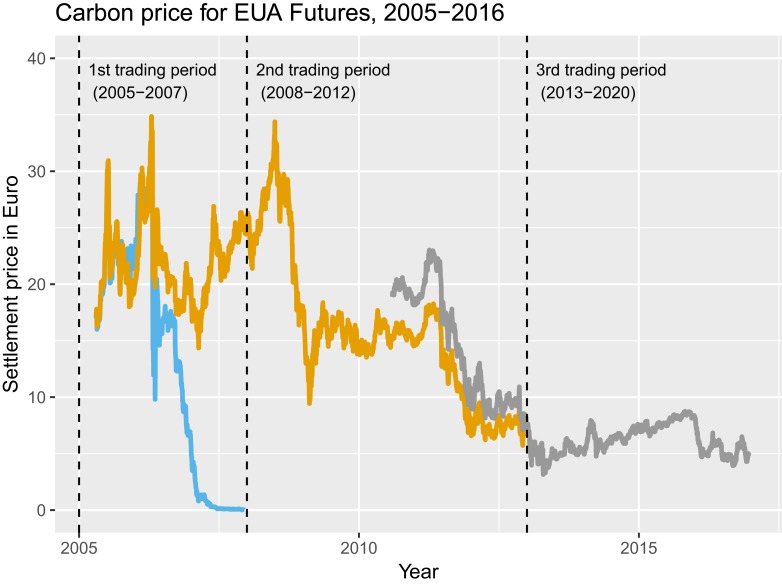
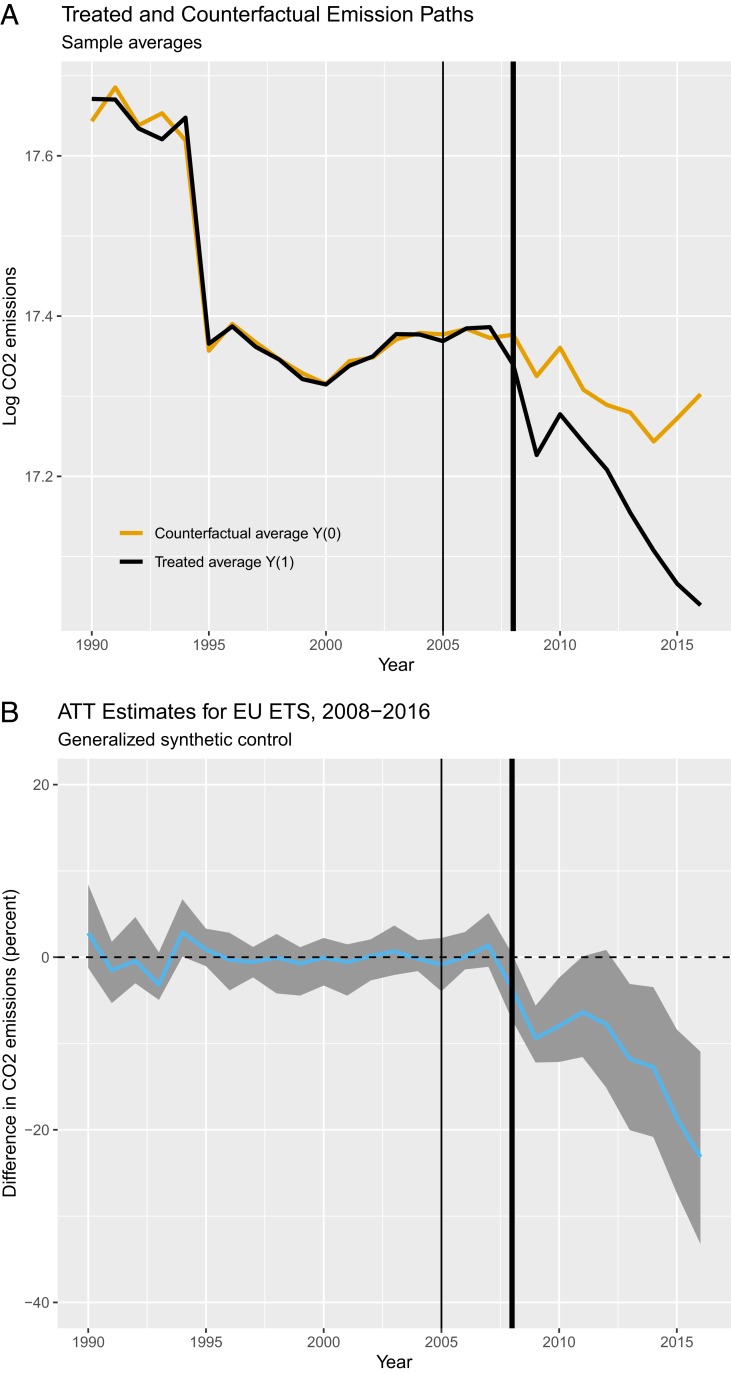
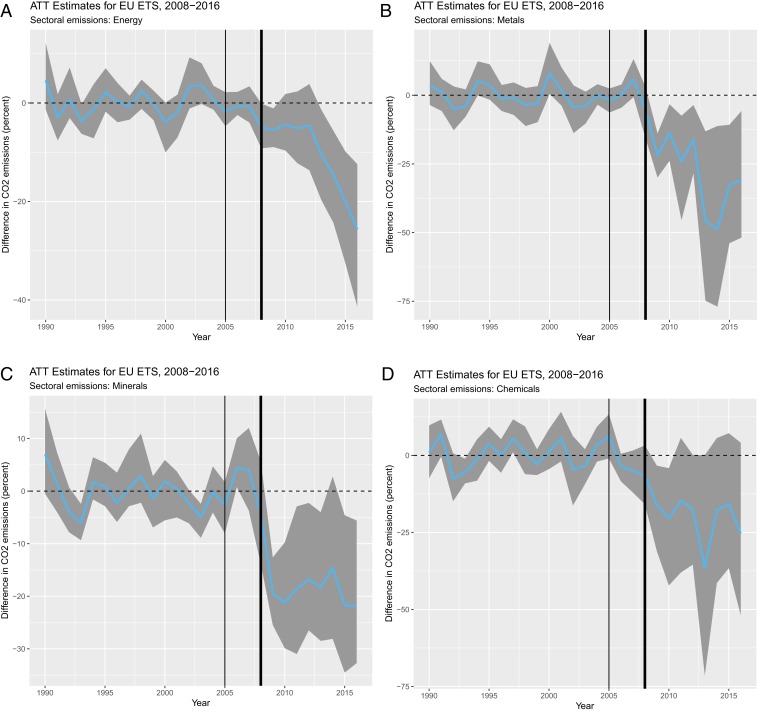
International carbon markets are an appealing and increasingly popular tool to regulate carbon emissions. By putting a price on carbon, carbon markets reshape incentives faced by firms and reduce the value of emissions. How effective are carbon markets? Observers have tended to infer their effectiveness from market prices. The general belief is that a carbon market needs a high price in order to reduce emissions. As a result, many observers remain skeptical of initiatives such as the European Union Emissions Trading System (EU ETS), whose price remained low (compared to the social cost of carbon). In this paper, we assess whether the EU ETS reduced C O 2 emissions despite low prices. We motivate our study by documenting that a carbon market can be effective if it is a credible institution that can plausibly become more stringent in the future. In such a case, firms might cut emissions even though market prices are low. In fact, low prices can be a signal that the demand for carbon permits weakens. Thus, low prices are compatible with successful carbon markets. To assess whether the EU ETS reduced carbon emissions even as permits were cheap, we estimate counterfactual carbon emissions using an original sectoral emissions dataset. We find that the EU ETS saved about 1.2 billion tons of C O 2 between 2008 and 2016 (3.8%) relative to a world without carbon markets, or almost half of what EU governments promised to reduce under their Kyoto Protocol commitments. Emission reductions in sectors covered under the EU ETS were higher.
Overview
The claims and statistics of this paper haven’t been checked yet.
Free: it reads the open-access text and checks the first 5 claims that cite a source we can check. Create a free account to check every claim.
Integrity signals
Registry
Cites
Statistics
Figures
Verification
Claims the paper makes
The claims and statistics of this paper haven’t been checked yet.
Free: it reads the open-access text and checks the first 5 claims that cite a source we can check. Create a free account to check every claim.
Claims other papers make about this one
Each is checked against this paper’s own text: does it say what the citing paper says it does?
The source backs part of the claim, not all of it — or backs it for a different population, condition or comparison.
In the citing paper
“ETS-related policies on emission control have been generally considered to have a positive effect on both reducing emissions and promoting the presence of carbon sinks”
From The first compliance cycle of China's National Emissions Trading Scheme: insights and implications (2022) · cites this paper as [5]
Experimental — accuracy not yet measuredThe source backs part of the claim, not all of it — or backs it for a different population, condition or comparison.
In the citing paper
“The finding is consistent with two previous studies on China’s regional ETSs,35,39 and the comparison of the industry-based RGGI and the EU ETS with the service-based Tokyo ETS shows similar result,55,57,59”
From Carbon Abatement and Leakage in China's Regional Carbon Emission Trading (2024) · cites this paper as [57]
Experimental — accuracy not yet measuredThe cited source says what the claim attributes to it.
In the citing paper
“This performance is far below that (19–24%) of the Regional Greenhouse Gas Initiative (RGGI),55,56 nearing that (7–12%) of the European Union Emissions Trading System (EU ETS),57,58 almost equals to that (5–7%) of the Tokyo ETS,59,60 and being superior to the California ETS.61,62”
From Carbon Abatement and Leakage in China's Regional Carbon Emission Trading (2024) · cites this paper as [57]
Self-check
Percentages, sums and reported differences re-computed from the paper’s own numbers.
The self-check needs the paper’s full text.
Citations
Cites
Abadie, A., Diamond, A., & Hainmueller, J. (2010) · Journal of the American Statistical Association · doi:10.1198/jasa.2009.ap08746 · Cited by 5,513
Comparative Politics and the Synthetic Control Method
Abadie, A., Diamond, A., & Hainmueller, J. (2015) · American Journal of Political Science · doi:10.1111/ajps.12116 · Cited by 2,406
Comparative Politics and the Synthetic Control MethodPreprint
Abadie, A., Diamond, A., & Hainmueller, J. (2014) · SSRN Electronic Journal · doi:10.2139/ssrn.1950298 · Cited by 2,217
Panel Data Models With Interactive Fixed Effects
(2009) · Econometrica · doi:10.3982/ecta6135 · Cited by 1,690 · cited 2×
“The interactive fixed effects finally capture unobserved time-varying confounding from, for instance, different effects of the 2007/2008 financial crisis on European economies and their emissions (48).”
BackgroundMethodGrowth in emission transfers via international trade from 1990 to 2008
Peters, G. P., Minx, J. C., Weber, C. L., & Edenhofer, O. (2011) · Proceedings of the National Academy of Sciences · doi:10.1073/pnas.1006388108 · Cited by 1,599
Revisiting the social cost of carbon
Nordhaus, W. D. (2017) · Proceedings of the National Academy of Sciences · doi:10.1073/pnas.1609244114 · Cited by 1,366 · cited 1×
“First, the importance of carbon pricing has often been studied through the lens of integrated assessment models (36, 37).”
BackgroundEnvironmental Policy and Directed Technological Change: Evidence from the European Carbon Market
Calel, R., & Dechezleprêtre, A. (2016) · Review of Economics and Statistics · doi:10.1162/rest_a_00470 · Cited by 1,147
Generalized Synthetic Control Method: Causal Inference with Interactive Fixed Effects Models
Xu, Y. (2017) · Political Analysis · doi:10.1017/pan.2016.2 · Cited by 938 · cited 3×
“However, to evaluate policies, such as the EU ETS, which are introduced in multiple countries simultaneously, we instead resort to the generalized synthetic control method (15).”
BackgroundMethodInfluentialWarming the World: Economic Models of Global Warming
Nordhaus, W. D., & Boyer, J. (2000) · The MIT Press eBooks · doi:10.7551/mitpress/7158.001.0001 · Cited by 845 · cited 1×
“First, the importance of carbon pricing has often been studied through the lens of integrated assessment models (36, 37).”
BackgroundAbadie, A., Diamond, A., & Hainmueller, J. (2007) · National Bureau of Economic Research · doi:10.3386/t0335 · Cited by 815
Research works printed but not linked: 2
- Wagner U. J., Muûls M., Martin R., Colmer J., “ The causal effects of the European Union emissions trading scheme: Evidence from French manufacturing plants. (2014). http://conference.iza.org/conference_files/EnvEmpl2014/martin_r7617.pdf. Accessed 23 September 2019.
- Pretick S., Wagner U. J., The impact of carbon trading on industry: Evidence from German manufacturing firms in Kiel Working Papers No. 1912 (Kiel Institute for World Economy, 2014). https://papers.ssrn.com/sol3/papers.cfm?abstract_id=2389800. Accessed 15 August 2019.
Cited by
Items 201–300 of 698
The Drivers of Emission Reductions in the European Carbon Market
Bjørnland, H. C., Cross, J. L., & Kapfhammer, F. (2023) · Econstor (Econstor) · Cited by 14
Theoretical framework for carbon trading in the built environment
Kukah, A. S. K., Jin, X., Osei‐Kyei, R., & Perera, S. (2024) · Journal of Engineering Design and Technology · doi:10.1108/jedt-09-2023-0383 · Cited by 13
Yu, Y., & Xu, Y. (2023) · International Journal of Environmental Research and Public Health · doi:10.3390/ijerph20085549 · Cited by 13
“For example, a 2–5% reduction in CO2 emissions between 2005 and 2007 [27] and the reduction of over 1 billion tons of CO2 in EU countries between 2008 and 2016 [28].”
BackgroundZheng, L., Omori, A., Cao, J., & Guo, X. (2023) · Sustainability · doi:10.3390/su15118518 · Cited by 14
Estimating the Effect of an EU-ETS Type Scheme in Australia Using a Synthetic Treatment Approach
Anderson, H. M., Gao, J., Turnip, G., Vahid, F., & Wei, W. (2022) · Energy Economics · doi:10.1016/j.eneco.2023.106798 · Cited by 13
Dou, R., Hou, Y., Wei, Y., & Liu, J. (2023) · Applied Soft Computing · doi:10.1016/j.asoc.2023.110887 · Cited by 13
Network evolutionary game analysis of green credit: A perspective of carbon emissions trading
Li, J., Li, S., Zhang, Y., & Tang, X. (2023) · Managerial and Decision Economics · doi:10.1002/mde.4064 · Cited by 13
Obani, I. P., & Akroh, T. O. (2024) · International Journal of Science and Research Archive · doi:10.30574/ijsra.2024.13.2.2126 · Cited by 13
Unilateral climate policies can substantially reduce national carbon pollution
Lépissier, A., & Mildenberger, M. (2021) · Climatic Change · doi:10.1007/s10584-021-03111-2 · Cited by 13
“Alongside parallel work by Bayer and Aklin (2020), our findings show the promise of synthetic control methods as a tool for ex post climate policy impact analysis that can provide net national estimates of CO2 abatement without relying on simplistic forward projections of emissions.”
BackgroundMethodLu, X., Liu, K., Liang, X. S., Lai, K. K., & Cui, H. (2022) · Environmental Science and Pollution Research · doi:10.1007/s11356-022-21316-5 · Cited by 13
“Since its launch in 2005, there have been a large body of recent works that have grown exponentially, highlighting the growing interest in the EUA on the EU ETS to encourage GHG reduction and decarbonization of economic actors (Hu et al. 2015; Bayer and Aklin 2020).”
BackgroundInfluentialQuantitative Evaluation of Carbon Reduction Policy Based on the Background of Global Climate Change
Meng, J., & Xu, W. (2023) · Sustainability · doi:10.3390/su151914581 · Cited by 12
From mitigation to adaptation: Problematizing climate change in the maritime transport industry
Stockbruegger, J., & Bueger, C. (2024) · Wiley Interdisciplinary Reviews Climate Change · doi:10.1002/wcc.894 · Cited by 12
“Only the EU, which has strong regulatory capacities, has so far designed an effective carbon market (Bayer & Aklin, 2020; Green, 2021).”
Carbon management for modern power system: An overview
Ding, Y., Liu, Y., Ruan, J., Sun, X., Shi, W., & Xu, Z. (2024) · Smart power & energy security. · doi:10.1016/j.spes.2024.06.001 · Cited by 12
Sun, Q., Ma, L., Fan, M., Wang, X., Zhao, Z., & Shi, Y. (2025) · Global Energy Interconnection · doi:10.1016/j.gloei.2024.12.002 · Cited by 12
Boeckx, J., Struyfs, K., & Torsin, W. (2025) · Journal of Financial and Quantitative Analysis · doi:10.1017/s0022109025000237 · Cited by 12
Shukla, A., Yadav, S. K., Yadav, D. K., Singh, J., Singh, R. B., Hasnain, S. M. M., & Zairov, R. (2025) · Unconventional Resources · doi:10.1016/j.uncres.2025.100199 · Cited by 12
When cost efficiency is ignored, carbon market success is overstated
Shi, X., Yu, J., Wang, K., Liu, P., & Wei, Y.-M. (2025) · Nexus · doi:10.1016/j.ynexs.2025.100082 · Cited by 12
How does carbon trading market promote green technology innovation?
Wang, X., Wang, J., Wang, K., & Umar, M. (2025) · Economics of Innovation and New Technology · doi:10.1080/10438599.2025.2551760 · Cited by 12
“First, the existing literature primarily focuses on assessing the influence of carbon trading markets on carbon emission reduction and providing evidence for their effective promotion of such reductions (Bayer and Aklin 2020; Zhang et al. 2020).”
Computing Synthetic Controls Using Bilevel Optimization
Malo, P., Eskelinen, J., Zhou, X. Y., & Kuosmanen, T. (2023) · Computational Economics · doi:10.1007/s10614-023-10471-7 · Cited by 12
“SCM has been employed in a large number of important applications (e.g., Abadie et al., 2010, 2015; Acemoglu et al., 2016; Cavallo et al., 2013; Gobillon & Magnac, 2016; Kleven et al., 2013; Bayer & Aklin, 2020).”
Chaudhuri, S., Roy, M., & Suresh, M. (2023) · Environmental Management · doi:10.1007/s00267-023-01908-8 · Cited by 12
Wang, Y., Ma, C., Ren, Y., & Narayan, S. (2023) · Financial Innovation · doi:10.1186/s40854-023-00547-6 · Cited by 12
“…(Bayer and Aklin 2020), thereby promoting the low-carbon transformation and economic growth of firms (Liu and Sun 2021; Marchewka-Bartkowiak and Jarno 2021) and increasing government public revenue and the implementation of climate change policy rules (Bayer and Aklin 2020; Liu and Sun 2021).”
BackgroundHow effective are emission taxes in reducing air pollution? A satellite-based case study for Spain
Erbertseder, T., Jacob, M., Taubenböck, H., & Zerwer, K. (2025) · Economic Analysis and Policy · doi:10.1016/j.eap.2025.04.012 · Cited by 12
Green hydrogen market and growth
Freund, S., & Sánchez, D. (2022) · Elsevier eBooks · doi:10.1016/b978-0-323-90394-3.00001-1 · Cited by 12
How emissions trading affects income inequality: evidence from China
Zhang, J., & Zhang, Y. (2022) · Climate Policy · doi:10.1080/14693062.2022.2099789 · Cited by 12
“Prior studies have confirmed the significant negative impact of ETS on regional carbon emissions, such as Gao et al. (2020), Fang et al. (2021), Zhang et al. (2020), Chen et al. (2020), and Bayer and Aklin (2020).”
BackgroundA blockchain model connecting electricity market and carbon trading market
Wang, Y., Feng, L., Wang, L., & Yu, W. (2025) · Alexandria Engineering Journal · doi:10.1016/j.aej.2025.01.108 · Cited by 11
Apeaning, R. W., Labaran, M., Simbi, C. H., & Ennin, E. (2025) · Journal of Cleaner Production · doi:10.1016/j.jclepro.2025.145395 · Cited by 12
Wang, X., Jin, W., & Stan, S. E. (2025) · Economic Analysis and Policy · doi:10.1016/j.eap.2025.04.020 · Cited by 11
Borucka, A., & Sobczuk, S. (2025) · Energies · doi:10.3390/en18092291 · Cited by 11
Regional inequality of the European ETS-2
Perdana, S., & Marc Vielle, B. (2025) · Energy Policy · doi:10.1016/j.enpol.2025.114891 · Cited by 11
Growth of Renewable Energy: A Review of Drivers from the Economic Perspective
Krozer, Y., Bykuć, S., & Coenen, F. H. J. M. (2025) · Energies · doi:10.3390/en18195250 · Cited by 11
Thermodynamic behaviors of coal spontaneous combustion under different CO 2 concentration
Wang, K., Wang, Z., Zhai, X., & Wen, H. (2022) · International Journal of Coal Preparation and Utilization · doi:10.1080/19392699.2022.2119562 · Cited by 11
“In addition, the use and storage of CO2 provide an effective means of reducing greenhouse gas emissions (Bayer and Aklin 2020; Dong et al. 2019; Lin and Raza 2019).”
BackgroundZhang, W., Zhou, G., Song, Z., Shi, X., Ye, M., Chen, X., Xiang, Y., Zheng, W., & Zhang, P. (2023) · Sustainability · doi:10.3390/su152216025 · Cited by 11
Unit-level monitoring data reveal the effectiveness of China’s national emissions trading scheme
Yan, G., Ruan, J., Qin, Z., Lyu, C., Qian, S., Jia, M., Zhang, Z., Cai, B., Wang, S., Wang, J., et al. (2025) · Cell Reports Sustainability · doi:10.1016/j.crsus.2025.100339 · Cited by 11
Choosing to diet: The impact and cost-effectiveness of China’s vehicle ownership restrictions
Liu, A. A., Dua, R., Hu, W., & Ku, A. L. (2022) · Transportation Research Part D Transport and Environment · doi:10.1016/j.trd.2022.103456 · Cited by 11
Cheng, S., Wu, Y., Wang, K., Chen, J., & Deng, L. (2025) · Humanities and Social Sciences Communications · doi:10.1057/s41599-025-05845-1 · Cited by 10
“Countries have made efforts in carbon mitigation and air pollution control, such as the European Union ’ s carbon emission trading market, the United Kingdom ’ s clean air strategy, and Canada ’ s carbon tax policy (Tang, 2019; Bayer and Aklin, 2020).”
Carbon pricing, commodity markets, and economic stability: Evidence from the EU ETS
Yan, K., & Lin, B. (2025) · Journal of commodity markets · doi:10.1016/j.jcomm.2025.100536 · Cited by 10
An authenticated and secure accounting system for international emissions trading
Li, C., Yu, Y., Yao, A. C.-C., Zhang, D., & Zhang, X. (2022) · Climate Policy · doi:10.1080/14693062.2022.2107474 · Cited by 10
ENERGY SYSTEM DECARBONIZATION AND CIRCULAR ECONOMY: "BYPASS EMISSION HOTSPOTS"
Zvarych, I., Brodovska, O., Krysovata, L., Gerchakivskyі, S., & Gerchakivska, O. Y. (2023) · International Journal of Energy for a Clean Environment · doi:10.1615/interjenercleanenv.2023048296 · Cited by 10
Lagodiienko, V., Datsii, O. I., Петренко, О., Теплюк, М., & Будяєв, М. О. (2023) · Naukovyi Visnyk Natsionalnoho Hirnychoho Universytetu · doi:10.33271/nvngu/2023-3/111 · Cited by 10
“[15] indicate that a carbon market can be efficient if it is a reliable institution whose policies are declared and predictable.”
BackgroundEmission Reduction Effects of China’s National Carbon Market: Evidence Based on the Power Sector
Xu, Y., Zhao, S., Chu, B., & Zhu, Y. (2024) · Energies · doi:10.3390/en17122859 · Cited by 10
Dritsaki, M., Dritsaki, C., Argyriou, V., & Sarigiannidis, P. G. (2024) · Journal of Infrastructure Policy and Development · doi:10.24294/jipd.v8i6.4462 · Cited by 10
Lu, X., He, P., Zhang, Z., & Apergis, N. (2024) · Energy Economics · doi:10.1016/j.eneco.2024.107868 · Cited by 10
Research on Factors Influencing Global Carbon Emissions and Forecasting Models
Ji, R. (2024) · Sustainability · doi:10.3390/su162310782 · Cited by 10
The impact of the EU ETS on greenhouse gas emissions in the EU from 2005 to 2022
Klimko, R., & Hasprová, S. (2025) · Economics and Environment · doi:10.34659/eis.2025.92.1.874 · Cited by 12
“The results from studies (Bayer & Aklin, 2020; Delarue et al., 2008; Kettner et al., ; Zimmermanova et al., 2015; Zimmermanova”
Farm biogas project considering carbon trading indicates promising economic results—a case study
Zhang, W., & Wu, L. (2023) · Environmental Science and Pollution Research · doi:10.1007/s11356-023-27016-y · Cited by 10
“More than 80 countries have adopted the emissions trading scheme (ETS) as their preferred policy tool for reducing emissions (Bayer and Aklin 2020).”
BackgroundA review contribution to emission trading schemes and low carbon growth
Aboagye, E. M., Zeng, C., Owusu, G., Mensah, F., Afrane, S., Ampah, J. D., & Brenyah, S. A. (2023) · Environmental Science and Pollution Research · doi:10.1007/s11356-023-27673-z · Cited by 10
“In 2005, the European Union (EU) enacted the EU ETS with the Kyoto Protocol’s targets in perspective (Bayer and Aklin 2020).”
BackgroundParinandi, S. (2022) · University of Michigan Press eBooks · doi:10.3998/mpub.11764131 · Cited by 11
Carbon Pricing and the Elasticity of Co2 EmissionsPreprint
Rafaty, R., Dolphin, G., & Pretis, F. (2022) · SSRN Electronic Journal · doi:10.2139/ssrn.4057209 · Cited by 11
Beyond Control: Policy Incoherence of the EU Emissions Trading System
Willner, M., & Perino, G. (2022) · Politics and Governance · doi:10.17645/pag.v10i1.4797 · Cited by 9
Low-Carbon Construction in China’s Construction Industry from the Perspective of Evolutionary Games
Yang, X., & Liu, K. (2024) · Buildings · doi:10.3390/buildings14061593 · Cited by 10
Miguel, J. A. S. R. D. S. (2025) · Water · doi:10.3390/w17142136 · Cited by 9
Zheng, Y., Zhan, J., Wang, C., Twumasi-Ankrah, M. J., Zhang, H., & Peng, X. (2025) · Sustainable Cities and Society · doi:10.1016/j.scs.2025.106916 · Cited by 9
Heterogeneous responses to carbon pricing: Firm-level evidence from Beijing emissions trading scheme
Tian, R., Wang, H., Zhang, D., Zhang, X., & Sterner, T. (2025) · Journal of Environmental Economics and Management · doi:10.1016/j.jeem.2025.103266 · Cited by 9
Huang, J., Chen, Q., Wang, Q., Gao, J., Yin, Y., & Guo, H. (2023) · Environmental Science and Pollution Research · doi:10.1007/s11356-023-28555-0 · Cited by 9
Global Climate Policy Beyond the Paris Agreement
Green, J. (2023) · PS Political Science & Politics · doi:10.1017/s1049096523000318 · Cited by 9
“Whereas some individual studies indicate that carbon pricing reduces emissions (Bayer and Aklin 2020; Dechezlêpretre, Nachtigall, and Venmans 2018), other studies point to gaming behavior (Badgley et al. 2022) and limited reductions (Green 2021b).”
BackgroundSolis-Jácome, A., Márquez, C. R., Morales-Cabrera, M. A., & Ponce‐Ortega, J. M. (2024) · Chemical Engineering and Processing - Process Intensification · doi:10.1016/j.cep.2024.109746 · Cited by 9
Searching for a Carbon Laffer Curve: Estimates from the European Union Emissions Trading System
Mazzarano, M., & Borghesi, S. (2024) · Metroeconomica · doi:10.1111/meca.12458 · Cited by 10
“Following the European experience, many countries opted for the implementation of an Emissions Trading System (ETS) to price carbon emissions and reduce them (Bayer & Aklin, 2020; Metcalf, 2021; Weitzman, 1974).”
The spillover effects of China’s carbon trading policy on coordinated emission efficiency
Cui, H., & Liu, Z. (2024) · Scientific Reports · doi:10.1038/s41598-024-63157-x · Cited by 9
Carbon emission reductions and offsets: Consumer perceptions of firm environmental sustainability
Utgård, J., & Gaustad, T. B. (2024) · Journal of Cleaner Production · doi:10.1016/j.jclepro.2024.143300 · Cited by 9
Dedicated climate ministries help to reduce carbon emissions
Limberg, J., Steinebach, Y., & Nyrup, J. (2024) · npj Climate Action · doi:10.1038/s44168-024-00147-9 · Cited by 9
“For instance, Bayer and Aklin 26 have shown that the rollout of the EU Emissions Trading Scheme (ETS) impacted businesses ’ behavior, even when carbon prices were insuf fi ciently high to drive tangible changes in carbon emission levels.”
Toward low-carbon transition: Does carbon regulation matter for spatial development inequality?
Zhu, X., Deng, Q., & Zhang, S. (2024) · Economic Change and Restructuring · doi:10.1007/s10644-024-09829-0 · Cited by 9
“Specifically, prior literature has extensively documented the various effects induced by European ETS by using propensity score matching (PSM), generalized synthetic control (GSC), and conventional difference-in-differences (DID) methods (Marin et al. 2018; Koch and Mama 2019; Bayer and Aklin 2020).”
Reduction Effect of Carbon Emission Trading Policy in Decreasing PM2.5 Concentrations in China
Weng, Z., Cheng, C., Xie, Y., & Ma, H. (2022) · International Journal of Environmental Research and Public Health · doi:10.3390/ijerph192316208 · Cited by 9
“The Carbon Emissions Trading Scheme (CETS) is market-oriented [1,2] and has become an appealing and increasingly popular tool for regulating carbon emissions [3].”
BackgroundCarbon Levy of the European Union:at the Intersection of Climate and Trade Policies
Strezhneva, M. V. (2023) · International Organisations Research Journal · doi:10.17323/1996-7845-2023-02-03 · Cited by 9
The bioeconomy needs economic, ecological and social sustainability
Kircher, M., & Management, K. (2022) · AIMS environmental science · doi:10.3934/environsci.2022003 · Cited by 9
“The pricing of carbon dioxide emissions through the EU ETS has led to a reduction in emissions in the sectors covered, preferably where energy-related SCOPE 1 and 2 emissions have been reduced [71].”
BackgroundHow Climate Policy Shapes Global Utility Markets: Dynamic Evidence From the EU Carbon Market
Yan, K., & Lin, B. (2025) · Sustainable Development · doi:10.1002/sd.3486 · Cited by 8
The impact of China’s carbon emissions trading system on energy justice
Zhang, Y., Cheng, H.-S., Wang, X., & Liu, J. (2025) · Structural Change and Economic Dynamics · doi:10.1016/j.strueco.2025.05.006 · Cited by 8
From Gridlock to Ratchet: Conditional Cooperation on Climate Change
Rowan, S. S. (2025) · International Organization · doi:10.1017/s0020818325000037 · Cited by 8
Madouri, H. (2025) · The Central European Review of Economics and Management · doi:10.29015/cerem.1022 · Cited by 8
Wei, H., Zhang, J., & Yuan, K. (2025) · Energy Strategy Reviews · doi:10.1016/j.esr.2025.101938 · Cited by 8
Chen, S., Huang, F.-W., & Lin, J.-H. (2022) · Sustainability · doi:10.3390/su14116633 · Cited by 8
Biomass – An Environmental Concern
Khobragade, D. S. (2024) · Wiley eBooks · doi:10.1002/9783527839032.ch1 · Cited by 8
Promoting Behavioral Change and Public Awareness for Sustainable Clean Air
Thompson, O. P., Breitenstein, R. S., Barnes, B. R., & Glory, R. (2024) · The handbook of environmental chemistry · doi:10.1007/698_2024_1171 · Cited by 8
Driving sustainable agroforestry through carbon credit-based policies: Realities and perspectives
Awazi, N. P. (2025) · Natural Resources Conservation and Research · doi:10.24294/nrcr10184 · Cited by 8
Du, Y., Chen, W., Dai, X., & Li, J. (2025) · Sustainability · doi:10.3390/su17062670 · Cited by 8
Ali, K. M., Tanjung, H., Sukmana, R., Jannah, M., & Mustaqimah, M. (2025) · Jurnal Sylva Lestari · doi:10.23960/jsl.v13i2.1111 · Cited by 10
Göksu, B., Yıldız, B., & Danış, M. (2025) · Sustainability · doi:10.3390/su17177967 · Cited by 8
A new framework for imagining the climate commons? The case of a Green New Deal in the US
Caggiano, H., & Landau, L. F. (2021) · Planning Theory · doi:10.1177/14730952211042765 · Cited by 8
“The EU Emissions Trading System (ETS) offers an example of a theoretically “bottom-up” approach to cap-and-trade, governing power generation, manufacturing, and air travel in 31 countries and reducing emissions by 3.8% between 2008 and 2016 (Bayer and Aklin, 2020).”
BackgroundInfluentialWhy Emissions Pricing Can’t Do It Alone
Hall, D., & McLachlan, R. I. (2022) · Policy Quarterly · doi:10.26686/pq.v18i1.7496 · Cited by 8
Ji, T., Jiang, P., & Xu, R. (2022) · Fuel · doi:10.1016/j.fuel.2022.127006 · Cited by 8
Kulovesi, K., & van Asselt, H. (2020) · Edward Elgar Publishing eBooks · doi:10.4337/9781035301157.00010 · Cited by 8
Assessing energy efficiency and regulatory complexity in steam-powered LNG carriers
Gutiérrez, C. G., Díaz-Ruiz-Navamuel, E., Martínez, Á. H., & Ortega, A. (2023) · Ocean Engineering · doi:10.1016/j.oceaneng.2023.115671 · Cited by 8
Climate Policy Curves: Linking Policy Choices to Climate Outcomes
Hänsel, M., Bauer, M. D., Drupp, M. A., Wagner, G., & Rudebusch, G. D. (2022) · Climate Policy · doi:10.1080/14693062.2024.2392744 · Cited by 8
“The first link involves technology and economics – how much emissions abatement will result from a rise in the effective price of CO 2 (Andersson, 2019; Bayer & Aklin, 2020; Pretis, 2022).”
Basaglia, P., Behr, S. M., & Drupp, M. A. (2023) · SSRN Electronic Journal · doi:10.2139/ssrn.4477996 · Cited by 9
The Effect of Carbon Pricing on Firm Performance: Worldwide EvidencePreprint
Hong Kong Institute for Monetary and Financial Research (2024) · SSRN Electronic Journal · doi:10.2139/ssrn.4851834 · Cited by 9
El-Hamid, H. T. A., Kacem, H. A., Keshta, A. E., & El-Alfy, M. A.-H. (2024) · South African Journal of Botany · doi:10.1016/j.sajb.2024.08.017 · Cited by 7
Enhanced Impacts of Extreme Weather Events on Forest: The Upper Valtellina (Italy) Case Study
Barbagallo, B., Rocca, N., Cresi, L., Diolaiuti, G., & Senese, A. (2024) · Remote Sensing · doi:10.3390/rs16193692 · Cited by 7
A Polycentric Approach for Addressing Wicked Social Problems
Lofthouse, J. K., & Kral, L. (2025) · Administrative Sciences · doi:10.3390/admsci15010022 · Cited by 9
“The European Union created the Emissions Trading System, which is one of the largest carbon cap-and-trade programs in the world (Bayer & Aklin, 2020).”
Allowance allocation design for China's national ETS: Based on the unit-level data
Ruan, J., Lyu, C., Qin, Z., Jia, M., Qian, S., Cheng, X., Cai, B., Wang, S., Yan, G., & Tang, L. (2025) · Energy · doi:10.1016/j.energy.2025.137301 · Cited by 7
Carbon markets and firms’ perceived climate regulatory risk
Adamolekun, G., Li, H., & Bing, X. (2025) · Journal of Environmental Management · doi:10.1016/j.jenvman.2025.127050 · Cited by 7
“A substantial body of research has focused on the effectiveness of ETS in improving carbon performance, particularly in reducing CO 2 emissions (e.g., Bayer and Aklin, 2020; Chen and Lin, 2021; Jiang et al., 2024; Zhang et al., 2020).”
Fixing Rising Price Paths for Fossil Energy: Basis of a “Green Growth” without Rebound Effects
Schulmeister, S. (2024) · United Nations University series on regionalism · doi:10.1007/978-3-031-49329-4_7 · Cited by 7
Carbon Emissions Trading and Employment: Evidence from China
Qiang, M., Lai, H., & Lyu, Z. (2025) · Sustainability · doi:10.3390/su17041404 · Cited by 7
Transmission between EU allowance prices and clean energy index
Lu, X., Liu, K., Lai, K. K., & Cui, H. (2022) · Procedia Computer Science · doi:10.1016/j.procs.2022.01.168 · Cited by 7
Yang, F., Choi, Y., & Lee, H. (2021) · Sustainability · doi:10.3390/su131810135 · Cited by 7
“Multilateral climatic cooperation is also advancing worldwide: An EU-wide emission trading system has been in effect for a decade and has been proven to be economically efficient in emission mitigation [5].”
BackgroundFree allowances and the risk of carbon leakage in the beginning of the third phase of the EU ETSPreprint
Ulmer, C. (2021) · SSRN Electronic Journal · doi:10.2139/ssrn.3880946 · Cited by 7
A study on the dynamic impact of carbon emission trading on green and high-quality development
Yang, Q., Zhang, B., Yan, Z., & Chen, T. (2024) · Environmental Science and Pollution Research · doi:10.1007/s11356-024-32584-8 · Cited by 6
“Carbon trading systems effectively address this issue by integrating emission costs into the operational expenditures of businesses via emission allowances, thereby incentivizing emission reductions (Bayer and Aklin 2020; Wang et al. 2021).”
How does carbon emissions trading affect China’s energy intensity?
Zha, D., Xu, T., & Wang, M. (2024) · Journal of the Asia Pacific Economy · doi:10.1080/13547860.2024.2378533 · Cited by 6
“The emission reduction effectiveness of ETS has so far been universally and globally acknowledged (Lin and Jia 2019; Bayer and Aklin 2020; Gao et al. 2020).”
Systematic review of modelling techniques in carbon trading research in construction
Kukah, A. S. K., Xiaohua, J., Osei‐Kyei, R., & Perera, S. (2024) · Journal of Facilities Management · doi:10.1108/jfm-03-2024-0027 · Cited by 6
Huang, Y., Zhang, Z., & Sun, S. (2024) · Water · doi:10.3390/w16243577 · Cited by 6
Pan, Z., Wang, Y., Guo, J., Zhang, X., Xue, S., Li, W., Chen, Z., & Liu, Z. (2025) · Processes · doi:10.3390/pr13030868 · Cited by 6
Kim, J. (2025) · Corporate Social Responsibility and Environmental Management · doi:10.1002/csr.70142 · Cited by 6
Metadata
- Authors
- Bayer, P., & Aklin, M.
- Affiliations
- University of Strathclyde (GB)
- University of Pittsburgh (US)
- Corresponding author
- Bayer, Patrick
- Venue
- Proceedings of the National Academy of Sciences
- Publisher
- National Academy of Sciences
- Published
- 2020-04-06
- Volume
- 117
- Issue
- 16
- Pages
- 8804-8812
- ISSN
- 0027-8424 (ISSN-L)
- 1091-6490
- PMC
- PMC7183178
- OpenAlex
- W3014509841
- Cited by
- 545
- References
- 48
- Citations by year
- 2026: 93 · 2025: 119 · 2024: 93 · 2023: 89 · 2022: 83 · 2021: 54 · 2020: 11
- FWCI
- 50.35
- Type
- journal article
- Language
- en
- Open access
- hybrid
- doi.org
- Licence
- Locations
- Proceedings of the National Academy of Sciences (publishedVersion, cc-by)
- PubMed Central (publishedVersion, cc-by)
- PubMed (publishedVersion)
- ENLIGHTEN (Jurnal Bimbingan dan Konseling Islam) (submittedVersion, cc-by-sa)
- Strathprints: The University of Strathclyde institutional repository (University of Strathclyde) (submittedVersion)
- Infoscience (Ecole Polytechnique Fédérale de Lausanne) (submittedVersion, cc-by-nc-nd)
- Funders
- British Academy (SG171349)
- Topics
- Social Sciences › Economics, Econometrics and Finance › Economics and Econometrics › Climate Change Policy and Economics
- Social Sciences › Economics, Econometrics and Finance › Economics and Econometrics › Energy, Environment, Economic Growth
- Physical Sciences › Energy › Renewable Energy, Sustainability and the Environment › Renewable energy and sustainable power systems
- Keywords
- EU Emissions Trading System, carbon pricing, emissions trading, CO2 emission reduction, carbon permits, institutional credibility, climate policy effectiveness
About these checks
Registry, retraction, Cites and statistics results are computed, not judged, with one exception: a printed reference that no index lists is read once by a model before it counts as a citation error. Claims are extracted by a model and kept only when their quote appears verbatim in the text; each cited source is then checked, with a model’s help, for whether it says what the claim relies on. Those verdicts can be wrong — read the claim’s quote and the cited source before relying on one.
Statistics and arithmetic are recomputed, not judged.
Confidence bands are shown only for fields calibrated on our annotated test set. None is calibrated yet, so no band is shown.
What counts as a claim ›How we measure confidence ›How we check this ›
Are you an author, or do you see a problem with this page? Request a review
Data sources
Bibliographic data: Semantic Scholar, OpenAlex, Crossref.
Contains information from the Semantic Scholar Academic Graph Datasets, made available under the ODC Attribution License (ODC-BY 1.0).
Semantic Scholar’s data is described in: Kinney, R., et al. (2023). The Semantic Scholar Open Data Platform. arXiv:2301.10140.
