

The DOI matches its Crossref record; 32 of the 33 references it cites were found in a registry or an index.
Communicating sentiment and outlook reverses inaction against collective risks
Open accessAbstract
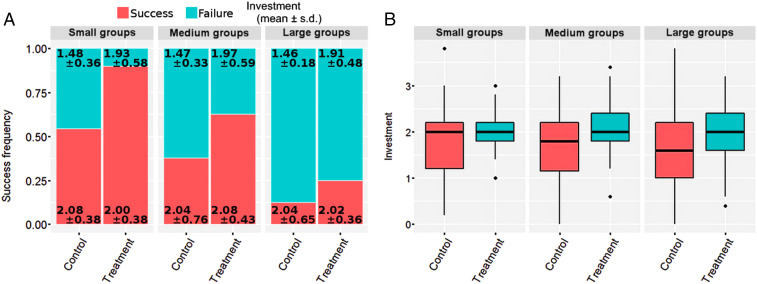
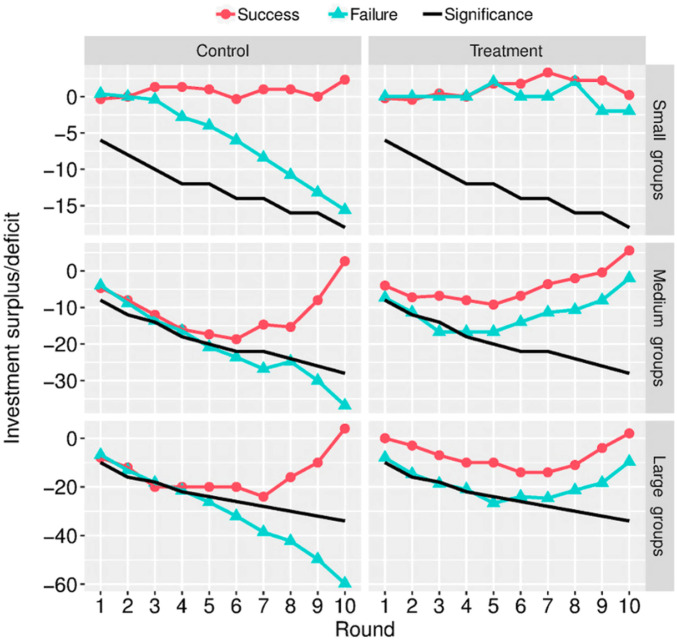
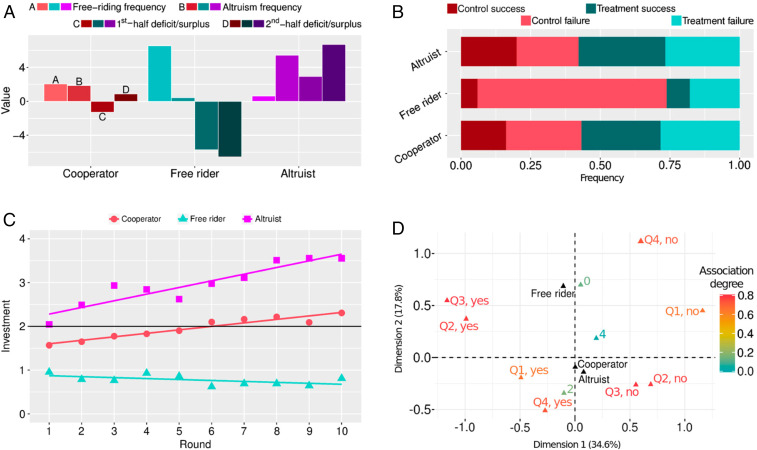
Significance: Collective risks trigger social dilemmas that require balancing selfish interests and common good. One important example is mitigating climate change, wherein without sufficient investments, worldwide negative consequences become increasingly likely. To study the social aspects of this problem, we organized a game experiment that reveals how group size, communication, and behavioral type drive prosocial action. We find that communicating sentiment and outlook leads to more positive outcomes, even among culturally heterogeneous groups. Although genuine free riders remain unfazed by communication, prosocial players better endure accumulated investment deficits, and thus fight off inaction as the failure looms. This suggests that climate negotiations may achieve more by leveraging existing goodwill than persuading skeptics to act.
Overview
The claims and statistics of this paper haven’t been checked yet.
Run the check — free, no account needed. It reads the open-access text and checks the sources it cites.
Integrity signals
Registry
Cites
Statistics
Figures
Verification
Claims the paper makes
The claims and statistics of this paper haven’t been checked yet.
Run the check — free, no account needed. It reads the open-access text and checks the sources it cites.
Claims other papers make about this one
Each is checked against this paper’s own text: does it say what the citing paper says it does?
In the citing paper
“For example, in multiplayer games, cheap talk14,15 and onymity16 sustain reciprocation”
From Deep reinforcement learning can promote sustainable human behaviour in a common-pool resource problem (2025) · cites this paper as [15]
Self-check
Percentages, sums and reported differences re-computed from the paper’s own numbers.
The self-check needs the paper’s full text.
Citations
Cites
A safe operating space for humanity
Rockström, J., Steffen, W., Noone, K., Persson, Å., Chapin, F. S., Lambin, E. F., Lenton, T. M., Scheffer, M., Folke, C., Schellnhuber, H. J., et al. (2009) · Nature · doi:10.1038/461472a · Cited by 13,333
Self-citationA General Framework for Analyzing Sustainability of Social-Ecological Systems
Ostrom, E. (2009) · Science · doi:10.1126/science.1172133 · Cited by 8,656
(1994) · Cited by 5,513
The Struggle to Govern the Commons
Dietz, T., Ostrom, E., & Stern, P. C. (2003) · Science · doi:10.1126/science.1091015 · Cited by 4,209
The Anthropocene: Are Humans Now Overwhelming the Great Forces of Nature
Steffen, W., Crutzen, P. J., & McNeill, J. R. (2007) · AMBIO: A Journal of the Human Environment · doi:10.1579/0044-7447(2007)36[614:taahno]2.0.co;2 · Cited by 3,487
Trajectories of the Earth System in the Anthropocene
Steffen, W., Rockström, J., Richardson, K., Lenton, T. M., Folke, C., Liverman, D., Summerhayes, C. P., Barnosky, A. D., Cornell, S. E., Crucifix, M., et al. (2018) · Proceedings of the National Academy of Sciences · doi:10.1073/pnas.1810141115 · Cited by 3,139 · cited 1×
“Since the Industrial Age, human environmental impacts have become so widespread that we are now in the Anthropocene geological era (1) and, more alarmingly, in the process of exceeding key boundaries of the planetary climate system (2, 3).”
BackgroundSelf-citationAre people conditionally cooperative? Evidence from a public goods experiment
Fischbacher, U., Gächter, S., & Fehr, E. (2001) · Economics Letters · doi:10.1016/s0165-1765(01)00394-9 · Cited by 2,780
Covenants with and without a Sword: Self-Governance Is Possible
Elinor Ostrom, B., Walker, J. M., & Gardner, R. (1992) · American Political Science Review · doi:10.2307/1964229 · Cited by 2,066
oTree - An Open-Source Platform for Laboratory, Online, and Field Experiments
Chen, D. L., Schonger, M., & Wickens, C. D. (2016) · Journal of Behavioral and Experimental Finance · doi:10.1016/j.jbef.2015.12.001 · Cited by 1,981
The Extent and Consequences of P-Hacking in Science
Head, M. L., Holman, L., Lanfear, R., Kahn, A. T., & Jennions, M. D. (2015) · PLOS Biology · doi:10.1371/journal.pbio.1002106 · Cited by 1,388 · cited 1×
“Appendix to avoid spurious results (31).”
Cited by
Sorted by citations
Xia, C., Wang, J., Perc, M., & Wang, Z. (2023) · Physics of Life Reviews · doi:10.1016/j.plrev.2023.05.002 · Cited by 354
Self-citationZhang, Y., Zhao, W., Wang, J., & Yuan, Y. (2024) · Neurocomputing · doi:10.1016/j.neucom.2024.128423 · Cited by 120
Language-based game theory in the age of artificial intelligence
Capraro, V., Paolo, R. D., Perc, M., & Pizziol, V. (2024) · Journal of The Royal Society Interface · doi:10.1098/rsif.2023.0720 · Cited by 97
Self-citationEmergence of Polarized Ideological Opinions in Multidimensional Topic Spaces
Baumann, F., Lorenz-Spreen, P., Sokolov, I. M., & Starnini, M. (2021) · Physical Review X · doi:10.1103/physrevx.11.011012 · Cited by 104
Evolutionary games on simplicial complexes
Guo, H., Jia, D., Sendiña–Nadal, I., Zhang, M., Wang, Z., Li, X., Alfaro-Bittner, K., Moreno, Y., & Boccaletti, S. (2021) · Chaos Solitons & Fractals · doi:10.1016/j.chaos.2021.111103 · Cited by 80
Self-citationHigher-order temporal interactions promote the cooperation in the multiplayer snowdrift game
Xu, Y. L., Wang, J., Xia, C., & Wang, Z. (2023) · Science China Information Sciences · doi:10.1007/s11432-022-3738-3 · Cited by 68
Self-citationComposite Effective Degree Markov Chain for Epidemic Dynamics on Higher-Order Networks
Chen, J., Feng, M., Zhao, D., Xia, C., & Wang, Z. (2023) · IEEE Transactions on Systems Man and Cybernetics Systems · doi:10.1109/tsmc.2023.3298019 · Cited by 55
Self-citationFan, W., & Xiao, F. (2022) · Engineering Applications of Artificial Intelligence · doi:10.1016/j.engappai.2022.105362 · Cited by 52
Huo, L., & Gu, J. (2022) · Physica A Statistical Mechanics and its Applications · doi:10.1016/j.physa.2022.128323 · Cited by 51
A collective risk dilemma for tourism restrictions under the COVID-19 context
Chica, M., Hernández, J. M., & Bulchand‐Gidumal, J. (2021) · Scientific Reports · doi:10.1038/s41598-021-84604-z · Cited by 48
Farahbakhsh, I., Bauch, C. T., & Anand, M. (2022) · Philosophical Transactions of the Royal Society B Biological Sciences · doi:10.1098/rstb.2021.0382 · Cited by 57
Self-citationEvolution of cooperation in the public goods game with Q-learning
Zheng, G., Zhang, J., Deng, S., Cai, W., & Chen, L. (2024) · Chaos Solitons & Fractals · doi:10.1016/j.chaos.2024.115568 · Cited by 50
How evolutionary game could solve the human vaccine dilemma
Kabir, K. M. A. (2021) · Chaos Solitons & Fractals · doi:10.1016/j.chaos.2021.111459 · Cited by 44
Coevolutionary dynamics of collective cooperation and dilemma strength in a collective-risk game
Hua, S., Xu, M., Liu, L., & Chen, X. (2024) · Physical Review Research · doi:10.1103/physrevresearch.6.023313 · Cited by 42
Guo, H., Wang, Z., Song, Z., Yuan, Y., Deng, X., & Li, X. (2022) · Neurocomputing · doi:10.1016/j.neucom.2022.08.023 · Cited by 40
Self-citationResearch on low-carbon technology diffusion among enterprises in networked evolutionary game
Wu, Y., Wang, X., Liu, Z., & Zhao, X. (2023) · Chaos Solitons & Fractals · doi:10.1016/j.chaos.2023.113852 · Cited by 40
Impact of resource-based conditional interaction on cooperation in spatial social dilemmas
Li, X., Han, W., Yang, W., Wang, J., Xia, C., Li, H., & Shi, Y. (2022) · Physica A Statistical Mechanics and its Applications · doi:10.1016/j.physa.2022.127055 · Cited by 36
Mixing prisoner’s dilemma games on higher-order networks
Wang, J., Nie, J., Guo, S., Özer, M., Xia, C., & Perc, M. (2024) · Neurocomputing · doi:10.1016/j.neucom.2024.128439 · Cited by 34
Self-citationGroupwise Label Enhancement Broad Learning System for Image Classification
Jin, J., Chang, S., Duan, J., Li, Y., Ding, W., Wang, Z., Chen, C. L. P., & Li, P. (2025) · IEEE Transactions on Cybernetics · doi:10.1109/tcyb.2025.3550175 · Cited by 34
Self-citationMulti-agent, human–agent and beyond: A survey on cooperation in social dilemmas
Mu, C., Guo, H., Chen, Y., Shen, C., Hu, D., Hu, S., & Wang, Z. (2024) · Neurocomputing · doi:10.1016/j.neucom.2024.128514 · Cited by 43
Self-citationDynamics of informal risk sharing in collective index insurance
Santos, F. P., Pacheco, J. M., Santos, F. C., & Levin, S. A. (2021) · Nature Sustainability · doi:10.1038/s41893-020-00667-2 · Cited by 34
A Generalized -Divergence With Applications in Pattern Classification
Xiao, F., Ding, W., & Pedrycz, W. (2025) · IEEE Transactions on Knowledge and Data Engineering · doi:10.1109/tkde.2025.3530524 · Cited by 32
Hua, S., Hui, Z., & Liu, L. (2023) · Proceedings of the Royal Society B Biological Sciences · doi:10.1098/rspb.2023.0949 · Cited by 31
Liu, X., & Zhang, Q. (2024) · IEEE Access · doi:10.1109/access.2024.3415349 · Cited by 30
Modeling Explosive Opinion Depolarization in Interdependent Topics
Ojer, J., Starnini, M., & Pastor‐Satorras, R. (2023) · Physical Review Letters · doi:10.1103/physrevlett.130.207401 · Cited by 34
Cross-diffusion induced Turing patterns on multiplex networks of a predator–prey model
Song, M., Gao, S., Liu, C., Bai, Y., Zhang, L., Xie, B., & Chang, L. (2023) · Chaos Solitons & Fractals · doi:10.1016/j.chaos.2023.113131 · Cited by 28
Success-driven opinion formation determines social tensions
Chica, M., Perc, M., & Santos, F. C. (2024) · iScience · doi:10.1016/j.isci.2024.109254 · Cited by 25
Self-citationGoh, H. H., Xu, Z., Liang, X., Zhang, D., Dai, W., Liu, H., Kurniawan, T. A., Wong, S. Y., & Goh, K. C. (2023) · Journal of Cleaner Production · doi:10.1016/j.jclepro.2023.138817 · Cited by 25
Zhu, C., & Xiao, F. (2022) · Applied Intelligence · doi:10.1007/s10489-022-03768-x · Cited by 25
Zhang, M., Jia, H., & Zheng, M. (2020) · Frontiers in Psychology · doi:10.3389/fpsyg.2020.542093 · Cited by 24
Random walk in random permutation set theory
Zhou, J., Li, Z., & Deng, Y. (2024) · Chaos An Interdisciplinary Journal of Nonlinear Science · doi:10.1063/5.0220154 · Cited by 22
Dong, Y., Ma, S., Zhang, B., Wang, W.-X., & Pacheco, J. M. (2021) · One Earth · doi:10.1016/j.oneear.2021.07.006 · Cited by 22
Q-learning-based migration leading to spontaneous emergence of segregation
He, Z., Geng, Y., Du, C., Ши, Л., & Wang, Z. (2022) · New Journal of Physics · doi:10.1088/1367-2630/acadfd · Cited by 21
Self-citationDynamic sanctioning mechanism for cooperative multi-agent systems
Liu, L., Wang, L., Niu, W., & Hua, S. (2025) · Expert Systems with Applications · doi:10.1016/j.eswa.2025.128873 · Cited by 20
LSTM based Sentiment Analysis of Financial News
Sharaff, A., Chowdhury, T. R., & Bhandarkar, S. (2023) · SN Computer Science · doi:10.1007/s42979-023-02018-2 · Cited by 20
Facilitating cooperation in human-agent hybrid populations through autonomous agents
Guo, H., Shen, C., Hu, S., Xing, J., Tao, P., Shi, Y., & Wang, Z. (2023) · iScience · doi:10.1016/j.isci.2023.108179 · Cited by 25
Self-citationEGTtools: Evolutionary game dynamics in Python
Domingos, E. F., Santos, F. C., & Lenaerts, T. (2023) · iScience · doi:10.1016/j.isci.2023.106419 · Cited by 19
Zhu, C., Pu, Y., Lyu, Z., Yang, K., & Yang, Q. (2024) · Knowledge-Based Systems · doi:10.1016/j.knosys.2024.112259 · Cited by 19
Network-based exploration of basin precipitation based on satellite and observed data
Gadhawe, M. A., Guntu, R. K., & Agarwal, A. (2021) · The European Physical Journal Special Topics · doi:10.1140/epjs/s11734-021-00017-z · Cited by 19
Effects of the information-driven awareness on epidemic spreading on multiplex networks
Wang, J., Xiong, W., Wang, R., Cai, S., Wu, D., Wang, W., & Chen, X. (2022) · Chaos An Interdisciplinary Journal of Nonlinear Science · doi:10.1063/5.0092031 · Cited by 16
Multi-games on a dynamic network and the evolution of cooperation
Huang, Y., & Chen, Y. (2025) · Chaos Solitons & Fractals · doi:10.1016/j.chaos.2025.115998 · Cited by 16
Inhibition and activation of interactions in networked weak prisoner’s dilemma
Yao, Y., Zeng, Z., Pi, B., & Feng, M. (2023) · Chaos An Interdisciplinary Journal of Nonlinear Science · doi:10.1063/5.0146999 · Cited by 15
An Analysis of Climate Change Based on Machine Learning and an Endoreversible Model
Vázquez-Ramírez, S., Torres-Ruiz, M. J., Quintero, R., Chui, K. T., & Sanchéz-Mejorada, C. G. (2023) · Mathematics · doi:10.3390/math11143060 · Cited by 16
Hybrid density-based adaptive weighted collaborative representation for imbalanced learning
Li, Y., Wang, S., Jin, J., Tao, H., Han, C., & Chen, C. L. P. (2024) · Applied Intelligence · doi:10.1007/s10489-024-05393-2 · Cited by 15
Fast Outbreak Sense and Effective Source Inference via Minimum Observer Set
Liu, Y., Wang, X., Wang, X., & Wang, Z. (2024) · IEEE/ACM Transactions on Networking · doi:10.1109/tnet.2024.3382546 · Cited by 15
Self-citationReplicator–mutator dynamics with evolutionary public goods game-environmental feedbacks
Du, C., Lu, Y., Zhang, Y., Shen, C., Ши, Л., & Guo, H. W. (2024) · Chaos An Interdisciplinary Journal of Nonlinear Science · doi:10.1063/5.0200761 · Cited by 15
Self-citationEvolution of cooperation on reinforcement-learning driven-adaptive networks
Du, C., Lu, Y., Meng, H., & Park, J. (2024) · Chaos An Interdisciplinary Journal of Nonlinear Science · doi:10.1063/5.0201968 · Cited by 14
Individual-centralized seeding strategy for influence maximization in information-limited networks
Liu, Y., Wang, X., Wang, X., Li, Y., Zhao, S., & Wang, Z. (2024) · Journal of The Royal Society Interface · doi:10.1098/rsif.2023.0625 · Cited by 14
Self-citationWang, P., & Yang, Z. (2024) · Chaos Solitons & Fractals · doi:10.1016/j.chaos.2024.115483 · Cited by 15
Domingos, E. F., Grujić, J., Burguillo, J. C., Santos, F. C., & Lenaerts, T. (2021) · Simulation Modelling Practice and Theory · doi:10.1016/j.simpat.2021.102299 · Cited by 14
Cooperation dynamics on hypergraphs with punishment and Q-learning
Zou, K., & Huang, C. (2025) · Expert Systems with Applications · doi:10.1016/j.eswa.2025.128989 · Cited by 13
Reward and Punishment Mechanism with weighting enhances cooperation in evolutionary games
Zu, J., Xu, F., Jin, T., & Xiang, W. (2022) · Physica A Statistical Mechanics and its Applications · doi:10.1016/j.physa.2022.128165 · Cited by 13
Wang, L., Liu, Y., Guo, R., Liang, Z., Liu, L., & Hua, S. (2024) · Proceedings of the Royal Society B Biological Sciences · doi:10.1098/rspb.2024.0182 · Cited by 13
Zhang, Z., Zhang, J., Li, L., Guo, Z., Zhang, Z., & Sun, G. (2024) · Chaos Solitons & Fractals · doi:10.1016/j.chaos.2024.115121 · Cited by 13
A novel weighted approach for time series forecasting based on visibility graph
Zhan, T., & Xiao, F. (2024) · Pattern Recognition · doi:10.1016/j.patcog.2024.110720 · Cited by 13
Yan, R., Xu, M., Liu, L., & Hua, S. (2024) · Physics Letters A · doi:10.1016/j.physleta.2024.129951 · Cited by 13
Koster, R., Pîslar, M., Tacchetti, A., Balaguer, J., Liu, L., Elie, R., Hauser, O. P., Tuyls, K., Botvinick, M., & Summerfield, C. (2025) · Nature Communications · doi:10.1038/s41467-025-58043-7 · Cited by 12
Cooperation dynamics in collective risk games with endogenous endowments
Quan, J., Zhang, X. Y., Chen, W., & Wang, X. (2023) · Chaos An Interdisciplinary Journal of Nonlinear Science · doi:10.1063/5.0155724 · Cited by 12
A Finite-Time Convergent Analysis of Continuous Action Iterated Dilemma
Wang, Z., Jin, X., Zhang, T., & Yu, D. (2024) · IEEE/CAA Journal of Automatica Sinica · doi:10.1109/jas.2023.123606 · Cited by 12
Self-citationVariance of belief information
Chen, X., Zhan, T., Zhou, G., & Deng, Y. (2025) · Applied Mathematical Modelling · doi:10.1016/j.apm.2025.116148 · Cited by 12
Arifah, Salman, D., YASSI, A., & Demmallino, E. B. (2023) · Regional Sustainability · doi:10.1016/j.regsus.2023.05.005 · Cited by 12
A multi-granularity distance with its application for decision making
Zhao, Y., Zhang, Z., & Xiao, F. (2024) · Information Sciences · doi:10.1016/j.ins.2024.120168 · Cited by 11
The effect of nonlinear environmental feedback on the outcomes of evolutionary dynamics
Huang, J., Zhu, Y., Xia, C., & Tanimoto, J. (2024) · Applied Mathematics and Computation · doi:10.1016/j.amc.2024.128990 · Cited by 11
Effect of mixed random and directional migration on cooperation in the spatial prisoner’s dilemma
Zhang, L., Pan, J., & Huang, C. (2023) · Chaos Solitons & Fractals · doi:10.1016/j.chaos.2023.113540 · Cited by 11
Imbalanced Broad Learning System with label relaxation and sample weight adaptation
Li, Y., Wang, Y., Jin, J., Zhang, W., Tao, H., Wu, H., & Chen, C. L. P. (2025) · Applied Soft Computing · doi:10.1016/j.asoc.2025.113543 · Cited by 12
Evolutionary cooperation under collective risk on hypergraphs
Hu, K., Tao, Y., Zhao, X., Li, W., & Ши, Л. (2025) · Chaos Solitons & Fractals · doi:10.1016/j.chaos.2025.116859 · Cited by 10
Huang, C.-C., & Wang, C.-L. (2024) · Journal of Water and Climate Change · doi:10.2166/wcc.2024.125 · Cited by 10
Catalytic evolution of cooperation in a population with behavioral bimodality
Sheng, A., Zhang, J., Zheng, G., Zhang, J., Cai, W., & Chen, L. (2024) · Chaos An Interdisciplinary Journal of Nonlinear Science · doi:10.1063/5.0231772 · Cited by 10
Adaptive weights-based relaxed broad learning system for imbalanced classification
Li, Y., Gao, Y., Jin, J., Nan, J., Meng, Y., Wang, M., & Chen, C. L. P. (2024) · Digital Signal Processing · doi:10.1016/j.dsp.2024.104869 · Cited by 11
Qiu, L., Zhao, J., & Sun, Z. (2024) · Communications in Nonlinear Science and Numerical Simulation · doi:10.1016/j.cnsns.2024.108293 · Cited by 9
A Fractal-Based Complex Belief Entropy for Uncertainty Measure in Complex Evidence Theory
Wu, K., Xiao, F., & Zhang, Y. (2024) · IEEE Transactions on Systems Man and Cybernetics Systems · doi:10.1109/tsmc.2024.3493200 · Cited by 9
Co-evolution of risk and cooperation in climate policies under wealth inequality
Pacheco, J. M., & Santos, F. C. (2024) · PNAS Nexus · doi:10.1093/pnasnexus/pgae550 · Cited by 9
Cooperative bots exhibit nuanced effects on cooperation across strategic frameworks
Si, Z., He, Z., Shen, C., & Tanimoto, J. (2025) · Journal of The Royal Society Interface · doi:10.1098/rsif.2024.0427 · Cited by 9
DHR-BLS: A Huber-type robust broad learning system with its distributed version
Zhang, Y., Ke, S., Li, J., Liu, W., Hu, J., & Yang, K. (2025) · Knowledge-Based Systems · doi:10.1016/j.knosys.2025.113184 · Cited by 9
Chang, C., Kristensen, N. P., Nghiem, T. P. L., Tan, C. L. Y., & Carrasco, L. R. (2021) · Royal Society Open Science · doi:10.1098/rsos.210206 · Cited by 9
Ingredient-guided multi-modal interaction and refinement network for RGB-D food nutrition assessment
Nian, F., Hu, Y., Gu, Y., Wu, Z., Yang, S., & Shu, J. (2024) · Digital Signal Processing · doi:10.1016/j.dsp.2024.104664 · Cited by 9
Xie, X., Sathasivam, S., Ma, H., & Yue, Z. (2024) · IEEE Access · doi:10.1109/access.2024.3471871 · Cited by 8
Effects of interdependent network reciprocity on the evolution of public cooperation
Su, L., Yang, Z., Zhou, B., Zhang, N., & Li, Y. (2023) · Applied Mathematics and Computation · doi:10.1016/j.amc.2023.128029 · Cited by 8
Zhu, P., Sun, J., Yu, D., Liu, C., Zhou, Y., & Wang, Z. (2023) · Nonlinear Dynamics · doi:10.1007/s11071-023-08865-1 · Cited by 8
Self-citationIdentify influential nodes in network of networks from the view of weighted information fusion
Lei, M., Liu, L., & Xiao, F. (2022) · Applied Intelligence · doi:10.1007/s10489-022-03856-y · Cited by 8
Complex pathways to cooperation emergent from asymmetry in heterogeneous populations
Guo, H. W., Shen, C., Zou, R., Tao, P., Shi, Y., Wang, Z., & Xing, J. (2024) · Chaos An Interdisciplinary Journal of Nonlinear Science · doi:10.1063/5.0188177 · Cited by 8
Self-citationAn analysis of a predator-prey model in which fear reduces prey birth and death rates
Xue, Y., Chen, F., Xie, X., & Chen, S. (2024) · AIMS Mathematics · doi:10.3934/math.2024630 · Cited by 8
Dishonesty as a collective‐risk social dilemma
Jiang, S., & Villeval, M. C. (2023) · Economic Inquiry · doi:10.1111/ecin.13171 · Cited by 7
Epidemic spreading in temporal multilayer networks coupling with individual behavioral changes
Cao, H., Xu, B., Yu, D., & Wang, Z. (2025) · Nonlinear Dynamics · doi:10.1007/s11071-025-11070-x · Cited by 7
Self-citationEvaluating Evidential Reliability in Pattern Recognition Based on Intuitionistic Fuzzy Sets
Xu, J., Zhan, T., & Deng, Y. (2025) · International Journal of Fuzzy Systems · doi:10.1007/s40815-025-02117-7 · Cited by 7
Multi-player evolutionary game of federated learning incentive mechanism based on system dynamics
Yang, P., Zhang, H., Gao, F., Xu, Y., & Jin, Z. (2023) · Neurocomputing · doi:10.1016/j.neucom.2023.126739 · Cited by 7
Diamond Intuitionistic Fuzzy Sets and Their Applications
Khan, M. B., Deaconu, A. M., Tayyebi, J., & Spridon, D. E. (2024) · IEEE Access · doi:10.1109/access.2024.3502202 · Cited by 7
Dual graph-regularized sparse robust adaptive non-negative matrix factorization
Xiong, W., Ma, Y., Zhang, C., & Liu, S. (2025) · Expert Systems with Applications · doi:10.1016/j.eswa.2025.127594 · Cited by 7
Huang, Y., & Xiao, F. (2023) · Engineering Applications of Artificial Intelligence · doi:10.1016/j.engappai.2023.107048 · Cited by 7
Wang, X., He, Z., & Ши, Л. (2024) · Chaos Solitons & Fractals · doi:10.1016/j.chaos.2024.114742 · Cited by 7
Granting leaders priority exit options promotes and jeopardizes cooperation in social dilemmas
Li, S., He, Z., Jia, D., Chen, S., Ши, Л., & Tanimoto, J. (2024) · Neurocomputing · doi:10.1016/j.neucom.2024.127566 · Cited by 7
Reliable Data Augmented Contrastive Learning for Sequential Recommendation
Zhao, M., Sun, A., Yu, J. X., Li, X., He, D., Yu, R., & Yu, M. (2024) · IEEE Transactions on Big Data · doi:10.1109/tbdata.2024.3453752 · Cited by 6
Shan, H., Liang, J., & Pi, W. (2024) · Physics Letters A · doi:10.1016/j.physleta.2024.130110 · Cited by 6
Zhang, Z., Yang, C., Han, W., Zhao, D., & Xia, C. (2025) · Chaos An Interdisciplinary Journal of Nonlinear Science · doi:10.1063/5.0307636 · Cited by 6
Bai, Y., & Ding, L. (2024) · Journal of Cleaner Production · doi:10.1016/j.jclepro.2024.142374 · Cited by 6
Evolution of trust in N-player trust games with loss assessment
Liu, Y., Wang, L., Guo, R., Hua, S., Liu, L., & Liang, Z. (2024) · Chaos An Interdisciplinary Journal of Nonlinear Science · doi:10.1063/5.0228886 · Cited by 6
Ma, T., & Fu, Y. (2024) · Advanced Engineering Informatics · doi:10.1016/j.aei.2024.102952 · Cited by 6
Spatiotemporal dynamics of a diffusive SI model in the regions of Turing-Hopf bifurcation point
Sun, T., Xue, Z.-C., & Zhang, H. (2024) · Nonlinear Dynamics · doi:10.1007/s11071-024-10635-6 · Cited by 6
Promotion of cooperation in a structured population with environmental feedbacks
Lyu, D., Liu, H., Deng, C., & Wang, X. (2024) · Chaos An Interdisciplinary Journal of Nonlinear Science · doi:10.1063/5.0236333 · Cited by 6
Peer pressure in extortion game can resolve social dilemma
Chang, Q., & Zhang, Y. (2021) · The European Physical Journal B · doi:10.1140/epjb/s10051-021-00108-9 · Cited by 6
Metadata
- Authors
- Wang, Z., Jusup, M., Guo, H., Shi, L., Geček, S., Anand, M., Perc, M., Bauch, C. T., Kurths, J., Boccaletti, S., & Schellnhuber, H. J.
- Affiliations
- Northwestern Polytechnical University (CN)
- Tokyo Institute of Technology (JP)
- Statistics and Mathematics College, Yunnan University of Finance and Economics, Kunming 650221, China;
- Ruđer Bošković Institute (HR)
- University of Guelph (CA)
- China Medical University (TW)
- University of Waterloo (CA)
- Potsdam Institute for Climate Impact Research (DE)
- Moscow Institute of Physics and Technology (RU)
- Corresponding author
- Wang, Zhen
- Jusup, Marko
- Schellnhuber, Hans Joachim
- ORCID
- Venue
- Proceedings of the National Academy of Sciences
- Publisher
- National Academy of Sciences
- Published
- 2020-07-15
- Volume
- 117
- Issue
- 30
- Pages
- 17650-17655
- ISSN
- 0027-8424 (ISSN-L)
- 1091-6490
- PMC
- PMC7395434
- OpenAlex
- W3042961264
- Cited by
- 185
- References
- 33
- Citations by year
- 2026: 21 · 2025: 39 · 2024: 66 · 2023: 28 · 2022: 13 · 2021: 17 · 2020: 1
- FWCI
- 20.07
- Type
- journal article
- Language
- en
- Open access
- hybrid
- doi.org
- Licence
- Locations
- Proceedings of the National Academy of Sciences (publishedVersion, cc-by)
- PubMed Central (publishedVersion, cc-by)
- PubMed (publishedVersion)
- University of Maribor digital library (University of Maribor) (submittedVersion, cc-by)
- Institutional Repository of the Ruđer Bošković Institute (Ruđer Bošković Institute) (submittedVersion, cc-by)
- RENATE (submittedVersion, cc-by-nc-nd)
- Publication Database PIK (Potsdam Institute for Climate Impact Research (PIK)) (submittedVersion, cc-by)
- RENATE (cc-by)
- Funders
- National Natural Science Foundation of China (31700393, 81961138010, 11931015, 11671348, U1803263)
- Javna Agencija za Raziskovalno Dejavnost RS (J4-9302, P1-0403, J1-9112)
- Hrvatska Zaklada za Znanost (#IP-2018-01-3150-AqADAPT, IP-2018, IP-2018-01-3150, -2018-01-3150, IP-2018-01)
- Fundamental Research Funds for the Central Universities (3102019PJ006, U1803263, 81961138010)
- Topics
- Social Sciences › Economics, Econometrics and Finance › Economics and Econometrics › Experimental Behavioral Economics Studies
- Social Sciences › Sociology and Political Science › Evolutionary Game Theory and Cooperation
- Social Sciences › Economics, Econometrics and Finance › Economics and Econometrics › Climate Change Policy and Economics
- Keywords
- collective action, free-riding, climate change mitigation, social dilemmas, investment behavior, group size, behavioral types, cooperation, altruism
- MeSH terms
- Behavior, Communication, Humans, Models, Theoretical, Climate Change
About these checks
Registry, retraction, Cites and statistics results are computed, not judged, with one exception: a printed reference that no index lists is read once by a model before it counts as a citation error. Claims are extracted by a model and kept only when their quote appears verbatim in the text; each cited source is then checked, with a model’s help, for whether it says what the claim relies on. Those verdicts can be wrong — read the claim’s quote and the cited source before relying on one.
Statistics and arithmetic are recomputed, not judged.
Confidence bands are shown only for fields calibrated on our annotated test set. None is calibrated yet, so no band is shown.
What counts as a claim ›How we measure confidence ›How we check this ›
Are you an author, or do you see a problem with this page? Request a review
