

The DOI matches its Crossref record; 32 of the 33 references it cites were found in a registry or an index.
Communicating sentiment and outlook reverses inaction against collective risks
Open accessAbstract
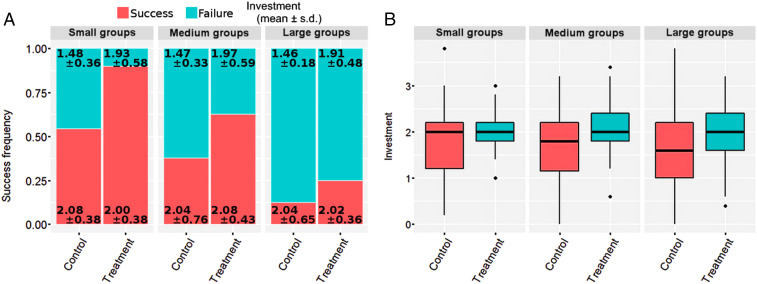
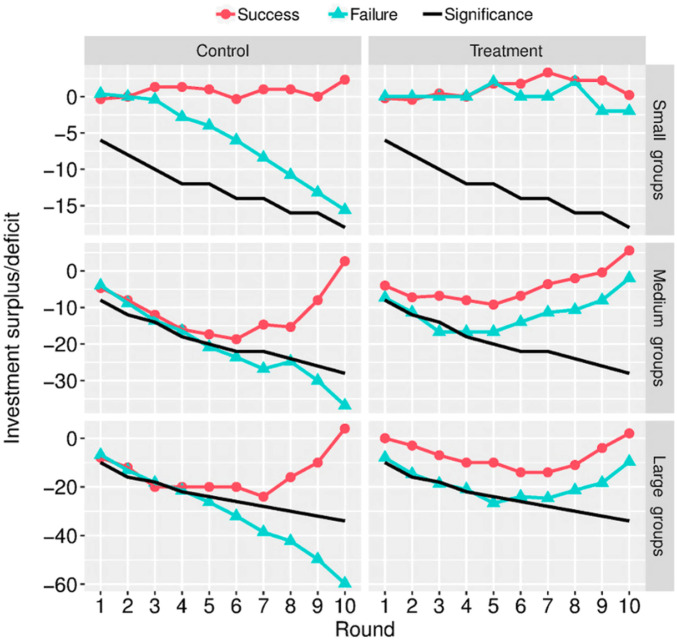
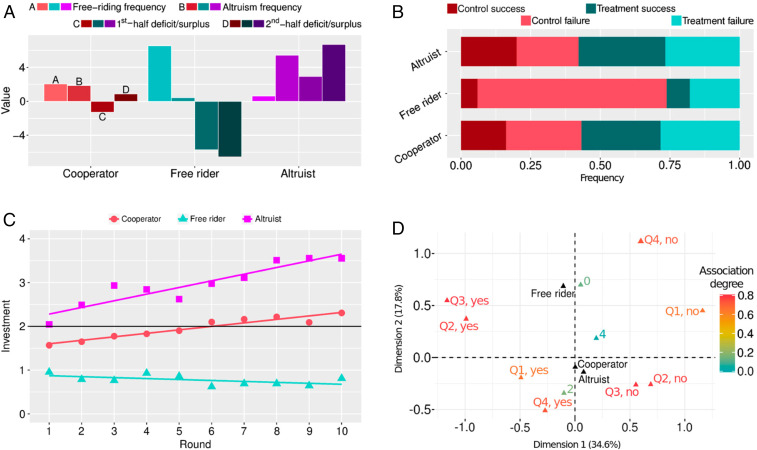
Significance: Collective risks trigger social dilemmas that require balancing selfish interests and common good. One important example is mitigating climate change, wherein without sufficient investments, worldwide negative consequences become increasingly likely. To study the social aspects of this problem, we organized a game experiment that reveals how group size, communication, and behavioral type drive prosocial action. We find that communicating sentiment and outlook leads to more positive outcomes, even among culturally heterogeneous groups. Although genuine free riders remain unfazed by communication, prosocial players better endure accumulated investment deficits, and thus fight off inaction as the failure looms. This suggests that climate negotiations may achieve more by leveraging existing goodwill than persuading skeptics to act.
Overview
The claims and statistics of this paper haven’t been checked yet.
Run the check — free, no account needed. It reads the open-access text and checks the sources it cites.
Integrity signals
Registry
Cites
Statistics
Figures
Verification
Claims the paper makes
The claims and statistics of this paper haven’t been checked yet.
Run the check — free, no account needed. It reads the open-access text and checks the sources it cites.
Claims other papers make about this one
Each is checked against this paper’s own text: does it say what the citing paper says it does?
In the citing paper
“For example, in multiplayer games, cheap talk14,15 and onymity16 sustain reciprocation”
From Deep reinforcement learning can promote sustainable human behaviour in a common-pool resource problem (2025) · cites this paper as [15]
Self-check
Percentages, sums and reported differences re-computed from the paper’s own numbers.
The self-check needs the paper’s full text.
Citations
Cites
A safe operating space for humanity
Rockström, J., Steffen, W., Noone, K., Persson, Å., Chapin, F. S., Lambin, E. F., Lenton, T. M., Scheffer, M., Folke, C., Schellnhuber, H. J., et al. (2009) · Nature · doi:10.1038/461472a · Cited by 13,333
Self-citationA General Framework for Analyzing Sustainability of Social-Ecological Systems
Ostrom, E. (2009) · Science · doi:10.1126/science.1172133 · Cited by 8,656
(1994) · Cited by 5,513
The Struggle to Govern the Commons
Dietz, T., Ostrom, E., & Stern, P. C. (2003) · Science · doi:10.1126/science.1091015 · Cited by 4,209
The Anthropocene: Are Humans Now Overwhelming the Great Forces of Nature
Steffen, W., Crutzen, P. J., & McNeill, J. R. (2007) · AMBIO: A Journal of the Human Environment · doi:10.1579/0044-7447(2007)36[614:taahno]2.0.co;2 · Cited by 3,487
Trajectories of the Earth System in the Anthropocene
Steffen, W., Rockström, J., Richardson, K., Lenton, T. M., Folke, C., Liverman, D., Summerhayes, C. P., Barnosky, A. D., Cornell, S. E., Crucifix, M., et al. (2018) · Proceedings of the National Academy of Sciences · doi:10.1073/pnas.1810141115 · Cited by 3,139 · cited 1×
“Since the Industrial Age, human environmental impacts have become so widespread that we are now in the Anthropocene geological era (1) and, more alarmingly, in the process of exceeding key boundaries of the planetary climate system (2, 3).”
BackgroundSelf-citationAre people conditionally cooperative? Evidence from a public goods experiment
Fischbacher, U., Gächter, S., & Fehr, E. (2001) · Economics Letters · doi:10.1016/s0165-1765(01)00394-9 · Cited by 2,780
Covenants with and without a Sword: Self-Governance Is Possible
Elinor Ostrom, B., Walker, J. M., & Gardner, R. (1992) · American Political Science Review · doi:10.2307/1964229 · Cited by 2,066
oTree - An Open-Source Platform for Laboratory, Online, and Field Experiments
Chen, D. L., Schonger, M., & Wickens, C. D. (2016) · Journal of Behavioral and Experimental Finance · doi:10.1016/j.jbef.2015.12.001 · Cited by 1,981
The Extent and Consequences of P-Hacking in Science
Head, M. L., Holman, L., Lanfear, R., Kahn, A. T., & Jennions, M. D. (2015) · PLOS Biology · doi:10.1371/journal.pbio.1002106 · Cited by 1,388 · cited 1×
“Appendix to avoid spurious results (31).”
Cited by
Sorted by citations
Items 101–185 of 185
Qiao, H., Deng, Z., Li, H., Hu, J., Song, Q., & Xia, C. (2021) · Applied Mathematics and Computation · doi:10.1016/j.amc.2021.126435 · Cited by 6
Language-based game theory in the age of artificial intelligencePreprint
Capraro, V., Paolo, R. D., Perc, M., & Pizziol, V. (2024) · doi:10.31234/osf.io/cuf8z · Cited by 6
Self-citationCoevolutionary dynamics of cooperation, risk, and cost in collective risk games
Wang, L., Hua, S., Liu, Y., Zhang, L., Liu, L., & Szolnoki, A. (2026) · PLoS Computational Biology · doi:10.1371/journal.pcbi.1013512 · Cited by 5
Complex Belief Divergence Measures for Multisource Information Fusion
Huang, J., & Xiao, F. (2024) · IEEE Transactions on Systems Man and Cybernetics Systems · doi:10.1109/tsmc.2024.3490183 · Cited by 4
Social dilemma for 30 years: Progress, framework, and future based on CiteSpace analysis
Gao, J., Geng, Y., Jiang, X., Li, J., & Yan, Y. (2024) · Medicine · doi:10.1097/md.0000000000041138 · Cited by 8
Hu, D., Liu, J., Liu, C., & Chu, C. (2025) · Chaos An Interdisciplinary Journal of Nonlinear Science · doi:10.1063/5.0235953 · Cited by 5
Separated interactive behaviors promote cooperation in the spatial prisoner’s dilemma game
Mao, D., Li, X., Mu, D., Liu, D., & Chen, C. (2021) · The European Physical Journal B · doi:10.1140/epjb/s10051-021-00118-7 · Cited by 5
Zhang, Z., Fang, A., Cui, L., Pan, Z., Zhang, W., Tan, C., & Wang, C. (2021) · Discrete Dynamics in Nature and Society · doi:10.1155/2021/8325302 · Cited by 5
The impact of diversity on group decision-making in the face of the free-rider problem
Stolle, C. M., Gula, B., Yu, R., & Huang, Y. (2024) · Judgment and Decision Making · doi:10.1017/jdm.2023.47 · Cited by 5
The spindle approximation of network epidemiological modeling
Mou, J., Dai, B., Tan, S., Holme, P., Lehmann, S., Liljeros, F., & Lu, X. B. (2024) · New Journal of Physics · doi:10.1088/1367-2630/ad4050 · Cited by 5
Multi-games with voluntary participation on a dynamic network and the evolution of cooperation
Huang, Y. (2025) · Chaos An Interdisciplinary Journal of Nonlinear Science · doi:10.1063/5.0282462 · Cited by 5
Normal distribution based on maximum Deng entropy
Li, S., & Xiao, F. (2023) · Chaos Solitons & Fractals · doi:10.1016/j.chaos.2022.113057 · Cited by 5
Emotion expression and cooperation under collective risks
de Melo, C. M., Santos, F. C., & Terada, K. (2023) · iScience · doi:10.1016/j.isci.2023.108063 · Cited by 5
Liu, J., Wang, C., Wang, X., & Li, Q. (2021) · Mathematical Problems in Engineering · doi:10.1155/2021/5592025 · Cited by 5
Divergence between predicted and actual perception of climate information
Tohidi, A., Balietti, S., Fraiberger, S. P., & Balietti, A. (2025) · PNAS Nexus · doi:10.1093/pnasnexus/pgaf084 · Cited by 7
Qin, Y., Zhang, J., Qiu, Z., Chen, Z., & Cai, R. (2025) · Journal of King Saud University - Computer and Information Sciences · doi:10.1007/s44443-025-00084-5 · Cited by 4
Jin, H., Xiao, B., & Zeng, S. (2025) · Environment Development and Sustainability · doi:10.1007/s10668-025-06917-7 · Cited by 5
Adaptive target regulation for multi-agent cooperation in collective-risk dilemmas
Hua, S., Liu, L., & Szolnoki, A. (2026) · Expert Systems with Applications · doi:10.1016/j.eswa.2026.132471 · Cited by 4
Kathirvelpandian, A., Rasheeq, A. A., Kantharajan, G., Kumawat, T., Kumar, T. T. A., & Sarkar, U. K. (2024) · Journal of Water and Climate Change · doi:10.2166/wcc.2024.373 · Cited by 4
Hybrid reward-punishment in feedback-evolving game for common resource governance
Lu, Z., Hua, S., Wang, L., & Liu, L. (2024) · Physical review. E · doi:10.1103/physreve.110.034301 · Cited by 4
Complex Deng entropy for uncertainty measure in complex evidence theory
Tang, C., & Xiao, F. (2024) · Engineering Applications of Artificial Intelligence · doi:10.1016/j.engappai.2024.109696 · Cited by 4
A fractal-based supremum and infimum complex belief entropy in complex evidence theory
Tianren, L. I. U., Zewei, Y. U., Xiao, F., Yangyang, Z. H. A. O., & Aritsugi, M. (2024) · Chinese Journal of Aeronautics · doi:10.1016/j.cja.2024.103350 · Cited by 4
Humans program artificial delegates to accurately solve collective-risk dilemmas but lack precision
Terrucha, I., Domingos, E. F., Suchon, R., Santos, F. C., Simoens, P., & Lenaerts, T. (2025) · Proceedings of the National Academy of Sciences · doi:10.1073/pnas.2319942121 · Cited by 4
Liao, Y., Lei, Y., Wang, Z., & Wang, X. (2026) · Nonlinear Dynamics · doi:10.1007/s11071-025-12095-y · Cited by 4
Self-citationA brief review of evolutionary game dynamics in the reinforcement learning paradigm
Zheng, G., Ou, X., deng, S., Zhang, J., & Chen, L. (2026) · Communications in Theoretical Physics · doi:10.1088/1572-9494/ae503e · Cited by 4
Cooperation with dynamic asymmetric evaluation in complex networks from a risk perspective
Xie, Y., Han, W., Qi, J., & Zhao, Z. (2024) · Chaos An Interdisciplinary Journal of Nonlinear Science · doi:10.1063/5.0177804 · Cited by 4
Xia, R., & Xiao, F. (2024) · Engineering Applications of Artificial Intelligence · doi:10.1016/j.engappai.2024.109056 · Cited by 4
Wang, X., Liao, Y., Tan, L., Zhang, W., & Li, H. (2024) · IEEE Transactions on Emerging Topics in Computational Intelligence · doi:10.1109/tetci.2024.3452685 · Cited by 4
Cooperative evolution with reward-based heterogeneous tax in spatial public goods games
Yue, L., Zhang, H., Sun, Y., An, T., & Wang, J. (2025) · iScience · doi:10.1016/j.isci.2025.111813 · Cited by 4
Seeding leading cooperators and institutions in networked climate dilemmas
Chica, M., & Santos, F. C. (2022) · Chaos Solitons & Fractals · doi:10.1016/j.chaos.2022.112987 · Cited by 4
Cooperation dynamics of the population with interactive diversity on interdependent networks
Tian, J., Wang, J., & Xia, C. (2023) · Physica A Statistical Mechanics and its Applications · doi:10.1016/j.physa.2023.128967 · Cited by 4
Li, R., Xu, B.-L., Chen, D., Zhou, J., & Yuan, W.-J. (2023) · Chaos Solitons & Fractals · doi:10.1016/j.chaos.2023.114104 · Cited by 4
Judgment on the evolution state of asymmetric games
Song, S., Pan, Q., & He, M. (2022) · Proceedings of the Royal Society A Mathematical Physical and Engineering Sciences · doi:10.1098/rspa.2022.0372 · Cited by 3
Fisher regularized discriminative broad learning system for visual classification
Li, X., Wei, J., Jin, J., Xu, T., & Yu, D. (2024) · Applied Soft Computing · doi:10.1016/j.asoc.2024.112341 · Cited by 3
COMPLEX NETWORK CLASSIFICATION USING DENG ENTROPY AND BIDIRECTIONAL LONG SHORT-TERM MEMORY
Soto-Camacho, M.-D.-C., Nagy, M., Molontay, R., & Ramírez-Arellano, A. (2024) · Fractals · doi:10.1142/s0218348x25500070 · Cited by 3
Gao, J., Yan, Y., Li, J., Bai, W., & Geng, Y. (2024) · Adaptive Behavior · doi:10.1177/10597123241302837 · Cited by 3
Greiff, M., & Kempa, K. (2025) · Journal of Economic Behavior & Organization · doi:10.1016/j.jebo.2025.107067 · Cited by 3
Deterrence by Collective Punishment May Work against Criminals but Never against Freedom Fighters
Bolle, F. (2021) · Games · doi:10.3390/g12020041 · Cited by 3
Dynamics of Corruption on Correlated Multiplex Networks with Overlap
Lu, D. Z., & Florı́a, L. M. (2022) · Chaos Solitons & Fractals · doi:10.1016/j.chaos.2023.113432 · Cited by 3
Threshold incentive mechanisms for the sustainable management of public resources
Wang, L., Hua, S., Liu, Y., Zhang, L., & Liu, L. (2024) · Chaos An Interdisciplinary Journal of Nonlinear Science · doi:10.1063/5.0233220 · Cited by 3
A Time Fractal-Based Complex Belief Entropy in Complex Evidence Theory for Pattern Classification
Tang, C., & Xiao, F. (2024) · IEEE Transactions on Systems Man and Cybernetics Systems · doi:10.1109/tsmc.2024.3507827 · Cited by 3
Reinforced Collaborative-Competitive Representation for Biomedical Image Recognition
Jin, J., Zhou, S. K., Li, Y., Zhu, T., Fan, C., Hua, Z., & Li, P. (2025) · Interdisciplinary Sciences Computational Life Sciences · doi:10.1007/s12539-024-00683-2 · Cited by 3
Asymmetric players in Prisons Dilemma Game
Han, Z., Zhu, P., Yang, J., & Yang, J. (2023) · Chaos Solitons & Fractals · doi:10.1016/j.chaos.2023.113892 · Cited by 3
Musa, S. S., Mkandawire, W. W., Inekwe, T., Dong, Y., Grozdani, A., Hong, H., Khandpekar, M., Nowak, S. A., Young, J.-G., Wong, A., et al. (2024) · medRxiv · doi:10.1101/2024.12.14.24318955 · Cited by 3
Gamifying climate content to enhance climate literacy: Opportunities for adult learners
Kuster, E. L., & Lim, D. H. (2025) · Journal of Geoscience Education · doi:10.1080/10899995.2025.2531580 · Cited by 2
Evolutionary dynamics of trust with voluntary participation and group-shared sanctions
Liu, Y., Wang, L., Guo, R., Hua, S., Liu, L., Zhang, L., & Chen, X. (2025) · Expert Systems with Applications · doi:10.1016/j.eswa.2025.130030 · Cited by 3
Cong, R., & Cui, J.-R. (2025) · Journal of Environmental Management · doi:10.1016/j.jenvman.2025.128329 · Cited by 2
Cooperation in collective dilemmas under opinion-based risk perceptions
Chica, M., Vargas-Pérez, V. A., & Hernández, J. M. (2026) · Applied Mathematical Modelling · doi:10.1016/j.apm.2026.116833 · Cited by 2
Evolutionary dynamics of spatial optional public goods games with non-participant externalities
Dai, X., Liu, H., Gao, S., Bai, H., Jia, D., & Shen, C. (2026) · Chaos Solitons & Fractals · doi:10.1016/j.chaos.2026.118250 · Cited by 2
Optimal Incremental-containment Control of Two-order Swarm System Based on Reinforcement Learning
Chen, H., Fu, W., Liu, J., Yu, D., & Chen, K. (2023) · International Journal of Control Automation and Systems · doi:10.1007/s12555-022-0710-7 · Cited by 2
The propagation dynamics of UAU-SEPIR in two-layered networks
Li, Y., & Han, Z. (2024) · Advances in Continuous and Discrete Models · doi:10.1186/s13662-024-03858-9 · Cited by 2
Sanchez, D. N., Eagleston, H., Anker, B., Jenkins, L. T., & Gunda, T. (2021) · Water · doi:10.3390/w13243655 · Cited by 2
Colubri, A., Grozdani, A., Khandpekar, M., Bansal, C., Graytee, Y., Al-Mohammedi, O., Al-Shabandar, A. A., Shabeeb, W. Y., Ghassan, Y., Swayedi, H., et al. (2026) · medRxiv · doi:10.64898/2026.01.10.26343836 · Cited by 2
Self-citationYang, L., Ning, Y., & Zhang, L. (2025) · Applied Mathematics and Computation · doi:10.1016/j.amc.2025.129367 · Cited by 1
Jakob, M. (2025) · Springer eBooks · doi:10.1007/978-3-031-93968-6 · Cited by 1
Direct reciprocity in multi-action repeated games
Zhang, F., Zhou, L., Zhang, G., & Wang, L. (2025) · Journal of Theoretical Biology · doi:10.1016/j.jtbi.2025.112312 · Cited by 1
Understanding human behaviour for pandemic preparedness with epigames
Colubri, A., Williams, D. C., Valente, T. W., Bauch, C. T., Drake, J. M., Mills, M. C., Drury, J., Fraser, C., Luca Ferretti, A., & Panovska‐Griffiths, J. (2026) · Nature Health · doi:10.1038/s44360-026-00071-8 · Cited by 1
Self-citationHan, Y., Sun, Y., Meng, F., Wang, C., & Zhang, C. (2026) · Neurocomputing · doi:10.1016/j.neucom.2026.133314 · Cited by 1
Wei, Y., Lei, Y., Jiang, F., Wang, X., & Qiao, J. (2026) · IEEE Transactions on Automation Science and Engineering · doi:10.1109/tase.2026.3675659 · Cited by 1
Yoshioka, H. (2024) · Chaos Solitons & Fractals · doi:10.1016/j.chaos.2024.114985 · Cited by 1
Liu, Q., Ren, H., Zhou, Q. F., & Li, H. (2024) · International Journal of Systems Science · doi:10.1080/00207721.2024.2441440 · Cited by 1
Evolutionary Dynamics of Stochastic Q Learning in Multi-Agent Systems
Liu, L., & Sun, G. C. (2025) · Axioms · doi:10.3390/axioms14040311 · Cited by 1
Trends in Coupled Human-Environment Systems Modelling: A Scoping ReviewPreprint
Thampi, V. A., Bauch, C. T., & Anand, M. (2024) · bioRxiv (Cold Spring Harbor Laboratory) · doi:10.1101/2024.11.08.618889 · Cited by 1
Self-citationThampi, V. A. (2021) · UWSpace (University of Waterloo)
Pansini, R., Kesberg, R., & Ши, Л. (2023) · Research Square · doi:10.21203/rs.3.rs-3384807/v1
Driving key nodes to learn cooperation in social dilemma
Fan, L., Guo, H., Yu, D., Xu, B., & Wang, Z. (2024) · Nonlinear Dynamics · doi:10.1007/s11071-024-10376-6
Self-citationRetargeted broad learning systems for image classification
Jin, J., Zhu, X., Geng, Y., Liu, J., Li, Y., Liang, J., Chen, C. L. P., & Li, P. (2025) · Digital Signal Processing · doi:10.1016/j.dsp.2025.105020
Wang, Y., Wang, T., Lu, Y., Pan, X., & Park, J. (2025) · Chaos An Interdisciplinary Journal of Nonlinear Science · doi:10.1063/5.0250482
Chen, Q., Pan, Q., He, M., & Gao, L. (2025) · Chaos Solitons & Fractals · doi:10.1016/j.chaos.2025.116551
Schrama, N., Tilman, A. R., & de Vasconcelos, V. V. L. (2025) · iScience · doi:10.1016/j.isci.2025.112831
Collectivist values help solve the climate dilemma
Pansini, R., Ши, Л., & Ши, Л. (2025) · Frontiers in Human Dynamics · doi:10.3389/fhumd.2025.1613898
Global profits, local decisions: Why global cooperation falters in multi-level games
Zhao, J., Yu, X., Ding, R., Gu, C., & Wang, X. (2025) · Expert Systems with Applications · doi:10.1016/j.eswa.2025.129450
Multimodal Dynamic Cost Matrix Adaptation under data imbalance for multimodal sentiment analysis
Wang, W., Liu, H., Huang, J., & Xu, B. (2025) · Pattern Recognition Letters · doi:10.1016/j.patrec.2025.11.005
Low-Rank Discriminative Broad Learning System for Hyperspectral Image Classification
Li, P., Yang, K., Shao, N., Zhao, Y., Geng, Y., & Jin, J. (2025) · Youth Academic Annual Conference of Chinese Association of Automation (YAC) · doi:10.1109/yac66630.2025.11149872
Affine non-negative discriminative representation for biomedical image classification
Hu, D., Jin, J., Zhou, S. K., Du, X., & Li, Y. (2026) · Neurocomputing · doi:10.1016/j.neucom.2026.132663
Verdière, N., Souleiman, G., Berred, A. M., & Souleiman, Y. (2026) · SSRN Electronic Journal · doi:10.2139/ssrn.6221301
Li, J. Z., & Lu, H.-Y. (2026) · Frontiers in Physics · doi:10.3389/fphy.2026.1705699
Temperature-controlled power normalization of belief function
Chen, X., Zhan, T., & Deng, Y. (2026) · Physica A Statistical Mechanics and its Applications · doi:10.1016/j.physa.2026.131662
Cooperation dynamics driven by inequality-averse reward in structured populations
Gong, N., Zhang, Y., Lu, Y., Li, S., & Shi, L. (2026) · Applied Mathematics and Computation · doi:10.1016/j.amc.2026.130194
Self-citationLiu, X., Pan, L., Ren, C., Jiang, B., & Tang, C. (2026) · Chaos An Interdisciplinary Journal of Nonlinear Science · doi:10.1063/5.0343966
Evolutionary dynamics of collective-risk dilemmas with two-stage adaptive switching incentives
Xu, M., Yan, R., Li, X., & Hua, S. (2026) · Chaos Solitons & Fractals · doi:10.1016/j.chaos.2026.119157
Li, S., Li, X., Ши, Л., He, J., & Szolnoki, A. (2026) · Chaos Solitons & Fractals · doi:10.1016/j.chaos.2026.119204
Reputation-regulated punishment promotes cooperation in spatial public goods games on hypergraphs
Zhang, Y., Zheng, Z., Zhang, X., & Ma, J. (2026) · Chaos Solitons & Fractals · doi:10.1016/j.chaos.2026.119205
Pal, R., Tiwari, P. K., Hens, C., & Das, P. (2026) · Nonlinear Dynamics · doi:10.1007/s11071-026-13097-0
Zealot-driven dynamics of cooperation in link-specific strategy environments
Jin, H., Shen, C., & Tanimoto, J. (2026) · Chaos Solitons & Fractals · doi:10.1016/j.chaos.2026.119351
Metadata
- Authors
- Wang, Z., Jusup, M., Guo, H., Shi, L., Geček, S., Anand, M., Perc, M., Bauch, C. T., Kurths, J., Boccaletti, S., & Schellnhuber, H. J.
- Affiliations
- Northwestern Polytechnical University (CN)
- Tokyo Institute of Technology (JP)
- Statistics and Mathematics College, Yunnan University of Finance and Economics, Kunming 650221, China;
- Ruđer Bošković Institute (HR)
- University of Guelph (CA)
- China Medical University (TW)
- University of Waterloo (CA)
- Potsdam Institute for Climate Impact Research (DE)
- Moscow Institute of Physics and Technology (RU)
- Corresponding author
- Wang, Zhen
- Jusup, Marko
- Schellnhuber, Hans Joachim
- ORCID
- Venue
- Proceedings of the National Academy of Sciences
- Publisher
- National Academy of Sciences
- Published
- 2020-07-15
- Volume
- 117
- Issue
- 30
- Pages
- 17650-17655
- ISSN
- 0027-8424 (ISSN-L)
- 1091-6490
- PMC
- PMC7395434
- OpenAlex
- W3042961264
- Cited by
- 185
- References
- 33
- Citations by year
- 2026: 21 · 2025: 39 · 2024: 66 · 2023: 28 · 2022: 13 · 2021: 17 · 2020: 1
- FWCI
- 20.07
- Type
- journal article
- Language
- en
- Open access
- hybrid
- doi.org
- Licence
- Locations
- Proceedings of the National Academy of Sciences (publishedVersion, cc-by)
- PubMed Central (publishedVersion, cc-by)
- PubMed (publishedVersion)
- University of Maribor digital library (University of Maribor) (submittedVersion, cc-by)
- Institutional Repository of the Ruđer Bošković Institute (Ruđer Bošković Institute) (submittedVersion, cc-by)
- RENATE (submittedVersion, cc-by-nc-nd)
- Publication Database PIK (Potsdam Institute for Climate Impact Research (PIK)) (submittedVersion, cc-by)
- RENATE (cc-by)
- Funders
- National Natural Science Foundation of China (31700393, 81961138010, 11931015, 11671348, U1803263)
- Javna Agencija za Raziskovalno Dejavnost RS (J4-9302, P1-0403, J1-9112)
- Hrvatska Zaklada za Znanost (#IP-2018-01-3150-AqADAPT, IP-2018, IP-2018-01-3150, -2018-01-3150, IP-2018-01)
- Fundamental Research Funds for the Central Universities (3102019PJ006, U1803263, 81961138010)
- Topics
- Social Sciences › Economics, Econometrics and Finance › Economics and Econometrics › Experimental Behavioral Economics Studies
- Social Sciences › Sociology and Political Science › Evolutionary Game Theory and Cooperation
- Social Sciences › Economics, Econometrics and Finance › Economics and Econometrics › Climate Change Policy and Economics
- Keywords
- collective action, free-riding, climate change mitigation, social dilemmas, investment behavior, group size, behavioral types, cooperation, altruism
- MeSH terms
- Behavior, Communication, Humans, Models, Theoretical, Climate Change
About these checks
Registry, retraction, Cites and statistics results are computed, not judged, with one exception: a printed reference that no index lists is read once by a model before it counts as a citation error. Claims are extracted by a model and kept only when their quote appears verbatim in the text; each cited source is then checked, with a model’s help, for whether it says what the claim relies on. Those verdicts can be wrong — read the claim’s quote and the cited source before relying on one.
Statistics and arithmetic are recomputed, not judged.
Confidence bands are shown only for fields calibrated on our annotated test set. None is calibrated yet, so no band is shown.
What counts as a claim ›How we measure confidence ›How we check this ›
Are you an author, or do you see a problem with this page? Request a review
