

The DOI matches its Crossref record; 94 of the 95 references it cites were found in a registry or an index, and 1 are not checked yet; none of the 87 sources its claims cite is checked for support yet.
Asteroid impact, not volcanism, caused the end-Cretaceous dinosaur extinction
Open accessAbstract
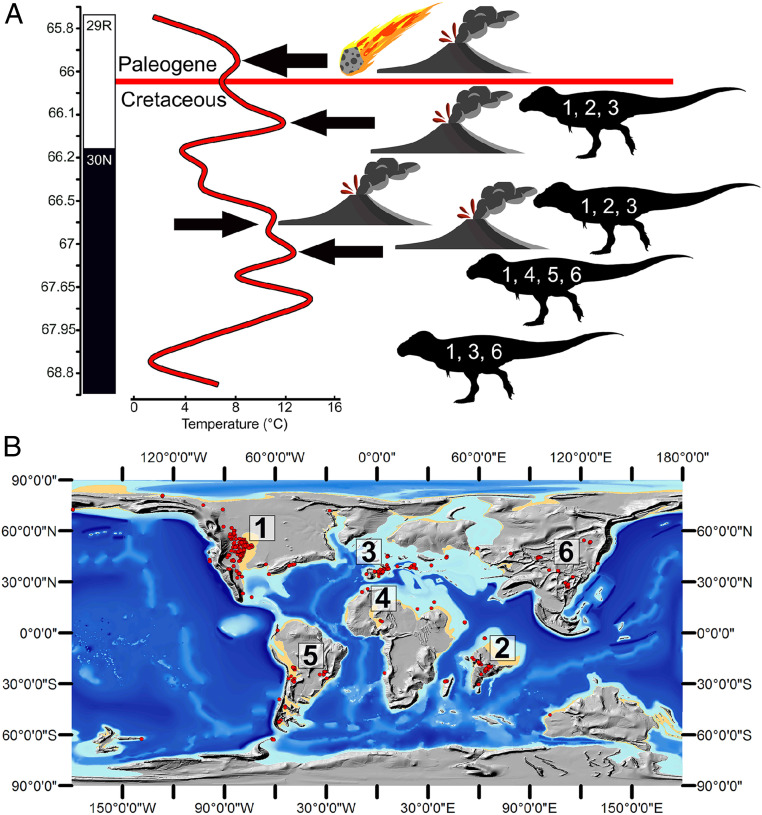
Significance: We present a quantitative test of end-Cretaceous extinction scenarios and how these would have affected dinosaur habitats. Combining climate and ecological modeling tools, we demonstrate a substantial detrimental effect on dinosaur habitats caused by an impact winter scenario triggered by the Chicxulub asteroid. We were not able to obtain such an extinction state with several modeling scenarios of Deccan volcanism. We further show that the concomitant prolonged eruption of the Deccan traps might have acted as an ameliorating agent, buffering the negative effects on climate and global ecosystems that the asteroid impact produced at the Cretaceous–Paleogene boundary.
Checked 2026-11-12 · 1 reference not checked yet
Overview
CoChat Summary
Written by AI from the paper’s full text.
TL;DR
Combining climate and habitat suitability models, this study finds that a Chicxulub asteroid impact winter produced extinction-level loss of non-avian dinosaur habitat, whereas modeled Deccan volcanism scenarios did not. Deccan CO₂ release may instead have buffered post-impact cooling and accelerated ecological recovery.
Key findings
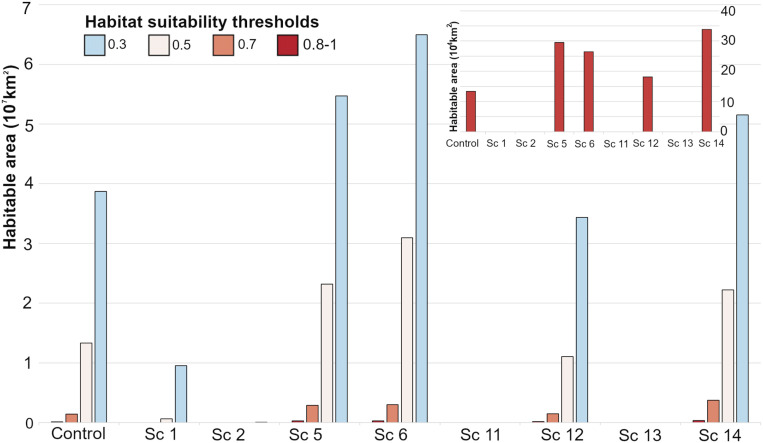
- Solar dimming scenarios reduced dinosaur habitat: 5% dimming left potential habitat at 4% and 24% of pre-K/Pg values at suitability thresholds 0.5 and 0.3, respectively; 10% dimming reduced habitat to 0.4% at the 0.3 threshold; habitat was extinguished at ≥15% dimming.
- Deccan CO₂ warming increased maximum dinosaur habitat suitability by ∼120% at 1,120 ppm CO₂ and ∼97% at 1,680 ppm CO₂ in Ensemble models, and by ∼27% and ∼32% in MaxEnt, so long-term Deccan volcanism alone could not explain complete dinosaur habitat disruption.
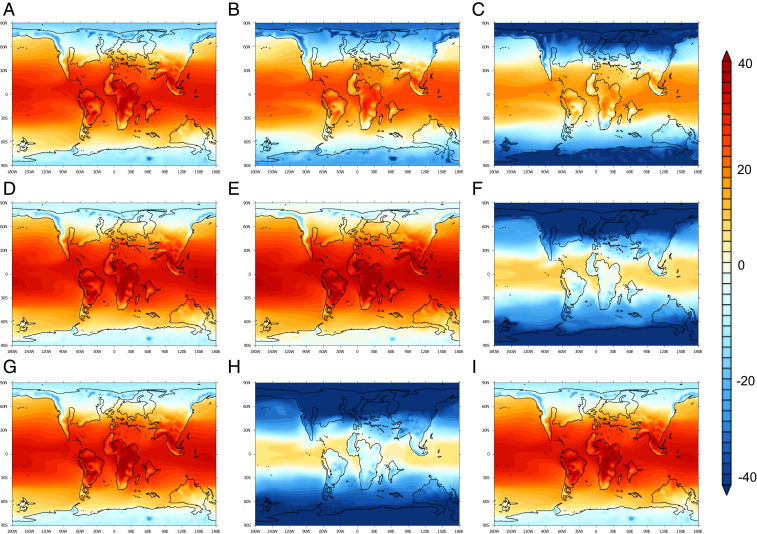
- Transient asteroid aerosol experiments produced >34 °C global mean cooling over the 6-y aerosol period, peak land surface cooling of −34.7 °C globally within 5 y, and >85% reduction in land precipitation, causing an extinction-level event for the non-avian dinosaur climatic niche.
- Climate recovery took around 30 y, accelerated by ∼10 y with Deccan-derived CO₂; an ash layer over North America offset ∼4–5 °C of land surface cooling. With active volcanism, maximum habitability increased 152% from preimpact levels after recovery.
Methods
- Used the coupled atmosphere–ocean GCM HadCM3L-M2.1 with end-Cretaceous boundary conditions and 560 ppm CO₂ baseline, running decoupled and transient scenarios including 5–20% solar dimming, 1,120/1,680 ppm CO₂, and 100× Pinatubo aerosol forcing with/without ash and Deccan CO₂.
- Assembled a late Maastrichtian (69–66 Ma) global dinosaur fossil-occurrence dataset from the Paleobiology Database, cleaned to 2,088 entries across nine clades.
- Modeled habitat suitability using Ensemble modeling in biomod2 and MaxEnt, with predictors limited to warmest/coldest annual quartile temperatures and wettest/driest yearly quarter precipitation after removing collinear variables (Pearson’s r ≥ 0.7).
Limitations
- The paper states that chemical processes were not simulated and could further lead to habitat loss; the precise amount of Deccan CO₂ released is unknown; and the pace and magnitude of Deccan volcanism remain uncertain.
- The authors state they do not discount biotic effects or other untested abiotic drivers (e.g., wildfire, acid rain, acidification, halogens, ultraviolet radiation, carbon cycle disruption), and they note that a deep-ocean impact scenario involving stratospheric water vapor was not tested.
- Evident from the text: habitat suitability models rely on analogy with crocodiles and birds and on fossil occurrence data, and the Deccan CO₂ scenarios are described as conservative/extreme and likely unrealistic in amount, so the modeled volcanic buffering effect depends on uncertain forcing assumptions.
Model-written summary. Check it against the paper before relying on it.
Integrity signals
Registry
Cites
Statistics
Figures
Verification
Claims the paper makes
31 Own result · 27 Check pending · 11 Own interpretation · 6 No full text of the sources · 6 Not checked yet · 4 Own method
A result the paper reports from its own data — it cites no other source for it, so there is none to check. The quote shows it is in the paper.
In the paper
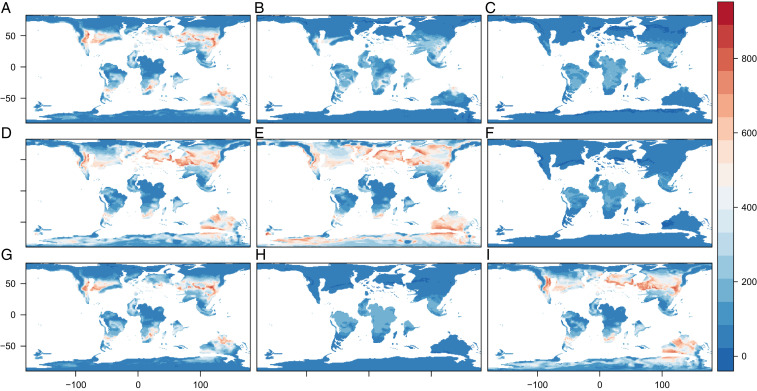
“At 10% solar dimming, potential habitat is effectively removed (0.4% of pre-K/Pg values) (Fig. 3C) at the lowest habitability threshold (0.3) (Fig. 4).”
§ Asteroid impact, not volcanism, caused the end-Cretaceous dinosaur extinction > Results
plainstates a cause- Asserted: passes — The authors put it forward as true.
- Checkable: passes — It can be checked against evidence.
- Load-bearing: passes — The paper’s conclusions depend on it.
- Based: passes — The paper gives a reason why it holds.
A result the paper reports from its own data — it cites no other source for it, so there is none to check. The quote shows it is in the paper.
In the paper
“We show that the abiotic impact of Deccan volcanism was not sufficient to cause the extinction of non-avian dinosaurs, while the effects of the impact alone were enough to cause the extinction.”
§ Asteroid impact, not volcanism, caused the end-Cretaceous dinosaur extinction > Discussion
plainstates a cause- Asserted: passes — The authors put it forward as true.
- Checkable: passes — It can be checked against evidence.
- Load-bearing: passes — The paper’s conclusions depend on it.
- Based: passes — The paper gives a reason why it holds.
A result the paper reports from its own data — it cites no other source for it, so there is none to check. The quote shows it is in the paper.
In the paper
“Global habitability increases in models simulating long-term CO2 injection due to Deccan volcanism, in case an asteroid impact would not have happened (Fig. 3 D and E): maximum dinosaur habitat suitability increases by ∼120% at 1,120 ppm of CO2 and ∼97% at 1,680 ppm of CO2.”
§ Asteroid impact, not volcanism, caused the end-Cretaceous dinosaur extinction > Results
hedgedstates a cause- Asserted: passes — The authors put it forward as true.
- Checkable: passes — It can be checked against evidence.
- Load-bearing: passes — The paper’s conclusions depend on it.
- Based: passes — The paper gives a reason why it holds.
A result the paper reports from its own data — it cites no other source for it, so there is none to check. The quote shows it is in the paper.
In the paper
“The 5% solar dimming experiment leads to a substantial, but noncatastrophic, 50% reduction in peak habitability from pre-K/Pg values (SI Appendix, Fig. S18 A and B).”
§ Asteroid impact, not volcanism, caused the end-Cretaceous dinosaur extinction > Results
plainstates a cause- Asserted: passes — The authors put it forward as true.
- Checkable: passes — It can be checked against evidence.
- Load-bearing: unclear — It is unclear whether the paper’s conclusions depend on it.
- Based: passes — The paper gives a reason why it holds.
A result the paper reports from its own data — it cites no other source for it, so there is none to check. The quote shows it is in the paper.
In the paper
“The transient asteroid experiments show an extinction-level event of the non-avian dinosaurs’ climatic niche (Fig. 3 F and H), coincident with the lowest temperatures reached in experimental simulations after asteroid-induced cooling (SI Appendix, Fig. S3).”
§ Asteroid impact, not volcanism, caused the end-Cretaceous dinosaur extinction > Results
plainstates an association- Asserted: passes — The authors put it forward as true.
- Checkable: passes — It can be checked against evidence.
- Load-bearing: passes — The paper’s conclusions depend on it.
- Based: passes — The paper gives a reason why it holds.
- It may state two separate claims as one. 25
- Probably not a substantial claim. 20
Create a free account to see these claims.
Create a free account to see these assumptions.
38 more claims
Create a free account to see all 85 claims and to verify the 50 references still open.
Self-check
Percentages, sums and reported differences re-computed from the paper’s own numbers.
Each contradiction between two passages listed here was confirmed by an independent check.
Rated minor: it would not touch a result — a value no result rests on, a p-value that stays on the same side of the significance level, or a conflict that is clerical, resolved elsewhere in the paper, or outside its own findings.
In the paper
§ Asteroid impact, not volcanism, caused the end-Cretaceous dinosaur extinction > Results
“A transient model including both Deccan volcanism and the effect of the Chicxulub impact is shown in F (scenario 11) and G (scenario 12), and with inactive volcanism (H, scenario 13 and I, scenario 14)”
§ Asteroid impact, not volcanism, caused the end-Cretaceous dinosaur extinction > Results
“The effect on the dinosaur-suitable habitats for two transient simulations with Deccan volcanism inactive (F, scenario 11 and G, scenario 12) and active (H, scenario 13 and I, scenario 14)”
Rated minor: it would not touch a result — a value no result rests on, a p-value that stays on the same side of the significance level, or a conflict that is clerical, resolved elsewhere in the paper, or outside its own findings.
In the paper
§ Asteroid impact, not volcanism, caused the end-Cretaceous dinosaur extinction > Discussion
“Our simulations (Tables 1 and 2) suggest that sea surface temperatures would have been reduced for all scenarios”
§ Asteroid impact, not volcanism, caused the end-Cretaceous dinosaur extinction > Results
“| Control | 22.64 | 12.41 | 21.65 | 11.49 | 18.96 | 3.5 | 2.38 | 3.2 | | −5% Sol. (Sc 1) | 16.93 | 12.06 | 14.87 | 1.83 | 11.42 | 3 | 2.05 | 2.75 | | −10% Sol. (Sc 2) | 11.06 | 11.72 | 4.56 | −12.18 | 0.13 | 2.5 | 1.59 | 2.26 | | 2 × CO2 > 4 × CO2 (Sc 5) | 25.11 | 12.56 | 24.47 | 16.2 | 22.28 | 3.58 | 2.49 | 3.29 | | 2 × CO2 > 6 × CO2 (Sc 6) | 27.02 | 12.66 | 26.86 | 20.24 | 25.11 | 3.59 | 2.5 | 3.3 |”
Citations
Cites
A statistical explanation of MaxEnt for ecologists
Elith, J., Phillips, S. J., Hastie, T., Dudík, M., Chee, Y. E., & Yates, C. J. (2011) · Diversity and Distributions · doi:10.1111/j.1472-4642.2010.00725.x · Cited by 6,699
Extraterrestrial Cause for the Cretaceous-Tertiary Extinction
Alvarez, L. W., Alvarez, W., Asaro, F., & Michel, H. V. (1980) · Science · doi:10.1126/science.208.4448.1095 · Cited by 3,198
BIOMOD – a platform for ensemble forecasting of species distributions
Thuiller, W., Lafourcade, B., Engler, R., & Araújo, M. B. (2009) · Ecography · doi:10.1111/j.1600-0587.2008.05742.x · Cited by 2,762
Opening the black box: an open‐source release of Maxent
Phillips, S. J., Anderson, R. P., Dudík, M., Schapire, R. E., & Blair, M. E. (2017) · Ecography · doi:10.1111/ecog.03049 · Cited by 2,729
Mass extinctions in the marine fossil record
Raup, D. M., & Sepkoski, J. J. (1982) · Science · doi:10.1126/science.215.4539.1501 · Cited by 1,774
The Chicxulub Asteroid Impact and Mass Extinction at the Cretaceous-Paleogene Boundary
Schulte, P., Alegret, L., Arenillas, I., Arz, J. A., Barton, P. J., Bown, P. R., Bralower, T. J., Christeson, G. L., Claeys, P., Cockell, C. S., et al. (2010) · Science · doi:10.1126/science.1177265 · Cited by 1,323
Self-citationThe Placental Mammal Ancestor and the Post–K-Pg Radiation of Placentals
O’Leary, M. A., Bloch, J. I., Flynn, J. J., Gaudin, T. J., Giallombardo, A., Giannini, N. P., Goldberg, S. L., Kraatz, B., Luo, Z., Meng, J., et al. (2013) · Science · doi:10.1126/science.1229237 · Cited by 1,228
Large igneous provinces and mass extinctions
Wignall, P. B. (2001) · Earth-Science Reviews · doi:10.1016/s0012-8252(00)00037-4 · Cited by 1,217
Standards for distribution models in biodiversity assessments
Araújo, M. B., Anderson, R. P., Barbosa, A. M., Beale, C. M., Dormann, C. F., Early, R., Garcia, R. A., Guisan, A., Maiorano, L., Naimi, B., et al. (2019) · Science Advances · doi:10.1126/sciadv.aat4858 · Cited by 1,214
PREDICTING SPECIES' GEOGRAPHIC DISTRIBUTIONS BASED ON ECOLOGICAL NICHE MODELING
Peterson, A. T. (2001) · The Condor · doi:10.1650/0010-5422(2001)103[0599:psgdbo]2.0.co;2 · Cited by 1,019
Research works printed but not linked: 1
- 10.1093/condor/103.3.599 · DOI
Cited by
Items 201–230 of 230
Fluctuations in Biodiversity Over Geological Time
Brayard, A. (2025) · Wiley eBooks · doi:10.1002/9781394361830.ch8
Mass Extinction Events and Recoveries Among Animals
Carvalho, I. D. S., Júnior, H. I. D. A., Fernandes, A. C. S., & d'Oliveira, J. (2025) · Elsevier eBooks · doi:10.1016/b978-0-443-15750-9.00100-2
Evolution: Disentangling dinosaur discovery and diversity
Allen, B. J. (2025) · Current Biology · doi:10.1016/j.cub.2025.04.005
Mizrahi, M. (2025) · Asian Journal of Philosophy · doi:10.1007/s44204-025-00294-8
Mass Extinctions and the Paleobotanical Record
Degani-Schmidt, I., Spiekermann, R., Gobo, W. V., & Jasper, A. (2025) · Elsevier eBooks · doi:10.1016/b978-0-443-15750-9.00101-4
Terrestrial planetary plants: Essential preparations for interstellar migration
Luo, X., Wang, Y., Zhan, J., & Ren, M. (2025) · Current Plant Biology · doi:10.1016/j.cpb.2025.100544
Patarroyo, G. D., Ceolín, D., Kochhann, K. G. D., Torres, G. A., & Rincón‐Martínez, D. (2025) · Journal of South American Earth Sciences · doi:10.1016/j.jsames.2025.105807
Mori, S., Arefifard, S., Algeo, T. J., & Schueth, J. D. (2025) · Marine Micropaleontology · doi:10.1016/j.marmicro.2025.102522
Antroposen ve iklim krizi: Doğanın sömürülmesinden adaletsizliğe
VURAL, Ç. (2025) · Nevşehir Hacı Bektaş Veli Üniversitesi SBE Dergisi · doi:10.30783/nevsosbilen.1622492
Jones, H. L., Kearns, L., Sepúlveda, J., Lowery, C. M., Alegret, L., Westerhold, T., Negra, M. H., Patzkowsky, M. E., & Bralower, T. J. (2025) · doi:10.31223/x5f74c
Morales, P., Gajardo, F., Valdivieso, C., Valladares, M. A., Genova, A. D., Orellana, A., Gutiérrez, R. A., González, M., Montecino, M. A., Maass, A., et al. (2024) · Figshare · doi:10.6084/m9.figshare.26735943
Morales, P., Gajardo, F., Valdivieso, C., Valladares, M. A., Genova, A. D., Orellana, A., Gutiérrez, R. A., González, M., Montecino, M. A., Maass, A., et al. (2024) · Figshare · doi:10.6084/m9.figshare.26735937
Morales, P., Gajardo, F., Valdivieso, C., Valladares, M. A., Genova, A. D., Orellana, A., Gutiérrez, R. A., González, M., Montecino, M. A., Maass, A., et al. (2024) · Figshare · doi:10.6084/m9.figshare.26735940
Bermúdez, H. D., Vajda, V., Clauss, K. G. V. S., Rundhaug, C., Kenny, G. G., Bolívar, L., Bermúdez, D., & Cui, Y. (2025) · SSRN Electronic Journal · doi:10.2139/ssrn.5477066
Asokan, A. D., Kadlag, Y., Srivastava, Y., Das, K. K., Hazarika, R., & Day, J. M. D. (2026) · Meteoritics and Planetary Science · doi:10.1111/maps.70099
Contreras-Figueroa, G., Hendy, A., & Aragón, J. L. (2026) · PLoS ONE · doi:10.1371/journal.pone.0343127
Liu, X., Zhang, H., Jiao, S., Gorgij, M. N., Cai, Y., Ni, W., Tang, L., & Shen, S. (2026) · Palaeogeography Palaeoclimatology Palaeoecology · doi:10.1016/j.palaeo.2026.113672
Couzens, A. M. C., Lau, C. L. F., & Sears, K. E. (2026) · bioRxiv (Cold Spring Harbor Laboratory) · doi:10.64898/2026.03.05.709990
Impact des interactions biotiques et paléo-évènements sur la diversification des Insecta
Jouault, C. (2024) · theses.fr (ABES) · doi:10.70675/cd725954zececz497dz9ff0zd89f2cb66620
Nikolaenko, D. (2026) · Pollution and Diseases · doi:10.66659/pd.2025.02
Wilson, J. D., Imperial, J. L., Trelfa, A. S. C., Lyson, T. R., & Bever, G. S. (2026) · Journal of Vertebrate Paleontology · doi:10.1080/02724634.2026.2642798
How to Survive a Mass Extinction: Lessons from Fern Gametophytes
Kim, E. H., Wheatley, K., Pelosi, J. A., Currano, E. D., Dunn, R. E., Gill, J. L., Pittermann, J., & Sessa, E. B. (2026) · American Fern Journal · doi:10.1640/0002-8444-116.2.109
Geographic Template for the Diversification of Amazonian Fishes
Albert, J. S., & REIS, R. E. (2026) · Fascinating life sciences · doi:10.1007/978-3-032-09328-8_1
Michele Stoppa, V. A., Stoppa, M., & Zuccheri, L. (2026) · ArTS Archivio della ricerca di Trieste (University of Trieste https://www.units.it/)
Erwin, D. H. (2026) · Natural Sciences · doi:10.1002/ntls.70079
Guillaume, A. R. D., Blain, H., Puértolas‐Pascual, E., & Moreno‐Azanza, M. (2026) · Cretaceous Research · doi:10.1016/j.cretres.2026.106505
Chiarenza, A. A., Howard, A., Varnham, G., Farnsworth, A., Valdes, P., & Mannion, P. (2026) · Science Advances · doi:10.1126/sciadv.aeg2217
Self-citationLife After Impact: Paleobathymetric Gradients in Post‐K/Pg Nannoplankton Boom‐Bust Successions
Jones, H. L., Kearns, L. E., Sepúlveda, J., Lowery, C. M., Alegret, L., Westerhold, T., Negra, M. H., Henehan, M. J., Whiteside, J. H., Vellekoop, J., et al. (2026) · Paleoceanography and Paleoclimatology · doi:10.1029/2026pa005729
Metadata
- Authors
- Chiarenza, A. A., Farnsworth, A., Mannion, P. D., Lunt, D. J., Valdes, P. J., Morgan, J. V., & Allison, P. A.
- Affiliations
- University College London (GB)
- School of Geographical Sciences, University of Bristol, BS8 1TH Bristol, United Kingdom
- University of Bristol (GB)
- Imperial College London (GB)
- Corresponding author
- Chiarenza, Alfio Alessandro
- ORCID
- Venue
- Proceedings of the National Academy of Sciences
- Publisher
- National Academy of Sciences
- Published
- 2020-06-29
- Volume
- 117
- Issue
- 29
- Pages
- 17084-17093
- ISSN
- 0027-8424 (ISSN-L)
- 1091-6490
- PMC
- PMC7382232
- OpenAlex
- W3038551147
- Cited by
- 228
- References
- 94
- Citations by year
- 2026: 24 · 2025: 32 · 2024: 32 · 2023: 36 · 2022: 65 · 2021: 29 · 2020: 9
- FWCI
- 18.30
- Type
- journal article
- Language
- en
- Open access
- hybrid
- doi.org
- Licence
- Locations
- Proceedings of the National Academy of Sciences (publishedVersion, cc-by-nc-nd)
- PubMed (publishedVersion)
- PubMed Central (publishedVersion, cc-by-nc-nd)
- Bristol Research (University of Bristol) (publishedVersion, cc-by-nc-nd)
- UCL Discovery (University College London) (submittedVersion)
- Spiral (Imperial College London) (submittedVersion, other-oa)
- Funders
- Natural Environment Research Council (NE/P005217/1, NE/P013805/1, NE/K014757/1)
- Topics
- Physical Sciences › Earth and Planetary Sciences › Paleontology › Paleontology and Stratigraphy of Fossils
- Physical Sciences › Earth and Planetary Sciences › Paleontology › Paleontology and Evolutionary Biology
- Physical Sciences › Earth and Planetary Sciences › Paleontology › Evolution and Paleontology Studies
- Keywords
- end-Cretaceous mass extinction, dinosaur extinction, Chicxulub impact, impact winter, Deccan Traps, Deccan volcanism, Cretaceous-Paleogene boundary, climate modeling, ecological modeling, extinction scenarios
- MeSH terms
- Animals, Carbon Dioxide, Climate, Fossils, India, Mexico, Models, Biological, Paleontology, Minor Planets, Volcanic Eruptions, Dinosaurs, History, Ancient, Extinction, Biological
About these checks
Registry, retraction, Cites and statistics results are computed, not judged, with one exception: a printed reference that no index lists is read once by a model before it counts as a citation error. Claims are extracted by a model and kept only when their quote appears verbatim in the text; each cited source is then checked, with a model’s help, for whether it says what the claim relies on. Those verdicts can be wrong — read the claim’s quote and the cited source before relying on one.
A language model drew the claims from the paper on 2026-11-12, under version 3 of the claim definition (model deepseek-v4.1-flash, prompt extract-v3).
A second model labelled each claim on 2026-11-12 (model jev-1.13-20260917, definition revision gold-guideline-v0.2).
Statistics and arithmetic are recomputed, not judged.
Confidence bands are shown only for fields calibrated on our annotated test set. None is calibrated yet, so no band is shown.
What counts as a claim ›How we measure confidence ›How we check this ›
Are you an author, or do you see a problem with this page? Request a review
