

Distinct hypertrophic cardiomyopathy genotypes result in convergent sarcomeric proteoform profiles revealed by top-down proteomics
Open accessThe DOI matches its Crossref record; 65 of the 70 references it cites were found in a registry or an index, and 5 are not checked yet; 18 of the 69 sources its claims cite were checked for support.
Abstract
Significance: Hypertrophic cardiomyopathy (HCM) is a common genetic heart disease and a leading cause of sudden cardiac death in young adults. HCM has been linked to mutations in genes encoding sarcomeric proteins, but how different mutations can result in a similar clinical phenotype is unknown. Analysis of surgical heart tissue samples from HCM patients with severe outflow track obstruction using high-resolution mass spectrometry–based top-down proteomics revealed a common pattern of altered sarcomeric proteoforms across HCM tissues compared to non-failing donor heart tissues. Our data suggest that common pathways are associated with clinical phenotypes in patients diagnosed with obstructive HCM, opening the door for the development of interventions that target the HCM phenotype rather than the individual sarcomeric gene mutation.
Verified 2026-10-05 · 5 references not checked yet
Overview
CoChat Summary
TL;DR
Top-down proteomics of human HCM septal myectomy and donor heart tissues revealed a complex sarcomeric proteoform landscape and convergent phosphorylation/isoform changes across different HCM genotypes. The findings suggest common PKA-related pathways and support targeting the obstructive HCM phenotype rather than individual sarcomeric mutations.
Key findings
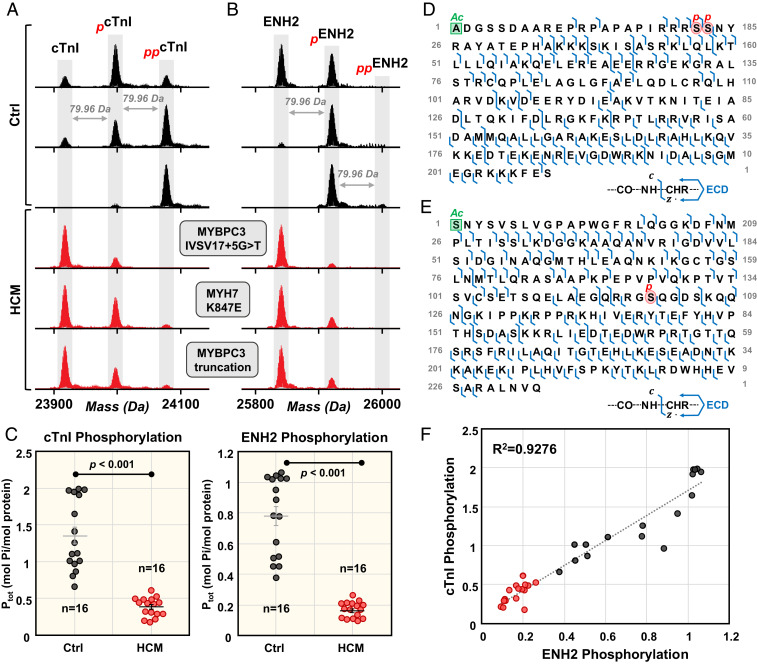
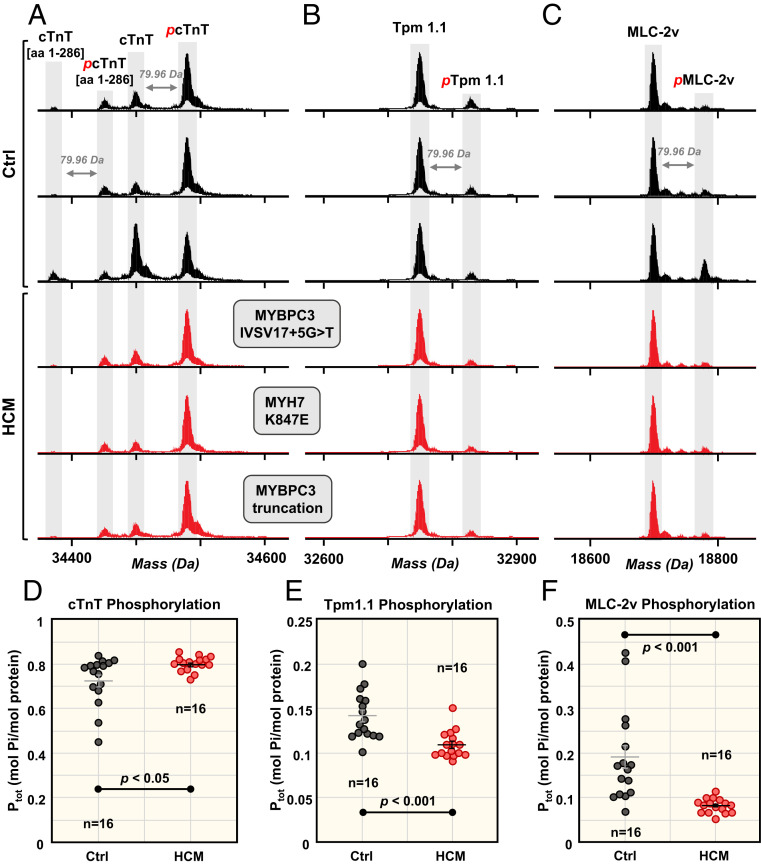
- In HCM tissues (n = 16) versus donor tissues (n = 16), total phosphorylation was significantly decreased for cTnI (HCM consistently below 0.6 mol Pi/mol protein vs. donor 0.7–2.0; P < 0.001), ENH2 (HCM below 0.3 vs. donor 0.4–1.1; P < 0.001), Tpm1.1 (23% decrease; P < 0.001), and MLC-2v (57% decrease; P < 0.001).
- cTnT total phosphorylation increased by about 10% in HCM tissues compared with donor tissues (P < 0.05), while cTnT (aa 1 to 286) phosphorylation increased by 8% but was not significant.
- cTnI and ENH2 phosphorylation were strongly linearly correlated across groups (R² = 0.9276); cTnI phosphorylation was localized to Ser22/23, ENH2 phosphorylation to Ser118, and PKA phosphorylated ENH2 in vitro.
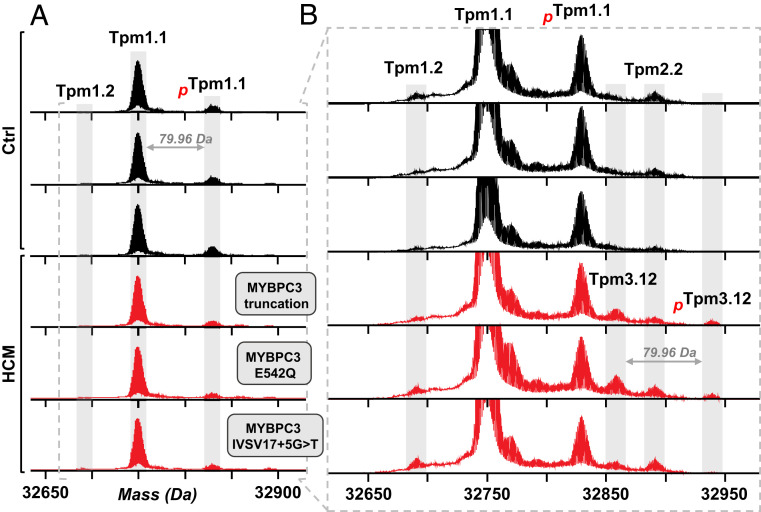
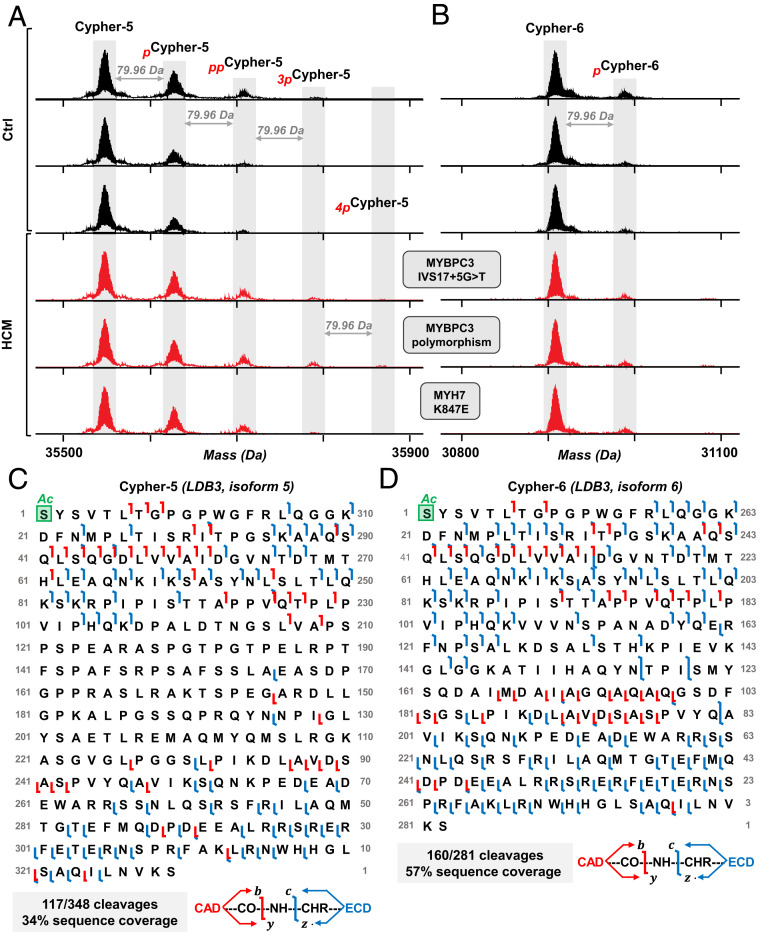
- Despite different HCM-causing mutations, the HCM tissues showed consistent sarcomeric proteoform alterations; Tpm3.12 was detected in eight HCM myectomy tissues but in none of the control samples, and MLC-1a percentage ranged from 0.7–11.3% in donor tissues and 1.1–13.9% in HCM tissues.
Methods
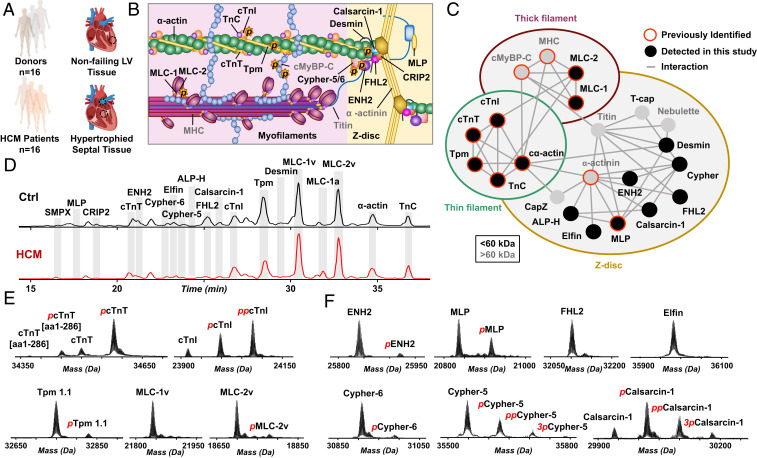
- Sarcomeric proteins were extracted from human septal myectomy tissues from obstructive HCM patients (n = 16) and left ventricular tissue from nonfailing donor hearts (n = 16); 500 ng total sarcomeric protein per sample was analyzed by LC-MS, requiring 7–10 mg tissue and less than 3 h per sample.
- Top-down MS used high-resolution LC-MS, with ultrahigh-resolution FTICR MS/MS and ECD/CAD for sequence characterization and PTM localization; proteoform relative abundance was calculated from peak intensities.
- Statistical significance between Ctrl and HCM groups was assessed with a Wilcoxon rank sum test because not all data were normally distributed by Shapiro–Wilk test; significance was set at P < 0.05.
Limitations
- The paper states that only surgical tissues from HCM patients with severe outflow tract obstruction undergoing septal myectomy were studied; early-stage/mild HCM is not represented, and it remains unclear whether the alterations are intrinsic to late-stage obstructive HCM or reflect obstructive physiology, so caution is needed in extrapolating to the entire HCM population.
- The paper states that only a small subset of HCM genotypes was captured, so the convergence conclusion is limited to obstructive HCM patients with mutations in MYH7 or MYBPC3 as analyzed, independent of specific mutation type.
- The text makes evident that low-abundance proteoforms (e.g., Tpm2.2, Tpm3.12, cypher-6, MLP, CRIP2, ALP-H) were difficult to quantify accurately, phosphorylation-site localization was challenging for low-abundance cypher proteoforms, and large proteins such as cMyBP-C (141 kDa) and MHC (223 kDa) were not detected because of MS signal decay with increasing molecular weight, coelution, and limited tissue amounts.
Model-written summary. Check it against the paper before relying on it.
Integrity signals
Registry
Cites
Statistics
Figures
Verification
Claims the paper makes
12 Valid · 0 Not valid · 25 Not checked · 100 Own results and interpretations
The sources with a verdict support this claim; the rest weren’t checked yet, have no full text we could read, or their verdicts aren’t rated yet.
In the paper
“Although the genetic basis of HCM has been identified and continues to be studied, the ability to predict clinical outcomes based on specific mutations in HCM patients is limited (3, 4, 11).”
§ Distinct hypertrophic cardiomyopathy genotypes result in convergent sarcomeric proteoform profiles revealed by top-down proteomics > Abstract
What the sources say
- Supportedcites [3] Landstrom A. P., Ackerman M. J., Mutation type is not clinically useful in predicting prognosis in hypertrophic cardiomyopathy. Circulation 122, 2441– 2449, discussion 2450 (2010). 21135372 PMC6309993 source
The Conclusion states that a specific mutation has no prognostic utility in isolation because the same mutation can produce markedly different HCM phenotypes. The Introduction’s “Recent Advances in the Prognostic Role of Genotyping” likewise says mutation-specific risk stratification is not possible, while distinguishing it from the potential value of a positive genetic test overall. (LLM, conf=0.94)
- Not checked yetcites [4] Frey N., Luedde M., Katus H. A., Mechanisms of disease: Hypertrophic cardiomyopathy. Nat. Rev. Cardiol. 9, 91– 100 (2011). 22027658 source
- Not checked yetcites [11] Tower-Rader A., Desai M. Y., Phenotype-genotype correlation in hypertrophic cardiomyopathy: Less signal, more noise? Circ. Cardiovasc. Imaging 10 (2017). 28193615 source
plain- Asserted: passes — The authors put it forward as true.
- Checkable: passes — It can be checked against evidence.
- Load-bearing: passes — The paper’s conclusions depend on it.
- Based: passes — The paper gives a reason why it holds.
- Supported
The cited sources support only part of this claim — read each source’s verdict below.
In the paper
“The decrease in cTnI phosphorylation at Ser22/23 observed in this study (Figs. 2 A, C, and E) is consistent with previous reports which investigated HCM (59, 61, 62).”
§ Distinct hypertrophic cardiomyopathy genotypes result in convergent sarcomeric proteoform profiles revealed by top-down proteomics > Discussion > Coordinated Decrease in cTnI and ENH2 Phosphorylation Suggests Dysregulation in PKA-Mediated Phosphorylation in HCM.
What the sources say
- Not checked yetcites [59] Messer A. E., Gallon C. E., McKenna W. J., Dos Remedios C. G., Marston S. B., The use of phosphate-affinity SDS-PAGE to measure the cardiac troponin I phosphorylation site distribution in human heart muscle. Proteomics Clin. Appl. 3, 1371– 1382 (2009). 21136957 source
- Not checked yetcites [61] Bayliss C. R.., Myofibrillar Ca(2+) sensitivity is uncoupled from troponin I phosphorylation in hypertrophic obstructive cardiomyopathy due to abnormal troponin T. Cardiovasc. Res. 97, 500– 508 (2013). 23097574 source
- Partly supportedcites [62] Messer A. E.., Mutations in troponin T associated with Hypertrophic Cardiomyopathy increase Ca(2+)-sensitivity and suppress the modulation of Ca(2+)-sensitivity by troponin I phosphorylation. Arch. Biochem. Biophys. 601, 113– 120 (2016). 27036851 PMC4909753 sourceExperimental — accuracy not yet measured
In the Discussion ("Regulatory properties of the homozygous TnT K280N mutant patient tissue sample") our copy states that "Previously HCM was studied in tissue from septal myectomies that always had a very low level of phosphorylation of both TnI and MyBP-C", and the Results ("Human heart sample with TnT K280N mutation") likewise describe HOCM interventricular septum muscle as having "very low levels of TnI phosphorylation" and the patient's 1.4-1.6 mols Pi/mol TnI as "substantially greater than heart samples from septal myectomy operations" while "not significantly different from donor heart troponin" (Table 1). That supports a decrease in overall cTnI phosphorylation in HCM tissue relative to donor. However, our copy never names the Ser22/23 sites: phosphorylation is measured only as total mols Pi/mol TnI by phosphate affinity SDS-PAGE (Methods, "Manipulation and measurement of TnI phosphorylation level"), with PKA used only to phosphorylate recombinant TnI in vitro, so the site-specific attribution is not stated here. Note also that these low-phosphorylation HCM observations are credited by the paper to earlier works ([23] Bayliss et al. 2012, [24] Messer et al. 2009, [35] Jacques et al. 2008, [36] Copeland et al. 2010) rather than generated as new data in this study, and this paper's own HCM patient sample was an exception with donor-equivalent phosphorylation. (LLM, conf=0.72)
plain- Asserted: passes — The authors put it forward as true.
- Checkable: passes — It can be checked against evidence.
- Load-bearing: passes — The paper’s conclusions depend on it.
- Based: passes — The paper gives a reason why it holds.
- Rests on 2 assumptions not shown here.
The cited sources support only part of this claim — read each source’s verdict below.
In the paper
“This is supported by the recent study by Marston and coworkers, which demonstrated that pressure overload was the most important stimulus leading to low phosphorylation levels of cTnI and cMyBP-C (43).”
§ Distinct hypertrophic cardiomyopathy genotypes result in convergent sarcomeric proteoform profiles revealed by top-down proteomics > Discussion > Converging Sarcomeric Proteoform Profiles in HCM.
What the sources say
- Partly supportedcites [43] Copeland O.., Pressure overload is associated with low levels of troponin I and myosin binding protein C phosphorylation in the hearts of patients with aortic stenosis. Front. Physiol. 11, 241 (2020). 32265736 PMC7096377 sourceExperimental — accuracy not yet measured
The Results and Discussion report lower TnI and MyBP-C phosphorylation in pressure-overloaded hearts than in donor hearts. The Conclusion describes an association with pressure overload but says the underlying cause is unknown; it does not establish pressure overload as the most important causal stimulus. (LLM, conf=0.89)
boostedstates a cause- Asserted: passes — The authors put it forward as true.
- Checkable: passes — It can be checked against evidence.
- Load-bearing: passes — The paper’s conclusions depend on it.
- Based: passes — The paper gives a reason why it holds.
- Partly supported
The sources with a verdict support this claim; the rest weren’t checked yet, have no full text we could read, or their verdicts aren’t rated yet.
In the paper
“Unlike genomics, proteomics more precisely reflects cellular responses and disease phenotypes (21, 27, 28).”
§ Distinct hypertrophic cardiomyopathy genotypes result in convergent sarcomeric proteoform profiles revealed by top-down proteomics > Discussion > Converging Sarcomeric Proteoform Profiles in HCM.
What the sources say
- Not checked yetcites [21] Siuti N., Kelleher N. L., Decoding protein modifications using top-down mass spectrometry. Nat. Methods 4, 817– 821 (2007). 17901871 PMC2365886 source
- Not checked yetcites [27] Aebersold R., Mann M., Mass-spectrometric exploration of proteome structure and function. Nature 537, 347– 355 (2016). 27629641 source
- Supportedcites [28] Gregorich Z. R., Chang Y. H., Ge Y., Proteomics in heart failure: Top-down or bottom-up? Pflugers Arch. 466, 1199– 1209 (2014). 24619480 PMC4037365 source
The Introduction of our copy draws exactly this contrast: 'unlike the genome, which is considered to be largely static, the proteome is highly dynamic,' and it frames proteomics — the comprehensive characterization of protein localization, modifications, interactions, activities and ultimately function — as 'particularly well-suited for advancing our understanding of complex disease mechanisms at the systems level.' The Future section repeats the static-genome/dynamic-proteome contrast in the context of elucidating disease state changes, and the Protein identification section ties understanding how cells/tissues are altered in disease to protein-level analysis. The citing sentence's 'more precisely reflects' is a slightly stronger wording than the source's dynamism/suitability framing, but the attributed content (genomics static vs proteomics capturing the dynamic cellular/disease state) is stated in our copy. (LLM, conf=0.80)
plainstates an association- Asserted: passes — The authors put it forward as true.
- Checkable: passes — It can be checked against evidence.
- Load-bearing: passes — The paper’s conclusions depend on it.
- Based: passes — The paper gives a reason why it holds.
The sources with a verdict support this claim; the rest weren’t checked yet, have no full text we could read, or their verdicts aren’t rated yet.
In the paper
“Moreover, genotype alone is not sufficient to predict clinical outcomes in HCM patients, given the multifactorial nature of the disease (3, 11, 42).”
§ Distinct hypertrophic cardiomyopathy genotypes result in convergent sarcomeric proteoform profiles revealed by top-down proteomics > Discussion > Converging Sarcomeric Proteoform Profiles in HCM.
What the sources say
- Supportedcites [3] Landstrom A. P., Ackerman M. J., Mutation type is not clinically useful in predicting prognosis in hypertrophic cardiomyopathy. Circulation 122, 2441– 2449, discussion 2450 (2010). 21135372 PMC6309993 source
The Conclusion says that factors beyond an HCM-causing mutation can produce markedly different outcomes in people with the same mutation, leaving a specific mutation without prognostic utility in isolation. The Introduction likewise describes HCM as multifactorial and cautions against using a distinct mutation alone to predict clinical phenotype. (LLM, conf=0.93)
- Not checked yetcites [11] Tower-Rader A., Desai M. Y., Phenotype-genotype correlation in hypertrophic cardiomyopathy: Less signal, more noise? Circ. Cardiovasc. Imaging 10 (2017). 28193615 source
- Supportedcites [42] Marian A. J., van Rooij E., Roberts R., Genetics and genomics of single-gene cardiovascular diseases: Common hereditary cardiomyopathies as prototypes of single-gene disorders. J. Am. Coll. Cardiol. 68, 2831– 2849 (2016). 28007145 PMC5189923 source
The Genetic Basis of HCM section, under “Genotype-phenotype association,” says variable expression and penetrance impede the predictive utility of genetic testing in HCM. It attributes that variability partly to multiple genetic and nongenetic determinants, supporting the claim that genotype alone cannot predict clinical outcomes. (LLM, conf=0.93)
plain- Asserted: passes — The authors put it forward as true.
- Checkable: passes — It can be checked against evidence.
- Load-bearing: passes — The paper’s conclusions depend on it.
- Based: passes — The paper gives a reason why it holds.
- Supported
64 more claims
Create a free account to see all 137 claims and to verify the 51 references still open.
- Probably not a substantial claim. 46
- It may state two separate claims as one. 44
Claims other papers make about this one
Each is checked against this paper’s own text: does it say what the citing paper says it does?
The cited source says what the claim attributes to it.
In the citing paper
“Their results convincingly show that regardless of the HCM causing mutation, convergent sarcomeric proteoforms were observed in the HCM samples compared to the donor samples.”
From Top-down proteomics: challenges, innovations, and applications in basic and clinical research (2020) · cites this paper as [149]
The cited source says what the claim attributes to it.
In the citing paper
“Tucholski et al. performed a large-scale quantitative top-down proteomics study of donor (n=16) and obstructive HCM (n=16) samples to compare the proteoform landscape between the two groups (Figure 4) [149].”
From Top-down proteomics: challenges, innovations, and applications in basic and clinical research (2020) · cites this paper as [149]
The cited source says what the claim attributes to it.
In the citing paper
“In addition, Tucholski et al. also observed highly consistent changes in the phosphorylation levels of cardiac troponin T, tropomyosin isoform 1.1, and the ventricular isoform of myosin light chain 2 in the HCM samples.”
From Top-down proteomics: challenges, innovations, and applications in basic and clinical research (2020) · cites this paper as [149]
In the citing paper
“Interestingly, the authors determined a strong linear correlation of decreased phosphorylation levels of cardiac troponin I and enigma homolog 2 in the HCM samples suggesting protein crosstalk or dysregulation of signaling by cAMP-dependent protein kinase A (Figure 4) [149].”
From Top-down proteomics: challenges, innovations, and applications in basic and clinical research (2020) · cites this paper as [149]
1 more claim about this paper
Create a free account to see every claim other papers make about this one.
Citations
Cites
Mass-spectrometric exploration of proteome structure and function
Aebersold, R., & Mann, M. (2016) · Nature · doi:10.1038/nature19949 · Cited by 2,334 · cited 3×
“While MS-based techniques provide information without a priori knowledge, shotgun bottom-up proteomics has intrinsic limitations due to the “peptide-to-protein” inference problem and is, therefore, unable to provide proteoform-specific information (12, 27).”
BackgroundProtein Analysis by Shotgun/Bottom-up Proteomics
Zhang, Y., Fonslow, B. R., Shan, B., Baek, M.-C., & Yates, J. R. (2013) · Chemical Reviews · doi:10.1021/cr3003533 · Cited by 1,491 · cited 1×
“In contrast to shotgun “bottom-up” proteomics (26, 27), which employs proteolytic digestion of proteins prior to MS analysis introducing a “peptide-to-protein” inference problem, top-down proteomics allows for direct analysis of intact proteins without digestion, thus providing a “bird’s-eye” view of existing proteofo…”
BackgroundElectron Capture Dissociation for Structural Characterization of Multiply Charged Protein Cations
Zubarev, R. A., Horn, D. M., Fridriksson, E. K., Kelleher, N. L., Kruger, N. A., Lewis, M. A., Carpenter, B. K., & McLafferty, F. W. (2000) · Analytical Chemistry · doi:10.1021/ac990811p · Cited by 986 · cited 1×
“To identify the specific sites of cTnI phosphorylation, we performed ultrahigh-resolution MS/MS using electron capture dissociation (ECD), which preserves labile PTMs such as phosphorylation (34).”
MethodClinical Course and Management of Hypertrophic Cardiomyopathy
Maron, B. J. (2018) · New England Journal of Medicine · doi:10.1056/nejmra1710575 · Cited by 944
Complete sequencing and characterization of 21,243 full-length human cDNAs
Ota, T., Suzuki, Y., Nishikawa, T., Otsuki, T., Sugiyama, T., Irie, R., Wakamatsu, A., Hayashi, K., Sato, H., Nagai, K., et al. (2004) · Nature Genetics · doi:10.1038/ng1285 · Cited by 925 · cited 1×
“Interestingly, wild-type elfin and a natural variant, elfin N175S (33), were revealed with evidence of both heterozygous and homozygous expression (SI Appendix, Fig.”
BackgroundHow many human proteoforms are there?
Aebersold, R., Agar, J. N., Amster, I. J., Baker, M. S., Bertozzi, C. R., Boja, E. S., Costello, C. E., Cravatt, B. F., Fenselau, C., Garcia, B. A., et al. (2018) · Nature Chemical Biology · doi:10.1038/nchembio.2576 · Cited by 907
Self-citationKnöll, R., Hoshijima, M., Hoffman, H. M., Person, V., Lorenzen-Schmidt, I., Bang, M.-L., Hayashi, T., Shiga, N., Yasukawa, H., Schaper, W., et al. (2002) · Cell · doi:10.1016/s0092-8674(02)01226-6 · Cited by 786 · cited 1×
“MLP comprises two LIM domains and is tethered to the Z-disk via its interactors, α-actinin2 and T-cap, playing an essential role in mechanical stretch sensor machinery (52).”
BackgroundLarge-scale phosphorylation analysis of mouse liver
Villén, J., Beausoleil, S. A., Gerber, S. A., & Gygi, S. P. (2007) · Proceedings of the National Academy of Sciences · doi:10.1073/pnas.0609836104 · Cited by 730 · cited 1×
“ECD fragmentation of the monophosphorylated and presence of phosphorylated z·-ions suggests that a phosphorylation site may be located at Thr107 or Thr111, phosphorylated residues that have been previously confirmed at the peptide level (39, 40).”
BackgroundDecoding protein modifications using top-down mass spectrometry
Siuti, N., & Kelleher, N. L. (2007) · Nature Methods · doi:10.1038/nmeth1097 · Cited by 503 · cited 3×
“In contrast to shotgun “bottom-up” proteomics (26, 27), which employs proteolytic digestion of proteins prior to MS analysis introducing a “peptide-to-protein” inference problem, top-down proteomics allows for direct analysis of intact proteins without digestion, thus providing a “bird’s-eye” view of existing proteofo…”
BackgroundPhosphorylation of troponin I and the inotropic effect of adrenaline in the perfused rabbit heart
SOLARO, R. J., MOIR, A. J. G., & PERRY, S. V. (1976) · Nature · doi:10.1038/262615a0 · Cited by 395 · cited 1×
“Myofibrilar Ca sensitivity is regulated by the PKA-mediated phosphorylation of cTnI at Ser22/23, with the phosphorylation of cTnI shown to decrease the Ca sensitivity of the myofilament in normal hearts (63, 64).”
Background
Cited by
Altered Cardiac Energetics and Mitochondrial Dysfunction in Hypertrophic Cardiomyopathy
Ranjbarvaziri, S., Kooiker, K. B., Ellenberger, M., Fajardo, G., Zhao, M., Vander Roest, A. S., Woldeyes, R. A., Koyano, T. T., Fong, R., Ma, N., et al. (2021) · Circulation · doi:10.1161/circulationaha.121.053575 · Cited by 309
Decoding Post-Translational Modification Crosstalk With Proteomics
Leutert, M., Entwisle, S. W., & Villén, J. (2021) · Molecular & Cellular Proteomics · doi:10.1016/j.mcpro.2021.100129 · Cited by 255
“More recently, top-down approaches have been applied to map proteoform landscapes of cardiac sarcomeric proteins and their differential phosphorylation in patient samples (64).”
BackgroundNovel Strategies to Address the Challenges in Top-Down Proteomics
Melby, J. A., Roberts, D. S., Larson, E. J., Brown, K. A., Bayne, E. F., Jin, S., & Ge, Y. (2021) · Journal of the American Society for Mass Spectrometry · doi:10.1021/jasms.1c00099 · Cited by 190
Self-citationRoberts, D. S., Loo, J. A., Tsybin, Y. O., Liu, X., Wu, S., Chamot-Rooke, J., Agar, J. N., Paša-Tolić, L., Smith, L. M., & Ge, Y. (2024) · Nature Reviews Methods Primers · doi:10.1038/s43586-024-00318-2 · Cited by 161
Self-citationTop-down proteomics: challenges, innovations, and applications in basic and clinical research
Brown, K. A., Melby, J. A., Roberts, D. S., & Ge, Y. (2020) · Expert Review of Proteomics · doi:10.1080/14789450.2020.1855982 · Cited by 152
Self-citationTargeting the sarcomere in inherited cardiomyopathies
Lehman, S. J., Crocini, C., & Leinwand, L. A. (2022) · Nature Reviews Cardiology · doi:10.1038/s41569-022-00682-0 · Cited by 128
Top-Down Proteomics and the Challenges of True Proteoform Characterization
Po, A., & Eyers, C. E. (2023) · Journal of Proteome Research · doi:10.1021/acs.jproteome.3c00416 · Cited by 123
Schmid, M., & Toepfer, C. N. (2021) · Biology Open · doi:10.1242/bio.057646 · Cited by 93
High sensitivity top–down proteomics captures single muscle cell heterogeneity in large proteoforms
Melby, J. A., Brown, K. A., Gregorich, Z. R., Roberts, D. S., Chapman, E. A., Ehlers, L. E., Gao, Z., Larson, E. J., Jin, Y., Lopez, J. R., et al. (2023) · Proceedings of the National Academy of Sciences · doi:10.1073/pnas.2222081120 · Cited by 70
“In particular, it is difficult to achieve comprehensive fragmentation in the online LC-MS/MS mode especially for large proteoforms >30 kDa (61).”
BackgroundSelf-citationDeciphering combinatorial post-translational modifications by top-down mass spectrometry
Brodbelt, J. S. (2022) · Current Opinion in Chemical Biology · doi:10.1016/j.cbpa.2022.102180 · Cited by 68
“ECD and CID were used to identify variations in profiles of sarcomeric proteins extracted from septal myectomy tissues from patients with hypertrophic cardiomyopathy, revealing alterations in splicing and phosphorylation patterns among FHL2, ALP-H, elfin, cypher-5, cypher-6, and calsarcin-1 [75].”
Licordari, R., Trimarchi, G., Teresi, L., Restelli, D., Lofrumento, F., Perna, A., Campisi, M., GREGORIO, C. D., Grimaldi, P., Calabrò, D., et al. (2023) · Journal of Clinical Medicine · doi:10.3390/jcm12103481 · Cited by 64
Small molecule modulation of protein corona for deep plasma proteome profiling
Ashkarran, A. A., Gharibi, H., Sadeghi, S. A., Modaresi, S. M., Wang, Q., Lin, T.-J., Yerima, G., Tamadon, A., Sayadi, M., Jafari, M. T., et al. (2024) · Nature Communications · doi:10.1038/s41467-024-53966-z · Cited by 65
Recent advances in top‐down proteome sample processing ahead of MS analysis
Nickerson, J. L., Baghalabadi, V., Rajendran, S. R. C. K., Jakubec, P. J., Said, H., McMillen, T. S., Dang, Z., & Doucette, A. A. (2023) · Mass Spectrometry Reviews · doi:10.1002/mas.21706 · Cited by 55
Xu, T., Wang, Q., Wang, Q., & Sun, L. (2024) · Analytical Methods · doi:10.1039/d4ay00651h · Cited by 56
Karpov, O. A., Stotland, A. B., Raedschelders, K., Chazarin, B., Ai, L., Murray, C. I., & Eyk, J. E. V. (2024) · Physiological Reviews · doi:10.1152/physrev.00026.2023 · Cited by 47
Omenn, G. S., Lane, L., Overall, C. M., Paik, Y., Cristea, I. M., Corrales, F. J., Lindskog, C., Weintraub, S. T., Roehrl, M. H. A., Liu, S., et al. (2021) · Journal of Proteome Research · doi:10.1021/acs.jproteome.1c00590 · Cited by 45
Larson, A., Codden, C. J., Huggins, G. S., Rastegar, H., Chen, F. Y., Maron, B. J., Rowin, E. J., Maron, M. S., & Chin, M. T. (2022) · Scientific Reports · doi:10.1038/s41598-022-08561-x · Cited by 44
Multi‐omic analyses and network biology in cardiovascular disease
Reitz, C. J., Kuzmanov, U., & Gramolini, A. O. (2023) · PROTEOMICS · doi:10.1002/pmic.202200289 · Cited by 42
“Likewise, similar top-down MS workflows have been used to profile disease-related changes in cardiac and skeletal muscle actin isoforms in human DCM[127],aswellassarcomericproteinisoformandphosphorylation signatures in HCM [128] and ICM patient samples [129].”
MethodSadeghi, S. A., Ashkarran, A. A., Wang, Q., Zhu, G., Mahmoudi, M., & Sun, L. (2024) · ACS Nano · doi:10.1021/acsnano.4c04675 · Cited by 47
Complexity in genetic cardiomyopathies and new approaches for mechanism-based precision medicine
Greenberg, M. J., & Tardiff, J. C. (2021) · The Journal of General Physiology · doi:10.1085/jgp.202012662 · Cited by 37
“, RLCs, troponin I, MyBPC) that tune the biophysical properties of contraction (Nakano et al., 2019; Tucholski et al., 2020).”
BackgroundJames, V. H., Nizamudeen, Z. A., Lea, D., Dottorini, T., Holmes, T. L., Johnson, B. B., Arkill, K. P., Denning, C. N., & Smith, J. G. W. (2021) · Stem Cells and Development · doi:10.1089/scd.2021.0202 · Cited by 36
“Proteomic analysis of primary tissue from the failing hearts of 16 HCM patients has recently revealed a common pattern of altered sarcomeric proteoforms compared with heart tissues from nonfailing donors [37].”
BackgroundMechanisms of myosin II force generation: insights from novel experimental techniques and approaches
Rassier, D. E., & Månsson, A. (2024) · Physiological Reviews · doi:10.1152/physrev.00014.2023 · Cited by 37
Quantitative Top-Down Proteomics by Isobaric Labeling with Thiol-Directed Tandem Mass Tags
Winkels, K., Koudelka, T., & Tholey, A. (2021) · Journal of Proteome Research · doi:10.1021/acs.jproteome.1c00460 · Cited by 32
Beltrami, M., Fedele, E., Fumagalli, C., Mazzarotto, F., Girolami, F., Ferrantini, C., Coppini, R., Tofani, L., Bertaccini, B., Poggesi, C., et al. (2023) · Circulation Genomic and Precision Medicine · doi:10.1161/circgen.122.003832 · Cited by 32
“dysfunction, n (%) 63 (20) 34 (18) 29 (25) 0.”
Exploring the Connection Between Relaxed Myosin States and the Anrep Effect
Sequeira, V., Maack, C., Reil, G., & Reil, J. (2024) · Circulation Research · doi:10.1161/circresaha.123.323173 · Cited by 33
“28,65 This raises a key question: is this a universal pattern across these (or most) HCM subtypes or do alterations in phosphorylation become more apparent as dilated-hypokinetic HCM progresses?”
BackgroundDefining the Sarcomeric Proteoform Landscape in Ischemic Cardiomyopathy by Top-Down Proteomics
Chapman, E. A., Aballo, T. J., Melby, J. A., Zhou, T., Price, S. J., Rossler, K. J., Lei, I., Tang, P. C. Y., & Ge, Y. (2023) · Journal of Proteome Research · doi:10.1021/acs.jproteome.2c00729 · Cited by 32
Self-citationLubeckyj, R. A., & Sun, L. (2021) · Molecular Omics · doi:10.1039/d1mo00335f · Cited by 31
Novel insights into sarcomere regulatory systems control of cardiac thin filament activation
Solís, C., & Solaro, R. J. (2021) · The Journal of General Physiology · doi:10.1085/jgp.202012777 · Cited by 31
“A role for cTnI in this effect was confirmed in studies with isoform switching to the slow skeletal TnI, the embryonic and neonatal isoform in transgenic (TG) mouse hearts and in isolated myocytes (Urboniene et al., 2005; Westfall and Metzger, 2007).”
BackgroundMass Spectrometry Strategies for O-Glycoproteomics
Helms, A., & Brodbelt, J. (2024) · Cells · doi:10.3390/cells13050394 · Cited by 19
“Middle-down strategies have been more commonly used for the characterization of biotherapeutics, such as monoclonal antibodies, by cleaving the antibodies into smaller Fc and Fab subunits for a streamlined analysis of N -glycoforms [140–142].”
BackgroundMethodGao, J., Liu, M., Lu, M., Zheng, Y., Wang, Y., Yang, J., Xue, X., Liu, Y., Tang, F., Wang, S., et al. (2024) · Protein & Cell · doi:10.1093/procel/pwae032 · Cited by 30
“Proteomic analysis of myocardial samples from HCM patients has been performed (Coats et al., 2018; Schuldt et al., 2021; Tucholski et al., 2020).”
MethodChapman, E. A., Roberts, D. S., Tiambeng, T. N., Andrews, J., Wang, M.-D., Reasoner, E. A., Melby, J. A., Li, B. H., Kim, D., Alpert, A. J., et al. (2023) · Nature Communications · doi:10.1038/s41467-023-43321-z · Cited by 28
Self-citationZhan, R., Rao, L., Chen, Z., Strash, N., & Bursac, N. (2021) · Acta Biomaterialia · doi:10.1016/j.actbio.2021.03.007 · Cited by 28
Jeong, K., Babović, M., Gorshkov, V., Kim, J., Jensen, O. N., & Kohlbacher, O. (2022) · Nature Communications · doi:10.1038/s41467-022-31922-z · Cited by 27
Seckler, H. S., Park, H.-M., Lloyd-Jones, C., Melani, R. D., Camarillo, J. M., Wilkins, J. T., Compton, P. D., & Kelleher, N. L. (2021) · Journal of the American Society for Mass Spectrometry · doi:10.1021/jasms.1c00026 · Cited by 25
Critical Evaluation of Current Hypotheses for the Pathogenesis of Hypertrophic Cardiomyopathy
Ušaj, M., Moretto, L., & Månsson, A. (2022) · International Journal of Molecular Sciences · doi:10.3390/ijms23042195 · Cited by 25
“Interestingly, the changes in the proteoform seem to be similar independent of the genetic basis of the HCM [250].”
BackgroundTop-Down Proteomics Identifies Plasma Proteoform Signatures of Liver Cirrhosis Progression
Forte, E., Sanders, J. M., Pla, I., Kanchustambham, V. L., Hollas, M. A. R., Huang, C.-F., Sanchez, A., Peterson, K. N., Melani, R. D., Huang, A., et al. (2024) · Molecular & Cellular Proteomics · doi:10.1016/j.mcpro.2024.100876 · Cited by 22
Bottom-up proteomic analysis of human adult cardiac tissue and isolated cardiomyocytes
Wojtkiewicz, M. S., Luecke, L. B., Castro, C., Burkovetskaya, M. E., Mesidor, R., & Gundry, R. L. (2021) · Journal of Molecular and Cellular Cardiology · doi:10.1016/j.yjmcc.2021.08.008 · Cited by 21
“Top-down (MS analysis of intact proteins) and bottom-up (MS analysis of peptides) proteomics studies have identified putative biomarkers for cardiomyopathies [6,7] and sarcomeric proteoforms altered in hypertrophic cardiomyopathy [8].”
BackgroundThe role of protein corona in advancing plasma proteomics
Saei, A. A., Sun, L., & Mahmoudi, M. (2024) · PROTEOMICS · doi:10.1002/pmic.202400028 · Cited by 19
Melby, J. A., de Lange, W. J., Zhang, J., Roberts, D. S., Mitchell, S. D., Tucholski, T., Kim, G., Kyrvasilis, A., McIlwain, S. J., Kamp, T. J., et al. (2021) · Journal of Proteome Research · doi:10.1021/acs.jproteome.0c00830 · Cited by 20
Self-citationGuzman, N. A., & Guzman, D. E. (2021) · Biomolecules · doi:10.3390/biom11101443 · Cited by 19
Kline, J. T., Belford, M. W., Huang, J., Greer, J. B., Bergen, D., Fellers, R. T., Greer, S. M., Horn, D. M., Zabrouskov, V., Huguet, R., et al. (2023) · Analytical Chemistry · doi:10.1021/acs.analchem.3c01534 · Cited by 17
Retrofitting the Heart: Explaining the Enigmatic Septal Thickening in Hypertrophic Cardiomyopathy
Federspiel, J. M., Reil, J., Xu, A., Scholtz, S., Batzner, A., Maack, C., & Sequeira, V. (2024) · Circulation Heart Failure · doi:10.1161/circheartfailure.123.011435 · Cited by 19
“The inconclusiveness of findings in human HCM studies, where most show no significant alterations in MLC2 or other major sarco-meric proteins, 93,94 coupled with the scarcity of research examining regional differences, underscores the need for further investigation.”
BackgroundZhu, Y., Jackson, D., Hunter, B., Beattie, L., Turner, L., Hambly, B. D., Jeremy, R., Malecki, C., Robertson, E., Li, A. S., et al. (2021) · ESC Heart Failure · doi:10.1002/ehf2.13768 · Cited by 17
“obstructive cardiomyopathy phenotype on a molecular level.(11) More recently, RNA sequencing was performed on foetal and adult donor heart tissues, and this identified the”
BackgroundInfluentialSelf-citationXu, M., Bermea, K. C., Ayati, M., Kim, H. B., Yang, X., Medina, A., Fu, Z., Heravi, A. S., Zhang, X., Na, C. H., et al. (2022) · Communications Biology · doi:10.1038/s42003-022-04021-4 · Cited by 18
Bayne, E. F., Rossler, K. J., Gregorich, Z. R., Aballo, T. J., Roberts, D. S., Chapman, E. A., Guo, W., Palecek, S. P., Ralphe, J. C., Kamp, T. J., et al. (2023) · Journal of Molecular and Cellular Cardiology · doi:10.1016/j.yjmcc.2023.06.003 · Cited by 16
Self-citationHilderink, S., Schuldt, M., Goebel, M., Jansen, V. J., Manders, E., Moorman, S., Dorsch, L. M., van Steenbeek, F. G., van der Velden, J., & Kuster, D. W. D. (2023) · Journal of Molecular and Cellular Cardiology · doi:10.1016/j.yjmcc.2023.10.008 · Cited by 16
A peptidoform based proteomic strategy for studying functions of post‐translational modifications
Liu, Y. (2021) · PROTEOMICS · doi:10.1002/pmic.202100316 · Cited by 14
Gudigar, A., Raghavendra, U., Samanth, J., Dharmik, C., Gangavarapu, M. R., Nayak, K., Ciaccio, E. J., Tan, R., Molinari, F., & Acharya, U. R. (2022) · Journal of Imaging · doi:10.3390/jimaging8040102 · Cited by 13
“Altered sarcomeric proteoforms have been identified in surgical samples of HCM patients [4], and the hypertrophied wall is composed of disarrayed myocardial fibers with interstitial fibrosis, which results in reduced ventricular compliance [5] (see Figure 1).”
BackgroundGarmany, R., Bos, J. M., Dasari, S., Johnson, K. L., Tester, D. J., Giudicessi, J. R., dos Remedios, C. G., Maleszewski, J. J., Ommen, S. R., Dearani, J. A., et al. (2023) · Scientific Reports · doi:10.1038/s41598-023-40795-1 · Cited by 12
“Using unsupervised machine learning methods, prior studies have demonstrated the proteome of HCM is similar regardless of genotype 7,8,19 suggesting that regardless of underlying genetic etiology, HCM converges on a final common pathway.”
BackgroundMethodZacharias, A. O., Fang, Z., Rahman, A., Talukder, A., Cornelius, S., & Chowdhury, S. M. (2020) · Journal of Separation Science · doi:10.1002/jssc.202000930 · Cited by 13
Reasoner, E. A., Chan, H., Aballo, T. J., Plouff, K., Noh, S., Ge, Y., & Jin, S. (2025) · ACS Nano · doi:10.1021/acsnano.4c18028 · Cited by 11
Self-citationAskarani, M. F., Fang, F., Counts, S., & Sun, L. (2025) · PROTEOMICS · doi:10.1002/pmic.70041 · Cited by 12
Hypertrophic Cardiomyopathy Phenocopies: Classification, Key Features, and Differential Diagnosis
Teresi, L., Trimarchi, G., Licordari, R., Restelli, D., Taverna, G., Liotta, P., Micari, A., Smecca, I. M., Dendramis, G., Turturiello, D., et al. (2025) · Biomedicines · doi:10.3390/biomedicines13123062 · Cited by 11
“Therefore, it results in a leading cause of genetic and heritable heart disease and SCD in young people [3,12,18].”
Jeong, K., Kaulich, P. T., Jung, W., Kim, J., Tholey, A., & Kohlbacher, O. (2023) · PROTEOMICS · doi:10.1002/pmic.202300068 · Cited by 10
Chapman, E. A., Li, B. H., Krichel, B., Chan, H., Buck, K. M., Roberts, D. S., & Ge, Y. (2024) · Journal of the American Society for Mass Spectrometry · doi:10.1021/jasms.3c00430 · Cited by 11
Self-citationSadeghi, S. A., Li, K., Yue, Y., Nimavard, R. T., Grumelot, S., Saei, A. A., Vali, H., Fang, F., Liu, X., Mahmoudi, M., et al. (2026) · Nature Communications · doi:10.1038/s41467-026-74306-3 · Cited by 11
Mass spectrometry-based proteomics for advancing solid organ transplantation research
Huang, C., Su, P., Fisher, T. D., Levitsky, J., Kelleher, N. L., & Forte, E. (2023) · Frontiers in Transplantation · doi:10.3389/frtra.2023.1286881 · Cited by 11
Aballo, T. J., Bae, J., Paltzer, W. G., Chapman, E. A., Perciaccante, A. J., Pergande, M. R., Salamon, R. J., Nuttall, D. J., Mann, M. W., Ge, Y., et al. (2025) · Cardiovascular Research · doi:10.1093/cvr/cvaf069 · Cited by 10
Self-citationSize Exclusion Chromatography Strategies and MASH Explorer for Large Proteoform Characterization
Tiambeng, T. N., Wu, Z., Melby, J. A., & Ge, Y. (2022) · Methods in molecular biology · doi:10.1007/978-1-0716-2325-1_3 · Cited by 10
Self-citationHu, Y., Zou, Y., Qiao, L., & Lin, L. (2024) · Molecular Therapy · doi:10.1016/j.ymthe.2024.08.030 · Cited by 10
Protein Biomarkers of Adverse Clinical Features and Events in Sarcomeric Hypertrophic Cardiomyopathy
Tahir, U. A., Kolm, P., Kwong, R. Y. K., Desai, M. Y., Dolman, S. F., Deng, S., Appelbaum, E. A., Desvigne-Nickens, P. M., Dimarco, J., Tiwari, G., et al. (2024) · Circulation Heart Failure · doi:10.1161/circheartfailure.124.011707 · Cited by 12
“4–6 While proteomic profiling of cardiac tissue in HCM has the advantage of ensuring that proteins of interest are being expressed in the heart, there are significant limitations to this approach.”
Dysfunctional sarcomeric relaxation in the heart
Knight, W. E., & Woulfe, K. C. (2022) · Current Opinion in Physiology · doi:10.1016/j.cophys.2022.100535 · Cited by 10
Sun, B., & Kekenes-Huskey, P. M. (2023) · Quarterly Reviews of Biophysics · doi:10.1017/s003358352300001x · Cited by 13
Lv, J., Pan, Z., Chen, J., Xu, R., Wang, D., Huang, J., Yang, D., Jiang, J., Yin, X., Cheng, H., et al. (2021) · Frontiers in Cardiovascular Medicine · doi:10.3389/fcvm.2021.753072 · Cited by 11
“Dysregulation of PKA-mediated phosphorylation is involved in cardiomyopathy (39).”
BackgroundRogers, H. T., Melby, J. A., Ehlers, L. E., Fischer, M. S., Larson, E. J., Gao, Z., Rossler, K. J., Wang, D., Alpert, A. J., & Ge, Y. (2024) · Analytical Chemistry · doi:10.1021/acs.analchem.3c05733 · Cited by 9
Self-citationLeveraging nanoparticle protein corona to advance plasma proteome profiling
Saei, A. A., Ghaffari, B., Bonakdarpour, B., Sun, L., Ge, Y., Nisbet, D. R., Serpooshan, V., Kostarelos, K., Borhan, B., Murphy, C. J., et al. (2026) · Nature Communications · doi:10.1038/s41467-026-74426-w · Cited by 9
“Phosphorylated sarcomeric proteoforms were determined as novel biomarkers of hypertrophic cardiomyopathy 71 .”
Self-citationWang, Q., Fang, F., & Sun, L. (2023) · Analytical and Bioanalytical Chemistry · doi:10.1007/s00216-023-04677-9 · Cited by 8
Gao, Z., Rossler, K. J., Rogers, H. T., Gregorich, Z. R., Aballo, T. J., Chapman, E. A., Price, S. J., Hermsen, J. L., de Lange, W. J., Zhu, Y., et al. (2025) · Circulation Heart Failure · doi:10.1161/circheartfailure.125.012899 · Cited by 7
Self-citationSarcomeric remodelling in human heart failure unraveled by single molecule long read sequencing
Haas, J., Schudy, S., Rauscher, B., Verdú, A. M., Roßkopf, S., Reich, C., Dönmez, G., Yalcin, A., Seeger, T., Dieterich, C., et al. (2026) · EMBO Molecular Medicine · doi:10.1038/s44321-025-00370-9 · Cited by 9
“Previous investigations suggested only limited expression of TPM3 in the heart (Dube et al, 2020) (Tucholski et al, 2020) (Lawlor et al, 2010).”
Tonry, C. L., Linden, K., Collier, P. H., Ledwidge, M. T., McDonald, K., Collins, B. C., & Watson, C. J. (2024) · Biomedicines · doi:10.3390/biomedicines12081712 · Cited by 7
“This insight is important as, while HCM is considered a genetically driven disease, the ability to predict clinical outcomes or offer personalised treatment approaches based on specific gene mutations remains limited for patients with HCM [17].”
BackgroundFLASHQuant: A Fast Algorithm for Proteoform Quantification in Top-Down Proteomics
Kim, J., Jeong, K., Kaulich, P. T., Winkels, K., Tholey, A., & Kohlbacher, O. (2024) · Analytical Chemistry · doi:10.1021/acs.analchem.4c03117 · Cited by 7
“LFQ of proteoforms in most cases still relies on deconvolution-centric software, such as Protein Deconvolution (Thermo Fisher Scientific) 22,23 , DataAnalysis (Bruker Daltonics) 24–26 , TopPIC suite 6,27,28 , and ProMex 29,30 .”
MethodFusion of Normoxic- and Hypoxic-Preconditioned Myoblasts Leads to Increased Hypertrophy
Pircher, T., Wackerhage, H., Akova, E., Böcker, W., Aszodi, A., & Saller, M. M. (2022) · Cells · doi:10.3390/cells11061059 · Cited by 7
“Intrudingly, we identified Pdlim3 and Ldb3 as oxygen-sensitive genes that are associated with hypertrophic cardiomyopathies [51,52].”
BackgroundMoore, J., & Emili, A. (2021) · International Journal of Molecular Sciences · doi:10.3390/ijms222413644 · Cited by 6
“For example, LC–MS/MS-based methods are able to map reversible phosphorylation of serine, threonine, and tyrosine residues that serve as essential toggle switches regulating signal transduction pathways, such as those driving fibrotic remodeling [6].”
BackgroundAballo, T. J., Roberts, D. S., Bayne, E. F., Zhu, W., Walcott, G. P., Mahmoud, A. I., Zhang, J. J., & Ge, Y. (2023) · Journal of Molecular and Cellular Cardiology · doi:10.1016/j.yjmcc.2023.01.004 · Cited by 6
Self-citationLi, A. S., Campbell, K. S., Lal, S., Ge, Y., KEOGH, A. M., Macdonald, P. S., Lau, X., Lai, J., Linke, W. A., van der Velden, J., et al. (2022) · Biophysical Reviews · doi:10.1007/s12551-022-00930-0 · Cited by 6
“Accordingly, our collaborator Professor Ying Ge will combine her expertise in cutting-edge high-resolution “top-down” MS-based, proteomics and functional studies to quantify intact proteins including their post-translational modifications of most sarcomeric proteins (Tucholski et al. 2020) to samples from PPCM patient…”
BackgroundSelf-citationKolley, F., Sidor, C., Dehapiot, B., Schnorrer, F., & Friedrich, B. M. (2024) · PRX Life · doi:10.1103/prxlife.2.013002 · Cited by 5
FLASHApp: Interactive Data Analysis and Visualization for Top‐Down Proteomics
Müller, T. D., Kim, J., Almaguer, A., Feroz, A., Kim, J., Walter, A., Jung, W., Kohlbacher, O., & Jeong, K. (2025) · PROTEOMICS · doi:10.1002/pmic.70042 · Cited by 5
Pulido, M., de Pedro, M. Á., Álvarez, V., Marchena, A. M., Blanco, V., Báez-Díaz, C., Crisóstomo, V., Casado, J. G., Sanchez-Margallo, F. M., & López, E. (2023) · Biology · doi:10.3390/biology12030340 · Cited by 5
“All of these genes have been evaluated in the interventricular septal myocardium of hypertrophic cardiomyopathy human patients showing different expression patterns when compared to control donors [40].”
Nagy, C., Lieu, L. B., Mullen, C., McAlister, G. C., Melani, R. D., Hinkle, J. D., & Fornelli, L. (2026) · Journal of the American Society for Mass Spectrometry · doi:10.1021/jasms.5c00385 · Cited by 4
Ion Activation Methods for Top‐Down Proteomics
Walker, J. N., & Brodbelt, J. S. (2026) · Mass Spectrometry Reviews · doi:10.1002/mas.70023 · Cited by 5
Vodnjov, N., Maver, A., Teran, N., Peterlin, B., Toplišek, J., & Writzl, K. (2024) · Journal of Cardiovascular Translational Research · doi:10.1007/s12265-024-10551-5 · Cited by 4
Biobanks in cardiovascular disease research
Гусакова, А. М., Kravchenko, E. S., Суслова, Т. Е., Popov, S. V., & Boshchenko, A. A. (2024) · CARDIOVASCULAR THERAPY AND PREVENTION · doi:10.15829/1728-8800-2024-4170 · Cited by 3
Chapman, E. A., Rogers, H. T., Gao, Z., Chan, H., Alvarado, F. J., & Ge, Y. (2025) · Journal of Molecular and Cellular Cardiology · doi:10.1016/j.yjmcc.2025.03.012 · Cited by 3
Self-citationRecent Advances in Top‐Down Proteomics for Single‐Cell Research
Melby, J. A., Su, P., & Gomes, F. P. (2026) · Mass Spectrometry Reviews · doi:10.1002/mas.70031 · Cited by 4
Alkaline nucleoplasm facilitates contractile gene expression in the mammalian heart
Hulíková, A., Park, K. C., Loonat, A. A., Gunadasa-Rohling, M., Curtis, M. K., Chung, Y. J., Wilson, A. D., Carr, C. A., Trafford, A. W., Fournier, M. L., et al. (2022) · Basic Research in Cardiology · doi:10.1007/s00395-022-00924-9 · Cited by 3
“Although little is known about the biological role of this gene in the heart, it is a putative transcription factor [15, 69, 89] with two LIM zinc-binding domains [40, 76] that may colocalize with troponin T [82] and other sarcomeric proteins [74].”
BackgroundWang, Y., Zhao, M., Liu, X., Xu, B., Reddy, G. R., Jovanović, A., Wang, Q., Zhu, C., Xu, H., Bayne, E. F., et al. (2024) · JACC Basic to Translational Science · doi:10.1016/j.jacbts.2024.03.007 · Cited by 3
Self-citationDeciphering Proteoform Landscape of Mammary Carcinoma by Top-Down Proteomics
Knott, S. J., Tucholski, T., Josyer, H., Inman, D. R., Friedl, A., Zhu, Y., Ge, Y., & Ponik, S. M. (2025) · Journal of Proteome Research · doi:10.1021/acs.jproteome.4c01044 · Cited by 2
Self-citationTargeted proteoform degradation for precision drug design, delivery, and therapy
Cui, C., Zhang, H., Wang, X., Li, N., & Zhan, X. (2026) · Drug Delivery · doi:10.1080/10717544.2026.2665871 · Cited by 2
“Specific phosphorylation of cTnI at Ser23/24 by protein kinase A generates a pathogenic proteoform that disrupts the troponin-tropomyosin complex, impairing myocardial contractility and leading to cardiac hypertrophy (Tucholski et al. 2020).”
InfluentialBeyond sarcomere genetics: proteomic insights into hypertrophic cardiomyopathy
Gregorich, Z. R., Gao, Z., Rossler, K. J., Ralphe, J. C., Kamp, T. J., & Ge, Y. (2026) · Biophysical Reviews · doi:10.1007/s12551-026-01445-8 · Cited by 2
“This finding is significant as it suggests that the manifestation of obstructive HCM coalesces at the proteoform level despite distinct HCM genotypes (Tucholski et al. 2020).”
InfluentialSelf-citationProteoforms in Disease: Biomedical Applications of Top‐Down Proteomics
Rogers, H. T., Gregorich, Z. R., Gant, M. S., Gao, Z., Chamot‐Rooke, J., & Ge, Y. (2026) · Mass Spectrometry Reviews · doi:10.1002/mas.70042 · Cited by 3
Self-citationProteomic research in clinical samples of cardiovascular diseases
Liang, Y., Chaurembo, A. I., Chanda, F., Mayamba, B. S., Tian, M., Huang, Z.-F., Xing, N., & Lin, H. (2026) · Medicine in Drug Discovery · doi:10.1016/j.medidd.2026.100253 · Cited by 1
Proteogenomics of Hypertrophic Cardiomyopathy Reveals Subtype-Specific Therapy
Ma, K., Yang, J., Guo, H., Li, P., Li, X., Dong, Z., Zhang, J., Zhang, C., Yang, P., Hua, C., et al. (2026) · Circulation Research · doi:10.1161/circresaha.126.328300 · Cited by 1
“4 Additionally, the translation of genetic data into clinical practice faces significant hurdles, as many recurrent mutations are currently undruggable, and gene editing may be effective only for gene-specific patients.”
Lin, L. Y., Barszczewski, T., Burgon, P. G., & Tibbits, G. F. (2022) · Springer eBooks · doi:10.1007/978-981-19-2655-6_44 · Cited by 1
Waknitz, M. A., Luecke, L. B., Mesidor, R., Wojtkiewicz, M. S., Castro, C., & Gundry, R. L. (2023) · Methods in molecular biology · doi:10.1007/978-1-0716-3527-8_9 · Cited by 1
Alromaihi, M., Alrumaihi, F., Alwanian, W. M., Alharbi, H. O., AlDuayji, N. N., Alfifi, S. M., Al-Doaiss, A. A., Alshabrmi, F. M., Thornbury, W., & Khan, S. U. (2025) · Current Problems in Cardiology · doi:10.1016/j.cpcardiol.2025.103040 · Cited by 2
Lin, L. Y., Barszczewski, T., Burgon, P. G., & Tibbits, G. F. (2022) · Springer eBooks · doi:10.1007/978-981-16-6016-0_44-1
Toward a Comprehensive Understanding of Obstructive Hypertrophic Cardiomyopathy
Masri, A. (2025) · JACC Basic to Translational Science · doi:10.1016/j.jacbts.2025.03.008
Characterization of the cardiac proteome of wild-type transthyretin amyloidosis cardiomyopathyPreprint
Rhodehamel, M., Jani, V., Gross, R., Dewan, K. C., Mulay, A. R., Koleini, N., Foster, M. W., Sharma, K., Aslam, M. I., Vaishnav, J., et al. (2025) · bioRxiv (Cold Spring Harbor Laboratory) · doi:10.1101/2025.09.29.679210
Principato, M. B., Carvelli, M. V., Paolucci, A. G., Miranda, S., Keller, G. A., Lago, M., Girolamo, G. D., & Carbajales, J. (2025) · Medical Sciences · doi:10.3390/medsci13040309
“Animal studies have shown that IFN-γ can downregulate the expression of contractile proteins [29,30], suggesting its role may vary across disease stages.”
Trajkovska, N., Jovova, L., & Stojanov, D. (2026) · Cardiogenetics · doi:10.3390/cardiogenetics16020007
“Although HCM is primarily caused by mutations in sarcomeric proteins, PTMs can strongly modify disease severity, progression, and phenotype, thereby representing an important area of investigation [18].”
Metadata
- Authors
- Tucholski, T., Cai, W., Gregorich, Z. R., Bayne, E. F., Mitchell, S. D., McIlwain, S. J., de Lange, W. J., Wrobbel, M., Karp, H., Hite, Z., Vikhorev, P. G., Marston, S. B., Lal, S., Li, A., dos Remedios, C., Kohmoto, T., Hermsen, J., Ralphe, J. C., Kamp, T. J., Moss, R. L., & Ge, Y.
- Affiliations
- University of Wisconsin–Madison (US)
- Imperial College London (GB)
- The University of Sydney (AU)
- Corresponding author
- Ge, Ying
- ORCID
- Venue
- Proceedings of the National Academy of Sciences
- Publisher
- National Academy of Sciences
- Published
- 2020-09-23
- Volume
- 117
- Issue
- 40
- Pages
- 24691-24700
- ISSN
- 0027-8424 (ISSN-L)
- 1091-6490
- PMC
- PMC7547245
- OpenAlex
- W3088010440
- Cited by
- 107
- References
- 70
- Citations by year
- 2026: 15 · 2025: 11 · 2024: 24 · 2023: 19 · 2022: 14 · 2021: 22 · 2020: 2
- FWCI
- 8.82
- Type
- journal article
- Language
- en
- Open access
- hybrid
- doi.org
- Licence
- Locations
- Proceedings of the National Academy of Sciences (publishedVersion, cc-by-nc-nd)
- PubMed Central (publishedVersion, cc-by-nc-nd)
- PubMed (publishedVersion)
- Spiral (Imperial College London) (submittedVersion, cc-by-nc-nd)
- Funders
- HHS | NIH | National Heart, Lung, and Blood Institute (R01 HL096971, R01 HL129798, U01 HL134764, HL139883)
- HHS | NIH | National Institute of General Medical Sciences (T32 GM008505, R01 GM125085, T32 GM008688)
- HHS | NIH | NIH Office of the Director (S10 OD018475)
- American Heart Association (17PRE33660224)
- British Heart Foundation (PG/17/5/32705)
- Topics
- Health Sciences › Medicine › Cardiology and Cardiovascular Medicine › Cardiomyopathy and Myosin Studies
- Physical Sciences › Chemistry › Spectroscopy › Advanced Proteomics Techniques and Applications
- Life Sciences › Biochemistry, Genetics and Molecular Biology › Molecular Biology › Heat shock proteins research
- Keywords
- hypertrophic cardiomyopathy, post-translational modification, phosphorylation, alternative splicing, myofilament proteins, protein kinase A signaling, septal myectomy, genotype-phenotype correlation, top-down proteomics
- MeSH terms
- Cardiomyopathy, Hypertrophic, Genotype, Humans, Myocardium, Proteins, Sarcomeres, Mass Spectrometry, Signal Transduction, Proteomics
About these checks
Registry, retraction, Cites and statistics results are computed, not judged, with one exception: a printed reference that no index lists is read once by a model before it counts as a citation error. Claims are extracted by a model and kept only when their quote appears verbatim in the text; each cited source is then checked, with a model’s help, for whether it says what the claim relies on. Those verdicts can be wrong — read the claim’s quote and the cited source before relying on one.
The claim verdicts this report counts are experimental: their accuracy is not yet measured.
A language model drew the claims from the paper on 2026-10-05, under version 3 of the claim definition (model deepseek-v4.1-flash, prompt extract-v3).
A second model labelled each claim on 2026-10-05 (model jev-1.13-20260917, definition revision gold-guideline-v0.2).
Cited sources are checked with a language model’s help (gpt-6-sol and qwen3.8-omni-flash).
Statistics and arithmetic are recomputed, not judged.
Confidence bands are shown only for fields calibrated on our annotated test set. None is calibrated yet, so no band is shown.
What counts as a claim ›How we measure confidence ›How we check this ›
Are you an author, or do you see a problem with this page? Request a review
Data sources
Bibliographic data: Semantic Scholar, OpenAlex, Crossref.
Contains information from the Semantic Scholar Academic Graph Datasets, made available under the ODC Attribution License (ODC-BY 1.0).
Semantic Scholar’s data is described in: Kinney, R., et al. (2023). The Semantic Scholar Open Data Platform. arXiv:2301.10140.
