

The DOI matches its Crossref record; 64 of the 65 references it cites were found in a registry or an index, and 1 are not checked yet.
Data integration enables global biodiversity synthesis
Open accessAbstract
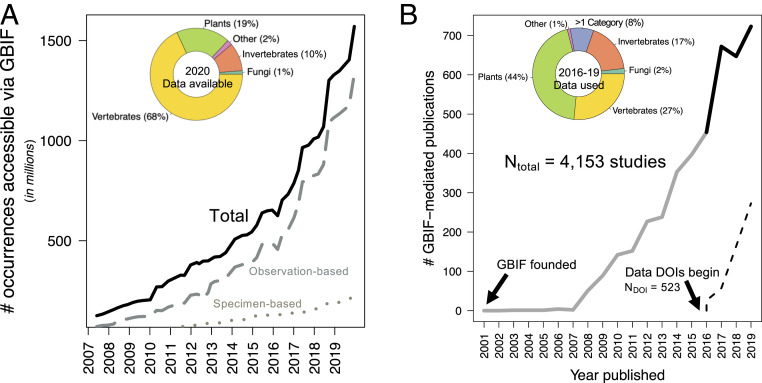
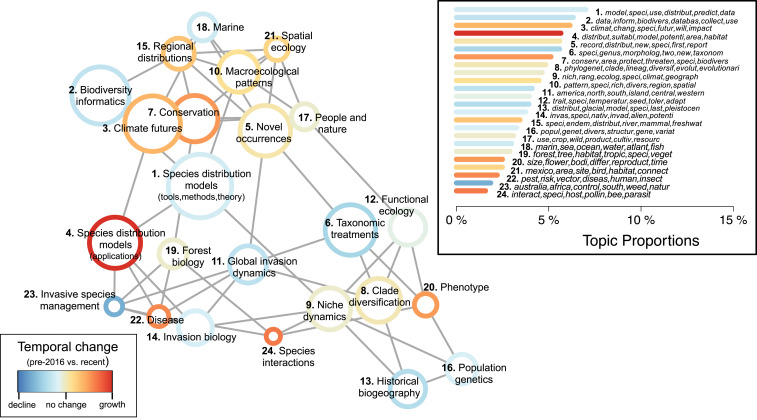
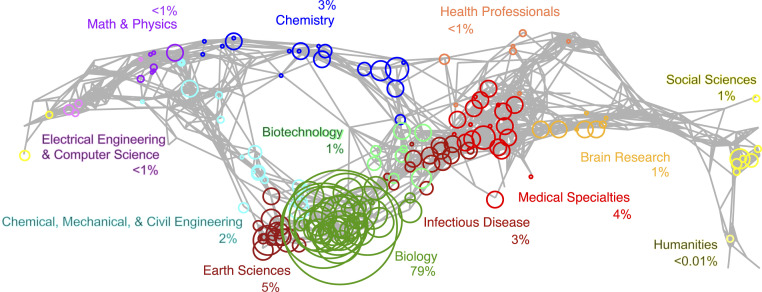
Significance: As anthropogenic impacts to Earth systems accelerate, biodiversity knowledge integration is urgently required to support responses to underpin a sustainable future. Consolidating information from disparate sources (e.g., community science programs, museums) and data types (e.g., environmental, biological) can connect the biological sciences across taxonomic, disciplinary, geographical, and socioeconomic boundaries. In an analysis of the research uses of the world’s largest cross-taxon biodiversity data network, we report the emerging roles of open-access data aggregation in the development of increasingly diverse, global research. These results indicate a new biodiversity science landscape centered on big data integration, informing ongoing initiatives and the strategic prioritization of biodiversity data aggregation across diverse knowledge domains, including environmental sciences and policy, evolutionary biology, conservation, and human health.
Overview
The claims and statistics of this paper haven’t been checked yet.
Run the check — free, no account needed. It reads the open-access text and checks the sources it cites.
Integrity signals
Registry
Cites
Statistics
Figures
Verification
Claims the paper makes
The claims and statistics of this paper haven’t been checked yet.
Run the check — free, no account needed. It reads the open-access text and checks the sources it cites.
Claims other papers make about this one
Each is checked against this paper’s own text: does it say what the citing paper says it does?
The check wasn’t confident either way, so it gives no verdict — never disputed.
In the citing paper
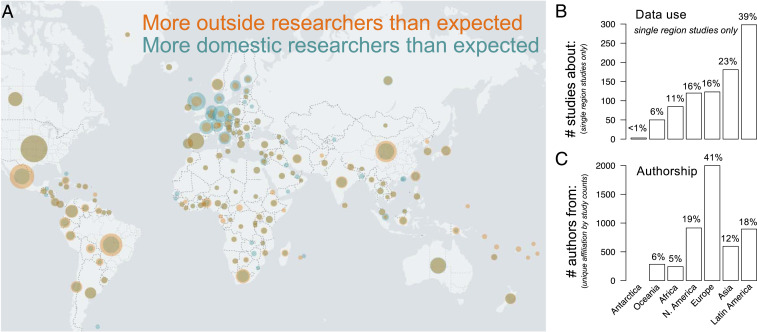
“Most specimens from tropical regions are housed in European and North American institutions (see figure 2 in Heberling et al. 2021).”
From How many mammal species are there now? Updates and trends in taxonomic, nomenclatural, and geographic knowledge (2025) · cites this paper as Heberling et al. 2021
Experimental — accuracy not yet measured
Self-check
Percentages, sums and reported differences re-computed from the paper’s own numbers.
The self-check needs the paper’s full text.
Citations
Cites
(2003) · Journal of Machine Learning Research · doi:10.5555/944919.944937 · Cited by 32,337
Very high resolution interpolated climate surfaces for global land areas
Hijmans, R. J., Cameron, S. E., Parra, J. L., Jones, P. G., & Jarvis, A. (2005) · International Journal of Climatology · doi:10.1002/joc.1276 · Cited by 19,860
The FAIR Guiding Principles for scientific data management and stewardship
Wilkinson, M. D., Dumontier, M., Aalbersberg, I. J., Appleton, G., Axton, M., Baak, A., Blomberg, N., Boiten, J.-W., da Silva Santos, L. B., Bourne, P. E., et al. (2016) · Scientific Data · doi:10.1038/sdata.2016.18 · Cited by 18,423
Maximum entropy modeling of species geographic distributions
Phillips, S. J., Anderson, R. P., & Schapire, R. E. (2006) · Ecological Modelling · doi:10.1016/j.ecolmodel.2005.03.026 · Cited by 15,396
Blei, D. M., Ng, A. Y., & Jordan, M. I. (2002) · The MIT Press eBooks · doi:10.7551/mitpress/1120.003.0082 · Cited by 12,683
Species Distribution Models: Ecological Explanation and Prediction Across Space and Time
Elith, J., & Leathwick, J. R. (2009) · Annual Review of Ecology, Evolution, and Systematics · doi:10.1146/annurev.ecolsys.110308.120159 · Cited by 6,707
Blei, D. M. (2012) · Communications of the ACM · doi:10.1145/2133806.2133826 · Cited by 5,516
Accelerated modern human–induced species losses: Entering the sixth mass extinction
Ceballos, G., Ehrlich, P. R., Barnosky, A. D., García, A., Pringle, R. M., & Palmer, T. M. (2015) · Science Advances · doi:10.1126/sciadv.1400253 · Cited by 4,220
Promoting an open research culture
Nosek, B. A., Alter, G., Banks, G. C., Borsboom, D., Bowman, S. D., Breckler, S. J., Buck, S., Chambers, C. D., Chin, G., Christensen, G., et al. (2015) · Science · doi:10.1126/science.aab2374 · Cited by 2,708
TRY plant trait database – enhanced coverage and open access
Kattge, J., Bönisch, G., Díaz, S. M., Lavorel, S., Prentice, I. C., Leadley, P., Tautenhahn, S., Werner, G. D. A., Aakala, T., Abedi, M., et al. (2019) · Global Change Biology · doi:10.1111/gcb.14904 · Cited by 2,210
Cited by
Sorted by citations
Cecco, G. J. D., Barve, V., Belitz, M., Stucky, B. J., Guralnick, R., & Hurlbert, A. (2021) · BioScience · doi:10.1093/biosci/biab093 · Cited by 309
Davis, C. “. (2022) · Trends in Ecology & Evolution · doi:10.1016/j.tree.2022.11.015 · Cited by 198
Medicinal plants meet modern biodiversity science
Davis, C. “., & Choisy, P. (2024) · Current Biology · doi:10.1016/j.cub.2023.12.038 · Cited by 219
Card, D. C., Shapiro, B., Giribet, G., Moritz, C., & Edwards, S. V. (2021) · Annual Review of Genetics · doi:10.1146/annurev-genet-071719-020506 · Cited by 151
Wang, Z., Wang, T., Zhang, X., Wang, J., Yang, Y., Sun, Y., Guo, X., Wu, Q., Nepovimová, E., Watson, A. E., et al. (2024) · The Science of The Total Environment · doi:10.1016/j.scitotenv.2024.173377 · Cited by 144
Metadata
- Authors
- Heberling, J. M., Miller, J. T., Noesgaard, D., Weingart, S. B., & Schigel, D.
- Affiliations
- Carnegie Museum of Natural History (US)
- Global Biodiversity Information Facility (DK)
- Carnegie Mellon University (US)
- Corresponding author
- Heberling, J. Mason
- Venue
- Proceedings of the National Academy of Sciences
- Publisher
- National Academy of Sciences
- Published
- 2021-02
- Volume
- 118
- Issue
- 6
- ISSN
- 0027-8424 (ISSN-L)
- 1091-6490
- PMC
- PMC8017944
- OpenAlex
- W3127515314
- Cited by
- 380
- References
- 65
- Citations by year
- 2026: 81 · 2025: 76 · 2024: 72 · 2023: 66 · 2022: 64 · 2021: 21
- FWCI
- 50.42
- Type
- journal article
- Language
- en
- Open access
- hybrid
- doi.org
- Licence
- Locations
- Proceedings of the National Academy of Sciences (publishedVersion, cc-by)
- PubMed Central (publishedVersion, cc-by)
- PubMed (publishedVersion)
- Topics
- Physical Sciences › Computer Science › Information Systems › Research Data Management Practices
- Physical Sciences › Environmental Science › Ecological Modeling › Species Distribution and Climate Change
- Physical Sciences › Environmental Science › Nature and Landscape Conservation › Ecology and Vegetation Dynamics Studies
- Keywords
- biodiversity data integration, GBIF, citizen science, species distribution modeling, macroecology
- MeSH terms
- Animals, Classification, Humans, Museums, Databases, Factual, Biodiversity
About these checks
Registry, retraction, Cites and statistics results are computed, not judged, with one exception: a printed reference that no index lists is read once by a model before it counts as a citation error. Claims are extracted by a model and kept only when their quote appears verbatim in the text; each cited source is then checked, with a model’s help, for whether it says what the claim relies on. Those verdicts can be wrong — read the claim’s quote and the cited source before relying on one.
Statistics and arithmetic are recomputed, not judged.
Confidence bands are shown only for fields calibrated on our annotated test set. None is calibrated yet, so no band is shown.
What counts as a claim ›How we measure confidence ›How we check this ›
Are you an author, or do you see a problem with this page? Request a review
