

Contributions of memory and brain development to the bioregulation of naps and nap transitions in early childhood
Open accessThe DOI matches its Crossref record; 114 of the 114 references it cites were found in a registry or an index.
Abstract
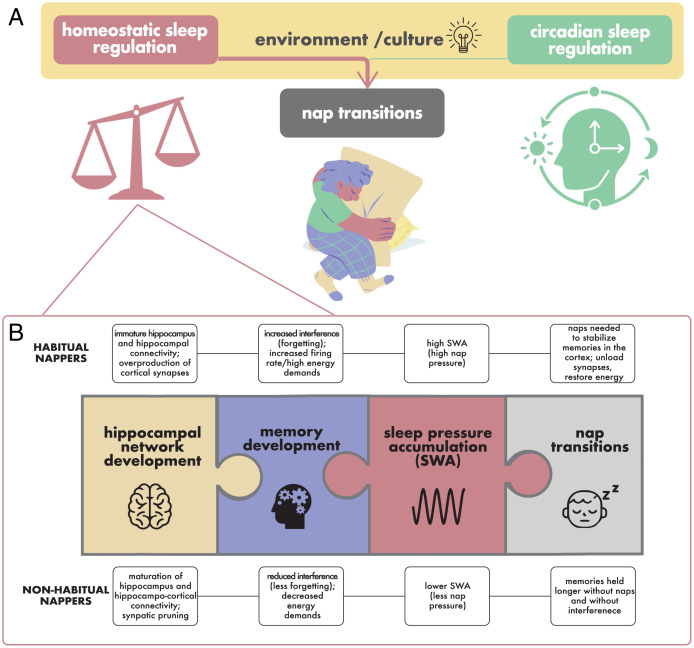
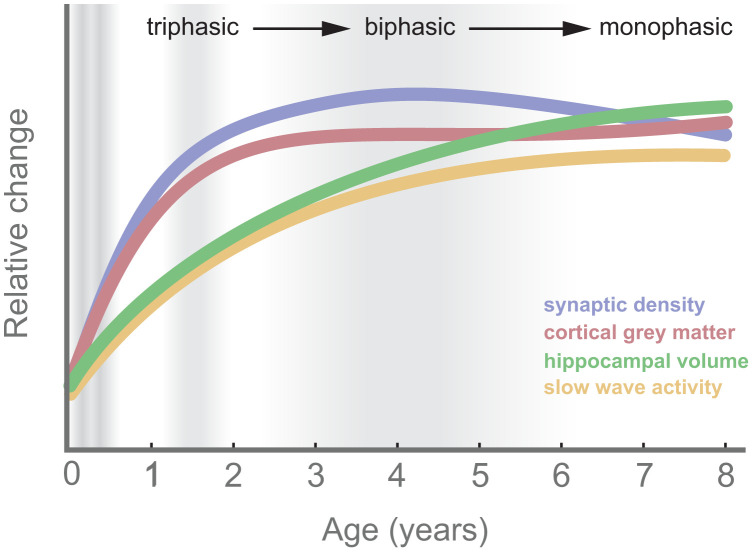
The transition from multiple sleep bouts each day to a single overnight sleep bout (i.e., nap transition) is a universal process in human development. Naps are important during infancy and early childhood as they enhance learning through memory consolidation. However, a normal part of development is the transition out of naps. Understanding nap transitions is essential in order to maximize early learning and promote positive long-term cognitive outcomes. Here, we propose a novel hypothesis regarding the cognitive, physiological, and neural changes that accompany nap transitions. Specifically, we posit that maturation of the hippocampal-dependent memory network results in more efficient memory storage, which reduces the buildup of homeostatic sleep pressure across the cortex (as reflected by slow-wave activity), and eventually, contributes to nap transitions. This hypothesis synthesizes evidence of bioregulatory mechanisms underlying nap transitions and sheds new light on an important window of change in development. This framework can be used to evaluate multiple untested predictions from the field of sleep science and ultimately, yield science-based guidelines and policies regarding napping in childcare and early education settings.
Overview
The claims and statistics of this paper haven’t been checked yet.
Free: it reads the open-access text and checks the first 5 claims that cite a source we can check. Create a free account to check every claim.
Integrity signals
Registry
Cites
Statistics
Figures
Verification
Claims the paper makes
The claims and statistics of this paper haven’t been checked yet.
Free: it reads the open-access text and checks the first 5 claims that cite a source we can check. Create a free account to check every claim.
Claims other papers make about this one
Each is checked against this paper’s own text: does it say what the citing paper says it does?
The check wasn’t confident either way, so it gives no verdict — never disputed.
In the citing paper
“Compared with adults, infants and children spent more time in SWS and REM sleep”
From Sleep—A brain-state serving systems memory consolidation (2023) · cites this paper as [246]
Experimental — accuracy not yet measured
Self-check
Percentages, sums and reported differences re-computed from the paper’s own numbers.
The self-check needs the paper’s full text.
Citations
Cites
Two-Process Model of Sleep Regulation
(2009) · Encyclopedia of Neuroscience · doi:10.1007/978-3-540-29678-2_6166 · Cited by 3,899 · cited 1×
“The two-process model of sleep regulation is a prominent conceptual model, which posits that sleep regulation emerges from the interaction of two distinct biological processes (18, 19).”
BackgroundRegional Brain Changes in Aging Healthy Adults: General Trends, Individual Differences and Modifiers
Raz, N., Lindenberger, U., Rodrigue, K. M., Kennedy, K. M., Head, D., Williamson, A., Dahle, C., Gerstorf, D., & Acker, J. D. (2005) · Cerebral Cortex · doi:10.1093/cercor/bhi044 · Cited by 2,875
Rasch, B., & Born, J. (2013) · Physiological Reviews · doi:10.1152/physrev.00032.2012 · Cited by 2,783
The Medial Temporal Lobe and Recognition Memory
Eichenbaum, H., Yonelinas, A. P., & Ranganath, C. (2007) · Annual Review of Neuroscience · doi:10.1146/annurev.neuro.30.051606.094328 · Cited by 2,580 · cited 1×
“For example, memory for novel objects alone is not reliant on the hippocampus, whereas memory requiring binding of an object with a location or ordering with another object does (67).”
BackgroundTononi, G., & Cirelli, C. (2014) · Neuron · doi:10.1016/j.neuron.2013.12.025 · Cited by 2,356
Sleep function and synaptic homeostasis
Tononi, G., & Cirelli, C. (2006) · Sleep Medicine Reviews · doi:10.1016/j.smrv.2005.05.002 · Cited by 2,151 · cited 1×
“Thus, we posit that early childhood is a time of competing demands of learning, which loads the brain (the hippocampus in particular), and sleeping, which may unload synapses across the cortex (42) and free up the hippocampus for ongoing learning (43).”
BackgroundBrain development in children and adolescents: Insights from anatomical magnetic resonance imaging
Lenroot, R. K., & Giedd, J. N. (2006) · Neuroscience & Biobehavioral Reviews · doi:10.1016/j.neubiorev.2006.06.001 · Cited by 1,863
Coordinated memory replay in the visual cortex and hippocampus during sleep
Ji, D., & Wilson, M. A. (2007) · Nature Neuroscience · doi:10.1038/nn1825 · Cited by 1,669 · cited 1×
“Numerous studies in animals have demonstrated that patterns of hippocampal activation associated with a learning episode are seen again in subsequent sleep and not in the prior sleep bouts (68).”
BackgroundThe two‐process model of sleep regulation: a reappraisal
Borbély, A. A., Daan, S., Wirz‐Justice, A., & Deboer, T. (2016) · Journal of Sleep Research · doi:10.1111/jsr.12371 · Cited by 1,577
Schizophrenia: Caused by a fault in programmed synaptic elimination during adolescence?
Feinberg, I. (1982) · Journal of Psychiatric Research · doi:10.1016/0022-3956(82)90038-3 · Cited by 1,395
Research works printed but not linked: 1
- D. Rumelhart, Schmeta: The Building Blocks of Cognition (Routledge, 2017).
Cited by
Sleep—A brain-state serving systems memory consolidation
Brodt, S., Inostroza, M., Niethard, N., & Born, J. (2023) · Neuron · doi:10.1016/j.neuron.2023.03.005 · Cited by 343
The functions of sleep: A cognitive neuroscience perspective
Simon, K. C. N. S., Nadel, L., & Payne, J. D. (2022) · Proceedings of the National Academy of Sciences · doi:10.1073/pnas.2201795119 · Cited by 74
Sleep Across the Lifespan: A Neurobehavioral Perspective
Simon, K. C. N. S., Cadle, C. E., Shuster, A. E., & Malerba, P. (2025) · Current Sleep Medicine Reports · doi:10.1007/s40675-025-00322-2 · Cited by 37
“On average, between ages 20 to 50 years, men show greater evening preference than women on average [21], and these sex differences dis - appear after the age of 50, coinciding with menopause in women [ 22 ].”
Sleep’s contribution to memory formation
Lutz, N. D., Harkotte, M., & Born, J. (2025) · Physiological Reviews · doi:10.1152/physrev.00054.2024 · Cited by 59
Ltifi, M. A., Chong, K. H., Ben-Bouzaiene, G., Okely, A. D., & Chelly, M. S. (2024) · Sports Medicine and Health Science · doi:10.1016/j.smhs.2024.08.001 · Cited by 12
“37 Similarly, napping following learning has been shown to enhance various forms of memory the following day, as well as improve executive functions such as attention and emotional regulation.”
Predictors of Early Nap Cessation: Longitudinal Findings from a Large Study of Young Children
Newton, A. T., Tremblay, P. F., Batterink, L. J., & Reid, G. J. (2022) · Sleep Epidemiology · doi:10.1016/j.sleepe.2022.100054 · Cited by 12
Lou, S., Hu, S., Chen, Y., Zhao, K., Zhou, Y., Hou, J., Liang, L., & Sun, H. (2024) · Sleep Medicine · doi:10.1016/j.sleep.2024.04.021 · Cited by 12
Napping and memory consolidation in early childhood: A systematic review and meta-analysis
Souabni, M., Souabni, M. J., Salem, A., Hammouda, O., Ammar, A., Saidi, O., Żmijewski, P., Jahrami, H., de Marco, G., Trabelsi, K., et al. (2025) · Sleep Medicine · doi:10.1016/j.sleep.2025.106649 · Cited by 14
The importance of sleep for the developing brain
Riggins, T., Ratliff, E. L., Horger, M. N., & Spencer, R. M. C. (2024) · Current Sleep Medicine Reports · doi:10.1007/s40675-024-00307-7 · Cited by 18
Self-citationLeisman, G., Alfasi, R., & D’Angiulli, A. (2025) · Journal of Integrative Neuroscience · doi:10.31083/jin41452 · Cited by 10
Age differences in generalization, memory specificity, and their overnight fate in childhood
Buchberger, E. S., Joechner, A., Ngo, C. T., Lindenberger, U., & Werkle‐Bergner, M. (2024) · Child Development · doi:10.1111/cdev.14089 · Cited by 9
A policy analysis of sleep-related legislation for Canadian licensed childcare facilities
Hall, W. A., Moynihan, M., Reid, G. J., & McMillan, R. (2024) · BMC Public Health · doi:10.1186/s12889-024-20150-3 · Cited by 5
Sleep-dependent memory consolidation in young and aged brains
Kumar, D., Yanagisawa, M., & Funato, H. (2024) · Aging Brain · doi:10.1016/j.nbas.2024.100124 · Cited by 6
“Naps in children are generally considered beneficial for memory [67].”
BackgroundPediatric sleep electrophysiology: Using polysomnography in developmental cognitive neuroscience
Gaudette, L., Swift, A. M., Horger, M. N., Holmes, J. F., & Spencer, R. M. C. (2025) · Developmental Cognitive Neuroscience · doi:10.1016/j.dcn.2025.101562 · Cited by 6
“Evidence supports a bidirectional relationship between brain development and sleep, with brain development influencing sleep patterns and sleep facilitating brain development (Spencer and Riggins, 2022; Lokhandwala and Spencer, 2022).”
Self-citationLaurent, C. W. S., Holmes, J. F., & Spencer, R. M. C. (2022) · International Journal of Environmental Research and Public Health · doi:10.3390/ijerph192215308 · Cited by 6
Self-citationChan, P. H. Y., Lai, C. M., Wong, P. C. M., & Lam, H. S. (2025) · Early Human Development · doi:10.1016/j.earlhumdev.2025.106354 · Cited by 4
Saletin, J., Moyles, S. M., Dionisos, V. O., Christiansen, T., Sherman, C. M., Mason, G. M., Bunge, S. A., Castellanos, F. X., Owens, J. A., Barker, D., et al. (2025) · SLEEP Advances · doi:10.1093/sleepadvances/zpaf038 · Cited by 3
“Though most studies of sleep loss have focused on adult populations, recent experiments probing naps in young children have suggested that sleep loss has similar consequences for learning in early development [24–27].”
Sleep trajectories and behavioural development in children and adolescents
Reynaud, È., Mazza, S., & Plancoulaine, S. (2026) · L Encéphale · doi:10.1016/j.encep.2026.02.012 · Cited by 3
Sleep and Selective Memory Consolidation in Infants: Exploring the Impact of Learning Contexts
Hermesch, N., Seehagen, S., Barr, R., Herbert, J. S., & Konrad, C. (2025) · Infancy · doi:10.1111/infa.70045 · Cited by 2
“From this perspective,changesinsleepbehaviormayalsoindicatebrainmaturation processes (Spencer and Riggins 2022).”
Pétrin, R., Beauchamp, K., Perreault, A., & Forest, G. (2026) · Sleep Medicine · doi:10.1016/j.sleep.2026.108966 · Cited by 3
Lin, J., Jiang, Y., Xiao, X., Zhu, Q., Wang, G., Lin, Q., & Jiang, F. (2024) · Journal of Clinical Sleep Medicine · doi:10.5664/jcsm.11062 · Cited by 3
Exploring the Relationship Between Age at Nap Cessation and Social-Emotional Functioning in Children
Loeffler, A., Rankin, P. S., Smith, S. S., Thorpe, K. J., & Staton, S. (2024) · Journal of Developmental & Behavioral Pediatrics · doi:10.1097/dbp.0000000000001259 · Cited by 1
The interplay between nap and nighttime sleep in preschool-aged children: an actigraphic study
Reynaud, È., Malevergne, L., Touchette, É., Rey, A. E., & Mazza, S. (2026) · BMC Public Health · doi:10.1186/s12889-025-26063-z · Cited by 3
“The average duration of actigraphy recording was 7.8 days (± 1.49, range [5–13]).”
InfluentialLaurent, C. W. S., Yousefi, F., Parvizi, P., Holmes, J. F., Lokhandwala, S., Riggins, T., & Spencer, R. M. C. (2026) · Journal of Sleep Research · doi:10.1111/jsr.70279 · Cited by 1
Self-citationNap Cessation in Preschoolers: When Context Matters Beyond Age‐Related Biology
Malevergne, L., Reynaud, È., Desforges, A., Plancoulaine, S., Mazza, S., & Rey, A. E. (2026) · Infant and Child Development · doi:10.1002/icd.70120 · Cited by 1
Sun, D., Chen, X.-Y., Yu, R., Tang, Q., & Xian, X. (2023) · Biological Rhythm Research · doi:10.1080/09291016.2023.2287251 · Cited by 1
“…most of the previous studies related to napping concentrate on infants or adolescents and explore its benefits or function for brain development or memory improvement (Ancoli-Israel and Martin 2006; Milner and Cote 2009; Jakubowski et al. 2016; Jones and Spencer 2020; Spencer and Riggins 2022).”
BackgroundNoh, E. (2023) · Authorea · doi:10.22541/au.168788347.73752869/v1 · Cited by 1
Where Did Nap Time Go? Why Older Kids Do Not Nap at School
Ganesh, D. B., Pandey, M., Riggins, T., Spencer, R. M. C., Tiwari, R., Wehland, M., & Leikin, S. (2024) · Frontiers for Young Minds · doi:10.3389/frym.2023.1224593
Self-citationDunstan, J., Canada, K. L., Spencer, R. M. C., & Riggins, T. (2024) · Cognitive Development · doi:10.1016/j.cogdev.2024.101518 · Cited by 1
Self-citationMarcos, U. N. M. D. S., Aguirre-Siancas, E. E., Contreras, O. B., Matuda-Silvestre, J. G., Marcos, U. N. M. D. S., de la Cruz-Rodríguez, R., Marcos, U. N. M. D. S., Lam-Figueroa, N. M., & Marcos, U. N. M. D. S. (2025) · IATREIA · doi:10.17533/udea.iatreia.327
Age and gender-related neurophysiological changes in sleep and wake states during childhood
Mammeri, K., Legendre, G., Journal, F., Fernandez, N., Ruppen-Maret, H., Combey, J., Schwartz, S., & Sterpenich, V. (2026) · Developmental Cognitive Neuroscience · doi:10.1016/j.dcn.2026.101681
“Conversely, the maturation of hippocampal networks in children has been proposed to result in more efficient memory processes, yielding reduced sleep homeostatic pressure, thereby facilitating the transition away from napping (Riggins et al., 2024; Spencer and Riggins, 2022).”
Webb, L., Phillips, A. J. K., & Roberts, J. A. (2026) · PLoS Computational Biology · doi:10.64898/2026.02.12.705640
Phillips, S. M., Jones, D., Howells, K., Bardid, F., Reilly, J., & Tucker, P. (2026) · International journal of child care and education policy/International journal of child care and education · doi:10.1186/s40723-026-00172-7 · Cited by 1
Trajectoires de sommeil et développement comportemental de l’enfant et de l’adolescent
Plancoulaine, S., & Reynaud, È. (2025) · Elsevier eBooks · doi:10.1016/b978-2-294-78711-9.00011-6
Ellis, M., JONES, A. T., Rankin, P. S., Bernard, A., Thorpe, K. J., Glozier, N., & Staton, S. (2026) · Journal of Autism and Developmental Disorders · doi:10.1007/s10803-026-07461-7
Pétrin, R., Pennestri, M., & Forest, G. (2026) · Journal of Sleep Research · doi:10.1111/jsr.70442
Who Did It? Sleep, Source Memory, and Action Memory in Human 4-Year-Olds
Konrad, C., Heinen, R. M., Hermesch, N., Gerson, S. A., Sommerville, J. A., Fricke, A., Moß, J., Macioszek, M.-S., Weinert, A. T., & Seehagen, S. (2026) · Behavioral Sciences · doi:10.3390/bs16091578
“Conversely, maturation of hippocampus-dependent memory networks has been suggested to yield more efficient memory storage and slower build-up of homeostatic sleep pressure (Spencer & Riggins, 2022).”
Paavonen, E. J., & de Bie, K. (2026) · Sleep Medicine · doi:10.1016/j.sleep.2026.109276
Associations between preschool sleep consolidation trajectories and receptive vocabulary at age 5
Touchette, É., Fréchette‐Boilard, G., Rey, A. E., Mazza, S., Pennestri, M., Forest, G., Reid, G. J., Plancoulaine, S., Petitclerc, A., Boivin, M., et al. (2026) · Sleep Medicine · doi:10.1016/j.sleep.2026.109295
Li, Y., & Cao, S. (2026) · Frontiers in Psychology · doi:10.3389/fpsyg.2026.1964754
“…which is consistent with the transition out of daytime napping, described as a universal process in human development and a normal part of maturation in early childhood (Spencer and Riggins, 2022); as naps are relinquished, total sleep shortens and more of the day becomes available for activity.”
Sociodemographic correlates of daytime napping in Canadian preschoolers
Acheampong, E., Lang, J. J., Reid, G. J., & Chaput, J. (2026) · Sleep Health · doi:10.1016/j.sleh.2026.09.010
Metadata
- Authors
- Spencer, R. M. C., & Riggins, T.
- Affiliations
- University of Massachusetts Amherst (US)
- University of Maryland, College Park (US)
- Corresponding author
- Spencer, Rebecca M. C.
- Venue
- Proceedings of the National Academy of Sciences
- Publisher
- National Academy of Sciences
- Published
- 2022-10-24
- Volume
- 119
- Issue
- 44
- Pages
- e2123415119-e2123415119
- ISSN
- 0027-8424 (ISSN-L)
- 1091-6490
- PMC
- PMC9636905
- OpenAlex
- W4307188337
- Semantic Scholar
- 71c8163025b713f8e5cce130777781e6f0afff01
- Cited by
- 41
- References
- 114
- Citations by year
- 2026: 15 · 2025: 10 · 2024: 10 · 2023: 3 · 2022: 3
- FWCI
- 3.35
- Type
- journal article
- Language
- en
- Open access
- hybrid
- doi.org
- Licence
- Locations
- Proceedings of the National Academy of Sciences (publishedVersion, cc-by)
- PubMed Central (publishedVersion, cc-by)
- PubMed (publishedVersion)
- Funders
- National Science Foundation (BCS 1749280)
- HHS | National Institutes of Health (NIH R21 HD094758, NIH R01 HL111695)
- Topics
- Life Sciences › Neuroscience › Cognitive Neuroscience › Sleep and Wakefulness Research
- Social Sciences › Psychology › Experimental and Cognitive Psychology › Sleep and related disorders
- Life Sciences › Neuroscience › Endocrine and Autonomic Systems › Circadian rhythm and melatonin
- Keywords
- napping, early childhood sleep, sleep homeostasis, slow-wave activity, hippocampal-dependent memory, memory consolidation, brain development, sleep regulation
- MeSH terms
- Memory Consolidation, Brain, Child, Preschool, Cognition, Humans, Learning, Sleep, Wakefulness
About these checks
Registry, retraction, Cites and statistics results are computed, not judged, with one exception: a printed reference that no index lists is read once by a model before it counts as a citation error. Claims are extracted by a model and kept only when their quote appears verbatim in the text; each cited source is then checked, with a model’s help, for whether it says what the claim relies on. Those verdicts can be wrong — read the claim’s quote and the cited source before relying on one.
Statistics and arithmetic are recomputed, not judged.
Confidence bands are shown only for fields calibrated on our annotated test set. None is calibrated yet, so no band is shown.
What counts as a claim ›How we measure confidence ›How we check this ›
Are you an author, or do you see a problem with this page? Request a review
Data sources
Bibliographic data: Semantic Scholar, OpenAlex, Crossref.
Contains information from the Semantic Scholar Academic Graph Datasets, made available under the ODC Attribution License (ODC-BY 1.0).
Semantic Scholar’s data is described in: Kinney, R., et al. (2023). The Semantic Scholar Open Data Platform. arXiv:2301.10140.
