

Income and emotional well-being: A conflict resolved
Open accessThe DOI matches its Crossref record; 21 of the 21 references it cites were found in a registry or an index; 3 of the 3 sources its claims cite were checked for support.
Abstract
Do larger incomes make people happier? Two authors of the present paper have published contradictory answers. Using dichotomous questions about the preceding day, [Kahneman and Deaton, Proc. Natl. Acad. Sci. U.S.A. 107 , 16489–16493 (2010)] reported a flattening pattern: happiness increased steadily with log(income) up to a threshold and then plateaued. Using experience sampling with a continuous scale, [Killingsworth, Proc. Natl. Acad. Sci. U.S.A. 118 , e2016976118 (2021)] reported a linear-log pattern in which average happiness rose consistently with log(income). We engaged in an adversarial collaboration to search for a coherent interpretation of both studies. A reanalysis of Killingsworth’s experienced sampling data confirmed the flattening pattern only for the least happy people. Happiness increases steadily with log(income) among happier people, and even accelerates in the happiest group. Complementary nonlinearities contribute to the overall linear-log relationship. We then explain why Kahneman and Deaton overstated the flattening pattern and why Killingsworth failed to find it. We suggest that Kahneman and Deaton might have reached the correct conclusion if they had described their results in terms of unhappiness rather than happiness; their measures could not discriminate among degrees of happiness because of a ceiling effect. The authors of both studies failed to anticipate that increased income is associated with systematic changes in the shape of the happiness distribution. The mislabeling of the dependent variable and the incorrect assumption of homogeneity were consequences of practices that are standard in social science but should be questioned more often. We flag the benefits of adversarial collaboration.
Overview
CoChat Summary
TL;DR
A joint adversarial reanalysis of Killingsworth’s experience-sampling data finds that the Kahneman–Deaton flattening pattern is real but confined to the least happy 15–20% of people, while happiness continues to rise with log income for the happier majority. The apparent conflict arose from standard but questionable practices: KD’s affect items were better interpreted as measures of unhappiness, and MK’s mean-based analysis missed offsetting nonlinearities across the happiness distribution.
Key findings
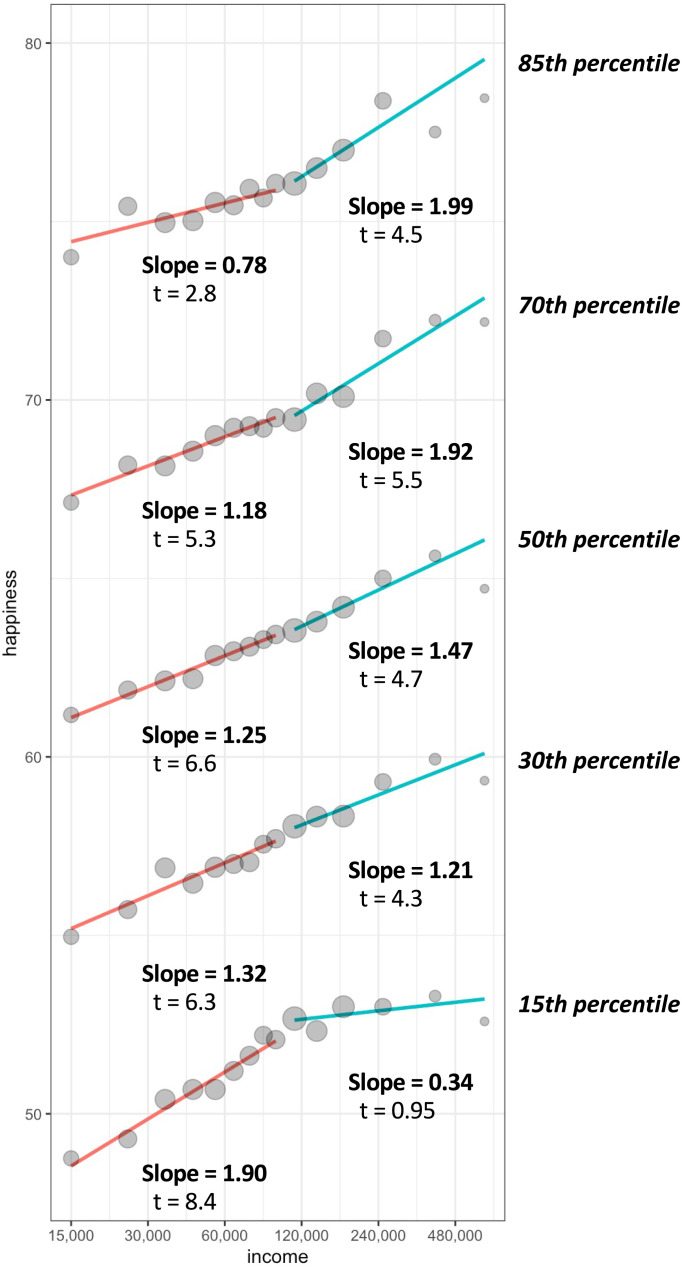
- Flattening is restricted to the least happy: for the 15th percentile, the slope below $100k was 1.90 (t = 8.4) and above $100k was 0.34 (t = 1.0, nonsignificant); for the 5th percentile, 2.34 (t = 4.7) vs 0.25 (t = 0.5); for the 10th, 1.75 (t = 6.6) vs 0.52 (t = 1.4); for the 20th, 1.84 (t = 8.5) vs 0.62 (t = 1.8, P = 0.08).
- The happier majority shows continued or accelerating gains: the 85th percentile slope accelerates above $100k (P = 0.023), the 70th approaches significance (P = 0.075), and the 30th/50th match the overall trend.
- The overall linear-log relationship is produced in part by complementary nonlinearities: the correlation between average happiness and log(income) is 0.09, and the median happiness difference between $15,000 and $250,000 household income is about five points on a 100-point scale.
- KD overstated flattening because their Gallup affect items had a ceiling effect and were best interpreted as measures of unhappiness; MK missed flattening because standard mean-based bivariate analysis did not inspect changes in the joint distribution.
Methods
- Adversarial collaboration reanalyzing MK’s experience-sampling data: 1,725,994 reports from 33,391 employed US adults aged 18–65 with household income at least $10,000/year; median age 33, median household income $85,000/year, median compliance 72%.
- Quantile regression was used to estimate separate slopes below and above $100,000 for happiness percentiles, including 5th–35th and 15th, 30th, 50th, 70th, and 85th percentiles; the KD threshold of ≤$90k was inflation-adjusted to ≤$97k, placing the cutoff in MK’s $90–100k category.
- Income was measured on an intake survey in $10,000 increments up to $100,000, then higher bands; values were set to band midpoints, and incomes over $500,000 were pooled to $625,000/year.
Limitations
- The paper states the income–well-being relationship is weak even if statistically robust, and that “increase” and “gain” are used for exposition while the analysis describes cross-sectional associations, not causal effects.
- The paper states the authors benefited from luck and that the close correspondence between KD and MK is better than social scientists can reasonably expect.
- Evident from the text: the main analysis is a reanalysis of MK’s experience-sampling data rather than a new experimental or longitudinal test, and income is approximated by category midpoints with the top incomes pooled, which may affect estimates.
Model-written summary. Check it against the paper before relying on it.
Integrity signals
Registry
Cites
Statistics
Figures
Verification
Claims the paper makes
3 Valid · 0 Not valid · 0 Not checked · 55 Own results and interpretations
Every source the paper cites for this claim was checked and supports it.
In the paper
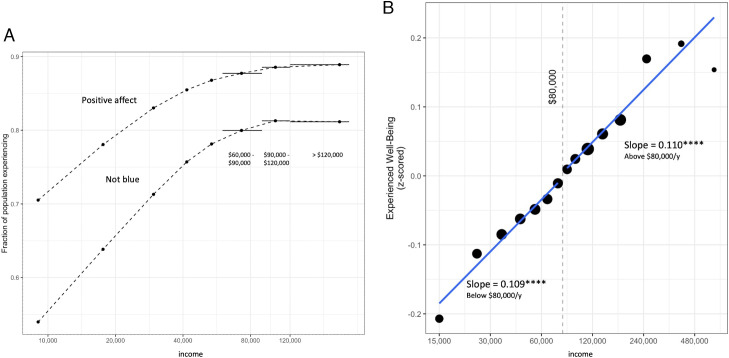
“As shown in Fig. 1B, MK found a linear relationship between average experienced happiness and log(income) which extended well beyond $200,000.”
§ Income and emotional well-being: A conflict resolved > Abstract
What the sources say
- Supportedcites [2] M. A. Killingsworth, Experienced well-being rises with income, even above $75,000 per year. Proc. Natl. Acad. Sci. U.S.A. 118, e2016976118 (2021). 33468644 PMC7848527 source
The Results and Discussion report a strikingly linear relationship between experienced well-being and log(income), with no observed plateau across the income range (Fig. 1). The Income Measure section says the analysis included income bands above $200,000, with incomes over $500,000 pooled at $625,000 for analysis and visualization. The Data Analysis section specifies that experienced well-being was averaged for each person. (LLM, conf=0.92)
plainstates an associationn = 33,391- Asserted: passes — The authors put it forward as true.
- Checkable: passes — It can be checked against evidence.
- Load-bearing: passes — The paper’s conclusions depend on it.
- Based: passes — The paper gives a reason why it holds.
- Supported
Every source the paper cites for this claim was checked and supports it.
In the paper
“The main finding of the KD study is the flattening pattern: the average of happiness scores rises up to a threshold income and then levels off.”
§ Income and emotional well-being: A conflict resolved > Abstract
What the sources say
- Supportedcites [1] D. Kahneman, A. Deaton, High income improves evaluation of life but not emotional well-being. Proc. Natl. Acad. Sci. U.S.A. 107, 16489– 16493 (2010). 20823223 PMC2944762 source
The Results report that emotional well-being rises with income and then levels off above about $75,000 a year. The paper distinguishes these happiness measures from life evaluation, which continues to rise with income; the flattening pattern applies to the former. (LLM, conf=0.88)
plainstates an association- Asserted: passes — The authors put it forward as true.
- Checkable: passes — It can be checked against evidence.
- Load-bearing: passes — The paper’s conclusions depend on it.
- Based: passes — The paper gives a reason why it holds.
- Supported
A result the paper states — it cites no source for it, so there is none to check. The quote shows it is in the paper.
In the paper
“The same increases of income have different effects on the happy and on the unhappy regions of the distribution.”
§ Income and emotional well-being: A conflict resolved > Results > Errors and Their Origins.
plainstates a cause- Asserted: passes — The authors put it forward as true.
- Checkable: passes — It can be checked against evidence.
- Load-bearing: passes — The paper’s conclusions depend on it.
- Based: passes — The paper gives a reason why it holds.
A result the paper reports from its own data — it cites no other source for it, so there is none to check. The quote shows it is in the paper.
In the paper
“and the difference between the medians of happiness at household incomes of $15,000 and $250,000 is about five points on a 100-point scale.”
§ Income and emotional well-being: A conflict resolved > Results
plainstates an association- Asserted: passes — The authors put it forward as true.
- Checkable: passes — It can be checked against evidence.
- Load-bearing: passes — The paper’s conclusions depend on it.
- Based: passes — The paper gives a reason why it holds.
A result the paper states — it cites no source for it, so there is none to check. The quote shows it is in the paper.
In the paper
“The trend is reversed for higher incomes, where very happy people gain much more from increased income than unhappy people do.”
§ Income and emotional well-being: A conflict resolved > Results > Errors and Their Origins.
plainstates a cause- Asserted: passes — The authors put it forward as true.
- Checkable: passes — It can be checked against evidence.
- Load-bearing: passes — The paper’s conclusions depend on it.
- Based: passes — The paper gives a reason why it holds.
29 more claims
Create a free account to see all 58 claims and every source verdict.
- Probably not a substantial claim. 13
- It may state two separate claims as one. 13
Citations
Cites
High income improves evaluation of life but not emotional well-being
Kahneman, D., & Deaton, A. (2010) · Proceedings of the National Academy of Sciences · doi:10.1073/pnas.1011492107 · Cited by 3,162 · cited 1×
“Kahneman and Deaton [(1); hereafter KD] reported data from “more than 450,000 responses to the Gallup-Healthways Well-Being Index, a daily survey of 1,000 US residents conducted by the Gallup Organization in 2008 to 9.”
Self-citationWill raising the incomes of all increase the happiness of all?
Easterlin, R. A. (1995) · Journal of Economic Behavior & Organization · doi:10.1016/0167-2681(95)00003-b · Cited by 3,116
Conditions for intuitive expertise: A failure to disagree.
Kahneman, D., & Klein, G. (2009) · American Psychologist · doi:10.1037/a0016755 · Cited by 2,443
Self-citationIncome, Health, and Well-Being around the World: Evidence from the Gallup World Poll
Deaton, A. (2008) · Journal of Economic Perspectives · doi:10.1257/jep.22.2.53 · Cited by 1,636
Will Money Increase Subjective Well-Being?
Diener, E., & Biswas-Diener, R. (2002) · Social Indicators Research · doi:10.1023/a:1014411319119 · Cited by 1,555
Money and Happiness: Income and Subjective Well-Being Across Nations
Diener, E., & Oishi, S. (2000) · Culture and Subjective Well-Being · doi:10.7551/mitpress/2242.003.0013 · Cited by 564
Money and mental wellbeing: A longitudinal study of medium-sized lottery wins
Gardner, J., & Oswald, A. J. (2007) · Journal of Health Economics · doi:10.1016/j.jhealeco.2006.08.004 · Cited by 562
Economic Growth and Subjective Well-Being: Reassessing the Easterlin Paradox
Stevenson, B., & Wolfers, J. (2008) · Brookings Papers on Economic Activity · doi:10.1353/eca.0.0001 · Cited by 545
Economic Growth and Subjective Well-Being: Reassessing the Easterlin Paradox
Stevenson, B., & Wolfers, J. (2008) · SSRN Electronic Journal · doi:10.2139/ssrn.1121237 · Cited by 519
Subjective Well-Being and Income: Is There Any Evidence of Satiation?
Stevenson, B., & Wolfers, J. (2013) · American Economic Review · doi:10.1257/aer.103.3.598 · Cited by 497
Research works printed but not linked: 1
- M. A. Killingsworth, Income and emotional well-being: A conflict resolved. Open Science Framework. https://osf.io/qye4a/. Deposited 1 February 2023. PMC10013834 36857342
Cited by
Beyond GDP: a review and conceptual framework for measuring sustainable and inclusive wellbeing
Jansen, A., Wang, R., Behrens, P., & Hoekstra, R. (2024) · The Lancet Planetary Health · doi:10.1016/s2542-5196(24)00147-5 · Cited by 167
The Cantril Ladder elicits thoughts about power and wealth
Nilsson, A. H., Eichstaedt, J. C., Lomas, T., Schwartz, A., & Kjell, O. (2024) · Scientific Reports · doi:10.1038/s41598-024-52939-y · Cited by 57
Blanchflower, D. G., & Bryson, A. (2024) · Social Indicators Research · doi:10.1007/s11205-024-03334-7 · Cited by 97
“…clear gender convergence over the past five decades in educational 4 There is also an extensive literature on the importance of income in wellbeing equations, including contributions from Nobel Prize winners (Easterlin, 1995, Kahneman and Deaton, 2010 and Killingsworth, Kahneman and Mellers, 2023).”
Causal inference for psychologists who think that causal inference is not for them
Rohrer, J. M. (2024) · Social and Personality Psychology Compass · doi:10.1111/spc3.12948 · Cited by 55
Mendelian randomization evidence for the causal effect of mental well-being on healthy aging
Ye, C., Liu, D., Chen, M., Kong, L., Dou, C., Wang, Y.-Y., Xu, M., Xu, Y., Li, M., Zhao, Z., et al. (2024) · Nature Human Behaviour · doi:10.1038/s41562-024-01905-9 · Cited by 37
“…indicators and mental well-being and revealed that income, rather than education or occupation, predominantly drove the effect of SES on mental well-being, consistent with recent evidence that higher income could contribute to better mental well-being, independent of sociodemographics 11,18 .”
Inclusion unlocks the creative potential of gender diversity in teams
Vedres, B., & Vásárhelyi, O. (2023) · Scientific Reports · doi:10.1038/s41598-023-39922-9 · Cited by 48
THE PSYCHOLOGY OF POVERTY: WHERE DO WE STAND?
Haushofer, J., & Salicath, D. (2023) · Social Philosophy and Policy · doi:10.1017/s0265052523000419 · Cited by 43
Narcissism and Wellbeing: A Cross-Cultural Meta-Analysis
Sedikides, C., Tang, Y., Liu, Y., de Boer, E., Assink, M., Thomaes, S. C. E., & Brummelman, E. (2024) · Personality and Social Psychology Bulletin · doi:10.1177/01461672241307531 · Cited by 31
“It refers to the extent to which individuals experience positive affect and judge their lives as being satisfying (Killingsworth et al., 2023; Layous et al., 2014).”
Choi, W., Wang, W., Kim, H. J., Lee, J.-M., & Kang, S. (2024) · Behavioral Sciences · doi:10.3390/bs14070606 · Cited by 28
“…by elucidating the relationship and mechanism between perceived ESG and psychological well-being, thereby reinforcing prior findings that analyzed the relationship between job meaningfulness [67], income and pay satisfaction [47,48,51], and psychological well-being through the COR perspective.”
BackgroundResultThe WELLBY: a new measure of social value and progress
Frijters, P., Krekel, C., Sanchis, R. G., & Santini, Z. I. (2024) · Humanities and Social Sciences Communications · doi:10.1057/s41599-024-03229-5 · Cited by 44
Vittengl, J. R. (2023) · Journal of Affective Disorders · doi:10.1016/j.jad.2023.10.019 · Cited by 27
Blanchflower, D. G., & Bryson, A. (2023) · National Bureau of Economic Research · doi:10.3386/w31212 · Cited by 26
From MIsgivings to MIse-en-scène: The role of invariance in personality science
Fischer, R. D., & Rudnev, M. (2024) · European Journal of Personality · doi:10.1177/08902070241283081 · Cited by 41
“Only an adversarial collaboration that carefully examined the operationalization and analytical choices was able to reconcile the differences (Killingsworth et al., 2023).”
Kennedy, E., Ozmen, M., Bouldin, E. D., Panahi, S., Mobasher, H., Troyanskaya, M., Martindale, S. L., Merritt, V. C., O'Neil, M. E., Sponheim, S. R., et al. (2024) · Journal of Neurotrauma · doi:10.1089/neu.2023.0381 · Cited by 15
Campoamor-Olegario, L. A., Camitan, D. S., & Guinto, M. L. M. (2025) · Frontiers in Psychology · doi:10.3389/fpsyg.2025.1490437 · Cited by 36
“…income leads to better well-being due to increased access to resources and improved living conditions (Asebedo et al., 2022; Diener and Biswas-Diener, 2002; Killingsworth et al., 2023) and lower income with poorer health outcomes (Bor et al., 2017; Mullahy et al., 2018; Truesdale and Jencks, 2016).”
Beyond Income: Exploring the Role of Household Wealth for Subjective Well-Being in Germany
Jantsch, A., Blanc, J. L., & Schmidt, T. F. N. (2024) · Journal of Happiness Studies · doi:10.1007/s10902-024-00811-1 · Cited by 19
“2 See Jantsch and Veenhoven (2019) for a comprehensive review.”
InfluentialFischer, R. D., Karl, J. A., Luczak–Roesch, M., & Hartle, L. (2023) · doi:10.31234/osf.io/3f9ca · Cited by 12
Higher income is associated with greater life satisfaction, and more stress
Akkiraju, K., & Rao, N. D. (2025) · Communications Psychology · doi:10.1038/s44271-025-00210-z · Cited by 16
“This difference has been attributed to the different extents of satiationexperiencedbypeopleatdifferentlevelsofwell-beingamonghigh-incomeearners 14 .”
The McMansion Effect: Top Size Inequality, House Satisfaction and Home Improvement in U.S. SuburbsPreprint
Bellet, C. S. (2019) · SSRN Electronic Journal · doi:10.2139/ssrn.3378131 · Cited by 13
Advancing the psychology of social class with large-scale replications in four countries
Batruch, A., Sommet, N., & Autin, F. (2025) · Nature Human Behaviour · doi:10.1038/s41562-025-02234-1 · Cited by 25
Kraft, P., & Kraft, B. (2023) · Frontiers in Psychology · doi:10.3389/fpsyg.2023.1283601 · Cited by 20
Make science more collegial: why the time for ‘adversarial collaboration’ has come
(2025) · Nature · doi:10.1038/d41586-025-01379-3 · Cited by 13
Economic uncertainty and population health: insights from emerging markets and developing countries
Liu, L. (2023) · Frontiers in Public Health · doi:10.3389/fpubh.2023.1292236 · Cited by 16
The Anna Karenina income effect: Well-being inequality decreases with income
Teeselink, B. K., & Zauberman, G. S. (2023) · Journal of Economic Behavior & Organization · doi:10.1016/j.jebo.2023.05.036 · Cited by 16
The Mcmansion Effect: Top House Size and Positional Externalities in U.S. SuburbsPreprint
Bellet, C. S. (2023) · SSRN Electronic Journal · doi:10.2139/ssrn.4523288 · Cited by 9
Efficiency vs. Welfare in Benefit-Cost Analysis: The Case of Government FundingPreprint
Liscow, Z. D., & Sunstein, C. R. (2023) · SSRN Electronic Journal · doi:10.2139/ssrn.4589563 · Cited by 9
Income and education show distinct links to health and happiness in daily life
Newman, D. B., Gordon, A. M., & Mendes, W. B. (2025) · Nature Human Behaviour · doi:10.1038/s41562-025-02264-9 · Cited by 12
“We next examined nonlinear relationships because previous research has detected nonlinear associations between income and well-being 11,12,32 .”
We have to talk about overconsumption (in three different ways)
Millward-Hopkins, J., & Fisch-Romito, V. (2025) · Environmental Research Letters · doi:10.1088/1748-9326/adb986 · Cited by 13
Zhou, P., Zhou, Y., Li, T., Zhao, R., & Sun, W. (2024) · Psychology in the Schools · doi:10.1002/pits.23308 · Cited by 15
Does capitalism disfavor women? Evidence from life satisfaction
Berggren, N., & Bjørnskov, C. (2024) · Southern Economic Journal · doi:10.1002/soej.12691 · Cited by 7
Basabreen, S. (2025) · Applied Research in Quality of Life · doi:10.1007/s11482-025-10447-9 · Cited by 9
“Moreover, a recent study found that being in the happier group can actually accelerate the effect of increased income (Killingsworth et al., 2023).”
Vittersø, J. (2025) · Springer eBooks · doi:10.1007/978-3-031-69292-5_2 · Cited by 11
Housing hierarchy of needs that contribute to the well-being of residents
Kamata, T., & Kawakubo, S. (2024) · IOP Conference Series Earth and Environmental Science · doi:10.1088/1755-1315/1363/1/012088 · Cited by 7
The wellbeing framework for consumer experiences in the circular economy of the textile industry
Petreca, B. B., Jewitt, C., Fotopoulou, A., Golmohammadi, L., O’Nascimento, R., Chamberlin, L., Bianchi‐Berthouze, N., Obrist, M., & Baurley, S. L. (2025) · Humanities and Social Sciences Communications · doi:10.1057/s41599-025-05813-9 · Cited by 14
“Moreover, the relationship between income, consumption and wellbeing varies depending on the inequality of the society under consideration and position of individuals in this spectrum (Buttrick and Oishi, 2023; Killingsworth et al., 2023).”
Ren, Q., Wang, L., & Ye, M. (2025) · Journal of Economic Behavior & Organization · doi:10.1016/j.jebo.2025.106905 · Cited by 11
The Sensitivity of the Human Development Index to Assumptions about Income
Kula, M. C., Charles J. Moyer, Jr., & Panday, P. (2024) · Journal of Economic Analysis · doi:10.58567/jea04010010 · Cited by 8
“In Killingsworth et al (2023), they reconsider the nature of the Gallup survey questions used by Kahneman and Deaton (2010) and the lack of analysis on different sub-sample data done by Killingsworth (2021).”
Inappropriate causal assumptions underlie Killingsworth, Kahneman, and Mellers’ conclusions
Rohrer, J. M., & Wenz, S. E. (2024) · Proceedings of the National Academy of Sciences · doi:10.1073/pnas.2313712121 · Cited by 5
Xie, Q., Luo, X., Lu, S., Fan, X. L., & Li, S. (2024) · Children and Youth Services Review · doi:10.1016/j.childyouth.2024.107882 · Cited by 5
The McMansion effect: Positional externalities in U.S. suburbs
Bellet, C. S. (2024) · Journal of Public Economics · doi:10.1016/j.jpubeco.2024.105174 · Cited by 18
Status invisibility alleviates the economic gradient in happiness in social network experiments
Nishi, A., German, C., Iwamoto, S. K., & Christakis, N. A. (2023) · Nature Mental Health · doi:10.1038/s44220-023-00159-0 · Cited by 9
“Although there is a diminishing marginal gain of well-being with greater levels of income in general 2,6,9,10 , richer individuals are happier on average.”
BackgroundLiving Well or Spending More? A 25-Year Review of Income, Consumption, and Life Satisfaction
Bortolotti, A., Berardino, C. D., & Palumbo, R. (2026) · Journal of Happiness Studies · doi:10.1007/s10902-026-01006-6 · Cited by 9
“The subsequent reconciliation by Killingsworth et al (2023 ) showed that these divergent findings stem from differences in baseline happiness levels and measurement approaches, underscoring the importance of methodological pluralism in this field.”
Risk, Death, and Well-Being: The Ethical Foundations of Fatality Risk Regulation
Adler, M. D. (2025) · doi:10.1093/9780197505984.001.0001 · Cited by 5
Study on the influence of commuting time on workers' health status and its mechanism
Gan, Y., & Zhang, J. (2025) · Journal of Transport & Health · doi:10.1016/j.jth.2025.102010 · Cited by 9
Nakakita, M., & Nakatsuma, T. (2024) · Healthcare Analytics · doi:10.1016/j.health.2024.100367 · Cited by 4
Is happiness independent of income? Set point theory à la Kahneman
Khalil, E. L. (2024) · Journal for the Theory of Social Behaviour · doi:10.1111/jtsb.12434 · Cited by 5
Shimada, K. (2024) · International Journal of Educational Development · doi:10.1016/j.ijedudev.2024.103109 · Cited by 4
Kamuzora, A. N. (2024) · Sustainable Energy Research · doi:10.1186/s40807-024-00112-4 · Cited by 6
“A fundamental concept in Prospect Theory is the value function, which describes how individuals evaluate outcomes relative to a reference point (Killingsworth et al., 2023).”
BackgroundVelykodna, M., Tkachenko, O., Шило, О. С., Mitchenko, K., Miroshnyk, Z., Kvitka, N., & Charyieva, O. (2024) · Mental Health Review Journal · doi:10.1108/mhrj-01-2024-0006 · Cited by 9
Rahmatullah, R., Wibowo, A. H. E., & Mustaqim, M. H. (2024) · Jurnal Informatika Ekonomi Bisnis · doi:10.37034/infeb.v6i1.810 · Cited by 4
Money and happiness: A consideration of history and psychological mechanisms
Buttrick, N. R., & Oishi, S. (2023) · Proceedings of the National Academy of Sciences · doi:10.1073/pnas.2301893120 · Cited by 12
“In this issue, Killingsworth et al. (1) report the find - ings of a reanalysis of prior data that helps to shine light on the question.”
BackgroundInfluentialIdentifying Key Predictors of Subjective Well-Being across 92 Countries: A Machine Learning Approach
Li, R., & Yueqin, H. U. (2026) · Journal of Happiness Studies · doi:10.1007/s10902-025-01004-0 · Cited by 6
“Most recently, Killingsworth et al. (2023) engaged in an adversarial collaboration that reanalyzed the 2021 dataset.”
InfluentialBoström, M., & Callmer, Å. (2025) · Current Sociology · doi:10.1177/00113921251381810 · Cited by 7
The Political Psychology of Economic Inequality
Connolly, D. J., Chater, N., & Loewenstein, G. F. (2025) · Psychological Science in the Public Interest · doi:10.1177/15291006261431555 · Cited by 4
Bazzoli, A., & Hughes, I. M. (2025) · Journal of Business and Psychology · doi:10.1007/s10869-025-10047-2 · Cited by 6
“This non-linear trend echoes prior research which has positioned earnings of around $75,000 per year as an inflection point in the relationship between income and happiness (Killingsworth et al., 2023).”
Araki, S., & Li, S. (2025) · Higher Education · doi:10.1007/s10734-025-01477-1 · Cited by 8
“…et al., 2018; Kahneman & Deaton, 2010), recent evidence shows that the saturation is evident primarily among the least happy individuals, whereas happiness steadily increases along with income among happier individuals and even accelerates within the happiest group (Killingsworth et al., 2023).”
Institutional environment of the bioeconomy from a theoretical perspective
Śliwa, R., & Pink, M. (2025) · Routledge eBooks · doi:10.4324/9781003453529-3 · Cited by 3
From MIsgivings to MIse-en-scène: the role of invariance in personality sciencePreprint
Fischer, R. D., & Rudnev, M. (2024) · doi:10.31234/osf.io/5uwmb · Cited by 4
Income and emotional well-being: Evidence for well-being plateauing around $200,000 per year
Bennedsen, M. (2024) · Economics Letters · doi:10.1016/j.econlet.2024.111730 · Cited by 6
“We follow Killingsworth (2021) and Killingsworth et al. (2023) and let z i be the z-scored well-being level reported by individual i , i.e. where y := N − 1 P Ni =1 y i is the sample mean and s 2 y := ( N − 1) − 1 P Ni =1 ( y i − y ) 2 is the sample variance of the reported well-being levels, with…”
BackgroundMethodResultInfluentialInsatiable Wealth Preference: Evidence from Japanese Household SurveyPreprint
Akesaka, M., Mikami, R., & Ono, Y. (2024) · SSRN Electronic Journal · doi:10.2139/ssrn.4800341 · Cited by 3
Veterinarians’ Personality, Job Satisfaction, and Wellbeing
Volk, J. O., Schimmack, U., & Strand, E. B. (2023) · Advances in Small Animal Care · doi:10.1016/j.yasa.2023.05.006 · Cited by 5
Tran, D. T., & Howard, J. L. (2026) · Motivation and Emotion · doi:10.1007/s11031-026-10263-0 · Cited by 5
Social status and the relationship between income rank and well-being in 109 nations
Quispe-Torreblanca, E. G., Neve, J.-E. D., & Brown, G. D. A. (2026) · Nature Communications · doi:10.1038/s41467-026-69729-x · Cited by 2
Song, J., Pan, F., & Liu, H. (2025) · BMC Psychology · doi:10.1186/s40359-025-03591-2 · Cited by 4
Briscoe, M. D., Givens, J. E., & Fitzgerald, J. B. (2025) · Environmental Sociology · doi:10.1080/23251042.2025.2530915 · Cited by 2
“Working together to resolve this dilemma, a more robust analysis showed that flattening of happiness after income thresholds does exist, but only for the least happy 20% of the United States (Killingsworth, Kahneman, and Mellers 2023).”
Buddhist Thought on Happiness and Income Growth Relations Across Varying Income Countries
Pastpipatkul, P., & Ko, H. (2025) · Journal of Happiness Studies · doi:10.1007/s10902-025-00921-4 · Cited by 2
“Among happier people, happiness was found steadily increased with logarithm (log) income but non-linear relationship at which Killingsworth et al (2023) argued that Kahneman and Deaton (2010) could mislabel or use the wrong assumption of homogeneity.”
Zhu, D. (2025) · Journal of Smart Cities and Society · doi:10.1177/27723577251337005 · Cited by 3
“Due to the limitations of social science measurement tools, it is difficult to say how many indicators can reflect citizens’ real-life feelings and thoughts, which remains uncertain (Killingsworth et al., 2023).”
A theory of value – towards a more responsible way of being. The reflections of a practitioner
Chapman, J. (2025) · Journal of Applied Accounting Research · doi:10.1108/jaar-09-2024-0344 · Cited by 2
Detecting Non-linear Dependence through Genome Wide AnalysisPreprint
Akingbuwa, W. A., & Nivard, M. G. (2025) · bioRxiv (Cold Spring Harbor Laboratory) · doi:10.1101/2025.02.12.637804 · Cited by 2
“There is evidence that in at least a subset of people, income is positively associated with subjective well-being up to a certain point, after which the effect diminishes or plateaus 4,5 .”
Life Satisfaction and Its Relation to Leisure and Self-Reported Health with an Example from Mexico
López, F. S., & Chimal, A. (2024) · Encyclopedia · doi:10.3390/encyclopedia4040114 · Cited by 3
Guo, J., & Yang, C. (2024) · Sustainability · doi:10.3390/su16208763 · Cited by 5
How do advertised prices affect consumers' financial well‐being and happiness?
Dahlén, M., Colliander, J., Gajic, V., Kim, O., & Thorbjørnsen, H. (2024) · Psychology and Marketing · doi:10.1002/mar.22026 · Cited by 2
Advancing arts philanthropy practices for well‐being
Addis, M., & Rurale, A. (2024) · Journal of Philanthropy and Marketing · doi:10.1002/nvsm.1828 · Cited by 4
Clark, C. J., Isch, C. G., Connor, P., & Tetlock, P. E. (2024) · Behavioral and Brain Sciences · doi:10.1017/s0140525x2300239x · Cited by 2
Effective altruism, tithing, and a principle of progressive giving
Aloyo, E. (2023) · Ethics & Global Politics · doi:10.1080/16544951.2023.2246257 · Cited by 2
Three concepts of happiness: From ancient Greece to modern sciences
Semenov, A., & Nedeljković, Z. (2023) · ПОЛИТЕИА · doi:10.5937/politeia0-48389 · Cited by 2
Eswaran, M. (2026) · WORLD SCIENTIFIC eBooks · doi:10.1142/9789819816521_0002 · Cited by 1
Are Life Satisfaction and WHO-5 Interchangeable Wellbeing Metrics?
Grimes, A., Brown, P. H., & Morrison, P. S. (2026) · Social Indicators Research · doi:10.1007/s11205-026-03807-x · Cited by 2
“Requirement (i) emphasises the need to test relationships across the full distribution rather than just at their means (Killingsworth et al., 2023).”
Gąsiorowska, A., Manchanda, R., & Kościelniak, M. (2026) · European Journal of Social Psychology · doi:10.1002/ejsp.70054 · Cited by 3
Santiago-Torner, C., Marfil, J. A. C., & Tarrats-Pons, E. (2026) · Human Behavior and Emerging Technologies · doi:10.1155/hbe2/2867288 · Cited by 6
From rivals to partners: adversarial collaboration in ecology and evolution
Gefaell, J., & Uller, T. (2025) · Trends in Ecology & Evolution · doi:10.1016/j.tree.2025.11.001 · Cited by 2
Graafland, J. J. (2025) · De Economist · doi:10.1007/s10645-025-09460-y · Cited by 3
“This finding is in line with research by Stevenson and Wolfers (2008), Killingsworth (2021) and Killingsworth et al. (2023) who found that even at high levels of income subjective well-being increases with income in a micro sample.”
China’s Happiness in the New Century, 2003–2021
Yang, J., & Yang, Z. (2025) · Journal of Happiness Studies · doi:10.1007/s10902-025-00955-8 · Cited by 3
“The most recent studies have revealed that hedonic happiness increases with income beyond those satiation points identified in previous research (Killingsworth, 2021; Killingsworth et al., 2023).”
Удовлетворённость жизнью и факторы, влияющие на удовлетворённость жизнью
Сидоренко, Ю. І. (2025) · Vestnik of Russian New University Series Man in the modern world · doi:10.18137/rnu.v925x.25.03.p.118 · Cited by 1
Yamaji, N., Yoneoka, D., Suzuki, D., Sasayama, K., Ota, E., Nishimura, E., Tachimori, H., & Saito, E. (2025) · JMIR Pediatrics and Parenting · doi:10.2196/68119 · Cited by 1
Brzeziński, M. (2025) · Social Indicators Research · doi:10.1007/s11205-025-03638-2 · Cited by 1
“…of this literature has been dedicated to exploring the concept of well-being satiation, positing that beyond a certain income threshold, further increases in income do not contribute to greater well-being (Kahneman & Deaton, 2010; Jebb et al., 2018; Killingsworth, 2021; Killingsworth et al., 2023).”
Martuza, J., Dahlén, M., & Thorbjørnsen, H. (2025) · The Journal of Positive Psychology · doi:10.1080/17439760.2025.2502485 · Cited by 1
“Previous research has shown that having more money might make you happy, but only if you are a reasonably happy person to begin with (Killingsworth et al., 2023).”
Klimaschutz durch Degrowth? – Ordonomische Anfragen an die Position radikaler Wachstumskrititk
Pies, I., & Schultz, F. C. (2023) · ORDO · doi:10.1515/ordo-2025-2008 · Cited by 1
Bagley, R. S., & Mindthoff, A. (2025) · Journal of Veterinary Medical Education · doi:10.3138/jvme-2024-0130 · Cited by 1
Advice on Guidance: Peer Review of Draft Circular A-4 “Regulatory Analysis”
Blomquist, G. C. (2025) · Journal of Benefit-Cost Analysis · doi:10.1017/bca.2025.14 · Cited by 2
“The top part of the distribution of happiness increases with log(income) more quickly at non-low levels of income compared to the lower 20% of the happiness distribution, which gains little additional happiness (Killingsworth et al. , 2023).”
Housing Investments and Well-being in Slums: Observational Evidence from ColombiaPreprint
García, G., Sáiz, A., Muñoz, J. C., Lalinde-Velásquez, J., & Mejía, D. (2025) · SSRN Electronic Journal · doi:10.2139/ssrn.5387296 · Cited by 1
The miseries that remain may yet be alleviated
Arslan, R. C. (2024) · Proceedings of the National Academy of Sciences · doi:10.1073/pnas.2314207121 · Cited by 1
Unequally Happy: Happiness Inequality Across Satisfaction Domains in a Developing-Country Context
Zapata, O. (2024) · Applied Research in Quality of Life · doi:10.1007/s11482-024-10368-z · Cited by 3
“Academic research has also been rapidly addressing subjective well-being, its measurements (Benjamin et al., 2017; Kaiser et al., 2022; Krueger & Schkade, 2008) and determinants (Clark, 2018; Clark et al., 2008; Dolan et al., 2008; Killingsworth et al., 2023; Mackerron, 2012).”
Wang, Y., Li, W., Liu, X., Zhang, Q., Lu, D., & Chen, Z. (2024) · Frontiers in Psychology · doi:10.3389/fpsyg.2024.1335595 · Cited by 2
“This contradicts the common argument that “money can buy well-being” (Kahneman and Deaton, 2010; Killingsworth et al., 2023).”
BackgroundNo human is an island: essays on the economic geography of happiness
Ziogas, T. (2024) · University of Groningen research database (University of Groningen / Centre for Information Technology) · doi:10.33612/diss.984225400 · Cited by 1
Correlation of Regional Gross Domestic Product with Happiness Index in Each Province in Indonesia
Ibrahim, J. T., Mufriantie, F., & Amir, N. O. (2024) · International Journal of Economics and Management Studies · doi:10.14445/23939125/ijems-v11i3p101 · Cited by 1
Teachers Motivating Themselves by Motivating Students: A Cryptocurrency Appears
Andre, J. (2024) · International Journal of Emerging Technologies in Learning (iJET) · doi:10.3991/ijet.v19i03.43007
SOSYOEKONOMİK STATÜNÜN DUYGU VE DAVRANIŞLARA ETKİSİ
Kamilçelebi, H. (2024) · Marmara Üniversitesi İktisadi ve İdari Bilimler Dergisi · doi:10.14780/muiibd.1439507 · Cited by 2
The Coordination Value Of RegulationPreprint
Baker, E., & Sunstein, C. R. (2024) · SSRN Electronic Journal · doi:10.2139/ssrn.5059357 · Cited by 1
One More Time, Does Money Buy Happiness?
Fisher, J., & Frechette, M. (2023) · Applied Research in Quality of Life · doi:10.1007/s11482-023-10221-9 · Cited by 2
Metadata
- Authors
- Killingsworth, M. A., Kahneman, D., & Mellers, B.
- Affiliations
- University of Pennsylvania (US)
- Princeton University (US)
- Corresponding author
- Killingsworth, Matthew A.
- Venue
- Proceedings of the National Academy of Sciences
- Publisher
- National Academy of Sciences
- Published
- 2023-03
- Volume
- 120
- Issue
- 10
- Pages
- e2208661120-e2208661120
- ISSN
- 0027-8424 (ISSN-L)
- 1091-6490
- PMC
- PMC10013834
- OpenAlex
- W4322719851
- Cited by
- 190
- References
- 20
- Citations by year
- 2026: 40 · 2025: 72 · 2024: 56 · 2023: 19
- FWCI
- 55.19
- Type
- journal article
- Language
- en
- Open access
- hybrid
- doi.org
- Licence
- Locations
- Proceedings of the National Academy of Sciences (publishedVersion, cc-by-nc-nd)
- PubMed Central (publishedVersion, cc-by-nc-nd)
- PubMed (publishedVersion)
- OSF Preprints (OSF Preprints) (submittedVersion)
- Topics
- Social Sciences › Psychology › Social Psychology › Psychological Well-being and Life Satisfaction
- Social Sciences › Sociology and Political Science › Income, Poverty, and Inequality
- Social Sciences › Decision Sciences › General Decision Sciences › Decision-Making and Behavioral Economics
- Keywords
- income and happiness, emotional well-being, nonlinear income effects, ceiling effect, adversarial collaboration, reanalysis, ecological momentary assessment
- MeSH terms
- Sadness, Emotions, Happiness, Humans, Cluster Analysis, Apoptosis, Multiple Acyl Coenzyme A Dehydrogenase Deficiency
About these checks
Registry, retraction, Cites and statistics results are computed, not judged, with one exception: a printed reference that no index lists is read once by a model before it counts as a citation error. Claims are extracted by a model and kept only when their quote appears verbatim in the text; each cited source is then checked, with a model’s help, for whether it says what the claim relies on. Those verdicts can be wrong — read the claim’s quote and the cited source before relying on one.
A language model drew the claims from the paper on 2026-10-10, under version 3 of the claim definition (model deepseek-v4.1-flash, prompt extract-v3).
A second model labelled each claim on 2026-10-10 (model jev-1.13-20260917, definition revision gold-guideline-v0.2).
Cited sources are checked with a language model’s help (gpt-6-sol).
Statistics and arithmetic are recomputed, not judged.
Confidence bands are shown only for fields calibrated on our annotated test set. None is calibrated yet, so no band is shown.
What counts as a claim ›How we measure confidence ›How we check this ›
Are you an author, or do you see a problem with this page? Request a review
Data sources
Bibliographic data: Semantic Scholar, OpenAlex, Crossref.
Contains information from the Semantic Scholar Academic Graph Datasets, made available under the ODC Attribution License (ODC-BY 1.0).
Semantic Scholar’s data is described in: Kinney, R., et al. (2023). The Semantic Scholar Open Data Platform. arXiv:2301.10140.
