

Trends in inequalities in the prevalence of dementia in the United States
Open accessThe DOI matches its Crossref record; 30 of the 30 references it cites were found in a registry or an index.
Abstract
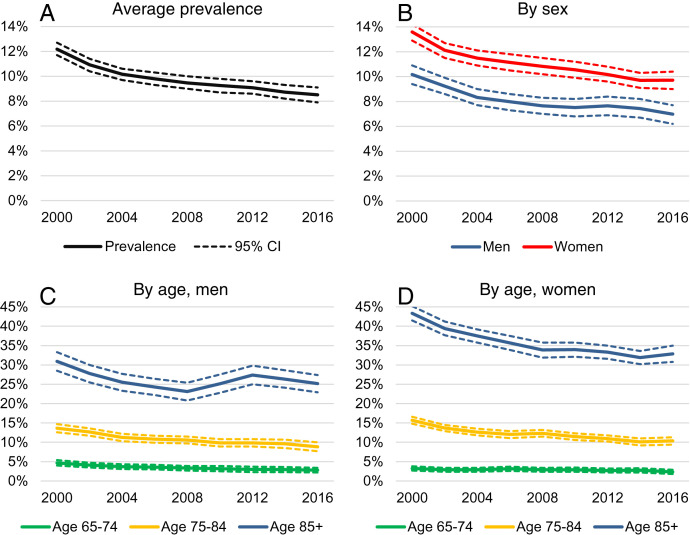
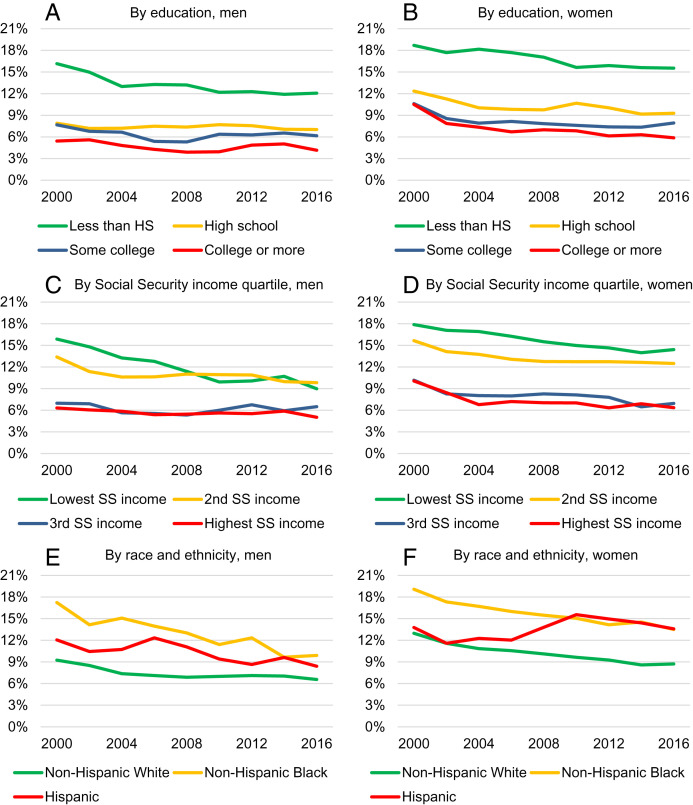
This paper presents estimates of the prevalence of dementia in the United States from 2000 to 2016 by age, sex, race and ethnicity, education, and a measure of lifetime earnings, using data on 21,442 individuals aged 65 y and older and 97,629 person-year observations from a nationally representative survey, the Health and Retirement Study (HRS). The survey includes a range of cognitive tests, and a subsample underwent clinical assessment for dementia. We developed a longitudinal, latent-variable model of cognitive status, which we estimated using the Markov Chain Monte Carlo method. This model provides more accurate estimates of dementia prevalence in population subgroups than do previously used methods on the HRS. The age-adjusted prevalence of dementia decreased from 12.2% in 2000 (95% CI, 11.7 to 12.7%) to 8.5% in 2016 (7.9 to 9.1%) in the 65+ population, a statistically significant decline of 3.7 percentage points or 30.1%. Females are more likely to live with dementia, but the sex difference has narrowed. In the male subsample, we found a reduction in inequalities across education, earnings, and racial and ethnic groups; among females, those inequalities also declined, but less strongly. We observed a substantial increase in the level of education between 2000 and 2016 in the sample. This compositional change can explain, in a statistical sense, about 40% of the reduction in dementia prevalence among men and 20% among women, whereas compositional changes in the older population by age, race and ethnicity, and cardiovascular risk factors mattered less.
Overview
The claims and statistics of this paper haven’t been checked yet.
Free: it reads the open-access text and checks the first 5 claims that cite a source we can check. Create a free account to check every claim.
Integrity signals
Registry
Cites
Statistics
Figures
Verification
Claims the paper makes
The claims and statistics of this paper haven’t been checked yet.
Free: it reads the open-access text and checks the first 5 claims that cite a source we can check. Create a free account to check every claim.
Claims other papers make about this one
Each is checked against this paper’s own text: does it say what the citing paper says it does?
The source backs part of the claim, not all of it — or backs it for a different population, condition or comparison.
In the citing paper
“This decline in incidence has been attributed to improvements over the 20th century in Alzheimer's risk factors, such as increased prevention and treatment of hypertension and greater educational attainment.221”
From 2023 Alzheimer's disease facts and figures (2023) · cites this paper as [221]
Experimental — accuracy not yet measured
Self-check
Percentages, sums and reported differences re-computed from the paper’s own numbers.
The self-check needs the paper’s full text.
Citations
Cites
The global prevalence of dementia: a systematic review and metaanalysis.
Prince, M., Bryce, R., Albanese, E., Wimo, A., Ribeiro, W., & Ferri, C. P. (2013) · Alzheimer's & Dementia · doi:10.1016/j.jalz.2012.11.007 · Cited by 4,941
Hearing loss and cognitive decline in older adults
Lin, F. R., Yaffe, K., Xia, J., Xue, Q.-L., Harris, T. B., Purchase-Helzner, E., Satterfield, S., Ayonayon, H. N., Ferrucci, L., Simonsick, E. M., et al. (2013) · JAMA Internal Medicine · doi:10.1001/jamainternmed.2013.1868 · Cited by 4,017
2021 Alzheimer's disease facts and figures
(2021) · Alzheimer's & Dementia · doi:10.1002/alz.12328 · Cited by 2,201
Prevalence of Dementia in the United States: The Aging, Demographics, and Memory Study
Plassman, B. L., Langa, K. M., Fisher, G. G., Heeringa, S. G., Weir, D. R., Ofstedal, M. B., Burke, J. R., Hurd, M. D., Potter, G. G., Rodgers, W. L., et al. (2007) · Neuroepidemiology · doi:10.1159/000109998 · Cited by 1,932
Self-citationMonetary Costs of Dementia in the United States
Hurd, M. D., Martorell, P., Delavande, A., Mullen, K. J., & Langa, K. M. (2013) · New England Journal of Medicine · doi:10.1056/nejmsa1204629 · Cited by 1,484
Self-citationMatthews, F. E., Arthur, A., Barnes, L. E., Bond, J., Jagger, C., Robinson, L., & Brayne, C. (2013) · The Lancet · doi:10.1016/s0140-6736(13)61570-6 · Cited by 1,155
Crimmins, E. M., Kim, J. K., Langa, K. M., & Weir, D. R. (2011) · The Journals of Gerontology Series B: Psychological Sciences and Social Sciences · doi:10.1093/geronb/gbr048 · Cited by 1,056
Incidence of dementia over three decades in the Framingham heart study
Satizabal, C. L., Beiser, A. S., Chouraki, V., Chêne, G., Dufouil, C., & Seshadri, S. (2016) · New England Journal of Medicine · doi:10.1056/nejmoa1504327 · Cited by 1,051
Sex differences in Alzheimer disease — the gateway to precision medicine
for the Women’s Brain Project and the Alzheimer Precision Medicine Initiative, Ferretti, M. T., Iulita, M. F., Cavedo, E., Chiesa, P. A., Schumacher Dimech, A., Santuccione Chadha, A., Baracchi, F., Girouard, H., Misoch, S., et al. (2018) · Nature Reviews Neurology · doi:10.1038/s41582-018-0032-9 · Cited by 1,009
A Comparison of the Prevalence of Dementia in the United States in 2000 and 2012
Langa, K. M., Larson, E. B., Crimmins, E. M., Faul, J. D., Levine, D. A., Kabeto, M. U., & Weir, D. R. (2017) · JAMA Internal Medicine · doi:10.1001/jamainternmed.2016.6807 · Cited by 910
Research works printed but not linked: 1
- P. Hudomiet, M. D. Hurd, S. Rohwedder, The Lifetime Risk of Living with Dementia for Short and Medium Durations Based on a Longitudinal Model of Cognition Estimated on Nationally Representative U.S. Data (RAND Corporation, 2022).
Cited by
2023 Alzheimer's disease facts and figures
(2023) · Alzheimer's & Dementia · doi:10.1002/alz.13016 · Cited by 3,212
Martin, S. S., Aday, A. W., Almarzooq, Z. I., Anderson, C. A. M., Arora, P., Avery, C. L., Baker-Smith, C. M., Barone Gibbs, B., Beaton, A. Z., Boehme, A. K., et al. (2024) · Circulation · doi:10.1161/cir.0000000000001209 · Cited by 2,800
2024 Alzheimer's disease facts and figures
(2024) · Alzheimer's & Dementia · doi:10.1002/alz.13809 · Cited by 2,536
Martin, S. S., Aday, A. W., Allen, N. B., Almarzooq, Z. I., Anderson, C. A. M., Arora, P., Avery, C. L., Baker-Smith, C. M., Bansal, N., Beaton, A. Z., et al. (2025) · Circulation · doi:10.1161/cir.0000000000001303 · Cited by 1,080
2025 Alzheimer's disease facts and figures
(2025) · Alzheimer's & Dementia · doi:10.1002/alz.70235 · Cited by 474
Palaniappan, L. P., Allen, N. B., Almarzooq, Z. I., Anderson, C. A. M., Arora, P., Avery, C. L., Baker-Smith, C. M., Bansal, N., Currie, M. E., Earlie, R. S., et al. (2026) · Circulation · doi:10.1161/cir.0000000000001412 · Cited by 242
2026 Alzheimer's disease facts and figures
Alzheimer's, T. S. O. A. D. A. A. W. S. C. I. T. B. I., neurons, T. B. N. A. E. A. A. H. A. B. H. B. O., long, E. W., connections, B. E. T. E. E. I. N. T. F. C. W. O. N. A. S., synapses, C., memories, I. F. I. T. B. O. C. T. A. R. B. O. N. A. T. U. B. A. N. T. B. C. T. O. S. T. A. S. T. T. R. T. T. B. T. S. F. T. C. B. O., thoughts, sensations, emotions, & skills., M. A. (2026) · Alzheimer s & Dementia · doi:10.1002/alz.71345 · Cited by 126
Cao, X., Wang, M., Zhou, M., Mi, Y., Fazekas‐Pongor, V., Major, D., Lehoczki, A., & Guo, Y. (2024) · GeroScience · doi:10.1007/s11357-024-01180-6 · Cited by 30
“These findings align with other studies [4, 24, 25] but also highlight the need for continued attention to age and sex differences in dementia burden and the effectiveness of intervention strategies.”
Social determinants of dementia: A scoping review
Walsh, S., Klee, M., Hui, E. K., Saeed, U., Waters, S., Kuhn, I. L., Siette, J., Orgeta, V., Stafford, J., Smith, L., et al. (2025) · Alzheimer s & Dementia · doi:10.1002/alz.70524 · Cited by 37
Prevalence of dementia in Singapore: Changes across a decade
Subramaniam, M., Abdin, E., Asharani, P. V., Roystonn, K., Devi, F., Wang, P., Shafie, S., Sagayadevan, V., Jeyagurunathan, A., Chua, B. Y., et al. (2025) · Alzheimer s & Dementia · doi:10.1002/alz.14485 · Cited by 26
Blass, B., Ford, C. B., Soneji, S. S., Zepel, L., Rosa, T. D., Kaufman, B. G., Mantri, S., Fan, L., Grory, B. M., Xian, Y., et al. (2025) · BMJ · doi:10.1136/bmj-2024-083034 · Cited by 31
Singhaarachchi, P. H., Antal, P., Calon, F., Culmsee, C., Delpech, J.-C., Feldotto, M., Geertsema, J., Hoeksema, E. E., Kőrösi, A., Layé, S., et al. (2024) · Neuroscience & Biobehavioral Reviews · doi:10.1016/j.neubiorev.2024.105724 · Cited by 21
“Women are twice as likely to develop AD than men, and nearly two thirds of the current cases of AD are in women, at least in some geographical regions (Hudomiet et al., 2022; Chene et al., 2015).”
BackgroundJiang, B., Liu, Q., Li, J.-P., Lin, S.-N., Wan, H., Yu, Z.-W., Wang, J., Zhuang, W., Tang, J.-H., Chen, C., et al. (2024) · BMC Geriatrics · doi:10.1186/s12877-024-05054-6 · Cited by 25
“[23], and India (7.4”
InfluentialThe updated prevalence and risk factors of dementia in old adults in China: A cross-sectional study
Gan, J., Zeng, Y., Huang, G., Wang, X., Lü, Y., Niu, J., Meng, X., Cai, P., Li, X., Li, Y., et al. (2024) · Journal of Alzheimer s Disease · doi:10.1177/13872877241297155 · Cited by 20
Feng, K., Song, X., & Caswell, H. (2024) · The Journals of Gerontology Series A · doi:10.1093/gerona/glae106 · Cited by 21
Geographic variation in shortfalls of dementia specialists in the United States
Liu, J., Baker, L., Chen, A. Y.-A., & Wang, J. (2024) · Health Affairs Scholar · doi:10.1093/haschl/qxae088 · Cited by 32
“For the second threshold, we considered those with MCI or dementia (prevalence 8.5% 23,24 ) and estimated 45 dementia specialists per 100 000 population aged 65 years and older ((0.229 + 0.085)/700*100 000).”
BackgroundInfluentialOutdoor nighttime light exposure (light pollution) is associated with Alzheimer’s disease
Voigt, R. M., Ouyang, B., & Keshavarzian, A. (2024) · Frontiers in Neuroscience · doi:10.3389/fnins.2024.1378498 · Cited by 22
Braley, T. J., Lyu, X., Dunietz, G. L., Schulz, P., Bove, R. M., Chervin, R. D., Paulson, H. L., & Shedden, K. (2024) · SLEEP Advances · doi:10.1093/sleepadvances/zpae077 · Cited by 15
U.S. dementia care spending by state: 2010–2019
Lastuka, A., Breshock, M. R., McHugh, T. A., Sogge, W. T., Swart, V. M., & Dieleman, J. L. (2024) · Alzheimer s & Dementia · doi:10.1002/alz.13746 · Cited by 14
Dementia care in a rapidly aging society
Eggleston, K. N., & Kim, D. J. (2025) · Alzheimer s & Dementia · doi:10.1002/alz.70268 · Cited by 12
“34 Policy to support the most vulnerable may be even more important in light of a steepening educational gradient in health, including a wider gap in the prevalence of functional disability between those with low and high educational attainment.”
Trajectory of multimorbidity before dementia: A 24‐year follow‐up study
Guo, J., Gao, B., Huang, Y., & Song, S. (2024) · Alzheimer s & Dementia Diagnosis Assessment & Disease Monitoring · doi:10.1002/dad2.12523 · Cited by 13
“Because the prevalence and incidence of dementiavarybyage,sex,race,education,andapolipoproteinE( APOE ) ε 4, 14–16 we also aimed to examine whether TOM before dementia is modified by these factors.”
BackgroundEducation, Occupational Environment, and Cognitive Function in Later Life
Cao, Q., Carr, D. C., & Taylor, M. G. (2025) · The Journals of Gerontology Series B · doi:10.1093/geronb/gbaf043 · Cited by 13
Torres, J. M., Calderon, L. E., Kogut, K. R., MacCuish, K., Warner, M. L., Rodríguez, M. T. G., Garcia, L., Romero, M., Morga, N., McDowell-Sanchez, A. K., et al. (2025) · American Journal of Epidemiology · doi:10.1093/aje/kwaf036 · Cited by 10
Lohner, V., Badhwar, A., Detcheverry, F. E., García, C. L., Gellersen, H. M., Khodakarami, Z., Lattmann, R., Li, R., Low, A., Mazo, C., et al. (2025) · Alzheimer s Research & Therapy · doi:10.1186/s13195-025-01815-6 · Cited by 11
Kanuri, S. H., & Sirrkay, P. J. (2025) · Neurology International · doi:10.3390/neurolint17090134 · Cited by 7
“On the contrary, another study reported that the age-adjusted prevalence of dementia decreased from 12.2% to 8% from 2000 to 2016 [2].”
InfluentialWalters, E. E., Luczak, S. E., Beam, C. R., Ericsson, M., Kremen, W. S., Krueger, R. F., Markon, K. E., McGue, M. K., Nygaard, M., Panizzon, M. S., et al. (2025) · European Journal of Epidemiology · doi:10.1007/s10654-025-01286-x · Cited by 7
“The effect may further be more pronounced in men than in women [12].”
Limited connectedness of spontaneous speech may be a marker of dementia due to Alzheimer’s disease
Botezatu, M. R., Miller, E., & Kiselica, A. M. (2023) · Frontiers in Aging Neuroscience · doi:10.3389/fnagi.2023.1252614 · Cited by 5
“(Hudomiet et al., 2022), and this number is expected to more than double by 2060 (Alzheimer's Association, 2023).”
BackgroundA health-equity framework for tailoring digital non-pharmacological interventions in aging
Turnbull, A. G., Odden, M. C., Gould, C. E., Adeli, E., Kaplan, R. M., & Lin, F. V. (2024) · Nature Mental Health · doi:10.1038/s44220-024-00347-6 · Cited by 7
“…risk for a range of mental health disorders including depression (18.9% in a low-income group, compared with 16.9 and 12.1 for middle and high income, respectively) 16 and dementia (around 9% in the lowest quartile of earners aged 65+, compared with less than 6% in the highest quartile) 17 .”
InfluentialPerales‐Puchalt, J., Checa, I., Espejo, B., Carbonell, M. M., Fracachán-Cabrera, M., Baker, C., Ramírez, M., Mendez-Asaro, P., Zimmer, M., Williams, K. N., et al. (2025) · Hispanic Journal of Behavioral Sciences · doi:10.1177/07399863241308996 · Cited by 4
“Despite their large representation in the US, Latinos experience multiple disparities in dementia, including a disproportionately high dementia risk (Hudomiet et al., 2022), low and delayed detection (Lin et al., 2020), and poorer treatment, care, and wellbeing outcomes (Chen et al., 2020; Hinton…”
Zhang, Y. S., Gross, A. L., Dougherty, R. J., Kobayashi, L. C., Schrack, J. A., & Freedman, V. A. (2025) · SSM - Population Health · doi:10.1016/j.ssmph.2025.101796 · Cited by 7
“Evidence regarding trends in dementia prevalence among Hispanic older adults remains unclear due to limited data (Hudomiet et al., 2022), highlighting the need for greater attention on this fast-growing and heterogeneous population.”
InfluentialLifestyle medicine for healthy cognitive aging: A narrative review
Halma, M. T. J., Marik, P. E., Gazda, S., & Tuszyński, J. A. (2024) · Brain Behavior and Immunity Integrative · doi:10.1016/j.bbii.2024.100077 · Cited by 6
Friedman, E. M., Wang, J. J. J., Weden, M. M., Slaughter, M. E., Shih, R. A., & Rutter, C. M. (2025) · Populations · doi:10.3390/populations1020010 · Cited by 4
“For example, the age-specific prevalence of dementia is higher in Black adults than White adults [14,15], and in women than men [6].”
Inequalities in the Duration and Lifetime Risk of Dementia in the United States
Hudomiet, P., Hurd, M. D., & Rohwedder, S. (2025) · Demography · doi:10.1215/00703370-12175489 · Cited by 6
Self-citationAmin, V., Behrman, J. R., Fletcher, J. M., Flores, C. A., Flores‐Lagunes, A., Kohler, I. V., Kohler, H., & Stites, S. D. (2025) · The Journals of Gerontology Series B · doi:10.1093/geronb/gbaf057 · Cited by 4
“An extra year of schooling increased immediate memory and verbal fluency scores by 0.07 SD s in the United States (Herd & Sicinski, 2022) and fluid intelligence scores by 0.12 SD s in the United Kingdom (Fletcher et al., 2021).”
InfluentialArteaga, I., de Jesús, A. H., Ginn, B., Abramson, C. M., & Dohan, D. P. (2025) · The Gerontologist · doi:10.1093/geront/gnaf207 · Cited by 4
Kim, J. H., Glymour, M. M., Langa, K. M., & Leist, A. K. (2025) · American Journal of Epidemiology · doi:10.1093/aje/kwaf001 · Cited by 3
Adams, R., Leoutsakos, J., Nowrangi, M. A., Oh, E. S., Rosenberg, P. B., Skolariki, K., Yaşar, S., Zandi, P. P., & Lyketsos, C. G. (2025) · Alzheimer s & Dementia Translational Research & Clinical Interventions · doi:10.1002/trc2.70070 · Cited by 6
Empathy as a crucial skill in disrupting disparities in global brain health
Fitri, F. I., Lage, C., Mollayeva, T., Santamaría‐García, H. A., Chan, M., Cominetti, M. R., Daria, T., Fallon, G., Gately, D., Gichu, M., et al. (2023) · Frontiers in Neurology · doi:10.3389/fneur.2023.1189143 · Cited by 7
Joo, H., Avelino‐Silva, T. J., Diaz‐Ramirez, L. G., Lee, S. J., & Whitlock, E. L. (2024) · Journal of the American Geriatrics Society · doi:10.1111/jgs.19247 · Cited by 3
“Baseline cognition was calculated from the HRS cognitive battery during the most recent (within 3.5 years) pre-procedure interview according to the method of Hudomiet, 12 which yields a global cognition measure including HRS multi-item cognitive tests and relevant patient factors.”
InfluentialEmpowering community health workers in dementia care in South Texas
Santiago-Mejías, S., Rhodes, S. L., Epps, F. R., Hilsabeck, R. C., Garza, N., Seshadri, S. S., & Patel, N. K. (2025) · Journal of Alzheimer s Disease · doi:10.1177/13872877251378463 · Cited by 3
Cao, Q., Carr, D. C., & Radey, M. (2025) · The Journals of Gerontology Series B · doi:10.1093/geronb/gbaf263 · Cited by 2
The impact of education on dementia: Evidence from compulsory schooling reforms in England
Monnet, N., Nichols, E., Kieny, C., & Avendano, M. (2026) · Social Science & Medicine · doi:10.1016/j.socscimed.2026.119071 · Cited by 4
Does Schooling Improve Cognitive Abilities at Older Ages? Causal Evidence From Nonparametric Bounds
Amin, V., Behrman, J. R., Fletcher, J. M., Flores, C. A., Flores‐Lagunes, A., & Kohler, H. (2025) · Demography · doi:10.1215/00703370-11865131 · Cited by 7
Menie, M. A. W. O., Peñaherrera-Aguirre, M., & Fuerst, J. (2025) · Twin Research and Human Genetics · doi:10.1017/thg.2025.17 · Cited by 3
Excess deaths due to incident Alzheimer’s dementia in women and men in the United StatesPreprint
James, B. D., Wang, T., Leurgans, S. E., Barnes, L. L., Márquez, D. X., & Bennett, D. A. (2025) · medRxiv · doi:10.1101/2025.08.27.25334590 · Cited by 2
Sharma, S., Hale, J. M., & Feraldi, A. (2025) · Population Studies · doi:10.1080/00324728.2025.2462283 · Cited by 1
“Factors such as differential trends in socio-economic status and chronic conditions (e.g. hypertension and dementia), favouring women, may have contributed to these trends (Wu et al. 2007; Tsai 2016; Blau and Kahn 2017; England et al. 2020; Hudomiet et al. 2022).”
U.S. Corrections Officers’ Discourse About Dementia: An Initial Focus Group
Davis, B. H., & Troutman‐Jordan, M. (2025) · Journal of connected speech. · doi:10.3138/jcspeech.30468 · Cited by 1
Neighborhood affluence and cognitive decline: Moderation by race?
Bell, M. J. (2025) · Social Science & Medicine · doi:10.1016/j.socscimed.2025.118595 · Cited by 2
Chen, K., Yu, G., & Li, H. (2025) · Experimental Gerontology · doi:10.1016/j.exger.2025.113019 · Cited by 1
Hamilton, L. J., Coleman, M. E., Sprecher, A., & Rutter, L. A. (2026) · Alzheimer s & Dementia Diagnosis Assessment & Disease Monitoring · doi:10.1002/dad2.70260 · Cited by 1
“9,10,12 Women are at elevated risk, 26 being twice as likely to receive a diagnosis, 27 and show faster decline compared to men.”
Mapping social health and dementia risk: A register-based study of older adults in Finland
Cisotto, E., Moretti, M., Silan, M., Damiens, J., Belloni, P., Korhonen, K., & Martikainen, P. (2026) · Social Science & Medicine · doi:10.1016/j.socscimed.2026.119154 · Cited by 1
Education and Adult Cognition in a Low-Income Setting: Differences among Adult Siblings
Zhang, Y. S., Frankenberg, E., & Thomas, D. (2024) · Journal of Human Capital · doi:10.1086/734385 · Cited by 2
Cognitive Trajectory Before and After Cataract Surgery: A Population‐Based Approach
Joo, H., Diaz‐Ramirez, L. G., Chen, C. L., Sun, C. Q., Smith, A. K., Boscardin, W. J., & Whitlock, E. L. (2025) · Journal of the American Geriatrics Society · doi:10.1111/jgs.19372 · Cited by 1
“It was derived from an analytic model that incorporated HRS cognitive test items, demographic variables, and health variables into a summary measure calibrated against the ADAMS classifications of HRS participants who underwent a detailed clinical assessment for dementia [20].”
Neuropalliative Care in Dementia
Weisbrod, N. (2025) · CONTINUUM Lifelong Learning in Neurology · doi:10.1212/cont.0000000000001639 · Cited by 1
Education and Adult Cognition in a Low-income Setting: Differences among Adult Siblings
Zhang, Y., Frankenberg, E., & Thomas, D. (2024) · National Bureau of Economic Research · doi:10.3386/w32362 · Cited by 1
Lohner, V., Badhwar, A., Detcheverry, F. E., García, C. L., Gellersen, H. M., Khodakarami, Z., Lattmann, R., Li, R., Low, A., Mazo, C., et al. (2024) · medRxiv · doi:10.1101/2024.12.17.24319166 · Cited by 1
More Schooling Can Delay the Onset of Dementia Later in Life
Amin, V., Behrman, J. R., Fletcher, J. M., Flores, C. A., Flores‐Lagunes, A., Kohler, I. V., Kohler, H., & Stites, S. D. (2025) · doi:10.17848/pb2025-85 · Cited by 1
Perales‐Puchalt, J., Baker, C., Wagle, B., Godar, M., Nieto-Gomez, S., Johnson, H., Drees, B. M., Fracachán-Cabrera, M., & Ramírez, M. (2025) · medRxiv · doi:10.1101/2025.09.19.25336094 · Cited by 1
Perales‐Puchalt, J., Checa, I., Espejo, B., Carbonell, M. M., Fracachán-Cabrera, M., Baker, C., Ramírez, M., Mendez-Asaro, P., Zimmer, M., Williams, K. N., et al. (2024) · medRxiv · doi:10.1101/2024.08.28.24312743
Rodriguez, M. J., & Perales‐Puchalt, J. (2024) · International Psychogeriatrics · doi:10.1016/j.inpsyc.2024.100022
Race and Incident Dementia Among Older Black and Older White Men
Jerry-Asooto, B., Kim, B., Huang, A., Gallo, J. J., Whitfield, K. E., Turner, R., & Thorpe, R. J. (2025) · Journal of Aging and Health · doi:10.1177/08982643241310296 · Cited by 1
“…health problem in the United States (Alzheimer ’ s Association, 2024, Division of Population Health, 2019; GBD 2016 Neurology Collaborators, 2019; Hudomiet et al., 2022) characterized largely by the substantial number of individuals with some form of dementia and signi fi cant racial or ethnic…”
Amin, V., Behrman, J. R., Fletcher, J. M., Flores, C. A., Flores‐Lagunes, A., Kohler, I. V., Kohler, H., & Stites, S. D. (2025) · Upjohn Research (W.E. Upjohn Institute for Employment Research) · doi:10.17848/wp25-418
Sapkota, S., Maillard, P., Fletcher, E. M., Harvey, D. J., Olichney, J., Farias, S. T., Gilsanz, P., Mungas, D., Whitmer, R. A., & DeCarli, C. S. (2025) · Neurobiology of Aging · doi:10.1016/j.neurobiolaging.2025.07.002
“Inequalities in dementia incidence across racial and ethnic minoritized groups have been observed across the United States (Anderson et al., 2004; Hudomiet et al., 2022; Kornblith et al., 2022; Mayeda et al., 2016).”
More Schooling Can Delay the Onset of Dementia Later in Life
Amin, V., Behrman, J. R., Fletcher, J. M., Flores, C. A., Flores‐Lagunes, A., Kohler, I. V., Kohler, H., & Stites, S. D. (2025) · Employment Research · doi:10.17848/1075-8445.32(3)-1
Employment Research, Vol. 32, No. 3, July 2025
(2025) · Employment Research · doi:10.17848/1075-8445.32(3
Remote Intervention to Support Caregivers of Latino People with Dementia: Feasibility StudyPreprint
Perales‐Puchalt, J., Ramirez-Mantilla, M., Fracachán-Cabrera, M., Baker, C., & Burns, J. M. (2025) · medRxiv · doi:10.1101/2025.09.18.25336084
Perales‐Puchalt, J., Parks, A. C., Lewandowski, T., Burns, J. M., & Vidoni, E. D. (2025) · medRxiv · doi:10.1101/2025.09.19.25336192
“Focusing on Latinos is particularly important, as they represent the fastest-growing older ethnoracial group in the US [5], are disproportionately impacted by dementia risk [6], and are projected to increase in number from 379,000 in 2012 to 3.5 million by 2060 [7].”
InfluentialFang, Y., & Han, J. (2025) · Research in Social and Administrative Pharmacy · doi:10.1016/j.sapharm.2025.11.011
Positive Behavior Support in Gerontology
Greenwald, A. E., Brown, L., O’Flaherty, C., & Jackson, D. (2025) · Issues in clinical child psychology · doi:10.1007/978-3-031-96102-1_15
Neurological diseases: Sex and gender differences in stroke, migraine, and Alzheimer’s dementia
Madsen, T. E., & McClure, S. C. (2026) · Elsevier eBooks · doi:10.1016/b978-0-443-26712-3.00006-9
Shaw, A. R., Perales‐Puchalt, J., Sandoval, R., Glover, C. M., Berkley‐Patton, J., Vidoni, E. D., & Burns, J. M. (2026) · Journal of Participatory Research Methods · doi:10.35844/001c.141305
Ryan-Claytor, C., & Luo, L. (2026) · International Journal of Epidemiology · doi:10.1093/ije/dyag026
Balance Disorders in Young and Middle‐Aged Adults: NHANES , 2001–2004 and 2021–2023
Hoffman, H. J., Fisher, D. E., Hogan, A. E., Cohen, H. S., Flamme, G. A., Themann, C. L., Li, C.-M., Ward, B. K., & Santina, C. C. D. (2026) · The Laryngoscope · doi:10.1002/lary.70482
Depressive symptoms and excess spending in older adults: evidence from WALLET study
Flores, E. V., Rorai, V., & Lichtenberg, P. A. (2026) · Aging & Mental Health · doi:10.1080/13607863.2026.2664687
Perales‐Puchalt, J., Baker, C., Wagle, B., Godar, M., Nieto-Gomez, S., Johnson, H., Drees, B. M., Fracachán-Cabrera, M., & Ramirez-Mantilla, M. (2026) · Journal of Alzheimer s Disease · doi:10.1177/13872877261450936 · Cited by 1
“1,13,14 There is a need for easily implementable caregiver support solutions that do not leave anyone behind.”
Kieny, C., Nolan, A., Ma, Y., & Avendano, M. (2026) · The Journal of the Economics of Ageing · doi:10.1016/j.jeoa.2026.100657 · Cited by 1
Spearman’s Hypothesis Tested Between and Within Genetic Ancestry Groups in the HRS-HCAP SamplePreprint
Сергеевич, Ш. В., & Fuerst, J. G. R. (2026) · Qeios · doi:10.32388/0s5gaa
Rojas, N., Calderon, L. E., Kogut, K. R., Perez-Rocha, Y., Guadamuz, J. S., Fleming, M. D., Warner, M. L., Eskenazi, B., González, H. M., DEARDORFF, J., et al. (2026) · SLEEP Advances · doi:10.1093/sleepadvances/zpag085
Pedagogical support of cognitive functions of mature individuals
Игоревна, О. Н. (2026) · Journal of Pedagogical Studies · doi:10.12737/2500-3305-2026-11-3-155-170
Boateng, C., & Duah, I. O. (2026) · PLOS Aging and Health · doi:10.1371/journal.page.0000025
“…U.S., however, the rapid expansion of the older adult population means that the absolute number of individuals living with dementia will continue to rise, underscoring the need to understand how comorbidity burden and psychosocial vulnerability shape cognitive health in later life [33,35,38,39].”
Optimal cutoffs for the Montreal Cognitive Assessment among English and Spanish speaking Latinos
Perales‐Puchalt, J., Aschenbrenner, A. J., Marquine, M. J., Rascovsky, K., & Parks, A. C. (2026) · Applied Neuropsychology Adult · doi:10.1080/23279095.2026.2737794
Yingying, H. U., & Yang, H. (2026) · Psychiatry Research · doi:10.1016/j.psychres.2026.117533
Metadata
- Authors
- Hudomiet, P., Hurd, M. D., & Rohwedder, S.
- Affiliations
- RAND Corporation (US)
- Corresponding author
- Hudomiet, Péter
- Venue
- Proceedings of the National Academy of Sciences
- Publisher
- National Academy of Sciences
- Published
- 2022-11-07
- Volume
- 119
- Issue
- 46
- Pages
- e2212205119-e2212205119
- ISSN
- 0027-8424 (ISSN-L)
- 1091-6490
- PMC
- PMC9674270
- OpenAlex
- W4308429944
- Cited by
- 83
- References
- 30
- Citations by year
- 2026: 18 · 2025: 41 · 2024: 21 · 2023: 3
- FWCI
- 10.59
- Type
- journal article
- Language
- en
- Open access
- hybrid
- doi.org
- Licence
- Locations
- Proceedings of the National Academy of Sciences (publishedVersion, cc-by-nc-nd)
- PubMed Central (publishedVersion, cc-by-nc-nd)
- PubMed (publishedVersion)
- RePEc: Research Papers in Economics (submittedVersion)
- Funders
- HHS | NIH | National Institute on Aging (R01AG053972)
- Topics
- Health Sciences › Medicine › Psychiatry and Mental health › Dementia and Cognitive Impairment Research
- Social Sciences › Health › Health disparities and outcomes
- Social Sciences › Psychology › Experimental and Cognitive Psychology › Cognitive Abilities and Testing
- Keywords
- dementia prevalence, health disparities, older adults, sex differences, racial and ethnic disparities, educational attainment, lifetime earnings, compositional change, cognitive status, cardiovascular risk factors, temporal trends
- MeSH terms
- Dementia, Educational Status, Ethnicity, Female, Humans, Male, Retirement, United States, Prevalence
About these checks
Registry, retraction, Cites and statistics results are computed, not judged, with one exception: a printed reference that no index lists is read once by a model before it counts as a citation error. Claims are extracted by a model and kept only when their quote appears verbatim in the text; each cited source is then checked, with a model’s help, for whether it says what the claim relies on. Those verdicts can be wrong — read the claim’s quote and the cited source before relying on one.
Statistics and arithmetic are recomputed, not judged.
Confidence bands are shown only for fields calibrated on our annotated test set. None is calibrated yet, so no band is shown.
What counts as a claim ›How we measure confidence ›How we check this ›
Are you an author, or do you see a problem with this page? Request a review
Data sources
Bibliographic data: Semantic Scholar, OpenAlex, Crossref.
Contains information from the Semantic Scholar Academic Graph Datasets, made available under the ODC Attribution License (ODC-BY 1.0).
Semantic Scholar’s data is described in: Kinney, R., et al. (2023). The Semantic Scholar Open Data Platform. arXiv:2301.10140.
