

Trends in inequalities in the prevalence of dementia in the United States
Open accessThe DOI matches its Crossref record; 30 of the 30 references it cites were found in a registry or an index.
Abstract
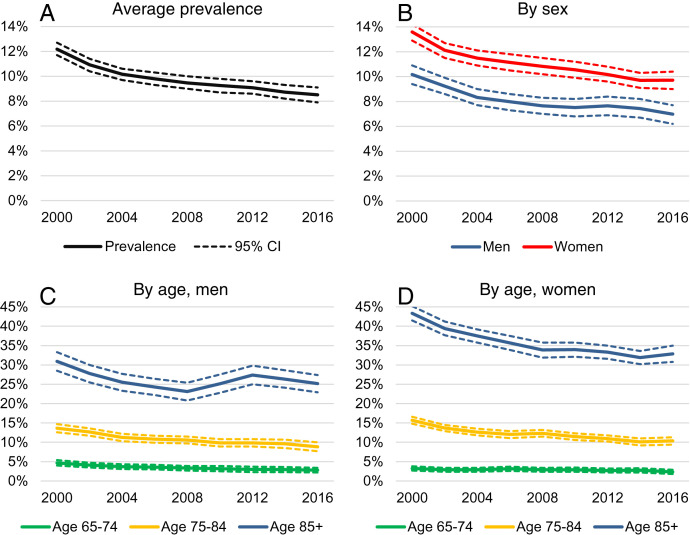
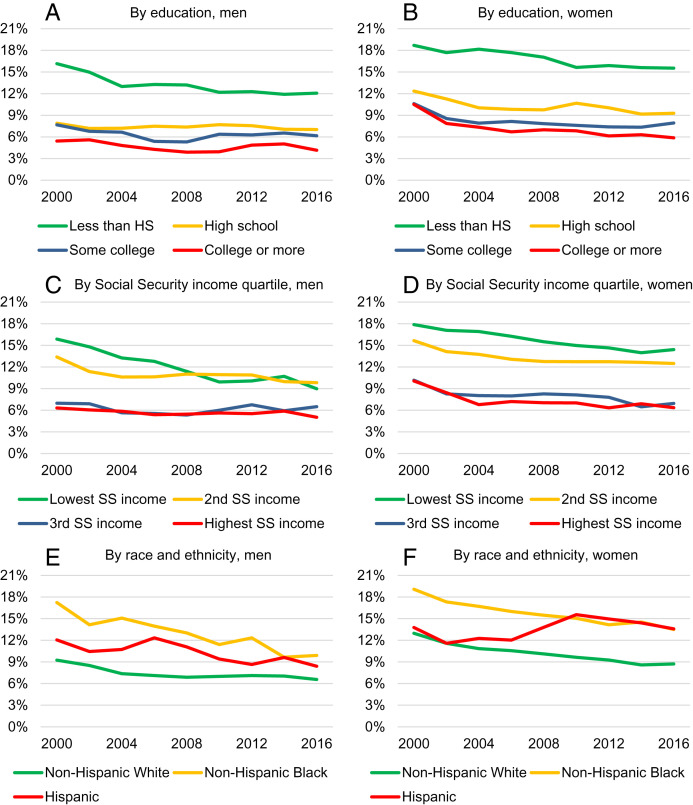
This paper presents estimates of the prevalence of dementia in the United States from 2000 to 2016 by age, sex, race and ethnicity, education, and a measure of lifetime earnings, using data on 21,442 individuals aged 65 y and older and 97,629 person-year observations from a nationally representative survey, the Health and Retirement Study (HRS). The survey includes a range of cognitive tests, and a subsample underwent clinical assessment for dementia. We developed a longitudinal, latent-variable model of cognitive status, which we estimated using the Markov Chain Monte Carlo method. This model provides more accurate estimates of dementia prevalence in population subgroups than do previously used methods on the HRS. The age-adjusted prevalence of dementia decreased from 12.2% in 2000 (95% CI, 11.7 to 12.7%) to 8.5% in 2016 (7.9 to 9.1%) in the 65+ population, a statistically significant decline of 3.7 percentage points or 30.1%. Females are more likely to live with dementia, but the sex difference has narrowed. In the male subsample, we found a reduction in inequalities across education, earnings, and racial and ethnic groups; among females, those inequalities also declined, but less strongly. We observed a substantial increase in the level of education between 2000 and 2016 in the sample. This compositional change can explain, in a statistical sense, about 40% of the reduction in dementia prevalence among men and 20% among women, whereas compositional changes in the older population by age, race and ethnicity, and cardiovascular risk factors mattered less.
Overview
The claims and statistics of this paper haven’t been checked yet.
Free: it reads the open-access text and checks the first 5 claims that cite a source we can check. Create a free account to check every claim.
Integrity signals
Registry
Cites
Statistics
Figures
Verification
Claims the paper makes
The claims and statistics of this paper haven’t been checked yet.
Free: it reads the open-access text and checks the first 5 claims that cite a source we can check. Create a free account to check every claim.
Claims other papers make about this one
Each is checked against this paper’s own text: does it say what the citing paper says it does?
The source backs part of the claim, not all of it — or backs it for a different population, condition or comparison.
In the citing paper
“This decline in incidence has been attributed to improvements over the 20th century in Alzheimer's risk factors, such as increased prevention and treatment of hypertension and greater educational attainment.221”
From 2023 Alzheimer's disease facts and figures (2023) · cites this paper as [221]
Experimental — accuracy not yet measured
Self-check
Percentages, sums and reported differences re-computed from the paper’s own numbers.
The self-check needs the paper’s full text.
Citations
Cites
The global prevalence of dementia: a systematic review and metaanalysis.
Prince, M., Bryce, R., Albanese, E., Wimo, A., Ribeiro, W., & Ferri, C. P. (2013) · Alzheimer's & Dementia · doi:10.1016/j.jalz.2012.11.007 · Cited by 4,941
Hearing loss and cognitive decline in older adults
Lin, F. R., Yaffe, K., Xia, J., Xue, Q.-L., Harris, T. B., Purchase-Helzner, E., Satterfield, S., Ayonayon, H. N., Ferrucci, L., Simonsick, E. M., et al. (2013) · JAMA Internal Medicine · doi:10.1001/jamainternmed.2013.1868 · Cited by 4,017
2021 Alzheimer's disease facts and figures
(2021) · Alzheimer's & Dementia · doi:10.1002/alz.12328 · Cited by 2,201
Prevalence of Dementia in the United States: The Aging, Demographics, and Memory Study
Plassman, B. L., Langa, K. M., Fisher, G. G., Heeringa, S. G., Weir, D. R., Ofstedal, M. B., Burke, J. R., Hurd, M. D., Potter, G. G., Rodgers, W. L., et al. (2007) · Neuroepidemiology · doi:10.1159/000109998 · Cited by 1,932
Self-citationMonetary Costs of Dementia in the United States
Hurd, M. D., Martorell, P., Delavande, A., Mullen, K. J., & Langa, K. M. (2013) · New England Journal of Medicine · doi:10.1056/nejmsa1204629 · Cited by 1,484
Self-citationMatthews, F. E., Arthur, A., Barnes, L. E., Bond, J., Jagger, C., Robinson, L., & Brayne, C. (2013) · The Lancet · doi:10.1016/s0140-6736(13)61570-6 · Cited by 1,155
Crimmins, E. M., Kim, J. K., Langa, K. M., & Weir, D. R. (2011) · The Journals of Gerontology Series B: Psychological Sciences and Social Sciences · doi:10.1093/geronb/gbr048 · Cited by 1,056
Incidence of dementia over three decades in the Framingham heart study
Satizabal, C. L., Beiser, A. S., Chouraki, V., Chêne, G., Dufouil, C., & Seshadri, S. (2016) · New England Journal of Medicine · doi:10.1056/nejmoa1504327 · Cited by 1,051
Sex differences in Alzheimer disease — the gateway to precision medicine
for the Women’s Brain Project and the Alzheimer Precision Medicine Initiative, Ferretti, M. T., Iulita, M. F., Cavedo, E., Chiesa, P. A., Schumacher Dimech, A., Santuccione Chadha, A., Baracchi, F., Girouard, H., Misoch, S., et al. (2018) · Nature Reviews Neurology · doi:10.1038/s41582-018-0032-9 · Cited by 1,009
A Comparison of the Prevalence of Dementia in the United States in 2000 and 2012
Langa, K. M., Larson, E. B., Crimmins, E. M., Faul, J. D., Levine, D. A., Kabeto, M. U., & Weir, D. R. (2017) · JAMA Internal Medicine · doi:10.1001/jamainternmed.2016.6807 · Cited by 910
Patient and Caregiver Characteristics and Nursing Home Placement in Patients With Dementia
Yaffe, K. (2002) · JAMA · doi:10.1001/jama.287.16.2090 · Cited by 903
Recent global trends in the prevalence and incidence of dementia, and survival with dementia
Prince, M., Ali, G.-C., Guerchet, M., Prina, A. M., Albanese, E., & Wu, Y.-T. (2016) · Alzheimer's Research & Therapy · doi:10.1186/s13195-016-0188-8 · Cited by 876
The changing prevalence and incidence of dementia over time - current evidence
Wu, Y.-T., Beiser, A. S., Breteler, M. M. B., Fratiglioni, L., Helmer, C., Hendrie, H. C., Honda, H., Ikram, M. A., Langa, K. M., Lobo, A., et al. (2017) · Nature Reviews Neurology · doi:10.1038/nrneurol.2017.63 · Cited by 775
Rocca, W. A., Petersen, R. C., Knopman, D. S., Hebert, L. E., Evans, D. A., Hall, K. S., Gao, S., Unverzagt, F. W., Langa, K. M., Larson, E. B., et al. (2011) · Alzheimer's & Dementia · doi:10.1016/j.jalz.2010.11.002 · Cited by 498
Is dementia incidence declining?: Trends in dementia incidence since 1990 in the Rotterdam Study
Schrijvers, E. M. C., Verhaaren, B. F. J., Koudstaal, P. J., Hofman, A., Ikram, M. A., & Breteler, M. M. B. (2012) · Neurology · doi:10.1212/wnl.0b013e3182553be6 · Cited by 408
New Insights into the Dementia Epidemic
Larson, E. B., Yaffe, K., & Langa, K. M. (2013) · New England Journal of Medicine · doi:10.1056/nejmp1311405 · Cited by 347
The Prevalence of Dementia in a Statewide Sample of New Nursing Home Admissions Aged 65 and Older
Magaziner, J., German, P., Zimmerman, S. I., Hebel, J. R., Burton, L., Gruber-Baldini, A. L., May, C., & Kittner, S. (2000) · The Gerontologist · doi:10.1093/geront/40.6.663 · Cited by 295
Association of Race and Ethnicity With Incidence of Dementia Among Older Adults
Kornblith, E., Bahorik, A., Boscardin, W. J., Xia, F., Barnes, D. E., & Yaffe, K. (2022) · JAMA · doi:10.1001/jama.2022.3550 · Cited by 247
Lawrence Gould, A., Boye, M. E., Crowther, M. J., Ibrahim, J. G., Quartey, G., Micallef, S., & Bois, F. Y. (2015) · Statistics in Medicine · doi:10.1002/sim.6141 · Cited by 164
Power, M. C., Bennett, E. E., Turner, R. W., Dowling, N. M., Ciarleglio, A., Glymour, M. M., & Gianattasio, K. Z. (2021) · JAMA Neurology · doi:10.1001/jamaneurol.2020.4471 · Cited by 157
Gianattasio, K. Z., Wu, Q., Glymour, M. M., & Power, M. C. (2019) · Epidemiology · doi:10.1097/ede.0000000000000945 · Cited by 128
Aging without Dementia is Achievable: Current Evidence from Epidemiological Research
Qiu, C., & Fratiglioni, L. (2018) · Journal of Alzheimer’s Disease · doi:10.3233/jad-171037 · Cited by 126
Trends in dementia incidence: Evolution over a 10‐year period in France
Grasset, L., Brayne, C., Joly, P., Jacqmin‐Gadda, H., Peres, K., Foubert‐Samier, A., Dartigues, J., & Helmer, C. (2016) · Alzheimer's & Dementia · doi:10.1016/j.jalz.2015.11.001 · Cited by 118
Hudomiet, P., Hurd, M. D., & Rohwedder, S. (2018) · The Journals of Gerontology: Series B · doi:10.1093/geronb/gbx169 · Cited by 96
Self-citationSex, Race, and Age Differences in Prevalence of Dementia in Medicare Claims and Survey Data
Zhu, Y., Chen, Y., Crimmins, E. M., & Zissimopoulos, J. M. (2021) · The Journals of Gerontology: Series B · doi:10.1093/geronb/gbaa083 · Cited by 72
Gianattasio, K. Z., Ciarleglio, A., & Power, M. C. (2020) · Epidemiology · doi:10.1097/ede.0000000000001101 · Cited by 69
Trends in Dementia Prevalence, Incidence, and Mortality in the United States (2000–2016)
Farina, M. P., Zhang, Y. S., Kim, J. K., Hayward, M. D., & Crimmins, E. M. (2022) · Journal of Aging and Health · doi:10.1177/08982643211029716 · Cited by 54
Hayward, M. D., Farina, M. P., Zhang, Y. S., Kim, J. K., & Crimmins, E. M. (2021) · The Journals of Gerontology: Series B · doi:10.1093/geronb/gbab015 · Cited by 42
Hickey, G. L., Philipson, P., Jorgensen, A., & Kolamunnage‐Dona, R. (2018) · Journal of the Royal Statistical Society Series A (Statistics in Society) · doi:10.1111/rssa.12348 · Cited by 41
ADAMS: Sample Design, Weighting and Analysis for ADAMS
Heeringa, S. G., Fisher, G. G., Hurd, M. D., Langa, K. M., Ofstedal, M. B., Plassman, B. L., & Rodgers, W. L. (2009) · doi:10.7826/isr-um.06.585031.001.05.0019.2009 · Cited by 23
Self-citation
Research works printed but not linked: 1
- P. Hudomiet, M. D. Hurd, S. Rohwedder, The Lifetime Risk of Living with Dementia for Short and Medium Durations Based on a Longitudinal Model of Cognition Estimated on Nationally Representative U.S. Data (RAND Corporation, 2022).
Cited by
2023 Alzheimer's disease facts and figures
(2023) · Alzheimer's & Dementia · doi:10.1002/alz.13016 · Cited by 3,212
Martin, S. S., Aday, A. W., Almarzooq, Z. I., Anderson, C. A. M., Arora, P., Avery, C. L., Baker-Smith, C. M., Barone Gibbs, B., Beaton, A. Z., Boehme, A. K., et al. (2024) · Circulation · doi:10.1161/cir.0000000000001209 · Cited by 2,800
2024 Alzheimer's disease facts and figures
(2024) · Alzheimer's & Dementia · doi:10.1002/alz.13809 · Cited by 2,536
Martin, S. S., Aday, A. W., Allen, N. B., Almarzooq, Z. I., Anderson, C. A. M., Arora, P., Avery, C. L., Baker-Smith, C. M., Bansal, N., Beaton, A. Z., et al. (2025) · Circulation · doi:10.1161/cir.0000000000001303 · Cited by 1,080
2025 Alzheimer's disease facts and figures
(2025) · Alzheimer's & Dementia · doi:10.1002/alz.70235 · Cited by 474
Metadata
- Authors
- Hudomiet, P., Hurd, M. D., & Rohwedder, S.
- Affiliations
- RAND Corporation (US)
- Corresponding author
- Hudomiet, Péter
- Venue
- Proceedings of the National Academy of Sciences
- Publisher
- National Academy of Sciences
- Published
- 2022-11-07
- Volume
- 119
- Issue
- 46
- Pages
- e2212205119-e2212205119
- ISSN
- 0027-8424 (ISSN-L)
- 1091-6490
- PMC
- PMC9674270
- OpenAlex
- W4308429944
- Cited by
- 83
- References
- 30
- Citations by year
- 2026: 18 · 2025: 41 · 2024: 21 · 2023: 3
- FWCI
- 10.59
- Type
- journal article
- Language
- en
- Open access
- hybrid
- doi.org
- Licence
- Locations
- Proceedings of the National Academy of Sciences (publishedVersion, cc-by-nc-nd)
- PubMed Central (publishedVersion, cc-by-nc-nd)
- PubMed (publishedVersion)
- RePEc: Research Papers in Economics (submittedVersion)
- Funders
- HHS | NIH | National Institute on Aging (R01AG053972)
- Topics
- Health Sciences › Medicine › Psychiatry and Mental health › Dementia and Cognitive Impairment Research
- Social Sciences › Health › Health disparities and outcomes
- Social Sciences › Psychology › Experimental and Cognitive Psychology › Cognitive Abilities and Testing
- Keywords
- dementia prevalence, health disparities, older adults, sex differences, racial and ethnic disparities, educational attainment, lifetime earnings, compositional change, cognitive status, cardiovascular risk factors, temporal trends
- MeSH terms
- Dementia, Educational Status, Ethnicity, Female, Humans, Male, Retirement, United States, Prevalence
About these checks
Registry, retraction, Cites and statistics results are computed, not judged, with one exception: a printed reference that no index lists is read once by a model before it counts as a citation error. Claims are extracted by a model and kept only when their quote appears verbatim in the text; each cited source is then checked, with a model’s help, for whether it says what the claim relies on. Those verdicts can be wrong — read the claim’s quote and the cited source before relying on one.
Statistics and arithmetic are recomputed, not judged.
Confidence bands are shown only for fields calibrated on our annotated test set. None is calibrated yet, so no band is shown.
What counts as a claim ›How we measure confidence ›How we check this ›
Are you an author, or do you see a problem with this page? Request a review
Data sources
Bibliographic data: Semantic Scholar, OpenAlex, Crossref.
Contains information from the Semantic Scholar Academic Graph Datasets, made available under the ODC Attribution License (ODC-BY 1.0).
Semantic Scholar’s data is described in: Kinney, R., et al. (2023). The Semantic Scholar Open Data Platform. arXiv:2301.10140.
