

The DOI matches its Crossref record; the references it cites are not checked yet.
Coordination dynamics between fuel cell and battery technologies in the transition to clean cars
Open accessAbstract
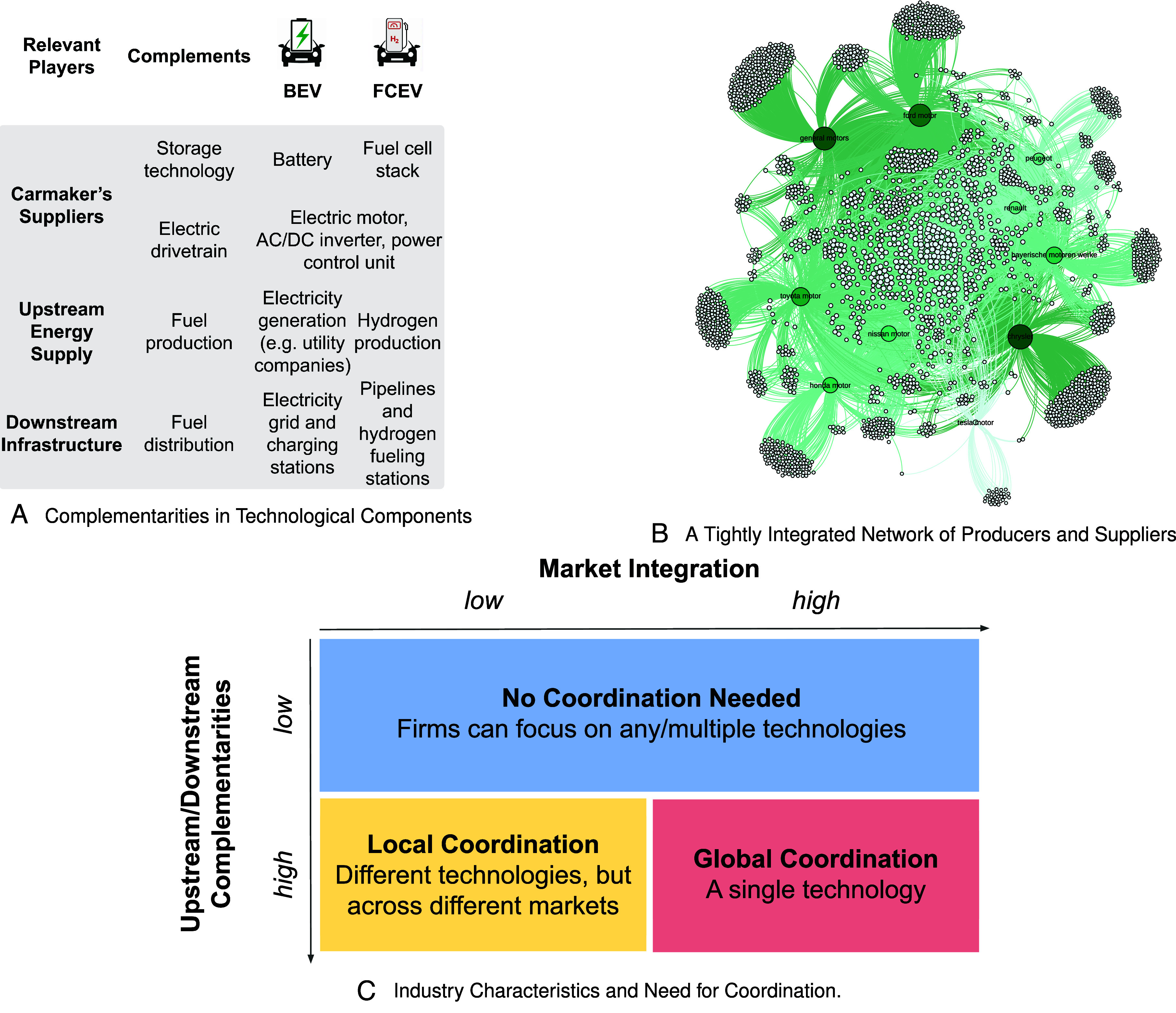
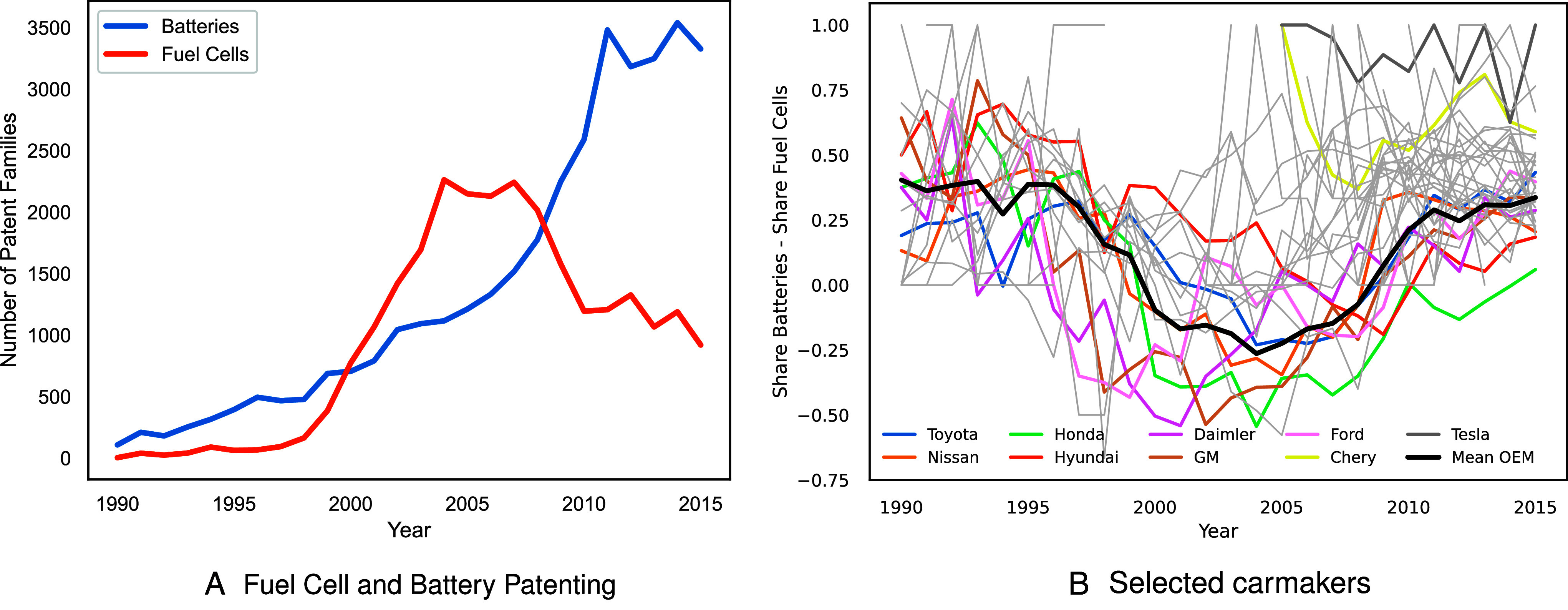
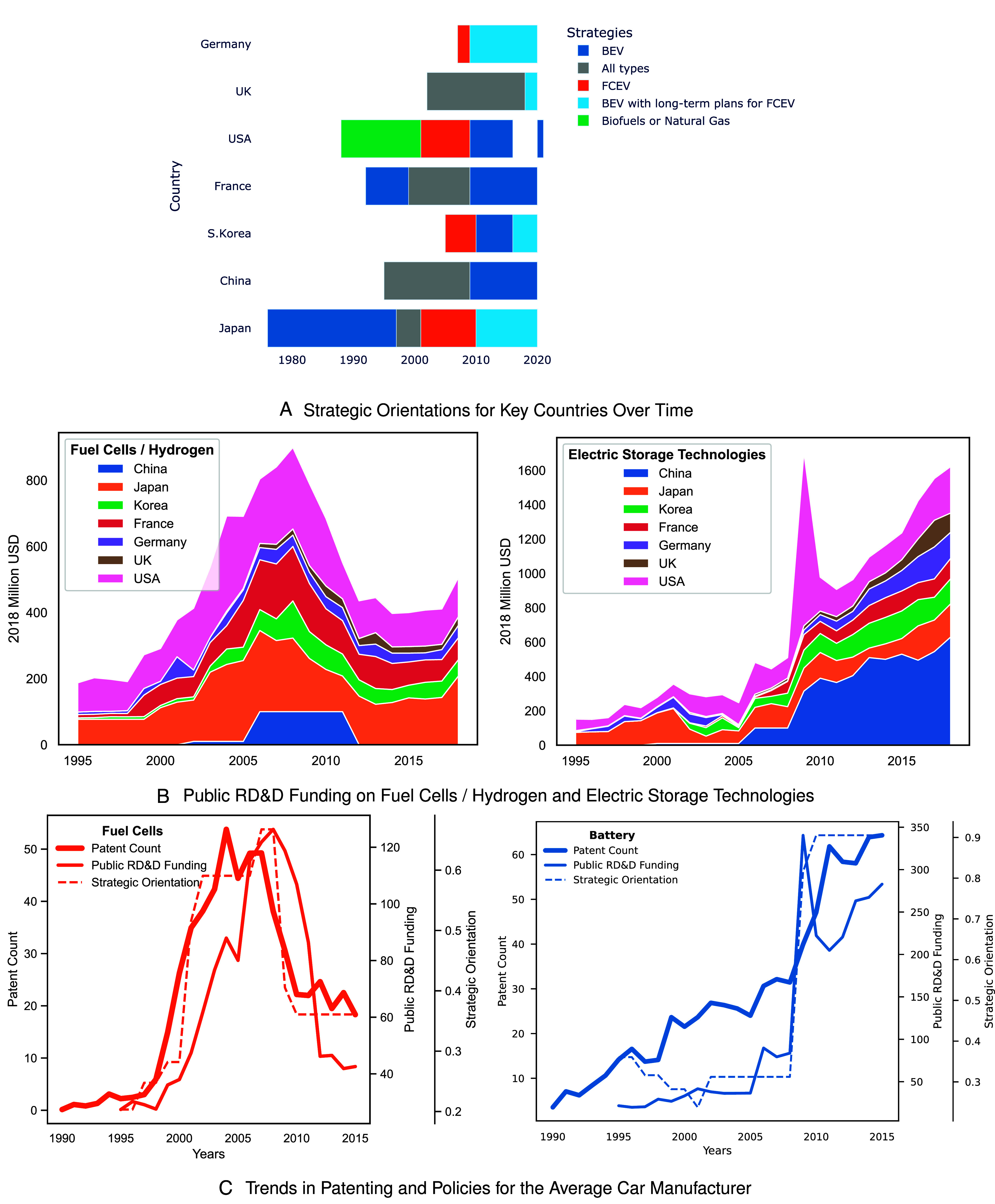
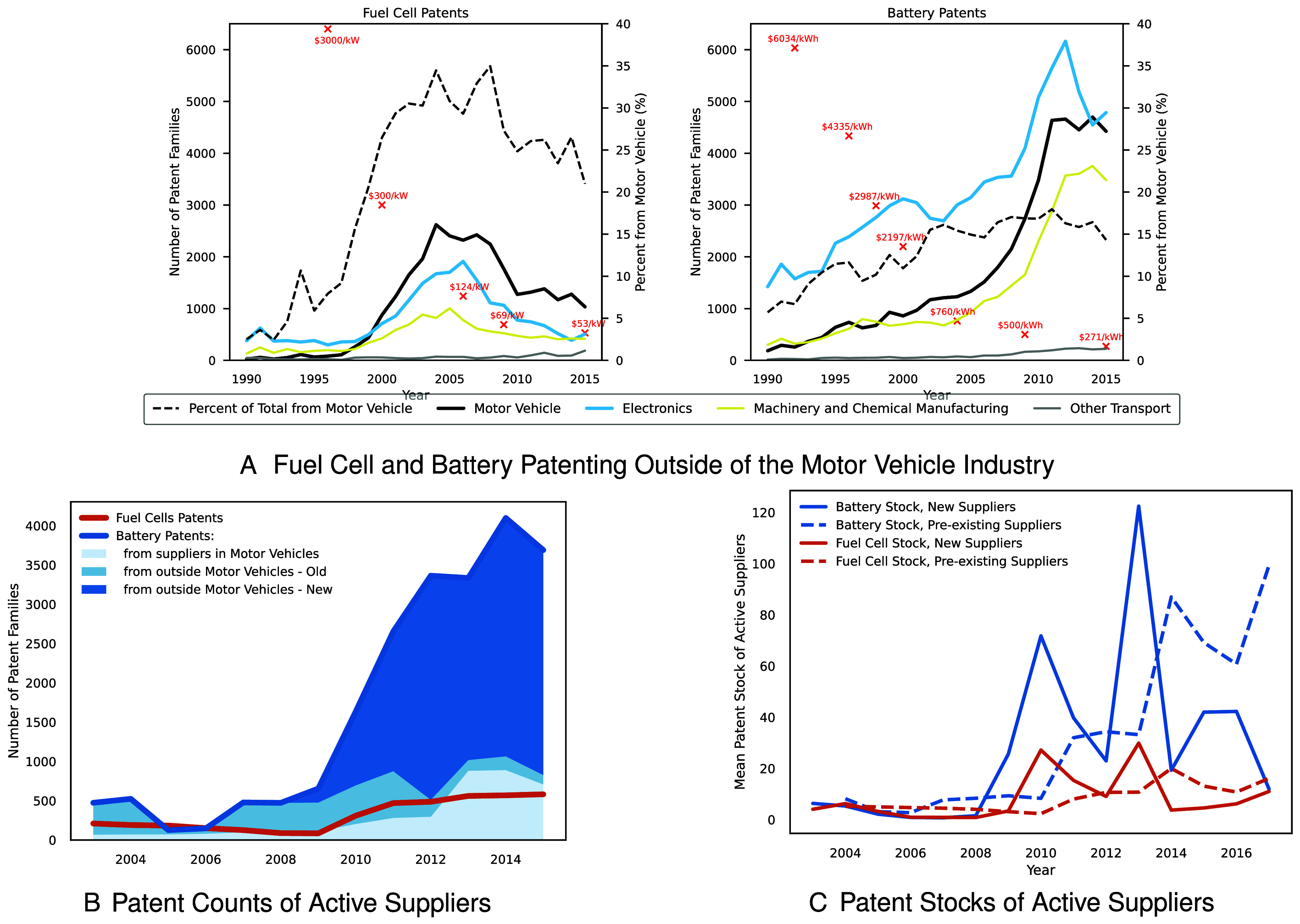
Significant progress reconciling economic activities with a stable climate requires radical and rapid technological change in multiple sectors. Here, we study the case of the automotive industry’s transition to electric vehicles, which involved choosing between two different technologies: fuel cell electric vehicles (FCEVs) or battery electric vehicles (BEVs). We know very little about the role that such technological uncertainty plays in shaping the strategies of firms, the efficacy of technological and climate policies, and the speed of technological transitions. Here, we explain that the choice between these two technologies posed a global and multisectoral coordination game, due to technological complementarities and the global organization of the industry’s markets and supply chains. We use data on patents, supply-chain relationships, and national policies to document historical trends and industry dynamics for these two technologies. While the industry initially focused on FCEVs, around 2008, the technological paradigm shifted to BEVs. National-level policies had a limited ability to coordinate global players around a type of clean car technology. Instead, exogenous innovation spillovers from outside the automotive sector played a critical role in solving this coordination game in favor of BEVs. Our results suggest that global and cross-sectoral technology policies may be needed to accelerate low-carbon technological change in other sectors, such as shipping or aviation. This enriches the existing theoretical paradigm, which ignores the scale of interdependencies between technologies and firms.
Overview
The claims and statistics of this paper haven’t been checked yet.
Run the check — free, no account needed. It reads the open-access text and checks the sources it cites.
Integrity signals
Registry
Cites
Statistics
Figures
Verification
Claims the paper makes
The claims and statistics of this paper haven’t been checked yet.
Run the check — free, no account needed. It reads the open-access text and checks the sources it cites.
Self-check
Percentages, sums and reported differences re-computed from the paper’s own numbers.
The self-check needs the paper’s full text.
Citations
The citation lists haven’t been fetched yet
References 68 · Cited by 19
Research works printed but not linked: 49
- 10.1086/261641 · DOI · Paper page
- 10.1016/0022-1996(95)01386-5 · DOI
- N. Stern, J. E. Stiglitz, The Social Cost of Carbon, Risk, Distribution, Market Failures: An Alternative Approach (National Bureau of Economic Research, Cambridge, MA, 2021), vol. 15.
- 10.1016/0167-2681(92)90050-L · DOI
- 10.1016/j.enpol.2018.04.015 · DOI
- 10.1016/j.enpol.2018.08.015 · DOI
- 10.1016/j.jedc.2018.10.006 · DOI
- 10.1073/pnas.1613559113 · DOI
- A. Pichler F. Lafond J. D. Farmer Technological interdependencies predict innovation dynamics. arXiv [Preprint] (2020). https://arxiv.org/abs/2003.00580 (Accessed 10 October 2023). · DOI
- 10.1016/j.techfore.2015.07.003 · DOI
- 10.1038/nenergy.2016.13 · DOI
- 10.1017/mor.2018.33 · DOI
- 10.1016/j.respol.2018.08.006 · DOI
- 10.1257/aer.102.1.131 · DOI
- 10.1086/684581 · DOI · Paper page
- R. Henderson R. G. Newell “Accelerating energy innovation: Insights from multiple sectors” (Tech. Rep. No. 16529 2010). · DOI
- 10.1016/j.jeem.2007.11.001 · DOI · Paper page
- 10.1561/101.00000111 · DOI
- 10.4324/9780367136604 · DOI
- 10.5547/ISSN0195-6574-EJ-Vol30-No4-2 · DOI
- 10.1016/j.respol.2022.104558 · DOI
- 10.1016/j.respol.2013.02.003 · DOI
- M. Gregoire-Zawilski D. Popp “Do technology standards induce innovation in environmental technologies when coordination is important?” (Working Paper No. 30872 2023). · DOI
- 10.1126/science.1250193 · DOI
- 10.1146/annurev.environ.33.032806.134935 · DOI
- 10.1109/JPROC.2007.892489 · DOI · Paper page
- 10.7551/mitpress/2366.001.0001 · DOI · Paper page
- 10.1002/smj.460 · DOI
- 10.1257/jep.12.4.31 · DOI
- 10.1257/jep.28.2.99 · DOI
- 10.1287/orsc.1090.0493 · DOI
- 10.1017/S0022050700007993 · DOI
- 10.2307/2393511 · DOI · Paper page
- 10.2307/41165984 · DOI
- 10.1016/j.jeem.2021.102420 · DOI
- 10.1016/j.jclepro.2010.09.015 · DOI
- 10.1017/mor.2018.32 · DOI
- 10.2307/2234208 · DOI · Paper page
- 10.2307/2555589 · DOI
- 10.1086/450399 · DOI
- 10.1073/pnas.1604989113 · DOI
- D. G. Victor, C. F. Sabel, Fixing the Climate: Strategies for an Uncertain World (Princeton University Press, 2022).
- 10.1007/s10640-009-9309-1 · DOI
- 10.1016/j.enpol.2011.07.052 · DOI
- D. Popp J. Pless I. Hascic N. Johnstone “Innovation and entrepreneurship in the energy sector” in The Role of Innovation and Entrepreneurship in Economic Growth M. J. Andrews A. Chatterji J. Lerner S. Stern Eds. (University of Chicago Press 2020).
- B. H. Hall, A. Jaffe, M. Trajtenberg, Market value and patent citations. RAND J. Econ. 36, 16–38 (2005).
- 10.2307/2118401 · DOI
- International Energy Agency, Energy Technology RD&D Budgets Database 1974–2022 (International Energy Agency, 2022).
- 10.1002/wcc.734 · DOI
Metadata
- Authors
- Dugoua, E., & Dumas, M.
- Affiliations
- Ifo Institute for Economic Research (DE)
- London School of Economics and Political Science (GB)
- Corresponding author
- Dugoua, Eugenie
- Dumas, Marion
- Venue
- Proceedings of the National Academy of Sciences
- Publisher
- National Academy of Sciences
- Published
- 2024-06-24
- Volume
- 121
- Issue
- 27
- Pages
- e2318605121-e2318605121
- ISSN
- 0027-8424 (ISSN-L)
- 1091-6490
- PMC
- PMC11228490
- OpenAlex
- W4399985355
- Cited by
- 19
- References
- 68
- Citations by year
- 2026: 8 · 2025: 7 · 2024: 4
- FWCI
- 1.89
- Type
- journal article
- Language
- en
- Open access
- hybrid
- doi.org
- Licence
- Locations
- Proceedings of the National Academy of Sciences (publishedVersion, cc-by-nc-nd)
- SSRN Electronic Journal (acceptedVersion)
- PubMed Central (publishedVersion, cc-by-nc-nd)
- PubMed (publishedVersion)
- London School of Economics and Political Science Research Online (London School of Economics and Political Science) (submittedVersion)
- RePEc: Research Papers in Economics (submittedVersion)
- Funders
- UKRI | Economic and Social Research Council (ES/R009708/1)
- Alfred P. Sloan Foundation (G-2019-12323.)
- Topics
- Physical Sciences › Engineering › Electrical and Electronic Engineering › Electric Vehicles and Infrastructure
- Social Sciences › Economics, Econometrics and Finance › Economics and Econometrics › Climate Change Policy and Economics
- Social Sciences › Decision Sciences › Management Science and Operations Research › Innovation Diffusion and Forecasting
- Keywords
- fuel cell vehicles, battery electric vehicles, electric vehicle transition, coordination games, technology complementarity, technological uncertainty, innovation spillovers, automotive industry, supply chain, patents, climate policy
About these checks
Registry, retraction, Cites and statistics results are computed, not judged, with one exception: a printed reference that no index lists is read once by a model before it counts as a citation error. Claims are extracted by a model and kept only when their quote appears verbatim in the text; each cited source is then checked, with a model’s help, for whether it says what the claim relies on. Those verdicts can be wrong — read the claim’s quote and the cited source before relying on one.
Statistics and arithmetic are recomputed, not judged.
Confidence bands are shown only for fields calibrated on our annotated test set. None is calibrated yet, so no band is shown.
What counts as a claim ›How we measure confidence ›How we check this ›
Are you an author, or do you see a problem with this page? Request a review
How to cite
Cite CoChat for the checks on this page, and the paper for its own findings.
- This page
- CoChat. (2026). Citation check: Coordination dynamics between fuel cell and battery technologies in the transition to clean cars. https://app.cochat.ai/papers/10.1073/pnas.2318605121
- The paper
- Dugoua, E., & Dumas, M. (2024). Coordination dynamics between fuel cell and battery technologies in the transition to clean cars. Proceedings of the National Academy of Sciences. https://doi.org/10.1073/pnas.2318605121
