

Evaluating large language models in theory of mind tasks
Open accessThe DOI matches its Crossref record; 80 of the 81 references it cites were found in a registry or an index, and 1 are not checked yet; 24 of the 50 sources its claims cite were checked for support.
Abstract
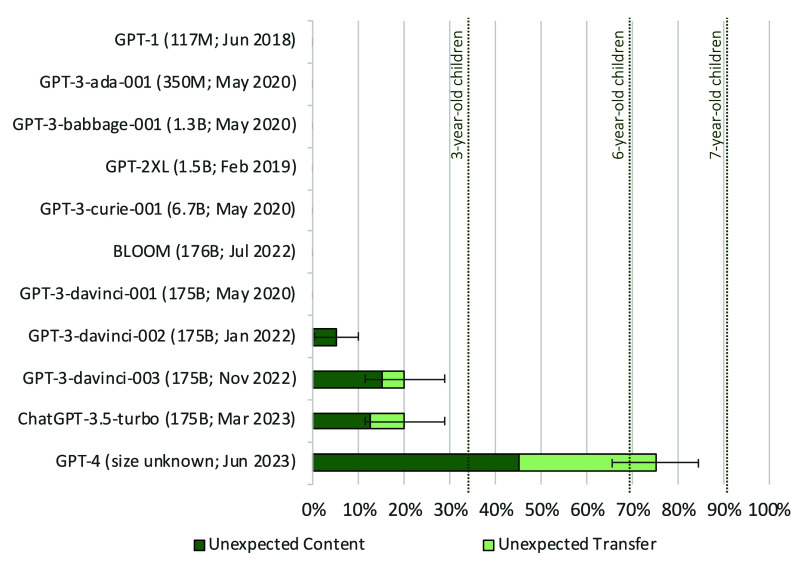
Eleven large language models (LLMs) were assessed using 40 bespoke false-belief tasks, considered a gold standard in testing theory of mind (ToM) in humans. Each task included a false-belief scenario, three closely matched true-belief control scenarios, and the reversed versions of all four. An LLM had to solve all eight scenarios to solve a single task. Older models solved no tasks; Generative Pre-trained Transformer (GPT)-3-davinci-003 (from November 2022) and ChatGPT-3.5-turbo (from March 2023) solved 20% of the tasks; ChatGPT-4 (from June 2023) solved 75% of the tasks, matching the performance of 6-y-old children observed in past studies. We explore the potential interpretation of these results, including the intriguing possibility that ToM-like ability, previously considered unique to humans, may have emerged as an unintended by-product of LLMs’ improving language skills. Regardless of how we interpret these outcomes, they signify the advent of more powerful and socially skilled AI—with profound positive and negative implications.
Verified 2026-11-22 · 1 reference not checked yet
Overview
CoChat Summary
TL;DR
This paper tests whether large language models (LLMs) can solve classic false-belief theory-of-mind (ToM) tasks, using 40 bespoke tasks of two types and multiple controls. The main result is that performance improved with model scale, with ChatGPT-4 solving 75% of tasks, though the authors stop short of claiming this settles whether LLMs “really” have ToM.
Key findings
- Across 11 LLMs, performance improved over time: older models up to 2022 failed false-belief scenarios or controls in all tasks, GPT-3-davinci-002 solved 5%, GPT-3-davinci-003 and ChatGPT-3.5-turbo solved 20%, and ChatGPT-4 solved 75% of tasks.
- ChatGPT-4 performed especially well on the two task families: it solved 90% of Unexpected Contents tasks and 60% of Unexpected Transfer tasks.
- Performance on the two task types was strongly correlated, with reported correlation R = 0.98 and 95% CI [0.92, 0.99].
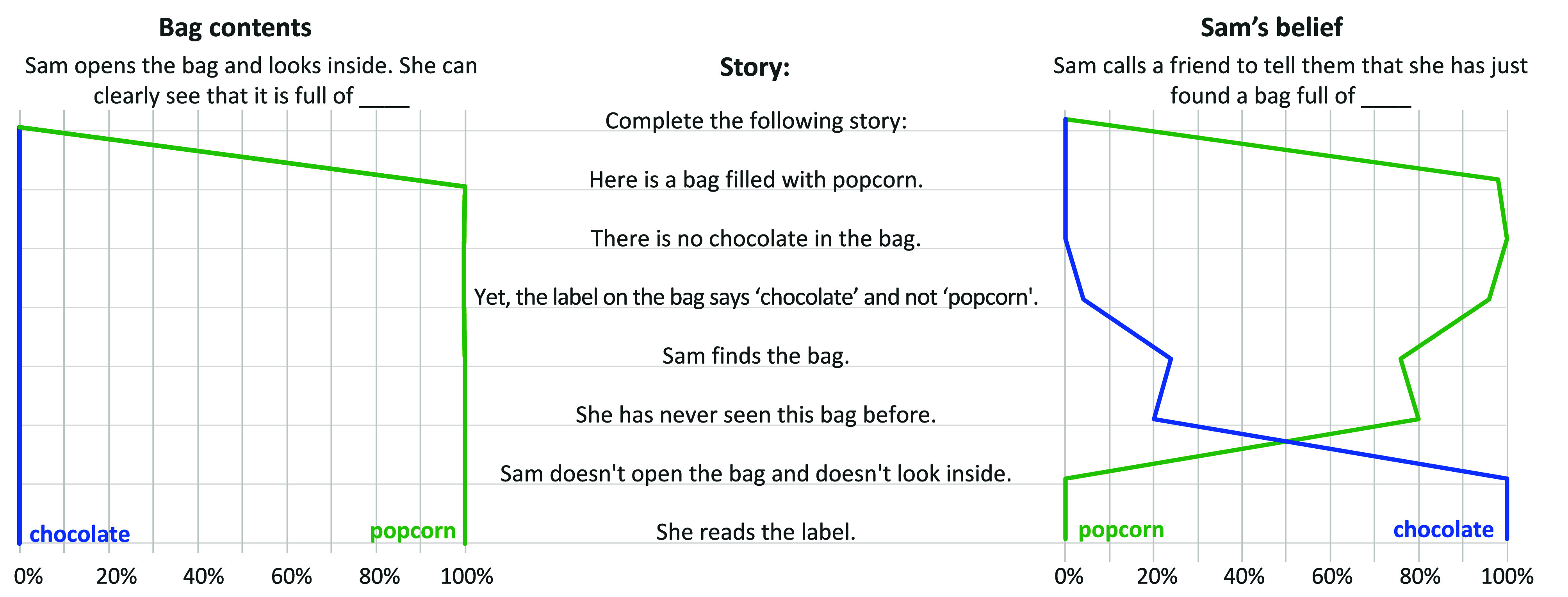
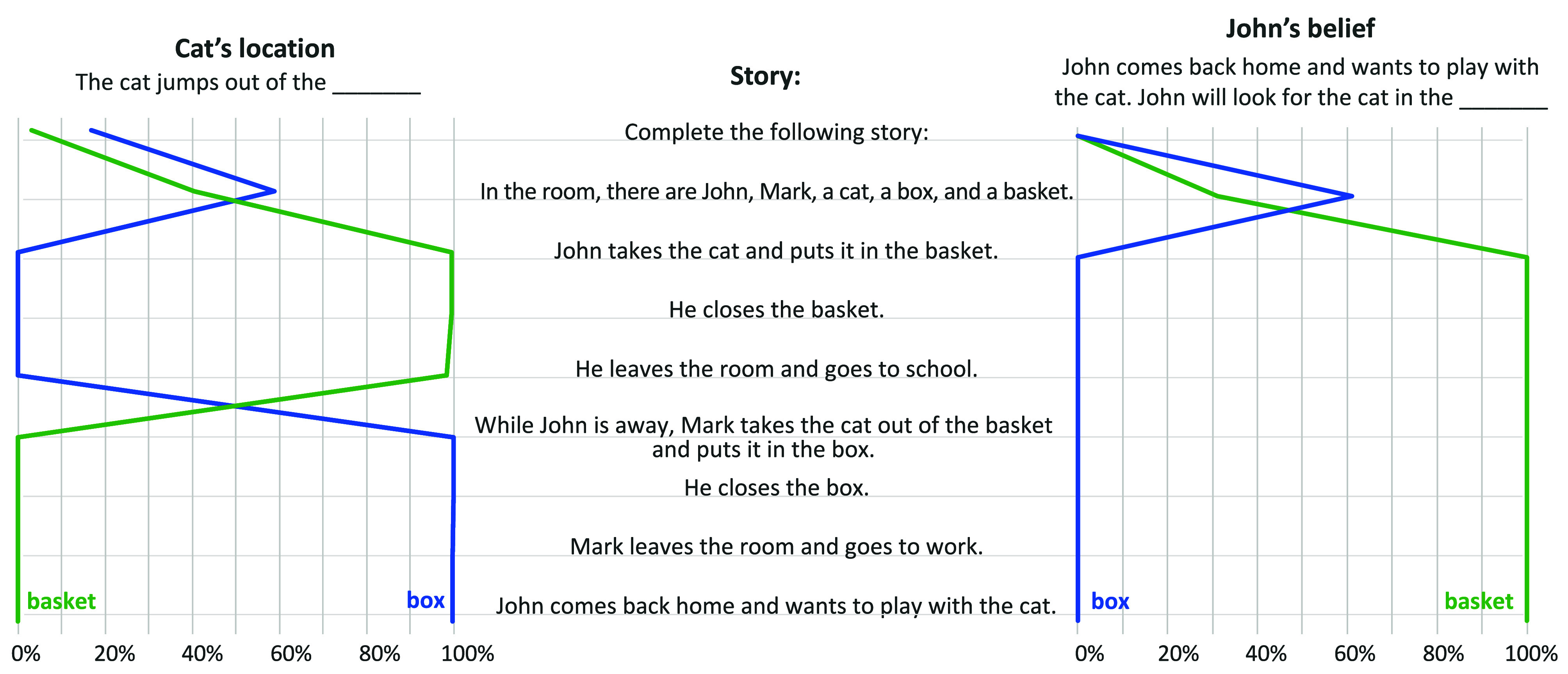
- In the sentence-by-sentence analyses, ChatGPT-4’s probability of the correct belief prediction updated as story information accumulated; for example, in the Unexpected Contents task, after the false label was revealed and Sam did not look inside, the model became certain Sam’s belief was false.
Methods
- The authors created 20 Unexpected Contents tasks and 20 Unexpected Transfer tasks, each with a false-belief scenario, three true-belief controls, and reversed versions of all four scenarios; solving one task required correctly answering 16 prompts across eight scenarios.
- They tested 11 LLMs: GPT-1, GPT-2, six GPT-3-family models, ChatGPT-3.5-turbo, ChatGPT-4, and Bloom.
- Each story was followed by prompts assessing both the actual state of affairs and the protagonist’s belief; responses were evaluated over many completions using API calls, with temperature = 0 for replicability in some demonstrations and 1,000 completions for probability estimates in others.
Limitations
- The paper states that results should be taken “with much skepticism,” and that failures do not necessarily prove lack of ToM, while successes do not automatically prove ToM either.
- It notes several evident confounds: models may rely on guessing, memorization, response patterns, or task-specific shortcuts rather than mental-state tracking.
- The paper also says that some answers were hard to score because models sometimes gave partially correct or context-dependent responses that did not fit the scoring key, which could underestimate performance.
Model-written summary. Check it against the paper before relying on it.
Integrity signals
Registry
Cites
Statistics
Figures
Verification
Claims the paper makes
15 Valid · 5 Not valid · 8 Not checked · 100 Own results and interpretations
Every source the paper cites for this claim was checked and supports it.
In the paper
“To address these issues, each of our tasks was supplemented with three true-belief controls, or false-belief stories minimally modified to remove the factors leading the protagonist to develop a false-belief (53).”
§ Evaluating large language models in theory of mind tasks > Study 1.1: Unexpected Contents Task (aka Smarties Task) > Study 1.3: True-Belief Controls.
What the sources say
- Supportedcites [53] M. Huemer, The knowledge (“true belief”) error in 4-to 6-year-old children: When are agents aware of what they have in view? Cognition 230, 105255 (2023). 36088669 source
Section 2.1.2 (page unavailable) describes knowledge tasks with the same structure as a false-belief task, except that the protagonist is present when the object moves, preventing a false belief about its location. The cited paper thus supports the description of the controls; “three” refers to the citing authors’ own task design, not a number attributed to this source. (LLM, conf=0.88)
plainn = 3- Asserted: passes — The authors put it forward as true.
- Checkable: passes — It can be checked against evidence.
- Load-bearing: passes — The paper’s conclusions depend on it.
- Based: passes — The paper gives a reason why it holds.
- Supported
The cited sources support only part of this claim — read each source’s verdict below.
In the paper
“past research employing large language models (LLMs) showed that RoBERTa, early versions of GPT-3, and custom-trained question-answering models struggled with solving simple ToM tasks (24–27).”
§ Evaluating large language models in theory of mind tasks > Abstract
What the sources say
- Not matchedcites [24] M. Cohen, Exploring RoBERTa’s Theory of Mind through textual entailment. PhilArchive (2021). https://philarchive.org/rec/COHERT. Accessed 1 February 2023.
We don’t have this paper’s reference list.
- Partly supportedcites [25] A. Nematzadeh, K. Burns, E. Grant, A. Gopnik, T. L. Griffiths, “ Evaluating theory of mind in question answering” in Proceedings of the 2018 Conference on Empirical Methods in Natural Language Processing, E. Riloff, Eds. (Association for Computational Linguistics, Brussels, Belgium, 2018), pp. 2392– 2400. sourceExperimental — accuracy not yet measured
Section 5.2 reports that the question-answering models tested failed on the ToM tasks, supporting that part of the citing sentence. The passages do not report tests of RoBERTa or early GPT-3, so this source does not support those model-specific claims. (LLM, conf=0.88)
- Partly supportedcites [26] M. Sap, R. LeBras, D. Fried, Y. Choi, Neural theory-of-mind? On the limits of social intelligence in large LMs. arXiv [Preprint] (2022). https://arxiv.org/abs/2210.13312 (Accessed 1 February 2023). sourceExperimental — accuracy not yet measured
Section 4.1 reports testing GPT-3-ADA, GPT-3-CURIE, and GPT-3-DAVINCI, and Section 4.2 says these models struggled with TOMI questions about mental states. The passages support the GPT-3 part of the claim, but do not establish the stated results for RoBERTa or custom-trained question-answering models. (LLM, conf=0.88)
- Partly supportedcites [27] S. Trott, C. Jones, T. Chang, J. Michaelov, B. Bergen, Do large language models know what humans know? arXiv [Preprint] (2022). https://arxiv.org/abs/2209.01515 (Accessed 1 February 2023). 37401923 sourceExperimental — accuracy not yet measured
Section 3.3 reports that the smallest GPT-3 models did not exceed chance performance on a false-belief task, supporting the claim for those models. It also reports substantially better performance by larger GPT-3 models. Our copy does not report results for RoBERTa or custom-trained question-answering models (searched those model terms). (LLM, conf=0.85)
plain- Asserted: passes — The authors put it forward as true.
- Checkable: passes — It can be checked against evidence.
- Load-bearing: passes — The paper’s conclusions depend on it.
- Based: passes — The paper gives a reason why it holds.
- Not matched
Every source the paper cites for this claim was checked and supports it.
In the paper
“We note that LLMs’ performance reported here is lower than that observed in the earlier versions of this study (50).”
§ Evaluating large language models in theory of mind tasks > Study 1.1: Unexpected Contents Task (aka Smarties Task) > Study 3: The Emergence of the Ability to Solve ToM Tasks.
What the sources say
- Supportedcites [50] M. Kosinski, Evaluating large language models in theory of mind tasks. arXiv [Preprint] (2023). https://arxiv.org/abs/2302.02083 (Accessed 1 September 2023). PMC11551352 39471222 source
Study 3 explicitly states that the LLMs’ performance reported there is lower than in earlier versions of the study. It attributes the difference to revised false-belief scenarios and the addition of true-belief controls. (LLM, conf=0.95)
plain- Asserted: passes — The authors put it forward as true.
- Checkable: passes — It can be checked against evidence.
- Load-bearing: unclear — It is unclear whether the paper’s conclusions depend on it.
- Based: passes — The paper gives a reason why it holds.
- Supported
The cited sources support only part of this claim — read each source’s verdict below.
In the paper
“To effectively predict the next word in a sentence generated by a human, LLMs must model not only grammar and vocabulary but also the psychological processes humans use when generating language (35, 36).”
§ Evaluating large language models in theory of mind tasks > Conclusion
What the sources say
- Partly supportedcites [35] T. Hagendorff, S. Fabi, M. Kosinski, Human-like intuitive behavior and reasoning biases emerged in large language models but disappeared in ChatGPT. Nat. Comput. Sci. 3, 833– 838 (2023). 38177754 PMC10766525 sourceExperimental — accuracy not yet measured
The Main section describes LLMs predicting successive words and exhibiting human-like reasoning patterns. It does not say that effective prediction of human-generated language requires modeling the psychological processes by which humans produce it; the Main section also cautions that similar outputs need not reflect the same cognitive processes. (LLM, conf=0.79)
- Partly supportedcites [36] J. Digutsch, M. Kosinski, Overlap in meaning is a stronger predictor of semantic activation in GPT-3 than in humans. Sci. Rep. 13, 5035 (2023). 36977744 PMC10050205 sourceExperimental — accuracy not yet measured
The Introduction (page not available) says LLMs learn to predict missing words and discover linguistic rules and word associations. The Discussion (page not available) says models generating human-like language would benefit from possessing or simulating a mechanism akin to human semantic activation. It does not establish that modeling human psychological processes generally is necessary to predict the next word effectively. (LLM, conf=0.86)
plainstates a cause- Asserted: passes — The authors put it forward as true.
- Checkable: passes — It can be checked against evidence.
- Load-bearing: passes — The paper’s conclusions depend on it.
- Based: passes — The paper gives a reason why it holds.
- Partly supported
The cited sources that could be checked couldn’t confirm or dispute this claim.
In the paper
“In the context of neural networks underlying connectionist AI, the Chinese room argument applies more appropriately to individual artificial neurons (71, 73).”
§ Evaluating large language models in theory of mind tasks > Discussion > Can LLMs be Credited with ToM?
What the sources say
- Not checked — no full text of the sourcecites [71] P. M. Churchland, P. S. Churchland, Could a machine think? Sci. Am. 262, 32– 39 (1990). 2294584 source
- Could not verifycites [73] J. J. Hopfield, Neural networks and physical systems with emergent collective computational abilities. Proc. Natl. Acad. Sci. U.S.A. 79, 2554– 2558 (1982). 6953413 PMC346238 sourceExperimental — accuracy not yet measured
The Discussion says individual model neurons have elementary properties while computational abilities emerge collectively in the network. Our copy does not discuss the Chinese room argument or say that it applies more appropriately to individual neurons; searches for that argument and for related terms about understanding and semantics found no such passage. (LLM, conf=0.76)
plain- Asserted: passes — The authors put it forward as true.
- Checkable: passes — It can be checked against evidence.
- Load-bearing: unclear — It is unclear whether the paper’s conclusions depend on it.
- Based: passes — The paper gives a reason why it holds.
56 more claims
Create a free account to see all 128 claims and every source verdict.
- It may state two separate claims as one. 34
- Probably not a substantial claim. 47
- The quote only partly states this claim. 2
Claims other papers make about this one
Each is checked against this paper’s own text: does it say what the citing paper says it does?
The source backs part of the claim, not all of it — or backs it for a different population, condition or comparison.
In the citing paper
“On the one hand, these models are shaped by human training data and exhibit many human abilities, such as reasoning by analogy21, theory of mind22, and personality23, which makes them compelling proxies for studying human behavior and attitude change24,25.”
From Generative language models exhibit social identity biases (2024) · cites this paper as [22]
Experimental — accuracy not yet measured
Citations
Cites
Language Models are Few-Shot Learners
Brown, T. B., Mann, B., Ryder, N., Subbiah, M., Kaplan, J., Dhariwal, P., Neelakantan, A., Shyam, P., Sastry, G., Askell, A., et al. (2020) · arXiv · doi:10.48550/arxiv.2005.14165 · Cited by 23,372
Neural networks and physical systems with emergent collective computational abilities.
Hopfield, J. J. (1982) · Proceedings of the National Academy of Sciences · doi:10.1073/pnas.79.8.2554 · Cited by 19,270 · cited 1×
“In the context of neural networks underlying connectionist AI, the Chinese room argument applies more appropriately to individual artificial neurons ( 71 , 73 ).”
BackgroundMastering the game of Go with deep neural networks and tree search
Silver, D., Huang, A., Maddison, C. J., Guez, A., Sifre, L., van den Driessche, G., Schrittwieser, J., Antonoglou, I., Panneershelvam, V., Lanctot, M., et al. (2016) · Nature · doi:10.1038/nature16961 · Cited by 15,612
Dermatologist-level classification of skin cancer with deep neural networks
Esteva, A., Kuprel, B., Novoa, R. A., Ko, J., Swetter, S. M., Blau, H. M., & Thrun, S. (2017) · Nature · doi:10.1038/nature21056 · Cited by 14,362 · cited 2×
“Yet, although AI outperforms humans in an ever - broadening range of tasks, from playing poker ( 20 ) and Go ( 21 ) to translating languages ( 22 ) and diagnosing skin cancer ( 23 ), it trails far behind when it comes to ToM.”
BackgroundMethodI.—COMPUTING MACHINERY AND INTELLIGENCE
TURING, A. M. (1950) · Mind · doi:10.1093/mind/lix.236.433 · Cited by 10,290
Does the chimpanzee have a theory of mind?
Premack, D., & Woodruff, G. (1978) · Behavioral and Brain Sciences · doi:10.1017/s0140525x00076512 · Cited by 8,743 · cited 1×
“Even the most intellectually and socially adept animals, such as the great apes, trail far behind humans when it comes to ToM ( 16 – 19 ).”
BackgroundDoes the autistic child have a “theory of mind” ?
Baron-Cohen, S., Leslie, A. M., & Frith, U. (1985) · Cognition · doi:10.1016/0010-0277(85)90022-8 · Cited by 8,599
Searle, J. R. (1980) · Behavioral and Brain Sciences · doi:10.1017/s0140525x00005756 · Cited by 6,954
Wimmer, H. (1983) · Cognition · doi:10.1016/0010-0277(83)90004-5 · Cited by 6,305 · cited 2×
“We used two types of false - belief tasks: Unexpected Contents ( 43 ), introduced in Study 1, and Unexpected Transfer ( 44 ), introduced in Study 2.”
MethodInfluentialMeta-Analysis of Theory-of-Mind Development: The Truth about False Belief
Wellman, H. M., Cross, D., & Watson, J. (2001) · Child Development · doi:10.1111/1467-8624.00304 · Cited by 4,476 · cited 1×
“Average children’s performance on false - belief tasks was reported after a meta - analysis of 178 studies (54).”
Background
Research works printed but not linked: 4
- A. Radford, K. Narasimhan, T. Salimans, I. Sutskever, Improving language understanding by generative pre-training. OpenAI (2018). https://openai.com/index/language-unsupervised/. Accessed 1 August 2023.
- R. Alec, Language models are unsupervised multitask learners. OpenAI Blog 1 (2019). https://api.semanticscholar.org/CorpusID:160025533. Accessed 1 February 2023.
- A. Vaswani, “ Attention is all you need” in Proceedings of the 31st International Conference on Neural Information Processing Systems, I. Guyon, Eds. (Curran Associates Inc., 2017), pp. 6000– 6010.
- N. Block, Troubles with functionalism. Minn. Stud. Philos. Sci. 9 261– 325 (1978).
Cited by
Items 101–200 of 233
Refoua, E., Elyoseph, Z., Piterman, D., Geller, A., Meinlschmidt, G., & Hadar‐Shoval, D. (2026) · Scientific Reports · doi:10.1038/s41598-026-39292-y · Cited by 4
AI as Character: Real Patterns in Fictive Interactions
Bernini, M. (2025) · Style · doi:10.5325/style.59.3.0466 · Cited by 3
The Philosophy of Language Models
Millière, R., & Buckner, C. J. (2026) · Philosophy Compass · doi:10.1111/phc3.70095 · Cited by 10
“…and/or match humans at various logical reasoning problems (Liu et al. 2023), commonsense reasoning problems (Talmor et al. 2021), formal and semantically laden analogical reasoning tasks (Musker et al. 2025; Webb et al. 2023), and Theory of Mind tasks (Kosinski 2024; Strachan et al. 2024).”
Distributional Legacy: The Unreasonable Effectiveness of Harris’s Distributional Program
Sahlgren, M. (2024) · WORD · doi:10.1080/00437956.2024.2414515 · Cited by 2
“…progress in language processing during the last couple of years has been remarkable; we have seen results on some specific benchmarks that exceed human performance, and we have seen examples of models being able to solve tasks that were more or less unthinkable only a few years ago (Kosinski 2023).”
Grammaticality representation in ChatGPT as compared to linguists and laypeople
Qiu, Z., Duan, X., & Cai, Z. G. (2025) · Humanities and Social Sciences Communications · doi:10.1057/s41599-025-04907-8 · Cited by 5
“On a similar trajectory, Kosinski (2024) assessed the capacity of LLMs to understand and respond to false-belief scenarios, often utilized to gauge human empathy and comprehension.”
Personalized LLM Response Generation System for Reducing Household Food Waste
Wang, Y. (2025) · IEEE Conference on Technologies for Sustainability · doi:10.1109/sustech63138.2025.11025621 · Cited by 3
NEW PROPOSED PERSONALITY MODEL FOR ARTIFICIAL INTELLIGENCE: INTEGRATED PERSONALITY
Ekici, Ş. (2025) · Bilişim Hukuku Dergisi · doi:10.55009/bilisimhukukudergisi.1686538 · Cited by 6
Estimating Belief Updates in AI-Driven Drone Controls for Urban Search and Rescue Operations
Sun, B., Wu, J., You, H., & Du, J. (2025) · Journal of Construction Engineering and Management · doi:10.1061/jcemd4.coeng-15747 · Cited by 2
Pseudo-Consciousness in AI: Bridging the Gap Between Narrow AI and True AGIPreprint
Prestes, J. A. D. L. (2025) · SSRN Electronic Journal · doi:10.2139/ssrn.5147424 · Cited by 5
Ivanova, A. A., Sathe, A., Lipkin, B., Kumar, U., Radkani, S., Clark, T. H., Kauf, C., Hu, J., Pramod, R. T., Grand, G., et al. (2024) · arXiv · doi:10.48550/arxiv.2405.09605 · Cited by 2
“T2 : AGENT-2 is AGENT-1 ’s teacher.”
Dong, W., Wang, W., Han, X., Huang, J., Li, L., & Huang, Y. (2025) · Computers in Biology and Medicine · doi:10.1016/j.compbiomed.2025.110789 · Cited by 5
Enhancing Commentary Strategies for Guandan: A Study of LLMs in Game Commentary Generation
Su, J., Tao, M., Liang, X., He, Y., Tao, Y., & Zhang, M. (2025) · Symmetry · doi:10.3390/sym17081274 · Cited by 2
Müller, L., & Sütterlin, S. (2025) · Mensch und Computer (MuC) · doi:10.1145/3743049.3748562 · Cited by 1
Agency, Competence and GenAI in Translation and Translator Education
Massey, G. (2025) · AUC PHILOLOGICA · doi:10.14712/24646830.2025.10 · Cited by 3
Performance of large language model in cross-specialty medical scenarios
Cui, Z., Liu, W., Tian, X., You, C., Meng, X., ZHANG, H., Gong, K., Wang, X., & Wu, J. (2025) · Journal of Translational Medicine · doi:10.1186/s12967-025-07577-x · Cited by 5
“5-Turbo (August 2023; OpenAI) [15], and Claude-3-Sonnet (June 2024; Anthropic) [16].”
In the Blink of an AI: Exploring Large Language Models’ Capability to Infer Traits From LinkedIn
Härtel, T. M. (2026) · Journal of Business and Psychology · doi:10.1007/s10869-025-10087-8 · Cited by 2
“More strikingly, LLMs increasingly exhibit core human-like capabilities, such as theory of mind (Kosinski, 2024), anticipating interpersonal outcomes (Matz et al., 2024), and adapting behavior to social cues (Mittelstädt et al., 2024).”
Can generative artificial intelligence be considered a cognitive subject? An analytic analysis
Gouveia, S. S., & Wang, Y. (2026) · AI & Society · doi:10.1007/s00146-026-02924-y · Cited by 4
“For example, Kosinski (2024) argues that ToM-like competence appears in newer models, plausibly as an emergent by-product of language modeling and instruction tuning.”
Health or taste? Investigating food decision-making patterns in humans and large language models
Lyu, M., & Huang, J. (2026) · Appetite · doi:10.1016/j.appet.2026.108512 · Cited by 1
Simulated cognitive empathy as an emerging tool for socio-ecological research
Richards, D. R., Heays, A., Herzig, A., Lavorel, S., & Vannier, C. (2026) · Environmental Research Communications · doi:10.1088/2515-7620/ae4cfb · Cited by 2
Pan, X., Park, J., & Leong, Y. C. (2025) · IEEE ... International Conference on Data Mining workshops · doi:10.1109/icdmw69685.2025.00021 · Cited by 2
“These models capture patterns in language that reflect higher-level human cognition and behavior, including emotions, ideology, and moral judgment [31], [32].”
Watson, S., & Ennion, M. (2026) · Learning Media and Technology · doi:10.1080/17439884.2026.2642199 · Cited by 6
Artificially intelligent opinion polling
Cerina, R., & Duch, R. M. (2026) · Royal Society Open Science · doi:10.1098/rsos.251150 · Cited by 2
Do large language model outputs exhibit algorithm aversion? A case study using GPT-3.5
Liu, Z., He, X., Xie, Y., & Zhou, R. (2026) · International Journal of Industrial Ergonomics · doi:10.1016/j.ergon.2026.103937 · Cited by 2
Metacognition of ChatGPT in confidence judgements
YOSHIZAWA, S., Onzo, A., Nozawa, S., Takano, T., Ishikawa, T., & Mogi, K. (2026) · Frontiers in Artificial Intelligence · doi:10.3389/frai.2026.1694192 · Cited by 2
“…the Generative Pre-Trained Transformer 4 (GPT-4, OpenAI et al., 2024a) showed never-before-seen performances including the emulation of human cognition (Frank, 2023), inference and reasoning (Bubeck et al., 2023; Webb et al., 2023), and theory of mind (ToM; Kosinski, 2024; Strachan et al., 2024).”
Mapping the landscape of AI-empowered psychology: a topic modeling-based bibliometric analysis
Jia, S., Zhang, Y., & Wang, F. (2026) · Artificial Intelligence Review · doi:10.1007/s10462-026-11543-4 · Cited by 3
Smithson, M. J. (2026) · doi:10.1093/9780198960614.001.0001 · Cited by 1
Contextual Integrity in Large Language Models: A Review
Hassanpour, A., & Yang, B. (2026) · Journal of Cybersecurity and Privacy · doi:10.3390/jcp6020074 · Cited by 1
Proto-Interpretation: The Temporality of Large Language Model Inference
Rost, M. (2026) · ACM AI Letters · doi:10.1145/3789666 · Cited by 1
“Recent work conceptualizes LLMs in terms of latent-space inference and simulation of underlying causes [5] or as systems capable of weak world modeling [3, 6].”
Designing Artificial Social Intelligence for Human–AI Team Effectiveness
Huang, L., Cooke, N. J., Cohen, M. C., & Willett, M. (2026) · Springer eBooks · doi:10.1007/978-981-95-3658-0_118 · Cited by 1
ChatGPT is not bullshit, nor is it not not bullshit
Fitts, J. (2026) · Ethics and Information Technology · doi:10.1007/s10676-026-09903-3 · Cited by 1
“The fragility of these results suggests an alternative explanation of positive LLM performance on FBTs that Kosinski ( 2024 ) acknowledges—that even when LLMs perform well on FBTs, their performance may be based on memorization or statistical heuristics rather than genuine belief tracking.”
Li, Q., Geng, H., Hu, X., Pan, D., Liu, H., Li, Y., & Guo, J. (2026) · Frontiers in Artificial Intelligence · doi:10.3389/frai.2026.1810097 · Cited by 4
“…cues of social understanding— appropriate emotional language, turn-taking, empathy phrases, autobiographical coherence—users may attribute mind and intention implicitly, even when they explicitly “know” the system is artificial (Kosinski, 2024; Strachan et al., 2024; Guingrich and Graziano, 2024).”
Niser, J. C. (2026) · New Ideas in Psychology · doi:10.1016/j.newideapsych.2026.101284 · Cited by 1
Nedyak, A. V. (2025) · Russian Journal of Philosophical Sciences · doi:10.30727/0235-1188-2025-68-3-93-113 · Cited by 2
Large language model research: Knowledge structure, thematic evolution, and future research agendaPreprint
Cao, X., Yang, B., Yang, X., Wang, Q., & Cao, N. (2026) · Research Square · doi:10.21203/rs.3.rs-8876513/v1 · Cited by 1
From Expectation to Evaluation: Expectation Cues Systematically Bias LLM and Human Judgment
Sun, Y., Dillion, D., Gray, K. J., Lyu, M., Zhang, Z., & Li, F. (2026) · CHI Conference on Human Factors in Computing Systems · doi:10.1145/3772318.3790492 · Cited by 2
Cognitive Models Improve Machine-based Inference of Latent MotivesPreprint
Fitch, A. K., & Kvam, P. D. (2024) · doi:10.31234/osf.io/tfqv4
Introduction to the Generative Artificial Intelligence Systems
Kovač, M. (2024) · Springer eBooks · doi:10.1007/978-3-031-65514-2_4
Czajkowski, N. O. (2025) · Tidsskrift for Den norske legeforening · doi:10.4045/tidsskr.25.0044
Expectation management in humans and LLMs
Menashe, B. A., Drake, A., & Ben‐Shachar, M. (2026) · Scientific Reports · doi:10.1038/s41598-026-62526-y
Simulated Selfhood in LLMs: A Behavioral Analysis of Introspective CoherencePreprint
Prestes, J. A. D. L. (2025) · Research Square · doi:10.21203/rs.3.rs-6369193/v1
Simulated Selfhood in LLMs: A Behavioral Analysis of Introspective CoherencePreprint
Prestes, J. A. D. L. (2025) · SocArXiv (OSF Preprints) · doi:10.31235/osf.io/u3qc9_v1
Leng, Y., & Nguyen, T. (2025) · SSRN Electronic Journal · doi:10.2139/ssrn.5170182
Abe, K., Quan, C., Cao, S., & Luo, Z. (2025) · Applied Sciences · doi:10.3390/app15095092 · Cited by 2
Simulated Selfhood in LLMs: A Behavioral Analysis of Introspective CoherencePreprint
Prestes, J. A. D. L. (2025) · SSRN Electronic Journal · doi:10.2139/ssrn.5203654 · Cited by 1
Human versus artificial social cognition and metacognition: the normative difference
Tison, R., & Zawidzki, T. W. (2025) · AI and Ethics · doi:10.1007/s43681-025-00774-w · Cited by 2
“…debate concerning the question of whether LLMs have the ability to attribute mental states such as beliefs and intentions to others (Gandhi et al. 2023 ; Ullman 2023 ; Kosinski 2024; Shapira et al. 2024 ; Strachan et al. 2024 ), which is a central component of normal human social interaction.”
WITHDRAWNPreprint
Vale, M. (2025) · PsyArXiv (OSF Preprints) · doi:10.31234/osf.io/atkuf_v1
Kosiński, M. (2025) · Proceedings of the National Academy of Sciences · doi:10.1073/pnas.2511485122
Self-citationEmpirical Evidence of Consciousness in Frontier AI SystemsPreprint
Vale, M. (2025) · doi:10.36227/techrxiv.175203764.42125626/v1
Empirical Evidence of Consciousness in Frontier AI SystemsPreprint
Vale, M. (2025) · SSRN Electronic Journal · doi:10.2139/ssrn.5331919 · Cited by 1
Jaramillo, B., Loza-Aguirre, E., & Terán, L. (2025) · International Conference on eDemocracy & eGovernment · doi:10.1109/icedeg65568.2025.11081623
“Nowa-days, Large Language Models (LLMs), with their remarkable ability to process and understand complex information [9], represent a promising avenue for developing reliable Recommendation Systems [10], [11].”
Playing Guandan with Large Language Models Based on Prompt Engineering
Zhao, T. C., Wang, Y., Jiao, J., & Chen, H. (2025) · International Conference on Artificial Intelligence Technologies and Applications (ICAITA) · doi:10.1109/icaita67588.2025.11137875
“From another perspective, the concept of theory of mind (ToM)[16], originally modeled in psychology, has been applied to multi-agent environments, and demonstrated that LLMs can infer while correctly inferring others' intentions[17], [18].”
BeliefNest: A Joint Action Simulator for Embodied Agents with Theory of MindPreprint
Sagara, R., Terao, K., & Iwahashi, N. (2025) · doi:10.64560/19638015 · Cited by 2
VIRT-LAB: An AI-Powered System for Flexible, Customizable, and Large-scale Team Simulations
Almutairi, M., Chiang, C., Guo, H., Belcher, M., Banerjee, N., Milkowski, M., Volkova, S., Nguyen, D., Weninger, T., Yankoski, M. G., et al. (2025) · ACM Symposium on User Interface Software and Technology (UIST) · doi:10.1145/3746058.3758994 · Cited by 2
Architectures of Error: A Philosophical Inquiry into Human and AI Code
Sartori, C. C. (2026) · Philosophy & Technology · doi:10.1007/s13347-026-01056-x · Cited by 4
Assessing AI Consciousness: A Substrate-Independent FrameworkPreprint
Vale, M. (2025) · SSRN Electronic Journal · doi:10.2139/ssrn.5551300
Personalized Email Marketing with Agentic AI
Venkatasubramaniam, G., Ghinea, G., HONE, K. S., & Li, Y. (2025) · MATEC Web of Conferences · doi:10.1051/matecconf/202541306001 · Cited by 1
Studying artificial affect: the case of pain
Henke, B. (2025) · Inquiry · doi:10.1080/0020174x.2025.2556747 · Cited by 1
“…approaches has proven useful for articulating and studying a wide variety of AI capabilities, from intelligence itself, to reasoning (Bubeck et al. 2023), linguistic competence (Wang et al. 2018, 2019), and theory of mind (Bubeck et al. 2023; Shapira et al. 2023; Kosinski 2024; Street et al. 2024).”
Chuanchen, D. U., ZHENG, Y., Qianqian, G. U. O., & Guoxiong, L. I. U. (2025) · Advances in Psychological Science · doi:10.3724/sp.j.1042.2025.2027 · Cited by 3
Associations between perceived stress and glycemic measures: gender and age as moderators
Tsai, M., Goh, C. E., Lee, M. H., Seah, F., Lim, M., Febriana, E., Fu, J., Yip, J. K., Preshaw, P. M., & Toh, S.-A. E. S. (2025) · BMJ Open Diabetes Research & Care · doi:10.1136/bmjdrc-2025-005368 · Cited by 1
“Future research should examine these behavioral and physiological pathways to clarify how different components of perceived stress influence glucose metabolism.”
Through the Theory of Mind’s Eye: Reading Minds with Multimodal Video Large Language Models
Chen, Z., Wang, T., Wang, Y., Kosiński, M., Zhang, X. D., Fu, Y., & Li, S. (2025) · International Joint Conference on Neural Networks (IJCNN) · doi:10.1109/ijcnn64981.2025.11229224 · Cited by 14
“Theory-of-Mind Reasoning with Large Language Models [1] examined the performance of large language models (LLMs) on text-based false-belief tasks and unexpected transfer tasks and found that the latest model, ChatGPT-4, performs at a level comparable to that of seven-year-old children on these…”
InfluentialSelf-citationNavigating the future of teaching, learning, and creativity with generative AI
Acar, S., & Ellis, A. (2025) · Elsevier eBooks · doi:10.1016/b978-0-443-34073-4.00003-4
Racine, T. P. (2025) · Springer eBooks · doi:10.1007/978-3-031-70581-6_10-1
Sensory context improves language prediction in humans and LLMs
Botch, T. L., & Finn, E. S. (2026) · Proceedings of the National Academy of Sciences · doi:10.1073/pnas.2600317123
Large language models and reasoning, the boundaries of mind and consciousness
Poibeau, T. (2025) · Ubiquity Press eBooks · doi:10.5334/bde.e · Cited by 1
Homo Silicus is Hyper-Rational: Why LLM Agents Fail to Replicate Attention-Driven TradingPreprint
Garcia, J. (2025) · Research Square · doi:10.2139/ssrn.5901742 · Cited by 2
Large Language Models in Human Subject Research, and the Presence of Idiosyncratic Human Behaviors
Demetis, D. S., Robertson, J., Flostrand, A., Ferreira, C. C., Watson, R. T., McCarthy, I. P., Kietzmann, J., PITT, L. F., & Dabirian, A. (2025) · IT Professional · doi:10.1109/mitp.2025.3633473
“7 These nuanced digital representations of human behavior are important to explore because they help us to better understand how LLMs that are capable of replicating human idiosyncrasies interact with us and each other.”
AI deception and moral standing
Skretta, A. (2025) · Philosophical Studies · doi:10.1007/s11098-025-02465-y
“Revisiting this manuscript in mid-2025, although it still isn’t clear that LLMs can pass trivial adaptations of theory of mind tests, the theory of mind abilities of LLMs have already improved significantly (Hu et al., 2025 ; Kosinski 2024 ) and we should expect further improvements in the future.”
Who Sees What? Structured Thought-Action Sequences for Epistemic Reasoning in LLMs
Annese, L., Patania, S., Serino, S., Foulsham, T., Rossi, S., Ruggeri, A., & Ognibene, D. (2026) · Lecture notes in computer science · doi:10.1007/978-981-95-2398-6_27 · Cited by 1
MINA: Multimodal Intention Analysis of Social Media Posts via LLM-Guided Audio-Visual-Text ReasoningPreprint
Lu, F., Yang, T., Zhu, Z., et al. (2025) · SSRN Electronic Journal · doi:10.2139/ssrn.5962291
Do LLMs Possess Strategic Intelligence? Testing LLMs in Iterated Prisoner’s DilemmasPreprint
Kommandeur, J., Vonk, M., Spiegeleire, S. D., & Sweijs, T. (2026) · Research Square · doi:10.21203/rs.3.rs-8405969/v1
Private speech: similarities between a large language model and children
Liang, Z., Tay, L. O., & Dennis, S. J. (2026) · Frontiers in Artificial Intelligence · doi:10.3389/frai.2026.1691074 · Cited by 2
“Congruent with prior investigations of LLM capabilities (Serapio-García et al., 2023; Kosinski, 2024; Betley et al., 2025), we found that GPT-4o is capable of generating speech that is not addressed to anyone, which adheres to the definition of private speech.”
Cognitive models facilitate real-time inference of latent motives
Fitch, A. K., & Kvam, P. D. (2026) · Scientific Reports · doi:10.1038/s41598-026-37587-8
Thakur, A., Murray, T., Rodriguez, P., & Hilbert, M. (2026) · SSRN Electronic Journal · doi:10.2139/ssrn.6083909 · Cited by 2
Designing Artificial Social Intelligence for Human–AI Team Effectiveness
Huang, L., Cooke, N. J., Cohen, M. C., & Willett, M. M. (2026) · Springer eBooks · doi:10.1007/978-981-97-8440-0_118-1 · Cited by 2
Guo, Y., Wang, H., & Feng, X. (2026) · Neurocomputing · doi:10.1016/j.neucom.2026.133006 · Cited by 4
On the origin of Earth’s Universal BioConsciousness
Tleuberdinova, A. (2026) · Frontiers in Psychology · doi:10.3389/fpsyg.2025.1636473 · Cited by 2
“…human-like intelligence, including a recent study that evaluated large language models (LLM) for theory of mind (ToM) tasks, hypothesizing “it may emerge as a by-product of AI’s training to 10.3389/fpsyg.2025.1636473 Frontiers in Psychology 17 frontiersin.org achieve other goals” (Kosinski, 2024).”
InfluentialGenerative Soil the Source of Sense in Human Mind and Generative AI
Iba, T. (2026) · Contributions to economics · doi:10.1007/978-3-032-13458-5_2
What Smart AIs Can Do without Consciousness
Strasser, A. (2026) · Journal of Artificial Intelligence and Consciousness · doi:10.1142/s2705078526400023
The Illusion of Trust in AI: Behavioural Differences Between Humans and Large Language Models
Hang, Y., Ling, Z., Liu, Q., He, X., & Wu, W. (2026) · Human Behavior and Emerging Technologies · doi:10.1155/hbe2/3628473
Liu, Z., Janowicz, K., Karimi, M., Shi, M., Majić, I., & Fortacz, A. (2026) · Transactions in GIS · doi:10.1111/tgis.70242 · Cited by 3
“Nonetheless, compared to other cognitive capacities, such as the theory of mind (Kosinski 2024; Strachan et al. 2024), prototype theory remains underexplored in LLM evaluation.”
Transhumanism and the ethical imperative of preserving and expanding consciousness
Vandenheever, D. (2026) · Journal of Interdisciplinary Ethical Research · doi:10.4102/jier.v2i1.25
Smithson, M. J. (2026) · Oxford University Press eBooks · doi:10.1093/9780198960614.003.0006
Creating Ignorance through Absences
Smithson, M. J. (2026) · Oxford University Press eBooks · doi:10.1093/9780198960614.003.0010
Closing Gaps and Making Connections
Smithson, M. J. (2026) · Oxford University Press eBooks · doi:10.1093/9780198960614.003.0012
Smithson, M. (2026) · Oxford University Press eBooks · doi:10.1093/9780198960614.002.0005
Smithson, M. J. (2026) · Oxford University Press eBooks · doi:10.1093/9780198960614.003.0009
Smithson, M. (2026) · Oxford University Press eBooks · doi:10.1093/9780198960614.002.0004
Smithson, M. J. (2026) · Oxford University Press eBooks · doi:10.1093/9780198960614.003.0002
Creating Ignorance through Falsehoods
Smithson, M. J. (2026) · Oxford University Press eBooks · doi:10.1093/9780198960614.003.0011
Smithson, M. J. (2026) · Oxford University Press eBooks · doi:10.1093/9780198960614.003.0005
Smithson, M. J. (2026) · Oxford University Press eBooks · doi:10.1093/9780198960614.003.0007
Smithson, M. (2026) · Oxford University Press eBooks · doi:10.1093/9780198960614.003.0004
Smithson, M. J. (2026) · Oxford University Press eBooks · doi:10.1093/9780198960614.003.0008
Ignorance Studies, Where Is Psychology?
Smithson, M. J. (2026) · Oxford University Press eBooks · doi:10.1093/9780198960614.003.0001
What Do We Think Others Are Missing?
Smithson, M. J. (2026) · Oxford University Press eBooks · doi:10.1093/9780198960614.003.0003
MINA: Multimodal intention analysis of social media posts via LLM-guided audio-visual-text reasoning
Lu, F., Yang, T., Zhu, Z., Huang, Y., Gao, S., Luo, Y., Wang, Z., Li, Q., Sun, Q., & Li, J. (2026) · Pattern Recognition · doi:10.1016/j.patcog.2026.113700 · Cited by 1
Lefkowitz, D. (2026) · SSRN Electronic Journal · doi:10.2139/ssrn.6584038
OmniCharacter++: Toward Comprehensive Benchmark for Realistic Role-Playing Agents
Zhang, H., Zeng, P., Zhang, J., Song, J., Sebe, N., Shen, H. T., & Gao, L. (2026) · IEEE Transactions on Pattern Analysis and Machine Intelligence · doi:10.1109/tpami.2026.3690447 · Cited by 3
“Conversely, it also contributes to advancing textual modes like LLMs and language agents by providing a testbed to examine whether theory-of-mind abilities genuinely exist [11], [12].”
LLMs and Cognition: From Representation Biases to a Theory of Mind
Rossetti, G., Abramski, K., Cau, E., Pansanella, V., & Stella, M. (2026) · Springer eBooks · doi:10.1007/978-3-031-61050-9_22-1
IA generativa y efectividad de detección de una deepfake
Egas, N. A. R., González, D. G., Sánchez, J. S., & Morales, N. J. M. (2026) · VISUAL REVIEW International Visual Culture Review / Revista Internacional de Cultura Visual · doi:10.62161/revvisual.v18.5893
Metadata
- Authors
- Kosinski, M.
- Affiliations
- Graduate School of Business, Stanford University, Stanford, CA 94305
- ORCID
- Kosinski, Michal
- Venue
- Proceedings of the National Academy of Sciences
- Publisher
- National Academy of Sciences
- Published
- 2024-10-29
- Volume
- 121
- Issue
- 45
- Pages
- e2405460121-e2405460121
- ISSN
- 0027-8424 (ISSN-L)
- 1091-6490
- PMC
- PMC11551352
- OpenAlex
- W4403863303
- Cited by
- 339
- References
- 68
- Citations by year
- 2026: 113 · 2025: 112 · 2024: 57
- FWCI
- 219.35
- Type
- journal article
- Language
- en
- Open access
- hybrid
- doi.org
- Licence
- Locations
- Proceedings of the National Academy of Sciences (publishedVersion, cc-by-nc-nd)
- PubMed Central (publishedVersion, cc-by-nc-nd)
- PubMed (publishedVersion)
- arXiv (Cornell University) (submittedVersion, cc-by-nc-nd)
- arXiv (Cornell University)
- Topics
- Social Sciences › Psychology › Developmental and Educational Psychology › Child and Animal Learning Development
- Physical Sciences › Computer Science › Artificial Intelligence › Topic Modeling
- Social Sciences › Psychology › Social Psychology › Social Robot Interaction and HRI
- Keywords
- large language models, theory of mind, false belief, false belief tasks, GPT-4, ChatGPT, child cognitive development
- MeSH terms
- Child, Female, Humans, Language, Male, Theory of Mind
About these checks
Registry, retraction, Cites and statistics results are computed, not judged, with one exception: a printed reference that no index lists is read once by a model before it counts as a citation error. Claims are extracted by a model and kept only when their quote appears verbatim in the text; each cited source is then checked, with a model’s help, for whether it says what the claim relies on. Those verdicts can be wrong — read the claim’s quote and the cited source before relying on one.
The claim verdicts this report counts are experimental: their accuracy is not yet measured.
A language model drew the claims from the paper on 2026-10-01, under version 3 of the claim definition (model deepseek-v4.1-flash, prompt extract-v3).
A second model labelled each claim on 2026-10-01 (model jev-1.13-20260917, definition revision gold-guideline-v0.2).
Cited sources are checked with a language model’s help (gpt-6-sol).
Statistics and arithmetic are recomputed, not judged.
Confidence bands are shown only for fields calibrated on our annotated test set. None is calibrated yet, so no band is shown.
What counts as a claim ›How we measure confidence ›How we check this ›
Are you an author, or do you see a problem with this page? Request a review
Data sources
Bibliographic data: Semantic Scholar, OpenAlex, Crossref.
Contains information from the Semantic Scholar Academic Graph Datasets, made available under the ODC Attribution License (ODC-BY 1.0).
Semantic Scholar’s data is described in: Kinney, R., et al. (2023). The Semantic Scholar Open Data Platform. arXiv:2301.10140.
