

Evaluating large language models in theory of mind tasks
Open accessThe DOI matches its Crossref record; 80 of the 81 references it cites were found in a registry or an index, and 1 are not checked yet; 24 of the 50 sources its claims cite were checked for support.
Abstract
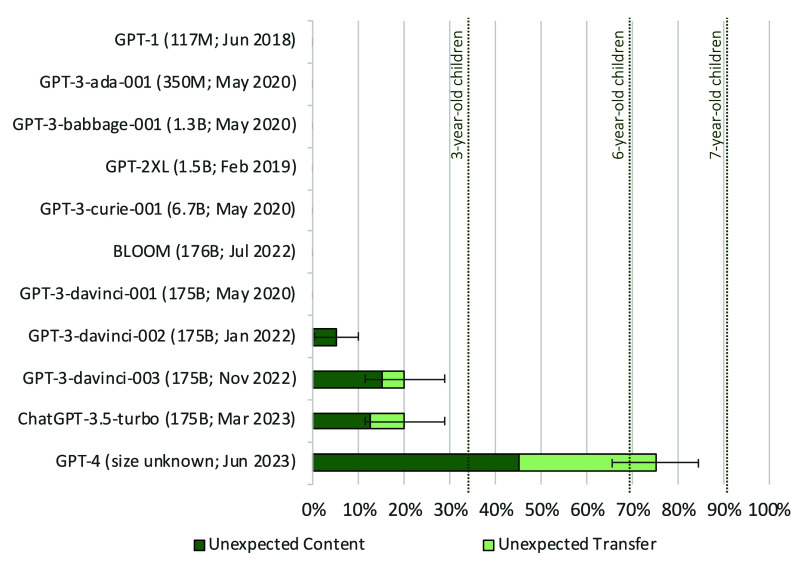
Eleven large language models (LLMs) were assessed using 40 bespoke false-belief tasks, considered a gold standard in testing theory of mind (ToM) in humans. Each task included a false-belief scenario, three closely matched true-belief control scenarios, and the reversed versions of all four. An LLM had to solve all eight scenarios to solve a single task. Older models solved no tasks; Generative Pre-trained Transformer (GPT)-3-davinci-003 (from November 2022) and ChatGPT-3.5-turbo (from March 2023) solved 20% of the tasks; ChatGPT-4 (from June 2023) solved 75% of the tasks, matching the performance of 6-y-old children observed in past studies. We explore the potential interpretation of these results, including the intriguing possibility that ToM-like ability, previously considered unique to humans, may have emerged as an unintended by-product of LLMs’ improving language skills. Regardless of how we interpret these outcomes, they signify the advent of more powerful and socially skilled AI—with profound positive and negative implications.
Verified 2026-11-22 · 1 reference not checked yet
Overview
CoChat Summary
TL;DR
This paper tests whether large language models (LLMs) can solve classic false-belief theory-of-mind (ToM) tasks, using 40 bespoke tasks of two types and multiple controls. The main result is that performance improved with model scale, with ChatGPT-4 solving 75% of tasks, though the authors stop short of claiming this settles whether LLMs “really” have ToM.
Key findings
- Across 11 LLMs, performance improved over time: older models up to 2022 failed false-belief scenarios or controls in all tasks, GPT-3-davinci-002 solved 5%, GPT-3-davinci-003 and ChatGPT-3.5-turbo solved 20%, and ChatGPT-4 solved 75% of tasks.
- ChatGPT-4 performed especially well on the two task families: it solved 90% of Unexpected Contents tasks and 60% of Unexpected Transfer tasks.
- Performance on the two task types was strongly correlated, with reported correlation R = 0.98 and 95% CI [0.92, 0.99].
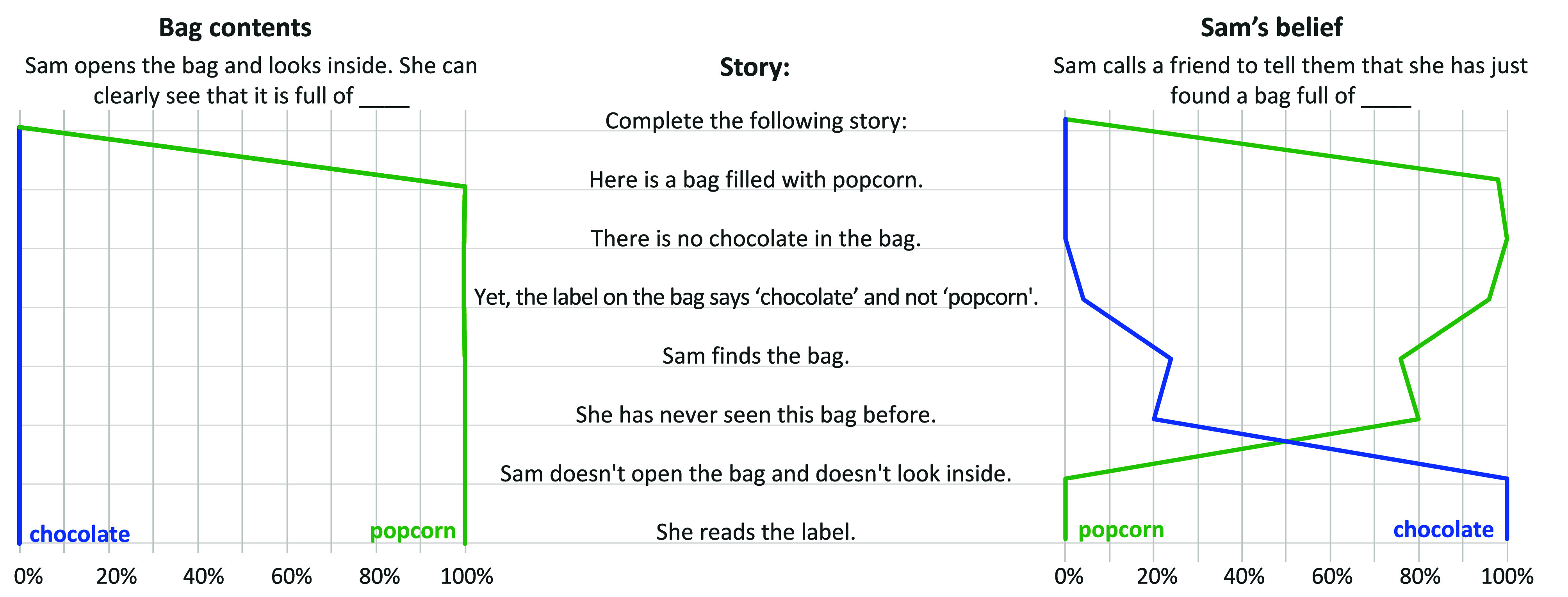
- In the sentence-by-sentence analyses, ChatGPT-4’s probability of the correct belief prediction updated as story information accumulated; for example, in the Unexpected Contents task, after the false label was revealed and Sam did not look inside, the model became certain Sam’s belief was false.
Methods
- The authors created 20 Unexpected Contents tasks and 20 Unexpected Transfer tasks, each with a false-belief scenario, three true-belief controls, and reversed versions of all four scenarios; solving one task required correctly answering 16 prompts across eight scenarios.
- They tested 11 LLMs: GPT-1, GPT-2, six GPT-3-family models, ChatGPT-3.5-turbo, ChatGPT-4, and Bloom.
- Each story was followed by prompts assessing both the actual state of affairs and the protagonist’s belief; responses were evaluated over many completions using API calls, with temperature = 0 for replicability in some demonstrations and 1,000 completions for probability estimates in others.
Limitations
- The paper states that results should be taken “with much skepticism,” and that failures do not necessarily prove lack of ToM, while successes do not automatically prove ToM either.
- It notes several evident confounds: models may rely on guessing, memorization, response patterns, or task-specific shortcuts rather than mental-state tracking.
- The paper also says that some answers were hard to score because models sometimes gave partially correct or context-dependent responses that did not fit the scoring key, which could underestimate performance.
Model-written summary. Check it against the paper before relying on it.
Integrity signals
Registry
Cites
Statistics
Figures
Verification
Claims the paper makes
15 Valid · 5 Not valid · 8 Not checked · 100 Own results and interpretations
Every source the paper cites for this claim was checked and supports it.
In the paper
“To address these issues, each of our tasks was supplemented with three true-belief controls, or false-belief stories minimally modified to remove the factors leading the protagonist to develop a false-belief (53).”
§ Evaluating large language models in theory of mind tasks > Study 1.1: Unexpected Contents Task (aka Smarties Task) > Study 1.3: True-Belief Controls.
What the sources say
- Supportedcites [53] M. Huemer, The knowledge (“true belief”) error in 4-to 6-year-old children: When are agents aware of what they have in view? Cognition 230, 105255 (2023). 36088669 source
Section 2.1.2 (page unavailable) describes knowledge tasks with the same structure as a false-belief task, except that the protagonist is present when the object moves, preventing a false belief about its location. The cited paper thus supports the description of the controls; “three” refers to the citing authors’ own task design, not a number attributed to this source. (LLM, conf=0.88)
plainn = 3- Asserted: passes — The authors put it forward as true.
- Checkable: passes — It can be checked against evidence.
- Load-bearing: passes — The paper’s conclusions depend on it.
- Based: passes — The paper gives a reason why it holds.
- Supported
The cited sources support only part of this claim — read each source’s verdict below.
In the paper
“past research employing large language models (LLMs) showed that RoBERTa, early versions of GPT-3, and custom-trained question-answering models struggled with solving simple ToM tasks (24–27).”
§ Evaluating large language models in theory of mind tasks > Abstract
What the sources say
- Not matchedcites [24] M. Cohen, Exploring RoBERTa’s Theory of Mind through textual entailment. PhilArchive (2021). https://philarchive.org/rec/COHERT. Accessed 1 February 2023.
We don’t have this paper’s reference list.
- Partly supportedcites [25] A. Nematzadeh, K. Burns, E. Grant, A. Gopnik, T. L. Griffiths, “ Evaluating theory of mind in question answering” in Proceedings of the 2018 Conference on Empirical Methods in Natural Language Processing, E. Riloff, Eds. (Association for Computational Linguistics, Brussels, Belgium, 2018), pp. 2392– 2400. sourceExperimental — accuracy not yet measured
Section 5.2 reports that the question-answering models tested failed on the ToM tasks, supporting that part of the citing sentence. The passages do not report tests of RoBERTa or early GPT-3, so this source does not support those model-specific claims. (LLM, conf=0.88)
- Partly supportedcites [26] M. Sap, R. LeBras, D. Fried, Y. Choi, Neural theory-of-mind? On the limits of social intelligence in large LMs. arXiv [Preprint] (2022). https://arxiv.org/abs/2210.13312 (Accessed 1 February 2023). sourceExperimental — accuracy not yet measured
Section 4.1 reports testing GPT-3-ADA, GPT-3-CURIE, and GPT-3-DAVINCI, and Section 4.2 says these models struggled with TOMI questions about mental states. The passages support the GPT-3 part of the claim, but do not establish the stated results for RoBERTa or custom-trained question-answering models. (LLM, conf=0.88)
- Partly supportedcites [27] S. Trott, C. Jones, T. Chang, J. Michaelov, B. Bergen, Do large language models know what humans know? arXiv [Preprint] (2022). https://arxiv.org/abs/2209.01515 (Accessed 1 February 2023). 37401923 sourceExperimental — accuracy not yet measured
Section 3.3 reports that the smallest GPT-3 models did not exceed chance performance on a false-belief task, supporting the claim for those models. It also reports substantially better performance by larger GPT-3 models. Our copy does not report results for RoBERTa or custom-trained question-answering models (searched those model terms). (LLM, conf=0.85)
plain- Asserted: passes — The authors put it forward as true.
- Checkable: passes — It can be checked against evidence.
- Load-bearing: passes — The paper’s conclusions depend on it.
- Based: passes — The paper gives a reason why it holds.
- Not matched
Every source the paper cites for this claim was checked and supports it.
In the paper
“We note that LLMs’ performance reported here is lower than that observed in the earlier versions of this study (50).”
§ Evaluating large language models in theory of mind tasks > Study 1.1: Unexpected Contents Task (aka Smarties Task) > Study 3: The Emergence of the Ability to Solve ToM Tasks.
What the sources say
- Supportedcites [50] M. Kosinski, Evaluating large language models in theory of mind tasks. arXiv [Preprint] (2023). https://arxiv.org/abs/2302.02083 (Accessed 1 September 2023). PMC11551352 39471222 source
Study 3 explicitly states that the LLMs’ performance reported there is lower than in earlier versions of the study. It attributes the difference to revised false-belief scenarios and the addition of true-belief controls. (LLM, conf=0.95)
plain- Asserted: passes — The authors put it forward as true.
- Checkable: passes — It can be checked against evidence.
- Load-bearing: unclear — It is unclear whether the paper’s conclusions depend on it.
- Based: passes — The paper gives a reason why it holds.
- Supported
The cited sources support only part of this claim — read each source’s verdict below.
In the paper
“To effectively predict the next word in a sentence generated by a human, LLMs must model not only grammar and vocabulary but also the psychological processes humans use when generating language (35, 36).”
§ Evaluating large language models in theory of mind tasks > Conclusion
What the sources say
- Partly supportedcites [35] T. Hagendorff, S. Fabi, M. Kosinski, Human-like intuitive behavior and reasoning biases emerged in large language models but disappeared in ChatGPT. Nat. Comput. Sci. 3, 833– 838 (2023). 38177754 PMC10766525 sourceExperimental — accuracy not yet measured
The Main section describes LLMs predicting successive words and exhibiting human-like reasoning patterns. It does not say that effective prediction of human-generated language requires modeling the psychological processes by which humans produce it; the Main section also cautions that similar outputs need not reflect the same cognitive processes. (LLM, conf=0.79)
- Partly supportedcites [36] J. Digutsch, M. Kosinski, Overlap in meaning is a stronger predictor of semantic activation in GPT-3 than in humans. Sci. Rep. 13, 5035 (2023). 36977744 PMC10050205 sourceExperimental — accuracy not yet measured
The Introduction (page not available) says LLMs learn to predict missing words and discover linguistic rules and word associations. The Discussion (page not available) says models generating human-like language would benefit from possessing or simulating a mechanism akin to human semantic activation. It does not establish that modeling human psychological processes generally is necessary to predict the next word effectively. (LLM, conf=0.86)
plainstates a cause- Asserted: passes — The authors put it forward as true.
- Checkable: passes — It can be checked against evidence.
- Load-bearing: passes — The paper’s conclusions depend on it.
- Based: passes — The paper gives a reason why it holds.
- Partly supported
The cited sources that could be checked couldn’t confirm or dispute this claim.
In the paper
“In the context of neural networks underlying connectionist AI, the Chinese room argument applies more appropriately to individual artificial neurons (71, 73).”
§ Evaluating large language models in theory of mind tasks > Discussion > Can LLMs be Credited with ToM?
What the sources say
- Not checked — no full text of the sourcecites [71] P. M. Churchland, P. S. Churchland, Could a machine think? Sci. Am. 262, 32– 39 (1990). 2294584 source
- Could not verifycites [73] J. J. Hopfield, Neural networks and physical systems with emergent collective computational abilities. Proc. Natl. Acad. Sci. U.S.A. 79, 2554– 2558 (1982). 6953413 PMC346238 sourceExperimental — accuracy not yet measured
The Discussion says individual model neurons have elementary properties while computational abilities emerge collectively in the network. Our copy does not discuss the Chinese room argument or say that it applies more appropriately to individual neurons; searches for that argument and for related terms about understanding and semantics found no such passage. (LLM, conf=0.76)
plain- Asserted: passes — The authors put it forward as true.
- Checkable: passes — It can be checked against evidence.
- Load-bearing: unclear — It is unclear whether the paper’s conclusions depend on it.
- Based: passes — The paper gives a reason why it holds.
56 more claims
Create a free account to see all 128 claims and every source verdict.
- It may state two separate claims as one. 34
- Probably not a substantial claim. 47
- The quote only partly states this claim. 2
Claims other papers make about this one
Each is checked against this paper’s own text: does it say what the citing paper says it does?
The source backs part of the claim, not all of it — or backs it for a different population, condition or comparison.
In the citing paper
“On the one hand, these models are shaped by human training data and exhibit many human abilities, such as reasoning by analogy21, theory of mind22, and personality23, which makes them compelling proxies for studying human behavior and attitude change24,25.”
From Generative language models exhibit social identity biases (2024) · cites this paper as [22]
Experimental — accuracy not yet measured
Citations
Cites
Language Models are Few-Shot Learners
Brown, T. B., Mann, B., Ryder, N., Subbiah, M., Kaplan, J., Dhariwal, P., Neelakantan, A., Shyam, P., Sastry, G., Askell, A., et al. (2020) · arXiv · doi:10.48550/arxiv.2005.14165 · Cited by 23,372
Neural networks and physical systems with emergent collective computational abilities.
Hopfield, J. J. (1982) · Proceedings of the National Academy of Sciences · doi:10.1073/pnas.79.8.2554 · Cited by 19,270 · cited 1×
“In the context of neural networks underlying connectionist AI, the Chinese room argument applies more appropriately to individual artificial neurons ( 71 , 73 ).”
BackgroundMastering the game of Go with deep neural networks and tree search
Silver, D., Huang, A., Maddison, C. J., Guez, A., Sifre, L., van den Driessche, G., Schrittwieser, J., Antonoglou, I., Panneershelvam, V., Lanctot, M., et al. (2016) · Nature · doi:10.1038/nature16961 · Cited by 15,612
Dermatologist-level classification of skin cancer with deep neural networks
Esteva, A., Kuprel, B., Novoa, R. A., Ko, J., Swetter, S. M., Blau, H. M., & Thrun, S. (2017) · Nature · doi:10.1038/nature21056 · Cited by 14,362 · cited 2×
“Yet, although AI outperforms humans in an ever - broadening range of tasks, from playing poker ( 20 ) and Go ( 21 ) to translating languages ( 22 ) and diagnosing skin cancer ( 23 ), it trails far behind when it comes to ToM.”
BackgroundMethodI.—COMPUTING MACHINERY AND INTELLIGENCE
TURING, A. M. (1950) · Mind · doi:10.1093/mind/lix.236.433 · Cited by 10,290
Does the chimpanzee have a theory of mind?
Premack, D., & Woodruff, G. (1978) · Behavioral and Brain Sciences · doi:10.1017/s0140525x00076512 · Cited by 8,743 · cited 1×
“Even the most intellectually and socially adept animals, such as the great apes, trail far behind humans when it comes to ToM ( 16 – 19 ).”
BackgroundDoes the autistic child have a “theory of mind” ?
Baron-Cohen, S., Leslie, A. M., & Frith, U. (1985) · Cognition · doi:10.1016/0010-0277(85)90022-8 · Cited by 8,599
Searle, J. R. (1980) · Behavioral and Brain Sciences · doi:10.1017/s0140525x00005756 · Cited by 6,954
Wimmer, H. (1983) · Cognition · doi:10.1016/0010-0277(83)90004-5 · Cited by 6,305 · cited 2×
“We used two types of false - belief tasks: Unexpected Contents ( 43 ), introduced in Study 1, and Unexpected Transfer ( 44 ), introduced in Study 2.”
MethodInfluentialMeta-Analysis of Theory-of-Mind Development: The Truth about False Belief
Wellman, H. M., Cross, D., & Watson, J. (2001) · Child Development · doi:10.1111/1467-8624.00304 · Cited by 4,476 · cited 1×
“Average children’s performance on false - belief tasks was reported after a meta - analysis of 178 studies (54).”
Background
Research works printed but not linked: 4
- A. Radford, K. Narasimhan, T. Salimans, I. Sutskever, Improving language understanding by generative pre-training. OpenAI (2018). https://openai.com/index/language-unsupervised/. Accessed 1 August 2023.
- R. Alec, Language models are unsupervised multitask learners. OpenAI Blog 1 (2019). https://api.semanticscholar.org/CorpusID:160025533. Accessed 1 February 2023.
- A. Vaswani, “ Attention is all you need” in Proceedings of the 31st International Conference on Neural Information Processing Systems, I. Guyon, Eds. (Curran Associates Inc., 2017), pp. 6000– 6010.
- N. Block, Troubles with functionalism. Minn. Stud. Philos. Sci. 9 261– 325 (1978).
Cited by
Items 201–233 of 233
ERMoV: Modeling Affective Mental States via Emotion Regulation for Dialogue Emotion Recognition
Sun, X., Liu, X., & Jiang, Y. (2026) · IEEE Transactions on Affective Computing · doi:10.1109/taffc.2026.3696654
“Researchers are actively exploring whether the sophisticated linguistic capabilities of models like GPT-4 translate to a genuine ability to reason about mental states [25].”
Harada, Y. (2026) · Qeios · doi:10.32388/be0zbc.3 · Cited by 1
Cheng, S., Liu, Z., Xie, Y., Zhu, Y., Wu, R., & Zhou, R. (2026) · SSRN Electronic Journal · doi:10.2139/ssrn.6878923
Thejll-Madsen, T., Yongsatianchot, N., & Marsella, S. (2026) · IEEE Transactions on Affective Computing · doi:10.1109/taffc.2026.3702035 · Cited by 4
“Since LLMs came into the public consciousness in late 2022, their ability to perform well across numerous domains has been widely demonstrated, including mathematics, scientific knowledge, common sense reasoning tasks, theory of mind, and emotional understanding [1], [2], [3], [4].”
Tanaka, S. (2026) · Neuroscience of Consciousness · doi:10.1093/nc/niag032
“For example, Kosinski (2024) suggests that Theory of Mind, defined as the ability to infer the mental states of others, may have emerged in LLMs as a byproduct of their improved language capacity.”
The meek shall inherit the Earth: personality, empathy, and the human shaping of LLMs
Mangalam, M. (2026) · AI and Ethics · doi:10.1007/s43681-026-01215-y
“Contemporary LLMs already show non-trivial performance on ToM, empathy, and con - versational benchmarks at the population level [71, 118]; our claim concerns how those capacities are calibrated to individual users over time, not whether base models possess them.”
Agreements and disagreements with resource-rational contractualism
Levine, S., Chater, N., Tenenbaum, J. B., & Cushman, F. A. (2026) · Behavioral and Brain Sciences · doi:10.1017/s0140525x26104555
Liu, F., Zhong, Z., Yang, A., Liu, Z., Jia, Q., Wu, Y., Yang, F., & Jing, N. (2026) · Information Processing & Management · doi:10.1016/j.ipm.2026.105025
Yapay zekânın grafik tasarım ve görsel iletişim tasarımında yaratıcılığı sınırlayan etkileri
Buçukoğlu, S. M. (2026) · Kayseri Üniversitesi Sosyal Bilimler Dergisi · doi:10.51177/kayusosder.1699724
LLMs, Epistemic Responsibility, and the Prospects for AGI
Wolf, M. P. (2026) · Minds and Machines · doi:10.1007/s11023-026-09790-z
“Pi, et al. (2023) So, optimists greeted Kosinski, et al. (2024) with great enthusiasm upon its arrival.”
Kostka, A., & Chudziak, J. A. (2026) · Knowledge · doi:10.3390/knowledge6030017
“While the emergent ToM capacity described in Section 2.3 has been demonstrated in controlled tests [18,30,31], this ability has proven brittle in dynamic, multi-turn collaborations.”
InfluentialQian, J., Li, L., Xie, M., & Hu, K. (2026) · Perspectives · doi:10.1080/0907676x.2026.2691889 · Cited by 1
Brain-inspired large model mindreading
Jin, J., Hu, Y., Wang, Z., Pan, Y., Ma, B., Dong, B., Dong, J., & Pei, G. (2026) · NeuroImage · doi:10.1016/j.neuroimage.2026.122108 · Cited by 4
Transferring Strategic Thinking From Large to Small Language Models for Multi-Agent Systems
Lorè, N., Ilami, S., & Heydari, B. (2026) · ASME Open Journal of Engineering · doi:10.1115/1.4072118 · Cited by 1
From Tasks to Traits: Can LLMs Infer Personality From Brief Assessment Center Behavior?
Härtel, T. M. (2026) · International Journal of Selection and Assessment · doi:10.1111/ijsa.70074 · Cited by 1
Chen, Z.-S., Jiao, W.-C., Tsang, Y.-P., Wu, C.-H., & Wang, X.-J. (2026) · Group Decision and Negotiation · doi:10.1007/s10726-026-10017-w · Cited by 1
“Moreover, the “black box” (Zou et al. 2023 ) nature of LLMs means that our mechanistic explanations for their decision-making processes remain at a speculative level (Kosinski 2024).”
Self-referential consistency in stateless language models: a behavioral perspective
Prestes, J. A. D. L. (2026) · AI & Society · doi:10.1007/s00146-026-03292-3
Leszczyński, G., Gaczek, P., & Mouakher, A. (2026) · International Conference on e-Education, e-Business, e-Management and e-Learning · doi:10.1109/ic4e69618.2026.11631610
“Today, AI can replicate cognitive functions [3] and is increasingly viewed as a collaborator rather than merely a tool [4].”
Beyond Human-like Responses: Evaluating the Implicit Personality Alignment of Large Language ModelsPreprint
HU, Q., Xie, F., Li, Z., Hu, X., Zhang, M., Shen, M., & Zhou, J. (2026) · SSRN Electronic Journal · doi:10.2139/ssrn.7312181
Leveling the Playing Field? Generative AI and Entrepreneurial Storytelling
Taeuscher, K., & Lounsbury, M. D. (2026) · Entrepreneurship Theory and Practice · doi:10.1177/10422587261472523 · Cited by 1
Piterman, D., Dery, H., Bar, K., Meinlschmidt, G., Geller, A., Hadar‐Shoval, D., Elyoseph, Z., & Refoua, E. (2026) · Scientific Reports · doi:10.1038/s41598-026-58013-z · Cited by 2
Artificial intelligence agents are responsive to identity cues in persuasive health communication
Nan, X., & Wu, X. (2026) · Frontiers in Communication · doi:10.3389/fcomm.2026.1784502
YAPAY ZEKÂNIN HUKUKİ STATÜSÜ VE SORUMLULUĞU: TÜRK HUKUKU BAKIMINDAN SUİ GENERİS BİR MODEL ÖNERİSİ
Yavuz, E. D. (2026) · Selçuk Üniversitesi Hukuk Fakültesi dergisi · doi:10.15337/suhfd.1949256
Toward Enthymeme Reconstruction: A Neuro-Symbolic Interface
Trajano, G., Hoffmann, S., Sarkadi, Ş., & Panisson, A. R. (2025) · IEEE/WIC/ACM International Conference on Web Intelligence and Intelligent Agent Technology (WI-IAT) · doi:10.1109/wi-iat67162.2025.00011
“However, LLMs alone still fall short in structured reasoning tasks, such as modeling Theory of Mind [2], [3], highlighting the need for neuro-symbolic approaches that combine their language capabilities with symbolic representations and reasoning frameworks.”
Yan, S., Pan, Y., Jiang, J., Feng, C., & He, S. (2026) · International Conference on Cloud Computing and Big Data Analytics (ICCCBDA) · doi:10.1109/icccbda69573.2026.11676592
“While LLMs demonstrate proficiency in formal logic and factual retrieval, their ability to conduct latent variable attribution—specifically, mining implicit motivations and stable personality traits from long-context, deceptive text streams—remains limited [1].”
Anthropomorphism and Zoomorphism and AI
Sultan, F. (2026) · Springer eBooks · doi:10.1007/978-3-031-52643-5_267-1
Raynaud, M., Raynaud, L., Truchot, A., & Loupy, A. (2026) · Computers in Human Behavior Reports · doi:10.1016/j.chbr.2026.101303
Beyond Human-like Responses: Evaluating the Implicit Personality Alignment of Large Language ModelsPreprint
HU, Q., Xie, F., Li, Z., Hu, X., Zhang, M., Shen, M., & Zhou, J. (2026) · SSRN Electronic Journal · doi:10.2139/ssrn.7468072
What Do You Mean? Exploring the Alleged Theory of Mind Abilities of Large Language Models
Lombardi, A., & Lenci, A. (2026) · Transactions of the Association for Computational Linguistics · doi:10.1162/tacl.a.807
Evaluating role-prompted LLM responses on autism-related Theory-of-Mind tasks
Salmani-Zarchi, M. M., Dousti, M. J., Khaledi, H. K., Mohajeri, M. M., Vahabie, A., & Faili, H. (2026) · Computers in Human Behavior · doi:10.1016/j.chb.2026.109185
Subjectivités et environnements numériques
Rabeyron, T., & Potier, R. (2026) · Dunod eBooks · doi:10.3917/dunod.jung.2026.01.0236
Mızrak, F., Kırgız, A. C., & Demirel, H. G. (2026) · Journal of Intelligence · doi:10.3390/jintelligence14100248
Piao, J., Yan, Y., Zhang, J., Li, N., Yan, J., Lan, X., Lu, Z., Zheng, Z., Wang, J. Y., Zhou, D., et al. (2025) · arXiv · doi:10.48550/arxiv.2502.08691 · Cited by 43
“Numerous studies have pointed out that after being empowered by LLMs, these agents agents have generated human-like “minds” [92, 63, 55].”
Metadata
- Authors
- Kosinski, M.
- Affiliations
- Graduate School of Business, Stanford University, Stanford, CA 94305
- ORCID
- Kosinski, Michal
- Venue
- Proceedings of the National Academy of Sciences
- Publisher
- National Academy of Sciences
- Published
- 2024-10-29
- Volume
- 121
- Issue
- 45
- Pages
- e2405460121-e2405460121
- ISSN
- 0027-8424 (ISSN-L)
- 1091-6490
- PMC
- PMC11551352
- OpenAlex
- W4403863303
- Cited by
- 339
- References
- 68
- Citations by year
- 2026: 113 · 2025: 112 · 2024: 57
- FWCI
- 219.35
- Type
- journal article
- Language
- en
- Open access
- hybrid
- doi.org
- Licence
- Locations
- Proceedings of the National Academy of Sciences (publishedVersion, cc-by-nc-nd)
- PubMed Central (publishedVersion, cc-by-nc-nd)
- PubMed (publishedVersion)
- arXiv (Cornell University) (submittedVersion, cc-by-nc-nd)
- arXiv (Cornell University)
- Topics
- Social Sciences › Psychology › Developmental and Educational Psychology › Child and Animal Learning Development
- Physical Sciences › Computer Science › Artificial Intelligence › Topic Modeling
- Social Sciences › Psychology › Social Psychology › Social Robot Interaction and HRI
- Keywords
- large language models, theory of mind, false belief, false belief tasks, GPT-4, ChatGPT, child cognitive development
- MeSH terms
- Child, Female, Humans, Language, Male, Theory of Mind
About these checks
Registry, retraction, Cites and statistics results are computed, not judged, with one exception: a printed reference that no index lists is read once by a model before it counts as a citation error. Claims are extracted by a model and kept only when their quote appears verbatim in the text; each cited source is then checked, with a model’s help, for whether it says what the claim relies on. Those verdicts can be wrong — read the claim’s quote and the cited source before relying on one.
The claim verdicts this report counts are experimental: their accuracy is not yet measured.
A language model drew the claims from the paper on 2026-10-01, under version 3 of the claim definition (model deepseek-v4.1-flash, prompt extract-v3).
A second model labelled each claim on 2026-10-01 (model jev-1.13-20260917, definition revision gold-guideline-v0.2).
Cited sources are checked with a language model’s help (gpt-6-sol).
Statistics and arithmetic are recomputed, not judged.
Confidence bands are shown only for fields calibrated on our annotated test set. None is calibrated yet, so no band is shown.
What counts as a claim ›How we measure confidence ›How we check this ›
Are you an author, or do you see a problem with this page? Request a review
Data sources
Bibliographic data: Semantic Scholar, OpenAlex, Crossref.
Contains information from the Semantic Scholar Academic Graph Datasets, made available under the ODC Attribution License (ODC-BY 1.0).
Semantic Scholar’s data is described in: Kinney, R., et al. (2023). The Semantic Scholar Open Data Platform. arXiv:2301.10140.
