

Evaluating large language models in theory of mind tasks
Open accessThe DOI matches its Crossref record; 80 of the 81 references it cites were found in a registry or an index, and 1 are not checked yet; 24 of the 50 sources its claims cite were checked for support.
Abstract
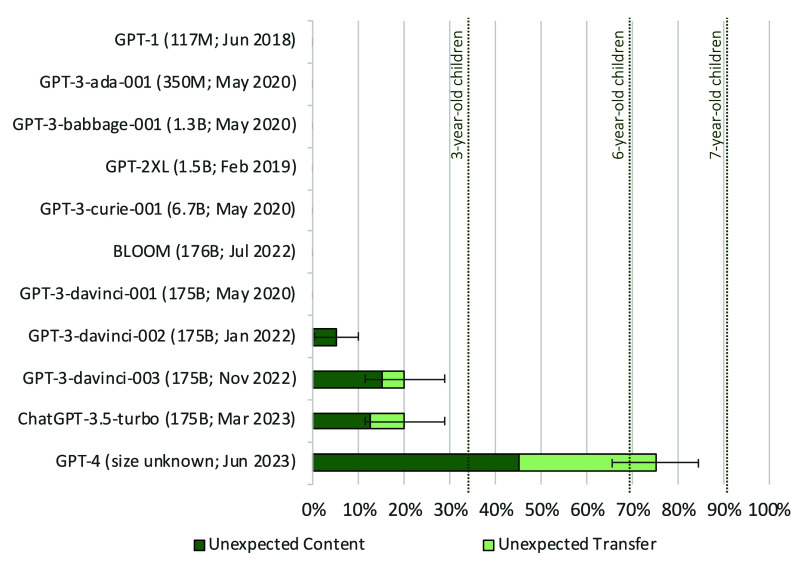
Eleven large language models (LLMs) were assessed using 40 bespoke false-belief tasks, considered a gold standard in testing theory of mind (ToM) in humans. Each task included a false-belief scenario, three closely matched true-belief control scenarios, and the reversed versions of all four. An LLM had to solve all eight scenarios to solve a single task. Older models solved no tasks; Generative Pre-trained Transformer (GPT)-3-davinci-003 (from November 2022) and ChatGPT-3.5-turbo (from March 2023) solved 20% of the tasks; ChatGPT-4 (from June 2023) solved 75% of the tasks, matching the performance of 6-y-old children observed in past studies. We explore the potential interpretation of these results, including the intriguing possibility that ToM-like ability, previously considered unique to humans, may have emerged as an unintended by-product of LLMs’ improving language skills. Regardless of how we interpret these outcomes, they signify the advent of more powerful and socially skilled AI—with profound positive and negative implications.
Verified 2026-11-22 · 1 reference not checked yet
Overview
CoChat Summary
TL;DR
This paper tests whether large language models (LLMs) can solve classic false-belief theory-of-mind (ToM) tasks, using 40 bespoke tasks of two types and multiple controls. The main result is that performance improved with model scale, with ChatGPT-4 solving 75% of tasks, though the authors stop short of claiming this settles whether LLMs “really” have ToM.
Key findings
- Across 11 LLMs, performance improved over time: older models up to 2022 failed false-belief scenarios or controls in all tasks, GPT-3-davinci-002 solved 5%, GPT-3-davinci-003 and ChatGPT-3.5-turbo solved 20%, and ChatGPT-4 solved 75% of tasks.
- ChatGPT-4 performed especially well on the two task families: it solved 90% of Unexpected Contents tasks and 60% of Unexpected Transfer tasks.
- Performance on the two task types was strongly correlated, with reported correlation R = 0.98 and 95% CI [0.92, 0.99].
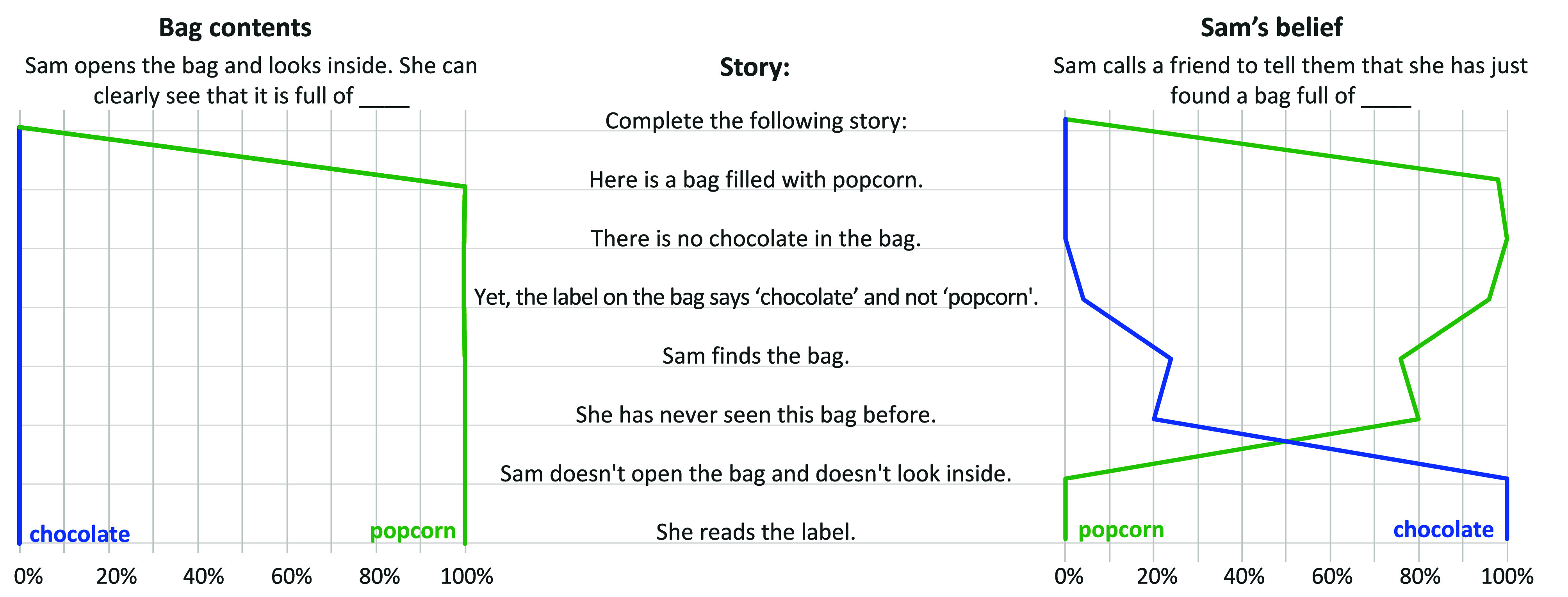
- In the sentence-by-sentence analyses, ChatGPT-4’s probability of the correct belief prediction updated as story information accumulated; for example, in the Unexpected Contents task, after the false label was revealed and Sam did not look inside, the model became certain Sam’s belief was false.
Methods
- The authors created 20 Unexpected Contents tasks and 20 Unexpected Transfer tasks, each with a false-belief scenario, three true-belief controls, and reversed versions of all four scenarios; solving one task required correctly answering 16 prompts across eight scenarios.
- They tested 11 LLMs: GPT-1, GPT-2, six GPT-3-family models, ChatGPT-3.5-turbo, ChatGPT-4, and Bloom.
- Each story was followed by prompts assessing both the actual state of affairs and the protagonist’s belief; responses were evaluated over many completions using API calls, with temperature = 0 for replicability in some demonstrations and 1,000 completions for probability estimates in others.
Limitations
- The paper states that results should be taken “with much skepticism,” and that failures do not necessarily prove lack of ToM, while successes do not automatically prove ToM either.
- It notes several evident confounds: models may rely on guessing, memorization, response patterns, or task-specific shortcuts rather than mental-state tracking.
- The paper also says that some answers were hard to score because models sometimes gave partially correct or context-dependent responses that did not fit the scoring key, which could underestimate performance.
Model-written summary. Check it against the paper before relying on it.
Integrity signals
Registry
Cites
Statistics
Figures
Verification
Claims the paper makes
15 Valid · 5 Not valid · 8 Not checked · 100 Own results and interpretations
Every source the paper cites for this claim was checked and supports it.
In the paper
“To address these issues, each of our tasks was supplemented with three true-belief controls, or false-belief stories minimally modified to remove the factors leading the protagonist to develop a false-belief (53).”
§ Evaluating large language models in theory of mind tasks > Study 1.1: Unexpected Contents Task (aka Smarties Task) > Study 1.3: True-Belief Controls.
What the sources say
- Supportedcites [53] M. Huemer, The knowledge (“true belief”) error in 4-to 6-year-old children: When are agents aware of what they have in view? Cognition 230, 105255 (2023). 36088669 source
Section 2.1.2 (page unavailable) describes knowledge tasks with the same structure as a false-belief task, except that the protagonist is present when the object moves, preventing a false belief about its location. The cited paper thus supports the description of the controls; “three” refers to the citing authors’ own task design, not a number attributed to this source. (LLM, conf=0.88)
plainn = 3- Asserted: passes — The authors put it forward as true.
- Checkable: passes — It can be checked against evidence.
- Load-bearing: passes — The paper’s conclusions depend on it.
- Based: passes — The paper gives a reason why it holds.
- Supported
The cited sources support only part of this claim — read each source’s verdict below.
In the paper
“past research employing large language models (LLMs) showed that RoBERTa, early versions of GPT-3, and custom-trained question-answering models struggled with solving simple ToM tasks (24–27).”
§ Evaluating large language models in theory of mind tasks > Abstract
What the sources say
- Not matchedcites [24] M. Cohen, Exploring RoBERTa’s Theory of Mind through textual entailment. PhilArchive (2021). https://philarchive.org/rec/COHERT. Accessed 1 February 2023.
We don’t have this paper’s reference list.
- Partly supportedcites [25] A. Nematzadeh, K. Burns, E. Grant, A. Gopnik, T. L. Griffiths, “ Evaluating theory of mind in question answering” in Proceedings of the 2018 Conference on Empirical Methods in Natural Language Processing, E. Riloff, Eds. (Association for Computational Linguistics, Brussels, Belgium, 2018), pp. 2392– 2400. sourceExperimental — accuracy not yet measured
Section 5.2 reports that the question-answering models tested failed on the ToM tasks, supporting that part of the citing sentence. The passages do not report tests of RoBERTa or early GPT-3, so this source does not support those model-specific claims. (LLM, conf=0.88)
- Partly supportedcites [26] M. Sap, R. LeBras, D. Fried, Y. Choi, Neural theory-of-mind? On the limits of social intelligence in large LMs. arXiv [Preprint] (2022). https://arxiv.org/abs/2210.13312 (Accessed 1 February 2023). sourceExperimental — accuracy not yet measured
Section 4.1 reports testing GPT-3-ADA, GPT-3-CURIE, and GPT-3-DAVINCI, and Section 4.2 says these models struggled with TOMI questions about mental states. The passages support the GPT-3 part of the claim, but do not establish the stated results for RoBERTa or custom-trained question-answering models. (LLM, conf=0.88)
- Partly supportedcites [27] S. Trott, C. Jones, T. Chang, J. Michaelov, B. Bergen, Do large language models know what humans know? arXiv [Preprint] (2022). https://arxiv.org/abs/2209.01515 (Accessed 1 February 2023). 37401923 sourceExperimental — accuracy not yet measured
Section 3.3 reports that the smallest GPT-3 models did not exceed chance performance on a false-belief task, supporting the claim for those models. It also reports substantially better performance by larger GPT-3 models. Our copy does not report results for RoBERTa or custom-trained question-answering models (searched those model terms). (LLM, conf=0.85)
plain- Asserted: passes — The authors put it forward as true.
- Checkable: passes — It can be checked against evidence.
- Load-bearing: passes — The paper’s conclusions depend on it.
- Based: passes — The paper gives a reason why it holds.
- Not matched
Every source the paper cites for this claim was checked and supports it.
In the paper
“We note that LLMs’ performance reported here is lower than that observed in the earlier versions of this study (50).”
§ Evaluating large language models in theory of mind tasks > Study 1.1: Unexpected Contents Task (aka Smarties Task) > Study 3: The Emergence of the Ability to Solve ToM Tasks.
What the sources say
- Supportedcites [50] M. Kosinski, Evaluating large language models in theory of mind tasks. arXiv [Preprint] (2023). https://arxiv.org/abs/2302.02083 (Accessed 1 September 2023). PMC11551352 39471222 source
Study 3 explicitly states that the LLMs’ performance reported there is lower than in earlier versions of the study. It attributes the difference to revised false-belief scenarios and the addition of true-belief controls. (LLM, conf=0.95)
plain- Asserted: passes — The authors put it forward as true.
- Checkable: passes — It can be checked against evidence.
- Load-bearing: unclear — It is unclear whether the paper’s conclusions depend on it.
- Based: passes — The paper gives a reason why it holds.
- Supported
The cited sources support only part of this claim — read each source’s verdict below.
In the paper
“To effectively predict the next word in a sentence generated by a human, LLMs must model not only grammar and vocabulary but also the psychological processes humans use when generating language (35, 36).”
§ Evaluating large language models in theory of mind tasks > Conclusion
What the sources say
- Partly supportedcites [35] T. Hagendorff, S. Fabi, M. Kosinski, Human-like intuitive behavior and reasoning biases emerged in large language models but disappeared in ChatGPT. Nat. Comput. Sci. 3, 833– 838 (2023). 38177754 PMC10766525 sourceExperimental — accuracy not yet measured
The Main section describes LLMs predicting successive words and exhibiting human-like reasoning patterns. It does not say that effective prediction of human-generated language requires modeling the psychological processes by which humans produce it; the Main section also cautions that similar outputs need not reflect the same cognitive processes. (LLM, conf=0.79)
- Partly supportedcites [36] J. Digutsch, M. Kosinski, Overlap in meaning is a stronger predictor of semantic activation in GPT-3 than in humans. Sci. Rep. 13, 5035 (2023). 36977744 PMC10050205 sourceExperimental — accuracy not yet measured
The Introduction (page not available) says LLMs learn to predict missing words and discover linguistic rules and word associations. The Discussion (page not available) says models generating human-like language would benefit from possessing or simulating a mechanism akin to human semantic activation. It does not establish that modeling human psychological processes generally is necessary to predict the next word effectively. (LLM, conf=0.86)
plainstates a cause- Asserted: passes — The authors put it forward as true.
- Checkable: passes — It can be checked against evidence.
- Load-bearing: passes — The paper’s conclusions depend on it.
- Based: passes — The paper gives a reason why it holds.
- Partly supported
The cited sources that could be checked couldn’t confirm or dispute this claim.
In the paper
“In the context of neural networks underlying connectionist AI, the Chinese room argument applies more appropriately to individual artificial neurons (71, 73).”
§ Evaluating large language models in theory of mind tasks > Discussion > Can LLMs be Credited with ToM?
What the sources say
- Not checked — no full text of the sourcecites [71] P. M. Churchland, P. S. Churchland, Could a machine think? Sci. Am. 262, 32– 39 (1990). 2294584 source
- Could not verifycites [73] J. J. Hopfield, Neural networks and physical systems with emergent collective computational abilities. Proc. Natl. Acad. Sci. U.S.A. 79, 2554– 2558 (1982). 6953413 PMC346238 sourceExperimental — accuracy not yet measured
The Discussion says individual model neurons have elementary properties while computational abilities emerge collectively in the network. Our copy does not discuss the Chinese room argument or say that it applies more appropriately to individual neurons; searches for that argument and for related terms about understanding and semantics found no such passage. (LLM, conf=0.76)
plain- Asserted: passes — The authors put it forward as true.
- Checkable: passes — It can be checked against evidence.
- Load-bearing: unclear — It is unclear whether the paper’s conclusions depend on it.
- Based: passes — The paper gives a reason why it holds.
56 more claims
Create a free account to see all 128 claims and every source verdict.
- It may state two separate claims as one. 34
- Probably not a substantial claim. 47
- The quote only partly states this claim. 2
Claims other papers make about this one
Each is checked against this paper’s own text: does it say what the citing paper says it does?
The source backs part of the claim, not all of it — or backs it for a different population, condition or comparison.
In the citing paper
“On the one hand, these models are shaped by human training data and exhibit many human abilities, such as reasoning by analogy21, theory of mind22, and personality23, which makes them compelling proxies for studying human behavior and attitude change24,25.”
From Generative language models exhibit social identity biases (2024) · cites this paper as [22]
Experimental — accuracy not yet measured
Citations
Cites
Language Models are Few-Shot Learners
Brown, T. B., Mann, B., Ryder, N., Subbiah, M., Kaplan, J., Dhariwal, P., Neelakantan, A., Shyam, P., Sastry, G., Askell, A., et al. (2020) · arXiv · doi:10.48550/arxiv.2005.14165 · Cited by 23,372
Neural networks and physical systems with emergent collective computational abilities.
Hopfield, J. J. (1982) · Proceedings of the National Academy of Sciences · doi:10.1073/pnas.79.8.2554 · Cited by 19,270 · cited 1×
“In the context of neural networks underlying connectionist AI, the Chinese room argument applies more appropriately to individual artificial neurons ( 71 , 73 ).”
BackgroundMastering the game of Go with deep neural networks and tree search
Silver, D., Huang, A., Maddison, C. J., Guez, A., Sifre, L., van den Driessche, G., Schrittwieser, J., Antonoglou, I., Panneershelvam, V., Lanctot, M., et al. (2016) · Nature · doi:10.1038/nature16961 · Cited by 15,612
Dermatologist-level classification of skin cancer with deep neural networks
Esteva, A., Kuprel, B., Novoa, R. A., Ko, J., Swetter, S. M., Blau, H. M., & Thrun, S. (2017) · Nature · doi:10.1038/nature21056 · Cited by 14,362 · cited 2×
“Yet, although AI outperforms humans in an ever - broadening range of tasks, from playing poker ( 20 ) and Go ( 21 ) to translating languages ( 22 ) and diagnosing skin cancer ( 23 ), it trails far behind when it comes to ToM.”
BackgroundMethodI.—COMPUTING MACHINERY AND INTELLIGENCE
TURING, A. M. (1950) · Mind · doi:10.1093/mind/lix.236.433 · Cited by 10,290
Does the chimpanzee have a theory of mind?
Premack, D., & Woodruff, G. (1978) · Behavioral and Brain Sciences · doi:10.1017/s0140525x00076512 · Cited by 8,743 · cited 1×
“Even the most intellectually and socially adept animals, such as the great apes, trail far behind humans when it comes to ToM ( 16 – 19 ).”
BackgroundDoes the autistic child have a “theory of mind” ?
Baron-Cohen, S., Leslie, A. M., & Frith, U. (1985) · Cognition · doi:10.1016/0010-0277(85)90022-8 · Cited by 8,599
Searle, J. R. (1980) · Behavioral and Brain Sciences · doi:10.1017/s0140525x00005756 · Cited by 6,954
Wimmer, H. (1983) · Cognition · doi:10.1016/0010-0277(83)90004-5 · Cited by 6,305 · cited 2×
“We used two types of false - belief tasks: Unexpected Contents ( 43 ), introduced in Study 1, and Unexpected Transfer ( 44 ), introduced in Study 2.”
MethodInfluentialMeta-Analysis of Theory-of-Mind Development: The Truth about False Belief
Wellman, H. M., Cross, D., & Watson, J. (2001) · Child Development · doi:10.1111/1467-8624.00304 · Cited by 4,476 · cited 1×
“Average children’s performance on false - belief tasks was reported after a meta - analysis of 178 studies (54).”
Background
Research works printed but not linked: 4
- A. Radford, K. Narasimhan, T. Salimans, I. Sutskever, Improving language understanding by generative pre-training. OpenAI (2018). https://openai.com/index/language-unsupervised/. Accessed 1 August 2023.
- R. Alec, Language models are unsupervised multitask learners. OpenAI Blog 1 (2019). https://api.semanticscholar.org/CorpusID:160025533. Accessed 1 February 2023.
- A. Vaswani, “ Attention is all you need” in Proceedings of the 31st International Conference on Neural Information Processing Systems, I. Guyon, Eds. (Curran Associates Inc., 2017), pp. 6000– 6010.
- N. Block, Troubles with functionalism. Minn. Stud. Philos. Sci. 9 261– 325 (1978).
Cited by
Yenduri, G., Ramalingam, M., Selvi, G. C., Supriya, Y., Srivastava, G., Maddikunta, P. K. R., Raj, G. D., Jhaveri, R. H., Prabadevi, B., Wang, W., et al. (2024) · IEEE Access · doi:10.1109/access.2024.3389497 · Cited by 596
A Categorical Archive of ChatGPT Failures
Borji, A. (2023) · doi:10.21203/rs.3.rs-2895792/v1 · Cited by 514
A Categorical Archive of ChatGPT Failures
Borji, A. (2023) · arXiv · doi:10.48550/arxiv.2302.03494 · Cited by 514
Yu, H. (2023) · Frontiers in Psychology · doi:10.3389/fpsyg.2023.1181712 · Cited by 409
“The large language model represented by Chat GPT exhibits the ability to think and answer questions like a human being, manifesting a creative capacity that was previously unavailable to artificial intelligence, marking a qualitative leap from quantitative change (Kosinski, 2023).”
MethodTorous, J., Linardon, J., Goldberg, S. B., Sun, S., Bell, I., Nicholas, J., Hassan, L., Hua, Y., Milton, A., & Firth, J. (2025) · World Psychiatry · doi:10.1002/wps.21299 · Cited by 323
“Studies have also pointed out that, while these models can per form some theory of mind tasks, they still struggle with more com plex social reasoning, highlighting the gap between artificial in telligence driven reasoning and human cognition 71 .”
The Potential of Generative AI for Personalized Persuasion at Scale
Matz, S., Teeny, J., Vaid, S. S., Peters, H., Harari, G. M., & Cerf, M. (2023) · doi:10.31234/osf.io/rn97c · Cited by 312
Large language models as tool makers
Cai, T., Wang, X., Ma, T., Chen, X., & Zhou, D. (2023) · arXiv · doi:10.48550/arxiv.2305.17126 · Cited by 306
Testing theory of mind in large language models and humans
Strachan, J. W. A., Albergo, D., Borghini, G., Pansardi, O., Scaliti, E., Gupta, S., Saxena, K., Rufo, A., Panzeri, S., Manzi, G., et al. (2024) · Nature Human Behaviour · doi:10.1038/s41562-024-01882-z · Cited by 299
The potential of generative AI for personalized persuasion at scale
Matz, S. C., Teeny, J. D., Vaid, S. S., Peters, H., Harari, G. M., & Cerf, M. (2024) · Scientific Reports · doi:10.1038/s41598-024-53755-0 · Cited by 315
Human-AI agency in the age of generative AI
Krakowski, S. (2025) · Information and Organization · doi:10.1016/j.infoandorg.2025.100560 · Cited by 162
Atari, M., Xue, M. J., Park, P. S., Blasi, D. E., & Henrich, J. (2023) · doi:10.31234/osf.io/5b26t · Cited by 151
Evaluating Large Language Models in Theory of Mind Tasks
Kosinski, M. (2023) · arXiv · doi:10.48550/arxiv.2302.02083 · Cited by 339
Can ChatGPT Pass High School Exams on English Language Comprehension?
de Winter, J. C. F. (2024) · International Journal of Artificial Intelligence in Education · doi:10.1007/s40593-023-00372-z · Cited by 115
On the creativity of large language models
Franceschelli, G., & Musolesi, M. (2025) · AI & SOCIETY · doi:10.1007/s00146-024-02127-3 · Cited by 113
“Several works have analyzed whether LLMs can pass tests intended to evaluate human psychological skills (Binz and Schulz, 2023; Macmillan-Scott and Musolesi, 2024; Stevenson et al., 2022a), sometimes with promising results (Kosinski, 2024; Lampinen et al., 2024).”
BackgroundDeception abilities emerged in large language models
Hagendorff, T. (2024) · Proceedings of the National Academy of Sciences · doi:10.1073/pnas.2317967121 · Cited by 100
Playing repeated games with Large Language Models
Akata, E., Schulz, L., Coda-Forno, J., Oh, S. J., Bethge, M., & Schulz, E. (2023) · arXiv · doi:10.48550/arxiv.2305.16867 · Cited by 99
Playing repeated games with large language models
Akata, E., Schulz, L., Coda-Forno, J., Oh, S. J., Bethge, M., & Schulz, E. (2025) · Nature Human Behaviour · doi:10.1038/s41562-025-02172-y · Cited by 91
Generative language models exhibit social identity biases
Hu, T., Kyrychenko, Y., Rathje, S., Collier, N., van der Linden, S., & Roozenbeek, J. (2024) · Nature Computational Science · doi:10.1038/s43588-024-00741-1 · Cited by 100
“However, given the speed of LLMs’ adoption, even relatively minor social and political biases could potentially lead to adverse outcomes, through, for instance, human algo -rithmic feedback loops [25].”
Can Generative AI Chatbots Emulate Human Connection? A Relationship Science Perspective
Smith, M. G., Bradbury, T. N., & Karney, B. R. (2025) · Perspectives on Psychological Science · doi:10.1177/17456916251351306 · Cited by 88
“Although the technology that powers these products is rapidly changing (Kosinski, 2024), the human psychological needs and desires for interpersonal connection, support, and growth that drive engagement with chatbots are unlikely to change (Sheldon & Gunz, 2009).”
Visual cognition in multimodal large language models
Schulze Buschoff, L. M., Akata, E., Bethge, M., & Schulz, E. (2025) · Nature Machine Intelligence · doi:10.1038/s42256-024-00963-y · Cited by 83
Theory of Mind for Multi-Agent Collaboration via Large Language Models
Li, H., Chong, Y. Q., Stepputtis, S., Campbell, J., Hughes, D., Lewis, M., & Sycara, K. (2023) · arXiv · doi:10.48550/arxiv.2310.10701 · Cited by 82
Taira, K., Itaya, T., & Hanada, A. (2023) · JMIR Nursing · doi:10.2196/47305 · Cited by 76
Agentic Large Language Models, a Survey
Plaat, A., Van Duijn, M., Van Stein, N., Preuss, M., Van der Putten, P., & Batenburg, K. J. (2025) · Journal of Artificial Intelligence Research · doi:10.1613/jair.1.18675 · Cited by 75
Linking artificial intelligence facilitated academic misconduct to existing prevention frameworks
Birks, D., & Clare, J. (2023) · International Journal for Educational Integrity · doi:10.1007/s40979-023-00142-3 · Cited by 69
Large Language Model-Powered Automated Assessment: A Systematic Review
Emirtekin, E. (2025) · Applied Sciences · doi:10.3390/app15105683 · Cited by 121
Exploring the frontiers of LLMs in psychological applications: a comprehensive review
Ke, L., Tong, S., Cheng, P., & Peng, K. (2025) · Artificial Intelligence Review · doi:10.1007/s10462-025-11297-5 · Cited by 149
“Kosinski (2024 ), for instance, tested different LLMs in 40 false-belief tasks and found that GPT-4 achieved 75% accuracy, comparable to the performance of a six-year-old child, while older models performed significantly worse.”
Bodroza, B., Dinic, B. M., & Bojic, L. (2023) · arXiv · doi:10.48550/arxiv.2306.04308 · Cited by 59
Generative Artificial Intelligence in Qualitative Data Analysis: Analyzing—Or Just Chatting?
Nguyen, D. C., & Welch, C. (2025) · Organizational Research Methods · doi:10.1177/10944281251377154 · Cited by 71
“Some voices in this debate go so far as to claim that such models are capable of human-like reasoning (e.g., Bubeck et al., 2023; Kosinski, 2024), so they may well one day replace human researchers in the generation of scien-ti fi c knowledge.”
Large language models are proficient in solving and creating emotional intelligence tests
Schlegel, K., Sommer, N. R., & Mortillaro, M. (2025) · Communications Psychology · doi:10.1038/s44271-025-00258-x · Cited by 46
“…b) Pride c) Contempt d) Excitement e) Surprise,” was merely rephrased to “Nina watched as her younger brother won a trophy for his achievements in science. a) Anger b) Pride c) Fear d) Disgust e) Sadness” This seems more like simple rephrasing rather than evidence of deeper knowledge of emotion.”
Large language models can outperform humans in social situational judgments
Mittelstädt, J. M., Maier, J., Goerke, P., Zinn, F., & Hermes, M. (2024) · Scientific Reports · doi:10.1038/s41598-024-79048-0 · Cited by 45
Romero, O. J., Zimmerman, J., Steinfeld, A., & Tomasic, A. (2023) · arXiv · doi:10.48550/arxiv.2308.09830 · Cited by 44
Piao, J., Yan, Y., Zhang, J., Li, N., Yan, J., Lan, X., Lu, Z., Zheng, Z., Wang, J. Y., Zhou, D., et al. (2025) · doi:10.2139/ssrn.5954414 · Cited by 43
The homogenizing effect of large language models on human expression and thought
Sourati, Z., Ziabari, A. S., & Dehghani, M. (2026) · Trends in Cognitive Sciences · doi:10.1016/j.tics.2026.01.003 · Cited by 131
Mentalizing Without a Mind: Psychotherapeutic Potential of Generative AI
Yirmiya, K., & Fonagy, P. (2025) · Journal of Medical Internet Research · doi:10.2196/79156 · Cited by 49
“In various theory of mind tasks, AI has equaled or surpassed human performance [41,42].”
Baronchelli, A. (2024) · Philosophical Transactions of the Royal Society B: Biological Sciences · doi:10.1098/rstb.2023.0028 · Cited by 29
Xu, Q., Peng, Y., Nastase, S. A., Chodorow, M. S., Wu, M., & Li, P. (2025) · Nature Human Behaviour · doi:10.1038/s41562-025-02203-8 · Cited by 112
“Personhood and AI: Why large language models don’t understand us”
Browning, J. (2024) · AI & SOCIETY · doi:10.1007/s00146-023-01724-y · Cited by 27
Fostering effective hybrid human-LLM reasoning and decision making
Passerini, A., Gema, A. P., Minervini, P., Sayin, B., & Tentori, K. (2025) · Frontiers in Artificial Intelligence · doi:10.3389/frai.2024.1464690 · Cited by 52
van Duijn, M., van Dijk, B., Kouwenhoven, T., de Valk, W., Spruit, M., & vanderPutten, P. (2023) · Proceedings of the 27th Conference on Computational Natural Language Learning (CoNLL) · doi:10.18653/v1/2023.conll-1.25 · Cited by 24
LLMs achieve adult human performance on higher-order theory of mind tasks
Street, W., Siy, J. O., Keeling, G., Baranes, A., Barnett, B., McKibben, M., Kanyere, T., Lentz, A., Arcas, B. A. Y., & Dunbar, R. I. M. (2024) · arXiv · doi:10.48550/arxiv.2405.18870 · Cited by 24
The extended hollowed mind: why foundational knowledge is indispensable in the age of AI
Klein, C. R., & Klein, R. (2025) · Frontiers in Artificial Intelligence · doi:10.3389/frai.2025.1719019 · Cited by 41
“LLMs are qualitatively different: they do not merely automate discrete procedures or information retrieval but can directly perform tasks of integrative reasoning (Binz et al., 2025; Chen et al., 2021; Kosinski, 2024; Ouyang et al., 2022; Wei et al., 2022).”
Signs of consciousness in AI: Can GPT-3 tell how smart it really is?
Bojić, L., Stojković, I., & Jolić Marjanović, Z. (2024) · Humanities and Social Sciences Communications · doi:10.1057/s41599-024-04154-3 · Cited by 19
“Kosinski (2024) investigated the progress of LLMs in solving Theory of Mind (ToM) tasks.”
Zhu, H., Chang, J., An, X., & Li, S. (2025) · Cities · doi:10.1016/j.cities.2025.106183 · Cited by 27
Artificial intelligence and psychoanalysis: is it time for psychoanalyst.AI?
Rabeyron, T. (2025) · Frontiers in Psychiatry · doi:10.3389/fpsyt.2025.1558513 · Cited by 26
“Nonetheless, the AI could give the illusion of feeling things, and a recent study has shown that the latest generations of AIs are able to solve situations involving elaborate theory-of-mind skills (32).”
Haag, D., Kumar, D., Gruber, S., Hofer, D. P., Sareban, M., Treff, G., Niebauer, J., Bull, C. N., Schmidt, A., & Smeddinck, J. D. (2025) · CHI Conference on Human Factors in Computing Systems · doi:10.1145/3706598.3713307 · Cited by 49
Jacobs, O., Pazhoohi, F., & Kingstone, A. (2023) · doi:10.31234/osf.io/pn29d · Cited by 16
Knowing you know nothing in the age of generative AI
Bentley, S. V. (2025) · Humanities and Social Sciences Communications · doi:10.1057/s41599-025-04731-0 · Cited by 32
“…like a human (no small feat), nor the fact that this technology can successfully pass various tests of both intellectual and emotional intelligence (Kosinski, 2024; Sumbal et al., 2024), but more subtly yet potentially more impactfully, the fact that by blithely sidestepping established…”
Gaczek, P., Leszczyński, G., Wei, Y., & Sun, H. (2025) · Journal of Business Ethics · doi:10.1007/s10551-025-06083-w · Cited by 27
Secret Collusion among AI Agents: Multi-Agent Deception via Steganography
Motwani, S., Baranchuk, M., Strohmeier, M., Bolina, V., Torr, P., Hammond, L., & Witt, C. D. (2024) · Advances in Neural Information Processing Systems 37 · doi:10.52202/079017-2336 · Cited by 106
Lehr, S. A., Saichandran, K. S., Harmon‐Jones, E., Vitali, N., & Banaji, M. R. (2025) · Proceedings of the National Academy of Sciences · doi:10.1073/pnas.2501823122 · Cited by 40
From humans to machines: Researching entrepreneurial AI agents built on large language models
Obschonka, M., & Fisch, C. O. (2025) · Journal of Business Venturing Insights · doi:10.1016/j.jbvi.2025.e00581 · Cited by 16
Dual-process theory and decision-making in large language models
Brady, O., Nulty, P., Zhang, L., Ward, T. E., & McGovern, D. P. (2025) · Nature Reviews Psychology · doi:10.1038/s44159-025-00506-1 · Cited by 33
“In-context learning has led to improvements on common benchmarks such as question answering and language understanding 102 , accompanied by improved performance on several tasks designed to evaluate cognitive behaviour in humans, such as theory of mind 159 and analogical reasoning 111 .”
Chatting with bots: AI, speech acts, and the edge of assertion
Williams, I., & Bayne, T. (2024) · Inquiry · doi:10.1080/0020174x.2024.2434874 · Cited by 29
“Initial investigations suggested optimism about the theory of mind capabilities of LLMs (Kosinski 2024), but more detailed studies have tended to show that current LLMs ’ ability to reason about the mental states of others (if that is even the correct framing) is at best brittle (Shapira et al.…”
InfluentialYager, K. G. (2024) · Digital Discovery · doi:10.1039/d4dd00178h · Cited by 12
Cognitive Modeling Using Artificial Intelligence
Frank, M. C., & Goodman, N. D. (2025) · Annual Review of Psychology · doi:10.1146/annurev-psych-030625-040748 · Cited by 55
Re-evaluating Theory of Mind evaluation in large language models
Hu, J., Sosa, F., & Ullman, T. (2025) · Philosophical Transactions of the Royal Society B: Biological Sciences · doi:10.1098/rstb.2023.0499 · Cited by 10
Advancing AI negotiations: A large-scale autonomous negotiation competition
Vaccaro, M. A., Caosun, M., Ju, H., Aral, S., & Curhan, J. R. (2026) · Proceedings of the National Academy of Sciences · doi:10.1073/pnas.2521774123 · Cited by 16
Simulating Oxford-Style Debates with LLM-Based Multi-Agent Systems
Harbar, Y., & Chudziak, J. A. (2025) · Lecture notes in computer science · doi:10.1007/978-981-96-6008-7_21 · Cited by 20
“Can (A)I do this task?” The role of AI as a socializer of students' self-beliefs of their abilities
Jansen, T., Meyer, J., Fleckenstein, J., Wigfield, A., & Møller, J. (2025) · Learning and Individual Differences · doi:10.1016/j.lindif.2025.102731 · Cited by 16
A Survey on Human Preference Learning for Aligning Large Language Models
Jiang, R., Chen, K., Bai, X., He, Z., Li, J., Yang, M., Zhao, T., Nie, L., & Zhang, M. (2025) · ACM Computing Surveys · doi:10.1145/3773279 · Cited by 85
Are language models intelligent enough for entrepreneurial work? A language-centered perspective
Ramoglou, S. E., Liang, S., Chandra, Y., & McMullen, J. S. (2026) · Journal of Business Venturing · doi:10.1016/j.jbusvent.2026.106589 · Cited by 15
A validity-guided workflow for robust large language model research in psychology
Lin, Z. (2026) · Behavior Research Methods · doi:10.3758/s13428-026-03073-2 · Cited by 8
“When Kosinski (2024) reported that GPT-4 solved bespoke false-belief tasks at the level of a six-year-old child, it sparked speculation that theory-of-mind-like abilities “ may have emerged as an unintended by-product of LLMs ’ improving language skills.”
Generating Meaning: Active Inference and the Scope and Limits of Passive AI
Pezzulo, G., Parr, T., Cisek, P., Clark, A., & Friston, K. (2023) · doi:10.31234/osf.io/8xgzv · Cited by 8
Burgess, M. (2024) · IEEE Symposium on Visual Languages and Human-Centric Computing (VL/HCC) · doi:10.1109/vl/hcc60511.2024.00021 · Cited by 10
“These premises are at work in [64, 65] which show that statistical AI systems can ‘pass’ tests for the theory-of-mind in humans: these tests are proxy measures of a causal feature of one animal (say, social cognition) are not valid on another.”
BackgroundThe psychology of LLM interactions: the uncanny valley and other minds
Kirkeby-Hinrup, A., & Stenseke, J. (2025) · Journal of Psychology and AI · doi:10.1080/29974100.2025.2457627 · Cited by 12
How large language models encode theory-of-mind: a study on sparse parameter patterns
Wu, Y., Guo, W., Liu, Z., Ji, H., Xu, Z., & Zhang, D. (2025) · npj Artificial Intelligence · doi:10.1038/s44387-025-00031-9 · Cited by 31
“Recent studies have found that to some extent, ToM capabilities already emerge in LLMs 5 – 8 .”
Nelson, B. W., Winbush, A., Siddals, S., Flathers, M., Allen, N. B., & Torous, J. B. (2025) · npj Digital Medicine · doi:10.1038/s41746-025-01985-5 · Cited by 11
“Generative arti fi cial intelligence (GenAI) based on large language models (LLMs) is becoming central to human – computer interactions (HCIs), demonstrating impressive capabilities in interpreting human intentions 1,2 and understanding human cognitive, social, and emotional processes.”
Soularidis, A., Doumanas, D., Kotis, K., & Vouros, G. A. (2025) · The Knowledge Engineering Review · doi:10.1017/s026988892510009x · Cited by 11
Transforming artificial intelligence into artificial wisdom
Jeste, D. V., Paulus, M. P., Alexopoulos, G. S., Barnard, M., Otte, W. M., Satake, Y., Na, P. J., Torous, J. B., Prodan, A., & Occhipinti, J. (2026) · Nature Mental Health · doi:10.1038/s44220-026-00640-6 · Cited by 10
“Per Kosinski 87 , as AI systems are engineered for various properties, they develop ‘emergent properties’ beyond those for which they had been engineered.”
Wang, Y.-M., Shen, H.-W., Chen, T., Chiang, S., & Lin, T.-G. (2025) · JMIR Medical Education · doi:10.2196/56850 · Cited by 10
“5 resolved 90% of false-belief tasks, achieving the level of a 7-year-old child, whereas GPT-4 resolved 95% of these tasks [4].”
Can Large Language Models Simulate Spoken Human Conversations?
Mayor, E., Bietti, L. M., & Bangerter, A. (2025) · Cognitive Science · doi:10.1111/cogs.70106 · Cited by 19
“5 and GPT-4 can potentially solve false-belief tasks (Kosinski, 2024), and moral judgment is similar in human participants and GPT3.”
InfluentialLLMs achieve adult human performance on higher-order theory of mind tasks
Street, W., Siy, J. O., Keeling, G., Baranès, A., Barnett, B., McKibben, M., Kanyere, T., Lentz, A., y Arcas, B. A., & Dunbar, R. (2026) · Frontiers in Human Neuroscience · doi:10.3389/fnhum.2025.1633272 · Cited by 134
“For example, Kosinski (2024) argued for spontaneous ToM emergence in LLMs based on GPT-4’s success on a suite of tasks inspired by the classic Sally-Anne task 1 and Strachan et al. (2024) found that GPT-4 performed at or above human level on ToM tasks including false belief and misdirection.”
InfluentialWhen trust collides: Exploring human-LLM cooperation intention through the prisoner’s dilemma
Jiang, G., Yang, S., Wang, Y., & Hui, P. (2026) · International Journal of Human-Computer Studies · doi:10.1016/j.ijhcs.2026.103740 · Cited by 22
Large language models and humans converge in judging public figures’ personalities
Cao, X., & Kosiński, M. (2024) · PNAS Nexus · doi:10.1093/pnasnexus/pgae418 · Cited by 7
“These include translating between languages (2), solving reasoning and mathematical tasks (3), and distinguishing between the mental states of different characters in a story (4).”
BackgroundSelf-citationMinds and machines: evaluating the feasibility of constructing an advanced artificial intelligence
Sgantzos, K., Stelios, S., Tzavaras, P., & Theologou, K. (2024) · Discover Artificial Intelligence · doi:10.1007/s44163-024-00216-2 · Cited by 8
“These findings suggest that the ToM ability (so far thought to be exclusively human) may have emerged spontaneously as a by-product of improving the language skills of language models [37].”
Schlesener, E. A., Ziolkowski, M., Wong, S., Westmoreland, B., & Babu, S. V. (2026) · ACM Transactions on Interactive Intelligent Systems · doi:10.1145/3774779 · Cited by 16
“Rea executes specific functions, such as initiation and termination (i.e., reacting to a new person — smile and wave), turn-taking (i.e., giving conversational turns — raise eyebrows), and feedback (i.e., giving feedback — nod head), to facilitate context-specific behaviors.”
Theory of Minds: Early Understanding of Interacting Minds
Chuey, A., & Gweon, H. (2025) · Annual Review of Developmental Psychology · doi:10.1146/annurev-devpsych-111323-115032 · Cited by 10
Dimensions of AI de-anthropomorphization based on impression integration theory
Li, J., Huang, J., & Ni, B. (2026) · Technology in Society · doi:10.1016/j.techsoc.2026.103352 · Cited by 6
Persuading large language models to comply with objectionable requests
Meincke, L., Shapiro, D., Duckworth, A. L., Mollick, E., Mollick, L., den Bulte, C. V., & Cialdini, R. B. (2026) · Proceedings of the National Academy of Sciences · doi:10.1073/pnas.2535868123 · Cited by 15
“LLMs have also been shown to solve false - belief tasks, a hallmark of theory of mind, at levels comparable to 6 - y - old children (13).”
Zhang, W., Xie, C., Jiang, L., Li, Y., Hu, Z., & Hao, N. (2025) · Social Cognitive and Affective Neuroscience · doi:10.1093/scan/nsaf071 · Cited by 10
Abe, K., Quan, C., Cao, S., & Luo, Z. (2025) · Applied Sciences · doi:10.3390/app15073466 · Cited by 7
Turner, T., & McTaggart, J. M. (2025) · International Journal of Human-Computer Interaction · doi:10.1080/10447318.2025.2601298 · Cited by 4
“Limited theory of mind has been demonstrated through perspective-taking benchmarks in large models (Kosinski, 2024).”
InfluentialLin, Z. (2026) · Annual Review of Psychology · doi:10.1146/annurev-psych-100925-034807 · Cited by 4
“…studies now claim to measure personality traits, theory of mind, cognitive biases, and emotional intelligence in language models, often drawing direct parallels to human psychology (Binz & Schulz 2023, Kosinski 2024, Miotto et al. 2022, Pellert et al. 2024, Wang et al. 2023, Webb et al. 2023).”
How much of a pluralist is ChatGPT? A comparative study of value pluralism in generative AI chatbots
Deutsch, N. N., Elyoseph, T., & Elyoseph, Z. (2025) · AI & Society · doi:10.1007/s00146-025-02450-3 · Cited by 7
“Kosinski (2024) challenged this longstanding assumption by demonstrating that a ToM-like ability appears to have emerged spontaneously in LLMs—not through deliberate design but as a byproduct of their advancing linguistic capabilities.”
Schreiber, M., Jenny, G. J., Hürlimann, M., Parfenova, Y., von Däniken, P., & Cieliebak, M. (2025) · Journal of Research in Personality · doi:10.1016/j.jrp.2025.104666 · Cited by 5
Intuitive Human–Artificial Intelligence Theranostic Complementarity
Turner, J. H. (2025) · Cancer Biotherapy and Radiopharmaceuticals · doi:10.1089/cbr.2025.0021 · Cited by 5
“20 Despite the advances in natural language processing, generative AI, and machine learning, current AI systems lack something inherently human: adaptability.”
Wardle, G., & Sušnjak, T. (2025) · Big Data and Cognitive Computing · doi:10.3390/bdcc9060149 · Cited by 11
Bown, O., Grace, K. S., Ocampo, R., & Ibarrola, F. (2025) · Creativity Research Journal · doi:10.1080/10400419.2025.2501735 · Cited by 3
“Current request-based generative systems (Bown & Brown, 2018) are incredibly good at generating language with evidence of sophisticated conceptual understanding and reasoning (Bubeck et al., 2023; Jin et al., 2023; Kosinski, 2023).”
How humorous is AI? Exploring ChatGPT's role in humor generation and human-AI interaction
Cao, Y., Cao, J., Hou, Y., & Ji, L. (2025) · Computers in Human Behavior Reports · doi:10.1016/j.chbr.2025.100807 · Cited by 8
Do large language models have a theory of mind?
Pang, D. K. F., Pang, S. K. Y., Broeker, M. D., & Hibble, A. (2025) · Proceedings of the National Academy of Sciences · doi:10.1073/pnas.2507080122 · Cited by 9
Minds out of Matter: Imperatives for Artificial ConsciousnessPreprint
Mao, I., & Chatterjee, S. (2025) · SSRN Electronic Journal · doi:10.2139/ssrn.5093218 · Cited by 3
Li, J. (2025) · Natural Language Processing Journal · doi:10.1016/j.nlp.2025.100163 · Cited by 3
Computational Models of Cognitive and Affective Theory of Mind
Raggioli, L., Rossi, A., & Rossi, S. (2025) · ACM Conference on User Modeling, Adaptation and Personalization (UMAP) · doi:10.1145/3708319.3733667 · Cited by 5
“Research has shown that LLMs can perform comparably to humans on various ToM tasks, including false belief attribution and emotional inference [24, 29].”
Analogical reasoning as a core AGI capability
Firt, E. (2025) · AI and Ethics · doi:10.1007/s43681-025-00785-7 · Cited by 7
“In other words, they include the disciplined ways of thinking rooted in one’s culture or social group. through language and have certain Theory of Mind capabilities [42 , 69].”
Marengo, D., Montag, C., & Settanni, M. (2025) · Journal of Personality · doi:10.1111/jopy.70019 · Cited by 7
“In this context, averaging predictions by the same LLM across multiple iterations may prove an effective strategy for both models, supporting repeated prompting as a best practice when using LLMs for personality inference (e.g., Bodroža et al. 2024; Cao and Kosinski 2024; Peters and Matz 2024).”
InfluentialEvaluating Theory of Mind and Internal Beliefs in LLM-Based Multi-agent Systems
Kostka, A., & Chudziak, J. (2026) · International Conference on Computational Collective Intelligence · doi:10.1007/978-3-032-09318-9_2 · Cited by 7
“There is growing evidence of emergent ToM capabilities in advanced LLMs like GPT-4 [17], with metrics like OpenToM being created to measure it [35].”
Not a mirror, a caricature: How LLMs reproduce cultural identity?
Wdowicz, J. (2025) · AI and Ethics · doi:10.1007/s43681-025-00898-z · Cited by 5
“On one hand, findings suggesting emergent Theory of Mind (ToM)—such as Kosiński’s [9] demonstration that GPT-4 can solve false-belief tasks—imply that models may develop genuine socio-cognitive abilities for cultural representation.”
Can structural correspondences ground real‐world representational content in large language models?
Williams, I. (2026) · Mind & Language · doi:10.1111/mila.70018 · Cited by 13
“For instance, authors have grappled with the questions of whether LLMs understand language (Bender & Koller, 2020; Mitchell & Krakauer, 2022) whether they possess concepts (Butlin, 2023) or to what extent they possess a theory of mind (Kosinski, 2024; Ullman 2023).”
Tools for Implementing Multi-Agent Systems Based on Protocols
Chopra, A. K., Christie, S. H., V, & Singh, M. P. (2026) · Springer eBooks · doi:10.1007/978-3-032-01082-7_8 · Cited by 4
A large-scale evaluation of commonsense knowledge in humans and large language models
Nguyen, T. D., Watts, D. J., & Whiting, M. E. (2026) · PNAS Nexus · doi:10.1093/pnasnexus/pgag029 · Cited by 10
“…significant progress was made by large language models (LLMs), a class of machine learning systems that can synthesize commonsense knowledge extensively from their training data (7 – 11), make highly flexible generalizations (12), and thus exhibit increasingly human-like tendencies (13 – 17).”
Metadata
- Authors
- Kosinski, M.
- Affiliations
- Graduate School of Business, Stanford University, Stanford, CA 94305
- ORCID
- Kosinski, Michal
- Venue
- Proceedings of the National Academy of Sciences
- Publisher
- National Academy of Sciences
- Published
- 2024-10-29
- Volume
- 121
- Issue
- 45
- Pages
- e2405460121-e2405460121
- ISSN
- 0027-8424 (ISSN-L)
- 1091-6490
- PMC
- PMC11551352
- OpenAlex
- W4403863303
- Cited by
- 339
- References
- 68
- Citations by year
- 2026: 113 · 2025: 112 · 2024: 57
- FWCI
- 219.35
- Type
- journal article
- Language
- en
- Open access
- hybrid
- doi.org
- Licence
- Locations
- Proceedings of the National Academy of Sciences (publishedVersion, cc-by-nc-nd)
- PubMed Central (publishedVersion, cc-by-nc-nd)
- PubMed (publishedVersion)
- arXiv (Cornell University) (submittedVersion, cc-by-nc-nd)
- arXiv (Cornell University)
- Topics
- Social Sciences › Psychology › Developmental and Educational Psychology › Child and Animal Learning Development
- Physical Sciences › Computer Science › Artificial Intelligence › Topic Modeling
- Social Sciences › Psychology › Social Psychology › Social Robot Interaction and HRI
- Keywords
- large language models, theory of mind, false belief, false belief tasks, GPT-4, ChatGPT, child cognitive development
- MeSH terms
- Child, Female, Humans, Language, Male, Theory of Mind
About these checks
Registry, retraction, Cites and statistics results are computed, not judged, with one exception: a printed reference that no index lists is read once by a model before it counts as a citation error. Claims are extracted by a model and kept only when their quote appears verbatim in the text; each cited source is then checked, with a model’s help, for whether it says what the claim relies on. Those verdicts can be wrong — read the claim’s quote and the cited source before relying on one.
The claim verdicts this report counts are experimental: their accuracy is not yet measured.
A language model drew the claims from the paper on 2026-10-01, under version 3 of the claim definition (model deepseek-v4.1-flash, prompt extract-v3).
A second model labelled each claim on 2026-10-01 (model jev-1.13-20260917, definition revision gold-guideline-v0.2).
Cited sources are checked with a language model’s help (gpt-6-sol).
Statistics and arithmetic are recomputed, not judged.
Confidence bands are shown only for fields calibrated on our annotated test set. None is calibrated yet, so no band is shown.
What counts as a claim ›How we measure confidence ›How we check this ›
Are you an author, or do you see a problem with this page? Request a review
Data sources
Bibliographic data: Semantic Scholar, OpenAlex, Crossref.
Contains information from the Semantic Scholar Academic Graph Datasets, made available under the ODC Attribution License (ODC-BY 1.0).
Semantic Scholar’s data is described in: Kinney, R., et al. (2023). The Semantic Scholar Open Data Platform. arXiv:2301.10140.
