Cited by 6Protein Structure and DynamicsChemical Synthesis and Analysisvaccines and immunoinformatics approaches

The DOI matches its Crossref record; 7 of the 7 references it cites were found in a registry or an index.

Mapping targetable sites on the human surfaceome for the design of novel binders

Open access

Published version of a preprint

Abstract

The human cell surfaceome, integral to cell communication and disease mechanisms, presents a prime target for therapeutic intervention. De novo protein binder design against these cell surface proteins offers a promising yet underexplored strategy for drug development. However, the vast search space and limited data on natural or competitive binders have historically limited experimental success. In this study, we systematically analyzed the entire human surfaceome, identifying approximately 4,500 targetable sites and introducing potential binding seeds for initiating protein design applications. To validate these seeds, we implemented two experimental approaches (protein scaffolding and peptide cyclization) on three representative targets (FGFR2, IFNAR2, and HER3). Our results revealed a high success rate, showing that seeds provide valuable starting points for binder design against our identified targetable sites, as well as the need for constant improvements of computational protein design pipelines utilizing machine learning and physics-based methods. Additionally, we present SURFACE-Bind, an interactive database offering open access to all generated data. The high-throughput computational design methods and target-specific binder seeds established here pave the way for a new generation of targeted therapeutics for the human surfaceome.

Overview

The claims and statistics of this paper haven’t been checked yet.

Run the check — free, no account needed. It reads the open-access text and checks the sources it cites.

A few free checks a day · papers already verified open instantly · results are public

Integrity signals

Registry

Crossref · 10.1073/pnas.2506269123

Cites

7 of 7 references verified0 citation errors · 0 not checkable

Statistics

Figures

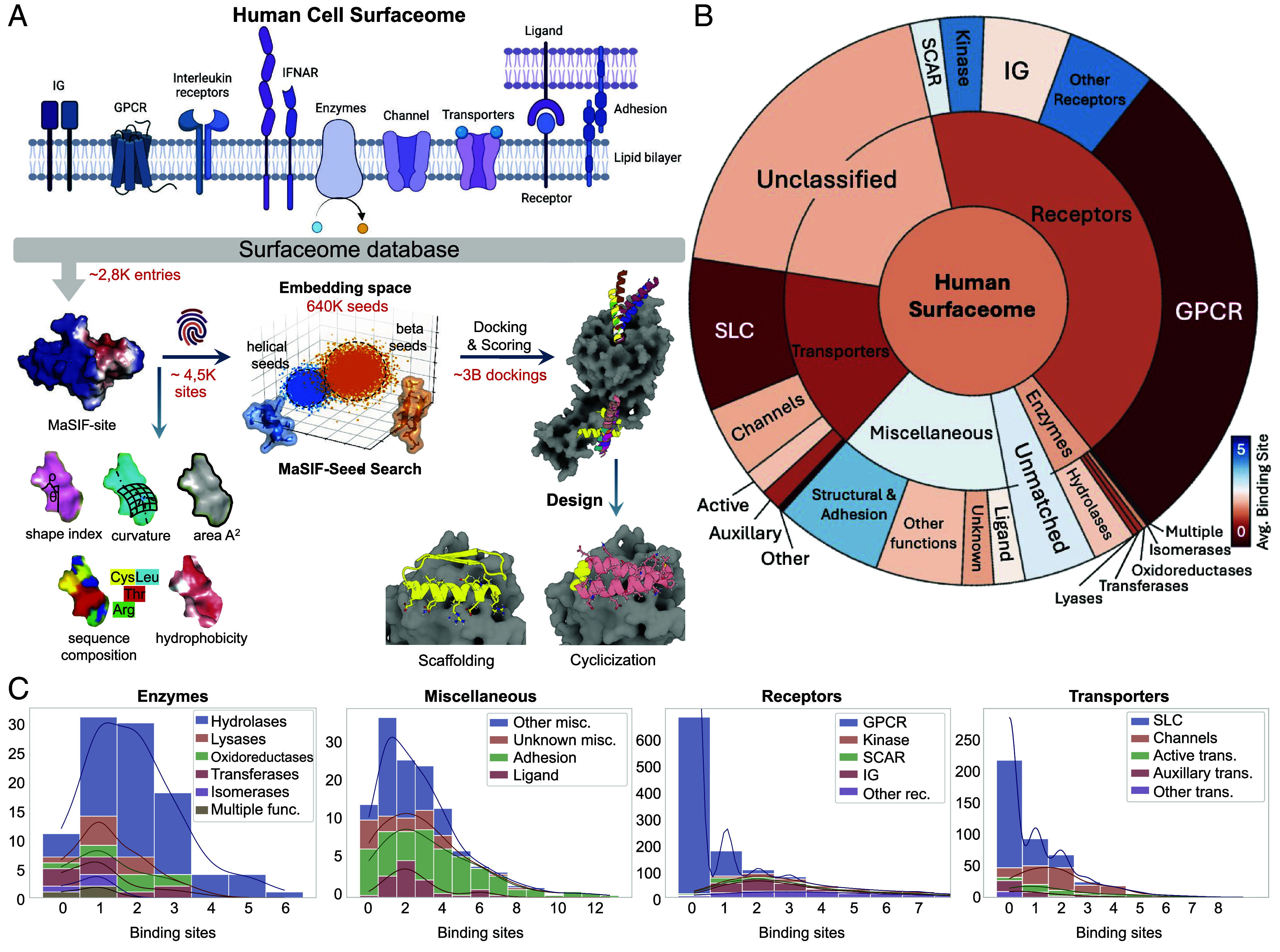
Fig. 1. Overview of computational workflow and targetable sites in the human surfaceome. (A) Schematic overview of the computational workflow. The Surfaceome structures were gathered from the SURFY database, comprising 2,886 entries (2) High propensity protein binding sites were predicted using MaSIF-site (13), resulting in a total of 4,500 binding sites. These binding sites were then targeted by a library of 640,000 protein fragments based on the MaSIF-seed algorithm (10) and followed by pairwise docking with the evaluation of around 3 billion interactions. Subsequently, two protein design approaches, including scaffolding and cyclic peptide design, were then applied on representative proteins to evaluate the quality of seeds under experimental settings. (B) Average predicted binding sites per family. Segment size corresponds to the number of proteins in each family, with GPCRs having the largest protein count but the fewest predicted binding sites, primarily located within the transmembrane (TM) domain. (C) Binding site frequency on the four main protein families. Each subfamily is shown in a different color. Miscellaneous and transporter main classes have several members with multiple predicted binding interfaces, where some members in adhesion proteins contain more than 12 binding interfaces.
Fig. 1. Overview of computational workflow and targetable sites in the human surfaceome. (A) Schematic overview of the computational workflow. The Surfaceome structures were gathered from the SURFY database, comprising 2,886 entries (2) High propensity protein binding sites were predicted using MaSIF-site (13), resulting in a total of 4,500 binding sites. These binding sites were then targeted by a library of 640,000 protein fragments based on the MaSIF-seed algorithm (10) and followed by pairwise docking with the evaluation of around 3 billion interactions. Subsequently, two protein design approaches, including scaffolding and cyclic peptide design, were then applied on representative proteins to evaluate the quality of seeds under experimental settings. (B) Average predicted binding sites per family. Segment size corresponds to the number of proteins in each family, with GPCRs having the largest protein count but the fewest predicted binding sites, primarily located within the transmembrane (TM) domain. (C) Binding site frequency on the four main protein families. Each subfamily is shown in a different color. Miscellaneous and transporter main classes have several members with multiple predicted binding interfaces, where some members in adhesion proteins contain more than 12 binding interfaces.CC BY-NC-ND · PubMed Central
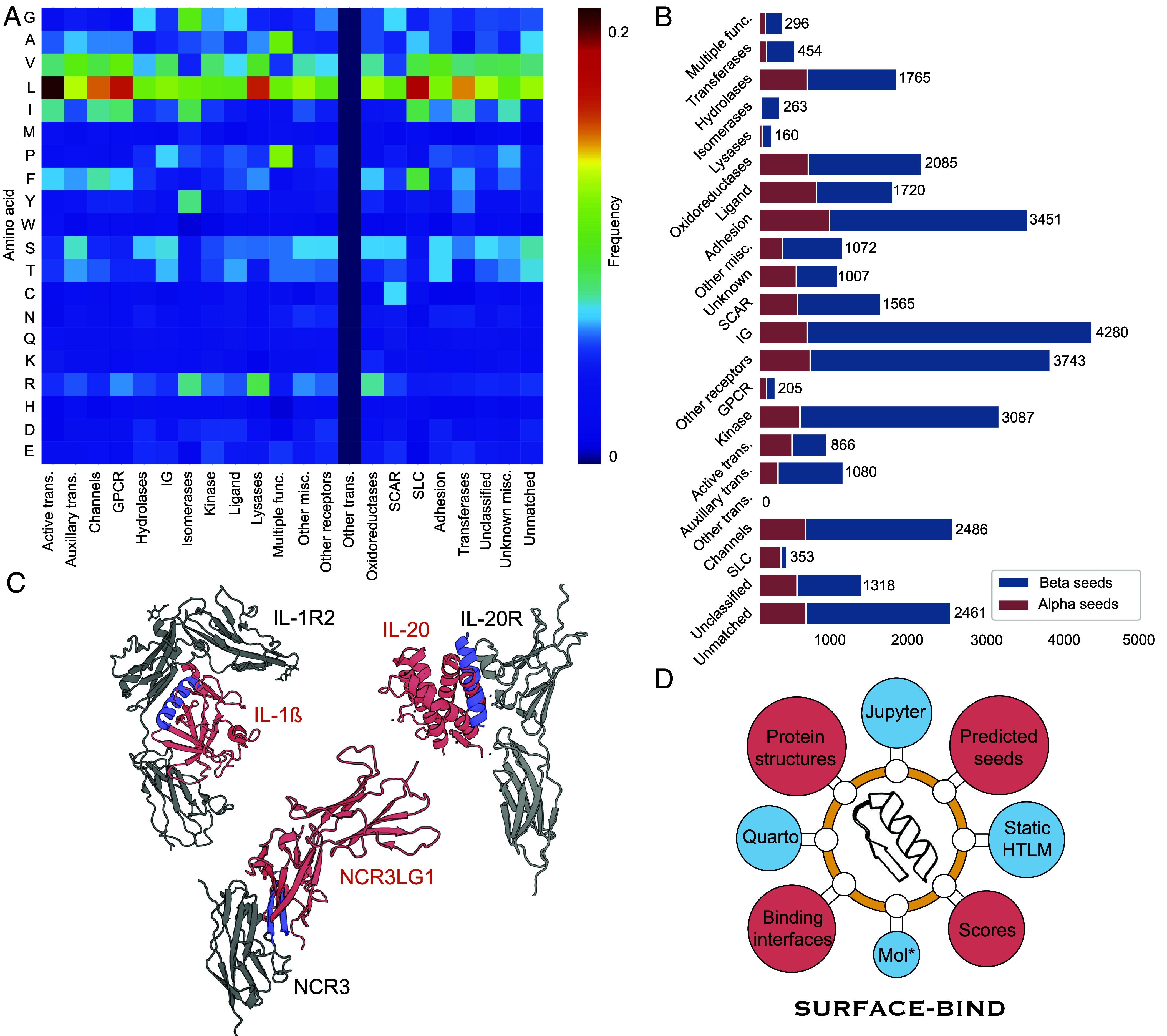
Fig. 2. Mapping of the targetable human surfaceome. (A) The amino acid frequency on the predicted binding sites for all subfamilies. Leucine is the most frequent amino acid found in the predicted binding sites across all main classes and specifically in the transporters family. Valine and serine are the second and third frequent amino acids, respectively. (B) Average number of alpha and beta seeds per subfamily. The number of detected alpha seeds is lower than the number of beta seeds, primarily due to the difference in the initial size of their databases. Although families with a higher number of binding sites obtained a higher number of seeds, the Ig subfamily showed a significant bind-ability to beta seeds. (C) Examples include entries with natural binders (gray and red) and detected inhibitory seeds (blue) that disrupt the interaction. (D) The SURFACE-Bind database provides the data openly available through static and interactive HTML pages.
Fig. 2. Mapping of the targetable human surfaceome. (A) The amino acid frequency on the predicted binding sites for all subfamilies. Leucine is the most frequent amino acid found in the predicted binding sites across all main classes and specifically in the transporters family. Valine and serine are the second and third frequent amino acids, respectively. (B) Average number of alpha and beta seeds per subfamily. The number of detected alpha seeds is lower than the number of beta seeds, primarily due to the difference in the initial size of their databases. Although families with a higher number of binding sites obtained a higher number of seeds, the Ig subfamily showed a significant bind-ability to beta seeds. (C) Examples include entries with natural binders (gray and red) and detected inhibitory seeds (blue) that disrupt the interaction. (D) The SURFACE-Bind database provides the data openly available through static and interactive HTML pages.CC BY-NC-ND · PubMed Central
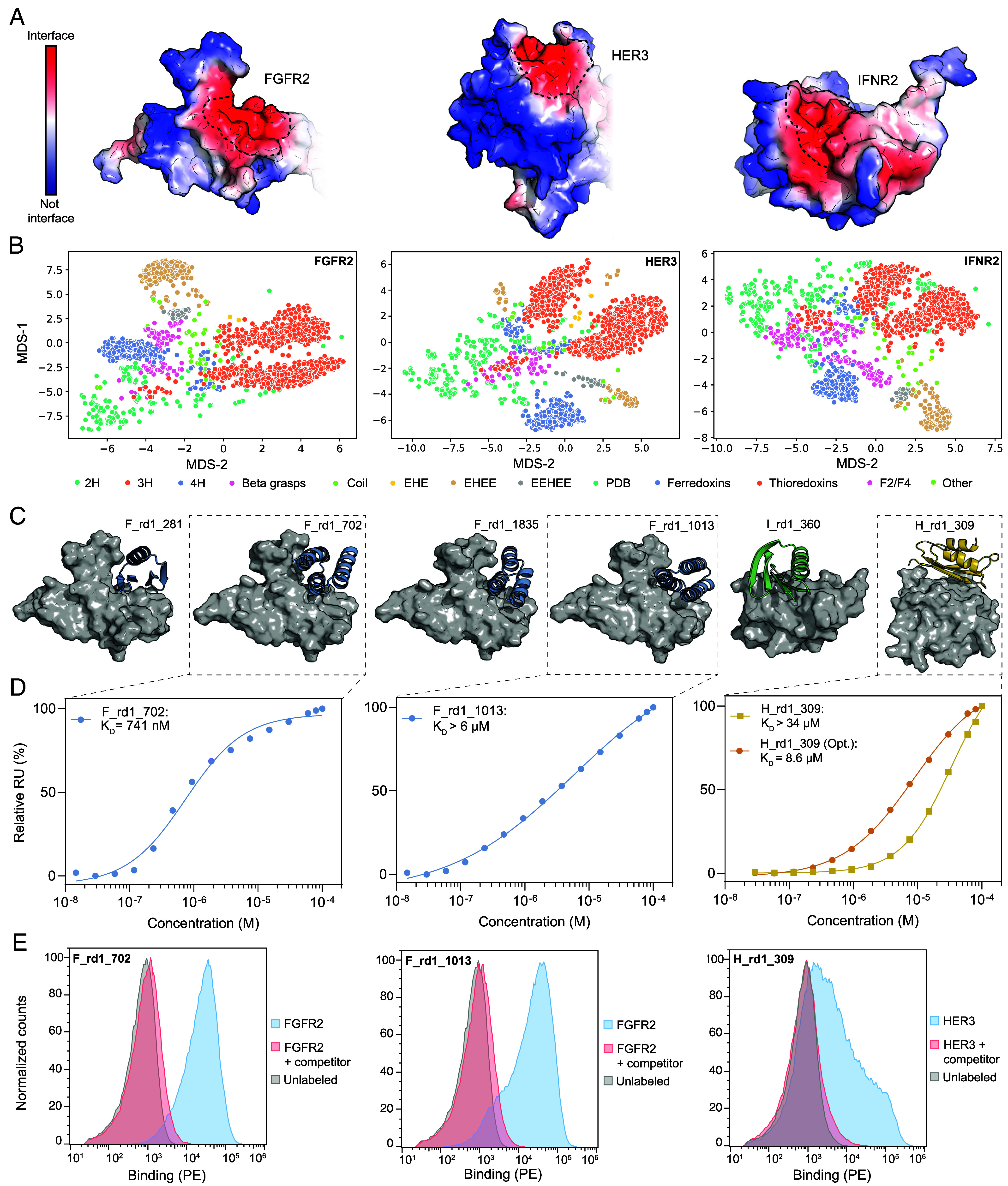
Fig. 3. Generation of de novo designed binders against surface receptors. (A) MaSIF-site interface predictions for the three protein targets. Red color indicates a high interface propensity, while blue color indicates a low propensity. (B) Fold diversity of the ~2,000 computational designs for the three target proteins mapped using multidimensional scaling (MDS) of pairwise rmsds between all designs. (C) Computational models of the six experimentally validated designs. Target proteins are shown in gray, and designs are colored in blue (FGFR2 binder), green (IFNAR2 binder), or yellow (HER3 binder). (D) Affinity measurements of three expressing binders performed by SPR. Steady state responses and dissociation constants were plotted using a nonlinear four-parameter curve fitting analysis. (E) Histograms of the binding signal (PE; phycoerythrin) measured by flow cytometry on yeast displaying designed binders. Yeast were labeled with their respective target protein in free form (blue) or preblocked with a competitor protein (red; 7NIJ for FGFR2 and RG7116 for HER3) or unlabeled (gray).
Fig. 3. Generation of de novo designed binders against surface receptors. (A) MaSIF-site interface predictions for the three protein targets. Red color indicates a high interface propensity, while blue color indicates a low propensity. (B) Fold diversity of the ~2,000 computational designs for the three target proteins mapped using multidimensional scaling (MDS) of pairwise rmsds between all designs. (C) Computational models of the six experimentally validated designs. Target proteins are shown in gray, and designs are colored in blue (FGFR2 binder), green (IFNAR2 binder), or yellow (HER3 binder). (D) Affinity measurements of three expressing binders performed by SPR. Steady state responses and dissociation constants were plotted using a nonlinear four-parameter curve fitting analysis. (E) Histograms of the binding signal (PE; phycoerythrin) measured by flow cytometry on yeast displaying designed binders. Yeast were labeled with their respective target protein in free form (blue) or preblocked with a competitor protein (red; 7NIJ for FGFR2 and RG7116 for HER3) or unlabeled (gray).CC BY-NC-ND · PubMed Central
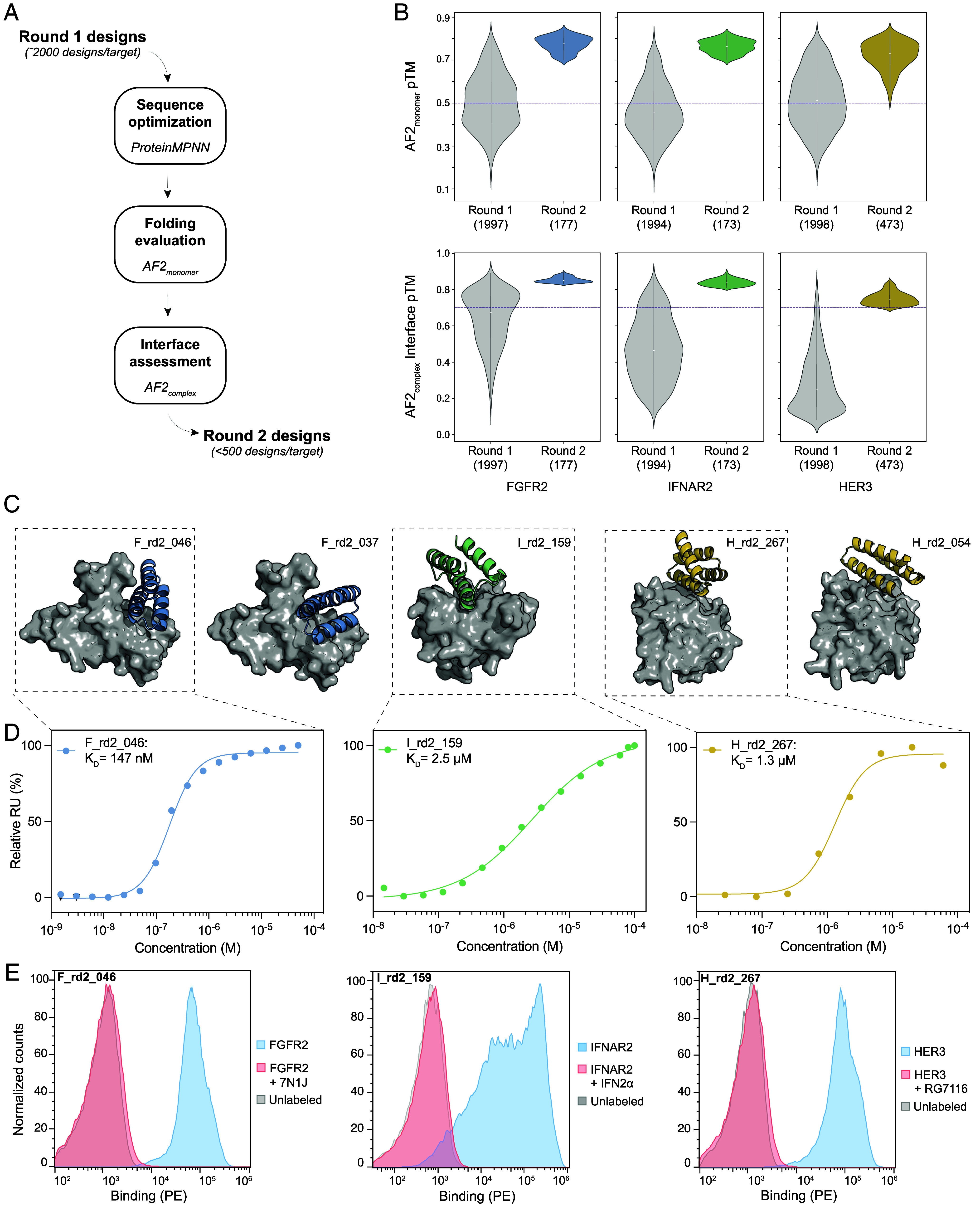
Fig. 4. Improved design pipeline and experimental characterization of optimized designs. (A) An enhanced computational pipeline including ProteinMPNN for interface design and/or scaffold optimization and AF2 for monomer folding and complex prediction (B) Comparison between designs before and after optimization for AF2 monomer predicted template modelling score (pTM) (Top, dashed line set at pTM = 0.5) and AF2 multimer ipTM (Bottom, dashed line set at ipTM = 0.7). (C) Computational models of five experimentally validated optimized designs. Target proteins are shown in gray and protein designs are colored in blue (FGFR2 binder), green (IFNAR2 binder), and yellow (HER3 binder). (D) Affinity measurements of three binders performed by SPR. Steady state responses and dissociation constants were plotted using a nonlinear four-parameter curve fitting analysis. (E) Histograms of the binding signal (PE, phycoerythrin) measured by flow cytometry on yeast displaying designed binders testing the binding specificity with competing reagents. Yeast were labeled with their respective target protein in free form (blue) or preblocked with a competitor protein (red) or unlabeled (gray).
Fig. 4. Improved design pipeline and experimental characterization of optimized designs. (A) An enhanced computational pipeline including ProteinMPNN for interface design and/or scaffold optimization and AF2 for monomer folding and complex prediction (B) Comparison between designs before and after optimization for AF2 monomer predicted template modelling score (pTM) (Top, dashed line set at pTM = 0.5) and AF2 multimer ipTM (Bottom, dashed line set at ipTM = 0.7). (C) Computational models of five experimentally validated optimized designs. Target proteins are shown in gray and protein designs are colored in blue (FGFR2 binder), green (IFNAR2 binder), and yellow (HER3 binder). (D) Affinity measurements of three binders performed by SPR. Steady state responses and dissociation constants were plotted using a nonlinear four-parameter curve fitting analysis. (E) Histograms of the binding signal (PE, phycoerythrin) measured by flow cytometry on yeast displaying designed binders testing the binding specificity with competing reagents. Yeast were labeled with their respective target protein in free form (blue) or preblocked with a competitor protein (red) or unlabeled (gray).CC BY-NC-ND · PubMed Central
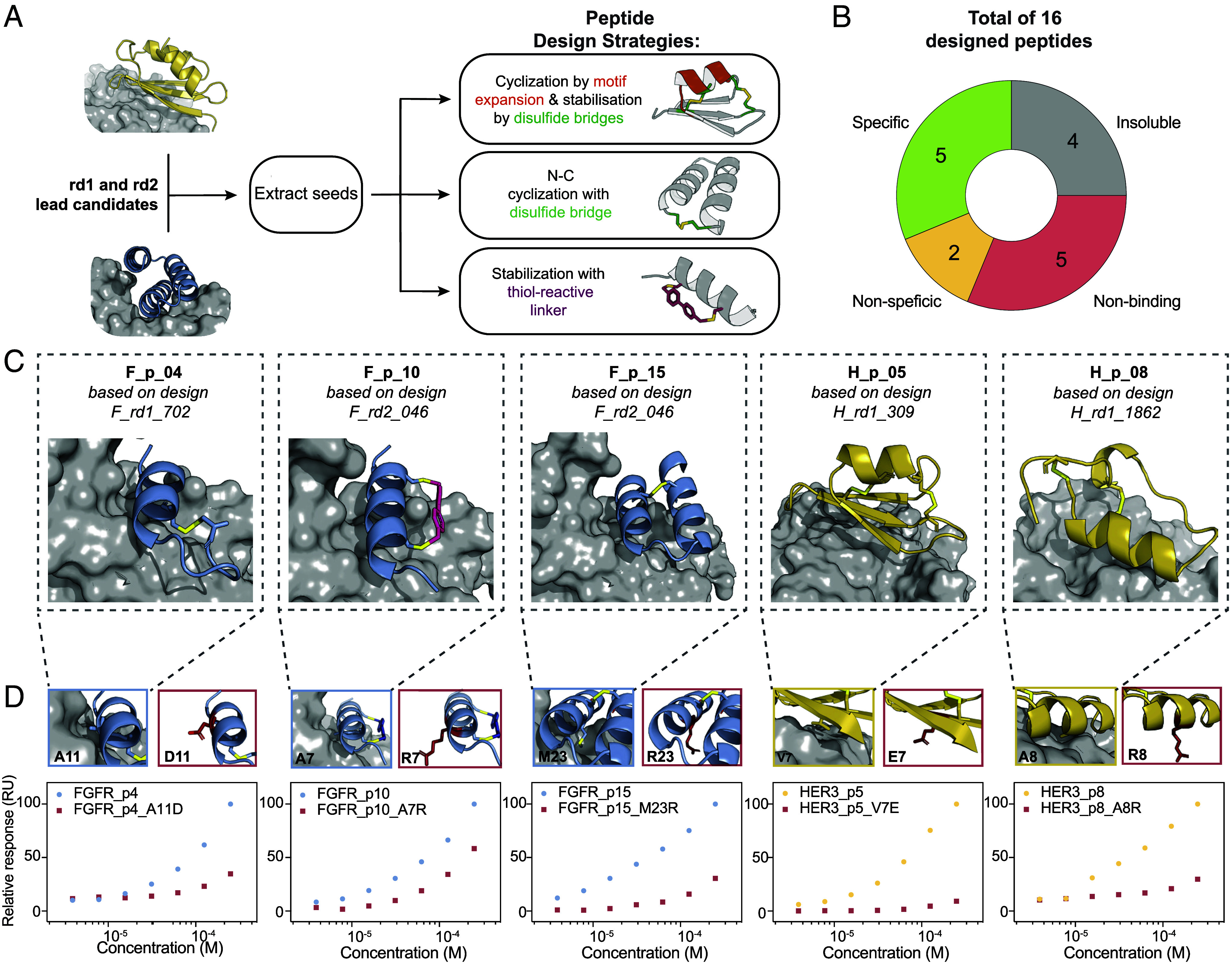
Fig. 5. Experimental characterization of stabilized peptides derived from de novo designed mini binders. (A) Overview of the employed peptide design strategies. The interface binding motifs from the experimentally validated rd1 and rd2 binders were extracted and used to design cyclized peptides. Three types of designs were generated, cyclic peptides with disulfides, peptides with a single disulfide, and peptides stabilized with thiol-reactive linkers. (B) Overview of properties of experimentally tested peptides. From a total of 16 synthesized peptides, four were insoluble, five did not show any binding to their target protein by SPR, four showed non target-specific binding, and five were target- and mode-specific binders. (C) Computational models of the five experimentally validated peptides targeting FGFR2 (blue) HER3 (yellow). (D) Affinity and specificity measurements of the five lead peptide candidates were performed using SPR. Maximum response at given concentrations is shown, highlighting specific peptide-target binding (FGFR2:blue, HER3:yellow) and their corresponding interface KO mutant (red), which exhibit reduced binding signal, thus demonstrating the peptides’ target specificity.
Fig. 5. Experimental characterization of stabilized peptides derived from de novo designed mini binders. (A) Overview of the employed peptide design strategies. The interface binding motifs from the experimentally validated rd1 and rd2 binders were extracted and used to design cyclized peptides. Three types of designs were generated, cyclic peptides with disulfides, peptides with a single disulfide, and peptides stabilized with thiol-reactive linkers. (B) Overview of properties of experimentally tested peptides. From a total of 16 synthesized peptides, four were insoluble, five did not show any binding to their target protein by SPR, four showed non target-specific binding, and five were target- and mode-specific binders. (C) Computational models of the five experimentally validated peptides targeting FGFR2 (blue) HER3 (yellow). (D) Affinity and specificity measurements of the five lead peptide candidates were performed using SPR. Maximum response at given concentrations is shown, highlighting specific peptide-target binding (FGFR2:blue, HER3:yellow) and their corresponding interface KO mutant (red), which exhibit reduced binding signal, thus demonstrating the peptides’ target specificity.CC BY-NC-ND · PubMed Central

Verification

Claims the paper makes

The claims and statistics of this paper haven’t been checked yet.

Run the check — free, no account needed. It reads the open-access text and checks the sources it cites.

A few free checks a day · papers already verified open instantly · results are public

Self-check

Percentages, sums and reported differences re-computed from the paper’s own numbers.

The self-check needs the paper’s full text.

Citations

Cites

Show all 7 references

Research works printed but not linked: 45

  1. 10.1016/j.cbpa.2018.09.020 · DOI
  2. 10.1073/pnas.1808790115 · DOI
  3. 10.1073/pnas.2102164118 · DOI
  4. 10.1038/s41573-022-00579-0 · DOI · Paper page
  5. 10.1038/s41586-022-04654-9 · DOI · Paper page
  6. 10.1016/j.cels.2023.10.006 · DOI
  7. 10.1038/s41467-023-38328-5 · DOI · Paper page
  8. 10.1038/s41586-023-05993-x · DOI
  9. 10.1038/s41592-019-0666-6 · DOI
  10. 10.1016/0022-2836(82)90515-0 · DOI
  11. 10.1016/j.cell.2010.06.011 · DOI · Paper page
  12. 10.1016/S1357-4310(00)01742-1 · DOI
  13. 10.1002/(SICI)1097-0185(199804)253:2<42::AID-AR7>3.0.CO;2-G · DOI
  14. 10.1093/nar/gkab1050 · DOI
  15. 10.1038/s41592-020-0848-2 · DOI · Paper page
  16. R. Evans Protein complex prediction with AlphaFold-Multimer. bioRxiv [Preprint] (2021). https://doi.org/10.1101/2021.10.04.463034. Accessed 1 April 2025. · DOI · Paper page
  17. 10.1021/jacs.3c10941 · DOI
  18. 10.1002/pro.4379 · DOI · Paper page
  19. S. A. Rettie Cyclic peptide structure prediction and design using AlphaFold2. Nat. Commun. 16 4730 (2025). · DOI
  20. M. Pacesa One-shot design of functional protein binders with BindCraft. Nature 646 483–492 (2025). · DOI
  21. 10.1038/s41586-023-06953-1 · DOI
  22. 10.1371/journal.pone.0020161 · DOI
  23. 10.1371/journal.pcbi.1008061 · DOI
  24. 10.1007/978-1-4939-3569-7_17 · DOI
  25. 10.1093/nar/28.1.235 · DOI · Paper page
  26. 10.1002/pro.4507 · DOI
  27. 10.1038/nature19791 · DOI
  28. 10.1038/s41467-022-34937-8 · DOI
  29. 10.1126/science.aan0693 · DOI · Paper page
  30. 10.1186/s12859-018-2367-z · DOI
  31. 10.1186/s12859-023-05345-6 · DOI
  32. 10.1038/s41586-024-07601-y · DOI
  33. 10.1038/s41592-022-01488-1 · DOI · Paper page
  34. 10.1126/science.adq1741 · DOI
  35. 10.1039/b502226f · DOI
  36. 10.1038/nprot.2006.94 · DOI
  37. 10.1021/acschembio.5b00963 · DOI
  38. 10.1126/science.aap7577 · DOI
  39. 10.1126/science.adk1687 · DOI
  40. 10.3390/ijms241713257 · DOI
  41. 10.1016/j.softx.2015.06.001 · DOI · Paper page
  42. 10.1021/acs.jpclett.6b00452 · DOI
  43. 10.1002/jcc.540130805 · DOI
  44. 10.1002/(SICI)1096-987X(199709)18:12<1463::AID-JCC4>3.0.CO;2-H · DOI
  45. 10.1063/1.328693 · DOI

Metadata

Authors
Balbi, P. E. M., Sadek, A., Marchand, A., Yu, T.-Y., Damjanovic, J., Georgeon, S., Schmidt, J., Fulle, S., Yang, C., Khakzad, H., & Correia, B. E.
Affiliations
  • École Polytechnique Fédérale de Lausanne (CH)
  • Novo Nordisk (Denmark) (DK)
  • Centre National de la Recherche Scientifique (FR)
Corresponding author
  • Balbi, Petra E. M.
  • Sadek, Ahmed
  • Marchand, Anthony
  • Yang, Che
  • Khakzad, Hamed
  • Correia, Bruno E.
Venue
Proceedings of the National Academy of Sciences
Published
2026-01-28
Volume
123
Issue
5
Pages
e2506269123-e2506269123
ISSN
  • 0027-8424 (ISSN-L)
  • 1091-6490
OpenAlex
W7125900310
Cited by
6
References
7
Citations by year
2026: 5
FWCI
10.22
Type
journal article
Language
en
Open access
Locations
  • Proceedings of the National Academy of Sciences (publishedVersion, cc-by-nc-nd)
  • bioRxiv (Cold Spring Harbor Laboratory) (acceptedVersion)
  • PubMed (publishedVersion)
  • PubMed Central (publishedVersion, cc-by-nc-nd)
  • Infoscience (Ecole Polytechnique Fédérale de Lausanne) (submittedVersion, cc-by-nc-nd)
Funders
  • National Center of Competence in Research in Molecular Systems Engineering (182895)
  • Swiss NSF (310030_197724)
  • French Agence Nationale de la Recherche (ANR-22-CPJ2-0075-01)
  • ERC Consolidator replacement (724228)
  • NovoSTAR program (538383)
Topics
  • Life Sciences › Biochemistry, Genetics and Molecular Biology › Molecular Biology › Protein Structure and Dynamics
  • Physical Sciences › Chemistry › Organic Chemistry › Chemical Synthesis and Analysis
  • Life Sciences › Biochemistry, Genetics and Molecular Biology › Molecular Biology › vaccines and immunoinformatics approaches
Keywords
protein scaffolding, peptide cyclization, FGFR2, IFNAR2, HER3, cell surface proteins, targeted therapeutics
MeSH terms
Binding Sites, Humans, Membrane Proteins, Protein Binding, Drug Design, Receptor, Fibroblast Growth Factor, Type 2

About these checks

Registry, retraction, Cites and statistics results are computed, not judged, with one exception: a printed reference that no index lists is read once by a model before it counts as a citation error. Claims are extracted by a model and kept only when their quote appears verbatim in the text; each cited source is then checked, with a model’s help, for whether it says what the claim relies on. Those verdicts can be wrong — read the claim’s quote and the cited source before relying on one.

Statistics and arithmetic are recomputed, not judged.

Confidence bands are shown only for fields calibrated on our annotated test set. None is calibrated yet, so no band is shown.

What counts as a claim ›How we measure confidence ›How we check this ›

Are you an author, or do you see a problem with this page? Request a review

How to cite

Cite CoChat for the checks on this page, and the paper for its own findings.

This page
CoChat. (2026). Citation check: Mapping targetable sites on the human surfaceome for the design of novel binders. https://app.cochat.ai/papers/10.1073/pnas.2506269123
The paper
Balbi, P. E. M., Sadek, A., Marchand, A., Yu, T.-Y., Damjanovic, J., Georgeon, S., Schmidt, J., Fulle, S., Yang, C., Khakzad, H., & Correia, B. E. (2026). Mapping targetable sites on the human surfaceome for the design of novel binders. Proceedings of the National Academy of Sciences. https://doi.org/10.1073/pnas.2506269123