

Arginine Conversion to Nitroxide by Tetrahydrobiopterin-free Neuronal Nitric-oxide Synthase
Open accessThe DOI matches its Crossref record; 46 of the 46 references it cites were found in a registry or an index.
Abstract
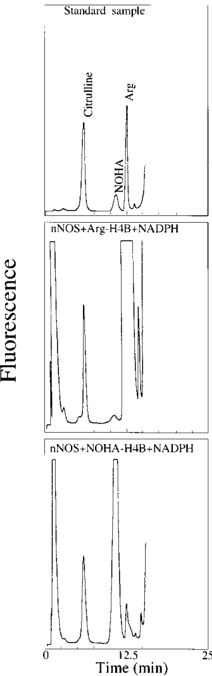
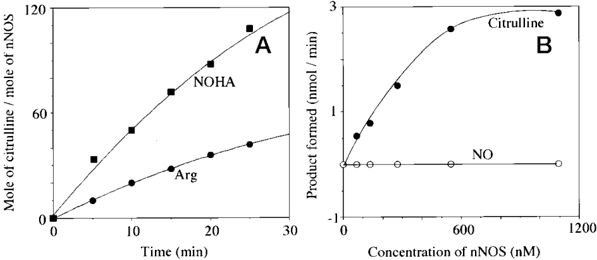
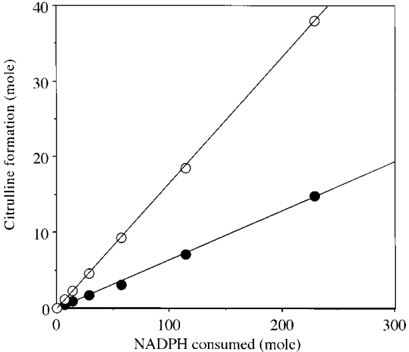
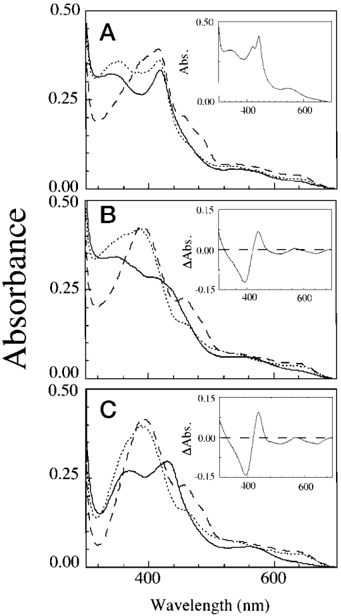
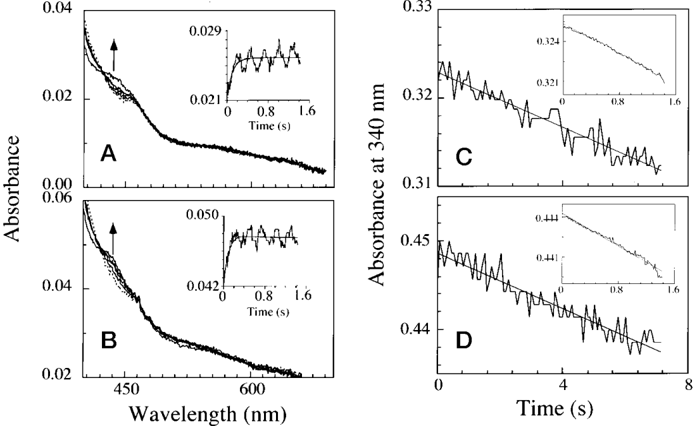
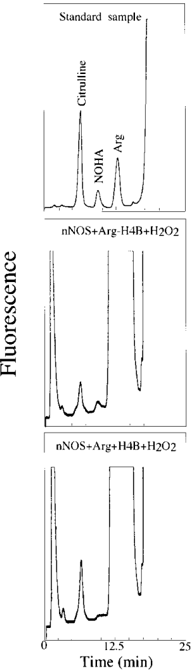
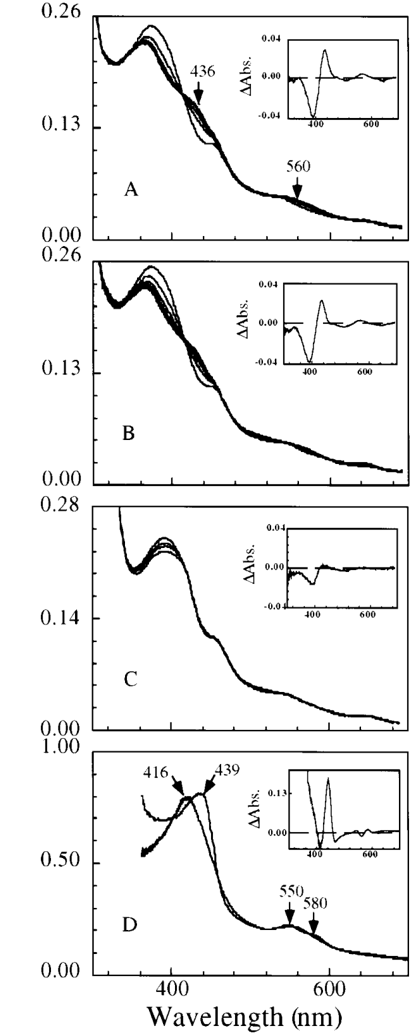
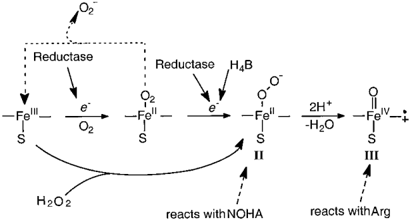
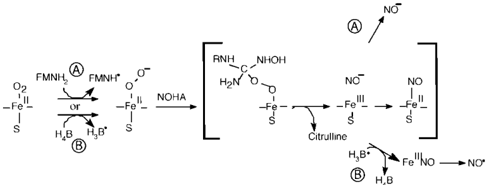
We studied catalysis by tetrahydrobiopterin (H4B)-free neuronal nitric-oxide synthase (nNOS) to understand how heme and H4B participate in nitric oxide (NO) synthesis. H4B-free nNOS catalyzed Arg oxidation to N(omega)-hydroxy-l-Arg (NOHA) and citrulline in both NADPH- and H(2)O(2)-driven reactions. Citrulline formation was time- and enzyme concentration-dependent but was uncoupled relative to NADPH oxidation, and generated nitrite and nitrate without forming NO. Similar results were observed when NOHA served as substrate. Steady-state and stopped-flow spectroscopy with the H4B-free enzyme revealed that a ferrous heme-NO complex built up after initiating catalysis in both NADPH- and H(2)O(2)-driven reactions, consistent with formation of nitroxyl as an immediate product. This differed from the H4B-replete enzyme, which formed a ferric heme-NO complex as an immediate product that could then release NO. We make the following conclusions. 1) H4B is not essential for Arg oxidation by nNOS, although it helps couple NADPH oxidation to product formation in both steps of NO synthesis. Thus, the NADPH- or H(2)O(2)-driven reactions form common heme-oxy species that can react with substrate in the presence or absence of H4B. 2) The sole essential role of H4B is to enable nNOS to generate NO instead of nitroxyl. On this basis we propose a new unified model for heme-dependent oxygen activation and H4B function in both steps of NO synthesis.
Overview
The claims and statistics of this paper haven’t been checked yet.
Free: it reads the open-access text and checks the first 5 claims that cite a source we can check. Create a free account to check every claim.
Integrity signals
Registry
Cites
Statistics
Figures
Verification
Claims the paper makes
The claims and statistics of this paper haven’t been checked yet.
Free: it reads the open-access text and checks the first 5 claims that cite a source we can check. Create a free account to check every claim.
Claims other papers make about this one
Each is checked against this paper’s own text: does it say what the citing paper says it does?
The cited source says what the claim attributes to it.
In the citing paper
“NOS itself has been suggested to produce HNO under hypoxic or low cofactor conditions or by oxidative degradation of the intermediate Nω-hydroxy-L-arginine [92, 93, 181-187].”
From Signaling and stress: The redox landscape in NOS2 biology (2015) · cites this paper as [93]
In the citing paper
“In addition, limited cofactor levels can lead to production of species other than NO (e.g., O2− or HNO) [92-94].”
From Signaling and stress: The redox landscape in NOS2 biology (2015) · cites this paper as [93]
Self-check
Percentages, sums and reported differences re-computed from the paper’s own numbers.
The self-check needs the paper’s full text.
Citations
Cites
NITRIC OXIDE AND MACROPHAGE FUNCTION
MacMicking, J., Xie, Q.-W., & Nathan, C. (1997) · Annual Review of Immunology · doi:10.1146/annurev.immunol.15.1.323 · Cited by 4,211
Cytochrome P-450: Structure, Mechanism, and Biochemistry
de Montellano, O., & Paul, R. (1986) · Medical Entomology and Zoology · Cited by 2,663
Cytochrome P450: Structure, mechanism, and biochemistry
Pryor, W. A. (1996) · Free Radical Biology and Medicine · doi:10.1016/0891-5849(96)83807-x · Cited by 1,598 · cited 1×
“occurs in the cytochrome P450 monooxygenases (14).”
Nitric Oxide Synthases: Properties and Catalytic Mechanism
Griffith, O. W., & Stuehr, D. J. (1995) · Annual Review of Physiology · doi:10.1146/annurev.ph.57.030195.003423 · Cited by 1,311
Self-citationNitric oxide synthases: which, where, how, and why?
Michel, T., & Feron, O. (1997) · Journal of Clinical Investigation · doi:10.1172/jci119750 · Cited by 1,011
Mammalian nitric oxide synthases
Stuehr, D. J. (1999) · Biochimica et Biophysica Acta (BBA) - Bioenergetics · doi:10.1016/s0005-2728(99)00016-x · Cited by 996
Self-citationInducible nitric oxide synthase: what difference does it make?
Nathan, C. (1997) · Journal of Clinical Investigation · doi:10.1172/jci119782 · Cited by 943
Methods in nitric oxide research
Feelisch, M., & Stamler, J. S. (1996) · ePrints Soton (University of Southampton) · Cited by 828
Structure of Nitric Oxide Synthase Oxygenase Dimer with Pterin and Substrate
Crane, B. R., Arvai, A. S., Ghosh, D. K., Wu, C., Getzoff, E. D., Stuehr, D. J., & Tainer, J. A. (1998) · Science · doi:10.1126/science.279.5359.2121 · Cited by 668
Self-citationCrystal Structure of Constitutive Endothelial Nitric Oxide Synthase
Raman, C. S., Li, H., Martásek, P., Král, V., Masters, B. S. S., & Poulos, T. L. (1998) · Cell · doi:10.1016/s0092-8674(00)81718-3 · Cited by 621
Research works printed but not linked: 1
- Kaufman, S. (1993) Adv. Enzymol. Relat. Areas Mol. Biol. 67, 77-264
Cited by
Nitric oxide signalling in cardiovascular health and disease
Farah, C., Michel, L. Y. M., & Balligand, J.-L. (2018) · Nature Reviews Cardiology · doi:10.1038/nrcardio.2017.224 · Cited by 779
Chronic Glutamate Toxicity in Neurodegenerative Diseases—What is the Evidence?
Lewerenz, J., & Maher, P. (2015) · Frontiers in Neuroscience · doi:10.3389/fnins.2015.00469 · Cited by 718
“Different mechanisms through which astrocytes can release L-glu have been proposed: vesicular L-glu release (Adak et al., 2000) and non-vesicular release via anion channels (Wang et al., 2013) and connexin hemichannels (Stehberg et al., 2012) as well as release via the cystine/glutamate antiporter…”
BackgroundChemical basis of inflammation-induced carcinogenesis
Ohshima, H., Tatemichi, M., & Sawa, T. (2003) · Archives of Biochemistry and Biophysics · doi:10.1016/s0003-9861(03)00283-2 · Cited by 620
Update on Mechanism and Catalytic Regulation in the NO Synthases
Stuehr, D. J., Santolini, J., Wang, Z.-Q., Wei, C.-C., & Adak, S. (2004) · Journal of Biological Chemistry · doi:10.1074/jbc.r400017200 · Cited by 518
Self-citationNitric Oxide and the Vascular Endothelium
Moncada, S., & Higgs, E. A. (2006) · Handbook of Experimental Pharmacology · doi:10.1007/3-540-32967-6_7 · Cited by 408
Metadata
- Authors
- Adak, S., Wang, Q., & Stuehr, D. J.
- Affiliations
- Cleveland Clinic (US)
- Venue
- Journal of Biological Chemistry
- Publisher
- Elsevier BV
- Published
- 2000-10
- Volume
- 275
- Issue
- 43
- Pages
- 33554-33561
- ISSN
- 0021-9258 (ISSN-L)
- OpenAlex
- W2052232788
- Cited by
- 229
- References
- 46
- Citations by year
- 2026: 2 · 2025: 2 · 2024: 3 · 2023: 5 · 2022: 1 · 2021: 5 · 2020: 6 · 2019: 4 · 2018: 8 · 2017: 2 · 2016: 15 · 2015: 12 · 2014: 4 · 2013: 7 · 2012: 10
- FWCI
- 9.79
- Type
- journal article
- Language
- en
- Open access
- hybrid
- doi.org
- Licence
- cc-by
- www.elsevier.com/tdm/userlicense/1.0/ (tdm)
- creativecommons.org/licenses/by/4.0/ (vor, 7306 d)
- Locations
- Journal of Biological Chemistry (publishedVersion, cc-by)
- PubMed (publishedVersion)
- Funders
- National Institutes of Health
- National Institute of General Medical Sciences (GM51491, R01GM051491)
- Topics
- Health Sciences › Medicine › Physiology (medical) › Nitric Oxide and Endothelin Effects
- Physical Sciences › Chemistry › Inorganic Chemistry › Metal-Catalyzed Oxygenation Mechanisms
- Life Sciences › Biochemistry, Genetics and Molecular Biology › Biochemistry › Hemoglobin structure and function
- Keywords
- neuronal nitric oxide synthase, tetrahydrobiopterin, nitric oxide production, arginine oxidation, citrulline, nitroxyl, nitrite and nitrate formation, enzyme mechanism
- MeSH terms
- Arginine, Biopterins, Catalysis, Citrulline, Heme, Hydrogen Peroxide, NADP, Nitric Oxide, Oxidation-Reduction, Nitric Oxide Synthase, Nitric Oxide Synthase Type I
About these checks
Registry, retraction, Cites and statistics results are computed, not judged, with one exception: a printed reference that no index lists is read once by a model before it counts as a citation error. Claims are extracted by a model and kept only when their quote appears verbatim in the text; each cited source is then checked, with a model’s help, for whether it says what the claim relies on. Those verdicts can be wrong — read the claim’s quote and the cited source before relying on one.
Statistics and arithmetic are recomputed, not judged.
Confidence bands are shown only for fields calibrated on our annotated test set. None is calibrated yet, so no band is shown.
What counts as a claim ›How we measure confidence ›How we check this ›
Are you an author, or do you see a problem with this page? Request a review
How to cite
Cite CoChat for the checks on this page, and the paper for its own findings.
- This page
- CoChat. (2026). Citation check: Arginine Conversion to Nitroxide by Tetrahydrobiopterin-free Neuronal Nitric-oxide Synthase. https://app.cochat.ai/papers/10.1074/jbc.m004337200
- The paper
- Adak, S., Wang, Q., & Stuehr, D. J. (2000). Arginine Conversion to Nitroxide by Tetrahydrobiopterin-free Neuronal Nitric-oxide Synthase. Journal of Biological Chemistry. https://doi.org/10.1074/jbc.m004337200
Data sources
Bibliographic data: Semantic Scholar, OpenAlex, Crossref.
Contains information from the Semantic Scholar Academic Graph Datasets, made available under the ODC Attribution License (ODC-BY 1.0).
Semantic Scholar’s data is described in: Kinney, R., et al. (2023). The Semantic Scholar Open Data Platform. arXiv:2301.10140.
