

Arginine Conversion to Nitroxide by Tetrahydrobiopterin-free Neuronal Nitric-oxide Synthase
Open accessThe DOI matches its Crossref record; 46 of the 46 references it cites were found in a registry or an index.
Abstract
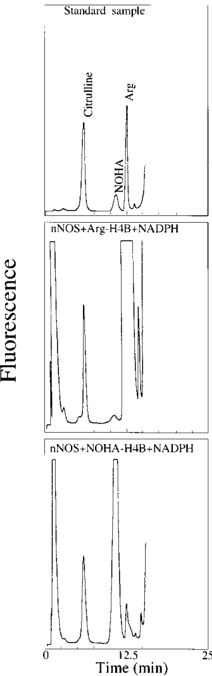
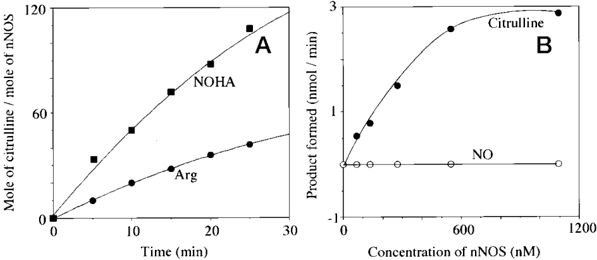
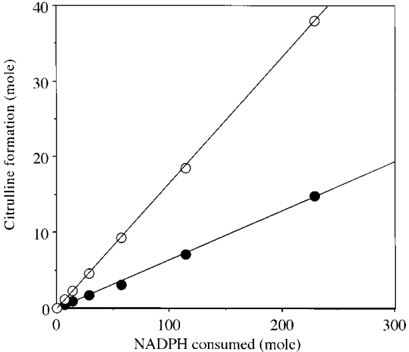
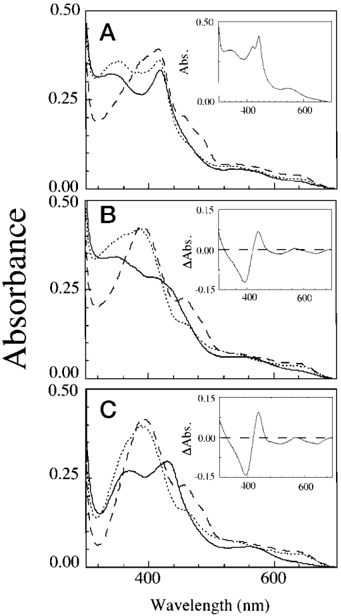
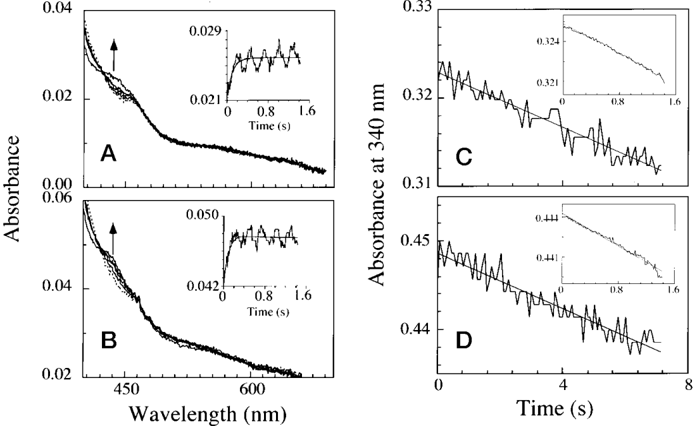
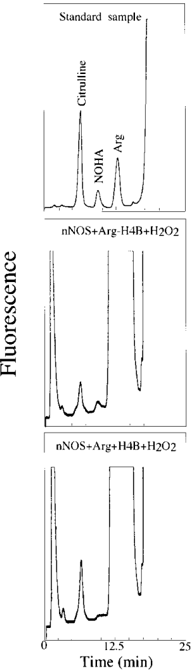
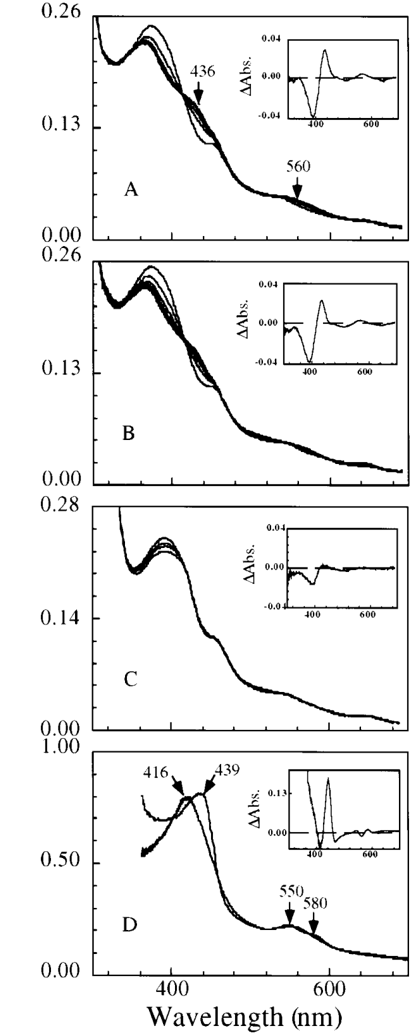
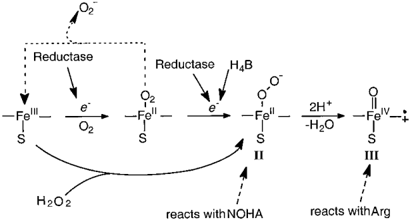
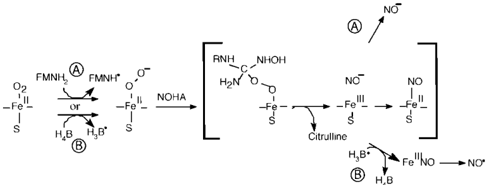
We studied catalysis by tetrahydrobiopterin (H4B)-free neuronal nitric-oxide synthase (nNOS) to understand how heme and H4B participate in nitric oxide (NO) synthesis. H4B-free nNOS catalyzed Arg oxidation to N(omega)-hydroxy-l-Arg (NOHA) and citrulline in both NADPH- and H(2)O(2)-driven reactions. Citrulline formation was time- and enzyme concentration-dependent but was uncoupled relative to NADPH oxidation, and generated nitrite and nitrate without forming NO. Similar results were observed when NOHA served as substrate. Steady-state and stopped-flow spectroscopy with the H4B-free enzyme revealed that a ferrous heme-NO complex built up after initiating catalysis in both NADPH- and H(2)O(2)-driven reactions, consistent with formation of nitroxyl as an immediate product. This differed from the H4B-replete enzyme, which formed a ferric heme-NO complex as an immediate product that could then release NO. We make the following conclusions. 1) H4B is not essential for Arg oxidation by nNOS, although it helps couple NADPH oxidation to product formation in both steps of NO synthesis. Thus, the NADPH- or H(2)O(2)-driven reactions form common heme-oxy species that can react with substrate in the presence or absence of H4B. 2) The sole essential role of H4B is to enable nNOS to generate NO instead of nitroxyl. On this basis we propose a new unified model for heme-dependent oxygen activation and H4B function in both steps of NO synthesis.
Overview
The claims and statistics of this paper haven’t been checked yet.
Free: it reads the open-access text and checks the first 5 claims that cite a source we can check. Create a free account to check every claim.
Integrity signals
Registry
Cites
Statistics
Figures
Verification
Claims the paper makes
The claims and statistics of this paper haven’t been checked yet.
Free: it reads the open-access text and checks the first 5 claims that cite a source we can check. Create a free account to check every claim.
Claims other papers make about this one
Each is checked against this paper’s own text: does it say what the citing paper says it does?
The cited source says what the claim attributes to it.
In the citing paper
“NOS itself has been suggested to produce HNO under hypoxic or low cofactor conditions or by oxidative degradation of the intermediate Nω-hydroxy-L-arginine [92, 93, 181-187].”
From Signaling and stress: The redox landscape in NOS2 biology (2015) · cites this paper as [93]
In the citing paper
“In addition, limited cofactor levels can lead to production of species other than NO (e.g., O2− or HNO) [92-94].”
From Signaling and stress: The redox landscape in NOS2 biology (2015) · cites this paper as [93]
Self-check
Percentages, sums and reported differences re-computed from the paper’s own numbers.
The self-check needs the paper’s full text.
Citations
Cites
NITRIC OXIDE AND MACROPHAGE FUNCTION
MacMicking, J., Xie, Q.-W., & Nathan, C. (1997) · Annual Review of Immunology · doi:10.1146/annurev.immunol.15.1.323 · Cited by 4,211
Cytochrome P-450: Structure, Mechanism, and Biochemistry
de Montellano, O., & Paul, R. (1986) · Medical Entomology and Zoology · Cited by 2,663
Cytochrome P450: Structure, mechanism, and biochemistry
Pryor, W. A. (1996) · Free Radical Biology and Medicine · doi:10.1016/0891-5849(96)83807-x · Cited by 1,598 · cited 1×
“occurs in the cytochrome P450 monooxygenases (14).”
Nitric Oxide Synthases: Properties and Catalytic Mechanism
Griffith, O. W., & Stuehr, D. J. (1995) · Annual Review of Physiology · doi:10.1146/annurev.ph.57.030195.003423 · Cited by 1,311
Self-citationNitric oxide synthases: which, where, how, and why?
Michel, T., & Feron, O. (1997) · Journal of Clinical Investigation · doi:10.1172/jci119750 · Cited by 1,011
Mammalian nitric oxide synthases
Stuehr, D. J. (1999) · Biochimica et Biophysica Acta (BBA) - Bioenergetics · doi:10.1016/s0005-2728(99)00016-x · Cited by 996
Self-citationInducible nitric oxide synthase: what difference does it make?
Nathan, C. (1997) · Journal of Clinical Investigation · doi:10.1172/jci119782 · Cited by 943
Methods in nitric oxide research
Feelisch, M., & Stamler, J. S. (1996) · ePrints Soton (University of Southampton) · Cited by 828
Structure of Nitric Oxide Synthase Oxygenase Dimer with Pterin and Substrate
Crane, B. R., Arvai, A. S., Ghosh, D. K., Wu, C., Getzoff, E. D., Stuehr, D. J., & Tainer, J. A. (1998) · Science · doi:10.1126/science.279.5359.2121 · Cited by 668
Self-citationCrystal Structure of Constitutive Endothelial Nitric Oxide Synthase
Raman, C. S., Li, H., Martásek, P., Král, V., Masters, B. S. S., & Poulos, T. L. (1998) · Cell · doi:10.1016/s0092-8674(00)81718-3 · Cited by 621
Research works printed but not linked: 1
- Kaufman, S. (1993) Adv. Enzymol. Relat. Areas Mol. Biol. 67, 77-264
Cited by
Items 201–232 of 232
Altawallbeh, G., Haque, M. M., Streletzky, K. A., Stuehr, D. J., & Bayachou, M. (2017) · Biochemical and Biophysical Research Communications · doi:10.1016/j.bbrc.2017.09.131 · Cited by 3
“To measure eNOSoxy enzymatic activity, we used the catalytic conversion of Nhydroxyarginine (NOHA) in the presence of hydrogen peroxide and other ingredients of NOSoxy activity [31].”
MethodSelf-citationQuantification of intracellular HNO delivery with capillary zone electrophoresis
Amarakoon, T. N., Ke, N., Aspinwall, C. A., & Miranda, K. M. (2021) · Nitric Oxide · doi:10.1016/j.niox.2021.10.005 · Cited by 3
Choi, H. J., Kim, S. W., Im, J., Lee, S.-G., Kim, M., & Hwang, O. (2003) · Neuroscience Letters · doi:10.1016/j.neulet.2003.08.032 · Cited by 3
Statistical models in protein structural alignments
Fofanov, V. Y. (2008) · Rice Research Repository (Rice University) · Cited by 3
Zeng, Y., Owens, P., Xia, Z., Santos, P. C. D., & King, S. B. (2025) · Redox Biology · doi:10.1016/j.redox.2025.103915 · Cited by 2
“Unlike NO, clear endogenous biological pathways for HNO formation have not been described, but nitric oxide synthase (NOS)-catalyzed reactions [38], oxidation of hydroxylamine derivatives, and the direct reaction of RSNO with nucleophiles have been proposed [17,39].”
Shi, J., Li, P., Bu, Y., Wang, W., Mou, Z., & Song, R. (2008) · International Journal of Quantum Chemistry · doi:10.1002/qua.21634 · Cited by 3
Sengupta, R., Sahoo, R., Ray, S. S., Dutta, T., Dasgupta, A. K., & Ghosh, S. (2006) · Molecular and Cellular Biochemistry · doi:10.1007/s11010-005-9027-0 · Cited by 2
“H2O2 Dependent L-arginine oxidation to nitrite was assayed in 96 well micro plates at 25 ◦C as described previously [39, 40].”
MethodTriggle, C. R., Ding, H., Ng, E. S. M., & Ellis, A. (2004) · Humana Press eBooks · doi:10.1007/978-1-59259-806-9_3 · Cited by 1
Comments on Contemporary Methods of Oxygen and Nitrogen Free Radical Detection
(2005) · CRC Press eBooks · doi:10.1201/9781420030853.pt3 · Cited by 1
Geometry-based methods for protein function prediction
Chen, B. Y. (2006) · Rice Research Repository (Rice University) · Cited by 1
Endothelial TRPV4 Dysfunction in a Streptozotocin-Diabetic Rat Model
Shamsaldeen, Y. A. (2017) · University of Hertfordshire Research Archive (University of Hertfordshire) · doi:10.18745/th.17622 · Cited by 1
“This coupled oxidation reaction occurs in the presence of other cofactors, including flavin adenine dinucleotide (FAD), flavin mononucleotide (FMN), tetrahydrobiopterin (BH4) and calmodulin (Adak et al., 2000).”
BackgroundCarvalho, E. M. (2020) · theses.fr (ABES) · doi:10.70675/4c867763z1789z4c11z88f5ze8355c16a639 · Cited by 2
Espey, M. G. (2003) · Handbook of experimental pharmacology · doi:10.1007/978-3-642-55742-2_13
Nitric Oxide Regulation in Redox Signaling
Vitturi, D. A., Krzywanski, D. M., Postlethwait, E. M., & Patel, R. P. (2009) · Wiley eBooks · doi:10.1002/9783527627585.ch12
Red Wine Polyphenols and Vascular Function
Botden, I. P. G. (2012) · RePub (Erasmus University Rotterdam)
Mansuy, D., & Lafite, P. (2007) · Journal of Porphyrins and Phthalocyanines · doi:10.1142/s108842460700031x
Mechanisms underlying the endothelium-dependent modulation of vascular tone
Iarova, P. L. (2011) · The University of Bath Online Publications Store (The University of Bath)
Knott, M. E., Dorfman, D., Chianelli, M. S., & Sáenz, D. A. (2012) · Neurochemistry International · doi:10.1016/j.neuint.2012.04.001
“Moreover, several authors have suggested that NOS produces nitroxyl rather than NO under certain conditions, particularly at low cofactor concentrations (Adak et al., 2000; Schmidt et al., 1996; Woodward et al., 2010), although this hypothesis has been challenged (Xia and Zweier, 1997).”
Plasmodium-Induced Nitrosative Stress in Anopheles stephensi: The Cost of Host Defense
Marie, T., & Peterson, L. (2005) · VTechWorks (Virginia Tech)
Efeito relaxante do doador de nitroxil (sal de Angeli) em veia cava de ratos
Zuchi, F. C. (2015) · Digital Library of Theses and Dissertations (Universidade de São Paulo) · doi:10.11606/d.60.2015.tde-25092015-150311
Role of NOS-like proteins found in bacteria
Dupont, A. L. (2006) · UWSpace (University of Waterloo) · Cited by 1
Miao, Z. (2016) · WakeSpace Scholarship (Wake Forest University)
Caractérisation structurale et fonctionnelle d'oxyde nitrique synthases bactériennes
Chartier, F. J.-M. (2007)
NO and the Vasculature: Where Does It Come from and What Does It Do?
Andrews, K. L., Triggle, C. R., & Ellis, A. (2006) · Kluwer Academic Publishers eBooks · doi:10.1007/1-4020-7960-5_2
Nitric oxide resistance in type 2 diabetes: Potential implications of HNO donors
Bahadoran, Z., Mirmiran, P., Kashfi, K., & Ghasemi, A. (2023) · Elsevier eBooks · doi:10.1016/b978-0-443-13342-8.00018-1
Research on the source of nitric acid and its detection and medical application
Liu, S., Gong, X., Zhu, T., Yan, S., Qin, M., Chen, X., & Chen, H. (2025) · Scientia Sinica Chimica · doi:10.1360/ssc-2024-0293
Wang, Z.-Q., Xu, K., Huang, S. D., Abeysirigunawardena, S. C., & Stuehr, D. J. (2026) · Journal of Inorganic Biochemistry · doi:10.1016/j.jinorgbio.2026.113297 · Cited by 1
Self-citationEtude du mécanisme d’activation de l’oxygène par les NO-Synthases
Brunel, A. (2012) · theses.fr (ABES) · doi:10.70675/45d61edbz36e0z45baz874bz16d19cb05432 · Cited by 2
“L’ensemble des résultats de cette partie est en cohérence avec ceux obtenus avec d’autres mutants de NOS bactérienne : saNOS [167, 219] mais aussi de NOS de mammifères : eNOS [167], nNOS [146, 165, 196] et iNOS [166].”
BackgroundInfluentialMécanisme moléculaire des NO-synthases bactériennes
Weisslocker-Schaetzel, M. (2016) · theses.fr (ABES) · doi:10.70675/c93b36b5z82f5z40d3z8064z40d8bc19457b
•NO/HNO interconversion in inorganic systems by the action of biologically relevant sulfur compounds
Vargas, P. (2025) · Repositorio Digital Institucional de la Universidad de Buenos Aires (Universidad de Buenos Aires)
Endogenous nitroxyl (HNO)-activated fluorescent probe for selective labeling of cancer cells
Biswas, S., Zhang, L., Athul, K. K., Zhou, Y., & Bhuniya, S. (2026) · Journal of Photochemistry and Photobiology A Chemistry · doi:10.1016/j.jphotochem.2026.117477 · Cited by 1
BindingDB Entry 50037411: L-arginine analogs as alternate substrates for nitric oxide synthase.
BindingDB (2012) · UC San Diego · doi:10.7270/q2v69kbc
Metadata
- Authors
- Adak, S., Wang, Q., & Stuehr, D. J.
- Affiliations
- Cleveland Clinic (US)
- Venue
- Journal of Biological Chemistry
- Publisher
- Elsevier BV
- Published
- 2000-10
- Volume
- 275
- Issue
- 43
- Pages
- 33554-33561
- ISSN
- 0021-9258 (ISSN-L)
- OpenAlex
- W2052232788
- Cited by
- 229
- References
- 46
- Citations by year
- 2026: 2 · 2025: 2 · 2024: 3 · 2023: 5 · 2022: 1 · 2021: 5 · 2020: 6 · 2019: 4 · 2018: 8 · 2017: 2 · 2016: 15 · 2015: 12 · 2014: 4 · 2013: 7 · 2012: 10
- FWCI
- 9.79
- Type
- journal article
- Language
- en
- Open access
- hybrid
- doi.org
- Licence
- cc-by
- www.elsevier.com/tdm/userlicense/1.0/ (tdm)
- creativecommons.org/licenses/by/4.0/ (vor, 7306 d)
- Locations
- Journal of Biological Chemistry (publishedVersion, cc-by)
- PubMed (publishedVersion)
- Funders
- National Institutes of Health
- National Institute of General Medical Sciences (GM51491, R01GM051491)
- Topics
- Health Sciences › Medicine › Physiology (medical) › Nitric Oxide and Endothelin Effects
- Physical Sciences › Chemistry › Inorganic Chemistry › Metal-Catalyzed Oxygenation Mechanisms
- Life Sciences › Biochemistry, Genetics and Molecular Biology › Biochemistry › Hemoglobin structure and function
- Keywords
- neuronal nitric oxide synthase, tetrahydrobiopterin, nitric oxide production, arginine oxidation, citrulline, nitroxyl, nitrite and nitrate formation, enzyme mechanism
- MeSH terms
- Arginine, Biopterins, Catalysis, Citrulline, Heme, Hydrogen Peroxide, NADP, Nitric Oxide, Oxidation-Reduction, Nitric Oxide Synthase, Nitric Oxide Synthase Type I
About these checks
Registry, retraction, Cites and statistics results are computed, not judged, with one exception: a printed reference that no index lists is read once by a model before it counts as a citation error. Claims are extracted by a model and kept only when their quote appears verbatim in the text; each cited source is then checked, with a model’s help, for whether it says what the claim relies on. Those verdicts can be wrong — read the claim’s quote and the cited source before relying on one.
Statistics and arithmetic are recomputed, not judged.
Confidence bands are shown only for fields calibrated on our annotated test set. None is calibrated yet, so no band is shown.
What counts as a claim ›How we measure confidence ›How we check this ›
Are you an author, or do you see a problem with this page? Request a review
Data sources
Bibliographic data: Semantic Scholar, OpenAlex, Crossref.
Contains information from the Semantic Scholar Academic Graph Datasets, made available under the ODC Attribution License (ODC-BY 1.0).
Semantic Scholar’s data is described in: Kinney, R., et al. (2023). The Semantic Scholar Open Data Platform. arXiv:2301.10140.
