

Post-translational Processing of β-Secretase (β-Amyloid-converting Enzyme) and Its Ectodomain Shedding
Open accessThe DOI matches its Crossref record; 49 of the 49 references it cites were found in a registry or an index.
Abstract
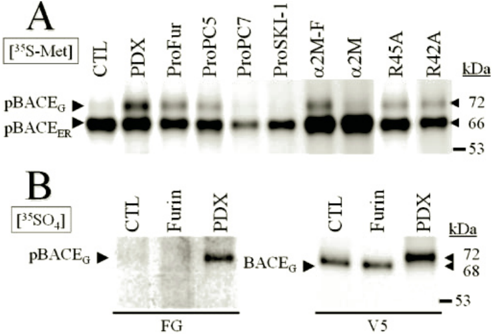
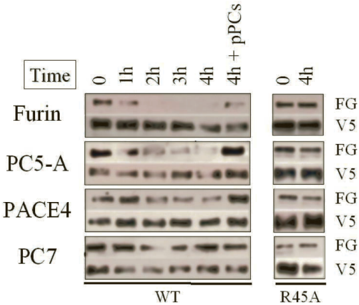
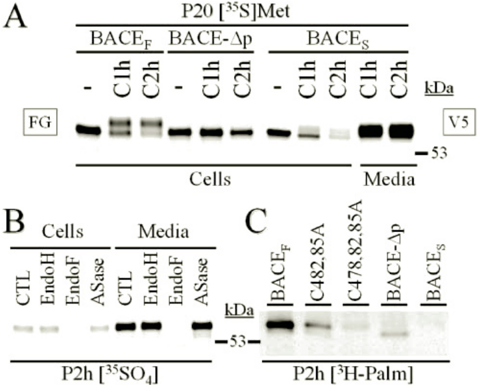
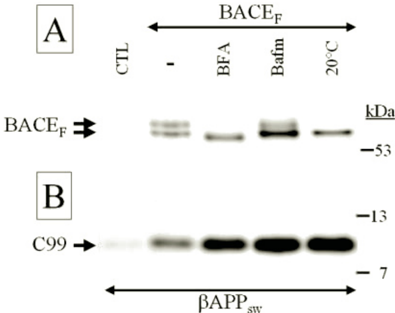
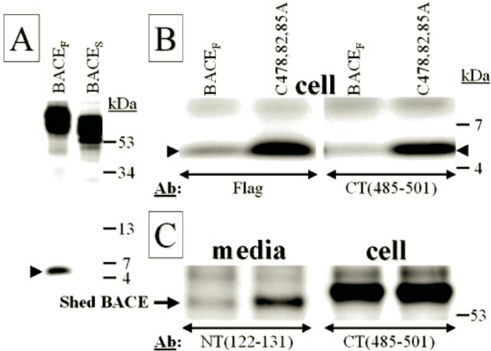
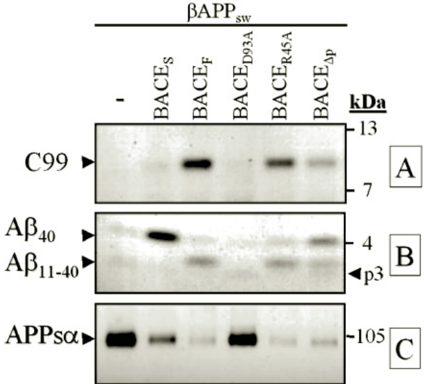
Processing of the beta-amyloid precursor protein (betaAPP) by beta- and gamma-secretases generates the amyloidogenic peptide Abeta, a major factor in the etiology of Alzheimer's disease. Following the recent identification of the beta-secretase beta-amyloid-converting enzyme (BACE), we herein investigate its zymogen processing, molecular properties, and cellular trafficking. Our data show that among the proprotein convertase family members, furin is the major converting enzyme of pro-BACE into BACE within the trans-Golgi network of HK293 cells. While we demonstrate that the 24-amino acid prosegment is required for the efficient exit of pro-BACE from the endoplasmic reticulum, it may not play a strong inhibitory role since we observe that pro-BACE can produce significant quantities of the Swedish mutant betaAPP(sw) beta-secretase product C99. BACE is palmitoylated at three Cys residues within its transmembrane/cytosolic tail and is sulfated at mature N-glycosylated moieties. Data with three different antibodies show that a small fraction of membrane-bound BACE is shed into the medium and that the extent of ectodomain shedding is palmitoylation-dependent. Overexpression of full-length BACE causes a significant increase in the production of C99 and a decrease in the alpha-secretase product APPsalpha. Although there is little increase in the generation of Abeta by full-length BACE, overexpression of either a soluble form of BACE (equivalent to the shed form) or one lacking the prosegment leads to enhanced Abeta levels. These findings suggest that the shedding of BACE may play a role in the amyloidogenic processing of betaAPP.
Overview
The claims and statistics of this paper haven’t been checked yet.
Free: it reads the open-access text and checks the first 5 claims that cite a source we can check. Create a free account to check every claim.
Integrity signals
Registry
Cites
Statistics
Figures
) ( A and C ) or ([BACEF]FG/ V5 1a 1-PDX) ( B and D) cDNAs. Two days post-transfections the cells were pulse-labeled in the absence or presence of 5 mM BFA for 15 min with [ 35 S]Met and then chased for 1 or 2 h. Cell lysates were immunoprecipitated with either the FG or V5 mAbs and analyzed by SDSPAGE on 8% Tricine gels. The migration position of the 53-kDa molecular mass standard and those of pro-BACE (pBACE) and BACE as well as their molecular masses are emphasized.](https://figures.cochat.ai/paper-figures/1364ddaa81664a3dbed628160cd856ec/post-translational-processing-of-secretase-amyloid-converting-enzyme-and-its-figure-1.png)
Verification
Claims the paper makes
The claims and statistics of this paper haven’t been checked yet.
Free: it reads the open-access text and checks the first 5 claims that cite a source we can check. Create a free account to check every claim.
Claims other papers make about this one
Each is checked against this paper’s own text: does it say what the citing paper says it does?
In the citing paper
“In addition, the size of the BACE1 active site is relatively large, including catalytic aspartic acid residues, flap, and 10 S loop.311”
From Amyloid β-based therapy for Alzheimer’s disease: Challenges, successes and future (2023) · cites this paper as [311]
Self-check
Percentages, sums and reported differences re-computed from the paper’s own numbers.
The self-check needs the paper’s full text.
Citations
Cites
Vassar, R., Bennett, B. D., Babu-Khan, S., Kahn, S., Mendiaz, E. A., Denis, P., Teplow, D. B., Ross, S., Amarante, P., Loeloff, R., et al. (1999) · Science · doi:10.1126/science.286.5440.735 · Cited by 3,876
Bowman, E. J., Siebers, A., & Altendorf, K. (1988) · Proceedings of the National Academy of Sciences · doi:10.1073/pnas.85.21.7972 · Cited by 1,784
Purification and cloning of amyloid precursor protein β-secretase from human brain
Sinha, S., Anderson, J. P., Barbour, R., Basi, G. S., Caccavello, R., Davis, D., Doan, M., Dovey, H. F., Frigon, N., Hong, J., et al. (1999) · Nature · doi:10.1038/990114 · Cited by 1,612
Membrane-anchored aspartyl protease with Alzheimer's disease β-secretase activity
Yan, R., Bienkowski, M. J., Shuck, M. E., Miao, H., Tory, M. C., Pauley, A. M., Brashler, J. R., Stratman, N. C., Mathews, W. R., Buhl, A. E., et al. (1999) · Nature · doi:10.1038/990107 · Cited by 1,438
Correlation Between Elevated Levels of Amyloid β-Peptide in the Brain and Cognitive Decline
Näslund, J. (2000) · JAMA · doi:10.1001/jama.283.12.1571 · Cited by 1,268
Resh, M. D. (1999) · Biochimica et Biophysica Acta (BBA) - Molecular Cell Research · doi:10.1016/s0167-4889(99)00075-0 · Cited by 1,250
Identification of a Novel Aspartic Protease (Asp 2) as β-Secretase
Hussain, I., Powell, D., Howlett, D. R., Tew, D. G., Meek, T. D., Chapman, C., Gloger, I. S., Murphy, K. E., Southan, C. D., Ryan, D. M., et al. (1999) · Molecular and Cellular Neuroscience · doi:10.1006/mcne.1999.0811 · Cited by 1,080
Lammich, S., Kojro, E., Postina, R., Gilbert, S., Pfeiffer, R., Jasionowski, M., Haass, C., & Fahrenholz, F. (1999) · Proceedings of the National Academy of Sciences · doi:10.1073/pnas.96.7.3922 · Cited by 975
Buxbaum, J. D., Liu, K.-N., Luo, Y., Slack, J. L., Stocking, K. L., Peschon, J. J., Johnson, R. S., Castner, B. J., Cerretti, D. P., & Black, R. A. (1998) · Journal of Biological Chemistry · doi:10.1074/jbc.273.43.27765 · Cited by 934
Evidence that β-Amyloid Protein in Alzheimer's Disease Is Not Derived by Normal Processing
Sisodia, S. S., Koo, E. H., Beyreuther, K., Unterbeck, A., & Price, D. L. (1990) · Science · doi:10.1126/science.1691865 · Cited by 893
Self-citation
Research works printed but not linked: 1
- Koike, H., Tomioka, S., Sorimachi, H., Saido, T. C., Maruyama, K., Okuyama, A., Fujisawa-Sehara, A., Ohno, S., Suzuki, K., and Ishiura, S. (1999) Bio- chem. J. 343, 371-375 · DOI · Paper page
Cited by
Furin at the cutting edge: From protein traffic to embryogenesis and disease
Thomas, G. (2002) · Nature Reviews Molecular Cell Biology · doi:10.1038/nrm934 · Cited by 1,216
Seidah, N. G., Benjannet, S., Wickham, L., Marcinkiewicz, J., Jasmin, S. B., Stifani, S., Basak, A., Prat, A., & Chrétien, M. (2003) · Proceedings of the National Academy of Sciences · doi:10.1073/pnas.0335507100 · Cited by 1,191
Self-citationThe neuronal sortilin-related receptor SORL1 is genetically associated with Alzheimer disease
Rogaeva, E., Meng, Y., Lee, J. H., Gu, Y., Kawarai, T., Zou, F., Katayama, T., Baldwin, C. T., Cheng, R., Hasegawa, H., et al. (2007) · Nature Genetics · doi:10.1038/ng1943 · Cited by 1,167
Trafficking and Proteolytic Processing of APP
Haass, C., Kaether, C., Thinakaran, G., & Sisodia, S. (2012) · Cold Spring Harbor Perspectives in Medicine · doi:10.1101/cshperspect.a006270 · Cited by 1,075
“During maturation, BACE1 undergoes a number of post/co-translational modifications, including N-glycosylation, disulfide bridge formation, and palmitoylation (Bennett et al. 2000b; Capell et al. 2000; Huse et al. 2000; Benjannet et al. 2001).”
BackgroundSelf-citationAmyloid β-based therapy for Alzheimer’s disease: Challenges, successes and future
Zhang, Y., Chen, H., Li, R., Sterling, K., & Song, W. (2023) · Signal Transduction and Targeted Therapy · doi:10.1038/s41392-023-01484-7 · Cited by 988
Metadata
- Authors
- Benjannet, S., Elagoz, A., Wickham, L., Mamarbachi, M., Munzer, J. S., Basak, A., Lazure, C., Cromlish, J. A., Sisodia, S., Checler, F., Chrétien, M., & Seidah, N. G.
- Affiliations
- Montreal Clinical Research Institute (CA)
- Ottawa Hospital (CA)
- University of Chicago (US)
- Centre National de la Recherche Scientifique (FR)
- Corresponding author
- Seidah, Nabil G.
- Venue
- Journal of Biological Chemistry
- Publisher
- Elsevier BV
- Published
- 2001-04
- Volume
- 276
- Issue
- 14
- Pages
- 10879-10887
- ISSN
- 0021-9258 (ISSN-L)
- OpenAlex
- W2040252771
- Cited by
- 301
- References
- 49
- Citations by year
- 2025: 6 · 2024: 4 · 2023: 5 · 2022: 4 · 2021: 9 · 2020: 6 · 2019: 5 · 2018: 6 · 2017: 8 · 2016: 8 · 2015: 4 · 2014: 11 · 2013: 13 · 2012: 13
- FWCI
- 14.55
- Type
- journal article
- Language
- en
- Open access
- hybrid
- doi.org
- Licence
- cc-by
- www.elsevier.com/tdm/userlicense/1.0/ (tdm)
- creativecommons.org/licenses/by/4.0/ (vor, 7124 d)
- Locations
- Journal of Biological Chemistry (publishedVersion, cc-by)
- PubMed (publishedVersion)
- Funders
- Government of Canada
- Canadian Institutes of Health Research
- Topics
- Life Sciences › Neuroscience › Cellular and Molecular Neuroscience › Alzheimer's disease research and treatments
- Life Sciences › Biochemistry, Genetics and Molecular Biology › Cancer Research › Protease and Inhibitor Mechanisms
- Health Sciences › Medicine › Psychiatry and Mental health › Dementia and Cognitive Impairment Research
- Keywords
- beta-secretase, BACE, amyloid precursor protein, post-translational processing, furin, prosegment, trans-Golgi network, palmitoylation, ectodomain shedding, amyloid-beta, Alzheimer's disease, gamma-secretase, alpha-secretase, C99, endoplasmic reticulum exit
- MeSH terms
- Alzheimer Disease, Animals, Cell Line, Cell Membrane, Cytosol, Humans, Endopeptidases, Protein Processing, Post-Translational, Aspartic Acid Endopeptidases, Mice, Amyloid Precursor Protein Secretases
About these checks
Registry, retraction, Cites and statistics results are computed, not judged, with one exception: a printed reference that no index lists is read once by a model before it counts as a citation error. Claims are extracted by a model and kept only when their quote appears verbatim in the text; each cited source is then checked, with a model’s help, for whether it says what the claim relies on. Those verdicts can be wrong — read the claim’s quote and the cited source before relying on one.
Statistics and arithmetic are recomputed, not judged.
Confidence bands are shown only for fields calibrated on our annotated test set. None is calibrated yet, so no band is shown.
What counts as a claim ›How we measure confidence ›How we check this ›
Are you an author, or do you see a problem with this page? Request a review
How to cite
Cite CoChat for the checks on this page, and the paper for its own findings.
- This page
- CoChat. (2026). Citation check: Post-translational Processing of β-Secretase (β-Amyloid-converting Enzyme) and Its Ectodomain Shedding. https://app.cochat.ai/papers/10.1074/jbc.m009899200
- The paper
- Benjannet, S., Elagoz, A., Wickham, L., Mamarbachi, M., Munzer, J. S., Basak, A., Lazure, C., Cromlish, J. A., Sisodia, S., Checler, F., Chrétien, M., & Seidah, N. G. (2001). Post-translational Processing of β-Secretase (β-Amyloid-converting Enzyme) and Its Ectodomain Shedding. Journal of Biological Chemistry. https://doi.org/10.1074/jbc.m009899200
Data sources
Bibliographic data: Semantic Scholar, OpenAlex, Crossref.
Contains information from the Semantic Scholar Academic Graph Datasets, made available under the ODC Attribution License (ODC-BY 1.0).
Semantic Scholar’s data is described in: Kinney, R., et al. (2023). The Semantic Scholar Open Data Platform. arXiv:2301.10140.
