

Receptor Number and Caveolar Co-localization Determine Receptor Coupling Efficiency to Adenylyl Cyclase
Open accessThe DOI matches its Crossref record; 35 of the 35 references it cites were found in a registry or an index.
Abstract
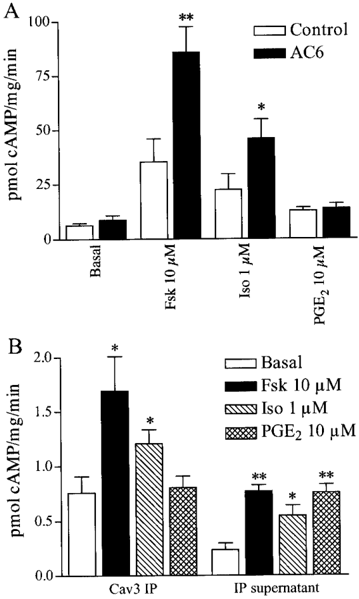
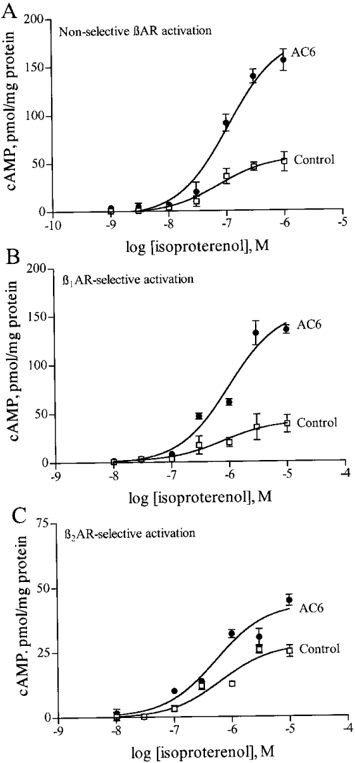
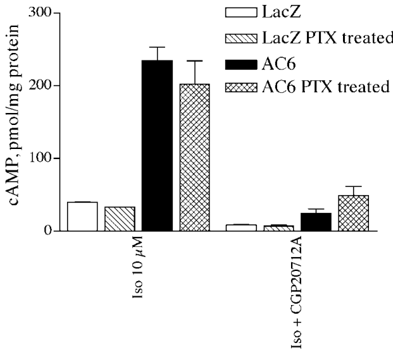
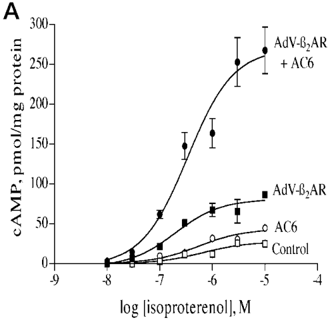
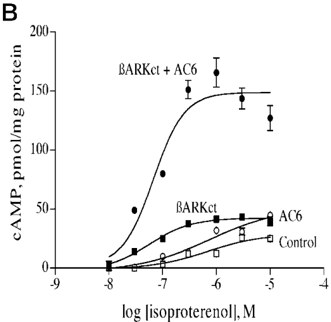
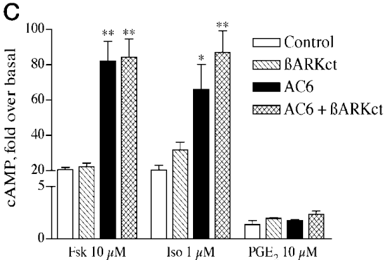
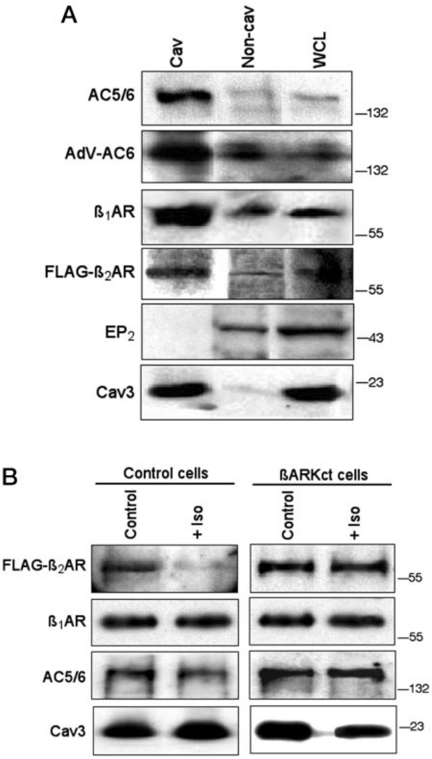
Recent evidence suggests that many signaling molecules localize in microdomains of the plasma membrane, particularly caveolae. In this study, overexpression of adenylyl cyclase was used as a functional probe of G protein-coupled receptor (GPCR) compartmentation. We found that three endogenous receptors in neonatal rat cardiomyocytes couple with different levels of efficiency to the activation of adenylyl cyclase type 6 (AC6), which localizes to caveolin-rich membrane fractions. Overexpression of AC6 enhanced the maximal cAMP response to beta(1)-adrenergic receptor (beta(1)AR)-selective activation 3.7-fold, to beta(2)AR-selective activation only 1.6-fold and to prostaglandin E(2) (PGE(2)) not at all. Therefore, the rank order of efficacy in coupling to AC6 is beta(1)AR > beta(2)AR > prostaglandin E(2) receptor (EP(2)R). beta(2)AR coupling efficiency was greater when we overexpressed the receptor or blocked its desensitization by expressing betaARKct, an inhibitor of G protein-coupled receptor kinase activation, but was not significantly greater when cells were treated with pertussis toxin. Assessment of receptor and AC expression indicated co-localization of AC5/6, beta(1)AR, and beta(2)AR, but not EP(2)R, in caveolin-rich membranes and caveolin-3 immunoprecipitates, likely explaining the observed activation of AC6 by betaAR subtypes but lack thereof by PGE(2). When cardiomyocytes were stimulated with a betaAR agonist, beta(2)AR were no longer found in caveolin-3 immunoprecipitates; an effect that was blocked by expression of betaARKct. Thus, agonist-induced translocation of beta(2)AR out of caveolae causes a sequestration of receptor from effector and likely contributes to the lower efficacy of beta(2)AR coupling to AC6 as compared with beta(1)AR, which do not similarly translocate. Therefore, spatial co-localization is a key determinant of efficiency of coupling by particular extracellular signals to activation of GPCR-linked effectors.
Overview
The claims and statistics of this paper haven’t been checked yet.
Free: it reads the open-access text and checks the first 5 claims that cite a source we can check. Create a free account to check every claim.
Integrity signals
Registry
Cites
Statistics
Figures
Verification
Claims the paper makes
The claims and statistics of this paper haven’t been checked yet.
Free: it reads the open-access text and checks the first 5 claims that cite a source we can check. Create a free account to check every claim.
Claims other papers make about this one
Each is checked against this paper’s own text: does it say what the citing paper says it does?
The cited source says what the claim attributes to it.
In the citing paper
“Of the many Gαs-coupled GPCRs in a given cell, certain receptors will preferentially couple to a specific AC isoform based on colocalization or preassembly (108–113).”
From Physiological roles of mammalian transmembrane adenylyl cyclase isoforms (2022) · cites this paper as [111]
Self-check
Percentages, sums and reported differences re-computed from the paper’s own numbers.
The self-check needs the paper’s full text.
Citations
Cites
Anderson, R. G. W. (1998) · Annual Review of Biochemistry · doi:10.1146/annurev.biochem.67.1.199 · Cited by 1,942
β-Arrestin acts as a clathrin adaptor in endocytosis of the β2-adrenergic receptor
Goodman, O. B., Krupnick, J. G., Santini, F., Gurevich, V. V., Penn, R. B., Gagnon, A. W., Keen, J. H., & Benovic, J. L. (1996) · Nature · doi:10.1038/383447a0 · Cited by 1,384
Song, K. S., Li, S., Okamoto, T., Quilliam, L. A., Sargiacomo, M., & Lisanti, M. P. (1996) · Journal of Biological Chemistry · doi:10.1074/jbc.271.16.9690 · Cited by 1,000
Role of β-Arrestin in Mediating Agonist-Promoted G Protein-Coupled Receptor Internalization
Ferguson, S. S. G., Downey, W. E., Colapietro, A.-M., Barak, L. S., Ménard, L., & Caron, M. G. (1996) · Science · doi:10.1126/science.271.5247.363 · Cited by 972
Acylation Targets Endothelial Nitric-oxide Synthase to Plasmalemmal Caveolae
Shaul, P. W., Smart, E. J., Robinson, L. J., German, Z., Yuhanna, I. S., Ying, Y., Anderson, R. G. W., & Michel, T. (1996) · Journal of Biological Chemistry · doi:10.1074/jbc.271.11.6518 · Cited by 800
Cardiac Function in Mice Overexpressing the β-Adrenergic Receptor Kinase or a βARK Inhibitor
Koch, W. J., Rockman, H. A., Samama, P., Hamilton, R., Bond, R. A., Milano, C. A., & Lefkowitz, R. J. (1995) · Science · doi:10.1126/science.7761854 · Cited by 719
Endothelial Nitric Oxide Synthase Targeting to Caveolae
Feron, O., Belhassen, L., Kobzik, L., Smith, T. W., Kelly, R. A., & Michel, T. (1996) · Journal of Biological Chemistry · doi:10.1074/jbc.271.37.22810 · Cited by 675
Rybin, V. O., Xu, X., Lisanti, M. P., & Steinberg, S. F. (2000) · Journal of Biological Chemistry · doi:10.1074/jbc.m006951200 · Cited by 520
A β 2 Adrenergic Receptor Signaling Complex Assembled with the Ca 2+ Channel Ca v 1.2
Davare, M. A., Avdonin, V., Hall, D. D., Peden, E. M., Burette, A., Weinberg, R. J., Horne, M. C., Hoshi, T., & Hell, J. W. (2001) · Science · doi:10.1126/science.293.5527.98 · Cited by 512
Coupling of β2-Adrenoceptor to GiProteins and Its Physiological Relevance in Murine Cardiac Myocytes
Xiao, R.-P., Avdonin, P., Zhou, Y.-Y., Cheng, H., Akhter, S. A., Eschenhagen, T., Lefkowitz, R. J., Koch, W. J., & Lakatta, E. G. (1999) · Circulation Research · doi:10.1161/01.res.84.1.43 · Cited by 387
Research works printed but not linked: 4
- Schwencke, C., Yamamoto, M., Okumura, S., Toya, Y., Kim, S. J., and Ishikawa, Y. (1999) Mol. Endocrinol. 13, 1061-1070
- Ostrom, R. S., Violin, J. D., Coleman, S., and Insel, P. A. (2000) Mol. Pharma- col. 57, 1075-1079
- Ostrom, R. S., Post, S. R., and Insel, P. A. (2000) J. Pharmacol. Exp. Ther. 294, 407-412
- Xiao, R. P., Ji, X., and Lakatta, E. G. (1995) Mol. Pharmacol. 47, 322-329
Cited by
Lipid rafts: bringing order to chaos
Pike, L. J. (2003) · Journal of Lipid Research · doi:10.1194/jlr.r200021-jlr200 · Cited by 1,138
Caveolae: From Cell Biology to Animal Physiology
Razani, B., Woodman, S. E., & Lisanti, M. P. (2002) · Pharmacological Reviews · doi:10.1124/pr.54.3.431 · Cited by 987
“Why obvious hypercellularity is not observed in other Cav-1 null tissues remains to be examined, although there are several possible explanations.”
BackgroundInfluentialHanson, M. A., Cherezov, V., Griffith, M. T., Roth, C. B., Jaakola, V.-P., Chien, E. Y. T., Velasquez, J., Kuhn, P., & Stevens, R. C. (2008) · Structure · doi:10.1016/j.str.2008.05.001 · Cited by 933
Lipid raft microdomains and neurotransmitter signalling
Allen, J. A., Halverson-Tamboli, R. A., & Rasenick, M. M. (2007) · Nature Reviews Neuroscience · doi:10.1038/nrn2059 · Cited by 852
What Is the Role of β-Adrenergic Signaling in Heart Failure?
Lohse, M. J., Engelhardt, S., & Eschenhagen, T. (2003) · Circulation Research · doi:10.1161/01.res.0000102042.83024.ca · Cited by 764
Metadata
- Authors
- Ostrom, R. S., Gregorian, C., Drenan, R. M., Xiang, Y., Regan, J. W., & Insel, P. A.
- Affiliations
- University of California San Diego (US)
- Howard Hughes Medical Institute (US)
- University of Arizona (US)
- Corresponding author
- Insel, Paul A.
- Venue
- Journal of Biological Chemistry
- Publisher
- Elsevier BV
- Published
- 2001-11
- Volume
- 276
- Issue
- 45
- Pages
- 42063-42069
- ISSN
- 0021-9258 (ISSN-L)
- OpenAlex
- W1972870617
- Cited by
- 250
- References
- 34
- Citations by year
- 2026: 1 · 2025: 1 · 2024: 1 · 2023: 3 · 2022: 3 · 2021: 6 · 2020: 2 · 2019: 8 · 2018: 6 · 2017: 7 · 2016: 6 · 2015: 8 · 2014: 15 · 2013: 10 · 2012: 10
- FWCI
- 5.78
- Type
- journal article
- Language
- en
- Open access
- hybrid
- doi.org
- Licence
- cc-by
- www.elsevier.com/tdm/userlicense/1.0/ (tdm)
- creativecommons.org/licenses/by/4.0/ (vor, 6922 d)
- Locations
- Journal of Biological Chemistry (publishedVersion, cc-by)
- PubMed (publishedVersion)
- Chapman University Digital Commons (Chapman University) (submittedVersion)
- Funders
- National Institutes of Health
- National Heart, Lung, and Blood Institute (HL53773, HL 63885, R01HL063885, P50HL053773, HL 0-7444, T32HL007444)
- Topics
- Life Sciences › Biochemistry, Genetics and Molecular Biology › Cell Biology › Caveolin-1 and cellular processes
- Life Sciences › Biochemistry, Genetics and Molecular Biology › Molecular Biology › Receptor Mechanisms and Signaling
- Life Sciences › Biochemistry, Genetics and Molecular Biology › Molecular Biology › Protein Kinase Regulation and GTPase Signaling
- Keywords
- caveolae, adenylyl cyclase type 5, beta1-adrenergic receptor, beta2-adrenergic receptor, prostaglandin E2 receptor, caveolin-3, receptor compartmentalization, receptor translocation, receptor desensitization, cAMP signaling, cardiomyocytes, pertussis toxin
- MeSH terms
- Cyclic AMP, Adenylyl Cyclases, Animals, Calcium, Enzyme Activation, Dinoprostone, Signal Transduction, Receptors, Adrenergic, beta-1, Receptors, Adrenergic, beta-2, Caveolae, Rats
About these checks
Registry, retraction, Cites and statistics results are computed, not judged, with one exception: a printed reference that no index lists is read once by a model before it counts as a citation error. Claims are extracted by a model and kept only when their quote appears verbatim in the text; each cited source is then checked, with a model’s help, for whether it says what the claim relies on. Those verdicts can be wrong — read the claim’s quote and the cited source before relying on one.
Statistics and arithmetic are recomputed, not judged.
Confidence bands are shown only for fields calibrated on our annotated test set. None is calibrated yet, so no band is shown.
What counts as a claim ›How we measure confidence ›How we check this ›
Are you an author, or do you see a problem with this page? Request a review
Data sources
Bibliographic data: Semantic Scholar, OpenAlex, Crossref.
Contains information from the Semantic Scholar Academic Graph Datasets, made available under the ODC Attribution License (ODC-BY 1.0).
Semantic Scholar’s data is described in: Kinney, R., et al. (2023). The Semantic Scholar Open Data Platform. arXiv:2301.10140.
