

The DOI matches its Crossref record; 36 of the 36 references it cites were found in a registry or an index.
Critical Role for Tetrahydrobiopterin Recycling by Dihydrofolate Reductase in Regulation of Endothelial Nitric-oxide Synthase Coupling
Open accessAbstract
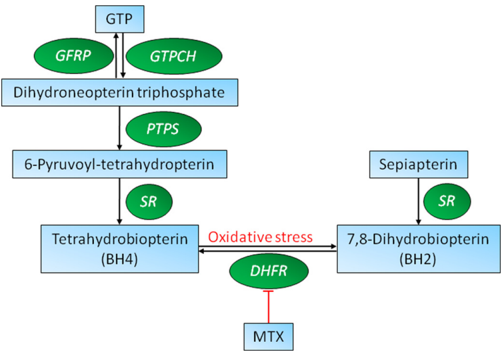
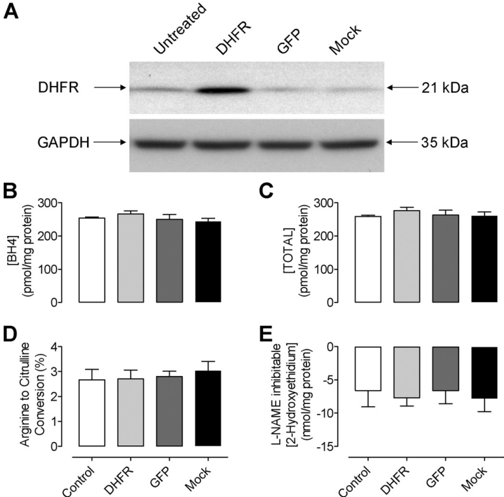
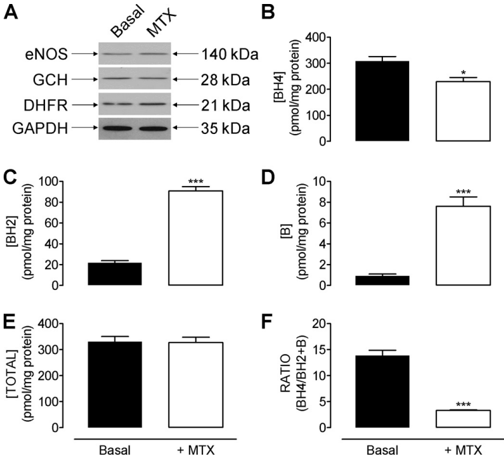
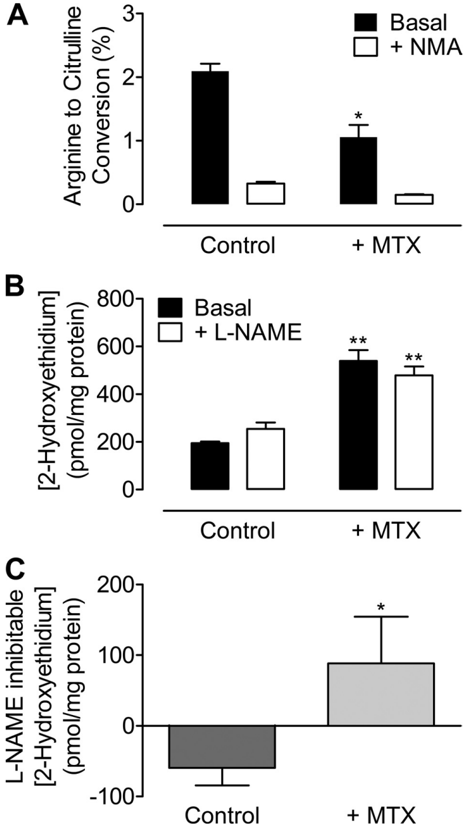
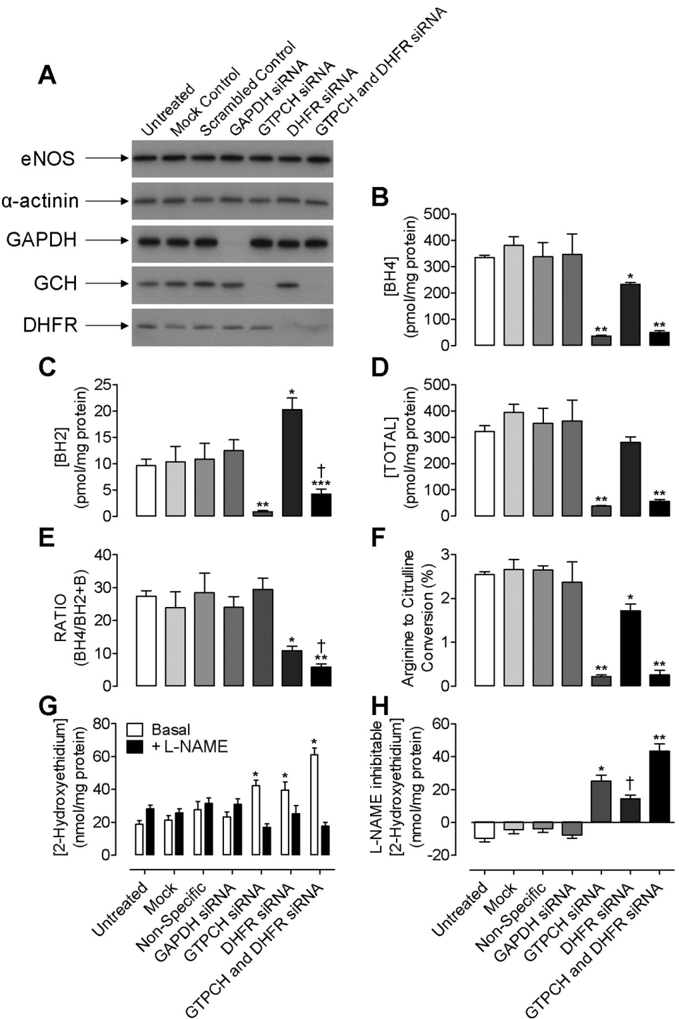
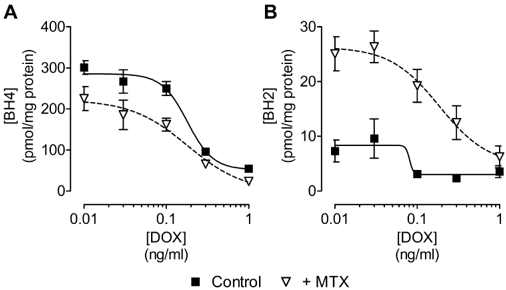
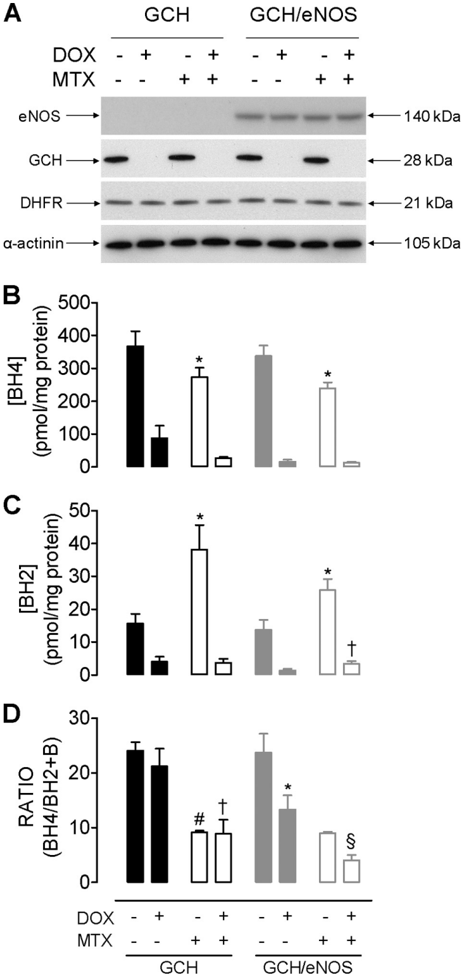
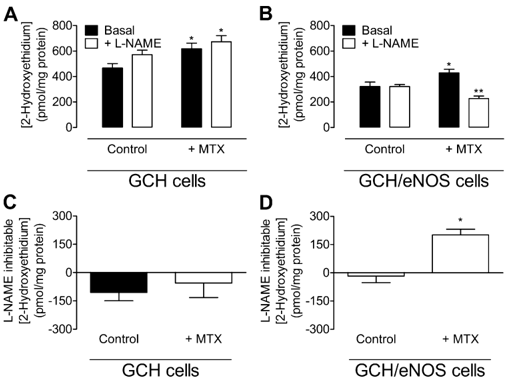
Tetrahyrobiopterin (BH4) is a required cofactor for the synthesis of nitric oxide by endothelial nitric-oxide synthase (eNOS), and BH4 bioavailability within the endothelium is a critical factor in regulating the balance between NO and superoxide production by eNOS (eNOS coupling). BH4 levels are determined by the activity of GTP cyclohydrolase I (GTPCH), the rate-limiting enzyme in de novo BH4 biosynthesis. However, BH4 levels may also be influenced by oxidation, forming 7,8-dihydrobiopterin (BH2), which promotes eNOS uncoupling. Conversely, dihydrofolate reductase (DHFR) can regenerate BH4 from BH2, but the functional importance of DHFR in maintaining eNOS coupling remains unclear. We investigated the role of DHFR in regulating BH4 versus BH2 levels in endothelial cells and in cell lines expressing eNOS combined with tet-regulated GTPCH expression in order to compare the effects of low or high levels of de novo BH4 biosynthesis. Pharmacological inhibition of DHFR activity by methotrexate or genetic knockdown of DHFR protein by RNA interference reduced intracellular BH4 and increased BH2 levels resulting in enzymatic uncoupling of eNOS, as indicated by increased eNOS-dependent superoxide but reduced NO production. In contrast to the decreased BH4:BH2 ratio induced by DHFR knockdown, GTPCH knockdown greatly reduced total biopterin levels but with no change in BH4:BH2 ratio. In cells expressing eNOS with low biopterin levels, DHFR inhibition or knockdown further diminished the BH4:BH2 ratio and exacerbated eNOS uncoupling. Taken together, these data reveal a key role for DHFR in eNOS coupling by maintaining the BH4:BH2 ratio, particularly in conditions of low total biopterin availability.
Overview
The claims and statistics of this paper haven’t been checked yet.
Run the check — free, no account needed. It reads the open-access text and checks the sources it cites.
Integrity signals
Registry
Cites
Statistics
Figures
Verification
Claims the paper makes
The claims and statistics of this paper haven’t been checked yet.
Run the check — free, no account needed. It reads the open-access text and checks the sources it cites.
Claims other papers make about this one
Each is checked against this paper’s own text: does it say what the citing paper says it does?
In the citing paper
“Thus, rather than the relative amount of BH2, the BH4/BH2 ratio gives a more precise estimation of the endothelial function (190, 192, 974).”
From Sources of Vascular Nitric Oxide and Reactive Oxygen Species and Their Regulation (2019) · cites this paper as [192]
In the citing paper
“The conversion of BH4 to BH2 in the setting of endothelial dysfunction has been widely reported (192, 258, 550).”
From Sources of Vascular Nitric Oxide and Reactive Oxygen Species and Their Regulation (2019) · cites this paper as [192]
Self-check
Percentages, sums and reported differences re-computed from the paper’s own numbers.
The self-check needs the paper’s full text.
Citations
Cites
Hypercholesterolemia increases endothelial superoxide anion production.
Ohara, Y., Peterson, T. E., & Harrison, D. G. (1993) · Journal of Clinical Investigation · doi:10.1172/jci116491 · Cited by 1,765
Superoxide generation by endothelial nitric oxide synthase: The influence of cofactors
Vásquez-Vivar, J., Kalyanaraman, B., Martásek, P., Hogg, N., Masters, B. S. S., Karoui, H., Tordo, P., & Pritchard, K. A. (1998) · Proceedings of the National Academy of Sciences · doi:10.1073/pnas.95.16.9220 · Cited by 1,484
Tetrahydrobiopterin biosynthesis, regeneration and functions
Thöny, B., Auerbach, G., & Blau, N. (2000) · Biochemical Journal · doi:10.1042/bj3470001 · Cited by 867
Guidelines for the Management of Rheumatoid Arthritis 2002 Update
Goolsby, M. J., & Newsome, G. (2002) · Journal of the American Academy of Nurse Practitioners · doi:10.1111/j.1745-7599.2002.tb00072.x · Cited by 858
Superoxide and peroxynitrite inatherosclerosis.
White, C. R., Brock, T. A., Chang, L. Y., Crapo, J. D., BRISCOE, P. M., Ku, D. D., Bradley, W. A., Gianturco, S. H., Gore, J. Z., & Freeman, B. Α. (1994) · Proceedings of the National Academy of Sciences · doi:10.1073/pnas.91.3.1044 · Cited by 684
Zhao, H., Joseph, J., Fales, H. M., Sokoloski, E. A., Levine, R. L., Vasquez-Vivar, J., & Kalyanaraman, B. (2005) · Proceedings of the National Academy of Sciences · doi:10.1073/pnas.0501719102 · Cited by 576
Panza, J. A., García, C. E., Kilcoyne, C. M., Quyyumi, A. A., & Cannon, R. O. (1995) · Circulation · doi:10.1161/01.cir.91.6.1732 · Cited by 428
Chalupský, K., & Cai, H. “. (2005) · Proceedings of the National Academy of Sciences · doi:10.1073/pnas.0409594102 · Cited by 338
Ozaki, M., Kawashima, S., Yamashita, T., Hirase, T., Namiki, M., Inoue, N., Hirata, K., Yasui, H., Sakurai, H., Yoshida, Y., et al. (2002) · Journal of Clinical Investigation · doi:10.1172/jci15215 · Cited by 312
Anticancer Antifolates: Current Status and Future Directions
McGuire, J. J. (2003) · Current Pharmaceutical Design · doi:10.2174/1381612033453712 · Cited by 305
VÁSQUEZ-VIVAR, J., MARTÁSEK, P., WHITSETT, J., JOSEPH, J., & KALYANARAMAN, B. (2002) · Biochemical Journal · doi:10.1042/bj3620733 · Cited by 287
Ozaki, M., Kawashima, S., Yamashita, T., Hirase, T., Namiki, M., Inoue, N., Hirata, K.-I., Yasui, H., Sakurai, H., Yoshida, Y., et al. (2002) · Journal of Clinical Investigation · doi:10.1172/jci0215215 · Cited by 268
Fink, B., Laude, K. M., McCann, L. A., Doughan, A. K., Harrison, D. G., & Dikalov, S. (2004) · American Journal of Physiology-Cell Physiology · doi:10.1152/ajpcell.00028.2004 · Cited by 259
Crabtree, M. J., Smith, C. L., Lam, G., Goligorsky, M. S., & Gross, S. S. (2008) · American Journal of Physiology-Heart and Circulatory Physiology · doi:10.1152/ajpheart.00823.2007 · Cited by 213
Self-citationHurshman, A. R., Krebs, C., Edmondson, D. E., Huynh, B. H., & Marletta, M. A. (1999) · Biochemistry · doi:10.1021/bi992026c · Cited by 208
Crabtree, M. J., Tatham, A. L., Al-Wakeel, Y., Warrick, N., Hale, A. B., Cai, S., Channon, K. M., & Alp, N. J. (2009) · Journal of Biological Chemistry · doi:10.1074/jbc.m805403200 · Cited by 200
Self-citationAlp, N. J., McAteer, M. A., Khoo, J., Choudhury, R. P., & Channon, K. M. (2004) · Arteriosclerosis, Thrombosis, and Vascular Biology · doi:10.1161/01.atv.0000115637.48689.77 · Cited by 194
Self-citationMaetzel, A., Wong, A., Strand, V., Tugwell, P., Wells, G. A., & Bombardier, C. (2000) · Lara D. Veeken · doi:10.1093/rheumatology/39.9.975 · Cited by 184
Tzeng, E., Billiar, T. R., Robbins, P. D., Loftus, M., & Stuehr, D. J. (1995) · Proceedings of the National Academy of Sciences · doi:10.1073/pnas.92.25.11771 · Cited by 174
Altered Tetrahydrobiopterin Metabolism in Atherosclerosis
Vasquez-Vivar, J. M., Duquaine, D. C., Whitsett, J., Kalyanaraman, B., & Rajagopalan, S. (2002) · Arteriosclerosis Thrombosis and Vascular Biology · doi:10.1161/01.atv.0000029122.79665.d9 · Cited by 123
Nichol, C. A., Lee, C. L., EDELSTEIN, M. P., Chao, J. Y., & Duch, D. S. (1983) · Proceedings of the National Academy of Sciences · doi:10.1073/pnas.80.6.1546 · Cited by 120
Nzila, A. M., Ward, S. A., Marsh, K., Sims, P. F. G., & Hyde, J. E. (2005) · Trends in Parasitology · doi:10.1016/j.pt.2005.04.002 · Cited by 108
Schmidt, P. P., Lange, R., Gorren, A. C. F., Werner, E. R., Mayer, B., & Andersson, K. K. (2001) · JBIC Journal of Biological Inorganic Chemistry · doi:10.1007/s007750000185 · Cited by 94
Sugiyama, T., Levy, B. D., & Michel, T. M. (2009) · Journal of Biological Chemistry · doi:10.1074/jbc.m809295200 · Cited by 94
Katušić, Z. S., Stelter, A., & Milstien, S. (1998) · Arteriosclerosis Thrombosis and Vascular Biology · doi:10.1161/01.atv.18.1.27 · Cited by 93
McDonald, D., Alp, N. J., & Channon, K. M. (2004) · Pharmacogenetics · doi:10.1097/00008571-200412000-00006 · Cited by 86
Self-citationHuang, A., Zhang, Y., Chen, K., Hatakeyama, K., & Keaney, J. F. (2004) · Circulation Research · doi:10.1161/01.res.0000153669.24827.df · Cited by 79
Sawabe, K., Wakasugi, K. O., & Hasegawa, H. (2004) · Journal of Pharmacological Sciences · doi:10.1254/jphs.fp0040280 · Cited by 75
IGF-I alleviates diabetes-induced RhoA activation, eNOS uncoupling, and myocardial dysfunction
Ren, J. T., Duan, J., Thomas, D. P., Yang, X., Sreejayan, N., Sowers, J. R., Leri, A., Kajstura, J., Gao, F., & Anversa, P. (2008) · American Journal of Physiology-Regulatory, Integrative and Comparative Physiology · doi:10.1152/ajpregu.00713.2007 · Cited by 63
Curtius, H., Heintel, D., Ghisla, S., Küster, T., Leimbacher, W., & Niederwieser, A. (1985) · European Journal of Biochemistry · doi:10.1111/j.1432-1033.1985.tb08855.x · Cited by 50
Kaufman, S., Kapatos, G., Rizzo, W. B., Schulman, J. D., Tamarkin, L., & Loon, G. R. V. (1983) · Annals of Neurology · doi:10.1002/ana.410140309 · Cited by 48
Brand, M. P., Hyland, Κ., Engle, T., Smith, I., & Heales, S. (1996) · Journal of Neurochemistry · doi:10.1046/j.1471-4159.1996.66031150.x · Cited by 47
Linscheid, P., Schaffner, A., Blau, N., & Schoedon, G. (1998) · Circulation · doi:10.1161/01.cir.98.17.1703 · Cited by 43
Heales, S., & Hyland, K. (1989) · Journal of Chromatography B Biomedical Sciences and Applications · doi:10.1016/s0378-4347(00)82658-4 · Cited by 36
Ionova, I. A., Vásquez-Vivar, J., Whitsett, J., Herrnreiter, A., Medhora, M., Cooley, B. C., & Pieper, G. M. (2008) · American Journal of Physiology-Heart and Circulatory Physiology · doi:10.1152/ajpheart.00748.2008 · Cited by 35
de Bono, J. P., Warrick, N., Bendall, J. K., Channon, K. M., & Alp, N. J. (2006) · Nitric Oxide · doi:10.1016/j.niox.2006.03.008 · Cited by 32
Self-citation
Cited by
Sorted by citations
Reperfusion injury and reactive oxygen species: The evolution of a concept
Granger, D. N., & Kvietys, P. R. (2015) · Redox Biology · doi:10.1016/j.redox.2015.08.020 · Cited by 1,550
Xu, S., Ilyas, I., Little, P. J., Li, H., Kamato, D., Zheng, X., Luo, S., Li, Z., Liu, P., Han, J., et al. (2021) · Pharmacological Reviews · doi:10.1124/pharmrev.120.000096 · Cited by 1,205
B Vitamins and the Brain: Mechanisms, Dose and Efficacy—A Review
Kennedy, D. (2016) · Nutrients · doi:10.3390/nu8020068 · Cited by 1,055
Nitric oxide signalling in cardiovascular health and disease
Farah, C., Michel, L. Y. M., & Balligand, J.-L. (2018) · Nature Reviews Cardiology · doi:10.1038/nrcardio.2017.224 · Cited by 779
Methotrexate and its mechanisms of action in inflammatory arthritis
Cronstein, B. N., & Aune, T. M. (2020) · Nature Reviews Rheumatology · doi:10.1038/s41584-020-0373-9 · Cited by 723
Metadata
- Authors
- Crabtree, M. J., Tatham, A. L., Hale, A. B., Alp, N. J., & Channon, K. M.
- Affiliations
- John Radcliffe Hospital (GB)
- Corresponding author
- Channon, Keith M.
- Venue
- Journal of Biological Chemistry
- Publisher
- Elsevier BV
- Published
- 2009-10
- Volume
- 284
- Issue
- 41
- Pages
- 28128-28136
- ISSN
- 0021-9258 (ISSN-L)
- PMC
- PMC2788863
- OpenAlex
- W2058599067
- Cited by
- 210
- References
- 36
- Citations by year
- 2026: 4 · 2025: 9 · 2024: 11 · 2023: 13 · 2022: 13 · 2021: 12 · 2020: 14 · 2019: 13 · 2018: 12 · 2017: 17 · 2016: 11 · 2015: 12 · 2014: 13 · 2013: 6 · 2012: 12
- FWCI
- 11.08
- Type
- journal article
- Language
- en
- Open access
- hybrid
- doi.org
- Licence
- Locations
- Journal of Biological Chemistry (publishedVersion, cc-by)
- Europe PMC (PubMed Central) (publishedVersion)
- PubMed Central (publishedVersion)
- PubMed (publishedVersion)
- Funders
- Wellcome Trust (GR074428/Z/04/Z)
- Topics
- Health Sciences › Medicine › Physiology (medical) › Nitric Oxide and Endothelin Effects
- Health Sciences › Nursing › Nutrition and Dietetics › Folate and B Vitamins Research
- Life Sciences › Biochemistry, Genetics and Molecular Biology › Molecular Biology › Biochemical and Molecular Research
- Keywords
- tetrahydrobiopterin, dihydrofolate reductase, endothelial nitric oxide synthase, eNOS uncoupling, 7,8-dihydrobiopterin, GTP cyclohydrolase I, nitric oxide production, superoxide production, methotrexate, endothelial cells
- MeSH terms
- Animals, Antioxidants, Biopterins, Cell Line, Cells, Cultured, Doxycycline, Endothelium, Vascular, GTP Cyclohydrolase, Methotrexate, Oxidation-Reduction, Superoxides, Tetrahydrofolate Dehydrogenase, RNA, Small Interfering, NIH 3T3 Cells, Endothelial Cells, Mice, Nitric Oxide Synthase Type III
About these checks
Registry, retraction, Cites and statistics results are computed, not judged, with one exception: a printed reference that no index lists is read once by a model before it counts as a citation error. Claims are extracted by a model and kept only when their quote appears verbatim in the text; each cited source is then checked, with a model’s help, for whether it says what the claim relies on. Those verdicts can be wrong — read the claim’s quote and the cited source before relying on one.
Statistics and arithmetic are recomputed, not judged.
Confidence bands are shown only for fields calibrated on our annotated test set. None is calibrated yet, so no band is shown.
What counts as a claim ›How we measure confidence ›How we check this ›
Are you an author, or do you see a problem with this page? Request a review
