Cited by 24

The DOI matches its Crossref record; 2 of the 2 references it cites were found in a registry or an index.

Dynamic Interaction of HDAC1 with a Glucocorticoid Receptor-regulated Gene Is Modulated by the Activity State of the Promoter

Qiu, Yi, Stavreva, Diana A., Luo, Yi, Indrawan, Anindya, Chang, Myron, Hager, Gordon L.·2011·Journal of Biological Chemistry

Overview

The claims and statistics of this paper haven’t been checked yet.

Run the check — free, no account needed. It reads the open-access text and checks the sources it cites.

A few free checks a day · papers already verified open instantly · results are public

Integrity signals

Registry

Crossref · 10.1074/jbc.m110.185488

Cites

2 of 2 references verified0 citation errors · 0 not checkable

Statistics

Figures

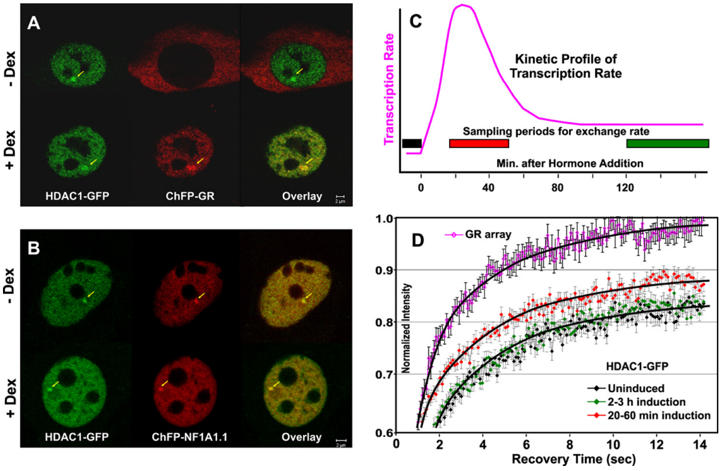
FIGURE1 HDAC1mobilityontheMMTVarraychangesupongeneactivation. A , 3617 cells were transfected with HDAC1-GFP and ChFP-GR in the presence of tetracycline to suppress GFP-GR expression. Arrows indicate HDAC1-GFPandChFP-GRlocalizationontheMMTVarray.Fortranscriptioninduction,cellswere treated with 100 nM dexamethasone ( Dex ) ∼ 24 h after the transfection. B , localization of ChFP-NF1A1.1 to the array independently identified the MMTV promoter structures. C , schematic presentation of the kinetic profile of MMTV transcription rates (1, 9). D , FRAP recovery curves of GFP-tagged HDAC1 at the MMTV array before induction ( black diamonds ), 20-60 min after induction ( red diamonds ), and 2-3 h after induction ( green diamonds ). FRAP recovery for GFP-GR is also presented ( purple open diamonds ). Note that the mobility of GFP-tagged HDAC1 increased dramatically shortly (30-60 min) after dexamethasone treatment ( red diamonds ) compared with the mobility in uninduced cells ( black diamonds ) and then returned ( green diamonds ) to the initial slower mobility after prolonged dexamethasone treatment (120-180 min). The difference between the HDAC1-GFP FRAP recovery curves at the induced, uninduced, and repressed states is statistically highly significant (both p values < 0.001). The data represent means ± S.E. from three independent experiments (n ≥ 15 cells).
FIGURE1 HDAC1mobilityontheMMTVarraychangesupongeneactivation. A , 3617 cells were transfected with HDAC1-GFP and ChFP-GR in the presence of tetracycline to suppress GFP-GR expression. Arrows indicate HDAC1-GFPandChFP-GRlocalizationontheMMTVarray.Fortranscriptioninduction,cellswere treated with 100 nM dexamethasone ( Dex ) ∼ 24 h after the transfection. B , localization of ChFP-NF1A1.1 to the array independently identified the MMTV promoter structures. C , schematic presentation of the kinetic profile of MMTV transcription rates (1, 9). D , FRAP recovery curves of GFP-tagged HDAC1 at the MMTV array before induction ( black diamonds ), 20-60 min after induction ( red diamonds ), and 2-3 h after induction ( green diamonds ). FRAP recovery for GFP-GR is also presented ( purple open diamonds ). Note that the mobility of GFP-tagged HDAC1 increased dramatically shortly (30-60 min) after dexamethasone treatment ( red diamonds ) compared with the mobility in uninduced cells ( black diamonds ) and then returned ( green diamonds ) to the initial slower mobility after prolonged dexamethasone treatment (120-180 min). The difference between the HDAC1-GFP FRAP recovery curves at the induced, uninduced, and repressed states is statistically highly significant (both p values < 0.001). The data represent means ± S.E. from three independent experiments (n ≥ 15 cells).CC-BY · From the PDF
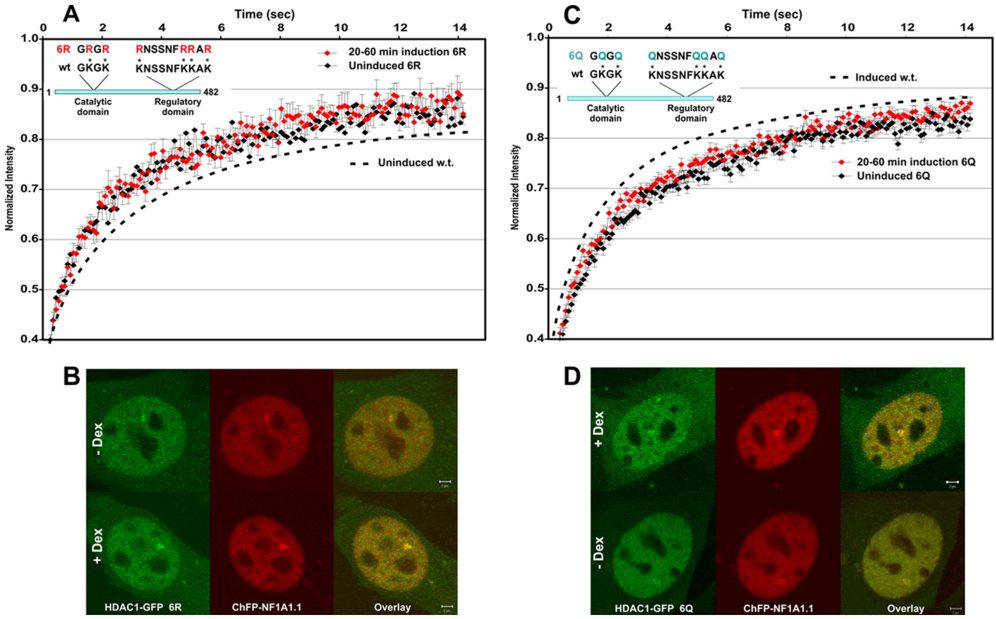
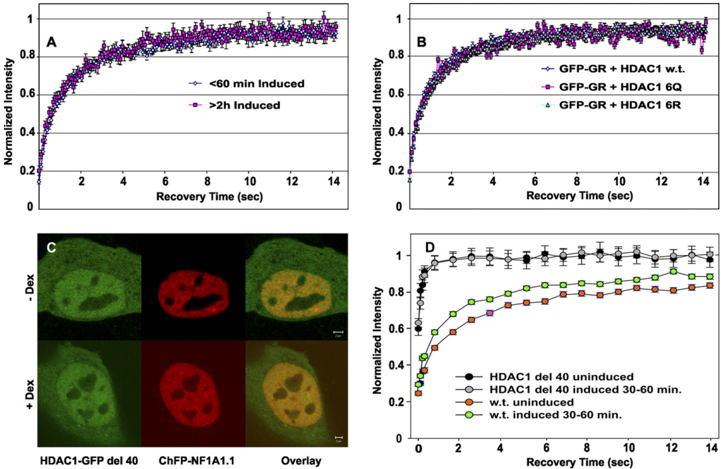
FIGURE2 HDAC1modificationssignificantly change HDAC1 mobility. A , FRAP analysis of the GFP-tagged HDAC1 6R mutant at the MMTV array before and after dexamethasone induction. The lysine-to-arginine mutant of HDAC1, which mimics unmodified HDAC1, exhibited accelerated mobility identical to the mobility of wild-type HDAC1 at early time points (30-60 min) upon dexamethasone treatment. The mobility did not change throughout the induction cycle. B , the GFP-tagged HDAC1 6R mutant was enriched at the MMTV locus marked by ChFP-NF1A1.1 in both induced and uninduced cells. Dex , dexamethasone. C , FRAP analysis of the GFP-tagged HDAC1 6Q mutant at the MMTV array before and after dexamethasone induction. The lysine-to-glutamine mutant of HDAC1,whichmimicsacetylatedHDAC1,exhibitedretardedmobilityidenticaltothemobilityofwild-typeHDAC1intheuninducedstateoratlatertimepoints (60-120min)upondexamethasonetreatment.Themobilitydidnotchangethroughouttheinductioncycle. D , the GFP-tagged HDAC1 6Q mutant colocalized with ChFP-NF1A1.1 at the array locus in both induced and uninduced cells. The data are means ± S.E. from three independent experiments (n ≥ 15 cells).
FIGURE2 HDAC1modificationssignificantly change HDAC1 mobility. A , FRAP analysis of the GFP-tagged HDAC1 6R mutant at the MMTV array before and after dexamethasone induction. The lysine-to-arginine mutant of HDAC1, which mimics unmodified HDAC1, exhibited accelerated mobility identical to the mobility of wild-type HDAC1 at early time points (30-60 min) upon dexamethasone treatment. The mobility did not change throughout the induction cycle. B , the GFP-tagged HDAC1 6R mutant was enriched at the MMTV locus marked by ChFP-NF1A1.1 in both induced and uninduced cells. Dex , dexamethasone. C , FRAP analysis of the GFP-tagged HDAC1 6Q mutant at the MMTV array before and after dexamethasone induction. The lysine-to-glutamine mutant of HDAC1,whichmimicsacetylatedHDAC1,exhibitedretardedmobilityidenticaltothemobilityofwild-typeHDAC1intheuninducedstateoratlatertimepoints (60-120min)upondexamethasonetreatment.Themobilitydidnotchangethroughouttheinductioncycle. D , the GFP-tagged HDAC1 6Q mutant colocalized with ChFP-NF1A1.1 at the array locus in both induced and uninduced cells. The data are means ± S.E. from three independent experiments (n ≥ 15 cells).CC-BY · From the PDF
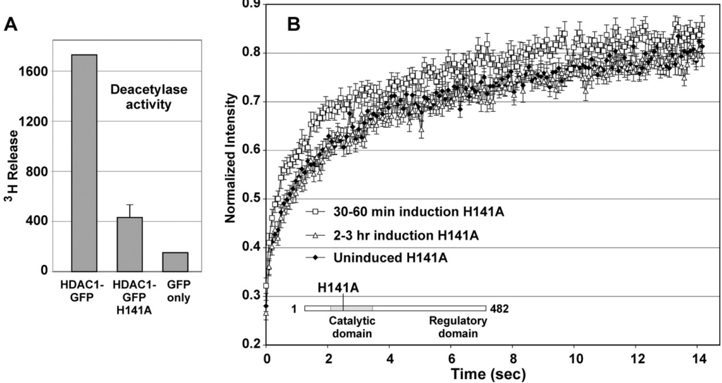
FIGURE 3 Loss of deacetylase activity does not affect the HDAC1 mobility profile during gene activation. A , deacetylase activity of GFP-tagged HDAC1 H141A. Cell extracts from HDAC1-GFP- and HDAC1 H141A-GFP-transfected 3134 cells were immunoprecipitated with anti-GFP or IgG (background control) antibody, and the deacetylation activity of the resulting immunoprecipitates was determined. The GFP-tagged HDAC1 H141A mutant, harboring a point mutation in the HDAC1 catalytic domain, had lost its deacetylase activity. B , FRAP analysis of GFP-tagged HD1 H141A on the MMTV array revealed mobility similar to the wild-type HDAC1 mobility. The data are means ± S.E. from three independent experiments (n ≥ 15 cells).
FIGURE 3 Loss of deacetylase activity does not affect the HDAC1 mobility profile during gene activation. A , deacetylase activity of GFP-tagged HDAC1 H141A. Cell extracts from HDAC1-GFP- and HDAC1 H141A-GFP-transfected 3134 cells were immunoprecipitated with anti-GFP or IgG (background control) antibody, and the deacetylation activity of the resulting immunoprecipitates was determined. The GFP-tagged HDAC1 H141A mutant, harboring a point mutation in the HDAC1 catalytic domain, had lost its deacetylase activity. B , FRAP analysis of GFP-tagged HD1 H141A on the MMTV array revealed mobility similar to the wild-type HDAC1 mobility. The data are means ± S.E. from three independent experiments (n ≥ 15 cells).CC-BY · From the PDF
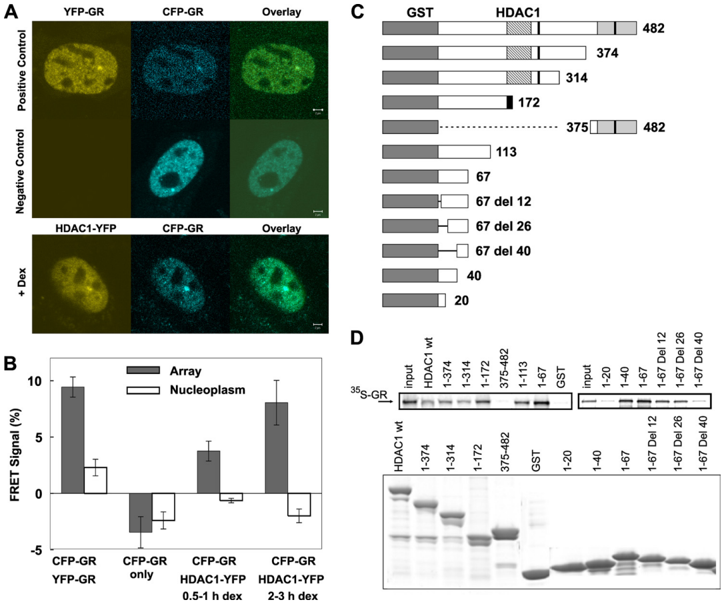
FIGURE 4 HDAC1 and GR physically interact at the MMTV array. A , HDAC1-YFP/CFP-GR FRET pair and YFP-GR/CFP-GR FRET pair colocalized at the MMTV array site. Dex , dexamethasone. B , YFP-GR/HDAC1-CFPinteractionmeasuredbyFRET.TheFRETsignalbetweenYFP-GRandCFP-GRservedasapositivecontrol. C , schematic representation of GST-HDAC1 constructs. D , various GST-HDAC1fusionproteinswerepurifiedfrom Escherichia coli . The GST pulldown assays were performed in the presence of 35 S-labeled GR or HDAC1. The results demonstrate that amino acids 26-40 of HDAC1 are important for GR/HDAC1 and HDAC1/HDAC1 interactions.
FIGURE 4 HDAC1 and GR physically interact at the MMTV array. A , HDAC1-YFP/CFP-GR FRET pair and YFP-GR/CFP-GR FRET pair colocalized at the MMTV array site. Dex , dexamethasone. B , YFP-GR/HDAC1-CFPinteractionmeasuredbyFRET.TheFRETsignalbetweenYFP-GRandCFP-GRservedasapositivecontrol. C , schematic representation of GST-HDAC1 constructs. D , various GST-HDAC1fusionproteinswerepurifiedfrom Escherichia coli . The GST pulldown assays were performed in the presence of 35 S-labeled GR or HDAC1. The results demonstrate that amino acids 26-40 of HDAC1 are important for GR/HDAC1 and HDAC1/HDAC1 interactions.CC-BY · From the PDF
FIGURE5 GFP-GRFRAPrecoveryattheMMTVarrayisHDAC1-independent. A , GR mobility did not changethroughouttheinductioncycle. B , FRAPanalysisofGR mobilityattheMMTVarrayincellscoexpressingHDAC1ortheHDAC16RorHDAC16QmutantdemonstratedthatGRmobilitywasnotinfluencedbyHDAC1mobility. C , the GFP-tagged HDAC1 del 40 mutant was not enriched at the MMTV array locus. Dex , dexamethasone. D , FRAP analysis of the GFP-tagged HDAC1 del 40 mutant during the dexamethasone induction cycle. The FRAP recovery curves of wild-type HDAC1-GFP are also shown as references. The GFP-tagged HDAC1 del 40 mutant, which was unable to bind to GR and HDAC1, was highly mobile. The data are means ± S.E. from three independent experiments (n ≥ 15 cells).
FIGURE5 GFP-GRFRAPrecoveryattheMMTVarrayisHDAC1-independent. A , GR mobility did not changethroughouttheinductioncycle. B , FRAPanalysisofGR mobilityattheMMTVarrayincellscoexpressingHDAC1ortheHDAC16RorHDAC16QmutantdemonstratedthatGRmobilitywasnotinfluencedbyHDAC1mobility. C , the GFP-tagged HDAC1 del 40 mutant was not enriched at the MMTV array locus. Dex , dexamethasone. D , FRAP analysis of the GFP-tagged HDAC1 del 40 mutant during the dexamethasone induction cycle. The FRAP recovery curves of wild-type HDAC1-GFP are also shown as references. The GFP-tagged HDAC1 del 40 mutant, which was unable to bind to GR and HDAC1, was highly mobile. The data are means ± S.E. from three independent experiments (n ≥ 15 cells).CC-BY · From the PDF
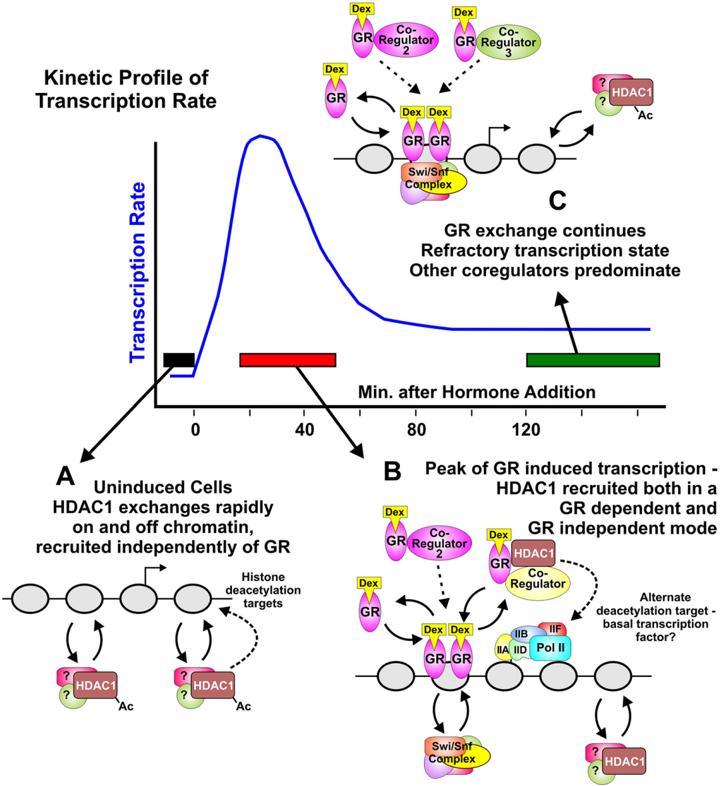
FIGURE 6 HDAC1exchange dynamics vary with promoter activity state. Shown is a model for the HDAC1 interactions during MMTV promoter activation and down-regulation. A , uninduced promoter; B , MMTV promoter at the peak of GR-induced transcription; C , refractory transcription state. Dex , dexamethasone; Pol II , polymerase II.
FIGURE 6 HDAC1exchange dynamics vary with promoter activity state. Shown is a model for the HDAC1 interactions during MMTV promoter activation and down-regulation. A , uninduced promoter; B , MMTV promoter at the peak of GR-induced transcription; C , refractory transcription state. Dex , dexamethasone; Pol II , polymerase II.CC-BY · From the PDF

Verification

Claims the paper makes

The claims and statistics of this paper haven’t been checked yet.

Run the check — free, no account needed. It reads the open-access text and checks the sources it cites.

A few free checks a day · papers already verified open instantly · results are public

Claims other papers make about this one

Each is checked against this paper’s own text: does it say what the citing paper says it does?

Self-check

Percentages, sums and reported differences re-computed from the paper’s own numbers.

The self-check needs the paper’s full text.

Citations

Cites

Show all 2 references

Research works printed but not linked: 25

  1. Qiu, 2006, Mol. Cell, 22, 669, 10.1016/j.molcel.2006.04.019 · DOI · Paper page
  2. Hager, 2002, Curr. Opin. Genet. Dev., 12, 137, 10.1016/S0959-437X(02)00278-2 · DOI
  3. Hager, 2006, Chromosome Res., 14, 107, 10.1007/s10577-006-1030-0 · DOI
  4. Hager, 2004, Biochim. Biophys. Acta, 1677, 46, 10.1016/j.bbaexp.2003.09.016 · DOI
  5. Rayasam, 2005, Mol. Cell. Biol., 25, 2406, 10.1128/MCB.25.6.2406-2418.2005 · DOI
  6. Nagaich, 2004, Ann. N.Y. Acad. Sci., 1024, 213, 10.1196/annals.1321.002 · DOI
  7. Agresti, 2005, Mol. Cell, 18, 109, 10.1016/j.molcel.2005.03.005 · DOI
  8. Becker, 2002, EMBO Rep., 3, 1188, 10.1093/embo-reports/kvf244 · DOI
  9. Bosisio, 2006, EMBO J., 25, 798, 10.1038/sj.emboj.7600977 · DOI
  10. Sharp, 2006, J. Cell Sci., 119, 4101, 10.1242/jcs.03161 · DOI
  11. Dundr, 2002, Science, 298, 1623, 10.1126/science.1076164 · DOI
  12. Karpova, 2008, Science, 319, 466, 10.1126/science.1150559 · DOI
  13. Grozinger, 2002, Chem. Biol., 9, 3, 10.1016/S1074-5521(02)00092-3 · DOI
  14. Sengupta, 2004, J. Cell Biochem., 93, 57, 10.1002/jcb.20179 · DOI
  15. Strahl, 2000, Nature, 403, 41, 10.1038/47412 · DOI · Paper page
  16. Chang, 2005, J. Biol. Chem., 280, 796, 10.1074/jbc.M409053200 · DOI
  17. Reid, 2005, Oncogene, 24, 4894, 10.1038/sj.onc.1208662 · DOI
  18. Luo, 2009, J. Biol. Chem., 284, 34901, 10.1074/jbc.M109.038356 · DOI
  19. Taunton, 1996, Science, 272, 408, 10.1126/science.272.5260.408 · DOI · Paper page
  20. Walker, 1999, Methods, 19, 386, 10.1006/meth.1999.0874 · DOI
  21. Karpova, 2003, J. Microsc., 209, 56, 10.1046/j.1365-2818.2003.01100.x · DOI
  22. Huang, 2000, Mol. Cell. Biol., 20, 2248, 10.1128/MCB.20.6.2248-2259.2000 · DOI · Paper page
  23. Rundlett, 1996, Proc. Natl. Acad. Sci. U.S.A., 93, 14503, 10.1073/pnas.93.25.14503 · DOI
  24. Hassig, 1998, Proc. Natl. Acad. Sci. U.S.A., 95, 3519, 10.1073/pnas.95.7.3519 · DOI · Paper page
  25. Taplick, 2001, J. Mol. Biol., 308, 27, 10.1006/jmbi.2001.4569 · DOI

Cited by

Sorted by citations

See all 24

Metadata

Authors
Qiu, Y., Stavreva, D. A., Luo, Y., Indrawan, A., Chang, M., & Hager, G. L.
Venue
Journal of Biological Chemistry
Publisher
Elsevier BV
Published
2011-03
Volume
286
Issue
9
Pages
7641-7647
ISSN
0021-9258
Cited by
24
References
2
Language
en

About these checks

Registry, retraction, Cites and statistics results are computed, not judged, with one exception: a printed reference that no index lists is read once by a model before it counts as a citation error. Claims are extracted by a model and kept only when their quote appears verbatim in the text; each cited source is then checked, with a model’s help, for whether it says what the claim relies on. Those verdicts can be wrong — read the claim’s quote and the cited source before relying on one.

Statistics and arithmetic are recomputed, not judged.

Confidence bands are shown only for fields calibrated on our annotated test set. None is calibrated yet, so no band is shown.

What counts as a claim ›How we measure confidence ›How we check this ›

Are you an author, or do you see a problem with this page? Request a review

How to cite

Cite CoChat for the checks on this page, and the paper for its own findings.

This page
CoChat. (2026). Citation check: Dynamic Interaction of HDAC1 with a Glucocorticoid Receptor-regulated Gene Is Modulated by the Activity State of the Promoter. https://app.cochat.ai/papers/10.1074/jbc.m110.185488
The paper
Qiu, Y., Stavreva, D. A., Luo, Y., Indrawan, A., Chang, M., & Hager, G. L. (2011). Dynamic Interaction of HDAC1 with a Glucocorticoid Receptor-regulated Gene Is Modulated by the Activity State of the Promoter. Journal of Biological Chemistry. https://doi.org/10.1074/jbc.m110.185488