

The CRH Family Coding for Cell Wall Glycosylphosphatidylinositol Proteins with a Predicted Transglycosidase Domain Affects Cell Wall Organization and Virulence of Candida albicans
Open accessThe DOI matches its Crossref record; 60 of the 61 references it cites were found in a registry or an index.
Abstract
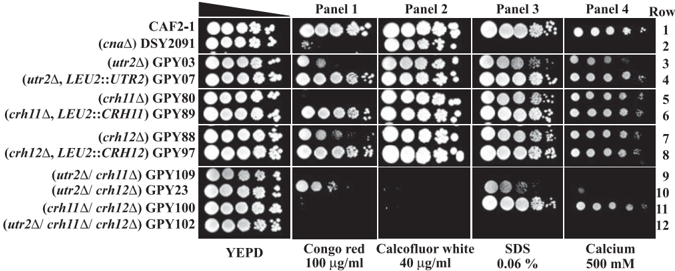
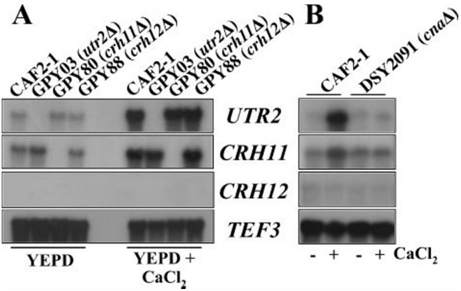
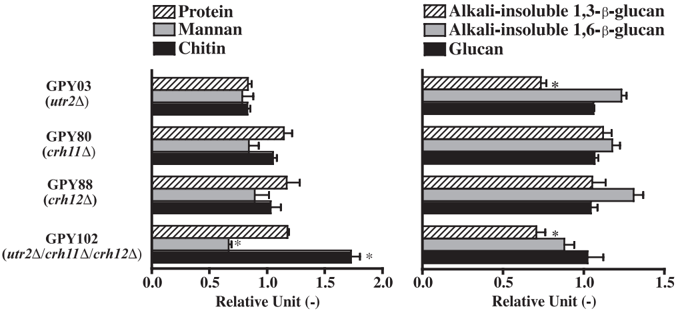
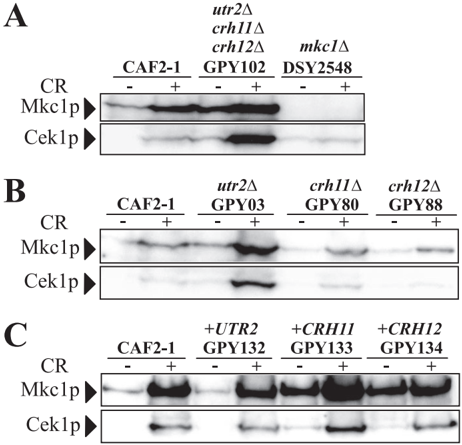
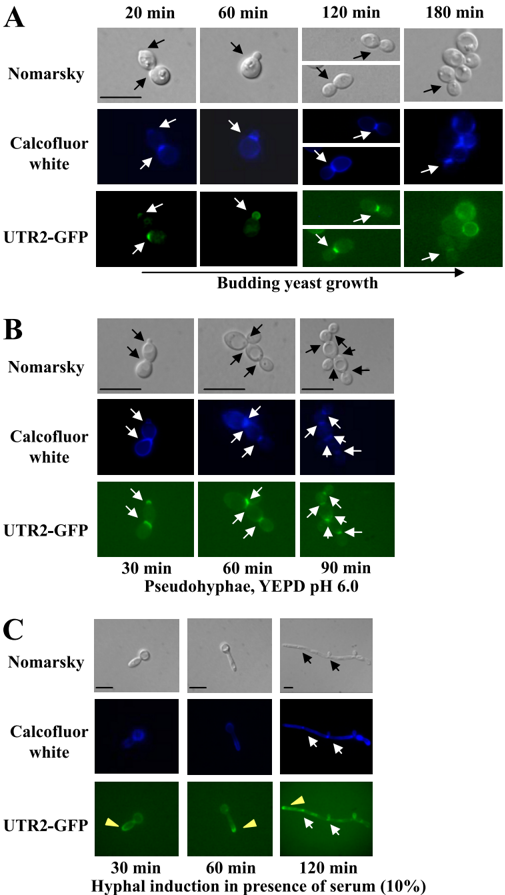
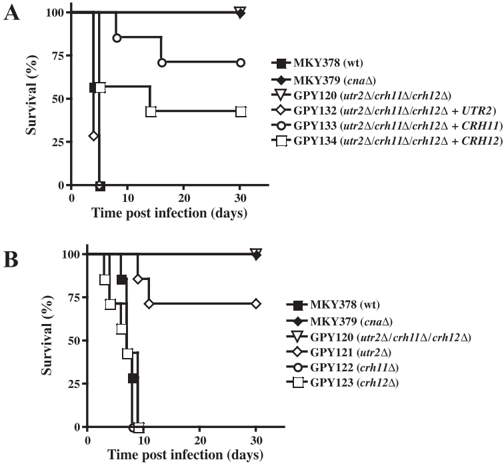
In Candida albicans UTR2 (CSF4), CRH11, and CRH12 are members of a gene family (the CRH family) that encode glycosylphosphatidylinositol-dependent cell wall proteins with putative transglycosidase activity. Deletion of genes of this family resulted in additive sensitivity to compounds interfering with normal cell wall formation (Congo red, calcofluor white, SDS, and high Ca(2+) concentrations), suggesting that these genes contribute to cell wall organization. A triple mutant lacking UTR2, CRH11, and CRH12 produced a defective cell wall, as inferred from increased sensitivity to cell wall-degrading enzymes, decreased ability of protoplasts to regenerate a new wall, constitutive activation of Mkc1p, the mitogen-activated protein kinase of the cell wall integrity pathway, and an increased chitin content of the cell wall. Importantly, this was accompanied by a decrease in alkali-insoluble 1,3-beta-glucan but not total glucan content, suggesting that formation of the linkage between 1,3-beta-glucan and chitin might be affected. In support of this idea, localization of a Utr2p-GFP fusion protein largely coincided with areas of chitin incorporation in C. albicans. As UTR2 and CRH11 expression is regulated by calcineurin, a serine/threonine protein phosphatase involved in tolerance to antifungal drugs, cell wall morphogenesis, and virulence, this points to a possible relationship between calcineurin and the CRH family. Deletion of UTR2, CRH11, and CRH12 resulted in only a partial overlap with calcineurin-dependent phenotypes, suggesting that calcineurin has additional targets. Interestingly, cells deleted for UTR2, CRH11, and CRH12 were, like a calcineurin mutant, avirulent in a mouse model of systemic infection but retained the capacity to colonize target organs (kidneys) as the wild type. In conclusion, this work establishes the role of UTR2, CRH11, and CRH12 in cell wall organization and integrity.
Overview
The claims and statistics of this paper haven’t been checked yet.
Free: it reads the open-access text and checks the first 5 claims that cite a source we can check. Create a free account to check every claim.
Integrity signals
Registry
Cites
Statistics
Figures

Verification
Claims the paper makes
The claims and statistics of this paper haven’t been checked yet.
Free: it reads the open-access text and checks the first 5 claims that cite a source we can check. Create a free account to check every claim.
Self-check
Percentages, sums and reported differences re-computed from the paper’s own numbers.
The self-check needs the paper’s full text.
Citations
Cites
A colorimetric method for the determination of sugars
DUBOIS, M., GILLES, K., HAMILTON, J. K., REBERS, P. A., & SMITH, F. (1951) · Nature · doi:10.1038/168167a0 · Cited by 2,504
New families in the classification of glycosyl hydrolases based on amino acid sequence similarities
Henrissat, B., & Bairoch, A. (1993) · Biochemical Journal · doi:10.1042/bj2930781 · Cited by 1,974
Isogenic strain construction and gene mapping in Candida albicans.
Fonzi, W. A., & Irwin, M. Y. (1993) · Genetics · doi:10.1093/genetics/134.3.717 · Cited by 1,687
Updating the sequence-based classification of glycosyl hydrolases
HENRISSAT, B., & BAIROCH, A. (1996) · Biochemical Journal · doi:10.1042/bj3160695 · Cited by 1,349
Dynamics of cell wall structure in Saccharomyces cerevisiae
Klis, F. (2002) · FEMS Microbiology Reviews · doi:10.1016/s0168-6445(02)00087-6 · Cited by 1,005
Self-citationCalderone, R. (2012) · ASM Press eBooks · Cited by 912
The distinct morphogenic states of Candida albicans
Sudbery, P., Gow, N., & Berman, J. (2004) · Trends in Microbiology · doi:10.1016/j.tim.2004.05.008 · Cited by 876
Sanglard, D., Kuchler, K., Ischer, F., Pagani, J. L., Monod, M., & Bille, J. (1995) · Antimicrobial Agents and Chemotherapy · doi:10.1128/aac.39.11.2378 · Cited by 815
Self-citationRecent Advances in Carbohydrate Bioengineering
Gilbert, H. J. (1999) · Medical Entomology and Zoology · Cited by 786
Netea, M. G. (2006) · Journal of Clinical Investigation · doi:10.1172/jci27114 · Cited by 753
Research works printed but not linked: 2
- Klis, F. M., Mol, P., Hellingwerf, K., and Brul, S. (2002) FEMS Microbiol. Rev. 26, 239 -256 · doi:10.1111/j.1574-6976.2002.tb00613.x · Paper page
- Hanahan, D. (1985) in DNA Cloning. A Practical Approach (Glover, D. M., ed) pp. 109 -135, IRL Press at Oxford University Press, Oxford
Cited by
Candidalysin is a fungal peptide toxin critical for mucosal infection
Moyes, D. L., Wilson, D., Richardson, J. P., Mogavero, S., Tang, S. X., Wernecke, J., Höfs, S., Gratacap, R. L., Robbins, J., Runglall, M., et al. (2016) · Nature · doi:10.1038/nature17625 · Cited by 942
Fungal Cell Wall Organization and Biosynthesis
Free, S. J. (2013) · Advances in Genetics · doi:10.1016/b978-0-12-407677-8.00002-6 · Cited by 576
Candida albicans Cell Wall Proteins
Chaffin, W. L. (2008) · Microbiology and Molecular Biology Reviews · doi:10.1128/mmbr.00032-07 · Cited by 515
Harnessing calcineurin as a novel anti-infective agent against invasive fungal infections.
Steinbach, W. J., Reedy, J. L., Cramer, R. A., Perfect, J. R., & Heitman, J. (2007) · Nature Reviews Microbiology · doi:10.1038/nrmicro1680 · Cited by 313
Munro, C. A., Selvaggini, S., De Bruijn, I., Walker, L., Lenardon, M. D., Gerssen, B., Milne, S., Brown, A. J. P., & Gow, N. A. R. (2007) · Molecular Microbiology · doi:10.1111/j.1365-2958.2007.05588.x · Cited by 309
Metadata
- Authors
- Pardini, G., De Groot, P. W. J., Coste, A. T., Karababa, M., Klis, F. M., de Koster, C. G., & Sanglard, D.
- Affiliations
- Centre Hospitalier Universitaire Vaudois (CH)
- University of Amsterdam (NL)
- Corresponding author
- Sanglard, Dominique
- Venue
- Journal of Biological Chemistry
- Publisher
- Elsevier BV
- Published
- 2006-12
- Volume
- 281
- Issue
- 52
- Pages
- 40399-40411
- ISSN
- 0021-9258 (ISSN-L)
- OpenAlex
- W2040556195
- Cited by
- 121
- References
- 61
- Citations by year
- 2026: 2 · 2025: 6 · 2024: 6 · 2023: 7 · 2022: 6 · 2021: 9 · 2020: 4 · 2019: 7 · 2018: 4 · 2017: 3 · 2016: 6 · 2015: 5 · 2014: 6 · 2013: 5 · 2012: 6
- FWCI
- 3.11
- Type
- journal article
- Language
- en
- Open access
- hybrid
- doi.org
- Licence
- cc-by
- www.elsevier.com/tdm/userlicense/1.0/ (tdm)
- creativecommons.org/licenses/by/4.0/ (vor, 5043 d)
- Locations
- Journal of Biological Chemistry (publishedVersion, cc-by)
- PubMed (publishedVersion)
- UvA-DARE (University of Amsterdam) (publishedVersion)
- IRIS (submittedVersion)
- SERVAL (Université de Lausanne) (submittedVersion)
- Data Archiving and Networked Services (DANS) (submittedVersion)
- Funders
- European Commission
- Universiteit van Amsterdam
- Topics
- Life Sciences › Biochemistry, Genetics and Molecular Biology › Molecular Biology › Fungal and yeast genetics research
- Health Sciences › Medicine › Infectious Diseases › Antifungal resistance and susceptibility
- Health Sciences › Medicine › Infectious Diseases › Fungal Infections and Studies
- Keywords
- Candida albicans, cell wall organization, cell wall integrity, virulence, calcineurin, β-1,3-glucan, chitin, cell wall degrading enzymes, protoplast regeneration, systemic infection
- MeSH terms
- Animals, Candida albicans, Candidiasis, Cell Wall, Congo Red, Fungal Proteins, Multigene Family, Glycoside Hydrolases, Multienzyme Complexes, Transferases, Glycosylphosphatidylinositols, Gene Deletion, Protein Structure, Tertiary, Virulence Factors, Mice
About these checks
Registry, retraction, Cites and statistics results are computed, not judged, with one exception: a printed reference that no index lists is read once by a model before it counts as a citation error. Claims are extracted by a model and kept only when their quote appears verbatim in the text; each cited source is then checked, with a model’s help, for whether it says what the claim relies on. Those verdicts can be wrong — read the claim’s quote and the cited source before relying on one.
Statistics and arithmetic are recomputed, not judged.
Confidence bands are shown only for fields calibrated on our annotated test set. None is calibrated yet, so no band is shown.
What counts as a claim ›How we measure confidence ›How we check this ›
Are you an author, or do you see a problem with this page? Request a review
Data sources
Bibliographic data: Semantic Scholar, OpenAlex, Crossref.
Contains information from the Semantic Scholar Academic Graph Datasets, made available under the ODC Attribution License (ODC-BY 1.0).
Semantic Scholar’s data is described in: Kinney, R., et al. (2023). The Semantic Scholar Open Data Platform. arXiv:2301.10140.
