

DNA Replication Fidelity
Open accessThe DOI matches its Crossref record; 111 of the 111 references it cites were found in a registry or an index; 12 of the 104 sources its claims cite were checked for support.
Abstract
Review of the mechanisms that make DNA copying accurate, including nucleotide selectivity, proofreading, and mismatch repair.
Overview
CoChat Summary
TL;DR
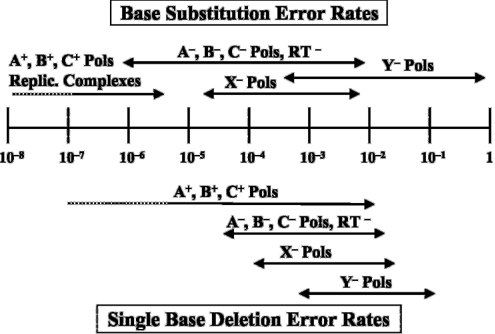
This review synthesizes how DNA polymerases achieve high replication fidelity, emphasizing nucleotide selectivity, conformational changes, proofreading, and mismatch/lesion handling. It also notes that fidelity varies enormously across polymerase families, from about \(10^{-7}\)–\(10^{-8}\) error rates for replicative systems to \(10^{-1}\)–\(10^{-3}\) for translesion synthesis polymerases.
Key findings
- In vivo, bacteriophage and *E. coli* replication in the absence of mismatch repair and external stress show base substitution error rates of about \(10^{-7}\) to \(10^{-8}\); eukaryotic replication is likely at least this accurate.
- Replicative polymerases from families A, B, and C typically have error rates in the \(10^{-6}\) to \(10^{-8}\) range, and their proofreading-defective derivatives reveal that fidelity often reflects \(10^{4}\)–\(10^{6}\)-fold selectivity for correct nucleotide insertion plus excision of 90%–99.9% of mismatches.
- Translesion synthesis polymerases are the least accurate, with misinsertion and base substitution error rates generally ranging from \(10^{-1}\) to \(10^{-3}\); for one polymerase, insertion of dGTP opposite template T can approach an error rate of 1.
- The paper argues that fidelity is shaped by multiple mechanisms, including geometric selection, base-base hydrogen bonding, water exclusion, dNTP-induced conformational change, mismatch extension/proofreading, and handling of damaged or misaligned substrates.
Methods
- Not an experimental study; this is a narrative review of DNA replication fidelity.
- It synthesizes prior biochemical, kinetic, structural, and mutational studies across bacteria, eukaryotes, and translesion synthesis polymerases, using published data and crystal structures.
- The main analysis is comparative and conceptual: it contrasts error-rate ranges, polymerase families, and mechanistic models of fidelity.
Limitations
- The paper states that error rates for repair reactions “have not yet been extensively studied,” so some conclusions about repair-associated DNA synthesis are predictive rather than directly measured.
- Many mechanistic claims are presented as hypotheses or interpretations of structural/kinetic data rather than definitive proof, especially for dNTP-induced conformational changes and water exclusion.
- The text makes evident that some sections are incomplete or only outlined in the provided version; if relying strictly on the excerpt, not all topics announced in the headings are fully developed.
Model-written summary. Check it against the paper before relying on it.
Integrity signals
Registry
Cites
Statistics
Figures


Verification
Claims the paper makes
10 Valid · 1 Not valid · 37 Not checked · 32 Own results and interpretations
The sources with a verdict support this claim; the rest weren’t checked yet, have no full text we could read, or their verdicts aren’t rated yet.
In the paper
“Kinetic studies (reviewed in Refs.15,19,[33][34][35][36] have established that fidelity depends on differences in the binding affinities and insertion rates of incorrect versus correct dNTPs.”
§ DNA Replication Fidelity > dNTP Binding Affinity, dNTP-induced Conformational
What the sources say
- Not checked — no full text of the sourcecites [15] Kunkel, 2000, Annu. Rev. Biochem. source
- Not checked — no full text of the sourcecites [19] Beard, 2003, Structure source
- Not checked — no full text of the sourcecites [33] Goodman, 1993, Crit. Rev. Biochem. Mol. Biol. source
- Not checked — no full text of the sourcecites [34] Johnson, 1993, Annu. Rev. Biochem. source
- Not checked — no full text of the sourcecites [35] Showalter, 2002, Biochemistry source
- Supportedcites [36] Beard, 2002, J. Biol. Chem. source
The paper’s introductory discussion defines nucleotide-insertion specificity as the insertion-rate constant divided by the incoming dNTP’s dissociation constant, and fidelity as the ratio of catalytic efficiencies for correct and incorrect nucleotides. That supports the claim that both binding and insertion kinetics enter into fidelity. (LLM, conf=0.92)
boostedstates a cause- Asserted: passes — The authors put it forward as true.
- Checkable: passes — It can be checked against evidence.
- Load-bearing: passes — The paper’s conclusions depend on it.
- Based: passes — The paper gives a reason why it holds.
Every source the paper cites for this claim was checked and supports it.
In the paper
“These results suggest that fidelity is primarily governed by the ability to insert the correct nucleotide (36) and focus attention on the conformational changes and interactions needed to achieve and stabilize the transition state.”
§ DNA Replication Fidelity > dNTP Binding Affinity, dNTP-induced Conformational
What the sources say
- Supportedcites [36] Beard, 2002, J. Biol. Chem. source
The paper’s Concluding Remarks state that differences between low- and high-fidelity DNA polymerases arise primarily from their ability to insert the correct nucleotide. This directly supports the clause attributed to citation (36). (LLM, conf=0.94)
hedgedstates a cause- Asserted: passes — The authors put it forward as true.
- Checkable: passes — It can be checked against evidence.
- Load-bearing: passes — The paper’s conclusions depend on it.
- Based: passes — The paper gives a reason why it holds.
- Supported
Every source the paper cites for this claim was checked and supports it.
In the paper
“In contrast, catalytic efficiencies for incorrect insertions by these polymerases vary over a much narrower range.”
§ DNA Replication Fidelity > dNTP Binding Affinity, dNTP-induced Conformational
What the sources say
- Supportedcites [36] Beard, 2002, J. Biol. Chem. source
In the Table I analysis (page not provided), correct-insertion efficiencies span a 10-million-fold range. The same section reports that, for most mispairs, a tenfold decrease in correct-insertion efficiency corresponds to little or no decrease in incorrect-insertion efficiency, supporting the narrower-range comparison. (LLM, conf=0.90)
plain- Asserted: passes — The authors put it forward as true.
- Checkable: passes — It can be checked against evidence.
- Load-bearing: passes — The paper’s conclusions depend on it.
- Based: passes — The paper gives a reason why it holds.
- Supported
The sources with a verdict support this claim; the rest weren’t checked yet, have no full text we could read, or their verdicts aren’t rated yet.
In the paper
“As for base substitutions, insertion/deletion error rates vary widely in a polymerase-and DNA sequence-dependent manner (56,57), such that single base deletion error rates (Fig. 1, bottom) can sometimes exceed base substitution error rates (58).”
§ DNA Replication Fidelity > Substrate Misalignments and Insertion/Deletion Fidelity
What the sources say
- Not checked — no full text of the sourcecites [56] Kunkel, 1990, Biochemistry source
- Not checked — no full text of the sourcecites [57] Bebenek, 2000, Cold Spring Harbor Symp. Quant. Biol. source
- Supportedcites [58] Bebenek, 2003, J. Biol. Chem. source
Citation 58 is attached to the claim that single-base deletion error rates can exceed base-substitution error rates. The Results (p. 2) state that human Pol λ’s average single-base deletion error rate exceeds its single-base substitution error rate. The preceding claim about broad polymerase- and sequence-dependent variation is cited to references 56 and 57, not this paper. (LLM, conf=0.94)
plainstates an association- Asserted: passes — The authors put it forward as true.
- Checkable: passes — It can be checked against evidence.
- Load-bearing: unclear — It is unclear whether the paper’s conclusions depend on it.
- Based: passes — The paper gives a reason why it holds.
In the paper
“Studies of bacteriophage and Escherichia coli replication in the absence of DNA mismatch repair and external environmental stress suggest that the base substitution error rate of the replication machinery in vivo is in the range of 10 Ϫ7 to 10 Ϫ8 (4).”
§ DNA Replication Fidelity > How Accurate Is DNA Synthesis?
What the sources say
- Not checked — no full text of the sourcecites [4] Schaaper, 1993, J. Biol. Chem. source
hedged- Asserted: passes — The authors put it forward as true.
- Checkable: passes — It can be checked against evidence.
- Load-bearing: unclear — It is unclear whether the paper’s conclusions depend on it.
- Based: passes — The paper gives a reason why it holds.
31 more claims
Create a free account to see all 80 claims and every source verdict.
- It may state two separate claims as one. 42
- Probably not a substantial claim. 8
Citations
Cites
Molecular Structure of Nucleic Acids: A Structure for Deoxyribose Nucleic Acid
WATSON, J. D., & CRICK, F. H. C. (1953) · Nature · doi:10.1038/171737a0 · Cited by 13,584
Friedberg, E. C., Walker, G. C., Siede, W., Wood, R. D., Schultz, R. A., & Ellenberger, T. (2005) · doi:10.1128/9781555816704 · Cited by 5,683
Bootsma, D., & Hoeijmakers, J. H. J. (1996) · Trends in Genetics · doi:10.1016/0168-9525(96)81408-9 · Cited by 2,282
Frameshift Mutations and the Genetic Code
Streisinger, G., Okada, Y., Emrich, J., Newton, J., Tsugita, A., Terzaghi, E., & Inouye, M. (1966) · Cold Spring Harbor Symposia on Quantitative Biology · doi:10.1101/sqb.1966.031.01.014 · Cited by 1,400
(1991) · PubMed · Cited by 1,305
A constant rate of spontaneous mutation in DNA-based microbes.
Drake, J. W. (1991) · Proceedings of the National Academy of Sciences · doi:10.1073/pnas.88.16.7160 · Cited by 1,199
Kunkel, T. A., & Bebenek, K. (2000) · Annual Review of Biochemistry · doi:10.1146/annurev.biochem.69.1.497 · Cited by 1,003
Self-citationMECHANISMS AND BIOLOGICAL EFFECTS OF MISMATCH REPAIR
Modrich, P. (1991) · Annual Review of Genetics · doi:10.1146/annurev.ge.25.120191.001305 · Cited by 892
MutT protein specifically hydrolyses a potent mutagenic substrate for DNA synthesis
Maki, H., & Sekiguchi, M. (1992) · Nature · doi:10.1038/355273a0 · Cited by 891
DNA Polymerases: Structural Diversity and Common Mechanisms
Steitz, T. A. (1999) · Journal of Biological Chemistry · doi:10.1074/jbc.274.25.17395 · Cited by 848
Research works printed but not linked: 1
- Loeb, 2003, Cancer Res., 51, 3075
Cited by
Bird, A. (2007) · Nature · doi:10.1038/nature05913 · Cited by 3,011
“DNA synthesis is spectacularly accurate, making only 1 'unforced' error for every 10 7 –10 8 bases copie”
BackgroundMechanisms of DNA damage, repair, and mutagenesis
Chatterjee, N., & Walker, G. C. (2017) · Environmental and Molecular Mutagenesis · doi:10.1002/em.22087 · Cited by 2,039
Rates of evolutionary change in viruses: patterns and determinants
Duffy, S., Shackelton, L. A., & Holmes, E. C. (2008) · Nature Reviews Genetics · doi:10.1038/nrg2323 · Cited by 1,551
“Similarly, it is uncertain what portion of the in vivo mutation rate in DNA viruses is due to polymerase error, as opposed to the differing effects of host and viral error-correction enzyme”
BackgroundKunkel, T. A., & Erie, D. A. (2005) · Annual Review of Biochemistry · doi:10.1146/annurev.biochem.74.082803.133243 · Cited by 1,367
Self-citationSanjuán, R., Nebot, M. R., Chirico, N., Mansky, L. M., & Belshaw, R. (2010) · Journal of Virology · doi:10.1128/jvi.00694-10 · Cited by 1,246
“additional host-mediated copying processes (50, 87), they probably contribute little to the overall mutation rate.”
Background
Metadata
- Authors
- Kunkel, T. A.
- Affiliations
- National Institutes of Health (US)
- Corresponding author
- Kunkel, Thomas A.
- ORCID
- Kunkel, Thomas A.
- Venue
- Journal of Biological Chemistry
- Publisher
- Elsevier BV
- Published
- 2004-04
- Volume
- 279
- Issue
- 17
- Pages
- 16895-16898
- ISSN
- 0021-9258 (ISSN-L)
- OpenAlex
- W2152112318
- Cited by
- 754
- References
- 110
- Citations by year
- 2026: 17 · 2025: 14 · 2024: 11 · 2023: 19 · 2022: 16 · 2021: 24 · 2020: 33 · 2019: 35 · 2018: 30 · 2017: 36 · 2016: 29 · 2015: 29 · 2014: 38 · 2013: 43 · 2012: 47
- FWCI
- 3.27
- Type
- journal article
- Language
- en
- Open access
- hybrid
- doi.org
- Licence
- cc-by
- www.elsevier.com/tdm/userlicense/1.0/ (tdm)
- creativecommons.org/licenses/by/4.0/ (vor, 6043 d)
- Locations
- Journal of Biological Chemistry (publishedVersion, cc-by)
- PubMed (publishedVersion)
- Topics
- Life Sciences › Biochemistry, Genetics and Molecular Biology › Molecular Biology › DNA Repair Mechanisms
- Life Sciences › Biochemistry, Genetics and Molecular Biology › Molecular Biology › DNA and Nucleic Acid Chemistry
- Health Sciences › Medicine › Pathology and Forensic Medicine › Genetic factors in colorectal cancer
- Keywords
- DNA replication fidelity, DNA polymerase, DNA mismatch repair, DNA polymerase V, DNA polymerase IV, translesion synthesis
- MeSH terms
- Base Composition, DNA, DNA Replication, Escherichia coli, Hydrogen Bonding, Models, Molecular, Nucleic Acid Conformation, Thermodynamics, Gene Deletion, Entropy, Base Pairing, Base Pair Mismatch
About these checks
Registry, retraction, Cites and statistics results are computed, not judged, with one exception: a printed reference that no index lists is read once by a model before it counts as a citation error. Claims are extracted by a model and kept only when their quote appears verbatim in the text; each cited source is then checked, with a model’s help, for whether it says what the claim relies on. Those verdicts can be wrong — read the claim’s quote and the cited source before relying on one.
The claim verdicts this report counts are experimental: their accuracy is not yet measured.
A language model drew the claims from the paper on 2026-10-09, under version 3 of the claim definition (model deepseek-v4.1-flash, prompt extract-v3).
A second model labelled each claim on 2026-10-09 (model jev-1.13-20260917, definition revision gold-guideline-v0.2).
Cited sources are checked with a language model’s help (gpt-6-sol).
Statistics and arithmetic are recomputed, not judged.
Confidence bands are shown only for fields calibrated on our annotated test set. None is calibrated yet, so no band is shown.
What counts as a claim ›How we measure confidence ›How we check this ›
Are you an author, or do you see a problem with this page? Request a review
How to cite
Cite CoChat for the checks on this page, and the paper for its own findings.
- This page
- CoChat. (2026). Citation check: DNA Replication Fidelity. https://app.cochat.ai/papers/10.1074/jbc.r400006200
- The paper
- Kunkel, T. A. (2004). DNA Replication Fidelity. Journal of Biological Chemistry. https://doi.org/10.1074/jbc.r400006200
Data sources
Bibliographic data: Semantic Scholar, OpenAlex, Crossref.
Contains information from the Semantic Scholar Academic Graph Datasets, made available under the ODC Attribution License (ODC-BY 1.0).
Semantic Scholar’s data is described in: Kinney, R., et al. (2023). The Semantic Scholar Open Data Platform. arXiv:2301.10140.
