

An Improved Model for Prediction of Retention Times of Tryptic Peptides in Ion Pair Reversed-phase HPLC
Open accessThe DOI matches its Crossref record, with a small difference in title or year; 48 of the 48 references it cites were found in a registry or an index.
Abstract
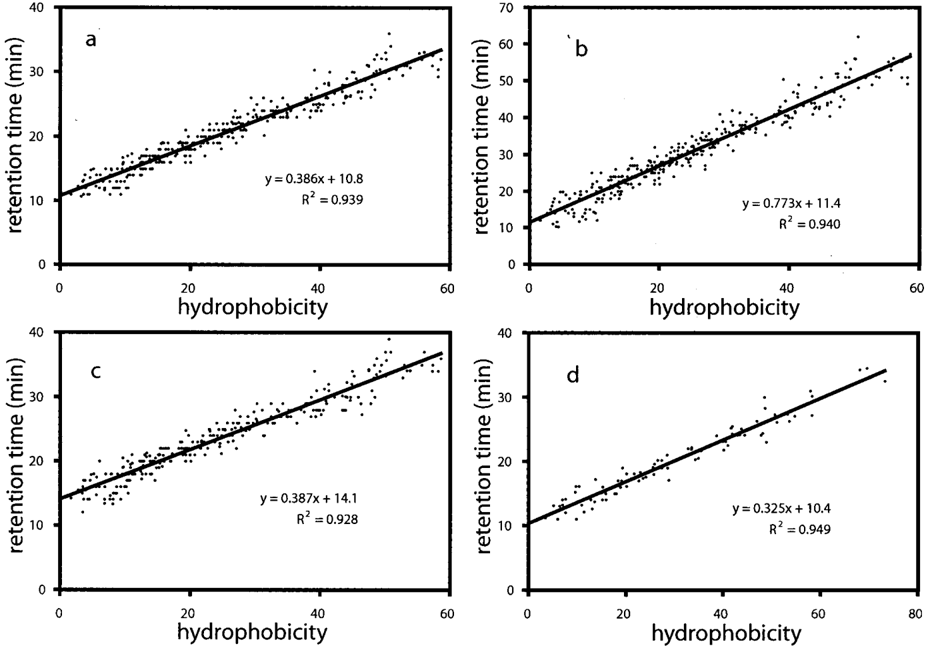
The proposed model is based on the measurement of the retention times of 346 tryptic peptides in the 560- to 4,000-Da mass range, derived from a mixture of 17 protein digests. These peptides were measured in HPLC-MALDI MS runs, with peptide identities confirmed by MS/MS. The model relies on summation of the retention coefficients of the individual amino acids, as in previous approaches, but additional terms are introduced that depend on the retention coefficients for amino acids at the N-terminal of the peptide. In the 17-protein mixture, optimization of two sets of coefficients, along with additional compensation for peptide length and hydrophobicity, yielded a linear dependence of retention time on hydrophobicity, with an R2 value about 0.94. The predictive capability of the model was used to distinguish peptides with close m/z values and for detailed peptide mapping of selected proteins. Its applicability was tested on columns of different sizes, from nano- to narrow-bore, and for direct sample injection, or injection via a pre-column. It can be used for accurate prediction of retention times for tryptic peptides on reversed-phase (300-A pore size) columns of different sizes with a linear water-ACN gradient and with TFA as the ion-pairing modifier.
Overview
The claims and statistics of this paper haven’t been checked yet.
Free: it reads the open-access text and checks the first 5 claims that cite a source we can check. Create a free account to check every claim.
Integrity signals
Registry
Cites
Statistics
Figures
Verification
Claims the paper makes
The claims and statistics of this paper haven’t been checked yet.
Free: it reads the open-access text and checks the first 5 claims that cite a source we can check. Create a free account to check every claim.
Claims other papers make about this one
Each is checked against this paper’s own text: does it say what the citing paper says it does?
The cited source says what the claim attributes to it.
In the citing paper
“Using the SSRC algorithm to determine the hydrophobicity coefficient of peptides de novo (Krokhin et al., 2004), we found that the peptides also eluted at the expected retention time based on their assigned sequences (Figure 4F).”
From Splice-Junction-Based Mapping of Alternative Isoforms in the Human Proteome (2019) · cites this paper as Krokhin et al., 2004
Self-check
Percentages, sums and reported differences re-computed from the paper’s own numbers.
The self-check needs the paper’s full text.
Citations
Cites
Electrospray Ionization for Mass Spectrometry of Large Biomolecules
Fenn, J. B., Mann, M., Meng, C. K., Wong, S. F., & Whitehouse, C. M. (1989) · Science · doi:10.1126/science.2675315 · Cited by 7,634 · cited 5×
“However, the optimum conditions for operation of the HPLC and the mass spectrometer are usually different, so on-line coupling of the HPLC to the mass spectrometer, as commonly used for ESI, may require undesirable compromises for both approaches, as well as requiring strict time constraints.”
BackgroundInfluentialLaser desorption ionization of proteins with molecular masses exceeding 10,000 daltons
Karas, M., & Hillenkamp, F. (1988) · Analytical Chemistry · doi:10.1021/ac00171a028 · Cited by 5,637 · cited 1×
“MALDI (2, 3) and ESI (4), as well as improved instrumentation.”
BackgroundQuantitative analysis of complex protein mixtures using isotope-coded affinity tags
Gygi, S. P., Rist, B., Gerber, S. A., Turecek, F., Gelb, M. H., & Aebersold, R. (1999) · Nature Biotechnology · doi:10.1038/13690 · Cited by 4,683
Direct analysis of protein complexes using mass spectrometry
Link, A. J., Eng, J., Schieltz, D. M., Carmack, E., Mize, G. J., Morris, D. R., Garvik, B. M., & Yates, J. R. (1999) · Nature Biotechnology · doi:10.1038/10890 · Cited by 2,237 · cited 4×
“large-scale high-throughput proteomics (9, 10), because of its”
BackgroundInfluentialMatrix-assisted laser desorption/ionization mass spectrometry of biopolymers.
Hillenkamp, F., Karas, M., Beavis, R. C., & Chait, B. T. (1991) · Analytical Chemistry · doi:10.1021/ac00024a716 · Cited by 1,930 · cited 2×
“9 5% (3) 5% (3) Glyceraldehyde-3-phosphate dehydrogenase (rabbit) 35.”
BackgroundSelf-citationMass Spectrometry in Proteomics
Aebersold, R., & Goodlett, D. R. (2001) · Chemical Reviews · doi:10.1021/cr990076h · Cited by 1,238 · cited 1×
“large-scale high-throughput proteomics (9, 10), because of its”
BackgroundAnalysis of Proteins and Proteomes by Mass Spectrometry
Mann, M., Hendrickson, R. C., & Pandey, A. (2001) · Annual Review of Biochemistry · doi:10.1146/annurev.biochem.70.1.437 · Cited by 1,219 · cited 2×
“molecules, such as membrane proteins (1) or species with”
BackgroundProteolytic 18O Labeling for Comparative Proteomics: Model Studies with Two Serotypes of Adenovirus
Yao, X., Freas, A., Ramirez, J., Demirev, P. A., & Fenselau, C. (2001) · Analytical Chemistry · doi:10.1021/ac001404c · Cited by 759 · cited 1×
“9 81% (12) 77% (9) -Lactalbumin (bovine) 14.”
Verma, R., Chen, S., Feldman, R., Schieltz, D., Yates, J., Dohmen, J., & Deshaies, R. J. (2000) · Molecular Biology of the Cell · doi:10.1091/mbc.11.10.3425 · Cited by 540 · cited 2×
“6 40% (8) 35% (6) Ribonuclease A (bovine) 14.”
Medzihradszky, K. F., Campbell, J. M., Baldwin, M. A., Falick, A. M., Juhasz, P., Vestal, M. L., & Burlingame, A. L. (2000) · Analytical Chemistry · doi:10.1021/ac990809y · Cited by 531
Research works printed but not linked: 4
- Krokhin, O., Cheng, K., Bykova, N., Ens, W., and Standing, K. G. (2003) An (off-line HPLC)-(orthogonal injection MALDI)-(QqTOFMS) instrument par- ticularly useful for the analysis of post-translational modifications. Exam- ples: I. Identification of two phosphorylated sites in tryptic peptides from the ABRF PRG03 sample (bovine protein disulphide isomerase). II. De novo sequencing and analysis of post-translational modifications on SARS viral proteins. 51 th ASMS Conference on Mass Spectrometry and Allied Topics, Montreal, June 8 -12
- Hu, P., Rejtar, T., Preisler, J., and Karger B. L. (2001) LC-MALDI/TOF MS analysis of complex peptide mixtures using vacuum deposition interface. 49th ASMS Conference on Mass Spectrometry and Allied Topics, Chi- cago, IL, May 27-31
- Rejtar, T., Chen, H., Moskovets, E., Li, L., Andreev, V., and Karger B. L. (2003) Universal deposition device for off-line coupling of LC to MALDI MS and MS/MS. 51th ASMS Conference on Mass Spectrometry and Allied Topics, Montreal, June 8 -12
- Krokhin, O., Qian, Y., McNabb, J. R., Spicer, V., Ens, W., and Standing, K. G. (2002) An off-line interface for HPLC and orthogonal MALDI TOF. 50th ASMS Conference on Mass Spectrometry and Allied Topics, Or- lando, FL, June 2-6
Cited by
Items 101–200 of 291
Informatics for peptide retention properties in proteomic LC‐MS
Shinoda, K., Sugimoto, M., Tomita, M., & Ishihama, Y. (2008) · PROTEOMICS · doi:10.1002/pmic.200700692 · Cited by 38
“Krokhin et al. [41] applied separate retention coefficients for amino acids at the N terminus of the peptide in addition to the peptide length, further improving the retention-coefficient model.”
BackgroundKrokhin, O. V., Ezzati, P., & Spicer, V. (2017) · Analytical Chemistry · doi:10.1021/acs.analchem.7b00537 · Cited by 36
Self-citationHigh-throughput proteomics using matrix-assisted laser desorption/ ionization mass spectrometry
Cramer, R., Gobom, J., & Nordhoff, E. (2005) · Expert Review of Proteomics · doi:10.1586/14789450.2.3.407 · Cited by 34
Yeung, D., Klaassen, N., Mizero, B., Spicer, V., & Krokhin, O. V. (2020) · Journal of Chromatography A · doi:10.1016/j.chroma.2020.460909 · Cited by 33
Self-citationConnexin multi-site phosphorylation: Mass spectrometry-based proteomics fills the gap
Chen, V. C., Gouw, J. W., Naus, C. C. G., & Foster, L. J. (2012) · Biochimica et Biophysica Acta (BBA) - Biomembranes · doi:10.1016/j.bbamem.2012.02.028 · Cited by 39
Hou, J., Cui, Z., Xie, Z., Xue, P., Wu, P., Chen, X., Li, J., Cai, T., & Yang, F. (2010) · Journal of Proteome Research · doi:10.1021/pr900646k · Cited by 35
Almeida, A., Gabriel, M., Firlej, V., Jaular, L. M., Lejars, M., Cipolla, R., Petit, F., Vogt, N., Jouve, M. J., Dingli, F., et al. (2022) · Journal of Extracellular Vesicles · doi:10.1002/jev2.12210 · Cited by 35
“Observed retention times from nonmodified peptide (excepted for Carbamidomethylation of cysteins) were averaged across all samples and plotted against the predicted hydrophobicity index calculated with an SSRCalc-based algorithm (Krokhin et al., 2004) using the R package ggplot2.”
Lu, Y., Zhou, X. W., Stemmer, P. M., & Reid, G. E. (2011) · Journal of the American Society for Mass Spectrometry · doi:10.1007/s13361-011-0190-0 · Cited by 32
Methods for the Analysis of Protein Phosphorylation–Mediated Cellular Signaling Networks
White, F. M., & Wolf‐Yadlin, A. (2016) · Annual Review of Analytical Chemistry · doi:10.1146/annurev-anchem-071015-041542 · Cited by 37
Lao, Y., Güngörmüşler, M., Shuvo, S. R., Verbeke, T. J., Spicer, V., & Krokhin, O. V. (2015) · Journal of Proteomics · doi:10.1016/j.jprot.2015.05.018 · Cited by 31
Self-citationLengqvist, J., Eriksson, H., Gry, M., Uhlén, K., Björklund, C., Bjellqvist, B., Jakobsson, P., & Lehtiö, J. (2010) · Amino Acids · doi:10.1007/s00726-010-0704-2 · Cited by 31
“However, it was soon realized that the existing algorithms needed improvements; more specifically, they should consider other peptide properties, such as length (Mant et al. 1988), secondary structures (Blondelle et al. 1995), sequencespecific correction factors and the ion-pairing separation mechanism ( Krokhin et al…”
BackgroundImproved Ranking Functions for Protein and Modification-Site Identifications
Bern, M. W., & Goldberg, D. T. (2008) · Journal of Computational Biology · doi:10.1089/cmb.2007.0119 · Cited by 31
“ComByne uses a model developed by Krokhin et al. (2004) with coefficients trained by Ted Jones (PPD Inc., Menlo Park, CA); this model computes a quantity called “retention index” as a weighted sum of contributions for each amino acid residue, along with peptide-length and N-and C-terminus…”
Spicer, V., & Krokhin, O. V. (2017) · Journal of Chromatography A · doi:10.1016/j.chroma.2017.12.046 · Cited by 31
Self-citationCharych, D. H., Coyne, M. Y., Yabannavar, A. V., Narberes, J., Chow, S., Wallroth, M., Shafer, C. M., & Walter, A. O. (2008) · Journal of Cellular Biochemistry · doi:10.1002/jcb.21698 · Cited by 31
“The method employs offline reverse phase HPLC fractionation followed by MALDI-qTOF tandem mass spectrometry on each of the HPLC fractions [Krokhin et al., 2004].”
MethodBöddi, K., Takátsy, A., Szabó, S. S., Markó, L., Márk, L., Wittmann, I., Ohmacht, R., Montskó, G., Vallant, R. M., Ringer, T., et al. (2009) · Journal of Separation Science · doi:10.1002/jssc.200800462 · Cited by 32
Enmark, M., Häggström, J., Samuelsson, J., & Fornstedt, T. (2022) · Journal of Chromatography A · doi:10.1016/j.chroma.2022.462999 · Cited by 334
Perlova, T. Y., Goloborodko, A. A., Margolin, Y., Pridatchenko, M. L., Tarasova, I. A., Gorshkov, A. V., Moskovets, E. V., Ivanov, A. R., & Gorshkov, M. V. (2010) · PROTEOMICS · doi:10.1002/pmic.200900837 · Cited by 29
Off-line coupling of microcolumn separations to desorption mass spectrometry
Peš, O., & Preisler, J. (2010) · Journal of Chromatography A · doi:10.1016/j.chroma.2010.02.058 · Cited by 30
Azoulay‐Shemer, T., Harpaz‐Saad, S., Cohen-Peer, R., Mett, A., Spicer, V., Lovat, N. E. J., Krokhin, O. V., Brand, A., Gidoni, D., Standing, K. G., et al. (2010) · Plant and Cell Physiology · doi:10.1093/pcp/pcq174 · Cited by 29
“For more detailed analyses, the proteolyzed fragments were separated into forty 1 min fractions by reversed-phase HPLC and deposited onto a MALDI target by a robot previously constructed in the Manitoba laboratory ( Krokhin et al. 2004 ).”
MethodSelf-citationPredicting Peptide Retention Times for Proteomics
Krokhin, O. V., & Spicer, V. (2010) · Current Protocols in Bioinformatics · doi:10.1002/0471250953.bi1314s31 · Cited by 31
Self-citationReimer, J. M., Shamshurin, D., Harder, M., Yamchuk, A., Spicer, V., & Krokhin, O. V. (2011) · Journal of Chromatography A · doi:10.1016/j.chroma.2011.05.079 · Cited by 28
Self-citationSpicer, V., Lao, Y., Shamshurin, D., Ezzati, P., Wilkins, J. A., & Krokhin, O. V. (2014) · Analytical Chemistry · doi:10.1021/ac503352h · Cited by 28
Self-citationCao, Y., Guan, Q., Sun, T., Wang, H., Leng, J., & Guo, Y. (2014) · Analytica Chimica Acta · doi:10.1016/j.aca.2014.08.027 · Cited by 27
“The anionic counterions of TFA could interact with the charged moiety of the derivatives [42], which improved the peak shapes and shortened the retention time.”
BackgroundUhplc For The Separation of Proteins And Peptides
Howard, J. W., Kay, R. G., Pleasance, S., & Creaser, C. S. (2012) · Bioanalysis · doi:10.4155/bio.12.283 · Cited by 30
Analysis of Glucose Transporter Topology and Structural Dynamics
Blodgett, D. M., Graybill, C. A., & Carruthers, A. (2008) · Journal of Biological Chemistry · doi:10.1074/jbc.m804802200 · Cited by 32
The Use of Targeted Proteomics to Determine the Stoichiometry of Large Macromolecular Assemblies
Ori, A., Andrés‐Pons, A., & Beck, M. (2014) · Methods in cell biology · doi:10.1016/b978-0-12-417160-2.00006-0 · Cited by 25
Han, D., Moon, S., Kim, Y., Ho, W., Kim, K., KANG, Y. Y., Jun, H., & Kim, Y. (2012) · Journal of Proteome Research · doi:10.1021/pr200990b · Cited by 28
McQueen, P., Spicer, V., Rydzak, T., Sparling, R., Levin, D. B., Wilkins, J. A., & Krokhin, O. V. (2012) · PROTEOMICS · doi:10.1002/pmic.201100425 · Cited by 25
“A number of novel peptide RP-HPLC retention prediction models were reported in the past 8 years [10–15].”
MethodSelf-citationPeptide retention prediction in reversed-phase chromatography: proteomic applications
Krokhin, O. V. (2012) · Expert Review of Proteomics · doi:10.1586/epr.11.79 · Cited by 25
Self-citationFundamentals of Protein Separations: 50 Years of Nanotechnology, and Growing
Egas, D. A., & Wirth, M. J. (2008) · Annual Review of Analytical Chemistry · doi:10.1146/annurev.anchem.1.031207.112912 · Cited by 25
RePLiCal: A QconCAT Protein for Retention Time Standardization in Proteomics Studies
Holman, S. W., McLean, L., & Eyers, C. E. (2016) · Journal of Proteome Research · doi:10.1021/acs.jproteome.5b00988 · Cited by 25
Chang, C., Yeung, D., Spicer, V., Ogata, K., Krokhin, O. V., & Ishihama, Y. (2021) · Journal of Proteome Research · doi:10.1021/acs.jproteome.1c00185 · Cited by 25
Self-citationDeep learning approaches for data-independent acquisition proteomics
Yang, Y., Lin, L., & Qiao, L. (2021) · Expert Review of Proteomics · doi:10.1080/14789450.2021.2020654 · Cited by 27
“Studies of peptide retention time prediction can be tracked back to the 1980s [48,49], and so far a variety of retention time prediction methods have been proposed [50], which can be divided into three primary categories: index-based methods such as SSRCalc [51], physiochemical modeling-based meth-ods like BioLCCC [52…”
Ludwig, C., & Aebersold, R. H. (2014) · Royal Society of Chemistry eBooks · doi:10.1039/9781782626985-00080 · Cited by 32
Standardization of retention time data for AMT tag proteomics database generation
Tarasova, I. A., Guryča, V., Pridatchenko, M. L., Gorshkov, A. V., Kieffer‐Jaquinod, S., Evreinov, V. V., Masselon, C., & Gorshkov, M. V. (2008) · Journal of Chromatography B · doi:10.1016/j.jchromb.2008.12.047 · Cited by 24
Samuelsson, J., Eiríksson, F. F., Åsberg, D., Þorsteinsdóttir, M., & Fornstedt, T. (2019) · Journal of Chromatography A · doi:10.1016/j.chroma.2019.03.043 · Cited by 24
Vu, H., Spicer, V., Gotfrid, A., & Krokhin, O. V. (2009) · Journal of Chromatography A · doi:10.1016/j.chroma.2009.11.065 · Cited by 24
Self-citationBioinformatic Challenges in Targeted Proteomics
Reker, D., & Malmström, L. (2012) · Journal of Proteome Research · doi:10.1021/pr300276f · Cited by 24
Analysis of iodinated peptides by LC-DAD/ESI ion trap mass spectrometry
Vergote, V., Bodé, S., Peremans, K. Y., Vanbree, H., Baert, B., Slegers, G., Burvenich, C., & Spiegeleer, B. M. J. D. (2006) · Journal of Chromatography B · doi:10.1016/j.jchromb.2006.11.028 · Cited by 24
Retention Characteristics of Peptides in RP-LC: Peptide Retention Prediction
Babushok, V. I., & Зенкевич, И. Г. (2010) · Chromatographia · doi:10.1365/s10337-010-1721-8 · Cited by 23
Greening, D. W., Kapp, E. A., & Simpson, R. J. (2017) · The Enzymes · doi:10.1016/bs.enz.2017.08.003 · Cited by 25
Afkham, H. M., Qiu, X., The, M., & Käll, L. (2016) · Bioinformatics · doi:10.1093/bioinformatics/btw619 · Cited by 24
She, Y., Krokhin, O. V., Spicer, V., Loboda, A. V., Garland, G., Ens, W., Standing, K. G., & Westmore, J. B. (2007) · Journal of the American Society for Mass Spectrometry · doi:10.1016/j.jasms.2007.02.008 · Cited by 21
Self-citationTarasova, I. A., Gorshkov, A. V., Evreinov, V. V., Adams, K., Zubarev, R. A., & Gorshkov, M. V. (2008) · Polymer Science Series A · doi:10.1134/s0965545x08030097 · Cited by 21
Öztürk, A., Donald, L. J., Li, L., Duckworth, H. W., & Duckworth, M. L. (2006) · Endocrinology · doi:10.1210/en.2006-0492 · Cited by 21
Berg, M., Parbel, A., Pettersen, H., Fenyö, D., & Björkesten, L. (2006) · Rapid Communications in Mass Spectrometry · doi:10.1002/rcm.2476 · Cited by 20
Jiang, X., Shamshurin, D., Spicer, V., & Krokhin, O. V. (2012) · Journal of Chromatography B · doi:10.1016/j.jchromb.2012.12.010 · Cited by 19
Self-citationYing, W., Perlman, D. H., Li, L., Théberge, R., Costello, C. E., & McComb, M. E. (2009) · Rapid Communications in Mass Spectrometry · doi:10.1002/rcm.4343 · Cited by 19
Badgett, M. J., Boyes, B. E., & Orlando, R. (2018) · Journal of Chromatography A · doi:10.1016/j.chroma.2017.12.055 · Cited by 19
“There have been some models that have incorporated optimized coefficients that are based on the distance from the termini, but excluding the coefficients derived from hydrophobic residues one spot over from the N-terminus, there were no other identified trends that suggested that doing the same would improve the fit o…”
BackgroundMethodResultInfluentialHoubart, V., Rozet, E., Matagne, A., Crommen, J., Servais, A., & Fillet, M. (2013) · Journal of Chromatography A · doi:10.1016/j.chroma.2013.09.036 · Cited by 18
Iwaniak, A., Mińkiewicz, P., Hrynkiewicz, M., Bucholska, J., & Darewicz, M. (2020) · Polish Journal of Food and Nutrition Sciences · doi:10.31883/pjfns/113532 · Cited by 18
“If there is no signifi cant difference in hydrophobicity, peptides with longer chains have usually longer retention times than these with shorter chains [Krokhin et al., 2004; Krokhin, 2006; Spicer et al., 2007; Dziuba et al., 2011].”
BackgroundMethodInfluentialIdentification of Variants of the High Plains virus Infecting Wheat in Kansas
Seifers, D. L., Martin, T. J., Harvey, T. L., Haber, S., Krokhin, O. V., Spicer, V., Ying, S., & Standing, K. G. (2009) · Plant Disease · doi:10.1094/pdis-93-12-1265 · Cited by 18
Self-citationMass Spectrometry-Based Protein Quantification
Chen, Y., Wang, F., Xu, F., & Yang, T. (2016) · Advances in experimental medicine and biology · doi:10.1007/978-3-319-41448-5_15 · Cited by 17
Selected Reaction Monitoring Applied to Quantitative Proteomics
Kiyonami, R., & Domon, B. (2010) · Methods in molecular biology · doi:10.1007/978-1-60761-780-8_9 · Cited by 17
May, D., Liu, Y., Law, W., Fitzgibbon, M., Wang, H., Hanash, S., & McIntosh, M. W. (2008) · Journal of Proteome Research · doi:10.1021/pr8004502 · Cited by 17
Schlösser, A., Vanselow, J. T., & Kramer, A. (2007) · Analytical Chemistry · doi:10.1021/ac0707784 · Cited by 17
Shamshurin, D., Spicer, V., & Krokhin, O. V. (2011) · Journal of Chromatography A · doi:10.1016/j.chroma.2011.06.092 · Cited by 16
Self-citationMRMaid 2.0: Mining PRIDE for Evidence-Based SRM Transitions
Fan, J., Mohareb, F. R., Bond, N. J., Lilley, K. S., & Bessant, C. (2012) · OMICS A Journal of Integrative Biology · doi:10.1089/omi.2011.0143 · Cited by 16
“This is used later to calculate estimated RT by the SSRCalc method (Krokhin et al., 2004).”
MRMaid: The SRM Assay Design Tool for Arabidopsis and Other Species
Fan, J., Mohareb, F. R., Jones, A. M. E., & Bessant, C. (2012) · Frontiers in Plant Science · doi:10.3389/fpls.2012.00164 · Cited by 17
Empirical approach to false discovery rate estimation in shotgun proteomics
Goloborodko, A. A., Mayerhofer, C., Zubarev, A. R., Tarasova, I. A., Gorshkov, A. V., Zubarev, R. A., & Gorshkov, M. V. (2010) · Rapid Communications in Mass Spectrometry · doi:10.1002/rcm.4417 · Cited by 17
Bodzioch, K., Bączek, T., Kaliszan, R., & Heyden, Y. V. (2008) · Journal of Pharmaceutical and Biomedical Analysis · doi:10.1016/j.jpba.2008.09.004 · Cited by 16
Husi, H., & Albalat, A. (2014) · Elsevier eBooks · doi:10.1016/b978-0-12-386882-4.00009-8 · Cited by 19
Analysis of RP-HPLC Loading Conditions for Maximizing Peptide Identifications in Shotgun Proteomics
Peterson, A. C., Hohmann, L. J., Huang, L. J., Kim, B., Eng, J. K., & Martin, D. B. (2009) · Journal of Proteome Research · doi:10.1021/pr9001417 · Cited by 22
Seeley, K. W., & Stevens, S. M. (2011) · Journal of Proteomics · doi:10.1016/j.jprot.2011.11.025 · Cited by 19
Liu, H., Yang, L. L., Khainovski, N., Dong, M., Hall, S. C., Fisher, S. J., Biggin, M. D., Jin, J., & Witkowska, H. E. (2011) · Analytical Chemistry · doi:10.1021/ac200911v · Cited by 15
OʼHanlon, T. P., Li, Z., Gan, L., Gourley, M. F., Rider, L. G., & Miller, F. W. (2011) · Arthritis Research & Therapy · doi:10.1186/ar3506 · Cited by 14
“The retention time is predicted using amino acid composition throughout the peptide and specifically at the amino-terminus, as well as peptide length, following the approach previously published [14], but trained on a data set similar to that acquired here.”
MethodGussakovsky, D., Anderson, G., Spicer, V., & Krokhin, O. V. (2020) · Journal of Separation Science · doi:10.1002/jssc.202000578 · Cited by 14
Self-citationRetention Time Prediction for TMT-Labeled Peptides in Proteomic LC-MS Experiments
Mizero, B., Villacrés, C., Spicer, V., Viner, R., Saba, J. A., Patel, B. B., Snovida, S. I., Jensen, P. J., Hühmer, A. F. R., & Krokhin, O. V. (2022) · Journal of Proteome Research · doi:10.1021/acs.jproteome.1c00833 · Cited by 13
Self-citationScrosati, P. M., & Konermann, L. (2023) · Analytical Chemistry · doi:10.1021/acs.analchem.2c05667 · Cited by 14
Design and Application of a Data-Independent Precursor and Product Ion Repository
Thalassinos, K., Vissers, J. P. C., Tenzer, S., Levin, Y., Thompson, J. W., Daniel, D., Mann, D., DeLong, M. R., Moseley, M. A., America, A. H. P., et al. (2012) · Journal of the American Society for Mass Spectrometry · doi:10.1007/s13361-012-0416-9 · Cited by 14
“[49], by obtaining linear fit parameters based on hydrophobicity [50] and standardizing to a reference.”
BackgroundCentrifugal methods and devices for rapid in‐gel digestion of proteins
Lazarev, A. V., Rejtar, T., Dai, S., & Karger, B. L. (2009) · Electrophoresis · doi:10.1002/elps.200800474 · Cited by 13
HLA export by melanoma cells decoys cytotoxic T cells to promote immune evasion
Chemla, Y., Itzhaki, O., Melamed, S., Weller, C., Sade, Y., Manich, P., Reshef, K., Xenidis, N., Maliah, A., Levy, G., et al. (2025) · Cell · doi:10.1016/j.cell.2025.11.020 · Cited by 13
Chen, W., McCool, E. N., Sun, L., Zang, Y., Ning, X., & Liu, X. (2022) · Journal of Proteome Research · doi:10.1021/acs.jproteome.2c00124 · Cited by 12
Ramesh, P., Nisar, M., Neha, Ammankallu, S., Babu, S., Nandakumar, R., Abhinand, C. S., Prasad, T. S. K., Codi, J. A. K., & Raju, R. (2024) · Journal of Proteomics · doi:10.1016/j.jprot.2024.105262 · Cited by 12
Proteomics Analysis of Embryo and Endosperm from Mature Common Buckwheat Seeds
Kamal, A. H. M., Jang, I.-D., Kim, D., Suzuki, T., Chung, K.-Y., Choi, J., Lee, M.-S., Park, C., Park, S. U., Lee, S. H., et al. (2011) · Journal of Plant Biology · doi:10.1007/s12374-010-9143-6 · Cited by 12
“Since the emPAI index does not require further experimentation in protein identification experiments, it is only suggested to be used routinely in the reporting of proteomic results ( Krokhin et al. 2004 ; I shihama et al. 2005 ;S hinoda et al.2010).”
Lu, W., Liu, X., Liu, S., Cao, W., Zhang, Y., & Yang, P. (2017) · Scientific Reports · doi:10.1038/srep43959 · Cited by 12
Amrhein, S., Oelmeier, S. A., Dismer, F., & Hubbuch, J. J. (2014) · The Journal of Physical Chemistry B · doi:10.1021/jp407390f · Cited by 12
Retention Time Prediction and Protein Identification
Henneman, A. A., & Palmblad, M. (2013) · Methods in molecular biology · doi:10.1007/978-1-62703-392-3_4 · Cited by 12
Ackloo, S. Z., & Loboda, A. V. (2004) · Rapid Communications in Mass Spectrometry · doi:10.1002/rcm.1775 · Cited by 12
tipNrich: A Tip-Based N-Terminal Proteome Enrichment Method
Lee, S., Ju, S., Kim, S. J., Choi, J., Kım, K., Kim, D., Jeon, E., & Lee, C. (2021) · Analytical Chemistry · doi:10.1021/acs.analchem.1c01722 · Cited by 12
Grigoryan, M., Shamshurin, D., Spicer, V., & Krokhin, O. V. (2013) · Analytical Chemistry · doi:10.1021/ac402310t · Cited by 11
Self-citationSánchez, A., Pérez‐Riverol, Y., González, L. J., Noda, J., Betancourt, L. H., Ramos, Y., Gil, J., Alvarez, R. V., Padrón, G., & Besada, V. (2010) · Analytical Chemistry · doi:10.1021/ac1012738 · Cited by 11
Modeling the separation of small peptides by cation‐exchange chromatography
Harscoat‐Schiavo, C., Raminosoa, F., Ronat-Heit, E., Vanderesse, R., & Marc, I. (2010) · Journal of Separation Science · doi:10.1002/jssc.201000112 · Cited by 11
Advances in mass spectrometry-based omics analysis of trace organics in water
Tang, Y., Craven, C. B., Wawryk, N. J. P., Qiu, J., Li, F., & Li, X. (2020) · TrAC Trends in Analytical Chemistry · doi:10.1016/j.trac.2020.115918 · Cited by 11
McQueen, P., & Krokhin, O. V. (2012) · Expert Review of Proteomics · doi:10.1586/epr.12.8 · Cited by 10
Self-citationTypic: A Practical and Robust Tool to Rank Proteotypic Peptides for Targeted Proteomics
Pauletti, B. A., Granato, D. C., Carnielli, C. M., Câmara, G. A., Normando, A. G. C., Telles, G. P., & Leme, A. F. P. (2022) · Journal of Proteome Research · doi:10.1021/acs.jproteome.2c00585 · Cited by 10
Membrane Protein Analyses Using Alkylated Trihydroxyacetophenone (ATHAP) as a MALDI Matrix
Fukuyama, Y., Nakajima, C., Izumi, S., & Tanaka, K. (2016) · Analytical Chemistry · doi:10.1021/acs.analchem.5b03700 · Cited by 10
Porto, D. L., da Silva, A. R. R., Oliveira, A. D. S., Nogueira, F. H. A., Fernandes‐Pedrosa, M. D. F., & Aragão, C. F. S. (2020) · Microchemical Journal · doi:10.1016/j.microc.2020.104921 · Cited by 10
Modeling Experimental Design for Proteomics
Eriksson, J. W., & Fenyö, D. (2010) · Methods in molecular biology · doi:10.1007/978-1-60761-842-3_14 · Cited by 10
“The surviving peptides are separated into fractions according to a separation model (12).”
Dziuba, J., Mińkiewicz, P., & Mogut, D. (2011) · Acta Scientiarum Polonorum Technologia Alimentaria · Cited by 9
Eisen, D., Planatscher, H., Hardie, D. B., Kraushaar, U., Pynn, C. J., Stoll, D., Borchers, C. H., Joos, T. O., & Poetz, O. (2013) · Journal of Proteomics · doi:10.1016/j.jprot.2013.02.017 · Cited by 9
Quantitative structure–chromatographic retention correlations of quinoline derivatives
Nekrasova, N. A., & Kurbatova, S. V. (2017) · Journal of Chromatography A · doi:10.1016/j.chroma.2017.02.063 · Cited by 9
Mizero, B., Yeung, D., Spicer, V., & Krokhin, O. V. (2021) · Journal of Chromatography A · doi:10.1016/j.chroma.2021.462584 · Cited by 9
Self-citationMining Proteomic MS/MS Data for MRM Transitions
Chem, J. A., Bianco, L., & Bessant, C. (2009) · Methods in molecular biology · doi:10.1007/978-1-60761-444-9_13 · Cited by 10
Dykstra, A. B., Lubinsky, T. G., Vitrac, H., Campuzano, I. D. G., Bondarenko, P. V., & Simone, A. R. (2024) · Analytical Chemistry · doi:10.1021/acs.analchem.4c05246 · Cited by 8
Yeung, D., Spicer, V., Zahedi, R. P., & Krokhin, O. V. (2023) · Computational and Structural Biotechnology Journal · doi:10.1016/j.csbj.2023.02.047 · Cited by 8
Self-citationRetention Time Prediction and Protein Identification
Henneman, A. A., & Palmblad, M. (2019) · Methods in molecular biology · doi:10.1007/978-1-4939-9744-2_4 · Cited by 8
The Future of Large-Scale Collaborative Proteomics
Dowsey, A. W., & Yang, G. (2008) · Proceedings of the IEEE · doi:10.1109/jproc.2008.925421 · Cited by 11
Hewel, J. A., & Emili, A. (2008) · PROTEOMICS - CLINICAL APPLICATIONS · doi:10.1002/prca.200800030 · Cited by 8
Chen, V. C., Chou, C., Hsieh, H., Perreault, H., & Khoo, K. (2008) · Journal of Mass Spectrometry · doi:10.1002/jms.1450 · Cited by 7
Metadata
- Authors
- Krokhin, O. V., Craig, R., Spicer, V., Ens, W., Standing, K. G., Beavis, R. C., & Wilkins, J. A.
- Affiliations
- University of Manitoba (CA)
- Corresponding author
- Krokhin, O.V.
- Venue
- Molecular & Cellular Proteomics
- Publisher
- Elsevier BV
- Published
- 2004-09
- Volume
- 3
- Issue
- 9
- Pages
- 908-919
- ISSN
- 1535-9476 (ISSN-L)
- OpenAlex
- W2133258252
- Cited by
- 284
- References
- 46
- Citations by year
- 2026: 6 · 2025: 6 · 2024: 6 · 2023: 9 · 2022: 13 · 2021: 12 · 2020: 9 · 2019: 7 · 2018: 5 · 2017: 15 · 2016: 9 · 2015: 6 · 2014: 14 · 2013: 15 · 2012: 22
- FWCI
- 5.58
- Type
- journal article
- Language
- en
- Open access
- hybrid
- doi.org
- Licence
- cc-by
- www.elsevier.com/tdm/userlicense/1.0/ (tdm)
- www.elsevier.com/legal/tdmrep-license (tdm)
- creativecommons.org/licenses/by/4.0/ (vor, 5852 d)
- Locations
- Molecular & Cellular Proteomics (publishedVersion, cc-by)
- PubMed (publishedVersion)
- Funders
- University of Manitoba
- National Institutes of Health
- Canadian Institutes of Health Research
- Natural Sciences and Engineering Research Council of Canada
- National Institute of General Medical Sciences (R01GM059240, GM 59240)
- Topics
- Physical Sciences › Chemistry › Spectroscopy › Advanced Proteomics Techniques and Applications
- Physical Sciences › Chemistry › Spectroscopy › Mass Spectrometry Techniques and Applications
- Physical Sciences › Chemistry › Analytical Chemistry › Analytical Chemistry and Chromatography
- Keywords
- retention time prediction, tryptic peptides, ion-pair reversed-phase HPLC, hydrophobicity, N-terminal amino acids, peptide length, peptide mapping, protein digests
- MeSH terms
- Amino Acid Sequence, Animals, Chromatography, High Pressure Liquid, Humans, Models, Theoretical, Molecular Sequence Data, Molecular Weight, Peptide Fragments, Peptide Mapping, Trypsin, Neural Networks, Computer, Spectrometry, Mass, Matrix-Assisted Laser Desorption-Ionization, Proteomics, Hydrophobic and Hydrophilic Interactions
About these checks
Registry, retraction, Cites and statistics results are computed, not judged, with one exception: a printed reference that no index lists is read once by a model before it counts as a citation error. Claims are extracted by a model and kept only when their quote appears verbatim in the text; each cited source is then checked, with a model’s help, for whether it says what the claim relies on. Those verdicts can be wrong — read the claim’s quote and the cited source before relying on one.
Statistics and arithmetic are recomputed, not judged.
Confidence bands are shown only for fields calibrated on our annotated test set. None is calibrated yet, so no band is shown.
What counts as a claim ›How we measure confidence ›How we check this ›
Are you an author, or do you see a problem with this page? Request a review
Data sources
Bibliographic data: Semantic Scholar, OpenAlex, Crossref.
Contains information from the Semantic Scholar Academic Graph Datasets, made available under the ODC Attribution License (ODC-BY 1.0).
Semantic Scholar’s data is described in: Kinney, R., et al. (2023). The Semantic Scholar Open Data Platform. arXiv:2301.10140.
