

Two-Stage Final Exams: An Assessment Strategy for Enhanced Collaborative Learning and Reduced Student Stress
Open accessThe DOI matches its Crossref record; 37 of the 38 references it cites were found in a registry or an index; 2 of the 5 sources its claims cite were checked for support.
Abstract
Two-stage exams, which pair a traditional individual exam with a subsequent collaborative, group exam, have been shown to enhance learning, retention, and student attitudes in midterm settings. This study investigates whether these benefits extend to final exam settings, compares the traditional final exam experience with a two-stage variation, and explores using an asynchronous group component to maintain the exam’s comprehensive nature. Within introductory courses at two different institutions, two formats for two-stage exams were implemented: one with a 2-hour individual exam followed by a 1-hour synchronous group exam and another with a 3-hour individual exam followed by an untimed, asynchronous group exam completed within 36 hours. Survey data comparing student experiences with two-stage midterm and final exams showed consistently positive responses at both institutions. When comparing two-stage final exams to traditional (individual-only) final exams, students reported greater perceived learning and anticipated retention, decreased anxiety, and an overwhelming preference for the two-stage format. These findings suggest that implementing a two-stage format for the final is feasible without compromising the evaluative purpose of a final exam, while maintaining high student motivation and engagement.
Overview
CoChat Summary
TL;DR
Two-stage final exams pairing individual and group stages in introductory physics courses at two institutions produced student reports of engagement, perceived learning, anticipated retention, reduced anxiety, and strong preference over traditional individual-only finals. Both a 2 hr individual + 1 hr group format and a 3 hr individual + 1.5 hr asynchronous group format were feasible.
Key findings
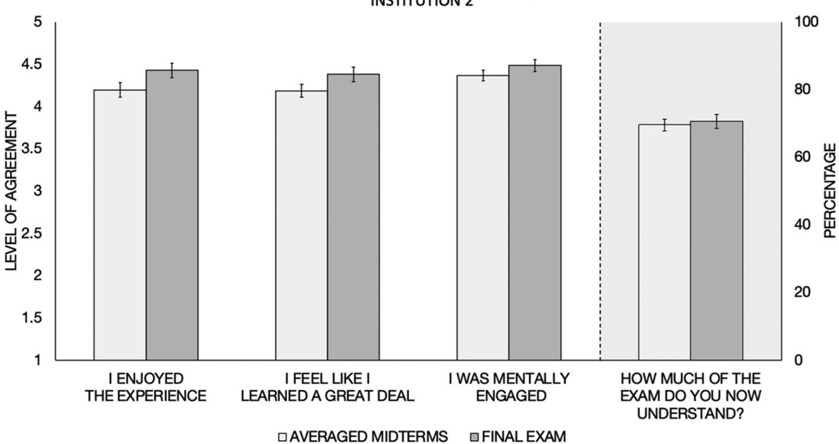
Students rated the final group exam experience as equivalent to or better than midterm group exams, with mental engagement during the final group exam as high as during midterm group exams even though they knew they would not be retested; the group exam accounted for 20% of the overall exam score at both institutions.
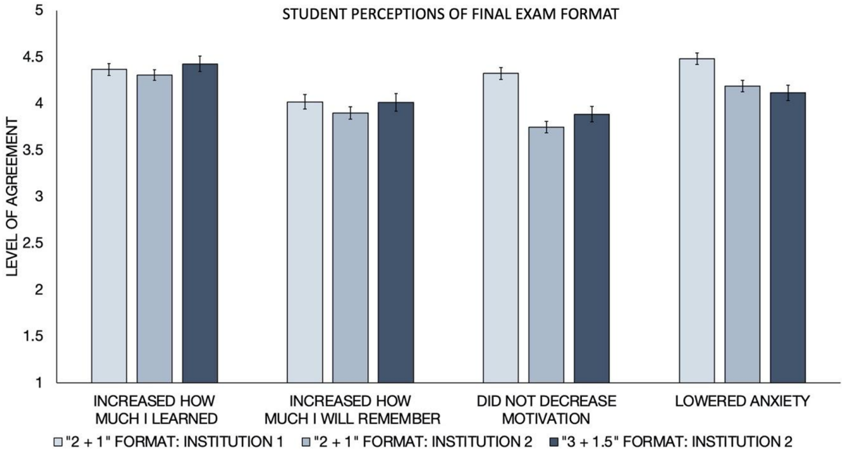
- In post-final surveys, students reported that the group portion increased how much they learned, likely increased what they would remember 3 months later, did not lower group members’ motivation, and lowered overall anxiety about the final exam compared with a traditional individual-only final.
- Additional Institution 1 courses: over 90% of 159 surveyed students preferred the “2 hr Individual + 1 hr Group” format over a traditional individual final. Self-perceived understanding rose from around 65% (±1.8%) to approximately 93% (±1.3%) in Physical Sciences 3 and from around 72% (±6%) to 92% (±5%) in Physics 15B after the group exam.
- Institution 2 students’ post-group perceptions of understanding were 20–25% lower than Institution 1, aligning with average exam scores at Institution 2 being consistently ∼20% lower; at both institutions these perceptions were significantly higher than average individual exam scores and within a few percentage points of average group exam scores.
Methods
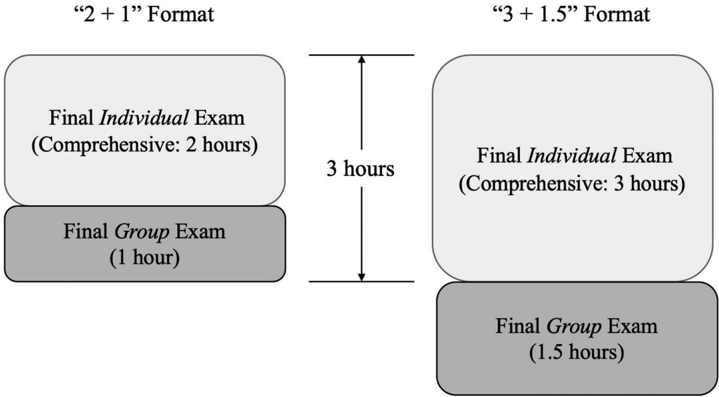
Three large-enrollment introductory physics courses at Harvard University (Institution 1) and the University of California, Merced (Institution 2); all featured two-stage midterms and a comprehensive two-stage final. Institution 1’s Physical Sciences 3 and Institution 2’s Introductory Physics II used “2 hr Individual + 1 hr Group”; Institution 2’s Introductory Physics I used “3 hr Individual + 1.5 hr Group” with the group stage asynchronous within 36 hours.
- The “2 + 1” format fit both stages within the Registrar’s three-hour window; the “3 + 1.5” format kept the full three-hour individual exam and added an asynchronous 1.5-hour group exam. Group stages were closed-book/closed-notes.
- Voluntary five-minute surveys followed each exam, using Likert items on enjoyment, perceived learning, mental engagement, feedback/understanding, and comparison to a traditional final. Response rates were 90% (160/178) at Institution 1, 87% (92/106) for the “3 hr Individual + 1.5 hr Group” course at Institution 2, and 94% (216/229) for the “2 hr Individual + 1 hr Group” course at Institution 2. Analyses used de-identified aggregate data; students indicated consent, and formal IRB review was not required under institutional policy.
Limitations
The paper states that a more direct comparison between two-stage and traditional final exams would have required assigning students to two groups, which would have been unpopular and likely unethical; the comparison therefore relies on student perceptions and is “not definitive.”
- The paper states that further research is needed on long-term impacts of two-stage final exams on student learning, retention, and well-being; the 3-month retention finding is anticipated, not directly measured.
- Evident from the text: the sample is limited to three introductory physics courses at two institutions in active-learning contexts, survey response rates were 87–94%, and the additional supporting data from two Institution 1 courses were described as not central to the study.
Model-written summary. Check it against the paper before relying on it.
Integrity signals
Registry
Cites
Statistics
Figures




Verification
Claims the paper makes
1 Valid · 0 Not valid · 2 Not checked · 26 Own results and interpretations
A result the paper reports from its own data — it cites no other source for it, so there is none to check. The quote shows it is in the paper.
In the paper
“The students' perceptions of how much they understood after completing the group exams at Institution 2 were 20-25% lower than those at Institution 1”
§ Two-Stage Final Exams: An Assessment Strategy for Enhanced Collaborative Learning and Reduced Student Stress > Comparing Two-Stage Midterm and Final Exams: The Student Experience
plain- Asserted: passes — The authors put it forward as true.
- Checkable: passes — It can be checked against evidence.
- Load-bearing: unclear — It is unclear whether the paper’s conclusions depend on it.
- Based: passes — The paper gives a reason why it holds.
A result the paper reports from its own data — it cites no other source for it, so there is none to check. The quote shows it is in the paper.
In the paper
“Survey data comparing student experiences with two-stage midterm and final exams showed consistently positive responses at both institutions.”
§ Two-Stage Final Exams: An Assessment Strategy for Enhanced Collaborative Learning and Reduced Student Stress > Abstract
plain- Asserted: passes — The authors put it forward as true.
- Checkable: passes — It can be checked against evidence.
- Load-bearing: passes — The paper’s conclusions depend on it.
- Based: passes — The paper gives a reason why it holds.
A result the paper reports from its own data — it cites no other source for it, so there is none to check. The quote shows it is in the paper.
In the paper
“an overwhelming preference for the twostage format.”
§ Two-Stage Final Exams: An Assessment Strategy for Enhanced Collaborative Learning and Reduced Student Stress > Abstract
boosted- Asserted: passes — The authors put it forward as true.
- Checkable: passes — It can be checked against evidence.
- Load-bearing: passes — The paper’s conclusions depend on it.
- Based: passes — The paper gives a reason why it holds.
- Rests on an assumption not shown here.
A result the paper reports from its own data — it cites no other source for it, so there is none to check. The quote shows it is in the paper.
In the paper
“students at both institutions indicated that they felt completing the final group exam increased how much they learned”
§ Two-Stage Final Exams: An Assessment Strategy for Enhanced Collaborative Learning and Reduced Student Stress > Comparing Two-Stage Final Exams to Traditional (Individual-Only) Final Exams: Student Opinions
hedgedstates a cause- Asserted: passes — The authors put it forward as true.
- Checkable: passes — It can be checked against evidence.
- Load-bearing: passes — The paper’s conclusions depend on it.
- Based: passes — The paper gives a reason why it holds.
- Rests on an assumption not shown here.
A result the paper reports from its own data — it cites no other source for it, so there is none to check. The quote shows it is in the paper.
In the paper
“Students at both institutions rated their experience with this format for the final group exam as equivalent to or better than a midterm group exam.”
§ Two-Stage Final Exams: An Assessment Strategy for Enhanced Collaborative Learning and Reduced Student Stress > Comparing Two-Stage Midterm and Final Exams: The Student Experience
plainn = 2- Asserted: passes — The authors put it forward as true.
- Checkable: passes — It can be checked against evidence.
- Load-bearing: passes — The paper’s conclusions depend on it.
- Based: passes — The paper gives a reason why it holds.
9 more claims
Create a free account to see all 29 claims and every source verdict.
- It may state two separate claims as one. 12
- The quote only partly states this claim. 2
- Probably not a substantial claim. 6
Self-check
Percentages, sums and reported differences re-computed from the paper’s own numbers.
Each contradiction between two passages listed here was confirmed by an independent check.
Rated major: it would touch a result — a value a result rests on, reported and recomputed p-values on opposite sides of the significance level, two passages that conflict with no sign which is right, or a cited work retracted before this paper was published.
In the paper
§ Two-Stage Final Exams: An Assessment Strategy for Enhanced Collaborative Learning and Reduced Student Stress > Abstract
“another with a 3-hour individual exam followed by an untimed, asynchronous group exam completed within 36 hours.”
§ Two-Stage Final Exams: An Assessment Strategy for Enhanced Collaborative Learning and Reduced Student Stress > Implementations of the Two-Stage Final Exam
“The "3 hr Individual + 1.5 hr Group" format consisted of a three-hour individual exam followed by a 1.5-hour group exam.”
Citations
Cites
The role of deliberate practice in the acquisition of expert performance
Ericsson, K. A., Krampe, R. T., & Tesch-Römer, C. (1993) · Psychological Review · doi:10.1037/0033-295x.100.3.363 · Cited by 9,564 · cited 1×
“…interactive lectures combine small-group activities and instructor feedback (Deslauriers et al., 2011; Deslauriers & Wieman, 2011; Beyer et al., 2016; McCarty & Deslauriers, 2020) and reinforce deliberate practice throughout (Ericsson et al, 1993; Miller et al., 2021, Dunleavy et al., 2022).”
Assessment and Classroom Learning
Black, P., & Wiliam, D. (1998) · Assessment in Education: Principles, Policy & Practice · doi:10.1080/0969595980050102 · Cited by 8,152 · cited 1×
“This stands in stark contrast to the feedback students receive on traditional exams, which tends to focus on correct thinking and is often delayed by as much as a week or more, thus providing little or no contribution to learning (Black & William, 1998; Bransford et al., 2004).”
Hestenes, D., Wells, M., & Swackhamer, G. (1992) · The Physics Teacher · doi:10.1119/1.2343497 · Cited by 3,235
Test-Enhanced Learning: Taking Memory Tests Improves Long-Term Retention
Roediger, H. L., & Karpicke, J. D. (2006) · Psychological Science · doi:10.1111/j.1467-9280.2006.01693.x · Cited by 2,867
Theobald, E. J., Hill, M. J., Tran, E., Agrawal, S., Arroyo, E. N., Behling, S., Chambwe, N., Cintrón, D. L., Cooper, J. D., Dunster, G., et al. (2020) · Proceedings of the National Academy of Sciences · doi:10.1073/pnas.1916903117 · Cited by 1,387 · cited 1×
“These perceptions, along with a likely reduction in stress and anxiety (see Figure 4), could benefit students from underrepresented groups and may thus reduce the achievement gap among underrepresented minorities (Harris et al., 2019; Theobald et al., 2020).”
Deslauriers, L., McCarty, L. S., Miller, K., Callaghan, K., & Kestin, G. (2019) · Proceedings of the National Academy of Sciences · doi:10.1073/pnas.1821936116 · Cited by 1,371 · cited 1×
“Under the direction of an instructor with active learning experience (Deslauriers et al., 2019), the 90-minute, biweekly, interactive lectures combine small-group activities and instructor feedback (Deslauriers et al., 2011; Deslauriers & Wieman, 2011; Beyer et al., 2016; McCarty & Deslauriers,…”
Self-citationImproved Learning in a Large-Enrollment Physics Class
Deslauriers, L., Schelew, E., & Wieman, C. (2011) · Science · doi:10.1126/science.1201783 · Cited by 1,270 · cited 1×
“…experience (Deslauriers et al., 2019), the 90-minute, biweekly, interactive lectures combine small-group activities and instructor feedback (Deslauriers et al., 2011; Deslauriers & Wieman, 2011; Beyer et al., 2016; McCarty & Deslauriers, 2020) and reinforce deliberate practice throughout…”
Self-citationEmotional Intensity Predicts Autobiographical Memory Experience
Talarico, J. M., LaBar, K. S., & Rubin, D. C. (2004) · Memory & Cognition · doi:10.3758/bf03196886 · Cited by 556
Test format and corrective feedback modify the effect of testing on long-term retention
Kang, S. H. K., McDermott, K. B., & Roediger, H. L. (2007) · European Journal of Cognitive Psychology · doi:10.1080/09541440601056620 · Cited by 513 · cited 1×
“Such testing options have the advantages of individual student accountability and a potential increase in long-term retention of the exam content due to the intensity of the experience (Talarico, 2004; Roediger & Karpicke, 2006; Kang et al., 2007).”
STUDENT RETENTION OF COURSE CONTENT IS IMPROVED BY COLLABORATIVE-GROUP TESTING
Cortright, R. N., Collins, H. L., Rodenbaugh, D. W., & DiCarlo, S. E. (2003) · Advances in Physiology Education · doi:10.1152/advan.00041.2002 · Cited by 215 · cited 2×
“…perception of the course (Gilley & Clarkston, 2014; Leight et al., 2012; Schindler, 2004; Stearns, 1996; Yu et al., 2010; Zipp, 2007); improved students’ relationships with groupmates (Cortright et al., 2003; Sandahl, 2010; Zipp, 2007); and reduced class dropout rates (Bruno, 2017; Stearns, 1996).”
Research works printed but not linked: 3
- Bransford, J. D., Brown, A. L., & Cocking, R. R. (2000). How people learn: Brain, mind, experience, and school. National Academy Press.
- Cooke, E. E., Barko, T. M., Cortright, R. N., & Collins, H. L. (2019). Collaborative testing and mixed-gender groups: Does gender influence performance? Journal of College Science Teaching, 48(4), 18–25.
- Wieman, C. E. (2012). Applying new research to improve science education. Issues in Science and Technology, 29(1), 47–78. https://issues.org/issue/29-1/#.X5yX6xptPkY.link
Cited by
Active learning through flexible collaborative exams: Improving assessments across disciplines
Callaghan, K., Kestin, G., Klales, A., McCarty, L., & Deslauriers, L. (2026) · Active Learning in Higher Education · doi:10.1177/14697874251344293 · Cited by 2
“…overall score based on a student’s individual performance also increases individual accountability and lessens the likelihood of any issues of free-loading, a possible but uncommon occurrence during collaborative exams (Callaghan et al., 2025; Levy et al., 2023; Rieger & Heiner, 2014; Zipp, 2007).”
Self-citation
Metadata
- Authors
- Callaghan, K., Milbourne, T., Klales, A., Kestin, G., Arguelles, C., McCarty, L., & Deslauriers, L.
- Affiliations
- Louisiana State University (US)
- Harvard University (US)
- Department of Physics, Harvard University
- Corresponding author
- Deslauriers, Louis
- Venue
- Journal of College Science Teaching
- Publisher
- Informa UK Limited
- Published
- 2026-02-06
- Volume
- 55
- Issue
- 2
- Pages
- 115-124
- ISSN
- 0047-231X (ISSN-L)
- 1943-4898
- OpenAlex
- W7128310790
- Cited by
- 1
- References
- 35
- Citations by year
- 2026: 1
- FWCI
- 21.20
- Type
- journal article
- Language
- en
- Open access
- hybrid
- doi.org
- Licence
- Locations
- The journal of college science teaching (publishedVersion, cc-by-nc-nd)
- arXiv (Cornell University) (submittedVersion)
- arXiv (Cornell University) (cc-by)
- Topics
- Social Sciences › Education › Student Assessment and Feedback
- Social Sciences › Psychology › Developmental and Educational Psychology › Innovative Teaching and Learning Methods
- Social Sciences › Education › Innovative Teaching Methods
- Keywords
- final examinations, cooperative learning, asynchronous assessment, student stress, test anxiety, student attitudes, introductory course, assessment methods, student motivation
About these checks
Registry, retraction, Cites and statistics results are computed, not judged, with one exception: a printed reference that no index lists is read once by a model before it counts as a citation error. Claims are extracted by a model and kept only when their quote appears verbatim in the text; each cited source is then checked, with a model’s help, for whether it says what the claim relies on. Those verdicts can be wrong — read the claim’s quote and the cited source before relying on one.
The claim verdicts this report counts are experimental: their accuracy is not yet measured.
A language model drew the claims from the paper on 2026-10-10, under version 3 of the claim definition (model deepseek-v4.1-flash, prompt extract-v3).
A second model labelled each claim on 2026-10-10 (model jev-1.13-20260917, definition revision gold-guideline-v0.2).
Statistics and arithmetic are recomputed, not judged.
Confidence bands are shown only for fields calibrated on our annotated test set. None is calibrated yet, so no band is shown.
What counts as a claim ›How we measure confidence ›How we check this ›
Are you an author, or do you see a problem with this page? Request a review
How to cite
Cite CoChat for the checks on this page, and the paper for its own findings.
- This page
- CoChat. (2026). Citation check: Two-Stage Final Exams: An Assessment Strategy for Enhanced Collaborative Learning and Reduced Student Stress. https://app.cochat.ai/papers/10.1080/0047231x.2026.2620442
- The paper
- Callaghan, K., Milbourne, T., Klales, A., Kestin, G., Arguelles, C., McCarty, L., & Deslauriers, L. (2026). Two-Stage Final Exams: An Assessment Strategy for Enhanced Collaborative Learning and Reduced Student Stress. Journal of College Science Teaching. https://doi.org/10.1080/0047231x.2026.2620442
Data sources
Bibliographic data: Semantic Scholar, OpenAlex, Crossref.
Contains information from the Semantic Scholar Academic Graph Datasets, made available under the ODC Attribution License (ODC-BY 1.0).
Semantic Scholar’s data is described in: Kinney, R., et al. (2023). The Semantic Scholar Open Data Platform. arXiv:2301.10140.
