

Peer feedback on academic writing: undergraduate students’ peer feedback role, peer feedback perceptions and essay performance
Open accessThe DOI matches its Crossref record; 37 of the 37 references it cites were found in a registry or an index.
Abstract
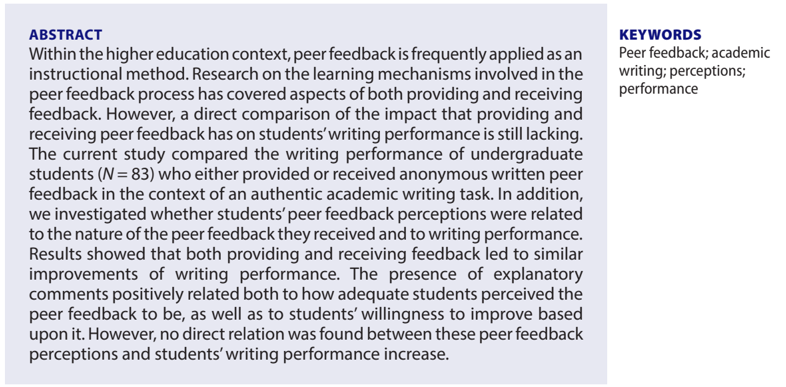
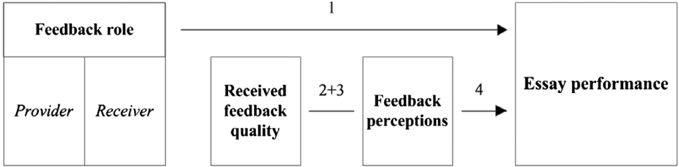
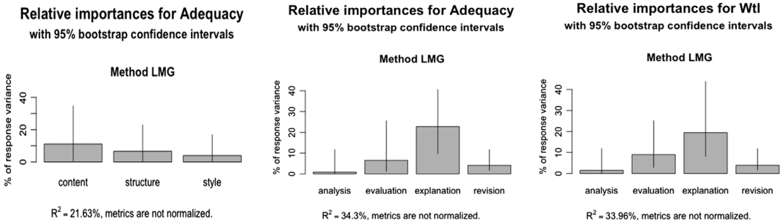
Within the higher education context, peer feedback is frequently applied as an instructional method. Research on the learning mechanisms involved in the peer feedback process has covered aspects of both providing and receiving feedback. However, a direct comparison of the impact that providing and receiving peer feedback has on students’ writing performance is still lacking. The current study compared the writing performance of undergraduate students (N = 83) who either provided or received anonymous written peer feedback in the context of an authentic academic writing task. In addition, we investigated whether students’ peer feedback perceptions were related to the nature of the peer feedback they received and to writing performance. Results showed that both providing and receiving feedback led to similar improvements of writing performance. The presence of explanatory comments positively related both to how adequate students perceived the peer feedback to be, as well as to students’ willingness to improve based upon it. However, no direct relation was found between these peer feedback perceptions and students’ writing performance increase.
Overview
The claims and statistics of this paper haven’t been checked yet.
Free: it reads the open-access text and checks the first 5 claims that cite a source we can check. Create a free account to check every claim.
Integrity signals
Registry
Cites
Statistics
Figures


Verification
Claims the paper makes
The claims and statistics of this paper haven’t been checked yet.
Free: it reads the open-access text and checks the first 5 claims that cite a source we can check. Create a free account to check every claim.
Claims other papers make about this one
Each is checked against this paper’s own text: does it say what the citing paper says it does?
The cited source says what the claim attributes to it.
In the citing paper
“The literature reveals that peer feedback has positive impacts on students' learning, such as improving professional skills (Brill, 2016; Lowell & Ashby, 2018), enhancing writing performance (Huisman et al., 2018; Nelson & Schunn, 2009; Noroozi et al., 2023; Shang, 2019), and fostering argumentation skills (Noroozi & Hatami, 2019).”
From Online peer feedback in higher education: A synthesis of the literature (2024) · cites this paper as Huisman et al., 2018
The cited source says what the claim attributes to it.
In the citing paper
“for example because it requires students to actively consider the assessment criteria (Huisman et al. 2018).”
From The impact of formative peer feedback on higher education students' academic writing: a Meta-Analysis (2019) · cites this paper as Huisman et al. 2018
Self-check
Percentages, sums and reported differences re-computed from the paper’s own numbers.
The self-check needs the paper’s full text.
Citations
Cites
Borenstein, M., Hedges, L. V., Higgins, J. P. T., & Rothstein, H. R. (2009) · doi:10.1002/9780470743386 · Cited by 14,225
Hattie, J., & Timperley, H. (2007) · Review of Educational Research · doi:10.3102/003465430298487 · Cited by 12,905 · cited 5×
“…and those involved in receiving peer feedback (e.g. receiving information on the discrepancies between current performance, goal performance, and how to close this gap; Hattie and Timperley 2007; Nicol and Macfarlane-Dick 2006), have a similar impact on students’ subsequent writing performance.”
BackgroundInfluentialBorenstein, M., Hedges, L. V., Higgins, J. P. T., & Rothstein, H. R. (2021) · doi:10.1002/9781119558378 · Cited by 9,799
Teachers' beliefs and educational research: cleaning up a messy construct
Pajares, M. F. (1992) · Review of Educational Research · doi:10.3102/00346543062003307 · Cited by 9,007 · cited 1×
“In that light, and as perceptions are likely to influence information processing (Pajares 1992), it may be considered somewhat surprising that students in the current study did perceive peer feedback as adequate when it included such explanatory comments, but that these perceptions – in turn – did…”
BackgroundNicol, D. J., & Macfarlane‐Dick, D. (2006) · Studies in Higher Education · doi:10.1080/03075070600572090 · Cited by 5,846
Relative Importance for Linear Regression in R : The Package relaimpo
Grömping, U. (2006) · Journal of Statistical Software · doi:10.18637/jss.v017.i01 · Cited by 2,615 · cited 2×
“1, R Core team 2017), the ‘relaimpo’ package (Groemping 2006) was applied to compare the relative contribution of the independent variables.”
MethodInfluentialHandbook of Research on Educational Communications and Technology
(2008) · Routledge eBooks · doi:10.4324/9780203880869 · Cited by 1,678
Peer feedback: the learning element of peer assessment
Liu, N.-F., & Carless, D. (2006) · Teaching in Higher Education · doi:10.1080/13562510600680582 · Cited by 1,034 · cited 1×
“On the other hand, the current study’s findings are in line with prior research by Schunn and colleagues (e.g. Cho, Schunn, and Wilson 2006).”
ResultRethinking feedback practices in higher education: a peer review perspective
Nicol, D., Thomson, A., & Breslin, C. (2014) · Assessment & Evaluation in Higher Education · doi:10.1080/02602938.2013.795518 · Cited by 966 · cited 4×
“…in authentic contexts indicate that students can perceive the benefits of providing peer feedback (Chen 2010), and that they may even consider this more beneficial to their learning than receiving feedback from peers (Ludemann and McMakin 2014; McConlogue 2015; Nicol, Thomson, and Breslin 2014).”
BackgroundResultInfluentialTo give is better than to receive: The benefits of peer review to the reviewer's own writing
Lundstrom, K., & Baker, W. (2009) · Journal of Second Language Writing · doi:10.1016/j.jslw.2008.06.002 · Cited by 843
Research works printed but not linked: 1
- Agricola, B., F. J. Prins, M. F. van der Schaaf, and J. van Tartwijk. 2016. 'Changes in Students' Self-Regulated Learning, Feedback Perception and Motivation during Undergraduate Research Projects.' In European Association for Research on Learning and Instruction (EARLI). Munich, Germany.
Cited by
Items 301–317 of 317
What have researchers examined? Capturing the conceptual diversity of peer feedback quality measures
Zhang, Y., & Schunn, C. D. (2026) · Studies In Educational Evaluation · doi:10.1016/j.stueduc.2026.101642
Liang, C., Chen, Y., Yan, Y., & Ogata, H. (2026) · Computers and Education Open · doi:10.1016/j.caeo.2026.100402
AI-Based Assessment of Revision-Associated Research Writing Development in a Peer-Feedback-Supported
Yahmadi, H. H. N. A. (2026) · Information · doi:10.3390/info17080744
Chen, S., Xue, A., Wang, S., Li, T., & Wang, T. (2026) · Learning Environments Research · doi:10.1007/s10984-026-09598-9
“Specifically, increased teacher support (Sadoughi & Hejazi, 2021; Wang et al., 2024) and peer support (Huisman et al., 2018; Yu & Lee, 2016) are positively associated with EFL learning outcomes among college students.”
Developmental Feedback as a High-Impact Teaching Practice
Till, L. V., Hernandez, I., & Cotter, K. A. (2026) · Active Learning in Higher Education · doi:10.1177/14697874261472912
Ma, X., Wang, D., & Chen, G. (2026) · The Journal of Educational Research · doi:10.1080/00220671.2026.2710208
Why So Much Writing? I Thought This Was an IT class
McKenna, C. J. (2026) · Business and Professional Communication Quarterly · doi:10.1177/23294906261472047
Accept, elaborate, modify, or no uptake?: Which peer feedback features matter?
Gao, X., Schunn, C. D., Gulikers, J. T. M., Banihashem, S. K., Biemans, H. J. A., & Noroozi, O. (2026) · Contemporary Educational Psychology · doi:10.1016/j.cedpsych.2026.102491
Examining Equitable, Student-Centered STEM Undergraduate Instruction Across Three U.S. Institutions
Orman, D. S. J. V., Hanley, D., Melton, J., & Gray, A. (2026) · Education Sciences · doi:10.3390/educsci16081346
“Another important strategy involves activating peers as resources for one another through collaborative and structured small-group work (Riebe et al., 2016; Scager et al., 2016) and peer feedback (Huisman et al., 2018, 2019; Wanner & Palmer, 2018).”
Murayama, K., Ohara, R., Koseki, Y., Yang, C.-L., Narumi, T., & Kuzuoka, H. (2026) · ACM Symposium on Applied Perception · doi:10.1145/3821409.3821473
Peer feedback quality matters for post-feedback outcomes: A meta-analysis
Alemdağ, E., Lipnevich, A. A., Bardach, L., & Lindner, M. A. (2026) · Educational Research Review · doi:10.1016/j.edurev.2026.100848
A self-regulated learning perspective on L2 learners’ engagement with peer feedback in writing
Cheng, X., & Teng, L. S. (2026) · Metacognition and Learning · doi:10.1007/s11409-026-09495-9 · Cited by 1
“Their favorable attitudes could be widely seen in previous studies (e.g., Huisman et al., 2018 ; Zhang & Gao, 2024 ).”
Zhang, S., & Guo, T. (2026) · Journal of Computing in Higher Education · doi:10.1007/s12528-026-09505-4
Reynolds, B. L., Bai, X., Wei, R., & Lei, Y. (2026) · Language Awareness · doi:10.1080/09658416.2026.2726930
Using AI-Powered Applications to Enhance Peer Feedback in the Online Classroom
Ahmadi, S., & Novak, E. (2026) · Emerald Group Publishing Limited eBooks · doi:10.1108/978-1-80791-234-520261010
Meng, Y., & Major, J. (2026) · Research Square · doi:10.21203/rs.3.rs-11275334/v1
Metadata
- Authors
- Huisman, B., Saab, N., van Driel, J., & van den Broek, P.
- Affiliations
- Leiden University (NL)
- Melbourne Graduate School of Teaching, The University of Melbourne, Melbourne, Australia
- Department of Educational Science, Leiden University, Leiden, The Netherlands
- Corresponding author
- Huisman, Bart
- Venue
- Assessment & Evaluation in Higher Education
- Publisher
- Informa UK Limited
- Published
- 2018-01-07
- Volume
- 43
- Issue
- 6
- Pages
- 955-968
- ISSN
- 0260-2938 (ISSN-L)
- 1469-297X
- OpenAlex
- W2783481537
- Cited by
- 318
- References
- 37
- Citations by year
- 2026: 38 · 2025: 32 · 2024: 57 · 2023: 64 · 2022: 37 · 2021: 44 · 2020: 24 · 2019: 17 · 2018: 5
- FWCI
- 72.96
- Type
- journal article
- Language
- en
- Open access
- hybrid
- doi.org
- Licence
- cc-by-nc-nd
- Locations
- Assessment & Evaluation in Higher Education (publishedVersion, cc-by-nc-nd)
- Leiden Repository (Leiden University) (submittedVersion)
- Data Archiving and Networked Services (DANS) (submittedVersion, other-oa)
- Topics
- Social Sciences › Education › Student Assessment and Feedback
- Social Sciences › Arts and Humanities › Language and Linguistics › EFL/ESL Teaching and Learning
- Social Sciences › Education › Evaluation of Teaching Practices
- Keywords
- peer feedback, academic writing, writing performance, receiving feedback, undergraduate students, essay writing
About these checks
Registry, retraction, Cites and statistics results are computed, not judged, with one exception: a printed reference that no index lists is read once by a model before it counts as a citation error. Claims are extracted by a model and kept only when their quote appears verbatim in the text; each cited source is then checked, with a model’s help, for whether it says what the claim relies on. Those verdicts can be wrong — read the claim’s quote and the cited source before relying on one.
Statistics and arithmetic are recomputed, not judged.
Confidence bands are shown only for fields calibrated on our annotated test set. None is calibrated yet, so no band is shown.
What counts as a claim ›How we measure confidence ›How we check this ›
Are you an author, or do you see a problem with this page? Request a review
Data sources
Bibliographic data: Semantic Scholar, OpenAlex, Crossref.
Contains information from the Semantic Scholar Academic Graph Datasets, made available under the ODC Attribution License (ODC-BY 1.0).
Semantic Scholar’s data is described in: Kinney, R., et al. (2023). The Semantic Scholar Open Data Platform. arXiv:2301.10140.
