

Peer feedback on academic writing: undergraduate students’ peer feedback role, peer feedback perceptions and essay performance
Open accessThe DOI matches its Crossref record; 37 of the 37 references it cites were found in a registry or an index.
Abstract
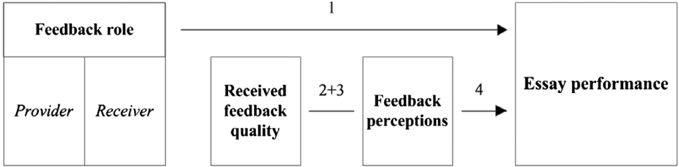
Within the higher education context, peer feedback is frequently applied as an instructional method. Research on the learning mechanisms involved in the peer feedback process has covered aspects of both providing and receiving feedback. However, a direct comparison of the impact that providing and receiving peer feedback has on students’ writing performance is still lacking. The current study compared the writing performance of undergraduate students (N = 83) who either provided or received anonymous written peer feedback in the context of an authentic academic writing task. In addition, we investigated whether students’ peer feedback perceptions were related to the nature of the peer feedback they received and to writing performance. Results showed that both providing and receiving feedback led to similar improvements of writing performance. The presence of explanatory comments positively related both to how adequate students perceived the peer feedback to be, as well as to students’ willingness to improve based upon it. However, no direct relation was found between these peer feedback perceptions and students’ writing performance increase.
Overview
The claims and statistics of this paper haven’t been checked yet.
Free: it reads the open-access text and checks the first 5 claims that cite a source we can check. Create a free account to check every claim.
Integrity signals
Registry
Cites
Statistics
Figures


Verification
Claims the paper makes
The claims and statistics of this paper haven’t been checked yet.
Free: it reads the open-access text and checks the first 5 claims that cite a source we can check. Create a free account to check every claim.
Claims other papers make about this one
Each is checked against this paper’s own text: does it say what the citing paper says it does?
The cited source says what the claim attributes to it.
In the citing paper
“The literature reveals that peer feedback has positive impacts on students' learning, such as improving professional skills (Brill, 2016; Lowell & Ashby, 2018), enhancing writing performance (Huisman et al., 2018; Nelson & Schunn, 2009; Noroozi et al., 2023; Shang, 2019), and fostering argumentation skills (Noroozi & Hatami, 2019).”
From Online peer feedback in higher education: A synthesis of the literature (2024) · cites this paper as Huisman et al., 2018
The cited source says what the claim attributes to it.
In the citing paper
“for example because it requires students to actively consider the assessment criteria (Huisman et al. 2018).”
From The impact of formative peer feedback on higher education students' academic writing: a Meta-Analysis (2019) · cites this paper as Huisman et al. 2018
Self-check
Percentages, sums and reported differences re-computed from the paper’s own numbers.
The self-check needs the paper’s full text.
Citations
Cites
Borenstein, M., Hedges, L. V., Higgins, J. P. T., & Rothstein, H. R. (2009) · doi:10.1002/9780470743386 · Cited by 14,225
Hattie, J., & Timperley, H. (2007) · Review of Educational Research · doi:10.3102/003465430298487 · Cited by 12,905 · cited 5×
“…and those involved in receiving peer feedback (e.g. receiving information on the discrepancies between current performance, goal performance, and how to close this gap; Hattie and Timperley 2007; Nicol and Macfarlane-Dick 2006), have a similar impact on students’ subsequent writing performance.”
BackgroundInfluentialBorenstein, M., Hedges, L. V., Higgins, J. P. T., & Rothstein, H. R. (2021) · doi:10.1002/9781119558378 · Cited by 9,799
Teachers' beliefs and educational research: cleaning up a messy construct
Pajares, M. F. (1992) · Review of Educational Research · doi:10.3102/00346543062003307 · Cited by 9,007 · cited 1×
“In that light, and as perceptions are likely to influence information processing (Pajares 1992), it may be considered somewhat surprising that students in the current study did perceive peer feedback as adequate when it included such explanatory comments, but that these perceptions – in turn – did…”
BackgroundNicol, D. J., & Macfarlane‐Dick, D. (2006) · Studies in Higher Education · doi:10.1080/03075070600572090 · Cited by 5,846
Relative Importance for Linear Regression in R : The Package relaimpo
Grömping, U. (2006) · Journal of Statistical Software · doi:10.18637/jss.v017.i01 · Cited by 2,615 · cited 2×
“1, R Core team 2017), the ‘relaimpo’ package (Groemping 2006) was applied to compare the relative contribution of the independent variables.”
MethodInfluentialHandbook of Research on Educational Communications and Technology
(2008) · Routledge eBooks · doi:10.4324/9780203880869 · Cited by 1,678
Peer feedback: the learning element of peer assessment
Liu, N.-F., & Carless, D. (2006) · Teaching in Higher Education · doi:10.1080/13562510600680582 · Cited by 1,034 · cited 1×
“On the other hand, the current study’s findings are in line with prior research by Schunn and colleagues (e.g. Cho, Schunn, and Wilson 2006).”
ResultRethinking feedback practices in higher education: a peer review perspective
Nicol, D., Thomson, A., & Breslin, C. (2014) · Assessment & Evaluation in Higher Education · doi:10.1080/02602938.2013.795518 · Cited by 966 · cited 4×
“…in authentic contexts indicate that students can perceive the benefits of providing peer feedback (Chen 2010), and that they may even consider this more beneficial to their learning than receiving feedback from peers (Ludemann and McMakin 2014; McConlogue 2015; Nicol, Thomson, and Breslin 2014).”
BackgroundResultInfluentialTo give is better than to receive: The benefits of peer review to the reviewer's own writing
Lundstrom, K., & Baker, W. (2009) · Journal of Second Language Writing · doi:10.1016/j.jslw.2008.06.002 · Cited by 843
Research works printed but not linked: 1
- Agricola, B., F. J. Prins, M. F. van der Schaaf, and J. van Tartwijk. 2016. 'Changes in Students' Self-Regulated Learning, Feedback Perception and Motivation during Undergraduate Research Projects.' In European Association for Research on Learning and Instruction (EARLI). Munich, Germany.
Cited by
Using artificial intelligence in academic writing and research: An essential productivity tool
Khalifa, M., & Albadawy, M. (2024) · Computer Methods and Programs in Biomedicine Update · doi:10.1016/j.cmpbup.2024.100145 · Cited by 580
Artificial Intelligence for Assessment and Feedback to Enhance Student Success in Higher Education
Hooda, M., Rana, C., Dahiya, O., Rizwan, A., & Hossain, M. S. (2022) · Mathematical Problems in Engineering · doi:10.1155/2022/5215722 · Cited by 444
Chien, S.-Y., Hwang, G.-J., & Jong, M. S.-Y. (2020) · Computers & Education · doi:10.1016/j.compedu.2019.103751 · Cited by 438
Huisman, B., Saab, N., van den Broek, P., & van Driel, J. (2019) · Assessment & Evaluation in Higher Education · doi:10.1080/02602938.2018.1545896 · Cited by 306
“The very act of providing peer feedback can be beneficial as well (Lundstrom and Baker 2009; Cho and MacArthur 2011; Cho and Cho 2011; Lee 2015), for example because it requires students to actively consider the assessment criteria (Huisman et al. 2018).”
BackgroundSelf-citationGuo, K., Pan, M., Li, Y., & Lai, C. (2024) · The Internet and Higher Education · doi:10.1016/j.iheduc.2024.100962 · Cited by 173
How does online peer feedback improve argumentative essay writing and learning?
Latifi, S., Noroozi, O., Hatami, J., & Biemans, H. J. A. (2021) · Innovations in Education and Teaching International · doi:10.1080/14703297.2019.1687005 · Cited by 137
“This is in line with previous studies that emphasise the positive e ff ects of scripts on the quality of students ’ written argumentative essays (Huisman et al., 2018; Noroozi et al., 2016).”
BackgroundResultFrom feedback to revisions: Effects of feedback features and perceptions
Wu, Y., & Schunn, C. D. (2020) · Contemporary Educational Psychology · doi:10.1016/j.cedpsych.2019.101826 · Cited by 135
“Explanatory comments have been found to be positively related to students’ understanding of peer feedback and students’ willingness to respond to it (Gielen et al., 2010; Huisman et al., 2018).”
BackgroundBauer, E., Greisel, M., Kuznetsov, I., Berndt, M., Kollar, I., Dresel, M., Fischer, M. R., & Fischer, F. (2023) · British Journal of Educational Technology · doi:10.1111/bjet.13336 · Cited by 130
“However, if learners lack motivation or are overwhelmed by feedback (Aben et al., 2022; Huisman et al., 2018, 2020; Strijbos et al., 2021), they can react maladaptively, for example, by ignoring the feedback (Butler & Winne, 1995).”
BackgroundWu, Y., & Schunn, C. D. (2021) · American Educational Research Journal · doi:10.3102/0002831220945266 · Cited by 118
“…have then also shown that these general document improvements appear to be the result of both receiving comments (Path 2; Huisman et al., 2018; Lu & Law, 2012; Paulus, 1999; M. Yang et al., 2006) and providing comments (Path 3; Huisman et al., 2018; Lu & Law, 2012; Philippakos & MacArthur, 2016).”
BackgroundResultInfluentialOnline peer feedback patterns of success and failure in argumentative essay writing
Kerman, N. T., Noroozi, O., Banihashem, S. K., Karami, M., & Biemans, H. J. A. (2024) · Interactive Learning Environments · doi:10.1080/10494820.2022.2093914 · Cited by 116
“…instructional strategies, students may still struggle with engaging in deep cognitive thinking skills during peer feedback processes which in turn may cause some students to be less successful or even unsuccessful regarding their writing performance (Huisman et al., 2018; Noroozi et al., 2020).”
BackgroundMethodInfluentialLatifi, S., Noroozi, O., & Talaee, E. (2023) · Interactive Learning Environments · doi:10.1080/10494820.2020.1799032 · Cited by 107
“Recently, online peer feedback has been used for various purposes such as improving students’ writing quality (e.g. Huisman et al., 2018), domain-specific learning (e.g. Latifi et al., 2019; Noroozi, Hatami, et al., 2018; Valero Haro et al., 2019), motivation (e.g. Hsia et al., 2016), self-efficacy…”
MethodOnline peer feedback in higher education: A synthesis of the literature
Kerman, N. T., Banihashem, S. K., Karami, M., Er, E., van Ginkel, S., & Noroozi, O. (2024) · Education and Information Technologies · doi:10.1007/s10639-023-12273-8 · Cited by 109
Noroozi, O., Banihashem, S. K., Taghizadeh Kerman, N., Parvaneh Akhteh Khaneh, M., Babaee, M., Ashrafi, H., & Biemans, H. J. A. (2023) · Interactive Learning Environments · doi:10.1080/10494820.2022.2034887 · Cited by 105
“…review (Mercader et al., 2020; Nelson & Schunn, 2009), students feedback literacy (Carless & Boud, 2018) and students perception of peer review (Huisman et al., 2018; Wu & Schunn, 2020b), however, gender impacts on uptake of the peer review has not been explicitly considered in the literature…”
BackgroundQuality of Feedback in Higher Education: A Review of Literature
Haughney, K., Wakeman, S., & Hart, L. (2020) · Education Sciences · doi:10.3390/educsci10030060 · Cited by 104
Lin, H., Hwang, G., Chang, S., & Hsu, Y. (2021) · Computers & Education · doi:10.1016/j.compedu.2021.104266 · Cited by 139
Huang, C., Tu, Y., Han, Z., Jiang, F., Wu, F. Q., & Jiang, Y. (2023) · Computers & Education · doi:10.1016/j.compedu.2023.104910 · Cited by 110
Making internal feedback explicit: exploiting the multiple comparisons that occur during peer review
Nicol, D., & McCallum, S. (2022) · Assessment & Evaluation in Higher Education · doi:10.1080/02602938.2021.1924620 · Cited by 90
“This research shows that in terms of performance improvements, students learn as much or more from reviewing and providing feedback on the work of peers than from receiving feedback comments from peers (lundstrom and Baker 2009; li, liu, and Steckelberg 2010: Cho and Cho 2011; Patchan and Schunn 2015; Huisman et al. 2…”
BackgroundResultInfluentialGrudges and gratitude: the social-affective impacts of peer assessment
Zhou, J., Zheng, Y., & Tai, J. H.-M. (2020) · Assessment & Evaluation in Higher Education · doi:10.1080/02602938.2019.1643449 · Cited by 88
“Previous studies have predominantly elicited students’ perceptions and emotions related to peer feedback via focus group discussions (Patton 2012), questionnaires (Huisman et al. 2018), interviews (Wang 2014; Zhu and Carless 2018) and stimulated recalls (Yu et al. 2018).”
BackgroundResultAudio peer feedback to promote deep learning in online education
Filius, R. M., de Kleijn, R. A. M., Uijl, S. G., Prins, F. J., van Rijen, H. V. M., & Grobbee, D. E. (2019) · Journal of Computer Assisted Learning · doi:10.1111/jcal.12363 · Cited by 84
Peer feedback to support collaborative knowledge improvement: What kind of feedback feed-forward?
Tan, J. S. H., & Chen, W. (2022) · Computers & Education · doi:10.1016/j.compedu.2022.104467 · Cited by 107
Wu, Y., & Schunn, C. D. (2023) · Contemporary Educational Psychology · doi:10.1016/j.cedpsych.2023.102160 · Cited by 78
Cao, Z., Yu, S., & Huang, J. (2019) · Studies in Educational Evaluation · doi:10.1016/j.stueduc.2019.08.001 · Cited by 78
A systematic review on peer assessment: intrapersonal and interpersonal factors
Panadero, E., Alqassab, M., Fernández Ruiz, J., & Ocampo, J. C. (2023) · Assessment & Evaluation in Higher Education · doi:10.1080/02602938.2023.2164884 · Cited by 80
“…Hwang, Hung, and Chen 2014; Lai and Hwang 2015; Hsia, Huang, and Hwang 2016; Kuo et al. 2017; Berndt, Strijbos, and Fischer 2018; Ersöz and Şad 2018; Huisman et al. 2018; Chien, Hwang, and Jong 2020; Hassell & Lee, 2019; Li 2019; Li, Gao, and Guo 2020; Chen et al. 2020; Lim, Son, and Kang 2021).”
BackgroundYu, S. (2019) · Assessing Writing · doi:10.1016/j.asw.2019.03.004 · Cited by 71
Does perception mean learning? Insights from an online peer feedback setting
Noroozi, O., Alqassab, M., Taghizadeh Kerman, N., Banihashem, S. K., & Panadero, E. (2025) · Assessment & Evaluation in Higher Education · doi:10.1080/02602938.2024.2345669 · Cited by 72
“One area of research that has attracted particular attention in recent years is using online peer feedback to teach argumentative writing (Huisman et al. 2018; Latifi, Noroozi, and Talaee 2021, 2023; Noroozi et al. 2023).”
Gao, Y., Schunn, C. D. D., & Yu, Q. (2019) · Assessment & Evaluation in Higher Education · doi:10.1080/02602938.2018.1499075 · Cited by 71
“…studies have in general followed a writer/reviewer/ comment-centric perspective, focusing on the features of comments as a whole and the effects of the reviewing process (Tsui and Ng 2000; Lundstrom and Baker 2009; Cho and Cho 2011; Zhao 2014; Berggren 2015; Walker 2015; Huisman et al. 2018).”
BackgroundFeedback-giving practice for L2 writing teachers: Friend or foe?
Yu, S. (2021) · Journal of Second Language Writing · doi:10.1016/j.jslw.2021.100798 · Cited by 71
Peer review in the classroom: student perceptions, peer feedback quality and the role of assessment
Gaynor, J. W. (2019) · Assessment & Evaluation in Higher Education · doi:10.1080/02602938.2019.1697424 · Cited by 92
“The implications for practice are similar to the recent Huisman et al. (2018) study previously mentioned.”
BackgroundResultStructural validity and invariance of the Feedback Perceptions Questionnaire
Strijbos, J.-W., Pat-El, R., & Narciss, S. (2021) · Studies in Educational Evaluation · doi:10.1016/j.stueduc.2021.100980 · Cited by 69
“Third, the FPQ has been used in various studies investigating perceptions of peer feedback (Berndt et al., 2018; Dijks, Brummer, & Kostons, 2018; Huisman, Saab, Van Driel, & Van den Broek, 2018; Peters, K ¨ orndle, & Narciss, 2018; Strijbos et al., 2010) teacher feedback (Agricola, Van der Schaaf,…”
MethodEFL student engagement with giving peer feedback in academic writing: A longitudinal study
Zhang, F., Schunn, C., Chen, S., Li, W., & Li, R. (2023) · Journal of English for Academic Purposes · doi:10.1016/j.jeap.2023.101255 · Cited by 63
What aspects of online peer feedback robustly predict growth in students' task performance?
Zong, Z., Schunn, C. D., & Wang, Y. (2021) · Computers in Human Behavior · doi:10.1016/j.chb.2021.106924 · Cited by 61
“…as not understandable, not actionable, incorrect, insufficient, or not persuasive, and these dimensions have been associated with the likelihood of acting on peer feedback (e.g., Nelson & Schunn, 2009; Kaufman & Schunn, 2011; Patchan et al., 2016; Huisman et al., 2018; Wu & Schunn, 2020a).”
BackgroundThe role of students’ epistemic beliefs for their argumentation performance in higher education
Noroozi, O. (2023) · Innovations in Education and Teaching International · doi:10.1080/14703297.2022.2092188 · Cited by 60
“…strategy that can be used for students’ argumentation-based learning especially in classes with a large cohort of students where educators cannot effectively support students’ argumentation with feedback due to high workload (Huisman et al., 2018; Latifi et al., 2021; Noroozi & Hatami, 2019).”
BackgroundPeer assessment as a learning and self-assessment tool: a look inside the black box
Stančić, M. (2020) · Assessment & Evaluation in Higher Education · doi:10.1080/02602938.2020.1828267 · Cited by 103
“…respect, some studies show that both providing and receiving peer feedback are beneficial (Mulder, Pearce, et al. 2014; Mulder, Baik, et al. 2014; Huisman et al. 2018; Wanner and Palmer 2018; Zhou, Zheng, and Tai 2020); while others suggest that students perceive that providing feedback to…”
BackgroundSchillings, M., Roebertsen, H., Savelberg, H., van Dijk, A., & Dolmans, D. (2021) · Higher Education Research & Development · doi:10.1080/07294360.2020.1798889 · Cited by 56
“Although empirical research reveals mainly positive student perceptions on peer feedback and students’ willingness to implement peer feedback (Huisman et al., 2018), positive findings are also reported regarding writing performance.”
BackgroundInfluentialFrom plans to actions: A process model for why feedback features influence feedback implementation
Wu, Y., & Schunn, C. D. (2021) · Instructional Science · doi:10.1007/s11251-021-09546-5 · Cited by 70
“Therefore, teachers are generally encouraged to use peer feedback in their instruction to enhance student learning (Gielen & De Wever, 2015a; Huisman et al., 2018; Topping, 1998).”
BackgroundMethodInfluentialFang, J.-W., Chang, S., Hwang, G., & Yang, G. (2021) · Educational Technology Research and Development · doi:10.1007/s11423-021-09990-7 · Cited by 69
Learning to improve the quality peer feedback through experience with peer feedback
Zong, Z., Schunn, C. D., & Wang, Y. (2020) · Assessment & Evaluation in Higher Education · doi:10.1080/02602938.2020.1833179 · Cited by 67
“…research has also demonstrated the effectiveness of peer feedback: students can increase knowledge and skills by receiving and providing feedback (Lundstrom and Baker 2009; Tsivitanidou, Zacharia, and Hovardas 2011; Huisman et al. 2018; Wichmann, Funk, and Rummel 2018; Wu and Schunn 2020a).”
BackgroundZhang, Y., Pi, Z., Chen, L., Zhang, X., & Yang, J. (2021) · Thinking Skills and Creativity · doi:10.1016/j.tsc.2021.100950 · Cited by 60
Connecting feedback to self-efficacy: Receiving and providing peer feedback in teacher education
Prilop, C. N., Weber, K. E., Prins, F. J., & Kleinknecht, M. (2021) · Studies In Educational Evaluation · doi:10.1016/j.stueduc.2021.101062 · Cited by 68
Understanding the what and when of peer feedback benefits for performance and transfer
Yu, Q., & Schunn, C. D. (2023) · Computers in Human Behavior · doi:10.1016/j.chb.2023.107857 · Cited by 43
“Conversely, other received feedback can be relatively superficial, not understandable, and (rarely) totally incorrect (Huisman et al., 2018; Patchan et al., 2016; Wu & Schunn, 2020a).”
BackgroundEvaluMate: Using AI to support students’ feedback provision in peer assessment for writing
Guo, K. (2024) · Assessing Writing · doi:10.1016/j.asw.2024.100864 · Cited by 59
Aben, J. E. J., Timmermans, A. C., Dingyloudi, F., Lara, M. M., & Strijbos, J.-W. (2022) · Learning and Individual Differences · doi:10.1016/j.lindif.2022.102175 · Cited by 53
Engaging with multiple sources of feedback in academic writing: postgraduate students’ perspectives
Xu, L., & Zhang, T. (2023) · Assessment & Evaluation in Higher Education · doi:10.1080/02602938.2022.2161089 · Cited by 40
“This finding confirms the benefit of engaging with peer feedback in improving writing and learning (Huisman et al. 2018; Fan and Xu 2020).”
BackgroundResultNursing students' experiences and perception of peer feedback: A qualitative systematic review
Wong, B. S. H., & Shorey, S. (2022) · Nurse Education Today · doi:10.1016/j.nedt.2022.105469 · Cited by 49
Effects of anonymity on online peer review in second-language writing
van den Bos, A. H., & Tan, E. (2019) · Computers & Education · doi:10.1016/j.compedu.2019.103638 · Cited by 38
Online peer feedback on video presentations: type of feedback and improvement of presentation skills
N. Z. Day, I., Saab, N., & Admiraal, W. (2022) · Assessment & Evaluation in Higher Education · doi:10.1080/02602938.2021.1904826 · Cited by 38
“However, previous research (Strijbos, Narciss, and Dünnebier 2010; Huisman et al. 2018) also found no relation between peer feedback beliefs or perceptions and results.”
ResultSelf-citationMaking internal feedback explicit: harnessing the comparisons students make during two-stage exams
Nicol, D., & Selvaretnam, G. (2021) · Assessment & Evaluation in Higher Education · doi:10.1080/02602938.2021.1934653 · Cited by 58
Bouwer, R., Lesterhuis, M., Bonne, P., & De Maeyer, S. (2018) · Frontiers in Education · doi:10.3389/feduc.2018.00086 · Cited by 37
Incidencia de la revisión por pares en la construcción de textos académicos a nivel universitario
Pereira, M. M. B. (2021) · DELTA Documentação de Estudos em Lingüística Teórica e Aplicada · doi:10.1590/1678-460x202153017 · Cited by 42
Making sense of generative AI for assessments: Contrasting student claims and assessor evaluations
Fischer, I., Sweeney, S., Lucas, M., & Gupta, N. (2024) · The International Journal of Management Education · doi:10.1016/j.ijme.2024.101081 · Cited by 101
Ho, P. V. P. (2019) · Computer Assisted Language Learning · doi:10.1080/09588221.2019.1609521 · Cited by 42
“Instructors training students to write essays in the higher education context use commentary activities extensively (Huisman, Saab, Driel, & Broek, 2018).”
BackgroundWu, W., Huang, J., Han, C., & Zhang, J. (2022) · Studies In Educational Evaluation · doi:10.1016/j.stueduc.2022.101140 · Cited by 54
Exploration of a group assessment model to foster student teachers’ critical thinking
Zhang, S., Li, H., Wen, Y., Zhang, Y., Guo, T., & He, X. (2023) · Thinking Skills and Creativity · doi:10.1016/j.tsc.2023.101239 · Cited by 48
Designing effective peer assessment processes in higher education: a systematic review
Fleckney, P., Thompson, J., & Vaz‐Serra, P. (2024) · Higher Education Research & Development · doi:10.1080/07294360.2024.2407083 · Cited by 81
“Whereas many students perceive peer assessment as positive (Huisman et al., 2018; Mulder et al., 2014a; Wanner & Palmer, 2018; Zhou et al., 2020), a significant proportion do not.”
Li, A. W. (2022) · Reading and Writing · doi:10.1007/s11145-022-10279-1 · Cited by 42
“1 3 Recent studies in ESL writing contexts have provided some empirical evidence for incorporating scoring rubrics into peer-mediated assessments (e.g., Becker, 2016; Chang et al., 2021; Huisman et al., 2018; Paré & Joordens, 2008).”
BackgroundLu, Q., Zhu, X., & Cheong, C. M. (2021) · Frontiers in Psychology · doi:10.3389/fpsyg.2021.739962 · Cited by 44
Brooks, C., Burton, R., der Kleij, F. M. V., Carroll, A., Olave-Encina, K., & Hattie, J. (2020) · Studies In Educational Evaluation · doi:10.1016/j.stueduc.2020.100943 · Cited by 46
Ko, E. G., & Lim, K. Y. (2021) · The Asia-Pacific Education Researcher · doi:10.1007/s40299-021-00562-0 · Cited by 49
Farrokhnia, M., Latifi, S., Papadopoulos, P. M., Hogenkamp, L., Gijlers, H., Khosravi, H., & Noroozi, O. (2026) · International Journal of Educational Technology in Higher Education · doi:10.1186/s41239-026-00579-9 · Cited by 55
Zhang, F., Min, H.-T., He, P., Chen, S., & Ren, S. (2023) · Assessing Writing · doi:10.1016/j.asw.2023.100770 · Cited by 30
Zhang, Y., Schunn, C. D., & Wu, Y. (2024) · International Journal of Educational Technology in Higher Education · doi:10.1186/s41239-024-00458-1 · Cited by 36
“; Huisman et al., 2018), typically measured using Likert scales.”
MethodCiampa, K., & Wolfe, Z. M. (2023) · Teaching in Higher Education · doi:10.1080/13562517.2020.1822313 · Cited by 26
“Cooperative learning is an instructional technique utilizing grouping structure in which students are divided into heterogeneous and/or homogeneous groups to complete instructional activities (Huisman et al. 2018; Zamani and Huang 2016).”
BackgroundInfluentialSupportive Peer Feedback in Tertiary Education: Analysis of Pre-Service Teachers’ Perceptions
Ortíz, D. C., Nogué, L., Serra, T., & Colomer, J. (2019) · Education Sciences · doi:10.3390/educsci9040280 · Cited by 33
“Indeed, the cumulative experience of multiple peer feedback occurrences over time may positively affect pre-service teachers’ attitudes, beliefs, and/or performance [17], and therefore favor positive perceptions of self-efficacy, and, later, perceptions of improved learning.”
BackgroundMethodHow do undergraduates perceive the use of assessment? A study in higher education
Pereira, D., Cadime, I., Brown, G., & Flores, M. A. (2021) · European Journal of Higher Education · doi:10.1080/21568235.2020.1871393 · Cited by 40
Chen, Y., Li, M., Cukurova, M., & Jong, M. S. (2023) · British Journal of Educational Technology · doi:10.1111/bjet.13376 · Cited by 28
“In particular, giving PF is regarded as a beneficial method to enhance learners’ writing performance as it enables them to actively consider the assessment rubrics (Huisman et al., 2018).”
Li, H. H., & Zhang, L. J. (2021) · PLoS ONE · doi:10.1371/journal.pone.0251569 · Cited by 48
“Some of them have investigated the nature of such interactions concerning what students talk about [39–41] as well as the functions and subjects of peer feedback interactions [42,43].”
BackgroundPeer Assessment in Writing Instruction
Yu, S. (2024) · Cambridge University Press eBooks · doi:10.1017/9781009429979 · Cited by 33
Motlhaka, H. A. (2020) · The Electronic Journal of e-Learning · doi:10.34190/ejel.20.18.4.006 · Cited by 39
“…others and thus becomes self-regulated, self-mediated and self-aware through feedback received from the environment (e.g. others, artifacts) and self-reflection on second language writers’ understanding and experience (Yu and Hu, 2017; Huisman et al, 2018; Zhao, 2018; Fathi and Khodabakhsh, 2019).”
BackgroundZong, Z., Schunn, C. D., & Wang, Y. (2021) · Assessment & Evaluation in Higher Education · doi:10.1080/02602938.2021.1968792 · Cited by 22
Teaching sourcing during online inquiry – adolescents with the weakest skills benefited the most
Hämäläinen, E. K., Kiili, C., Räikkönen, E., Lakkala, M., Ilomäki, L., Toom, A., & Marttunen, M. J. (2022) · Instructional Science · doi:10.1007/s11251-022-09597-2 · Cited by 29
“Importantly, peer feedback not only benefits the receiver but also the provider, as it requires students to actively consider the criteria for advanced sourcing (Huisman et al., 2018) and helps them to reflect on their own sourcing skills (Van Popta et al.”
BackgroundZhu, W., Yu, S., & Zheng, Y. (2023) · Assessment & Evaluation in Higher Education · doi:10.1080/02602938.2023.2235635 · Cited by 26
“As a common instructional strategy in second language (L2) writing classrooms, peer feedback could not only help promote learner engagement in revision (Huisman et al. 2018) and reader awareness (Berggren 2015), but also enhance peer interactions (Diab 2011).”
BackgroundZhang, Y., Chen, H., Pi, Z., & Yang, J. (2023) · Teaching and Teacher Education · doi:10.1016/j.tate.2023.104408 · Cited by 27
Rubric co-creation to promote quality, interactivity and uptake of peer feedback
Yan, D. “. (2024) · Assessment & Evaluation in Higher Education · doi:10.1080/02602938.2024.2333005 · Cited by 26
“Second, acceptance of peer feedback information is also influenced by a set of affective factors, e.g. socio-affective readiness, trust, disposition and attitude (Huisman et al. 2018).”
Leveraging integrated peer-assisted learning clusters as a support for online learning
Ala, O. G., Yang, H., & Ala, A. A. (2021) · Interactive Learning Environments · doi:10.1080/10494820.2021.1943454 · Cited by 26
“…(Nicol et al., 2014), types of feed-backs (Bayerlein, 2014; Lati fi et al., 2019), the role of gender (Noroozi et al., 2020), change in attitude (Huisman et al., 2018), and the contribution such feedbacks make on the students ’ essay writing skills and learning in general (Noroozi et al.,…”
BackgroundLu, Q., Yao, Y., & Zhu, X. (2023) · Assessing Writing · doi:10.1016/j.asw.2023.100725 · Cited by 35
The Power of Peer Learning: Fostering Students’ Learning Processes and Outcomes
Noroozi, O., & Wever, B. D. (2023) · Social interaction in learning and development · doi:10.1007/978-3-031-29411-2 · Cited by 34
Kerman, N. T., Banihashem, S. K., & Noroozi, O. (2023) · Social interaction in learning and development · doi:10.1007/978-3-031-29411-2_16 · Cited by 28
Rusli, R. B., Hashim, H. B., Yunus, M. M., Zakaria, N. Y. K., & Norman, H. (2019) · International Journal of Interactive Mobile Technologies (iJIM) · doi:10.3991/ijim.v13i11.10910 · Cited by 19
Peer review in academic writing: Different perspectives from instructors and students
Ahmed, R. A. (2020) · TESOL Journal · doi:10.1002/tesj.537 · Cited by 29
The influence of peer assessment training on assessment knowledge and reflective writing skill
Hoffman, B. (2019) · Journal of Applied Research in Higher Education · doi:10.1108/jarhe-01-2019-0004 · Cited by 16
Cui, Y., Jin, H., & Gao, Y. (2023) · Assessing Writing · doi:10.1016/j.asw.2023.100751 · Cited by 19
The role and features of peer assessment feedback in college English writing
Sun, Q., Chen, F., & Yin, S. (2023) · Frontiers in Psychology · doi:10.3389/fpsyg.2022.1070618 · Cited by 27
“In addition to that, teachers could guide peer reviewers to explain the problems upon identifying them, since explanatory comments have been found to be positively related to students’ understanding of peer feedback and students’ willingness to respond to it (Gielen et al., 2010; Huisman et al., 2018).”
BackgroundA bibliometric analysis of global research on education in the Scopus database, 2013–2022
Maral, M. (2024) · Global Knowledge, Memory and Communication · doi:10.1108/gkmc-01-2024-0039 · Cited by 46
Teaching Academic Literacies in international relations: towards a pedagogy of practice
Olsson, E. M., Gelot, L., Schaffer, J. K., & Litsegård, A. (2021) · Teaching in Higher Education · doi:10.1080/13562517.2021.1992753 · Cited by 26
Shadiev, R., Liu, J., & Yang, L. (2024) · Computer Assisted Language Learning · doi:10.1080/09588221.2023.2300990 · Cited by 26
“Peer evaluation is beneficial for learning, because learners need to consider the assessment criteria for judging the quality of work they evaluate (Hanjani & Li, 2014; Huisman et al., 2018).”
Rehman, N., Huang, X., Mahmood, A., Maqbool, S., & Javed, S. (2024) · New Directions for Child and Adolescent Development · doi:10.1155/2024/1271802 · Cited by 17
Effects of peer-editing on L2 writing achievement among secondary school students in Ethiopia
Sahle, S., Siawk, Y. A., & Gebremariam, H. T. (2023) · Cogent Education · doi:10.1080/2331186x.2023.2211467 · Cited by 19
“As a result, a review of the literature reveals a focus on the effect of peer-editing on writing achievement (for example, Chong, 2022; Huisman et al., 2018, 2019; Lee, 2017; Zhu & Carless, 2018), but a surprisingly limited discussion of the effect of peer-editing in each writing sub-skill in the…”
BackgroundMethodInfluentialACADEMIC INTEGRITY TEACHER TRAINING: PREVENTIVE PEDAGOGICAL PRACTICES ON THE COURSE LEVEL
Bjelobaba, S. (2021) · doi:10.11118/978-80-7509-772-9-0009 · Cited by 16
Indonesian Tertiary Education Students’ Academic Writing Setbacks and Solutions
Bram, B., & Angelina, P. (2022) · International Journal of Language Education · doi:10.26858/ijole.v6i3.22043 · Cited by 61
Goshu, K. C., & Gebremariam, H. T. (2024) · Ampersand · doi:10.1016/j.amper.2024.100195 · Cited by 28
Using Peer-Modo Feedback at the Pre-Writing Stage to Improve Year 4 Pupils’ Writing Performance
Yuk, A. C. K., & Yunus, M. M. (2021) · Journal of Education and e-Learning Research · doi:10.20448/journal.509.2021.81.116.124 · Cited by 16
Xue, S., Yang, Y., Du, J., & Liu, F. (2023) · Frontiers in Psychology · doi:10.3389/fpsyg.2023.1062517 · Cited by 12
“Student peer feedback offers several educational benefits for academic writing, for instance, it improves students’ communicative capabilities, facilitates meaningful interactions among peers, greatly engages students in learning, and offers new perspectives on writing (Huisman et al., 2018; Man et al., 2018).”
BackgroundShulgina, G., Costley, J., Щеглова, И. А., Zhang, H., & Sedova, N. S. (2024) · Smart Learning Environments · doi:10.1186/s40561-024-00315-8 · Cited by 20
“…suggests that giving feedback is more beneficial for a student’s writing performance than receiving it (Cho & MacArthur, 2011; Li et al., 2010; McCon-logue, 2015), whereas others evaluate both activities as equally effective for further text improvement (Huisman et al., 2018; Wu & Schunn, 2021).”
BackgroundTHE ROLE OF CORRECTIVE FEEDBACK ON ACADEMIC WRITING PERFORMANCE: EFL STUDENTS’ PERCEPTIONS
Wahyuningsih, S. E. (2020) · Edulingua Jurnal Linguistiks Terapan dan Pendidikan Bahasa Inggris · doi:10.34001/edulingua.v7i1.1167 · Cited by 12
Bylander, J., & Gustafsson, M. (2021) · European Journal of Physics · doi:10.1088/1361-6404/abcb57 · Cited by 15
“An additional mechanism at work in the peer review process is that of learning from being a reviewer and not only from getting review comments [68–70].”
BackgroundZhang, H., Southam, A., Fanguy, M., & Costley, J. (2021) · Interactive Technology and Smart Education · doi:10.1108/itse-01-2021-0011 · Cited by 15
Salem, A. A. M. S. (2022) · Frontiers in Education · doi:10.3389/feduc.2022.884709 · Cited by 26
“Peer feedback, for example, has been shown to improve students’ writing quality (Noroozi et al., 2016; Huisman et al., 2018; Noroozi and Hatami, 2019; Valero Haro et al., 2019), as well as students’ feedback quality (Gielen and De Wever, 2015; Noroozi et al., 2016; Huisman et al., 2018).”
BackgroundRetractedOpportunities and Challenges in Repeated Revisions to Pull-Requests: An Empirical Study
Li, Z., Yu, Y., Wang, T., Li, S., & Wang, H. (2022) · Proceedings of the ACM on Human-Computer Interaction · doi:10.1145/3555208 · Cited by 17
“This result reinforces the evidence of the positive effect of providing an explanation in feedback on the likelihood of implementation of the feedback [47, 109].”
ResultHoffmann, D. S., Kearns, K. D., Bovenmyer, K. M., Cumming, W. F. P., Drane, L. E., Gonin, M., Kelly, L. M., Rohde, L., Tabassum, S., & Blay, R. (2021) · Teaching & Learning Inquiry The ISSOTL Journal · doi:10.20343/9.1.15 · Cited by 12
Astrid, A., Rukmini, D., Fitriati, S. W., & Syafryadin, S. (2021) · Journal of language and Education · doi:10.17323/jle.2021.10585 · Cited by 24
Metadata
- Authors
- Huisman, B., Saab, N., van Driel, J., & van den Broek, P.
- Affiliations
- Leiden University (NL)
- Melbourne Graduate School of Teaching, The University of Melbourne, Melbourne, Australia
- Department of Educational Science, Leiden University, Leiden, The Netherlands
- Corresponding author
- Huisman, Bart
- Venue
- Assessment & Evaluation in Higher Education
- Publisher
- Informa UK Limited
- Published
- 2018-01-07
- Volume
- 43
- Issue
- 6
- Pages
- 955-968
- ISSN
- 0260-2938 (ISSN-L)
- 1469-297X
- OpenAlex
- W2783481537
- Cited by
- 318
- References
- 37
- Citations by year
- 2026: 38 · 2025: 32 · 2024: 57 · 2023: 64 · 2022: 37 · 2021: 44 · 2020: 24 · 2019: 17 · 2018: 5
- FWCI
- 72.96
- Type
- journal article
- Language
- en
- Open access
- hybrid
- doi.org
- Licence
- cc-by-nc-nd
- Locations
- Assessment & Evaluation in Higher Education (publishedVersion, cc-by-nc-nd)
- Leiden Repository (Leiden University) (submittedVersion)
- Data Archiving and Networked Services (DANS) (submittedVersion, other-oa)
- Topics
- Social Sciences › Education › Student Assessment and Feedback
- Social Sciences › Arts and Humanities › Language and Linguistics › EFL/ESL Teaching and Learning
- Social Sciences › Education › Evaluation of Teaching Practices
- Keywords
- peer feedback, academic writing, writing performance, receiving feedback, undergraduate students, essay writing
About these checks
Registry, retraction, Cites and statistics results are computed, not judged, with one exception: a printed reference that no index lists is read once by a model before it counts as a citation error. Claims are extracted by a model and kept only when their quote appears verbatim in the text; each cited source is then checked, with a model’s help, for whether it says what the claim relies on. Those verdicts can be wrong — read the claim’s quote and the cited source before relying on one.
Statistics and arithmetic are recomputed, not judged.
Confidence bands are shown only for fields calibrated on our annotated test set. None is calibrated yet, so no band is shown.
What counts as a claim ›How we measure confidence ›How we check this ›
Are you an author, or do you see a problem with this page? Request a review
Data sources
Bibliographic data: Semantic Scholar, OpenAlex, Crossref.
Contains information from the Semantic Scholar Academic Graph Datasets, made available under the ODC Attribution License (ODC-BY 1.0).
Semantic Scholar’s data is described in: Kinney, R., et al. (2023). The Semantic Scholar Open Data Platform. arXiv:2301.10140.
