

Peer feedback on academic writing: undergraduate students’ peer feedback role, peer feedback perceptions and essay performance
Open accessThe DOI matches its Crossref record; 37 of the 37 references it cites were found in a registry or an index.
Abstract
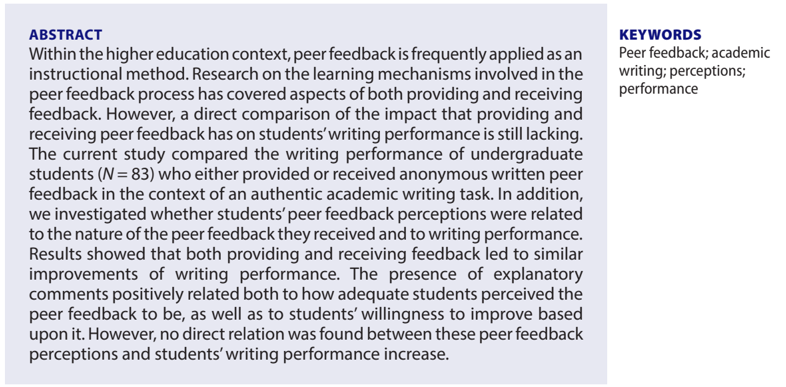
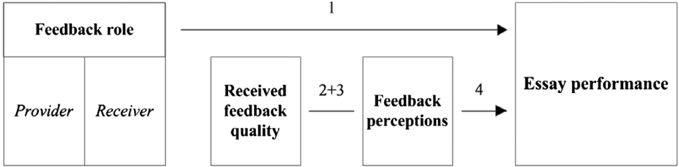
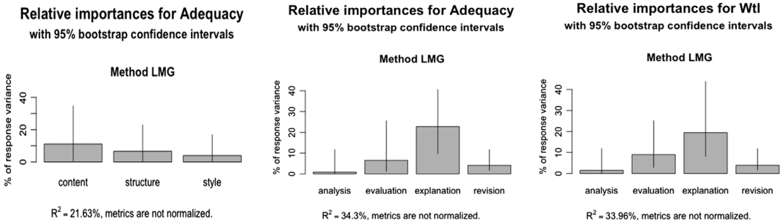
Within the higher education context, peer feedback is frequently applied as an instructional method. Research on the learning mechanisms involved in the peer feedback process has covered aspects of both providing and receiving feedback. However, a direct comparison of the impact that providing and receiving peer feedback has on students’ writing performance is still lacking. The current study compared the writing performance of undergraduate students (N = 83) who either provided or received anonymous written peer feedback in the context of an authentic academic writing task. In addition, we investigated whether students’ peer feedback perceptions were related to the nature of the peer feedback they received and to writing performance. Results showed that both providing and receiving feedback led to similar improvements of writing performance. The presence of explanatory comments positively related both to how adequate students perceived the peer feedback to be, as well as to students’ willingness to improve based upon it. However, no direct relation was found between these peer feedback perceptions and students’ writing performance increase.
Overview
The claims and statistics of this paper haven’t been checked yet.
Free: it reads the open-access text and checks the first 5 claims that cite a source we can check. Create a free account to check every claim.
Integrity signals
Registry
Cites
Statistics
Figures


Verification
Claims the paper makes
The claims and statistics of this paper haven’t been checked yet.
Free: it reads the open-access text and checks the first 5 claims that cite a source we can check. Create a free account to check every claim.
Claims other papers make about this one
Each is checked against this paper’s own text: does it say what the citing paper says it does?
The cited source says what the claim attributes to it.
In the citing paper
“The literature reveals that peer feedback has positive impacts on students' learning, such as improving professional skills (Brill, 2016; Lowell & Ashby, 2018), enhancing writing performance (Huisman et al., 2018; Nelson & Schunn, 2009; Noroozi et al., 2023; Shang, 2019), and fostering argumentation skills (Noroozi & Hatami, 2019).”
From Online peer feedback in higher education: A synthesis of the literature (2024) · cites this paper as Huisman et al., 2018
The cited source says what the claim attributes to it.
In the citing paper
“for example because it requires students to actively consider the assessment criteria (Huisman et al. 2018).”
From The impact of formative peer feedback on higher education students' academic writing: a Meta-Analysis (2019) · cites this paper as Huisman et al. 2018
Self-check
Percentages, sums and reported differences re-computed from the paper’s own numbers.
The self-check needs the paper’s full text.
Citations
Cites
Borenstein, M., Hedges, L. V., Higgins, J. P. T., & Rothstein, H. R. (2009) · doi:10.1002/9780470743386 · Cited by 14,225
Hattie, J., & Timperley, H. (2007) · Review of Educational Research · doi:10.3102/003465430298487 · Cited by 12,905 · cited 5×
“…and those involved in receiving peer feedback (e.g. receiving information on the discrepancies between current performance, goal performance, and how to close this gap; Hattie and Timperley 2007; Nicol and Macfarlane-Dick 2006), have a similar impact on students’ subsequent writing performance.”
BackgroundInfluentialBorenstein, M., Hedges, L. V., Higgins, J. P. T., & Rothstein, H. R. (2021) · doi:10.1002/9781119558378 · Cited by 9,799
Teachers' beliefs and educational research: cleaning up a messy construct
Pajares, M. F. (1992) · Review of Educational Research · doi:10.3102/00346543062003307 · Cited by 9,007 · cited 1×
“In that light, and as perceptions are likely to influence information processing (Pajares 1992), it may be considered somewhat surprising that students in the current study did perceive peer feedback as adequate when it included such explanatory comments, but that these perceptions – in turn – did…”
BackgroundNicol, D. J., & Macfarlane‐Dick, D. (2006) · Studies in Higher Education · doi:10.1080/03075070600572090 · Cited by 5,846
Relative Importance for Linear Regression in R : The Package relaimpo
Grömping, U. (2006) · Journal of Statistical Software · doi:10.18637/jss.v017.i01 · Cited by 2,615 · cited 2×
“1, R Core team 2017), the ‘relaimpo’ package (Groemping 2006) was applied to compare the relative contribution of the independent variables.”
MethodInfluentialHandbook of Research on Educational Communications and Technology
(2008) · Routledge eBooks · doi:10.4324/9780203880869 · Cited by 1,678
Peer feedback: the learning element of peer assessment
Liu, N.-F., & Carless, D. (2006) · Teaching in Higher Education · doi:10.1080/13562510600680582 · Cited by 1,034 · cited 1×
“On the other hand, the current study’s findings are in line with prior research by Schunn and colleagues (e.g. Cho, Schunn, and Wilson 2006).”
ResultRethinking feedback practices in higher education: a peer review perspective
Nicol, D., Thomson, A., & Breslin, C. (2014) · Assessment & Evaluation in Higher Education · doi:10.1080/02602938.2013.795518 · Cited by 966 · cited 4×
“…in authentic contexts indicate that students can perceive the benefits of providing peer feedback (Chen 2010), and that they may even consider this more beneficial to their learning than receiving feedback from peers (Ludemann and McMakin 2014; McConlogue 2015; Nicol, Thomson, and Breslin 2014).”
BackgroundResultInfluentialTo give is better than to receive: The benefits of peer review to the reviewer's own writing
Lundstrom, K., & Baker, W. (2009) · Journal of Second Language Writing · doi:10.1016/j.jslw.2008.06.002 · Cited by 843
Research works printed but not linked: 1
- Agricola, B., F. J. Prins, M. F. van der Schaaf, and J. van Tartwijk. 2016. 'Changes in Students' Self-Regulated Learning, Feedback Perception and Motivation during Undergraduate Research Projects.' In European Association for Research on Learning and Instruction (EARLI). Munich, Germany.
Cited by
Items 101–200 of 317
Facilitating Counselor Reflective Learning with a Real-time Annotation tool
Chen, T., Liu, M. X., Ding, E. Y., O'Neil, E., Agarwal, M., Kraut, R. E., & Dabbish, L. (2023) · CHI Conference on Human Factors in Computing Systems · doi:10.1145/3544548.3581551 · Cited by 15
“A study comparing the performance of undergraduate students who either provided or received written peer feedback in the context of a writing task found that both providing and receiving feedback led to similar improvements of writing performance [39].”
BackgroundTan, J. S. H., Chen, W., Su, J., & Su, G. (2023) · International Journal of Computer-Supported Collaborative Learning · doi:10.1007/s11412-023-09390-4 · Cited by 16
Li, W., Kau, K., & SHIUNG, Y.-J. (2023) · SAGE Open · doi:10.1177/21582440231209087 · Cited by 21
“Through the peer review process, student writers benefit from constructive criticism (Huisman et al., 2018; Weissbach & Pflueger, 2018), receive support that may reduce their writing anxiety, and develop into autonomous writers (Chaktsiris & Southworth, 2019).”
BackgroundBerry, D. N., Taylor, M. L., Nicolai, K. D., Koenka, A. C., Barnes, N., de Oliveira, L. C., & Zumbrunn, S. K. (2024) · Learning and Instruction · doi:10.1016/j.learninstruc.2024.102022 · Cited by 15
Gökoğlu, S., Yılmaz, F. G. K., & Yılmaz, R. (2024) · The International Review of Research in Open and Distributed Learning · doi:10.19173/irrodl.v25i4.7660 · Cited by 24
“Research has shown that peer feedback mechanisms, such as those applied in higher education contexts, have been frequently used as instructional methods to improve essay performance and student perceptions (Huisman et al., 2018).”
BackgroundAl-Obaydi, L. H., & Pikhart, M. (2025) · Language Testing in Asia · doi:10.1186/s40468-025-00375-8 · Cited by 21
“In this concern, studies have indicated that feedback quality, student writing (Huisman et al., 2018; Noroozi & Hatami, 2019), the support of formative practices of feedback (Boud, 2020), feedback literacy (Carless & Winstone, 2020), domain-specific knowledge gain (Valero Haro et al., 2019),…”
Exploring the Role of Training in Promoting Students’ Peer-Feedback Including Critical Peer-Feedback
Kaya, F., & Yaprak, Z. (2020) · Journal of Educational Research and Practice · doi:10.5590/jerap.2020.10.1.24 · Cited by 16
“Therefore, its usage is highly popular in the context of foreign language education, especially in higher levels (Huisman et al., 2018).”
BackgroundThe Teamwork Indicator – a feedback inventory for students in active group learning or team projects
Holen, A., & Sortland, B. (2021) · European Journal of Engineering Education · doi:10.1080/03043797.2021.1985435 · Cited by 18
“In higher education, peer feedback has lately becomemore frequently included in educational programs to improve learning (Huisman et al. 2018; Hulsman and Van Der Vloodt 2015).”
BackgroundTaking a closer look at how higher education students process and use (discrepant) peer feedback
Meenen, F. V., Masson, N., Catrysse, L., & Coertjens, L. (2022) · Learning and Instruction · doi:10.1016/j.learninstruc.2022.101711 · Cited by 16
Costley, J., Zhang, H., Courtney, M. G. R., Shulgina, G., Baldwin, M., & Fanguy, M. (2023) · Computer Assisted Language Learning · doi:10.1080/09588221.2023.2233573 · Cited by 17
“Moreover, peer editing has been widely used as a teaching strategy in L2 writing courses as a means to motivate students to offer suggestions on the drafts of their peers in order to improve their own writing (Huisman et al., 2018; Pham & Usaha, 2016; Yu & Lee, 2015; Zhu & Liu, 2020).”
When do students provide more peer feedback? The roles of performance and prior feedback experiences
Zong, Z., Schunn, C. D., & Wang, Y. (2023) · Instructional Science · doi:10.1007/s11251-023-09640-w · Cited by 13
“…been significant research examining the learning benefits of participating in peer feedback (e.g., Cho and Schunn, 2007 ; Lundstrom and Baker, 2009 ; van Zundert et al., 2010; Crinon, 2012; Adachi et al., 2018; Deiglmayr, 2018; Huisman et al., 2018; Martin and Evans, 2018 ; Zong et al., 2021a ).”
BackgroundXu, L., Hu, J., Su, Y., & Chen, X. (2024) · System · doi:10.1016/j.system.2024.103464 · Cited by 17
Huertas-Abril, C. A., Palacios-Hidalgo, F. J., & Parra, M. E. G. (2021) · RIED Revista Iberoamericana de Educación a Distancia · doi:10.5944/ried.24.2.28788 · Cited by 14
Deterring cheating using a complex assessment design: A case study
Bjelobaba, S. (2021) · The Literacy Trek · doi:10.47216/literacytrek.936053 · Cited by 12
“Previous research has shown that giving and receiving peer feedback can positively influence students’ writing performance (Huisman et al., 2018, 2019), promote language learning (Peeters, 2018), encourage silent students to participate in discussion (English, 2007), and encourage critical…”
BackgroundTaghizadeh Kerman, N., Banihashem, S. K., Noroozi, O., & Biemans, H. J. A. (2022) · 8th International Conference on Higher Education Advances (HEAd'22) · doi:10.4995/head22.2022.14445 · Cited by 6
Online peer editing: effects of comments and edits on academic writing skills
Zhang, H., Shulgina, G., Fanguy, M., & Costley, J. (2022) · Heliyon · doi:10.1016/j.heliyon.2022.e09822 · Cited by 18
“In the context of academic writing, both providing and receiving feedback may help students improve their writing skills as this kind of peer interaction allows students to gain knowledge from different perspectives through social sharing (Huisman et al., 2018).”
BackgroundAla, O. G., Hongtao, Y., & Ala, B. K. (2021) · Social Sciences & Humanities Open · doi:10.1016/j.ssaho.2021.100164 · Cited by 10
Hanafi, I., Kheder, K., Sabouni, R., Gorra Al Nafouri, M., Hanafi, B., Alsalkini, M., Kenjrawi, Y., Albkhetan, H., & Alhalabi, M. (2025) · Teaching and Learning in Medicine · doi:10.1080/10401334.2024.2332890 · Cited by 9
Supporting Collaborative Writing Tasks in Large-Scale Distance Education
Burchart, M., & Haake, J. M. (2024) · IEEE Transactions on Learning Technologies · doi:10.1109/tlt.2024.3355791 · Cited by 15
“Section VIII provides our conclusions and an outlook on future work.”
BackgroundWaluyo, B., & Panmei, B. (2024) · Journal of Technology and Science Education · doi:10.3926/jotse.2305 · Cited by 19
“In the context of Dutch university students, Huisman, Saab, Van Driel and Van Den Broek (2018) reported that both providing and receiving feedback led to comparable improvements in writing performance.”
BackgroundFinkenstaedt-Quinn, S. A., Watts, F. M., & Shultz, G. V. (2024) · Assessing Writing · doi:10.1016/j.asw.2024.100808 · Cited by 13
Bibliometric analysis of assessment and evaluation in higher education: 2012–2023
Sun, W., Ding, Y., Wang, R., Liu, Y., Wang, Y., Zhu, B. L., & Liu, Q. (2024) · Assessment & Evaluation in Higher Education · doi:10.1080/02602938.2024.2351602 · Cited by 13
van Blankenstein, F. M., O’Sullivan, J., Saab, N., & Steendijk, P. (2021) · BMC Medical Education · doi:10.1186/s12909-021-02755-z · Cited by 11
“To our knowledge, the criteria ‘ evaluation ’ , ‘ explanation ’ and ‘ suggestion ’ (or similar criteria) have only been used to analyse written peer feedback on academic writing [54 – 57] or concept maps [58].”
MethodSelf-citationEffect of Peer Feedback on Paragraph Writing Performance among High School Students
Trang, N. H., & Khau, A. H. (2022) · International Journal of Instruction · doi:10.29333/iji.2022.15211a · Cited by 17
Xie, Q., & Chang, Z. (2024) · Computers & Education · doi:10.1016/j.compedu.2024.105167 · Cited by 14
Online peer assessment in Galenic Pharmacy: enhancing evaluative judgement in higher education
Cano, E., Halbaut, L., Martins, L., & Molins, L. L. (2024) · Medical Education Online · doi:10.1080/10872981.2024.2409487 · Cited by 10
“Students’ perceptions of feedback have been systematically analysed [14–16] and appear to diverge from teachers’ perceptions.”
BackgroundConsistency in providing peer feedback: the role of individual and situational factors
Gao, X., Schunn, C. D., Noroozi, O., Gulikers, J. T. M., Banihashem, S. K., & Biemans, H. J. A. (2025) · Assessment & Evaluation in Higher Education · doi:10.1080/02602938.2025.2517617 · Cited by 12
“This is consistent with previous research suggesting that essay characteristics (i.e. content, structure, or style) do not substantially impact the general quality of peer feedback (Huisman et al. 2018).”
InfluentialEffect of self‐constructed concept map with peer feedback on chemistry learning outcome
Oni, O. S., Adesope, O., Wong, R. M., & Nishida, K. R. A. (2023) · School Science and Mathematics · doi:10.1111/ssm.12562 · Cited by 15
Shulgina, G., Fanguy, M., Zhang, H., Courtney, M. G. R., Baldwin, M., & Costley, J. (2024) · Computers & Education · doi:10.1016/j.compedu.2024.105104 · Cited by 10
Xiaomeng, Z., & Ravindran, L. (2024) · Studies In Educational Evaluation · doi:10.1016/j.stueduc.2024.101422 · Cited by 24
Hysaj, A., Freeman, M. B., & Khan, Z. R. (2023) · Lecture notes in computer science · doi:10.1007/978-3-031-35927-9_5 · Cited by 11
Li, K., Li, Y., Wang, Y., Chen, Y., & Hu, W. W. (2024) · Instructional Science · doi:10.1007/s11251-024-09690-8 · Cited by 8
“Peer feedback helps facilitate learner-centered processes and collaborative learning (Choi et al., 2021), and allows individuals to learn from giving and receiving feedback (Huisman et al., 2018; Sapouna, 2018).”
Zhang, Y., Schunn, C. D., & Wu, Y. (2025) · Contemporary Educational Psychology · doi:10.1016/j.cedpsych.2025.102397 · Cited by 11
An In-Depth Glimpse into Research on Academic Writing
Raitskaya, L., & Тихонова, Е. В. (2022) · Journal of language and Education · doi:10.17323/jle.2022.14586 · Cited by 15
Students’ perspective toward anonymous peer feedback in online writing classes
Ting, K.-Y. (2023) · Interactive Learning Environments · doi:10.1080/10494820.2023.2201322 · Cited by 9
“Feedback can comprise comments, questions, and suggestions (Huisman et al., 2018).”
Chen, W., Lyu, Q., & Su, J. (2024) · Instructional Science · doi:10.1007/s11251-024-09667-7 · Cited by 9
“Nevertheless, successful peer feedback is not promised by digital affordances, and students and students still face difficulties engaging in deep cognitive thinking processes (Huisman et al., 2018; Noroozi et al., 2020 ).”
The Impact of Negotiation as a Social Practice on EFL Writing Peer Assessment Sessions
Alqarni, T., & Alshakhi, A. (2021) · Theory and Practice in Language Studies · doi:10.17507/tpls.1110.23 · Cited by 7
“On the other hand, another study carried out by Huisman et al. (2018) aimed to compare the writing performance of undergraduate students who had provided or received anonymous written peer feedback in the context of academic writing.”
BackgroundKurniawati, K. (2022) · Journal of English Educational Study (JEES) · doi:10.31932/jees.v5i1.1609 · Cited by 15
Digital peer feedback on visual ideas: a study of eighth-grade students in visual art
Forslind, E.-L., Hrastinski, S., & Forsler, I. (2023) · Interactive Learning Environments · doi:10.1080/10494820.2022.2164785 · Cited by 12
“At the same time, visual skills are also sharpened by observing the visual ideas of others, and how these ideas are formulated, composed and designed (Lee et al., 2021; Huisman et al., 2018; Lati fi et al., 2020, 2021).”
InfluentialComparing motivational features between feedback givers and receivers in English speaking class
Su, W. (2022) · IRAL - International Review of Applied Linguistics in Language Teaching · doi:10.1515/iral-2021-0197 · Cited by 8
Fan, Y., & Xie, Z. (2024) · System · doi:10.1016/j.system.2024.103589 · Cited by 12
Huang, T., Wu, C., Zhang, W., & Chen, Y. (2025) · SAGE Open · doi:10.1177/21582440251344016 · Cited by 16
“Furthermore, feedback from the teacher and peers helped them to recognize and correct their mistakes in mechanics, and this also strengthened their understanding of mechanics further (Huisman et al., 2018).”
Heil, J., & Ifenthaler, D. (2025) · Assessment & Evaluation in Higher Education · doi:10.1080/02602938.2025.2530452 · Cited by 14
Applying, not ignoring: how feedback uptake and neural synchrony drive creativity
Yin, J., Jin, Z., Zhang, Y., Li, X., Li, Y., Zhang, G., & Luo, J. (2025) · npj Science of Learning · doi:10.1038/s41539-025-00351-0 · Cited by 6
“It is crucial to emphasize that how feedback receivers process information plays a decisive role in their ability enhancement 19,20 .”
The Effects of Peer Feedback on EFL Students’ Writing Performance
Trang, N. H. (2022) · Vietnam Journal of Education (online)/Vietnam Journal of Education/Giáo dục · doi:10.52296/vje.2022.185 · Cited by 15
“The current positive results are also advocated by Huisman et al. (2018), who discovered that their participants were satisfied with using peer-feedback in their writing.”
BackgroundInfluentialThe impact of peer-review on undergraduate grades when students decide whether to participate
Cook, B. R., Kamstra, P., Savige, T., Bannan, L.-A., Tjandra, E., Alexandra, A. N., & Cornes, I. C. (2020) · Journal of Geography in Higher Education · doi:10.1080/03098265.2020.1804844 · Cited by 6
“Wanner & Palmer, 2018), including recognition that learning and benefitting from peer-review may require multiple experiences over time (Huisman et al., 2018) and that many students perceive that the investment of time does not justify the returns”
BackgroundLiao, M., & Liao, Y. (2022) · Frontiers in Psychology · doi:10.3389/fpsyg.2022.874531 · Cited by 14
Becker, K., & Sloan, J. A. (2023) · Journal of Civil Engineering Education · doi:10.1061/jceecd.eieng-1927 · Cited by 6
Shorman, S. M., Allaymoun, M. H., & Hamid, O. A. H. (2023) · Internet of things · doi:10.1007/978-3-031-35525-7_24 · Cited by 7
Students’ Perceptions on Online Peer Feedback Practice In EFL Writing
Putra, I. G. K. M., Santosa, M. H., & Pratiwi, N. P. A. (2021) · IJEE (Indonesian Journal of English Education) · doi:10.15408/ijee.v8i2.21488 · Cited by 13
Le, H. V., Dang, T. B., Vo, T. P., Nguyen, M. Q. P., & Nguyen, N. Q. C. (2025) · Learning Culture and Social Interaction · doi:10.1016/j.lcsi.2025.100939 · Cited by 15
Alrefaie, Z. A., Alhazimi, A. M., Almarabheh, A. J., Madkhali, T., & Elsamanoudy, A. Z. (2026) · Medical Teacher · doi:10.1080/0142159x.2025.2604240 · Cited by 7
“Receiving feedback from mentors plays a vital role in helping students identify writing challenges, implement effective improvement strategies, and gradually develop their own expertise [7].”
Xie, X., Nimehchisalem, V., Yong, M. F., & Yap, N. T. (2024) · Arab World English Journal · doi:10.24093/awej/vol15no1.19 · Cited by 7
“However, reviewing the results of feedback literature and empirical cases, there is limited research focused on comparing the learning performance and cognitive effects of different roles in the peer feedback process (Allen & Katayama, 2016; Gao et al., 2023; Huisman et al., 2018).”
BackgroundAsk your peer! How requests for peer feedback affect peer feedback responses
van Blankenstein, F. M., Dirkx, K., & Bruycker, N. D. (2024) · Educational Research and Evaluation · doi:10.1080/13803611.2024.2376832 · Cited by 5
“The feedback requests and peer feedback comments were coded based on Van den Berg et al. (2006), Huisman et al. (2018), and Zhu (1995).”
Teachers’ Feedback on EFL Students’ Dissertation Writing in Morocco
Larouz, M., & Abouabdelkader, S. (2020) · Springer eBooks · doi:10.1007/978-3-030-25830-6_8 · Cited by 8
Udvardi-Lakos, N., Endres, T., Glogger‐Frey, I., & Renkl, A. (2023) · Frontiers in Education · doi:10.3389/feduc.2022.1067347 · Cited by 11
Self-regulating writers’ uses and non-uses of peer feedback
Usher, N. (2023) · Assessment & Evaluation in Higher Education · doi:10.1080/02602938.2023.2179970 · Cited by 5
“However, there can be much variation within a cohort as to preference – or indeed ambivalence – towards either giving or receiving feedback (Ion, Sánchez, and Agud 2019), and there are similar performance gains when students solely give or receive feedback (Huisman et al. 2018).”
BackgroundExploring the Type and Quality of Peer Feedback in a Graduate-Level Blended Course
Erbilgin, E., Robinson, J. M., Jarrah, A. M., Johnson, J. D., & Gningue, S. M. (2023) · Education Sciences · doi:10.3390/educsci13060548 · Cited by 8
Matuk, C. F., Yetman-Michaelson, L., Martin, R., Vasudevan, V., Burgas, K., Davidesco, I., Shevchenko, Y., Chaloner, K., & Dikker, S. (2023) · Instructional Science · doi:10.1007/s11251-023-09633-9 · Cited by 7
Student Experiences With Peer Review and Revision for Writing-to-Learn in a Chemistry Course Context
Finkenstaedt-Quinn, S. A., Milne, S. L., Petterson, M. N., Chen, J., & Shultz, G. V. (2024) · Written Communication · doi:10.1177/07410883241263542 · Cited by 8
“Contrastingly, otherstudies have found that students’ use of peer feedback to revise isnot tied to their perceptions (Huisman et al., 2018; Kaufman & Schunn, 2011; Strijbos et al., 2010).”
InfluentialStudents’ Perception On Peer Correction For Academic Writing Performance
Tsuroyya, C. (2020) · The Journal of English Literacy Education The Teaching and Learning of English as a Foreign Language · doi:10.36706/jele.v7i1.10674 · Cited by 7
Min, H., & Chiu, Y.-M. (2021) · English Teaching & Learning · doi:10.1007/s42321-021-00094-2 · Cited by 7
“Previous research has examined the association between the comments students give versus receive and their revision quality [6, 23, 24, 36], givers’ and receivers’ respective writing performance after training [20, 25, 33], or the revisions triggered by givers’ comments in their own writing [5].”
BackgroundResultInfluentialPercepción del alumnado universitario sobre la evaluación por pares en tareas de escritura
Cámara, A. G., Sánchez, M. J. F., & Herrera, S. S. (2023) · Revista Complutense de Educación · doi:10.5209/rced.79599 · Cited by 7
Peer-Reviews and AI Feedback Compared: University Students’ PreferencesPreprint
Zapata, G. C., Saini, A. K., Cope, B., Kalantzis, M., & Searsmith, D. (2024) · EdArXiv (OSF Preprints) · doi:10.35542/osf.io/uy8qp · Cited by 12
Creative self-efficacy and its relationship to peer feedback
Costley, J., Southam, A., Boitcov, M., Zhang, H., Shulgina, G., Baldwin, M., & Fanguy, M. (2025) · Innovations in Education and Teaching International · doi:10.1080/14703297.2025.2471404 · Cited by 6
“However, using peer feedback as an indicator of creativity in this way could be used in future studies in different contexts and might be worth exploring (Capron Puozzo & Audrin, 2021; Christensen-Salem et al., 2018; Huisman et al., 2018).”
Feedback Assisted by Technology: A Systematic Review of Empirical Research
Huang, W., Stephens, J. M., & Brown, G. (2025) · International Journal of Technology in Education · doi:10.46328/ijte.1061 · Cited by 10
“Furthermore, peer assessment requires learners to provide feedback, which is as critical as receiving it (Huisman et al., 2018).”
Process genre approach to L2 academic writing: An intervention study
Hanušová, S., Dontcheva-Navrátilová, O., Vališová, M. L., & Matulová, M. (2020) · XLinguae · doi:10.18355/xl.2020.13.04.03 · Cited by 15
“…in the development of students’ academic writing is, without any doubt, plenty of individually tailored feedback (e.g. Wingate, 2010; Muller, Gregoric, Rowland, 2017; Odena, Burgess, 2017; Huisman et al., 2018; Ho Pham, 2019) we believe that no academic writing course can afford to go without it.”
BackgroundResultInfluentialHua, C. (2023) · Language Teaching Research · doi:10.1177/13621688231195143 · Cited by 7
“Research has found that peer assessment benefits both the assessor and the assessee (Huisman et al., 2018; Sato & Lyster, 2012; Sippel & Jackson, 2015), and in some cases providing assessment is more beneficial than receiving it (Ion et al., 2018; Rouhi & Azizian, 2013; Zong et al., 2021).”
Zeeb, H., Bürgermeister, A., Saalbach, H., Renkl, A., & Glogger‐Frey, I. (2023) · Unterrichtswissenschaft · doi:10.1007/s42010-023-00184-z · Cited by 5
“On the other hand, feedback writing 1 entails dealing with the learning goals and making criteria-based judgments, thus fostering deeper understanding of the learning contents and future academic performance (e.g., Andrade 2009; Huisman et al. 2018).”
Brooks, C., Burton, R., der Kleij, F. M. V., Ablaza, C., Carroll, A., Hattie, J., & Salinas, J. G. (2024) · Frontiers in Education · doi:10.3389/feduc.2024.1433184 · Cited by 11
Ouyang, F., Zhang, N., Bai, X., & Liu, X. (2024) · Assessment & Evaluation in Higher Education · doi:10.1080/02602938.2024.2402540 · Cited by 5
“(Huisman et al. 2018).”
Özbek, T., Daumiller, M. H., Roshany-Tabrizi, A., Mömke, T., & Kollar, I. (2024) · Computers in Human Behavior Reports · doi:10.1016/j.chbr.2024.100540 · Cited by 7
Prilop, C. N., Rotsaert, T., & Vanderlinde, R. (2025) · Teaching and Teacher Education · doi:10.1016/j.tate.2025.104949 · Cited by 10
Forslind, E.-L., Hrastinski, S., & Forsler, I. (2025) · Learning Environments Research · doi:10.1007/s10984-025-09527-2 · Cited by 6
“Whether peer feedback is digital (Huisman et al., 2018) or on-site (Liu & Carless, 2006), or in-person (Liu & Carless, 2006), this type of feedback has been shown to help students self-assess their work.”
InfluentialChen, Y., Li, M., & Jong, M. S. (2025) · Journal of Educational Computing Research · doi:10.1177/07356331251342672 · Cited by 8
“Although the impact of PA and these feedback types on writing performance is well-documented (Huisman et al., 2018; Nelson & Schunn, 2009), there is limited understanding of how different feedback types impact students with different levels of writing performance.”
InfluentialNafi, A. (2019) · Zenodo (CERN European Organization for Nuclear Research) · doi:10.5281/zenodo.3551370 · Cited by 4
Sahla, S., & Altalhab, S. (2022) · English Language Teaching · doi:10.5539/elt.v15n10p45 · Cited by 5
“Several studies have confirmed that peer feedback can improve learners’ writing performance (Huisman et al., 2018; Huisman et al., 2019; Zhang & McEneaney, 2020).”
BackgroundVélez-Palacios, A. A., & Ramírez-Ávila, M. R. (2023) · YUYAY Estrategias Metodologías & Didácticas Educativas · doi:10.59343/yuyay.v1i2.14 · Cited by 4
A MOBILE APPLICATION DEVELOPED FOR SCAFFOLDING ESL LEARNERS IN PROVIDING PEER FEEDBACK
Lam, C. N. C., Habil, H., & Hui, S. M. (2022) · Journal of Nusantara Studies (JONUS) · doi:10.24200/jonus.vol7iss2pp291-313 · Cited by 7
“Perceived as adequate peer feedback and a significant predictor of students’ willingness to improve (Huisman, Saab, Van Driel, & Van Den Broek, 2018), the increase of explanatory feedback can be considered a positive outcome of using the app.”
BackgroundPeer review in early academic writing: impact vs. students’ beliefs
Boillos, M. M. (2024) · Innovation in Language Learning and Teaching · doi:10.1080/17501229.2024.2311836 · Cited by 3
“Still, according to Huisman et al. (2018), more information about the role of students ’ peer feedback perceptions and their relation to their performance is needed.”
InfluentialHenderikx, M., & Kreijns, K. (2022) · INTED proceedings · doi:10.21125/inted.2022.0474 · Cited by 3
Writing Circles: developing learner self-efficacy and agency through peer review activities
Busby, D., & Malone, C. (2023) · Journal of Learning Development in Higher Education · doi:10.47408/jldhe.vi27.872 · Cited by 11
The Effectiveness of and Students’ Perceptions of Peer Feedback: A Vietnam Action Research Project
Phan, T. N. L. (2023) · Rupkatha Journal on Interdisciplinary Studies in Humanities · doi:10.21659/rupkatha.v15n1.09 · Cited by 3
Engaging in a collaborative space: exploring the substance and impact of peer review conversations
Lineback, J. E., & Holbrook, E. (2024) · Assessment & Evaluation in Higher Education · doi:10.1080/02602938.2023.2290978 · Cited by 3
“Benefits of peer review range from improving student writing (Huisman et al. 2018, 2019; sánchez-Naranjo 2019) to increased content understanding (Finkenstaedt-Quinn et al. 2021) and enhanced metacognitive skills, like self-reflection (Nicol 2010; Kaufman and schunn 2011).”
BackgroundAimah, F. R., & Suhartoyo, E. (2024) · Journal on English as a Foreign Language · doi:10.23971/jefl.v14i1.7247 · Cited by 6
“The researchers used a meta-analysis methodology (Huisman et al., 2018).”
BackgroundInfluentialEnhancing coherence and student engagement through portfolio assignments and peer-feedback
Oestergaard, L. G., Hansen, J. S., Ravn, M. B., & Maribo, T. (2024) · Discover Education · doi:10.1007/s44217-024-00260-1 · Cited by 9
“Providing written feed-back on another student’s assignment demands a deep understanding of the subject, as the students must clarify their understanding in relation to a peer’s work [13].”
HALLAYMOUN, M., Shorman, S. M., & Hamid, O. A. H. (2024) · Arab ICT Conference (AICTC) · doi:10.1109/aictc58357.2024.10735029 · Cited by 4
“It enables students to connect and engage in educational dialogues easily and effectively, fostering collaborative learning and promoting independent discussions of academic subjects [1,15,27].”
BackgroundZamorano, D., Panadero, E., Alqassab, M., & Amillano, A. (2025) · The Journal of Experimental Education · doi:10.1080/00220973.2025.2466146 · Cited by 4
“…explore the differential effects of providing and receiving peer feedback, focusing mainly on three outcome variables: task performance (Huisman et al., 2018; Lundstrom & Baker, 2009), feedback implementation (Wu & Schunn, 2021, 2023) and perceptions such as perception of learning and…”
InfluentialHassani, J. B., Chalak, A., & Tabrizi, H. H. (2023) · Education & Self Development · doi:10.26907/esd.18.1.03 · Cited by 5
Support Student Integration of Multiple Peer Feedback on Research Writing in Thesis Circles
Hsiao, Y. P., & Rajagopal, K. (2023) · Social interaction in learning and development · doi:10.1007/978-3-031-29411-2_3 · Cited by 6
Beyond “Great Job”–Providing Peer Feedback in College Classrooms
Boardman, A. M., & Maynard, D. (2023) · College Teaching · doi:10.1080/87567555.2023.2238955 · Cited by 7
“…also been shown to reduce or eliminate feelings of subjectivity or unfairness in the evaluation of each other’s work, increase respect for the evaluator, and increase the likelihood students will use the peer feed-back to revise their work (Huisman et al. 2018; Ozogul, Olina, and Sullivan 2008).”
Kurniasih, K., Suhartoyo, E., & Fransiskus, F. (2024) · JEELS (Journal of English Education and Linguistics Studies) · doi:10.30762/jeels.v11i1.1464 · Cited by 6
“Previous studies reported that peer feedback provides a positive effect on the students’ writing performance (Huisman et al., 2018) and students were enthusiastic and enjoying when giving feedback (Su & Huang, 2022).”
BackgroundLehane, S., & O’Mahony, T. (2024) · European Journal of Higher Education · doi:10.1080/21568235.2024.2402361 · Cited by 4
“The overall results are largely in agreement with the findings from several other studies (Nicol, Thomson, and Breslin 2014; Huisman et al. 2018; Schillings et al. 2021).”
Recreating Discourse Community for Appropriating HOCs in Law Undergraduates’ Academic Writing
Luhach, S. (2020) · IAFOR Journal of Education · doi:10.22492/ije.8.4.09 · Cited by 3
“…and contexts utilising various online platforms as per the micro-genres of academic writing (Swales, 2016), students can certainly benefit from peer-feedbacks (Huisman et al., 2018), further hone their critical thinking (Bezanilla et al., 2019) and contribute original and innovative ideas.”
BackgroundInfluentialePortfolio as a Means of Scaffolding Reflection. From Written Reflections to Graphic Narratives
Hernández, G. G. (2019) · Materialien Deutsch als Fremd- und Zweitsprache · doi:10.17875/gup2021-1629 · Cited by 3
Attitude Toward Online Peer-Assessment Activity: Experiential Learning Theory Viewpoint
Yen, W.-H., & Chang, C. (2018) · Lecture notes in computer science · doi:10.1007/978-3-319-99737-7_6 · Cited by 3
Portfolioarbeit im Kontext von Sprachenunterricht: Neue internationale Entwicklungen
Ballweg, S., Barrot, J. S., Burwitz-Melzer, E., Dalziel, F., Dinn, J., Friedrich, J., Gavaldon, G., Hay, S., Kolb, A., Königs, F. G., et al. (2019) · Materialien Deutsch als Fremd- und Zweitsprache · doi:10.17875/gup2019-1204 · Cited by 7
“We decided to enrol those students who felt confident with the activity as we considered that their acceptance to participate in it might influence the peerfeedback efficiency and the way they got engaged in the task (Berndt et al. 2018, Huisman et al. 2018).”
BackgroundMethodEffects of Paper-based and Online Asynchronous Corrective Feedback on EFL Writing
Huang, H.-W., Xu, Y., Bai, Y., & Dusza, D. (2020) · International Conference on Education Technology and Computer · doi:10.1145/3436756.3437027 · Cited by 4
“Previous studies indicated that online peer feedback can enhance students’ writing quality [14] [15] [16], and students’ positive attitudes towards their learning subject [17].”
BackgroundAn Exploratory Study into Graduate Students’ Attitudes Towards Peer Assessment
Chen, H.-C., Pisoni, G., & Gijlers, H. (2021) · Advances in intelligent systems and computing · doi:10.1007/978-3-030-68201-9_32 · Cited by 3
Designing Assessment and Feedback to Improve Student Learning and Student Success
Day, I. N. Z., Admiraal, W., & Saab, N. (2021) · Springer eBooks · doi:10.1007/978-3-030-80045-1_11 · Cited by 9
Self-citation
Metadata
- Authors
- Huisman, B., Saab, N., van Driel, J., & van den Broek, P.
- Affiliations
- Leiden University (NL)
- Melbourne Graduate School of Teaching, The University of Melbourne, Melbourne, Australia
- Department of Educational Science, Leiden University, Leiden, The Netherlands
- Corresponding author
- Huisman, Bart
- Venue
- Assessment & Evaluation in Higher Education
- Publisher
- Informa UK Limited
- Published
- 2018-01-07
- Volume
- 43
- Issue
- 6
- Pages
- 955-968
- ISSN
- 0260-2938 (ISSN-L)
- 1469-297X
- OpenAlex
- W2783481537
- Cited by
- 318
- References
- 37
- Citations by year
- 2026: 38 · 2025: 32 · 2024: 57 · 2023: 64 · 2022: 37 · 2021: 44 · 2020: 24 · 2019: 17 · 2018: 5
- FWCI
- 72.96
- Type
- journal article
- Language
- en
- Open access
- hybrid
- doi.org
- Licence
- cc-by-nc-nd
- Locations
- Assessment & Evaluation in Higher Education (publishedVersion, cc-by-nc-nd)
- Leiden Repository (Leiden University) (submittedVersion)
- Data Archiving and Networked Services (DANS) (submittedVersion, other-oa)
- Topics
- Social Sciences › Education › Student Assessment and Feedback
- Social Sciences › Arts and Humanities › Language and Linguistics › EFL/ESL Teaching and Learning
- Social Sciences › Education › Evaluation of Teaching Practices
- Keywords
- peer feedback, academic writing, writing performance, receiving feedback, undergraduate students, essay writing
About these checks
Registry, retraction, Cites and statistics results are computed, not judged, with one exception: a printed reference that no index lists is read once by a model before it counts as a citation error. Claims are extracted by a model and kept only when their quote appears verbatim in the text; each cited source is then checked, with a model’s help, for whether it says what the claim relies on. Those verdicts can be wrong — read the claim’s quote and the cited source before relying on one.
Statistics and arithmetic are recomputed, not judged.
Confidence bands are shown only for fields calibrated on our annotated test set. None is calibrated yet, so no band is shown.
What counts as a claim ›How we measure confidence ›How we check this ›
Are you an author, or do you see a problem with this page? Request a review
Data sources
Bibliographic data: Semantic Scholar, OpenAlex, Crossref.
Contains information from the Semantic Scholar Academic Graph Datasets, made available under the ODC Attribution License (ODC-BY 1.0).
Semantic Scholar’s data is described in: Kinney, R., et al. (2023). The Semantic Scholar Open Data Platform. arXiv:2301.10140.
