

Infertility-related stress and depressive symptoms – the role of experiential avoidance: a cross-sectional study.
Open accessThe DOI matches its Crossref record; 50 of the 50 references it cites were found in a registry or an index; 6 of the 25 sources its claims cite were checked for support.
Abstract
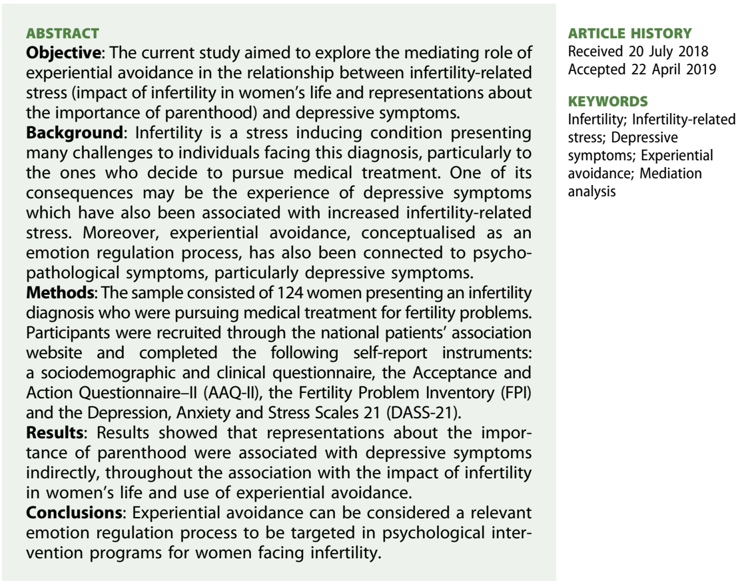
Objective: The current study aimed to explore the mediating role of experiential avoidance in the relationship between infertility-related stress (impact of infertility in women's life and representations about the importance of parenthood) and depressive symptoms. Background: Infertility is a stress inducing condition presenting many challenges to individuals facing this diagnosis, particularly to the ones who decide to pursue medical treatment. One of its consequences may be the experience of depressive symptoms which have also been associated with increased infertility-related stress. Moreover, experiential avoidance, conceptualised as an emotion regulation process, has also been connected to psychopathological symptoms, particularly depressive symptoms. Methods: The sample consisted of 124 women presenting an infertility diagnosis who were pursuing medical treatment for fertility problems. Participants were recruited through the national patients' association website and completed the following self-report instruments: a sociodemographic and clinical questionnaire, the Acceptance and Action Questionnaire–II (AAQ-II), the Fertility Problem Inventory (FPI) and the Depression, Anxiety and Stress Scales 21 (DASS-21). Results: Results showed that representations about the importance of parenthood were associated with depressive symptoms indirectly, throughout the association with the impact of infertility in women's life and use of experiential avoidance. Conclusions: Experiential avoidance can be considered a relevant emotion regulation process to be targeted in psychological intervention programs for women facing infertility.
Overview
CoChat Summary
## TL;DR
This cross-sectional study of 124 women with infertility found that experiential avoidance helped explain the link between infertility-related stress and depressive symptoms. In particular, the indirect path from valuing parenthood to depressive symptoms through greater life-domain impact and experiential avoidance was significant.
## Key findings
- The sample included 124 women with an infertility diagnosis who were pursuing medical treatment; ages ranged from 27 to 44 years (mean 35.81, SD 4.24), and infertility duration averaged 5.04 years (SD 3.95).
- All main study variables were significantly and moderately to strongly correlated; reported correlations included:
- representations about parenthood with impact on life domains, r = .35
- representations about parenthood with experiential avoidance, r = .37
- representations about parenthood with depressive symptoms, r = .36
- impact on life domains with experiential avoidance, r = .57
- impact on life domains with depressive symptoms, r = .52
- experiential avoidance with depressive symptoms, r = .65
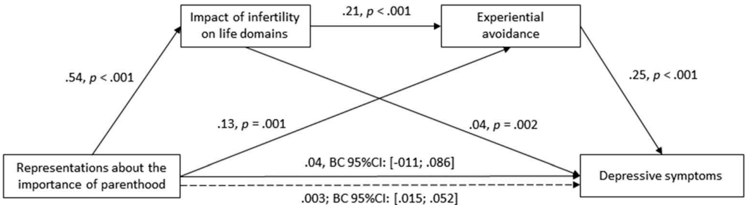
- In the mediation model, the direct effect of representations about parenthood on depressive symptoms was nonsignificant (effect = .04, SE = .02, p = .127).
- The indirect effect of representations about parenthood on depressive symptoms through impact on life domains and experiential avoidance was significant (indirect effect = 0.03, 95% CI [.015; 050]). The alternative serial mediation model was not significant (indirect effect = 0.01, 95% CI [.00; 03]).
## Methods
- Design: Cross-sectional study testing a serial multiple mediation model (PROCESS model 6) based on the theory that representations about parenthood influence depressive symptoms through impact on life domains and experiential avoidance.
- Sample/data: 124 women with a medically established infertility diagnosis, aged 18+, recruited through APFertilidade forum/newsletter/social media; data were collected online between March and June 2016.
- Main analysis: Pearson correlations plus bootstrap mediation analysis with 5000 samples; significance of indirect effects was determined by confidence intervals excluding 0.
## Limitations
- The paper states that, because it was cross-sectional, it does not allow establishing causation; it also notes that the mediation sequence was theoretical, not temporal.
- The paper states that experiential avoidance was measured with a general measure that may not capture infertility-specific features.
- The paper states that recruitment through an online survey may introduce sampling bias, self-selection issues, and under-representation of less educated or less internet-accessible participants; it also notes the sample was highly heterogeneous with women at different infertility stages.
Model-written summary. Check it against the paper before relying on it.
Integrity signals
Registry
Cites
Statistics
Figures


Verification
Claims the paper makes
5 Valid · 1 Not valid · 18 Not checked · 35 Own results and interpretations
Every source the paper cites for this claim was checked and supports it.
In the paper
“Studies addressing experiential avoidance in people dealing with infertility are scarce but couples with an infertility diagnosis pursuing medical treatment presented signi fi cantly higher scores of experiential avoidance when compared to fertile couples and couples applying for adoption (Cunha, Galhardo, & Pinto-Gouveia, 2016).”
What the sources say
- Supportedcites Cunha, Galhardo, & Pinto-Gouveia, 2016 matched to “Experiential avoidance, self-compassion, self-judgment and coping styles in infertility” (2016) source
The Participants section defines the infertility group as couples with a medically established diagnosis pursuing treatment, alongside fertile and adoption groups. The results accompanying Table 2 report significantly higher experiential-avoidance scores in the infertility group than in both comparison groups (p = .001 and p < .001, respectively). (LLM, conf=0.95)
plainstates an association- Asserted: passes — The authors put it forward as true.
- Checkable: passes — It can be checked against evidence.
- Load-bearing: passes — The paper’s conclusions depend on it.
- Based: passes — The paper gives a reason why it holds.
- Rests on an assumption not shown here.
- Supported
The cited sources support only part of this claim — read each source’s verdict below.
In the paper
“people with infertility who are undergoing treatment show a higher prevalence of depressive symptoms compared to control groups (Chen, Chang, Tsai, & Juang, 2004; Volgsten, Skoog, Ekselius, Lundkvist, & Sundstrom, 2008; Williams, Marsh, & Rasgon, 2007).”
What the sources say
- Not checked — no full text of the sourcecites Chen, Chang, Tsai, & Juang, 2004 matched to “Prevalence of depressive and anxiety disorders in an assisted reproductive technique clinic” (2004) source
- Partly supportedcites Volgsten, Skoog, Ekselius, Lundkvist, & Sundstrom, 2008 matched to “Prevalence of psychiatric disorders in infertile women and men undergoing in vitro fertilization treatment” (2008) sourceExperimental — accuracy not yet measured
The Introduction reports that depressive symptoms in infertile women were twice as common as in a control group. The Discussion also says depressive disorders in women and men undergoing IVF were more common than in the general population. But the paper’s comparison for both sexes concerns diagnosed disorders, not depressive symptoms measured against control groups; it also finds no higher rate than among gynaecological outpatients. (LLM, conf=0.84)
- Partly supportedcites Williams, Marsh, & Rasgon, 2007 matched to “Mood disorders and fertility in women: a critical review of the literature and implications for future research” (2007) sourceExperimental — accuracy not yet measured
The review’s section on rates of mood disorders in female patients with infertility (p. 5) reports a higher prevalence of depressive symptoms than in control groups in most, but not all, studies. The claim omits that qualification and extends a review focused on women to people with infertility generally. (LLM, conf=0.86)
plainstates an association- Asserted: passes — The authors put it forward as true.
- Checkable: passes — It can be checked against evidence.
- Load-bearing: unclear — It is unclear whether the paper’s conclusions depend on it.
- Based: passes — The paper gives a reason why it holds.
A result the paper reports from its own data — it cites no other source for it, so there is none to check. The quote shows it is in the paper.
In the paper
“| Depressive symptoms | 7.30 | 5.35 | .36* | .52* | .65* |”
plainstates an association- Asserted: passes — The authors put it forward as true.
- Checkable: passes — It can be checked against evidence.
- Load-bearing: passes — The paper’s conclusions depend on it.
- Based: passes — The paper gives a reason why it holds.
A result the paper reports from its own data — it cites no other source for it, so there is none to check. The quote shows it is in the paper.
In the paper
“| Impact of infertility on life domains | 74.35 | 15.99 | .35* | - | |”
plainstates an association- Asserted: passes — The authors put it forward as true.
- Checkable: passes — It can be checked against evidence.
- Load-bearing: unclear — It is unclear whether the paper’s conclusions depend on it.
- Based: passes — The paper gives a reason why it holds.
A result the paper reports from its own data — it cites no other source for it, so there is none to check. The quote shows it is in the paper.
In the paper
“| Depressive symptoms | 7.30 | 5.35 | .36* | .52* | .65* |”
plainstates an association- Asserted: passes — The authors put it forward as true.
- Checkable: passes — It can be checked against evidence.
- Load-bearing: unclear — It is unclear whether the paper’s conclusions depend on it.
- Based: passes — The paper gives a reason why it holds.
13 more claims
Create a free account to see all 59 claims and every source verdict.
- Probably not a substantial claim. 38
- It may state two separate claims as one. 16
- The quote only partly states this claim. 1
Claims other papers make about this one
Each is checked against this paper’s own text: does it say what the citing paper says it does?
The source backs part of the claim, not all of it — or backs it for a different population, condition or comparison.
In the citing paper
“In this respect, Galhardo etal. (2019) found a direct effect of representations regarding the importance of parenting on depressive symptoms through the impact of infertility and, consequently, experiential avoidance.”
From Mapping acceptance and commitment therapy outcomes in the context of infertility: a systematic review (2024) · cites this paper as Galhardo et al. (2019)
Experimental — accuracy not yet measuredThe source backs part of the claim, not all of it — or backs it for a different population, condition or comparison.
In the citing paper
“Therefore, individuals confronted with fertility problems tend to display maladaptive coping strategies as they tend to avoid thought, emotions, and situations that are somehow related to pregnancy or parenting as a way of dealing with the painful experience of infertility (Cunha etal., 2016; Galhardo etal., 2019).”
From Mapping acceptance and commitment therapy outcomes in the context of infertility: a systematic review (2024) · cites this paper as Galhardo et al., 2019
Experimental — accuracy not yet measuredThe cited source says what the claim attributes to it.
In the citing paper
“Galhardo etal. (2019) found a significant indirect effect of representations regarding the importance of parenthood on depressive symptoms, through the association with the impact of infertility on life domains and experiential avoidance (Impact of infertility on life domains and experiential avoidance; indirect effect = 0.03, 95%CI: [0.015; 050]).”
From Mapping acceptance and commitment therapy outcomes in the context of infertility: a systematic review (2024) · cites this paper as Galhardo et al. (2019)
Self-check
Percentages, sums and reported differences re-computed from the paper’s own numbers.
Rated major: it would touch a result — a value a result rests on, reported and recomputed p-values on opposite sides of the significance level, two passages that conflict with no sign which is right, or a cited work retracted before this paper was published.
In the paper
“| Previous infertility treatment ( n = 102) | | | | Intra-Cytoplasmic Sperm Injection (ICSI) | 30 | 24.2 | | In Vitro Fertilization (IVF) | 30 | 24.2 | | Ovarian Hormonal Stimulation (independent from IVF or ICSI) | 19 | 15.3 | | Intra-Uterine Insemination (IUI) | 14 | 11.3 | | Multiple treatments | 17 | 13.7 |”
Reported 102 · recomputed 110
Rated minor: it would not touch a result — a value no result rests on, a p-value that stays on the same side of the significance level, or a conflict that is clerical, resolved elsewhere in the paper, or outside its own findings.
In the paper
“| Previous infertility treatment ( n = 102) | | | | Intra-Cytoplasmic Sperm Injection (ICSI) | 30 | 24.2 | | In Vitro Fertilization (IVF) | 30 | 24.2 | | Ovarian Hormonal Stimulation (independent from IVF or ICSI) | 19 | 15.3 | | Intra-Uterine Insemination (IUI) | 14 | 11.3 | | Multiple treatments | 17 | 13.7 |”
Reported 100 · recomputed 88.7
Citations
Cites
(2013) · Cited by 44,563
Lovibond, P. F., & Lovibond, S. H. (1995) · Behaviour Research and Therapy · doi:10.1016/0005-7967(94)00075-u · Cited by 14,523
Mediation in experimental and nonexperimental studies: New procedures and recommendations.
Shrout, P. E., & Bolger, N. (2002) · Psychological Methods · doi:10.1037/1082-989x.7.4.422 · Cited by 11,335
Confidence Limits for the Indirect Effect: Distribution of the Product and Resampling Methods
MacKinnon, D. P., Lockwood, C. M., & Williams, J. (2004) · Multivariate Behavioral Research · doi:10.1207/s15327906mbr3901_4 · Cited by 7,806
Acceptance and commitment therapy: model, processes and outcomes
Hayes, S. C., Luoma, J. B., Bond, F. W., Masuda, A., & Lillis, J. (2006) · Behaviour Research and Therapy · doi:10.1016/j.brat.2005.06.006 · Cited by 6,587
Bond, F. W., Hayes, S. C., Baer, R. A., Carpenter, K. M., Guenole, N., Orcutt, H. K., Waltz, T., & Zettle, R. D. (2011) · Behavior Therapy · doi:10.1016/j.beth.2011.03.007 · Cited by 3,950 · cited 1×
“Acceptance and Action Questionnaire II (AAQ-II; Bond et al., 2011), Portuguese version by Pinto-Gouveia, Gregório, Dinis, and Xavier (2012).”
Hayes, S. C., Wilson, K. G., Gifford, E. V., Follette, V. M., & Strosahl, K. (1996) · Journal of Consulting and Clinical Psychology · doi:10.1037//0022-006x.64.6.1152 · Cited by 3,595
Wright, K. B. (2006) · Journal of Computer-Mediated Communication · doi:10.1111/j.1083-6101.2005.tb00259.x · Cited by 2,550 · cited 1×
“pants, with easy access to online platforms), and therefore limits the possibility to make generalizations regarding the study’s findings (Wright, 2005).”
BackgroundBoivin, J., Bunting, L., Collins, J. A., & Nygren, K. G. (2007) · Human Reproduction · doi:10.1093/humrep/dem046 · Cited by 2,437
Measuring experiential avoidance: A preliminary test of a working model
Hayes, S. C., Strosahl, K., Wilson, K. G., Bissett, R. T., Pistorello, J., Toarmino, D., Polusny, M. A., Dykstra, T. A., Batten, S. V., Bergan, J., et al. (2004) · The Psychological Record · doi:10.1007/bf03395492 · Cited by 2,140
The International Glossary on Infertility and Fertility Care, 2017
Zegers-Hochschild, F., Adamson, G. D., Dyer, S., Racowsky, C., de Mouzon, J., Sokol, R., Rienzi, L., Sunde, A., Schmidt, L., Cooke, I. D., et al. (2017) · Fertility and Sterility · doi:10.1016/j.fertnstert.2017.06.005 · Cited by 1,505
The international glossary on infertility and fertility care, 2017
Zegers-Hochschild, F., Adamson, G. D., Dyer, S., Racowsky, C., de Mouzon, J., Sokol, R., Rienzi, L., Sunde, A., Schmidt, L., Cooke, I. D., et al. (2017) · Human Reproduction · doi:10.1093/humrep/dex234 · Cited by 1,320
Kashdan, T. B., Barrios, V., Forsyth, J. P., & Steger, M. F. (2006) · Behaviour Research and Therapy · doi:10.1016/j.brat.2005.10.003 · Cited by 994
Current Directions in Mediation Analysis
MacKinnon, D. P., & Fairchild, A. J. (2009) · Current Directions in Psychological Science · doi:10.1111/j.1467-8721.2009.01598.x · Cited by 940
Ribeiro, J. L. P., Honrado, A., & Leal, I. M. P. (2004) · Psicologia Saúde & Doenças · Cited by 904
Experiential avoidance as a functional dimensional approach to psychopathology: An empirical review
Chawla, N., & Ostafin, B. (2007) · Journal of Clinical Psychology · doi:10.1002/jclp.20400 · Cited by 805 · cited 2×
“Though, experiential avoidance can also be a maladaptive process when the response pattern is rigid and inflexible, associated with negative mental health outcomes and poor quality of life (Chawla & Ostafin, 2007).”
BackgroundThe fertility problem inventory: measuring perceived infertility-related stress
Newton, C. R., Sherrard, W., & Glavac, I. (1999) · Fertility and Sterility · doi:10.1016/s0015-0282(99)00164-8 · Cited by 626
Emotion Regulation and Psychopathology: A Transdiagnostic Approach to Etiology and Treatment
Choate-Summers, M. (2011) · Cognitive Behaviour Therapy · doi:10.1080/16506073.2010.524747 · Cited by 501
Prevalence of infertility and help seeking among 15 000 women and men
Datta, J., Palmer, M. J., Tanton, C., Gibson, L. J., Jones, K. G., Macdowall, W., Glasier, A., Sonnenberg, P., Field, N., Mercer, C. H., et al. (2016) · Human Reproduction · doi:10.1093/humrep/dew123 · Cited by 471 · cited 1×
“More recently, Datta et al. (2016) stated that one in eight women and one in ten men experience infertility.”
BackgroundPrevalence of depressive and anxiety disorders in an assisted reproductive technique clinic
Chen, T.-H., Chang, S.-P., Tsai, C.-F., & Juang, K.-D. (2004) · Human Reproduction · doi:10.1093/humrep/deh414 · Cited by 365
Volgsten, H., Skoog Svanberg, A., Ekselius, L., Lundkvist, O., & Sundstrom Poromaa, I. (2008) · Human Reproduction · doi:10.1093/humrep/den154 · Cited by 303
Tull, M. T., Gratz, K. L., Salters, K., & Roemer, L. (2004) · Journal of Nervous & Mental Disease · doi:10.1097/01.nmd.0000144694.30121.89 · Cited by 298
Boivin, J., Bunting, L., Collins, J. A., & Nygren, K. G. (2007) · Human Reproduction · doi:10.1093/humrep/dem299 · Cited by 273
A Longitudinal Study of Experiential Avoidance in Emotional Disorders
Spinhoven, P., Drost, J., de Rooij, M., van Hemert, A. M., & Penninx, B. W. (2014) · Behavior Therapy · doi:10.1016/j.beth.2014.07.001 · Cited by 241 · cited 1×
“Experiential avoidance has been pointed as an important transdiagnostic factor that influences the course of emotional problems (Spinhoven et al., 2014).”
BackgroundLee, T.-Y. (2001) · Human Reproduction · doi:10.1093/humrep/16.8.1762 · Cited by 217
The nature of clinical depression: Symptoms, syndromes, and behavior analysis
Kanter, J. W., Busch, A. M., Weeks, C. E., & Landes, S. J. (2008) · The Behavior Analyst · doi:10.1007/bf03392158 · Cited by 189
Williams, K. E., Marsh, W. K., & Rasgon, N. L. (2007) · Human Reproduction Update · doi:10.1093/humupd/dmm019 · Cited by 188
Maroufizadeh, S., Karimi, E., Vesali, S., & Omani Samani, R. (2015) · International Journal of Gynecology & Obstetrics · doi:10.1016/j.ijgo.2015.03.044 · Cited by 172
Who is at risk of emotional problems and how do you know? Screening of women going for IVF treatment
Verhaak, C. M., Lintsen, A. M. E., Evers, A. W. M., & Braat, D. D. M. (2010) · Human Reproduction · doi:10.1093/humrep/deq054 · Cited by 167
Peterson, B. D., Sejbaek, C. S., Pirritano, M., & Schmidt, L. (2014) · Human Reproduction · doi:10.1093/humrep/det412 · Cited by 156 · cited 1×
“This relationship between infertility-related stress and depressive symptoms has been previously established (Peterson et al., 2014).”
BackgroundVariation in distress among women with infertility: evidence from a population-based sample
Greil, A. L., Shreffler, K. M., Schmidt, L., & McQuillan, J. (2011) · Human Reproduction · doi:10.1093/humrep/der148 · Cited by 124
Experiential avoidance and well-being: A daily diary analysis
Machell, K. A., Goodman, F. R., & Kashdan, T. B. (2015) · Cognition and Emotion · doi:10.1080/02699931.2014.911143 · Cited by 122
Using Acceptance and Commitment Therapy to Treat Distressed Couples: A Case Study With Two Couples
Peterson, B. D., Eifert, G. H., Feingold, T., & Davidson, S. (2009) · Cognitive and Behavioral Practice · doi:10.1016/j.cbpra.2008.12.009 · Cited by 122
Mindfulness-Based Program for Infertility: Efficacy study
Galhardo, A., Cunha, M., & Pinto-Gouveia, J. (2013) · Fertility and Sterility · doi:10.1016/j.fertnstert.2013.05.036 · Cited by 120
Self-citation(2010) · Cited by 114
Holley, S. R., Pasch, L. A., Bleil, M. E., Gregorich, S., Katz, P. K., & Adler, N. E. (2015) · Fertility and Sterility · doi:10.1016/j.fertnstert.2015.02.018 · Cited by 110 · cited 2×
“…Karimi, Vesali, & Omani-Samani, 2015); women with infertility who have a history of depression are more likely to become depressed during treatment (Holley et al., 2015); people with infertility who are undergoing treatment show a higher prevalence of depressive symptoms compared to control groups…”
BackgroundAssessing infertility stress: re-examining the factor structure of the Fertility Problem Inventory
Moura-Ramos, M., Gameiro, S., Canavarro, M. C., & Soares, I. (2012) · Human Reproduction · doi:10.1093/humrep/der388 · Cited by 105
Self-citation(2012) · Dialnet (Universidad de la Rioja) · Cited by 96
Sexty, R. E., Kollár, J., Sápy, T., Wischmann, T. H., & Bugán, A. (2013) · Archives of Gynecology and Obstetrics · doi:10.1007/s00404-013-2835-7 · Cited by 81
Psychiatric disorders among infertile and fertile women
Noorbala, A. A., Ramezanzadeh, F., Abedinia, N., & Naghizadeh, M. M. (2008) · Social Psychiatry and Psychiatric Epidemiology · doi:10.1007/s00127-008-0467-1 · Cited by 79
Using Acceptance and Commitment Therapy to Treat Infertility Stress
Peterson, B. D., & Eifert, G. H. (2011) · Cognitive and Behavioral Practice · doi:10.1016/j.cbpra.2010.03.004 · Cited by 78 · cited 1×
“…as Acceptance and Commitment Therapy or the Mindfulness Based Program for Infertility may be particularly useful since they address experiential avoidance and have proved to be effective (Galhardo, Cunha, & Pinto-Gouveia, 2013; Peterson & Eifert, 2011; Peterson, Eifert, Feingold, & Davidson, 2009).”
Background(2006) · doi:10.1017/cbo9780511547263.003 · Cited by 72
Experiential avoidance as a common psychological process in European cultures
Monestès, J.-L., Karekla, M., Jacobs, N., Michaelides, M. P., Hooper, N., Kleen, M., Ruiz, F. J., Miselli, G., Presti, G., Luciano, C., et al. (2018) · European Journal of Psychological Assessment · doi:10.1027/1015-5759/a000327 · Cited by 71 · cited 1×
“Besides being a putative factor for the onset and maintenance of a wide range of psychopathological symptoms, it also revealed to act as a transcultural process (Monestès et al., 2016).”
BackgroundTEACHER DISTRESS AND THE ROLE OF EXPERIENTIAL AVOIDANCE
Hinds, E., Jones, L. B., Gau, J. M., Forrester, K. K., & Biglan, A. (2015) · Psychology in the Schools · doi:10.1002/pits.21821 · Cited by 59
Shahar, B., & Herr, N. R. (2011) · Behaviour Research and Therapy · doi:10.1016/j.brat.2011.07.006 · Cited by 54
Experiential avoidance, self-compassion, self-judgment and coping styles in infertility
Cunha, M., Galhardo, A., & Pinto-Gouveia, J. (2016) · Sexual & Reproductive Healthcare · doi:10.1016/j.srhc.2016.04.001 · Cited by 48
Self-citationThe mediation effect of experiential avoidance between coping and psychopathology in chronic pain
Costa, J., & Pinto‐Gouveia, J. (2011) · Clinical Psychology & Psychotherapy · doi:10.1002/cpp.699 · Cited by 45
Experiential avoidance in the vulnerability to depression among adolescent females
Mellick, W., Vanwoerden, S., & Sharp, C. (2017) · Journal of Affective Disorders · doi:10.1016/j.jad.2016.10.034 · Cited by 25 · cited 1×
“Mellick, Vanwoerden, and Sharp (2017) found that experiential avoidance seems to act as a vulnerability factor for major depressive disorder in female adolescents.”
BackgroundEsterilidade e procriação medicamente assistida
Santos, T. A., & Ramos, M. M. (2010) · doi:10.14195/978-989-26-0383-4 · Cited by 5
Acceptance and Action Questionnaire--II--Portuguese Version
Pinto-Gouveia, J., Gregorio, S., Dinis, A., & Xavier, A. (2012) · PsycTESTS Dataset · doi:10.1037/t41341-000
Research works printed but not linked: 1
- Hayes, S. C., & Smith, S. (2005). Get out of your mind and into your life: The new acceptance and commitment therapy . Oakland: New Harbinger Publications, Inc.
Cited by
Infertility-related stress, social support, and coping of women experiencing infertility in Vietnam
Lam, T. Q., Luong, T. B., Tran, T., Dang, N. H., Nguyen, L. H., Nguyen, T., & Nguyen, P. T. H. (2022) · Health Psychology Report · doi:10.5114/hpr.2022.113437 · Cited by 31
“Depression has also been found to be very common in this group (Benyamini et al., 2005; Galhardo et al., 2020; Karimzadeh et al., 2017; Meller et al., 2002).”
BackgroundFoti, F.-L., Karner‐Huțuleac, A., & Maftei, A. (2023) · Frontiers in Public Health · doi:10.3389/fpubh.2023.1024438 · Cited by 30
“On the other hand, some studies suggested that infertility and, consequently, the inability to fulfill this role doesn’t directly lead to depression but somewhat indirectly, through feelings of inadequacy and unfulfillment (38, 93).”
BackgroundRelations between protective traits and psychological distress among women experiencing infertility
Hoyle, R. H., Davisson, E. K., & Novice, M. (2020) · Journal of Health Psychology · doi:10.1177/1359105320953466 · Cited by 25
Wendołowska, A. M., Kiełek-Rataj, E., Kalus, A. M., & Czyżowska, D. (2022) · International Journal of Environmental Research and Public Health · doi:10.3390/ijerph19041970 · Cited by 27
“As a consequence, infertile couples experience elevated levels of anxiety and depression [5,6], which is associated with a lower quality of their life [7].”
BackgroundThe Stigma and Infertility-Related Stress of Chinese Infertile Women: A Cross-Sectional Study
Luo, D., Zhouchen, Y.-B., Li, L., Jiang, Y.-L., Liu, Y., Redding, S. R., Wang, R., & Ouyang, Y. (2024) · Healthcare · doi:10.3390/healthcare12111053 · Cited by 26
Metadata
- Authors
- Galhardo, A., Alves, J., Moura-Ramos, M., & Cunha, M.
- Affiliations
- Instituto Superior Miguel Torga (PT)
- Faculty of Psychology and Educational Sciences, University of Coimbra-CINEICC, Coimbra, Portugal
- Corresponding author
- Galhardo, Ana
- Venue
- Journal of Reproductive and Infant Psychology
- Publisher
- Informa UK Limited
- Published
- 2019-05-02
- Volume
- 38
- Issue
- 2
- Pages
- 139-150
- ISSN
- 0264-6838 (ISSN-L)
- 1469-672X
- OpenAlex
- W2943617883
- Cited by
- 31
- References
- 48
- Citations by year
- 2026: 3 · 2025: 4 · 2024: 6 · 2023: 6 · 2022: 3 · 2021: 4 · 2020: 4 · 2019: 1
- FWCI
- 2.87
- Type
- journal article
- Language
- en
- Open access
- green
- hdl.handle.net
- Licence
- other-oa
- Locations
- Journal of Reproductive and Infant Psychology (publishedVersion)
- PubMed (publishedVersion)
- Portuguese National Funding Agency for Science, Research and Technology (RCAAP Project by FCT) (submittedVersion, other-oa)
- Topics
- Health Sciences › Medicine › Reproductive Medicine › Reproductive Health and Technologies
- Social Sciences › Psychology › Clinical Psychology › Mindfulness and Compassion Interventions
- Health Sciences › Medicine › Public Health, Environmental and Occupational Health › Maternal Mental Health During Pregnancy and Postpartum
- Keywords
- infertility, infertility-related stress, depressive symptoms, experiential avoidance, emotion regulation, acceptance and commitment therapy, psychological intervention
- MeSH terms
- Self-Control, Adaptation, Psychological, Adult, Anxiety, Cross-Sectional Studies, Depression, Female, Humans, Infertility, Pregnancy, Stress, Psychological, Self Report
About these checks
Registry, retraction, Cites and statistics results are computed, not judged, with one exception: a printed reference that no index lists is read once by a model before it counts as a citation error. Claims are extracted by a model and kept only when their quote appears verbatim in the text; each cited source is then checked, with a model’s help, for whether it says what the claim relies on. Those verdicts can be wrong — read the claim’s quote and the cited source before relying on one.
The claim verdicts this report counts are experimental: their accuracy is not yet measured.
A language model drew the claims from the paper on 2026-10-11, under version 3 of the claim definition (model deepseek-v4.1-flash, prompt extract-v3).
A second model labelled each claim on 2026-10-11 (model jev-1.13-20260917, definition revision gold-guideline-v0.2).
Cited sources are checked with a language model’s help (gpt-6-sol).
Statistics and arithmetic are recomputed, not judged.
Confidence bands are shown only for fields calibrated on our annotated test set. None is calibrated yet, so no band is shown.
What counts as a claim ›How we measure confidence ›How we check this ›
Are you an author, or do you see a problem with this page? Request a review
Data sources
Bibliographic data: Semantic Scholar, OpenAlex, Crossref.
Contains information from the Semantic Scholar Academic Graph Datasets, made available under the ODC Attribution License (ODC-BY 1.0).
Semantic Scholar’s data is described in: Kinney, R., et al. (2023). The Semantic Scholar Open Data Platform. arXiv:2301.10140.
