

Fostering student engagement with motivating teaching: an observation study of teacher and student behaviours
Open accessThe DOI matches its Crossref record; 74 of the 74 references it cites were found in a registry or an index.
Abstract
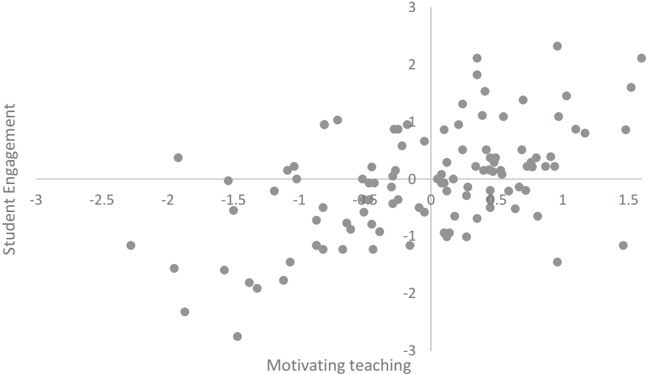
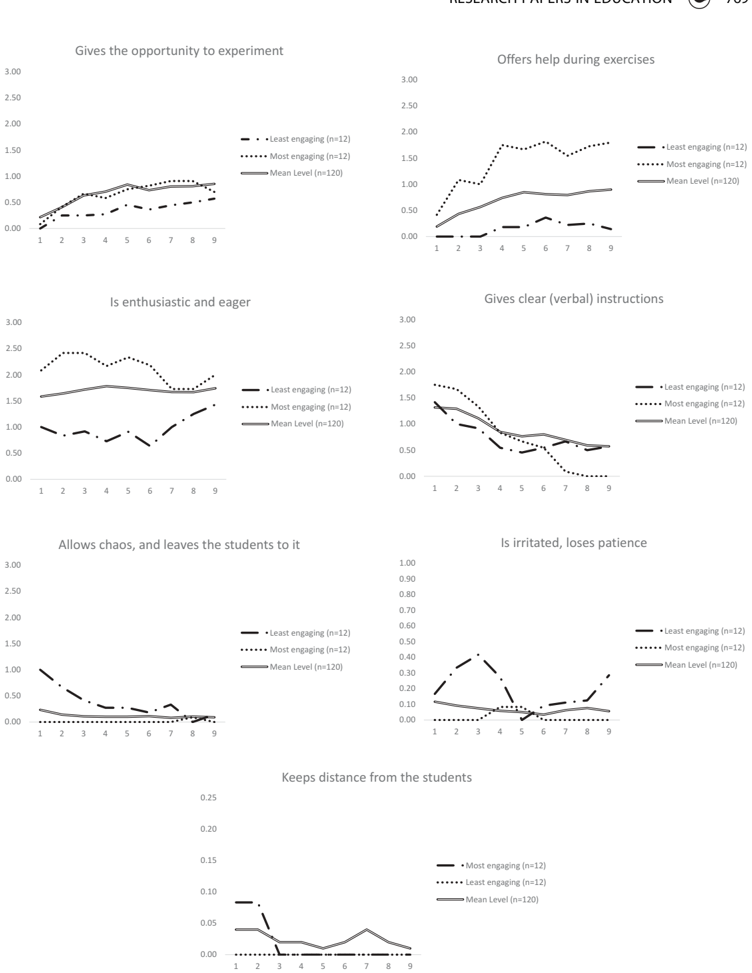
Given the importance of student engagement for students’ current and future success, it is essential to explore how teachers can foster student engagement within lessons. This study relied on classroom observations to describe how teachers applied Self-Determination Theory (SDT) related (de)motivating teaching behaviours to foster students’ engagement. Results from 120 observed lessons of 43 teachers indicated there were distinct relations between motivating teaching behaviours and student engagement. Most striking regarding the use of motivating teaching behaviours were the higher levels of relatedness support and guidance during activities in lessons in which students showed the highest levels of engagement. Conversely, in lessons where students were least engaged, teachers showed higher levels of chaotic teaching behaviours. Analyses of behaviours within lowly and highly engaging lessons showed that teachers in highly engaging lessons were observed to start with high levels of enthusiasm and after about ten to fifteen minutes focused on activating their students by offering room for experimenting and support while students worked on assignments. In contrast, teachers in lowly engaging lessons seemed to have a tendency to employ demotivating teaching behaviour at the start of the lesson. Implications and directions for future research are discussed.
Overview
The claims and statistics of this paper haven’t been checked yet.
Free: it reads the open-access text and checks the first 5 claims that cite a source we can check. Create a free account to check every claim.
Integrity signals
Registry
Cites
Statistics
Figures


Verification
Claims the paper makes
The claims and statistics of this paper haven’t been checked yet.
Free: it reads the open-access text and checks the first 5 claims that cite a source we can check. Create a free account to check every claim.
Claims other papers make about this one
Each is checked against this paper’s own text: does it say what the citing paper says it does?
The source backs part of the claim, not all of it — or backs it for a different population, condition or comparison.
In the citing paper
“Also, Cents-Boonstra et al. [53] investigated the role of motivating teaching behaviour and found that teachers who offered support and guidance during learning had more student engagement in comparison to teachers who did not offer any support or show enthusiasm for teaching.”
From Impact of online learning on student's performance and engagement: a systematic review (2024) · cites this paper as [53]
Experimental — accuracy not yet measured
Self-check
Percentages, sums and reported differences re-computed from the paper’s own numbers.
The self-check needs the paper’s full text.
Citations
Cites
Ryan, R. M., & Deci, E. L. (2000) · American Psychologist · doi:10.1037//0003-066x.55.1.68 · Cited by 54,599 · cited 1×
“In the current study, we relied on self-determination theory (SDT, Ryan and Deci 2000), to describe the classroom dynamics related to observed student engagement and (de)motivating teaching behaviours within lessons.”
Method-Handbook of Self-Determination Research by Edward L. Deci and Richard M. Ryan (Editors)
Paulson, D. S. (2002) · The Journal of mind and behavior · Cited by 5,169
Skinner, E. A., & Belmont, M. J. (1993) · Journal of Educational Psychology · doi:10.1037/0022-0663.85.4.571 · Cited by 3,428 · cited 2×
“Structure has been defined as the provision of desired information and guidance such that students can successfully achieve various outcomes (Grolnick and Pomerantz 2009; Skinner and Belmont 1993).”
BackgroundJournal on Educational Psychology
Winston, J., Mandernach, J., Winsor, D. L., Sinnott, J. D., & Gujjar, A. A. (2014) · Cited by 2,947
Niemiec, C. P., & Ryan, R. M. (2009) · Theory and Research in Education · doi:10.1177/1477878509104318 · Cited by 2,542
REEVE, J. (2009) · Educational Psychologist · doi:10.1080/00461520903028990 · Cited by 1,728 · cited 1×
“On the one hand teachers’ (de)motivating behaviour is influenced by trait-like teacher factors, such as teachers’ own motivational orientation (Van den Berghe et al. 2013), beliefs (Hornstra et al. 2015) and a preferred teaching style (Aelterman et al. 2014; Reeve 2009).”
BackgroundJang, H., Reeve, J., & Deci, E. L. (2010) · Journal of Educational Psychology · doi:10.1037/a0019682 · Cited by 1,650 · cited 8×
“In general, these studies indicate that observed motivating teaching behaviour (Reeve et al. 2004) is positively related to student engagement (Jang, Reeve, and Deci 2010; Reeve et al. 2004; Van den Berghe et al. 2016).”
BackgroundInfluentialAgency as a fourth aspect of students’ engagement during learning activities
Reeve, J., & Tseng, C.-M. (2011) · Contemporary Educational Psychology · doi:10.1016/j.cedpsych.2011.05.002 · Cited by 1,618
Enhancing Students' Engagement by Increasing Teachers' Autonomy Support
Reeve, J., Jang, H., Carrell, D., Jeon, S., & Barch, J. (2004) · Motivation and Emotion · doi:10.1023/b:moem.0000032312.95499.6f · Cited by 1,594 · cited 8×
“In general, these studies indicate that observed motivating teaching behaviour (Reeve et al. 2004) is positively related to student engagement (Jang, Reeve, and Deci 2010; Reeve”
BackgroundMethodInfluentialHandbook of Motivation at School
(2016) · Routledge eBooks · doi:10.4324/9781315773384 · Cited by 1,131
Research works printed but not linked: 6
- Drechsel, B., K. Prenzel, and M. Kramer. 2002. ' Self-determined and Interested Learning in Vocational Education. ' In Teaching -learning Processes in Vocational Education , edited by K. Beck, 43 -68. Frankfurt am Main: Peter Lang.
- Good, T., and J. Brophy. 1987. Looking in Classrooms . 4th ed. New York: Harper and Row.
- Hornstra, L., D. Weijers, I. Van der Veen, and T. Peetsma. 2016. Het Motiveren Van Leerlingen Met Verschillende Prestatieniveaus En Achtergrondken merken: Onderzoeksverslag . Utrecht: Universiteit Utrecht.
- Pelletier, L., and E. C. Sharp. 2009. ' Administrative Pressures and Teachers ' Interpersonal Behaviour in the Classroom. ' School Field 7 (2): 174 -183.
- Reeve, J. 2002. ' Self-determination Theory Applied to Educational Settings. ' In Handbook of Selfdetermination Research , edited by E. L. Deci and R. M. Ryan, 2 -183, New York: University of Rochester Press.
- Vugteveen, J., A. C. Timmermans, H. Korpershoek, M. Van Rooijen, and M.-C. Opdenakker. 2016. Overgangen En Aansluitingen in Het Onderwijs: Deelrapportage 3: Empirische Studie Naar De Cognitieve En Niet-cognitieve Ontwikkeling Van Leerlingen Rondom De Vmbo-mbo Overgang . Groningen: GION onderzoek/onderwijs.
Cited by
Items 101–200 of 216
Li, S., Chen, J., Sun, J., Li, J., & Yu, X. (2025) · Communications in computer and information science · doi:10.1007/978-3-031-99267-4_3 · Cited by 1
Lukuwi, L. A., & Seni, A. J. (2026) · Educational Dimension · doi:10.55056/ed.906 · Cited by 1
Molvinger, K. (2025) · Chemistry Education Research and Practice · doi:10.1039/d4rp00306c · Cited by 4
EngageMate: An IoT-Driven Platform for Monitoring Teacher Engagement and Classroom Dynamics
Gómez–Carmona, O., Fernández–de–Retana, M., Navarro, J., Solé-Beteta, X., Casado–Mansilla, D., & López–de–Ipiña, D. (2025) · International Conference on Smart and Sustainable Technologies (SpliTech) · doi:10.23919/splitech65624.2025.11091769 · Cited by 2
“…activities, plays a fundamental role in classroom dynamics and instructional effectiveness [27], as their emotional state, enthusiasm, and involvement can significantly influence student participation and comprehension, establishing a reciprocal relationship be-tween both actors [28], [10].”
Cloutier, G., Julien, C., Francoeur, A., Therriault, D., Smith, J., & Garon‐Carrier, G. (2025) · Psychology in the Schools · doi:10.1002/pits.70102 · Cited by 3
“…higher levels of engagement in class than boys (Lietaert et al. 2015), such that teachers may adopt practices around girls that are more aca-demically, emotionally, and behaviorally supportive, compared to when teachers are with boys (Cents ‐ Boonstra et al. 2020; Van den Berghe et al. 2016).”
Chandel, P., Thakur, A., Sharma, C., Gupta, N., & Mithu, A. (2025) · Lecture notes in networks and systems · doi:10.1007/978-981-96-6060-5_19 · Cited by 1
Qin, Y., Lu, G., & Ba, S. (2025) · Education and Information Technologies · doi:10.1007/s10639-025-13826-9 · Cited by 3
Abood, M. H., Ghbari, T. A., & Abuhmaid, A. M. (2025) · Innovations in Education and Teaching International · doi:10.1080/14703297.2025.2598582 · Cited by 3
Teaching the Person, Not the Topic: An Implicit Theory Approach to Management Education
Billsberry, J. (2025) · Organizational Behavior Teaching Review · doi:10.1177/10525629251406230 · Cited by 1
“When students cannot locate themselves within the curriculum, their motivation and engagement decline (Cents-Boonstra et al., 2021; Wong et al., 2024).”
Rahman, M. S., & Alam, M. M. (2026) · Journal of International Business and Economics · doi:10.15640/jibe.v13p3
Harnessing Learner Content and User Interface Design for Basic Education
Yeboah, A. N., & Goosen, L. (2026) · Advances in computational intelligence and robotics book series · doi:10.4018/979-8-3373-2913-0.ch001 · Cited by 1
Opara, I., Weerakoon, S. M., Saeed, G. J., Duran-Becerra, B., & Pagan, C. (2026) · Journal of Clinical Child & Adolescent Psychology · doi:10.1080/15374416.2026.2617211 · Cited by 2
Liu, D., Saunders, S., & Paracha, S. (2026) · Innovations in Education and Teaching International · doi:10.1080/14703297.2026.2641475 · Cited by 1
Sultana, A., Latheef, N. A., Siby, N., Sellami, A., Abbasi, S. A., & Ahmad, Z. (2026) · Cogent Education · doi:10.1080/2331186x.2026.2625448 · Cited by 4
Zhang, Y., & Liu, T. (2026) · Frontiers in Psychology · doi:10.3389/fpsyg.2026.1844412 · Cited by 2
王詩涵, & Tang, L. (2026) · Frontiers in Psychology · doi:10.3389/fpsyg.2026.1872072 · Cited by 1
Sutapa, I. N., Halim, S., Felecia, & Soetanto, D. P. (2026) · AAOU Journal/AAOU journal · doi:10.1108/aaouj-03-2026-0043 · Cited by 1
Study Engagement Among Secondary School Students During Covid-19 Pandemic
Ponnusamy, P., & Perumal, R. B. V. (2023) · MIER Journal of Educational Studies Trends & Practices · doi:10.52634/mier/2023/v13/i1/2161 · Cited by 1
Student perspectives on creating a positive classroom dynamic: science education in prison
Heron, P. J., Dalton, Kath, Shephard, G. E., Hutchins, S., Stewart, M. L., George, D., Reynolds, R., Sharif, A., Lewis, A., et al. (2023) · Research for All · doi:10.14324/rfa.07.1.08 · Cited by 1
Song, L., Yang, X., & Zhao, Y. (2023) · Revista de Psicodidáctica (English ed ) · doi:10.1016/j.psicoe.2023.06.003 · Cited by 1
Bauya, S. G., Cacayan, M. P., & Ulanday, D. M. P. (2023) · Journal of Science and Education (JSE) · doi:10.56003/jse.v3i3.151 · Cited by 1
“In connection to previous studies, the factors influencing the student’s motivation and resilience are assessment and school engagement (Simon, 2019; Leenknecht et al., 2020; Cents-Boonstra et al., 2021; Romano et al., 2021).”
BackgroundWork Engagement of Teachers Issues and Challenges: A Review
Menon, V. V., Devika, S. S., Manoharan, M., Pasha, N., & Rajkumar, N. (2023) · Journal of Ecophysiology and Occupational Health · doi:10.18311/jeoh/2023/34106 · Cited by 1
Critical reflections on formal teaching observations
O'Connor, S. (2024) · British Journal of Nursing · doi:10.12968/bjon.2024.33.8.382 · Cited by 1
How do you manage the online classrooms?: A narrative inquiry on online course teachers
Herlambang, I. (2024) · Bahasa dan Seni Jurnal Bahasa Sastra Seni dan Pengajarannya · doi:10.17977/um015v52i12024p101 · Cited by 1
Sukarsih, S., Zulkarnain, Z., Alamsyah, G., & Asha, L. (2024) · Journal Of Administration and Educational Management (ALIGNMENT) · doi:10.31539/alignment.v7i1.10336 · Cited by 1
Rahimi, M. (2024) · Language Learning Journal · doi:10.1080/09571736.2024.2438868 · Cited by 4
Senina, D. J. B., & Manguilimotan, Y. B. (2025) · EPRA International Journal of Multidisciplinary Research (IJMR) · doi:10.36713/epra19883 · Cited by 4
Abendaño, M. D. O. (2025) · European Journal of Contemporary Education and E-Learning · doi:10.59324/ejceel.2025.3(2).12 · Cited by 1
Effectiveness of e-learning to develop the ability to recognise and manage stroke
Mortimer, C. (2021) · Journal of Paramedic Practice · doi:10.12968/jpar.2021.13.5.190 · Cited by 1
Torrisi‐Steele, G. (2022) · Issues in Informing Science and Information Technology · doi:10.28945/4973 · Cited by 1
“A descriptive search of literature reveals the topic of student engagement, how to foster it (e.g. (Cents-Boonstra et al., 2021; Hulme et al., 2013; Moore et al., 2014) measure it and recognize it (e.g. Kennedy, 2020; Reading, 2008) is prolific.”
BackgroundTauchid, A., Saleh, M., Hartono, R., & Mujiyanto, J. (2021) · SSRN Electronic Journal · doi:10.2139/ssrn.3939435
Andreas, Y., Wulandari, P. A., & Pandjaitan, L. N. (2021) · Psikostudia Jurnal Psikologi · doi:10.30872/psikostudia.v10i3.6217 · Cited by 1
Heron, P. J., & Williams, J. A. (2022) · doi:10.5194/egusphere-2022-16-rc1
Heron, P. J., & Williams, J. A. (2022) · doi:10.5194/egusphere-2022-16-rc2
Heron, P. J., & Williams, J. A. (2022) · doi:10.5194/egusphere-2022-16-cc1
Heron, P. J. (2022) · doi:10.5194/egusphere-2022-16-ac2
Competitive storytelling: What do teachers do in assisting students to win the contest?
Syahputra, M. (2022) · English Education Journal · doi:10.24815/eej.v13i2.25699
“One of the ways to accelerate students’ skills is by having a contest (Cents-Boonstra et al., 2021; Singh, 2021).”
BackgroundSari, I. P., Sibarani, B., & Husein, R. (2022) · World Journal of English Language · doi:10.5430/wjel.v12n7p276
Reflection in Student Learning in a Semantics and Academic Writing Module
Wong, J. O. (2022) · Springer eBooks · doi:10.1007/978-981-19-4559-5_11
دور الإدارة المدرسية في تحقيق الاندماج المدرسي في التعليم عن بعد لدى طالبات المرحلة الثانوية بالرياض
الشهري, ر. ب. ح. ع. آ. م. (2023) · International Journal of Learning Management Systems · doi:10.21608/ijlms.2023.299929
Mujab, B. S., Puspitasari, D., & Rahmah, R. E. (2023) · Leksika Jurnal Bahasa Sastra dan Pengajarannya · doi:10.30595/lks.v17i2.16956
Seeing Student Engagement in Classroom Video: Affordances of Cognitive and Sociocultural Frameworks
Steinberg, S., Hmelo‐Silver, C. E., Zou, V., Danish, J. A., & Lester, J. C. (2023) · Computer-supported collaborative learning/The Computer-Supported Collaborative Learning Conference · doi:10.22318/cscl2023.752635 · Cited by 2
Learning Styles and Student Engagement: Towards a Personalized Instruction Program
Li, X. S. (2023) · Journal of Education and Educational Research · doi:10.54097/jeer.v5i3.13323 · Cited by 3
“Demographic patterns can change, and educational environments can evolve, so ongoing research can help institutions adapt their approaches as needed; 6.”
BackgroundTamimi, M. A. K. A., Iqbal, J., Abdullah, S., Bibi, A., Sultan, A., Thapur, M., Jamil, Y., Bilal, M., Ali, N., Hazara, S. M., et al. (2023) · doi:10.53555/jptcp.v30i18.3552
Qamar, W., Khaleeq, N., Farooq, A., Un-Nisa, W., Shah, S. R., & Mansoor, A. (2024) · Journal of Khyber College of Dentistry · doi:10.33279/jkcd.v14i01.627
“Additionally, our results demonstrated that the personalities of the faculty had a benefi cial impact on students' well-being, which is in line with other researches indicating that students' psychological and emotional wellbeing is infl uenced by supportive teacher-student relationships 2,18,21,22 .”
ResultSimilarities and differences in teaching behavior for honors and regular bachelor’s education
Kingma, T., Smits, A., Heijne-Penninga, M., Jaarsma, D. A. D. C., & Voogt, J. M. (2024) · Journal of the European Honors Council · doi:10.31378/jehc.205 · Cited by 1
SOCIAL WORK STUDENTS' ATTITUDES TOWARDS THE RELEVANCE OF THEIR STUDIES
Kondratavičienė, R., Bertašienė, I., & Mačiuikienė, D. (2024) · Environment Technology Resources Proceedings of the International Scientific and Practical Conference · doi:10.17770/etr2024vol1.8000
“This finding is consistent with the work of [34] who explored how teachers can encourage student engagement in the classroom.”
ResultSahal, L., & Qamaruddin, M. (2024) · Journal of Islamic Economics Lariba · doi:10.20885/jielariba.vol10.iss1.art26
INNOVATIVE WORK BEHAVIOR IN HIGHER EDUCATION: A SYSTEMATIC LITERATURE REVIEW
Ardianti, T., Tukiran, M., & Mariana, D. (2024) · Research and Development Journal of Education · doi:10.30998/rdje.v10i2.23807 · Cited by 4
Vietnamese Australian children’s voice on community language schools
Bui, T. M. T. (2024) · Australian Review of Applied Linguistics · doi:10.1075/aral.24046.bui
Investment in Learning English as an Additional Language
Prieto, P. F. O., Vargas, M. A. H., Kaya, J., & Leon, A. D. (2024) · Colombian Applied Linguistics Journal · doi:10.14483/22487085.21210
Huić, A., & Balaško, L. (2024) · Život i škola : časopis za teoriju i praksu odgoja i obrazovanja · doi:10.32903/zs.70.1.2 · Cited by 1
Collins, L., Tufts, S., Livieri, G., Leliopoulou, C., & Stroumpouki, T. (2025) · Journal of e-learning Research · doi:10.33422/jelr.v3i2.849
“…teaching and learning process such as student-led videos expressing their knowledge and opinions on a topic, has the ability to increase engagement; along with having their peers critique their videos or posts to promote a deeper peer learning bond between students (Cents-Boonstra et al., 2021).”
Asnawi, A., Sinaga, Y. K., Herman, H., Sianturi, B. K., Kartolo, R., & Tannuary, A. (2025) · Journal of Languages and Language Teaching · doi:10.33394/jollt.v13i1.13362 · Cited by 12
“McNamara (2007) in Setiawati and Budiasih (2022) asserts that reading strategies reflect cognitive and behavioral processes essential for comprehension (Dignath & Veenman, 2021; Cents-Boonstra et al., 2021; Yapp, de Graaff, & van den Bergh, 2023; Purba et al., 2023).”
Eficacia Publicitaria en Facebook: Un Estudio de Eye-tracking Aplicado al Enoturismo
Gómez-Carmona, D., Dueñas, P. P. M., & Tenorio, R. C. (2024) · VISUAL REVIEW International Visual Culture Review / Revista Internacional de Cultura Visual · doi:10.62161/revvisual.v16.5413 · Cited by 6
Academic Engagement in Undergraduate Nursing Students in Swat
Ali, M., Bibi, A., Ahmad, A., Ahmad, Z., Ahmad, F., Hussain, A., Fozia, Shah, B., Khan, S., & Iqbal, A. (2024) · NURSEARCHER (Journal of Nursing & Midwifery Sciences) · doi:10.54393/nrs.v4i04.125
Contexts Articulation for Teaching in Management: Competitive performance of organizations
Serralvo, F. A., & Romaro, P. (2025) · European Public & Social Innovation Review · doi:10.31637/epsir-2025-1210 · Cited by 1
“Student-Teacher Interaction: The role of student-teacher relationships and the quality of interactions were examined to influence engagement (Cents-Boonstra et al., 2020; Kahu, 2013).”
Barriers and Benefits of Serious Games and AI in Education
Faladžić, E. S., & Junuz, E. (2025) · International Symposium INFOTEH-JAHORINA (INFOTEH) · doi:10.1109/infoteh64129.2025.10959265 · Cited by 1
Validating Educational Game Development to Foster Learning Motivation in Elementary School Students
Putriningtyas, S., & Ambarwati, U. (2025) · Jurnal Ilmiah Sekolah Dasar · doi:10.23887/jisd.v8i3.62657 · Cited by 6
Pabico, J. K. (2025) · International Journal For Multidisciplinary Research · doi:10.36948/ijfmr.2025.v07i03.43704
“Literature supports that student-centered motivation strategies significantly enhance learning outcomes (Cents-Boonstra et al., 2020).”
Doren, N. V., Haerens, L. L., Compernolle, S., Flamant, N., Vanderlinde, R., & Cocker, K. A. D. (2025) · Springer eBooks · doi:10.1007/978-3-031-86908-2_7
Self-citationSkots, L. (2025) · Journal of Scholarly Engagement · doi:10.9743/jse.2025.8.1.4
Primayana, K. H., & Dewi, P. Y. A. (2025) · International Journal of Elementary Education · doi:10.23887/ijee.v9i2.97000 · Cited by 7
Cultura, C., & Curaza, L. J. (2025) · Pantao (International Journal of the Humanities and Social Sciences) · doi:10.69651/pijhss0402265
Personalized Learning Through Intelligent Assessment Systems: Enhancing Student Engagement
Yasin, Z., Utina, S. S., & Asrifan, A. (2025) · Advances in computational intelligence and robotics book series · doi:10.4018/979-8-3373-1062-6.ch006
Exploring Student Perceptions of Smart Wearable Devices in Middle-Distance Running
Meina, Z., Osman, N. B., & Yin, T. T. (2025) · International Journal of Academic Research in Progressive Education and Development · doi:10.6007/ijarped/v14-i3/26003
Dương, G. H., Nguyễn, T. B. N., Nguyễn, T. K. N., Võ, T. B. H., & Nguyễn, M. T. (2025) · Can Tho University Journal of Science · doi:10.22144/ctujos.2025.126
Professional Competence, Motivation, and Teacher Performance Discipline Moderates School Culture
Puspaningtyas, D. (2025) · Journal Research of Social Science Economics and Management · doi:10.59141/jrssem.v5i1.999 · Cited by 5
An Analysis of the Online Readiness and Student Success Assessment
Kellam, H., Jennings, L. A., Magruder, K. J., Smallwood, A. M. K., Purgason, A., & Richter, L. (2025) · American Journal of Distance Education · doi:10.1080/08923647.2025.2555643 · Cited by 2
“Student engagement and motivation to succeed both increase when they have choice and control of learning content (Cents-Boonstra et al., 2020).”
Çelik, M., Doğru, M., & Küçükaydın, M. A. (2025) · International Journal of Science Education · doi:10.1080/09500693.2025.2549384
The Unholy Trinity: Connecting the Unconnected—Systems, Strategies, and Students
Homayoonpoor, A. M., Collins, D. J., & Craig, M. (2025) · Education Sciences · doi:10.3390/educsci15101335
İdeal Sınıf Öğretmeni: Öğretmen Görüşlerine Dayalı Nitel Bir Araştırma
Bilge, O., Sarıçam, İ., & Beyhan, A. (2025) · Manas sosyal araştırmalar dergisi · doi:10.33206/mjss.1711236
Systematic Evaluation of YOLO in Student Behavior Detection - A New Dataset
Tran, A.-T., Nguyen, T.-K., Nguyen, T.-T., Tuan, A.-H., & Le, T.-H. (2025) · International Symposium on Communications and Information Technologies · doi:10.1109/iscit67082.2025.11231734
“However, consistently monitoring such behaviors in real-world classrooms especially in large or dynamic environments remains a significant challenge due to occlusions, frequent motion, and the inherent limitations of teacher observation [4], [5].”
Abundiente, K., Alindajao, K. E. J., Simbajon, R. C., Berido, C. A., Suarez, C. E., Gamas, J. C. L., Abo-Abo, D. L., Sun, T., & Acosta, M. M. (2025) · Sprin Journal of Arts Humanities and Social Sciences · doi:10.55559/sjahss.v4i9.576 · Cited by 1
“ese challenges notwithstanding, they focus on tracking the academic and training outcomes of the students and provide guidance and support in spite of the physical distance (Cents-Boonstra et al., 2020; Pestano, 2021).”
Motivational Attributes of Foreign Language Teachers: What Students Think
Liu, H., Bai, B., & Lalli, G. S. (2025) · European Journal of Education · doi:10.1111/ejed.70387
Barriers to Collaborative Innovation: Arabic Teachers' Reluctance to Share Teaching Methods
Khalid, F., & Setiyawan, A. (2025) · Jurnal Al Bayan Jurnal Jurusan Pendidikan Bahasa Arab · doi:10.24042/ceknm278
The MTCS Course Pedagogical Foundations: Active Learning and TPACK Model
Hazzan, O., Ragonis, N., & Lapidot, T. (2026) · Springer eBooks · doi:10.1007/978-3-032-00953-1_2
SkillSageAI: An AI-powered platform for student career readiness
Varma, S. P. (2026) · i-manager’s Journal on Software Engineering · doi:10.26634/jse.20.2.22689
Negerie, D., Tadesse, H., & Olkaba, T. T. (2026) · Discover Education · doi:10.1007/s44217-026-01249-8 · Cited by 3
McCoy, C. A. (2026) · Studies in Higher Education · doi:10.1080/03075079.2026.2629599
Cheng, J., Sulaiman, T., & Wong, K. Y. (2026) · Research Square · doi:10.21203/rs.3.rs-8351278/v1
Principles of Islamic Educational Leadership from Ibn Sahnūn’s Adab al-mu’allimin
Larsen, S., & Calvert, I. (2026) · Globalisation, comparative education and policy research · doi:10.1007/978-3-032-12922-2_5
Nurulsari, N., & Rizkyanti, C. A. (2026) · Educational Point · doi:10.71176/edup/17979
ENSURING ACCESS TO THE EDUCATIONAL PROCESS IN TIMES OF WAR: THE CHALLENGES OF TODAY
Ridel, T., Bondar, N. A., & Strelnyk, V. (2026) · Turkish Online Journal of Distance Education · doi:10.17718/tojde.1644998
Laranjeira, M. A. C., & Teixeira, M. O. (2026) · Journal of Psychologists and Counsellors in Schools · doi:10.1177/20556365261441045 · Cited by 1
Whose Knowledge Counts? Reimagining Assessment and Feedback for a Decolonised Curriculum
Elhinnawy, H. (2026) · Palgrave studies in race, inequality and social justice in education · doi:10.1007/978-3-032-14335-8_5
Gabriel, J. (2026) · International Journal of Sociology and Anthropology · doi:10.5897/ijsa2026.1036
Supporting physical education teachers to create an empowering motivational climate
Girard, S., Guise, A.-A. D., Désilets, É., Desbıens, J.-F., & Bezeau, D. (2026) · Frontiers in Psychology · doi:10.3389/fpsyg.2026.1771885
Gutman, L. M., Trujillo, M. S., Perowne, R., Song, M., Oaknín, M., & Navarrete, M. (2026) · International Journal of Applied Positive Psychology · doi:10.1007/s41042-026-00290-0
The use of Science Comics as a New Means to Promote Science in Adult Education: A Case Study
Gianni, A. M., & Antoniadis, N. (2026) · Adult Learning · doi:10.1177/10451595261464565
Cheng, J., Sulaiman, T., & Yan, W. K. (2026) · The Pertanika Journal of Learning Pedagogy and Educational Leadership · doi:10.47836/pjlpel.2.1.03
Implementing a Rewards Program to Improve Engagement in a Nurse Residency Program
Grube, M. L., Bigott, V., & Oberle, M. J. (2026) · The Journal of Continuing Education in Nursing · doi:10.3928/00220124-20260505-01
From Harm to Help: Transforming Anxiety Management in Schools
Buzanko, C. (2026) · Journal of Applied School Psychology · doi:10.1080/15377903.2026.2701659
Envisioning Pathways for Building Sustainable Communities: A University Coursework Research Agenda
Iliško, D., Badjanova, J., Pipere, A., & Zhang, W. (2026) · World sustainability series · doi:10.1007/978-3-032-22146-9_18
Engagement and Efficiency: A Study of Metadiscourse in Tibetan EFL Classrooms
Guan, S., & Chen, X. (2026) · Language Teaching Research · doi:10.1177/13621688261466614
Barba, A. (2025) · Philippine Journal of Interdisciplinary Research · doi:10.67730/jj7fsg38
Almazan, K. J., Buscato, D. R., Luben, J. A., Capuyan, T. N., Pintor, K. E., Egno, G. K., Porras, A. J., Baliad, L., Gabuat, H., Leopardas, Z., et al. (2026) · Psychology and Education A Multidisciplinary Journal · doi:10.70838/pemj.600209
Metadata
- Authors
- Cents-Boonstra, M., Lichtwarck-Aschoff, A., Denessen, E., Aelterman, N., & Haerens, L.
- Affiliations
- Radboud University Nijmegen (NL)
- Behavioural Science Institute, Radboud University, Nijmegen, The Netherlands
- Leiden University (NL)
- Ghent University (BE)
- Corresponding author
- Cents-Boonstra, Miriam
- Venue
- Research Papers in Education
- Publisher
- Informa UK Limited
- Published
- 2020-05-20
- Volume
- 36
- Issue
- 6
- Pages
- 754-779
- ISSN
- 0267-1522 (ISSN-L)
- 1470-1146
- OpenAlex
- W3027350858
- Semantic Scholar
- 34ee056fe97fe3a0bc9ba155615f29af31175260
- Cited by
- 216
- References
- 72
- Citations by year
- 2026: 48 · 2025: 68 · 2024: 45 · 2023: 25 · 2022: 20 · 2021: 9 · 2020: 1
- FWCI
- 15.02
- Type
- journal article
- Language
- en
- Open access
- hybrid
- doi.org
- Locations
- Research Papers in Education (publishedVersion, other-oa)
- Radboud Repository (Radboud University) (submittedVersion, other-oa)
- Ghent University Academic Bibliography (Ghent University) (submittedVersion, cc-by-nc-nd)
- University of Groningen research database (University of Groningen / Centre for Information Technology) (submittedVersion, cc-by-nc-nd)
- Radboud Repository (Radboud University) (submittedVersion)
- University of Groningen research database (University of Groningen / Centre for Information Technology) (submittedVersion)
- Funders
- funding agencies
- Topics
- Social Sciences › Psychology › Social Psychology › Motivation and Self-Concept in Sports
- Social Sciences › Psychology › Developmental and Educational Psychology › Education, Achievement, and Giftedness
- Social Sciences › Psychology › Developmental and Educational Psychology › Innovative Teaching and Learning Methods
- Keywords
- student engagement, self-determination theory, relatedness, teacher enthusiasm, classroom observation, teacher-student relationship
About these checks
Registry, retraction, Cites and statistics results are computed, not judged, with one exception: a printed reference that no index lists is read once by a model before it counts as a citation error. Claims are extracted by a model and kept only when their quote appears verbatim in the text; each cited source is then checked, with a model’s help, for whether it says what the claim relies on. Those verdicts can be wrong — read the claim’s quote and the cited source before relying on one.
Statistics and arithmetic are recomputed, not judged.
Confidence bands are shown only for fields calibrated on our annotated test set. None is calibrated yet, so no band is shown.
What counts as a claim ›How we measure confidence ›How we check this ›
Are you an author, or do you see a problem with this page? Request a review
Data sources
Bibliographic data: Semantic Scholar, OpenAlex, Crossref.
Contains information from the Semantic Scholar Academic Graph Datasets, made available under the ODC Attribution License (ODC-BY 1.0).
Semantic Scholar’s data is described in: Kinney, R., et al. (2023). The Semantic Scholar Open Data Platform. arXiv:2301.10140.
