

Fostering student engagement with motivating teaching: an observation study of teacher and student behaviours
Open accessThe DOI matches its Crossref record; 74 of the 74 references it cites were found in a registry or an index.
Abstract
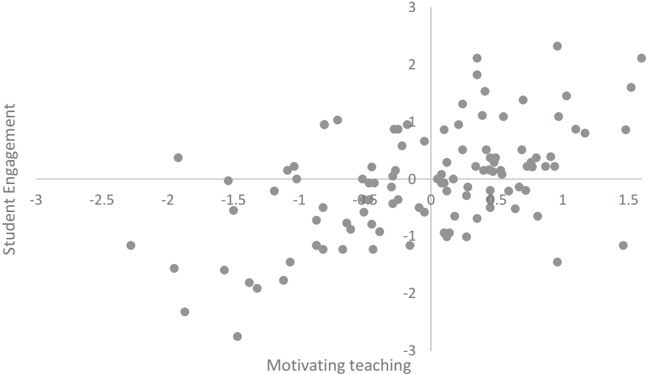
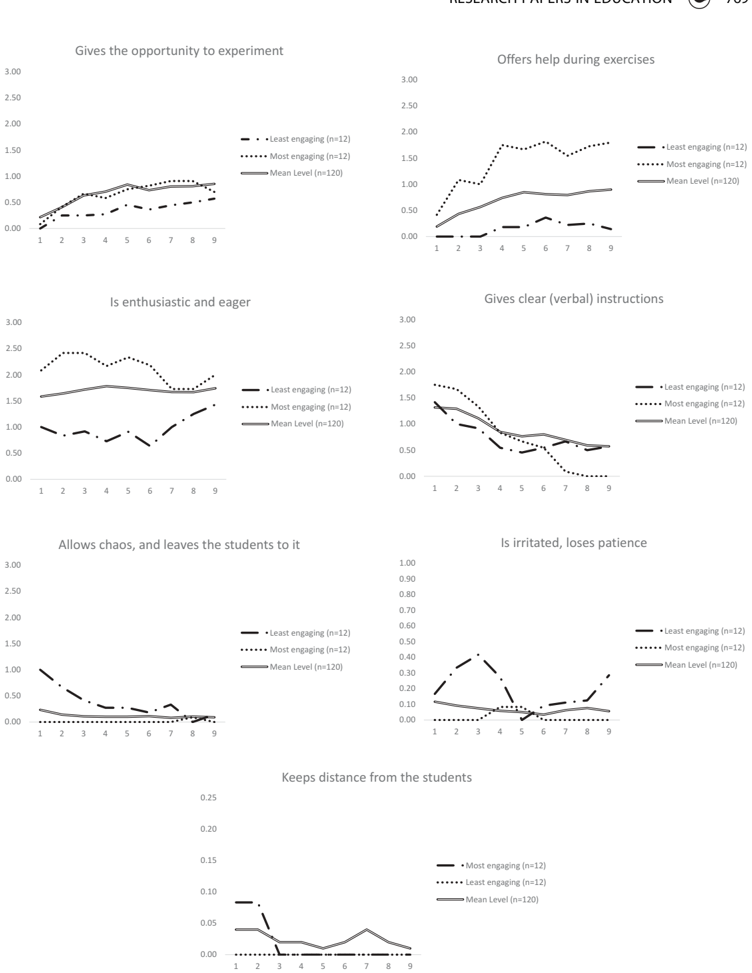
Given the importance of student engagement for students’ current and future success, it is essential to explore how teachers can foster student engagement within lessons. This study relied on classroom observations to describe how teachers applied Self-Determination Theory (SDT) related (de)motivating teaching behaviours to foster students’ engagement. Results from 120 observed lessons of 43 teachers indicated there were distinct relations between motivating teaching behaviours and student engagement. Most striking regarding the use of motivating teaching behaviours were the higher levels of relatedness support and guidance during activities in lessons in which students showed the highest levels of engagement. Conversely, in lessons where students were least engaged, teachers showed higher levels of chaotic teaching behaviours. Analyses of behaviours within lowly and highly engaging lessons showed that teachers in highly engaging lessons were observed to start with high levels of enthusiasm and after about ten to fifteen minutes focused on activating their students by offering room for experimenting and support while students worked on assignments. In contrast, teachers in lowly engaging lessons seemed to have a tendency to employ demotivating teaching behaviour at the start of the lesson. Implications and directions for future research are discussed.
Overview
The claims and statistics of this paper haven’t been checked yet.
Free: it reads the open-access text and checks the first 5 claims that cite a source we can check. Create a free account to check every claim.
Integrity signals
Registry
Cites
Statistics
Figures


Verification
Claims the paper makes
The claims and statistics of this paper haven’t been checked yet.
Free: it reads the open-access text and checks the first 5 claims that cite a source we can check. Create a free account to check every claim.
Claims other papers make about this one
Each is checked against this paper’s own text: does it say what the citing paper says it does?
The source backs part of the claim, not all of it — or backs it for a different population, condition or comparison.
In the citing paper
“Also, Cents-Boonstra et al. [53] investigated the role of motivating teaching behaviour and found that teachers who offered support and guidance during learning had more student engagement in comparison to teachers who did not offer any support or show enthusiasm for teaching.”
From Impact of online learning on student's performance and engagement: a systematic review (2024) · cites this paper as [53]
Experimental — accuracy not yet measured
Self-check
Percentages, sums and reported differences re-computed from the paper’s own numbers.
The self-check needs the paper’s full text.
Citations
Cites
Ryan, R. M., & Deci, E. L. (2000) · American Psychologist · doi:10.1037//0003-066x.55.1.68 · Cited by 54,599 · cited 1×
“In the current study, we relied on self-determination theory (SDT, Ryan and Deci 2000), to describe the classroom dynamics related to observed student engagement and (de)motivating teaching behaviours within lessons.”
Method-Handbook of Self-Determination Research by Edward L. Deci and Richard M. Ryan (Editors)
Paulson, D. S. (2002) · The Journal of mind and behavior · Cited by 5,169
Skinner, E. A., & Belmont, M. J. (1993) · Journal of Educational Psychology · doi:10.1037/0022-0663.85.4.571 · Cited by 3,428 · cited 2×
“Structure has been defined as the provision of desired information and guidance such that students can successfully achieve various outcomes (Grolnick and Pomerantz 2009; Skinner and Belmont 1993).”
BackgroundJournal on Educational Psychology
Winston, J., Mandernach, J., Winsor, D. L., Sinnott, J. D., & Gujjar, A. A. (2014) · Cited by 2,947
Niemiec, C. P., & Ryan, R. M. (2009) · Theory and Research in Education · doi:10.1177/1477878509104318 · Cited by 2,542
REEVE, J. (2009) · Educational Psychologist · doi:10.1080/00461520903028990 · Cited by 1,728 · cited 1×
“On the one hand teachers’ (de)motivating behaviour is influenced by trait-like teacher factors, such as teachers’ own motivational orientation (Van den Berghe et al. 2013), beliefs (Hornstra et al. 2015) and a preferred teaching style (Aelterman et al. 2014; Reeve 2009).”
BackgroundJang, H., Reeve, J., & Deci, E. L. (2010) · Journal of Educational Psychology · doi:10.1037/a0019682 · Cited by 1,650 · cited 8×
“In general, these studies indicate that observed motivating teaching behaviour (Reeve et al. 2004) is positively related to student engagement (Jang, Reeve, and Deci 2010; Reeve et al. 2004; Van den Berghe et al. 2016).”
BackgroundInfluentialAgency as a fourth aspect of students’ engagement during learning activities
Reeve, J., & Tseng, C.-M. (2011) · Contemporary Educational Psychology · doi:10.1016/j.cedpsych.2011.05.002 · Cited by 1,618
Enhancing Students' Engagement by Increasing Teachers' Autonomy Support
Reeve, J., Jang, H., Carrell, D., Jeon, S., & Barch, J. (2004) · Motivation and Emotion · doi:10.1023/b:moem.0000032312.95499.6f · Cited by 1,594 · cited 8×
“In general, these studies indicate that observed motivating teaching behaviour (Reeve et al. 2004) is positively related to student engagement (Jang, Reeve, and Deci 2010; Reeve”
BackgroundMethodInfluentialHandbook of Motivation at School
(2016) · Routledge eBooks · doi:10.4324/9781315773384 · Cited by 1,131
Student engagement and its relationship with early high school dropout
Archambault, I., Janosz, M., Fallu, J., & Pagani, L. S. (2009) · Journal of Adolescence · doi:10.1016/j.adolescence.2008.06.007 · Cited by 1,093
A Meta-analysis of the Effectiveness of Intervention Programs Designed to Support Autonomy
Su, Y.-L., & Reeve, J. (2011) · Educational Psychology Review · doi:10.1007/s10648-010-9142-7 · Cited by 924
What the student does: teaching for enhanced learning
Biggs, J. (2012) · Higher Education Research & Development · doi:10.1080/07294360.2012.642839 · Cited by 863
Wang, M.-T., & Fredricks, J. A. (2014) · Child Development · doi:10.1111/cdev.12138 · Cited by 753
Haerens, L., Aelterman, N., Vansteenkiste, M., Soenens, B., & Van Petegem, S. (2015) · Psychology of Sport and Exercise · doi:10.1016/j.psychsport.2014.08.013 · Cited by 747
Self-citationPelletier, L. G., Séguin-Lévesque, C., & Legault, L. (2002) · Journal of Educational Psychology · doi:10.1037/0022-0663.94.1.186 · Cited by 741 · cited 1×
“Examples of which are: the lesson subject; students’ behaviours (Matos et al. 2018; Van den Berghe et al. 2016); heavy workloads; feeling pressured (Pelletier, Seguin-Levesque, and Legault 2002; Pelletier and Sharp 2009; Ryan and Deci 2016); and negative perceptions of students’ abilities or…”
BackgroundJang, H., Kim, E. J., & Reeve, J. (2016) · Learning and Instruction · doi:10.1016/j.learninstruc.2016.01.002 · Cited by 738
Why Students Drop Out of School: A Review of 25 Years of Research
Lim, S. A., & Rumberger, R. W. (2008) · Issue Lab (Candid) · Cited by 712
Korpershoek, H., Canrinus, E. T., Fokkens-Bruinsma, M., & de Boer, H. (2020) · Research Papers in Education · doi:10.1080/02671522.2019.1615116 · Cited by 648
Development of Achievement Motivation and Engagement
Wigfield, A., Eccles, J. S., Fredricks, J. A., Simpkins, S., Roeser, R. W., & Schiefele, U. (2015) · Handbook of Child Psychology and Developmental Science · doi:10.1002/9781118963418.childpsy316 · Cited by 646 · cited 1×
“Student engagement is defined and operationalised in many ways (Skinner 2016; Wigfield et al. 2015).”
BackgroundSierens, E., Vansteenkiste, M., Goossens, L., Soenens, B., & Dochy, F. (2009) · British Journal of Educational Psychology · doi:10.1348/000709908x304398 · Cited by 618 · cited 1×
“When providing structure before the activity, teachers communicate clear guidelines, give an overview and objectives for the lesson and share their expectations (Jang, Reeve, and Deci 2010; Sierens et al. 2009; Vansteenkiste et al. 2012).”
BackgroundAelterman, N., Vansteenkiste, M., Haerens, L., Soenens, B., Fontaine, J. R. J., & Reeve, J. (2019) · Journal of Educational Psychology · doi:10.1037/edu0000293 · Cited by 614
Self-citationIssues and Challenges in Studying Parental Control: Toward a New Conceptualization
Grolnick, W. S., & Pomerantz, E. M. (2009) · Child Development Perspectives · doi:10.1111/j.1750-8606.2009.00099.x · Cited by 601 · cited 1×
“Structure has been defined as the provision of desired information and guidance such that students can successfully achieve various outcomes (Grolnick and Pomerantz 2009; Skinner and Belmont 1993).”
BackgroundIndividual Differences and the Development of Perceived Control
Skinner, E. A., Zimmer-Gembeck, M. J., Connell, J. P., Eccles, J. S., & Wellborn, J. G. (1998) · Monographs of the Society for Research in Child Development · doi:10.2307/1166220 · Cited by 585
Quin, D. (2017) · Review of Educational Research · doi:10.3102/0034654316669434 · Cited by 565 · cited 3×
“Although ample studies have demonstrated that motivating teaching behaviour relates to higher student engagement (Quin 2017), most of this research has been conducted using questionnaires tapping into students’ perceptions of the teacher’s teaching style (Jang et al.”
BackgroundInfluentialVansteenkiste, M., Sierens, E., Goossens, L., Soenens, B., Dochy, F., Mouratidis, A., Aelterman, N., Haerens, L., & Beyers, W. (2012) · Learning and Instruction · doi:10.1016/j.learninstruc.2012.04.002 · Cited by 542
Self-citationStroet, K., Opdenakker, M.-C., & Minnaert, A. (2013) · Educational Research Review · doi:10.1016/j.edurev.2012.11.003 · Cited by 418
Exploring social constructivism: theories and practicalities
Adams, P. (2006) · Education 3-13 · doi:10.1080/03004270600898893 · Cited by 376
Autonomy-Supportive Teaching: What It Is, How to Do It
Reeve, J. (2016) · Building Autonomous Learners · doi:10.1007/978-981-287-630-0_7 · Cited by 374
Supporting students' motivation, engagement, and learning during an uninteresting activity.
Jang, H. (2008) · Journal of Educational Psychology · doi:10.1037/a0012841 · Cited by 351
Adolescent educational success and mental health vary across school engagement profiles.
Wang, M.-T., & Peck, S. C. (2013) · Developmental Psychology · doi:10.1037/a0030028 · Cited by 310
Jang, H., Reeve, J., & Halusic, M. (2016) · The Journal of Experimental Education · doi:10.1080/00220973.2015.1083522 · Cited by 292
Vansteenkiste, M., Aelterman, N., De Muynck, G.-J., Haerens, L., Patall, E., & Reeve, J. (2018) · The Journal of Experimental Education · doi:10.1080/00220973.2017.1381067 · Cited by 280 · cited 1×
“2011; Niemiec and Ryan 2009), and provide meaningful rationales (Vansteenkiste et al. 2018).”
BackgroundSelf-citationStudent engagement as a function of environmental complexity in high school classrooms
Shernoff, D. J., Kelly, S., Tonks, S. M., Anderson, B., Cavanagh, R. F., Sinha, S., & Abdi, B. (2016) · Learning and Instruction · doi:10.1016/j.learninstruc.2015.12.003 · Cited by 264
Does observed controlling teaching behavior relate to students’ motivation in physical education?
De Meyer, J., Tallir, I. B., Soenens, B., Vansteenkiste, M., Aelterman, N., Van den Berghe, L., Speleers, L., & Haerens, L. (2014) · Journal of Educational Psychology · doi:10.1037/a0034399 · Cited by 261
Self-citationNguyen, T. D., Cannata, M., & Miller, J. (2018) · The Journal of Educational Research · doi:10.1080/00220671.2016.1220359 · Cited by 252
Observing Physical Education Teachers’ Need-Supportive Interactions in Classroom Settings
Haerens, L., Aelterman, N., Van den Berghe, L., De Meyer, J., Soenens, B., & Vansteenkiste, M. (2013) · Journal of Sport and Exercise Psychology · doi:10.1123/jsep.35.1.3 · Cited by 243 · cited 12×
“students feel personally accepted (Haerens et al. 2013; Korpershoek et al. 2019; Sparks et al. 2016).”
BackgroundMethodSelf-citationRyan, R. M., & Deci, E. L. (2016) · Research Bank (Australian Catholic University) · Cited by 232
Aelterman, N., Vansteenkiste, M., Van den Berghe, L., De Meyer, J., & Haerens, L. (2014) · Journal of Sport and Exercise Psychology · doi:10.1123/jsep.2013-0229 · Cited by 222
Self-citationvan Uden, J. M., Ritzen, H., & Pieters, J. M. (2014) · Teaching and Teacher Education · doi:10.1016/j.tate.2013.08.005 · Cited by 221
Haerens, L., Vansteenkiste, M., De Meester, A., Delrue, J., Tallir, I., Vande Broek, G., Goris, W., & Aelterman, N. (2018) · Physical Education and Sport Pedagogy · doi:10.1080/17408989.2017.1346070 · Cited by 203
Self-citationAelterman, N., Vansteenkiste, M., Van Keer, H., Van den Berghe, L., De Meyer, J., & Haerens, L. (2012) · Journal of Sport and Exercise Psychology · doi:10.1123/jsep.34.4.457 · Cited by 191
Self-citationMouratidis, A. A., Vansteenkiste, M., Sideridis, G., & Lens, W. (2011) · Journal of Educational Psychology · doi:10.1037/a0022773 · Cited by 169 · cited 2×
“2013), offer a minimal amount of meaningful choices (Mouratidis et al. 2011; Niemiec and Ryan 2009), and provide meaningful rationales (Vansteenkiste et al.”
BackgroundAuthentic and self-directed learning in vocational education: Challenges to vocational educators
de Bruijn, E., & Leeman, Y. (2011) · Teaching and Teacher Education · doi:10.1016/j.tate.2010.11.007 · Cited by 164
Van den Berghe, L., Soenens, B., Vansteenkiste, M., Aelterman, N., Cardon, G., Tallir, I. B., & Haerens, L. (2013) · Psychology of Sport and Exercise · doi:10.1016/j.psychsport.2013.04.006 · Cited by 161 · cited 10×
“These findings are in line with earlier findings of De Meyer et al. (2014) and Van den Berghe et al. (2013) who found that demotivating teaching behaviours are particularly harmful for students, despite their low occurrence, as one negative experience can have a more severe impact than a positive…”
BackgroundMethodResultSelf-citationReal-time teacher–student interactions: A Dynamic Systems approach
Pennings, H. J. M., van Tartwijk, J., Wubbels, T., Claessens, L. C. A., van der Want, A., & Brekelmans, M. (2013) · Teaching and Teacher Education · doi:10.1016/j.tate.2013.07.016 · Cited by 154
Matos, L., Reeve, J., Herrera, D., & Claux, M. (2018) · The Journal of Experimental Education · doi:10.1080/00220973.2018.1448746 · Cited by 133 · cited 4×
“Recent research (Jang et al. 2016; Matos et al. 2018) suggests that it is a reciprocal relationship: more (specifically more active) student engagement leads to more motivating teaching beha-”
BackgroundInfluentialZitter, I., & Hoeve, A. (2012) · OECD education working papers · doi:10.1787/5k97785xwdvf-en · Cited by 127
Towards competence‐based VET: dealing with the pitfalls
Biemans, H. J. A., Wesselink, R., Gulikers, J. T. M., Schaafsma, S. C. T., Verstegen, J. A. A. M., & Mulder, M. (2009) · Journal of Vocational Education and Training · doi:10.1080/13636820903194682 · Cited by 125
Hornstra, L., Stroet, K., van Eijden, E., Goudsblom, J., & Roskamp, C. (2018) · Educational Research and Evaluation · doi:10.1080/13803611.2018.1550841 · Cited by 123
Stroet, K., Opdenakker, M., & Minnaert, A. E. M. G. (2015) · Contemporary Educational Psychology · doi:10.1016/j.cedpsych.2015.06.002 · Cited by 119
Motivational teacher strategies: the role of beliefs and contextual factors
Hornstra, L., Mansfield, C., van der Veen, I., Peetsma, T., & Volman, M. (2015) · Learning Environments Research · doi:10.1007/s10984-015-9189-y · Cited by 117
Abbott‐Chapman, J., Martin, K., Ollington, N., Venn, A., Dwyer, T., & Gall, S. (2014) · British Educational Research Journal · doi:10.1002/berj.3031 · Cited by 117
Sparks, C., Dimmock, J. A., Lonsdale, C., & Jackson, B. (2016) · Psychology of sport and exercise · doi:10.1016/j.psychsport.2016.06.004 · Cited by 113
Van den Berghe, L., Cardon, G., Tallir, I., Kirk, D., & Haerens, L. (2016) · Physical Education and Sport Pedagogy · doi:10.1080/17408989.2015.1115008 · Cited by 108
Self-citationBasic psychological needs and school engagement: a focus on justice and agency
Molinari, L., & Mameli, C. (2017) · Social Psychology of Education · doi:10.1007/s11218-017-9410-1 · Cited by 99
Stroet, K., Opdenakker, M., & Minnaert, A. E. M. G. (2015) · Social Psychology of Education · doi:10.1007/s11218-015-9290-1 · Cited by 89
Krijgsman, C., Mainhard, T., van Tartwijk, J., Borghouts, L. B., Vansteenkiste, M., Aelterman, N., & Haerens, L. L. (2019) · Learning and Instruction · doi:10.1016/j.learninstruc.2018.12.005 · Cited by 84
Self-citationQuin, D., Hemphill, S. A., & Heerde, J. A. (2017) · Social Psychology of Education · doi:10.1007/s11218-017-9401-2 · Cited by 83
Learning in Workplace Simulations in Vocational Education: a Student Perspective
Jossberger, H., Brand‐Gruwel, S., van de Wiel, M. W. J., & Boshuizen, H. P. A. (2017) · Vocations and Learning · doi:10.1007/s12186-017-9186-7 · Cited by 68
Elffers, L. (2012) · European Journal of Psychology of Education · doi:10.1007/s10212-012-0128-3 · Cited by 65
den Berghe, L. V., Tallir, I., Cardon, G., Aelterman, N., & Haerens, L. L. (2015) · Journal of Sport and Exercise Psychology · doi:10.1123/jsep.2014-0150 · Cited by 59
Self-citationCents-Boonstra, M., Lichtwarck‐Aschoff, A., Denessen, E. J. P. G., Haerens, L. L., & Aelterman, N. (2018) · Journal of Vocational Education and Training · doi:10.1080/13636820.2018.1549092 · Cited by 51
Self-citationElffers, L. (2011) · UvA-DARE (University of Amsterdam) · Cited by 50
Barkoukis, V., Taylor, I., Chanal, J., & Ntoumanis, N. (2014) · Scandinavian Journal of Medicine & Science in Sports · doi:10.1111/sms.12174 · Cited by 45
Achievement Profiles of Students in High School Vocational Training Programs
Dubeau, A., Plante, I., & Frenay, M. (2016) · Vocations and Learning · doi:10.1007/s12186-016-9163-6 · Cited by 45
The importance of psychological need satisfaction in educational re-engagement
Nicholson, L. J., & Putwain, D. W. (2016) · Research Papers in Education · doi:10.1080/02671522.2016.1271004 · Cited by 42
Zitter, I., & Hoeve, A. (2012) · OECD Publishing (NJ1) · Cited by 16
(1998) · Monographs of the Society for Research in Child Development · doi:10.1111/j.1540-5834.1998.tb02760.x · Cited by 14
The teaching‐learning environment in a student‐centred physics classroom
Wilkinson, W. J., Treagust, D. F., Leggett, M., & Glasson, P. (1988) · Research Papers in Education · doi:10.1080/0267152880030304 · Cited by 10
Authentic and self-directed learning in vocational education
Leeman, Y. A. M., & de Bruijn, E. (2011) · Cited by 10
Hornstra, L., Weijers, D., van der Veen, I., & Peetsma, T. T. D. (2016) · UvA-DARE (University of Amsterdam) · Cited by 2
Where to go and how to get there
Haerens, L. L., Aelterman, N., Krijgsman, C., Mainhard, T., Borghouts, L. B., van Tartwijk, J., & Vansteenkiste, M. (2019) · Cited by 1
Self-citationBarbero (2014) · doi:10.1016/j · Cited by 1
Research works printed but not linked: 6
- Drechsel, B., K. Prenzel, and M. Kramer. 2002. ' Self-determined and Interested Learning in Vocational Education. ' In Teaching -learning Processes in Vocational Education , edited by K. Beck, 43 -68. Frankfurt am Main: Peter Lang.
- Good, T., and J. Brophy. 1987. Looking in Classrooms . 4th ed. New York: Harper and Row.
- Hornstra, L., D. Weijers, I. Van der Veen, and T. Peetsma. 2016. Het Motiveren Van Leerlingen Met Verschillende Prestatieniveaus En Achtergrondken merken: Onderzoeksverslag . Utrecht: Universiteit Utrecht.
- Pelletier, L., and E. C. Sharp. 2009. ' Administrative Pressures and Teachers ' Interpersonal Behaviour in the Classroom. ' School Field 7 (2): 174 -183.
- Reeve, J. 2002. ' Self-determination Theory Applied to Educational Settings. ' In Handbook of Selfdetermination Research , edited by E. L. Deci and R. M. Ryan, 2 -183, New York: University of Rochester Press.
- Vugteveen, J., A. C. Timmermans, H. Korpershoek, M. Van Rooijen, and M.-C. Opdenakker. 2016. Overgangen En Aansluitingen in Het Onderwijs: Deelrapportage 3: Empirische Studie Naar De Cognitieve En Niet-cognitieve Ontwikkeling Van Leerlingen Rondom De Vmbo-mbo Overgang . Groningen: GION onderzoek/onderwijs.
Cited by
Impact of online learning on student's performance and engagement: a systematic review
Akpen, C. N., Asaolu, S., Atobatele, S., Okagbue, H., & Sampson, S. (2024) · Discover Education · doi:10.1007/s44217-024-00253-0 · Cited by 205
“Also, Cents-Boonstra et al. [53] investigated the role of motivating teaching behaviour and found that teachers who offered support and guidance during learning had more student engagement in comparison to teachers who did not offer any support or show enthusiasm for teaching.”
Huang, L., & Wang, D. (2023) · Behavioral Sciences · doi:10.3390/bs13090704 · Cited by 170
Classroom Behavior Recognition Using Computer Vision: A Systematic Review
Liu, Q., Jiang, X., & Jiang, R. (2025) · Sensors · doi:10.3390/s25020373 · Cited by 97
Bao, C., Zhang, L. J., & Dixon, H. R. (2021) · Frontiers in Psychology · doi:10.3389/fpsyg.2021.710736 · Cited by 78
“, 2020), which requires that teachers should analyze the external factors that might impact student engagement; (2) student engagement is associated with student motivation (Yuan and Zhang, 2017; Bond et al., 2020; Cents-Boonstra et al., 2020) and persistence to learning (Archambault et al.”
BackgroundInfluentialSystematic review of inquiry-based learning: assessing impact and best practices in education
Ramaila, S. M. (2024) · F1000Research · doi:10.12688/f1000research.155367.1 · Cited by 91
Metadata
- Authors
- Cents-Boonstra, M., Lichtwarck-Aschoff, A., Denessen, E., Aelterman, N., & Haerens, L.
- Affiliations
- Radboud University Nijmegen (NL)
- Behavioural Science Institute, Radboud University, Nijmegen, The Netherlands
- Leiden University (NL)
- Ghent University (BE)
- Corresponding author
- Cents-Boonstra, Miriam
- Venue
- Research Papers in Education
- Publisher
- Informa UK Limited
- Published
- 2020-05-20
- Volume
- 36
- Issue
- 6
- Pages
- 754-779
- ISSN
- 0267-1522 (ISSN-L)
- 1470-1146
- OpenAlex
- W3027350858
- Semantic Scholar
- 34ee056fe97fe3a0bc9ba155615f29af31175260
- Cited by
- 216
- References
- 72
- Citations by year
- 2026: 48 · 2025: 68 · 2024: 45 · 2023: 25 · 2022: 20 · 2021: 9 · 2020: 1
- FWCI
- 15.02
- Type
- journal article
- Language
- en
- Open access
- hybrid
- doi.org
- Locations
- Research Papers in Education (publishedVersion, other-oa)
- Radboud Repository (Radboud University) (submittedVersion, other-oa)
- Ghent University Academic Bibliography (Ghent University) (submittedVersion, cc-by-nc-nd)
- University of Groningen research database (University of Groningen / Centre for Information Technology) (submittedVersion, cc-by-nc-nd)
- Radboud Repository (Radboud University) (submittedVersion)
- University of Groningen research database (University of Groningen / Centre for Information Technology) (submittedVersion)
- Funders
- funding agencies
- Topics
- Social Sciences › Psychology › Social Psychology › Motivation and Self-Concept in Sports
- Social Sciences › Psychology › Developmental and Educational Psychology › Education, Achievement, and Giftedness
- Social Sciences › Psychology › Developmental and Educational Psychology › Innovative Teaching and Learning Methods
- Keywords
- student engagement, self-determination theory, relatedness, teacher enthusiasm, classroom observation, teacher-student relationship
About these checks
Registry, retraction, Cites and statistics results are computed, not judged, with one exception: a printed reference that no index lists is read once by a model before it counts as a citation error. Claims are extracted by a model and kept only when their quote appears verbatim in the text; each cited source is then checked, with a model’s help, for whether it says what the claim relies on. Those verdicts can be wrong — read the claim’s quote and the cited source before relying on one.
Statistics and arithmetic are recomputed, not judged.
Confidence bands are shown only for fields calibrated on our annotated test set. None is calibrated yet, so no band is shown.
What counts as a claim ›How we measure confidence ›How we check this ›
Are you an author, or do you see a problem with this page? Request a review
Data sources
Bibliographic data: Semantic Scholar, OpenAlex, Crossref.
Contains information from the Semantic Scholar Academic Graph Datasets, made available under the ODC Attribution License (ODC-BY 1.0).
Semantic Scholar’s data is described in: Kinney, R., et al. (2023). The Semantic Scholar Open Data Platform. arXiv:2301.10140.
