

Personal Informatics, Self-Insight, and Behavior Change: A Critical Review of Current Literature
Open accessThe DOI matches its Crossref record; 58 of the 59 references it cites were found in a registry or an index.
Abstract
Personal informatics (PI) systems allow users to collect and review personally relevant information. The purpose commonly envisioned for these systems is that they provide users with actionable, data-driven self-insight to help them change their behavioral patterns for the better. Here, we review relevant theory as well as empirical evidence for this self-improvement hypothesis. From a corpus of 6,568, only 24 studies met the selection criteria of being a peer-reviewed empirical study reporting on actionable, data-driven insights from PI data, using a “clean” PI system with no other intervention techniques (e.g., additional coaching) on a nonclinical population. First results are promising—many of the selected articles report users gaining actionable insights—but we do note a number of methodological issues that make these results difficult to interpret. We conclude that more work is needed to investigate the self-improvement hypothesis and provide a set of recommendations for future work.
Overview
The claims and statistics of this paper haven’t been checked yet.
Free: it reads the open-access text and checks the first 5 claims that cite a source we can check. Create a free account to check every claim.
Integrity signals
Registry
Cites
Statistics
Figures



Verification
Claims the paper makes
The claims and statistics of this paper haven’t been checked yet.
Free: it reads the open-access text and checks the first 5 claims that cite a source we can check. Create a free account to check every claim.
Claims other papers make about this one
Each is checked against this paper’s own text: does it say what the citing paper says it does?
The cited source says what the claim attributes to it.
In the citing paper
“Ultimately, this can lead individuals to change their views about themselves (DeVito et al., 2017) and maybe even to modify their behavior (Isaacs et al., 2013;Kersten-van Dijk et al., 2017).”
From Understanding Autobiographical Memory in the Digital Age: The AMEDIA-Model (2024) · cites this paper as Kersten-van Dijk et al., 2017
In the citing paper
“Some HCI research on designing technology for reflection focuses on the domain of personal informatics, designing technology for the functional goal of supporting self-improvement [6,37].”
From Reflection Across AI-based Music Composition (2024) · cites this paper as [37]
Self-check
Percentages, sums and reported differences re-computed from the paper’s own numbers.
The self-check needs the paper’s full text.
Citations
Cites
Self-efficacy: Toward a unifying theory of behavioral change
Bandura, A. (1977) · Psychological Review · doi:10.1037/0033-295x.84.2.191 · Cited by 43,925 · cited 4×
“Perhaps the most obvious is information about past performance accomplishments (Bandura, 1977): If individuals succeeded at something before, they are likely to feel more confident that they can succeed again.”
BackgroundInfluentialFrom Intentions to Actions: A Theory of Planned Behavior
Ajzen, I. (1985) · Action Control · doi:10.1007/978-3-642-69746-3_2 · Cited by 19,057 · cited 2×
“…many of the concepts and ideas from the TTM are shared by a variety of other behavior (change) models, like the theory of planned behavior (Ajzen, 1985), the health belief model (Rosenstock, 1974), and various others (Bagozzi, 2000; Bandura, 1977, 1991; De Vries et al., 2003; Fishbein,…”
BackgroundHattie, J., & Timperley, H. (2007) · Review of Educational Research · doi:10.3102/003465430298487 · Cited by 12,905
The Transtheoretical Model of Health Behavior Change.
Prochaska, J. O., & Velicer, W. F. (1997) · American Journal of Health Promotion · doi:10.4278/0890-1171-12.1.38 · Cited by 7,782 · cited 3×
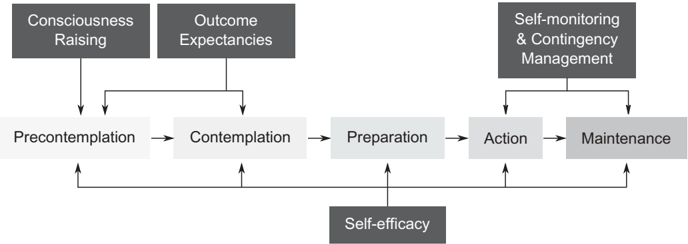
“Both Li et al. (2010, 2011) and Epstein et al. (2015) noted similarities between their models of PI (the stage-based model and the lived informatics model, respectively) and the TTM (Prochaska & Velicer, 1997).”
MethodResultSocial cognitive theory of self-regulation
Bandura, A. (1991) · Organizational Behavior and Human Decision Processes · doi:10.1016/0749-5978(91)90022-l · Cited by 6,875 · cited 4×
“…(change) models, like the theory of planned behavior (Ajzen, 1985), the health belief model (Rosenstock, 1974), and various others (Bagozzi, 2000; Bandura, 1977, 1991; De Vries et al., 2003; Fishbein, 2000; Hagger & Chatzisarantis, 2014; Klein, Mogles, & Van Wissen, 2011; Kluger & DeNisi, 1998;…”
BackgroundResultInfluentialA Protection Motivation Theory of Fear Appeals and Attitude Change1
Rogers, R. W. (1975) · The Journal of Psychology · doi:10.1080/00223980.1975.9915803 · Cited by 6,805 · cited 5×
“…belief model (Rosenstock, 1974), and various others (Bagozzi, 2000; Bandura, 1977, 1991; De Vries et al., 2003; Fishbein, 2000; Hagger & Chatzisarantis, 2014; Klein, Mogles, & Van Wissen, 2011; Kluger & DeNisi, 1998; Maes & Gebhardt, 2000; Rogers, 1975; Ryan, 2009; Schwarzer, 2008; Witte, 1992).”
BackgroundInfluentialHistorical Origins of the Health Belief Model
Rosenstock, I. M. (1974) · Health Education Monographs · doi:10.1177/109019817400200403 · Cited by 6,116 · cited 2×
“…from the TTM are shared by a variety of other behavior (change) models, like the theory of planned behavior (Ajzen, 1985), the health belief model (Rosenstock, 1974), and various others (Bagozzi, 2000; Bandura, 1977, 1991; De Vries et al., 2003; Fishbein, 2000; Hagger & Chatzisarantis, 2014;…”
BackgroundKluger, A. N., & DeNisi, A. (1996) · Psychological Bulletin · doi:10.1037/0033-2909.119.2.254 · Cited by 5,882 · cited 1×
“In a review, Kluger and Denisi (1996) found that the majority of feedback interventions were effective, although it should be noted that for about one third of the interventions the effect was adverse rather than beneficial.”
BackgroundReadings in Information Visualization: Using Vision to Think
Card, S. K., Mackinlay, J. D., & Shneiderman, B. (1999) · Cited by 3,935
Putting the fear back into fear appeals: the extended parallel process model
Witte, K. (1992) · Communication Monographs · doi:10.1080/03637759209376276 · Cited by 3,880 · cited 2×
“…belief model (Rosenstock, 1974), and various others (Bagozzi, 2000; Bandura, 1977, 1991; De Vries et al., 2003; Fishbein, 2000; Hagger & Chatzisarantis, 2014; Klein, Mogles, & Van Wissen, 2011; Kluger & DeNisi, 1998; Maes & Gebhardt, 2000; Rogers, 1975; Ryan, 2009; Schwarzer, 2008; Witte, 1992).”
Background
Research works printed but not linked: 6
- Consolvo, S., Klasnja, P., McDonald, D. W., Avrahami, D., Froehlich, J., LeGrand, L., … Landay, J. A. (2008). Flowers or a robot army?: En- couraging awareness & activity with personal, mobile displays. Proceedings of the UbiComp 2008 International Conference on Ubiquitous Computing . New York, NY: ACM.
- Fujinami, K. (2010). A case study on information presentation to increase awareness of walking exercise in everyday life. International Journal of Smart Home , 4 (4), 11 -26. doi:10.1007/978-3-540-68504-328 · doi:10.1007/978-3-540-68504-328
- Li, I., Dey, A. K., & Forlizzi, J. (2011). Understanding my data, myself: Sup -porting selfreflection with ubicomp technologies. Proceedings of the International Conference on Ubiquitous Computing . New York, NY: ACM.
- Park, S., Pedro, J. S., & Oliver, N. (2015). Mobitop: Bringing topic-based re -flection to mobile browsing habits. Proceedings of the 2015 International Joint Conference on Pervasive and
- Ubiquitous Computing and Proceedings of the 2015 International Symposium on Wearable Computers . New York, NY: ACM.
- 10.1007/978-1-4612-4964-11 · doi:10.1007/978-1-4612-4964-11
Cited by
Items 101–200 of 218
The quality of health and wellness self‐tracking data: A consumer perspective
Zhang, Y., & Trace, C. B. (2021) · Journal of the Association for Information Science and Technology · doi:10.1002/asi.24591 · Cited by 10
Measuring commitment to self-tracking: development of the C2ST scale
Hancı, E., Lacroix, J. P. W., Ruijten, P. A. M., Haans, A., & IJsselsteijn, W. A. (2020) · Personal and Ubiquitous Computing · doi:10.1007/s00779-020-01453-9 · Cited by 9
“Self-tracking technologies, such as fitness trackers, by means of providing ubiquitous and real-time monitoring, aim to increase self-awareness, thus prompting users towards making healthier lifestyle decisions [18].”
BackgroundSelf-citationSelf-Control in Cyberspace: Applying Dual Systems Theory to Digital Self-Control ToolsPreprint
Lyngs, U., Lukoff, K., Slovák, P., Binns, R., Slack, A., Inzlicht, M., Kleek, M. G. V., & Shadbolt, N. (2019) · SocArXiv (OSF Preprints) · doi:10.31235/osf.io/685tm · Cited by 9
Are Trackers Social Actors? The Role of Self-tracking on Self-evaluation
Hancı, E., Ruijten, P. A. M., Lacroix, J. P. W., Dijk, E. T. K.-V., & IJsselsteijn, W. A. (2019) · Lecture notes in computer science · doi:10.1007/978-3-030-17287-9_3 · Cited by 8
Self-citationСтуденческий дискурс о цифровом селф-трекинге: риторики и практики
Генриевна, Н. Е. (2020) · Monitoring obŝestvennogo mneniâ: èkonomičeskie i socialʹnye peremeny · doi:10.14515/monitoring.2020.2.989 · Cited by 8
FindMyself: A Mobile Self-Reflection App to Support Students in Career Decision-Making
Aragon-Hahner, S., Körber, J., Schneller, M., & Strickroth, S. (2023) · International Conference on Mobile and Ubiquitous Multimedia (MUM) · doi:10.1145/3626705.3627774 · Cited by 7
“PI systems help people collect and review personal data to improve self-awareness [37].”
BackgroundTowards a psychological computing approach to digital lifestyle interventions
Zhang, C. (2019) · Utrecht University Repository (Utrecht University) · Cited by 7
Nkem, D., & Xue, M. (2023) · ACM Symposium on Spatial User Interaction (SUI) · doi:10.1145/3607822.3616417 · Cited by 6
Ishita, S. Z., Kaliappan, S., Rashik, M., Epstein, D. A., & Karkar, R. (2026) · CHI Conference on Human Factors in Computing Systems · doi:10.1145/3772318.3791551 · Cited by 6
“A common concern regarding self-experimentation, particularly when it does not involve experts, is around its safety [54, 67].”
Toward Pluralizing Reflection in HCI through Daoism
Zhu, A. P., Mah, K., & Cho, J. (2026) · CHI Conference on Human Factors in Computing Systems · doi:10.1145/3772318.3790853 · Cited by 6
“Much of HCI research assumes idealized conditions, such as users being motivated, attentive, and cognitively available when engaging in reflective practices [105, 201].”
Selection of the best lecturers using the Simple Additive Weighting method
Noeman, A., & Priatna, W. (2020) · IJARCCE · doi:10.17148/ijarcce.2020.91111 · Cited by 6
“In Your Face!”: Visualizing Fitness Tracker Data in Augmented Reality
Rigling, S., Yu, X., & Sedlmair, M. (2023) · CHI Conference Extended Abstracts on Human Factors in Computing Systems (CHI EA) · doi:10.1145/3544549.3585912 · Cited by 6
“At the core of personal quantifcation and the related scientifc feld of personal informatics is the goal of gaining insights and information from quantifable, sensor-driven data about oneself—the “quantifed self” [11].”
BackgroundThe Advent of Digital Productivity Assistants: The Case of Microsoft MyAnalytics
Winikoff, M., Cranefield, J., Li, Y., Richter, A., & Doyle, C. (2021) · Open Access Victoria University of Wellington | Te Herenga Waka (Figshare) · doi:10.26686/wgtn.13513929 · Cited by 6
“[19] apply the trans-theoretical stages of change model to demonstrate that personal informatics tools are fairly successful in raising awareness of issues, and helping with behaviour maintenance, but that they provide little support for the critical early stage of change.”
Backgroundvan de Belt, T. H., de Croon, A., Freriks, F., Blomseth Christiansen, T., Eg Larsen, J., & de Groot, M. (2022) · JMIR Formative Research · doi:10.2196/32704 · Cited by 5
Ahmetoglu, Y., Iskandar, A., Taoh, S., Ying, A., Brumby, D. P., & Cox, A. L. (2025) · Annual Symposium on Human-Computer Interaction for Work (CHIWORK) · doi:10.1145/3729176.3729182 · Cited by 5
Jung, Y., Lee, K., & Hong, H. (2025) · Designing Interactive Systems Conference · doi:10.1145/3715336.3735840 · Cited by 5
Open Issues in Persuasive Technologies: Six HCI Challenges for the Design of Behavior Change Systems
Rapp, A., & Boldi, A. (2024) · Lecture notes in computer science · doi:10.1007/978-3-031-60428-7_8 · Cited by 5
Manning, J. B., BLANDFORD, A. E., & Edbrooke-Childs, J. H. (2024) · Journal of Medical Internet Research · doi:10.2196/50457 · Cited by 5
An intelligent interface for supporting coaches in providing running feedback
Cau, F. M., Mancosu, M. S., Mulas, F., Pilloni, P., & Spano, L. D. (2019) · Biannual Conference of the Italian SIGCHI Chapter (CHItaly) · doi:10.1145/3351995.3352039 · Cited by 5
“The goal was to support the exploration of the collected data [3] and to foster behaviour changes [2].”
BackgroundBentley, J. R., Yu, X., Karmarkar, A. M., Downer, B. G., Prochaska, J. D., & Lyons, E. (2022) · BMC Cancer · doi:10.1186/s12885-022-09629-7 · Cited by 5
Mood Prediction Based on Calendar Events Using Multitask Learning
Tateyama, N., Fukui, R., & Warisawa, S. (2022) · IEEE Access · doi:10.1109/access.2022.3193778 · Cited by 6
Smartphones in Personal Informatics: A Framework for Self-Tracking Research with Mobile Sensing
Vaid, S. S., & Harari, G. M. (2022) · Studies in neuroscience, psychology and behavioral economics · doi:10.1007/978-3-030-98546-2_6 · Cited by 5
Jáuregui, D. A. G., Dollack, F., & Perusquía-Hernández, M. (2021) · International Conference on Affective Computing and Intelligent Interaction Workshops and Demos (ACIIW) · doi:10.1109/aciiw52867.2021.9666320 · Cited by 5
Understanding and Measuring Perceived Productivity
Gennara, A. (2023) · Carleton University's Institutional Repository (MacOdrum Library, Carleton University) · doi:10.22215/etd/2023-15741 · Cited by 5
Manning, J. B., BLANDFORD, A. E., & Edbrooke-Childs, J. H. (2023) · JMIR Formative Research · doi:10.2196/50460 · Cited by 4
Leipold, N., Hauptmann, H., Böhm, M., Madenach, M., Lurz, M., Groh, G., Gedrich, K., & Krcmar, H. (2023) · AIS Transactions on Human-Computer Interaction · doi:10.17705/1thci.00082 · Cited by 4
Shin, Y., Kim, C., & Yoon, J. (2022) · [ ] With Design: Reinventing Design Modes · doi:10.1007/978-981-19-4472-7_31 · Cited by 4
Internet Self-regulation in Higher Education: A Metacognitive Approach to Internet Addiction
von Schoultz, D. J., Thomson, K.-L., & van Niekerk, J. (2020) · IFIP advances in information and communication technology · doi:10.1007/978-3-030-57404-8_15 · Cited by 4
Users Want Diverse, Multiple, and Personalized Behavior Change Support: Need-Finding Survey
Khan, M., Fernandes, G., & Maes, P. (2021) · Lecture notes in computer science · doi:10.1007/978-3-030-79460-6_20 · Cited by 4
LALLEMAND, C., van den Heuvel, R., van Renswouw, L., Bogers, S., Verburg, P., & Hummels, C. (2022) · Open Repository and Bibliography (University of Luxembourg) · Cited by 4
Quantified stress : toward data-driven stress awareness
Kersten - van Dijk, E. T. (2018) · TU/e Research Portal · Cited by 4
Self-citationUlysses in cyberspace: examining the effectiveness of design patterns for digital self-control
Lyngs, U. (2019) · Oxford University Research Archive (ORA) (University of Oxford) · doi:10.5287/ora-avq9rbk9n · Cited by 4
Essais sur l'adoption des technologies de quantification de soi : une approche critique
Moya, J. D. (2019) · theses.fr (ABES) · doi:10.70675/71fa5e23zbc1bz4e98zb8baz67f821674d90 · Cited by 4
A systematic review of shared personal informatics
Xue, M., An, P., Guo, Z., Liang, R.-H., Hu, J., Hansen, P., & Feijs, L. M. G. (2025) · Information and Software Technology · doi:10.1016/j.infsof.2025.107759 · Cited by 3
Informing the Design of Intervention Solutions for Body-Focused Repetitive Behaviors
Rezaei, P. P., Jokela, T., Vetek, A., & Salmimaa, M. (2024) · Proceedings of the ACM on Human-Computer Interaction · doi:10.1145/3676513 · Cited by 3
Infantilisation through Technology
Beck, B. (2020) · Techno:Phil · doi:10.1007/978-3-476-04896-7_4 · Cited by 3
Meier, S., & Glinka, K. (2018) · KN - Journal of Cartography and Geographic Information · doi:10.1007/bf03544555 · Cited by 3
DAN & Danny: Combining Analog and Digital Self-Tracking Data to Manage Wellbeing
Nogueira, J., Alves, T., & Nicolau, H. (2021) · International Conference on Graphics and Interaction (ICGI) · doi:10.1109/icgi54032.2021.9655289 · Cited by 3
“Overall, results are in line with the current state-of-the-art [31], [32].”
ResultPan, S., Ren, X., Vos, S. B., & Brombacher, A. (2023) · Frontiers in Psychology · doi:10.3389/fpsyg.2023.1265218 · Cited by 3
“On the other hand, dietary assessment tools have become a social approach (Lupton, 2014), while helping individuals gain self-awareness of daily intake (Kersten-van Dijk et al., 2017).”
BackgroundDesigning KRIYA: An AI Companion for Wellbeing Self-ReflectionPreprint
Zhu, S., Song, W., Shi, J. M., Yoo, D. W., Bhat, K., & Saha, K. (2026) · arXiv (Cornell University) · doi:10.48550/arxiv.2601.14589 · Cited by 3
Toebosch, R., Berger, A., & Lallemand, C. (2025) · International Conference on Tangible, Embedded, and Embodied Interaction (TEI) · doi:10.1145/3689050.3704425 · Cited by 2
“Self-tracking devices are often positioned as improving the lives of their users [36, 38], and results so far suggest that users can successfully use PI systems to gain actionable insights [22].”
Petrou, P., den Dulk, L., & Michaelides, G. (2026) · Human Relations · doi:10.1177/00187267251407641 · Cited by 2
“These three elements of raising awareness, goal-setting, and self-reflection are commonly used in (intervention) research aiming at behavioral change (Epton et al., 2017; Kersten-van Dijk et al., 2017).”
Li, W., Zhang, J., Ma, J., & Zhang, P. (2026) · CHI Conference on Human Factors in Computing Systems · doi:10.1145/3772318.3790916 · Cited by 2
“Bridging this gap requires understanding how users engage in sensemaking — the cognitive processes of framing, organizing, and interpreting data [60] — to explicate how reflection processes extend beyond examining the data [38].”
Digital Futures in Human-Computer Interaction: Design Thinking for Digital Transformation
Fu, Z., Barbara, A. K., & Scupelli, P. G. (2025) · CRC Press eBooks · doi:10.1201/9781032693606 · Cited by 2
'Stick to' Three: Fostering Awareness, Intentions, and Reflections on the Top Daily Tasks
Meyer, A. N., Ahmed, N., Cuber, I., Richner, S., Huang, E. M., Murphy, G. C., & Fritz, T. (2025) · Designing Interactive Systems Conference · doi:10.1145/3715336.3735792 · Cited by 2
Mitrevska, T., Kobiella, C., Feckl, J., Sakel, S., Butz, A. M., & Schneegass, C. (2025) · Australian Conference on Human-Computer Interaction (OzCHI) · doi:10.1145/3764687.3764696 · Cited by 2
Persuasive Feedback for Fitness Apps: Effects of Construal Level and Communication Style
Niess, J., Diefenbach, S., & Woźniak, P. W. (2020) · Lecture notes in computer science · doi:10.1007/978-3-030-45712-9_8 · Cited by 2
Rutjes, H., Willemsen, M. C., & IJsselsteijn, W. A. (2020) · TU/e Research Portal · Cited by 2
Self-citationDesign guidelines for behavioral feedback visualizations to support health behavior change
Nie, Q. (2022) · Illinois Digital Environment for Access to Learning and Scholarship (University of Illinois at Urbana-Champaign) · Cited by 2
Lushnikova, A., Bongard-Blanchy, K., Koenig, V., & Lallemand, C. (2023) · Lecture notes in computer science · doi:10.1007/978-3-031-42286-7_36 · Cited by 1
Dunning, D. A. (2024) · Oxford University Press eBooks · doi:10.1093/oxfordhb/9780197763414.013.23 · Cited by 1
A case study approach to understand Black adults’ engagement with a smartwatch
Harris, M. T., & Rogers, W. A. (2025) · Human Factors in Healthcare · doi:10.1016/j.hfh.2025.100114 · Cited by 2
Know thyself through data: Improving WhatsApp interaction awareness with data-driven visualizations
Hakobyan, O., & Drimalla, H. (2025) · Computers in Human Behavior · doi:10.1016/j.chb.2025.108867 · Cited by 1
BioCanvas: Dynamic Health Visualization through Daily AI-Generated Image and Poem
Horikawa, R., & Nakajima, T. (2025) · ACM International Joint Conference on Pervasive and Ubiquitous Computing (UbiComp) · doi:10.1145/3714394.3756339 · Cited by 1
“The widespread adoption of smartphones and wearable devices has made our daily lives more quantifiable than ever before [11, 19].”
Park, H. S., Jang, S., Lee, H., Kim, J. G., & Lee, U. (2026) · CHI Conference on Human Factors in Computing Systems · doi:10.1145/3772318.3790745 · Cited by 1
"What Are You Really Trying to Do?": Co-Creating Life Goals from Everyday Computer Use
Sapkota, S., Jörke, M., Sabbagh, Z., Shaikh, O., Wang, G., & Landay, J. A. (2026) · ACM Symposium on User Interface Software and Technology (UIST) · doi:10.1145/3830398.3830630 · Cited by 1
MyEcoPal: Bridging the Gap Between Sustainability Understanding and Sustainable Actions
Sun, Q., & Hsiao, I. (2026) · Lecture notes in computer science · doi:10.1007/978-981-95-7141-3_1 · Cited by 1
The First Reflection in Creative Experience (RiCE) Workshop
Ford, C., Sutskova, O., Cox, S. R., Sterman, S., Kreminski, M., van Koningsbruggen, R., Wang, A., Otenen, E., Ross, K., Fede, G. D., et al. (2026) · Creativity and Cognition · doi:10.1145/3803784.3804465 · Cited by 1
“For example, whilst most existing research on reflection focuses on task-oriented goals such as learning from data [13, 38], or reflecting on pedagogical goals [105, 106], artists often navigate unclear and ambiguous goals [51].”
BCD cards : a tool for designing theory-based behavior change technologies
Konstanti, C., Karapanos, E., & Markopoulos, P. (2019) · TU/e Research Portal · Cited by 1
The Context Dependency of Four Persuasive Game Design Principles
Erdbrink, A., Kortmann, R., & Verbraeck, A. (2019) · Translational systems sciences · doi:10.1007/978-981-13-8039-6_43 · Cited by 1
“So when a standard or goal is salient, it is more likely that the player is motivated to rectify the deviations from this standard or goal [14].”
BackgroundKnowles, S. (2021) · Springer eBooks · doi:10.1007/978-3-030-88995-1_7 · Cited by 1
Patient Safety Coaching in Healthcare
Knowles, S. (2024) · Springer eBooks · doi:10.1007/978-3-031-68722-8_4 · Cited by 1
Constructing Everyday Well-Being: Insights from God-Saeng (God生) for Personal Informatics
Song, I., Lee, K., Cho, J., Rapp, A., & Hong, H. (2026) · CHI Conference on Human Factors in Computing Systems · doi:10.1145/3772318.3790766 · Cited by 1
“InHCIresearch,digitaltechnologiesthatsupport behaviorchange are often studied under the frame of Personal Informatics (PI) or persuasive technologies [22, 34, 43].”
African American Female Clergy in Dual Clergy Marriage
Hutchinson, D. K.-M. (2019) · ScholarWorks (Walden University) · Cited by 1
Evaluating different visualization designs for multivariate personal health data
Alrehiely, M. (2020) · ORCA Online Research @Cardiff (Cardiff University) · Cited by 1
Zhang, C., Lakens, D., & IJsselsteijn, W. A. (2021) · Journal of Medical Internet Research · doi:10.2196/29629 · Cited by 1
Self-citationMurad, M. S. (2023) · Carleton University's Institutional Repository (MacOdrum Library, Carleton University) · doi:10.22215/etd/2023-15744 · Cited by 1
A Pragmatist Analysis of the Ethics of Self-Tracking
Wieczorek, M. (2023) · Dublin City University Open Access Institutional Repository (Dublin City University) · doi:10.5281/zenodo.10014215 · Cited by 1
Shin, Y. (2023) · eCommons (Cornell University) · doi:10.7298/zzn1-yk89 · Cited by 1
Walsh, B. (2023) · K-State Research Exchange (Kansas State University) · Cited by 1
Potapov, K. (2024) · UCL Discovery (University College London) · Cited by 1
Manning, J. B. (2023) · UCL Discovery (University College London) · Cited by 1
From Recorded Lives to Simulated Selves: Ethics of Documentation in the Age of AIPreprint
Jurčys, P., & Fenwick, M. (2025) · SSRN Electronic Journal · doi:10.2139/ssrn.5442094 · Cited by 1
Hollis, V. (2018) · eScholarship (California Digital Library)
“I Don't Understand…” Issues in Self-Quantifying Commuting
Boulard, C., Castellani, S., Colombino, T., & Grasso, A. M. (2019) · European Conference on Cognitive Ergonomics · doi:10.1145/3335082.3335100 · Cited by 1
“One recognized use of personal informatics is to support change management [17].”
BackgroundDesigning Toolkits for Self-Tracking and Self-Intervention to Improve Mental Health
Lee, K. (2018) · Scholarworks@UNIST (Ulsan National Institute of Science and Technology)
Vocino, M., & Walzak, L. (2020) · RAIS Journal for Social Sciences · doi:10.5281/zenodo.4286586
Bentley, J. R., Yu, X., Karmarkar, A. M., Downer, B. G., Prochaska, J. D., & Lyons, E. (2021) · Research Square · doi:10.21203/rs.3.rs-435122/v1
The impact of specificity in visualizing study behaviour
Nijmeijer, W. S. (2021) · Utrecht University Repository (Utrecht University)
Exploring persuasive technology in the context of health and wellbeing at work
de Korte, E. (2021) · TNO Repository · doi:10.4233/uuid:cbec4bb0-a54c-424a-b1ba-d32c5567b366
Managing personal health information from activity trackers: the healthy users' perspective
Feng, Y., & Agosto, D. E. (2018) · iDEA - Drexel University Institutional Repository · doi:10.17918/zp5f-5740
Farhat-ul-Ain, F.-U., Port, K., & Tomberg, V. (2022) · Communications in computer and information science · doi:10.1007/978-3-031-06388-6_34
Xue, Y., Zordan, M., Zhang, X., & Chen, C. (2024) · International Symposium of Chinese CHI (Chinese CHI) · doi:10.1145/3758871.3758963
“In current studies, biofeedback systems exploit the self-tracking and self-reflection of users to achieve, but the inherent biases of individuals must be taken into account [9][8][28].”
Exploring the prolonged use of wearable self-trackers: a practice theory perspective
Bakr, S. (2023) · Nottingham Trent University's Institutional Repository (Nottingham Trent Repository)
Health Coaches, Health Data, and Their Interaction
Rutjes, H. (2021) · TU/e Research Portal
Datendeutung und Selbstoptimierung in Praktiken des Self-Trackings
Balandis, O. (2025) · Zeitschrift für Semiotik · doi:10.14464/zsem.v45i3-4.869
Förderung einer gesunden Ernährung durch theoriegeleitetes mHealth Feedback Design
Leipold, N., Krcmar, H., & München, T. U. (2024)
User-centred design towards trust and engagement with agricultural climate services in Australia
Snow, S., & Wealands, K. (2024) · Australian Conference on Human-Computer Interaction (OzCHI) · doi:10.1145/3726986.3727019
“Reflections on both personal informatics [40] and household-scale informatics [75] consist of an oscillation between the Discovery Phase (exploration, fact-finding, knowledge building) and Maintenance Phase (checking things are tracking as expected [40].”
Tokat, A. (2023) · OpenMETU (Middle East Technical University)
Hermansson, E. (2018) · University Library of Skövde (University of Skövde)
Bullet Journal for mental health self-care: the role of Information Design
da Silva, N. A., Souto, V. T., & de Oliveira, A. M. (2025) · InfoDesign - Revista Brasileira de Design da Informação · doi:10.51358/id.v22i3.1254
Sanchez, S. E. R. (2025) · Carleton University's Institutional Repository (MacOdrum Library, Carleton University) · doi:10.22215/etd/2025-16879
Remr, J. (2026) · European Journal of Investigation in Health Psychology and Education · doi:10.3390/ejihpe16020026
“…self-tracking can yield meaningful benefits for some users and use cases, but outcomes depend on how tracking is embedded in everyday routines, how data are interpreted, and whether use is sustained over time (Feng et al., 2021; González-Baldovinos et al., 2025; Kersten-van Dijk et al., 2017).”
Fostering Emotional Self-reflection Through AI-Generated Images and Poems
Horikawa, R., & Nakajima, T. (2026) · Lecture notes in networks and systems · doi:10.1007/978-3-032-16995-2_1
Predictive Visualizations for Informed Casual Decision Processes
Koval, M. (2024) · theses.fr (ABES) · doi:10.70675/d696788ezb25az48e1z9dbbz9799bc3c4188
Szymanski, A., Jo, J., Sawwan, M., Eicher‐Miller, H. A., Conrado, A.-M., Wood, D. M., Dillahunt, T. R., & Metoyer, R. (2026) · CHI Conference on Human Factors in Computing Systems · doi:10.1145/3772318.3793193
Mu, J., & Sun, P. (2026) · Well-Being Sciences Review · doi:10.54844/wsr.2026.1139
Prepy: a Vertical Movement-Based Physical Reminder for Upcoming Schedules
Lee, G., Moon, J., Lim, J., Kim, N., & Park, Y.-W. (2026) · Designing Interactive Systems Conference · doi:10.1145/3800645.3812919
“Beyond information delivery, personalized notifications can mediate anticipation and preparation, supporting self-management and behavior regulation [26, 31].”
Nam, S., Jung, Y., Cho, K., Lim, H., & Hong, H. (2026) · Designing Interactive Systems Conference · doi:10.1145/3800645.3812925
“We also offer design considerations for visualizing decision processes and adapting scaffolding to user expertise.”
How Personal Informatics Induces Emotional Awareness: Theoretical Review
Himawan, A., Wong, R., & Gardner, L. A. (2026) · AIS Electronic Library (AISeL)
Metadata
- Authors
- Kersten-van Dijk, E. T., Westerink, J. H. D. M., Beute, F., & IJsselsteijn, W. A.
- Affiliations
- Eindhoven University of Technology, the Netherlands
- Eindhoven University of Technology (NL)
- Venue
- Human–Computer Interaction
- Publisher
- Informa UK Limited
- Published
- 2017-02-17
- Volume
- 32
- Issue
- 5-6
- Pages
- 268-296
- ISSN
- 0737-0024 (ISSN-L)
- 1532-7051
- OpenAlex
- W2574487674
- Cited by
- 171
- References
- 59
- Citations by year
- 2026: 20 · 2025: 20 · 2024: 17 · 2023: 18 · 2022: 15 · 2021: 23 · 2020: 20 · 2019: 26 · 2018: 9 · 2017: 3
- FWCI
- 19.60
- Type
- journal article
- Language
- en
- Open access
- hybrid
- doi.org
- Licence
- Locations
- Human-Computer Interaction (publishedVersion, cc-by-nc-nd)
- TU/e Research Portal (acceptedVersion, other-oa)
- TU/e Research Portal (acceptedVersion)
- TU/e Research Portal (submittedVersion, other-oa)
- TU/e Research Portal (submittedVersion)
- Topics
- Physical Sciences › Computer Science › Human-Computer Interaction › Innovative Human-Technology Interaction
- Health Sciences › Health Professions › General Health Professions › Mobile Health and mHealth Applications
- Social Sciences › Psychology › Applied Psychology › Digital Mental Health Interventions
- Keywords
- personal informatics, self-insight, behavior change, actionable insights, non-clinical population, methodological issues
About these checks
Registry, retraction, Cites and statistics results are computed, not judged, with one exception: a printed reference that no index lists is read once by a model before it counts as a citation error. Claims are extracted by a model and kept only when their quote appears verbatim in the text; each cited source is then checked, with a model’s help, for whether it says what the claim relies on. Those verdicts can be wrong — read the claim’s quote and the cited source before relying on one.
Statistics and arithmetic are recomputed, not judged.
Confidence bands are shown only for fields calibrated on our annotated test set. None is calibrated yet, so no band is shown.
What counts as a claim ›How we measure confidence ›How we check this ›
Are you an author, or do you see a problem with this page? Request a review
Data sources
Bibliographic data: Semantic Scholar, OpenAlex, Crossref.
Contains information from the Semantic Scholar Academic Graph Datasets, made available under the ODC Attribution License (ODC-BY 1.0).
Semantic Scholar’s data is described in: Kinney, R., et al. (2023). The Semantic Scholar Open Data Platform. arXiv:2301.10140.
