

Modeling the mental health service utilization decisions of university undergraduates: A discrete choice conjoint experiment
Open accessThe DOI matches its Crossref record; 43 of the 43 references it cites were found in a registry or an index.
Abstract
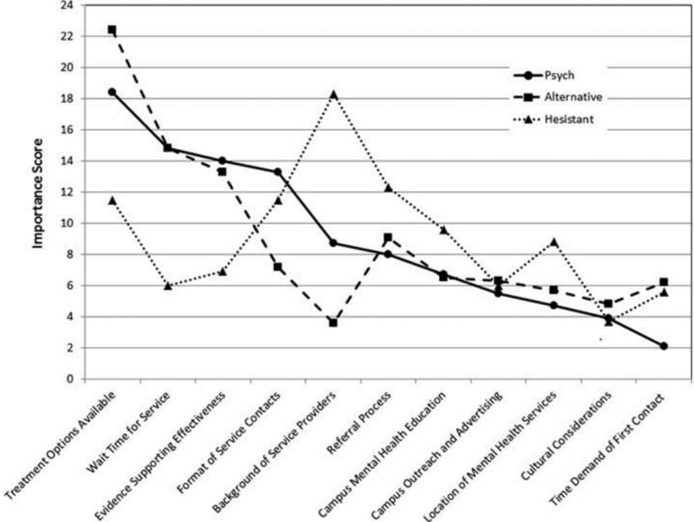
OBJECTIVE: We modeled design factors influencing the intent to use a university mental health service. PARTICIPANTS: Between November 2012 and October 2014, 909 undergraduates participated. METHOD: Using a discrete choice experiment, participants chose between hypothetical campus mental health services. RESULTS: Latent class analysis identified three segments. A Psychological/Psychiatric Service segment (45.5%) was most likely to contact campus health services delivered by psychologists or psychiatrists. An Alternative Service segment (39.3%) preferred to talk to peer-counselors who had experienced mental health problems. A Hesitant segment (15.2%) reported greater distress but seemed less intent on seeking help. They preferred services delivered by psychologists or psychiatrists. Simulations predicted that, rather than waiting for standard counseling, the Alternative Service segment would prefer immediate access to E-Mental health. The Usual Care and Hesitant segments would wait 6 months for standard counseling. CONCLUSIONS: E-Mental Health options could engage students who may not wait for standard services.
Overview
The claims and statistics of this paper haven’t been checked yet.
Free: it reads the open-access text and checks the first 5 claims that cite a source we can check. Create a free account to check every claim.
Integrity signals
Registry
Cites
Statistics
Figures



Verification
Claims the paper makes
The claims and statistics of this paper haven’t been checked yet.
Free: it reads the open-access text and checks the first 5 claims that cite a source we can check. Create a free account to check every claim.
Claims other papers make about this one
Each is checked against this paper’s own text: does it say what the citing paper says it does?
The source backs part of the claim, not all of it — or backs it for a different population, condition or comparison.
In the citing paper
“Research shows that students who cannot be offered immediate in-person treatment would prefer digital treatment to waiting (74).”
From Mental health services for German university students: acceptance of intervention targets and preference for delivery modes (2024) · cites this paper as [74]
Experimental — accuracy not yet measured
Self-check
Percentages, sums and reported differences re-computed from the paper’s own numbers.
The self-check needs the paper’s full text.
Citations
Cites
Nylund, K. L., Asparouhov, T., & Muthén, B. O. (2007) · Structural Equation Modeling: A Multidisciplinary Journal · doi:10.1080/10705510701575396 · Cited by 11,415 · cited 1×
“This solution proved interpretable and administratively relevant.(29,32) A bootstrap ¡2 log-likelihood difference test confirmed that three classes yielded a significantly better”
MethodDual-Processing Accounts of Reasoning, Judgment, and Social Cognition
Evans, J. S. B. T. (2008) · Annual Review of Psychology · doi:10.1146/annurev.psych.59.103006.093629 · Cited by 5,137
The prevalence and correlates of depression, anxiety, and stress in a sample of college students
Beiter, R., Nash, R., McCrady, M., Rhoades, D., Linscomb, M., Clarahan, M., & Sammut, S. (2015) · Journal of Affective Disorders · doi:10.1016/j.jad.2014.10.054 · Cited by 2,030 · cited 3×
“Students worry about their academic performance, the likelihood of succeeding, postgraduate plans, and financial difficulties.(1) They are concerned about their sleep, health, body image, and relationships with friends.”
BackgroundBridges, J. F. P., Hauber, A. B., Marshall, D., Lloyd, A., Prosser, L. A., Regier, D. A., Johnson, F. R., & Mauskopf, J. (2011) · Value in Health · doi:10.1016/j.jval.2010.11.013 · Cited by 2,029 · cited 2×
“With roots in marketing(13) and health economics,(14) DCEs are a method of choice in service preference research.(15) Discrete choice conjoint experiments begin by identifying the attributes of a service that might motivate utilization.”
BackgroundMental health problems and help-seeking behavior among college students
Hunt, J., & Eisenberg, D. (2010) · Journal of Adolescent Health · doi:10.1016/j.jadohealth.2009.08.008 · Cited by 1,949
Reed Johnson, F., Lancsar, E., Marshall, D., Kilambi, V., Mühlbacher, A., Regier, D. A., Bresnahan, B. W., Kanninen, B., & Bridges, J. F. P. (2013) · Value in Health · doi:10.1016/j.jval.2012.08.2223 · Cited by 1,799 · cited 1×
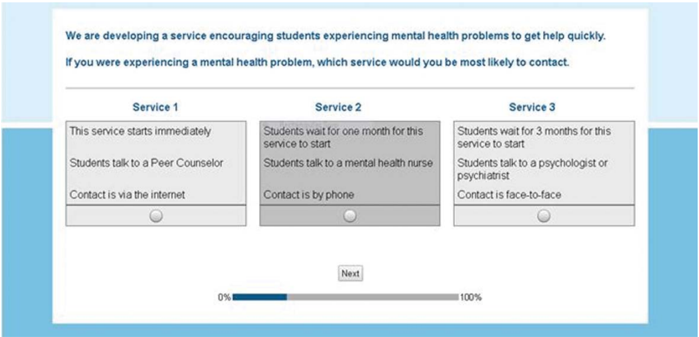
“A partial profile design presented choices composed of a subset of the study’s attributes.(25) Sawtooth Software’s experimental design algorithm(25) composed choice tasks presenting three options described by the levels of three attributes (Figure 1).”
MethodBlanco, C., Okuda, M., Wright, C., Hasin, D. S., Grant, B. F., Liu, S.-M., & Olfson, M. (2008) · Archives of General Psychiatry · doi:10.1001/archpsyc.65.12.1429 · Cited by 1,582 · cited 2×
“IV criteria for a psychiatric disorder within the last year.(2) Zivin and colleagues found that 60% of those students from a Midwestern US university who experienced mental health problems reported psychiatric difficulties 2 years later.”
BackgroundKessler, R. C., Green, J. G., Gruber, M. J., Sampson, N. A., Bromet, E., Cuitan, M., Furukawa, T. A., Gureje, O., Hinkov, H., Hu, C., et al. (2010) · International Journal of Methods in Psychiatric Research · doi:10.1002/mpr.310 · Cited by 1,434
Discrete choice experiments in health economics: a review of the literature
de Bekker‐Grob, E. W., Ryan, M., & Gerard, K. (2012) · Health Economics · doi:10.1002/hec.1697 · Cited by 1,329
Latent Class Analysis: An Alternative Perspective on Subgroup Analysis in Prevention and Treatment
Lanza, S. T., & Rhoades, B. L. (2013) · Prevention Science · doi:10.1007/s11121-011-0201-1 · Cited by 1,255 · cited 3×
“To obtain a representative model, each solution was computed 10 times from different starts.(28,29) To improve fit and explanatory power,(28,30,31) four covariates were included: K-6 scores, gender (0 D male versus 1 D female), the intent to use face-to-face mental health services, and the intent to use self-help serv…”
Method
Research works printed but not linked: 2
- American College Health Association. American College Health Association-National College Health Assessment II: Ontario Canada Reference Group Executive Summary Spring 2016. Hanover, MD: American College Health Association; 2016.
- Vermunt JK, Magidson J. Technical Guide for Latent GOLD 4.0: Basic and Advanced. Belmont, MA: Statistical Innovations Inc.; 2005.
Cited by
Post-Secondary Stress and Mental Well-Being: A Scoping Review of the Academic Literature
Linden, B., & Stuart, H. L. (2020) · Canadian Journal of Community Mental Health · doi:10.7870/cjcmh-2020-002 · Cited by 157
Student perspectives on mental health support and services in the UK
Batchelor, R., Pitman, E., Sharpington, A., Stock, M., & Cage, E. (2020) · Journal of Further and Higher Education · doi:10.1080/0309877x.2019.1579896 · Cited by 59
“This supports previous research demonstrating a desire for peer support services (Cunningham et al. 2017; Shaw 2014), although the number of unsure participants indicates that they may benefit from further information about peer support.”
BackgroundResultPsychopathology and self-harm among incoming first-year students in six Mexican universities
Benjet, C. L., Gutiérrez–García, R. A., Ramírez, A. Á., Borges, G. L. G., Díaz, A. C., González, M. S. D., González, R. G., de la Torre, A. E. H., Martínez, K. I. M., Medina‐Mora, M. E., et al. (2018) · Salud Pública de México · doi:10.21149/9158 · Cited by 80
Feiler, T., Vanacore, S. M., & Dolbier, C. L. (2023) · Adversity and Resilience Science · doi:10.1007/s42844-023-00094-0 · Cited by 61
“Many students experiencing distress do not seek mental health services (Cunningham et al., 2017), largely due to attitudinal barriers reflecting stigma-related concerns and perceptions that treatment is not needed (Ennis et al.”
BackgroundLarsen, A., Tele, A., & Kumar, M. (2021) · BMC Health Services Research · doi:10.1186/s12913-021-06499-w · Cited by 46
Hamilton, M. P., Hetrick, S. E., Mihalopoulos, C., Baker, D., Browne, V., Chanen, A. M., Pennell, K., Purcell, R., Stavely, H., & McGorry, P. D. (2017) · Medical Journal of Australia · doi:10.5694/mja17.00972 · Cited by 30
McGrady, M. E., Pai, A. L. H., & Prosser, L. A. (2020) · Health Psychology Review · doi:10.1080/17437199.2020.1715813 · Cited by 36
“…child (Cunningham et al., 2015), informational strategies describing mental health services (Cunningham et al., 2014), mental health services for university students (Cunningham et al., 2017), and efforts to sustain engagement in early intervention mental health treatment (Becker et al., 2019).”
BackgroundKählke, F., Hasking, P., Küchler, A.-M., & Baumeister, H. (2024) · Frontiers in Digital Health · doi:10.3389/fdgth.2024.1284661 · Cited by 18
“Research shows that students who cannot be offered immediate in-person treatment would prefer digital treatment to waiting (74).”
Jeftic, I., Furzer, B. J., Dimmock, J. A., Wright, K. E., Boyd, C., Budden, T., Rosenberg, M., Kramer, B., Buist, B. D., Fitzpatrick, I., et al. (2023) · Frontiers in Public Health · doi:10.3389/fpubh.2023.1104918 · Cited by 36
“Service provision of this kind is important in part because students value choice regarding treatment approaches and because they often desire alternatives to psychotherapy or medication—including lifestyle approaches such as exercise and diet (50, 51).”
BackgroundDederichs, M., Nitsch, F. J., & Apolinário-Hagen, J. (2022) · JMIR Medical Education · doi:10.2196/32017 · Cited by 16
“Evidence of acceptance of mHealth apps, including mental health apps, among university students is still limited and inconclusive [5,12,13], especially regarding the subgroup of medical students [14].”
BackgroundApolinário-Hagen, J., Fritsche, L., Wopperer, J., Wals, F., Harrer, M., Lehr, D., Ebert, D. D., & Salewski, C. (2021) · Frontiers in Psychology · doi:10.3389/fpsyg.2021.738950 · Cited by 20
Braun, P., Schwientek, A.-K., Angerer, P., Guthardt, L., Icks, A., Loerbroks, A., & Apolinário-Hagen, J. (2023) · Digital Health · doi:10.1177/20552076231173568 · Cited by 15
“DCEs offer an empirically grounded methodology to identify important components of information strategies on dMHSs, by modeling the preference strength for a variety of attributes and attribute levels.(74,75) This would make dMHSs information strategies more tangible to participants compared to conventional survey tec…”
BackgroundModelling student preferences for the design of campus counselling services
Walsh, S., Cullinan, J., Flannery, D. J., & Kennelly, B. (2020) · Studies in Higher Education · doi:10.1080/03075079.2020.1744124 · Cited by 14
“A literature review identified previous studies that examined the valuation of mental health services (E.g. Cunningham et al. 2017; Cunningham et al. 2014; Lee et al. 2014).”
BackgroundLi, K., Zhai, Y., Zhang, Y., Song, Q., Luo, X., & Liu, J. (2021) · European Journal of Horticultural Science · doi:10.17660/ejhs.2021/86.6.8 · Cited by 12
Apolinário-Hagen, J., Harrer, M., Salewski, C., Lehr, D., & Ebert, D. D. (2023) · Prävention und Gesundheitsförderung · doi:10.1007/s11553-022-00945-1 · Cited by 9
Forchuk, C. A., Kocha, I., Granek, J. A., Dempster, K. S., Younger, W. A., Gargala, D., Plouffe, R. A., Bailey, S., Guest, K., Richardson, J. D., et al. (2024) · Military Psychology · doi:10.1080/08995605.2024.2324647 · Cited by 14
“More generally, individuals may differ in predictable patterned ways, such that there may be clusters of individuals who share similar preferences, as has been found in previous mental health research employing CA (e.g., Cunningham et al., 2017).”
Ho, T. Q. A., Engel, L., Ride, J., Le, L. K., Melvin, G. A., Le, H., & Mihalopoulos, C. (2025) · Applied Health Economics and Health Policy · doi:10.1007/s40258-025-00958-9 · Cited by 7
“In the current literature, only two studies used DCEs to assess young people’s preferences for mental health information and services [34, 35].”
Fergus, L., Long, A. R., & Holston, D. (2023) · Journal of the Academy of Nutrition and Dietetics · doi:10.1016/j.jand.2023.01.011 · Cited by 11
Waumans, R. C., Muntingh, A., Veldwijk, J., Hoogendoorn, A. W., van Balkom, A. J. L. M., & Batelaan, N. M. (2023) · Applied Health Economics and Health Policy · doi:10.1007/s40258-023-00857-x · Cited by 7
“The hesitancy or unwillingness of certain sub-groups to engage in formal treatment has been previously reported [50, 51].”
Vargas-Huicochea, I., del Río, A. Á., Rodríguez-Machain, A. C., Aguirre‐Benítez, E. L., & Kelsall, N. C. (2020) · International Journal of Mental Health and Addiction · doi:10.1007/s11469-020-00380-3 · Cited by 3
Mallise, C. A., Wall, L., Paolucci, F., Davies, K., Hera-Fuentes, G. L., Wilson, J. W., Tickner, C., KAY‐LAMBKIN, F. J., & Heinsch, M. (2024) · Community Mental Health Journal · doi:10.1007/s10597-024-01350-y · Cited by 5
“Cultural Background: Six studies identified prefer - ences for the cultural background of clinicians (Becker et al., 2019; Becker et al., 2016; Cunningham et al., 2017; Dwight-Johnson et al., 2013; Hawke et al., 2021a, b), with all but one (Dwight-Johnson et al., 2013) reporting a statistically…”
InfluentialA Mindfulness-Based Intervention for University Students: A Feasibility Study
Dolbier, C. L., Conder, L., Guiler, W., & Haley, E. N. (2022) · Building Healthy Academic Communities Journal · doi:10.18061/bhac.v6i1.8980 · Cited by 3
“These students may be more likely to seek help through alternate services such as stress management, where they can learn how to manage distress outside the counseling center (Cunningham et al., 2017).”
BackgroundInfluentialdeJonge, M. L., Yuen, S., Simard, L., & Sabiston, C. M. (2025) · PLoS ONE · doi:10.1371/journal.pone.0330851 · Cited by 3
“Indeed, less than half of students who experience poor mental health are receptive to traditional mental health services (e.g., medication counseling), with many students preferring alternative or complementary services such as those focused on lifestyle [7,8].”
Cunningham, C. E., Rimas, H. L., Sivayoganathan, T., Stewart, B., Munn, C., Zipursky, R. B., Christensen, B. K., & Furimsky, I. (2020) · Emerging Adulthood · doi:10.1177/2167696820946894 · Cited by 3
“Although previous studies examined the features of campus mental health services influencing the initial decision to seek help (Cunningham et al., 2017), the features that might encourage students to contact a campus mental health service may differ from those influencing the decision to remain in…”
BackgroundMethodResultInfluentialFloris, M., Bruno, G., Purgato, M., Cammilli, I., Bottesi, G., Salcuni, S., Spoto, A., Gentili, C., & Cristea, I. A. (2025) · BJPsych Open · doi:10.1192/bjo.2025.10843 · Cited by 2
A mixed-methods investigation of COVID-19 pandemic-specific stress in college students
Dolbier, C. L., Vanacore, S. M., Conder, L., & Guiler, W. (2023) · Journal of American College Health · doi:10.1080/07448481.2023.2253929 · Cited by 2
What do justice-involved youth want from integrated youth services? A conjoint analysis.
Klymkiw, D. F., Day, D. M., Henderson, J. L., & Hawke, L. D. (2024) · PubMed Central · Cited by 3
Using multi-criteria decision analysis (MCDA) to support health research funding decision-making
Babashahi, S. (2020) · Otago University Research Archive (University of Otago) · Cited by 1
Burt, H. (2021) · cIRcle (University of British Columbia) · doi:10.14288/1.0401765
On-Campus Health Interventions: An Exploration of Student Perceptions
Dollimount, A. (2021) · Memorial University Research Repository (Memorial University)
Fergus, L. (2021) · Louisiana State University · doi:10.31390/gradschool_dissertations.5662 · Cited by 1
Physician Preferences for Universal Routine Depression Screening for Adolescents in Primary Care
Doan, T. T., Wright, D. R., DeJonckheere, M. J., Hutton, D. W., Ray, K. N., & Prosser, L. A. (2025) · JAMA Network Open · doi:10.1001/jamanetworkopen.2025.45361
Larsen, A., Tele, A., & Kumar, M. (2021) · Figshare · doi:10.6084/m9.figshare.14811040
deJonge, M. L., Nesbitt, A. E., Darnell, S. C., Hamza, C. A., & Sabiston, C. M. (2026) · JMIR Mental Health · doi:10.2196/92076 · Cited by 1
“…has the potential to support whole-cam-pus priorities, including social (eg, community engagement and social connection), structural (eg, accessible, inclusive PA spaces and referral pathways), and cultural (eg, reducing barriers to help-seeking) influences on student mental health [21,22].”
Metadata
- Authors
- Cunningham, C. E., Zipursky, R. B., Christensen, B. K., Bieling, P. J., Madsen, V., Rimas, H., Mielko, S., Wilson, F., Furimsky, I., Jeffs, L., & Munn, C.
- Affiliations
- Hamilton Health Sciences (CA)
- St. Joseph’s Healthcare Hamilton (CA)
- Australian National University (AU)
- Government of Nunavut (CA)
- McMaster University (CA)
- Corresponding author
- Cunningham, Charles E.
- Venue
- Journal of American College Health
- Publisher
- Informa UK Limited
- Published
- 2017-06-02
- Volume
- 65
- Issue
- 6
- Pages
- 389-399
- ISSN
- 0164-4300 (ISSN-L)
- 0744-8481
- 1940-3208
- OpenAlex
- W2615871210
- Cited by
- 35
- References
- 43
- Citations by year
- 2026: 1 · 2025: 4 · 2024: 4 · 2023: 6 · 2022: 3 · 2021: 7 · 2020: 6 · 2019: 2 · 2018: 1 · 2017: 1
- FWCI
- 3.92
- Type
- journal article
- Language
- en
- Open access
- hybrid
- doi.org
- Licence
- Locations
- Journal of American College Health (publishedVersion, cc-by-nc-nd)
- PubMed (publishedVersion)
- ANU Open Research (Australian National University) (submittedVersion, cc-by-nc-nd)
- Topics
- Health Sciences › Medicine › Psychiatry and Mental health › Mental Health Treatment and Access
- Social Sciences › Psychology › Applied Psychology › Digital Mental Health Interventions
- Social Sciences › Economics, Econometrics and Finance › Economics and Econometrics › Economic and Environmental Valuation
- Keywords
- university mental health services, help-seeking intentions, student mental health, service utilization, peer counselors, e-mental health, waiting time, latent class segmentation, distress, university students
- MeSH terms
- Adolescent, Attitude to Health, Mental Disorders, Decision Making, Female, Humans, Male, Mental Health, Student Health Services, Students, Universities
About these checks
Registry, retraction, Cites and statistics results are computed, not judged, with one exception: a printed reference that no index lists is read once by a model before it counts as a citation error. Claims are extracted by a model and kept only when their quote appears verbatim in the text; each cited source is then checked, with a model’s help, for whether it says what the claim relies on. Those verdicts can be wrong — read the claim’s quote and the cited source before relying on one.
Statistics and arithmetic are recomputed, not judged.
Confidence bands are shown only for fields calibrated on our annotated test set. None is calibrated yet, so no band is shown.
What counts as a claim ›How we measure confidence ›How we check this ›
Are you an author, or do you see a problem with this page? Request a review
Data sources
Bibliographic data: Semantic Scholar, OpenAlex, Crossref.
Contains information from the Semantic Scholar Academic Graph Datasets, made available under the ODC Attribution License (ODC-BY 1.0).
Semantic Scholar’s data is described in: Kinney, R., et al. (2023). The Semantic Scholar Open Data Platform. arXiv:2301.10140.
