

The DOI matches its Crossref record; 59 of the 59 references it cites were found in a registry or an index.
Acceptance of Artificial Intelligence Application in the Post-Covid Era and Its Impact on Faculty Members’ Occupational Well-being and Teaching Self Efficacy: A Path Analysis Using the UTAUT 2 Model
Open accessAbstract
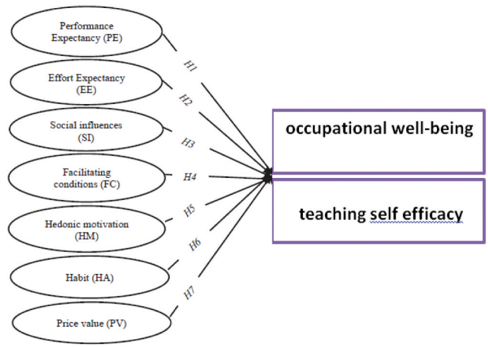
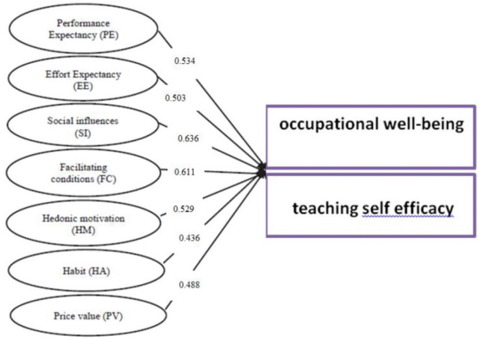
The purpose of the present study was to assess acceptance of Artificial Intelligence Application in the Post-covid Era and its impact of faculty members’ occupational well-being and teaching self efficacy using The UTAUT 2 Model. This study used a quantitative, non-experimental survey design to answer the research questions and study the relationships between the independent variables of performance expectancy, effort expectancy, social faculty members’ occupational well-being and teaching self efficacy. Faculty members from Umm AL-Qura University were targeted. An online questionnaire was used to collect data via Facebook and WhatsApp groups. I received a total of 350 questionnaire responses. They were 200 males(57.1%), and 150 females(42.9%). In confirmation of the research results, there is a significant positive relationship (p < .001) between occupational well-being (OWB)and teaching self efficacy(TSE) and performance expectancy (PE), effort expectancy (EE), social influence (SI), facilitating conditions (FC), price value (PV), and habit (HB), indicating that faculty members are influenced by the constructs established in the UTAUT2 model in the adoption of AI.
Overview
The claims and statistics of this paper haven’t been checked yet.
Run the check — free, no account needed. It reads the open-access text and checks the sources it cites.
Integrity signals
Registry
Cites
Statistics
Figures


Verification
Claims the paper makes
The claims and statistics of this paper haven’t been checked yet.
Run the check — free, no account needed. It reads the open-access text and checks the sources it cites.
Claims other papers make about this one
Each is checked against this paper’s own text: does it say what the citing paper says it does?
In the citing paper
“The study on 350 Saudi Arabian faculty members found a significant positive relationship between the constructs of the updated unified theory of acceptance and use of technology.”
From A systematic literature review of attitudes, intentions and behaviours of teaching academics pertaining to AI and generative AI (GenAI) in higher education: An analysis of GenAI adoption using the UTAUT framework (2024) · cites this paper as Alhwaiti et al., 2023
In the citing paper
“All three studies found a significant positive relationship between the constructs of UTAUT and AI adoption.”
In the citing paper
“Three AI studies (Ahmad et al., 2023; Alhwaiti, 2023; Al-Riyami et al., 2023) invoked the UTAUT framework developed by Venkatesh et al. (2003).”
In the citing paper
“Alhwaiti et al. (2023) used the updated UTAUT2 model, which also explores hedonic motivation, price value and habit.”
From A systematic literature review of attitudes, intentions and behaviours of teaching academics pertaining to AI and generative AI (GenAI) in higher education: An analysis of GenAI adoption using the UTAUT framework (2024) · cites this paper as Alhwaiti et al., 2023
Self-check
Percentages, sums and reported differences re-computed from the paper’s own numbers.
The self-check needs the paper’s full text.
Citations
Cites
User Acceptance of Information Technology: Toward A Unified View1
Venkatesh, V., Morris, M. G., Davis, G. B., & Davis, F. D. (2003) · MIS Quarterly · doi:10.2307/30036540 · Cited by 45,035
User Acceptance of Computer Technology: A Comparison of Two Theoretical Models
Davis, F. D., Bagozzi, R. P., & Warshaw, P. R. (1989) · Management Science · doi:10.1287/mnsc.35.8.982 · Cited by 25,709
Self-efficacy mechanism in human agency
Bandura, A. (1982) · American Psychologist · doi:10.1037/0003-066x.37.2.122 · Cited by 15,975
Venkatesh, V., Thong, J. Y. L., & Xu, X. (2012) · MIS Quarterly · doi:10.2307/41410412 · Cited by 15,756
Understanding digital transformation: A review and a research agenda
Vial, G. (2019) · The Journal of Strategic Information Systems · doi:10.1016/j.jsis.2019.01.003 · Cited by 7,337
Digital Transformation Strategies
Matt, C., Heß, T., & Benlian, A. (2015) · Business & Information Systems Engineering · doi:10.1007/s12599-015-0401-5 · Cited by 3,172
Negative Self-Efficacy and Goal Effects Revisited
Bandura, A., & Locke, E. A. (2003) · Journal of Applied Psychology · doi:10.1037/0021-9010.88.1.87 · Cited by 2,813
Park, S. Y. (2009) · Educational Technology & Society · Cited by 1,385
Loneliness and social isolation during the COVID-19 pandemic
Hwang, T.-J., Rabheru, K., Peisah, C., Reichman, W., & Ikeda, M. (2020) · International Psychogeriatrics · doi:10.1017/s1041610220000988 · Cited by 1,044 · cited 1×
“Recently, the educational community has recognized AI’s potential to facilitate learning in various contexts (Hwang et al. 2020).”
BackgroundChao, C.-M. (2019) · Frontiers in Psychology · doi:10.3389/fpsyg.2019.01652 · Cited by 1,041
Research works printed but not linked: 4
- Ekin, C. Ç. 2022. Eğitimde yapay zeka uygulamaları ve zeki öğretim sistemleri [Artificial intelligence applications and smart teaching systems in education]. Eğitimde Dijitalleşme ve Yeni Yaklaşımlar. Istanbul: Efe Akademi Puplication.
- 10.3926/jotse.1081 · DOI
- Shen, C., and H. Chuang. 2010. Exploring users’ attitudes and intentions toward the interactive whiteboard technology environment. International Review on Computers and Software 5:200–08.
- Sucu, İ. 2019. Yapay Zekânın toplum üzerindeki etkisi ve yapay zekâ (AI) filmi bağlamında yapay zekâya bakış [The effect of artifiticial intelligence on society and artificial intelligence the view of artificial intelligence in the context of film (I.A.)]. Uluslar Ders Kitapları Eğitim Materyalleri Derg 2 (2):203–15.
Cited by
Sorted by citations
ChatGPT in higher education learning: Acceptance and use
Habibi, A., Muhaimin, M., Danibao, B. K., Wibowo, Y. G., Wahyuni, S., & Octavia, A. (2023) · Computers and Education: Artificial Intelligence · doi:10.1016/j.caeai.2023.100190 · Cited by 214
Acosta-Enriquez, B. G., Arbulú Ballesteros, M. A., Huamaní Jordan, O., López Roca, C., & Saavedra Tirado, K. (2024) · BMC Psychology · doi:10.1186/s40359-024-01764-z · Cited by 164
Peláez‐Sánchez, I. C., Velarde-Camaqui, D., & Glasserman‐Morales, L. D. (2024) · Frontiers in Education · doi:10.3389/feduc.2024.1392091 · Cited by 219
Adoption of Artificial Intelligence in Education: A Systematic Literature Review
Al-Momani, A. M., & Ramayah, T. (2024) · Studies in computational intelligence · doi:10.1007/978-3-031-61463-7_7 · Cited by 151
Acosta-Enriquez, B. G., Ramos-Farroñán, E. V., Zapata, L. V. V., García, F. S. M., Rabanal-León, H. C., Angaspilco, J. E. M., & Bocanegra, J. C. S. (2024) · Heliyon · doi:10.1016/j.heliyon.2024.e38315 · Cited by 151
Jafari, F., & Keykha, A. (2023) · Journal of Applied Research in Higher Education · doi:10.1108/jarhe-09-2023-0426 · Cited by 164
Eşiyok, E., Gökçearslan, Ş., & Küçükergi̇n, K. G. (2024) · International Journal of Human-Computer Interaction · doi:10.1080/10447318.2024.2303557 · Cited by 122
Nikolic, S., Wentworth, I., Sheridan, L., Moss, S., Duursma, E., Jones, R. A., Ros, M., & Middleton, R. (2024) · Australasian Journal of Educational Technology · doi:10.14742/ajet.9643 · Cited by 102
“Some of the studies were difficult to categorise based on the provided information (e.g., Ahmad 2023; Alhwaiti 2023).”
Predicting Adoption Intention of Artificial Intelligence ChatGPT
Emon, M. M. H., Hassan, F., Nahid, M. H., & Rattanawiboonsom, V. (2023) · AIUB Journal of Science and Engineering (AJSE) · doi:10.53799/ajse.v22i2.797 · Cited by 70
Yakubu, M. N., David, N., & Abubakar, N. H. (2025) · Education and Information Technologies · doi:10.1007/s10639-025-13441-8 · Cited by 112
Abdalla, R. (2024) · Journal of Open Innovation Technology Market and Complexity · doi:10.1016/j.joitmc.2024.100327 · Cited by 86
Xu, S., Chen, P., & Zhang, G. (2024) · SAGE Open · doi:10.1177/21582440241290013 · Cited by 73
Moradi, H. (2025) · International Journal of Educational Technology in Higher Education · doi:10.1186/s41239-025-00530-4 · Cited by 43
Liu, J., Dai, Q., & Chen, J. (2024) · Education and Information Technologies · doi:10.1007/s10639-024-13105-z · Cited by 50
Customization at a glance: Investigating consumer experiences in mobile commerce applications
Siyal, A. W., Chen, H., Shah, S. J., Shahzad, F., & Bano, S. (2023) · Journal of Retailing and Consumer Services · doi:10.1016/j.jretconser.2023.103602 · Cited by 39
Wang, Y., Zhao, Y., Tian, X., Yang, J., & Luo, S. (2024) · International Journal of Technology and Design Education · doi:10.1007/s10798-024-09897-3 · Cited by 37
Ayyoub, A., Khlaif, Z., Hamamra, B., Bensalem, E., Mitwally, M., Sanmugam, M., Fteiha, A., Joma, A., Bsharat, T. R. K., Eidah, B. A., et al. (2025) · Human Behavior and Emerging Technologies · doi:10.1155/hbe2/6265087 · Cited by 35
Kumar, J., Rani, M., Rani, G., & Rani, V. (2024) · Digital Policy Regulation and Governance · doi:10.1108/dprg-11-2023-0167 · Cited by 38
Using artificial intelligence for hiring talents in a moderated mechanism
Islam, M., Rahman, M. M., Taher, M. A., Quaosar, G. M. A. A., & Uddin, M. A. (2024) · Future Business Journal · doi:10.1186/s43093-024-00303-x · Cited by 49
Factors influencing educators' AI adoption: A grounded meta-analysis review
Taheri, R., Nazemi, N., Pennington, S. E., Clark, J. A., & Dadgostari, F. (2025) · Computers and Education Artificial Intelligence · doi:10.1016/j.caeai.2025.100464 · Cited by 63
Uludağ, F., Kılıç, E., & Çelik, H. E. (2025) · Humanities and Social Sciences Communications · doi:10.1057/s41599-025-05641-x · Cited by 41
Navigating the adoption landscape of blockchain in food delivery: a UTAUT perspective
Shukla, V., Kumar, J., Rana, S., & Prashar, S. (2024) · British Food Journal · doi:10.1108/bfj-08-2023-0681 · Cited by 27
Alanzi, T. M., Alsalem, A. A., Alzahrani, H., Almudaymigh, N., Alessa, A., Mulla, R., Alqahtani, L., Bajonaid, R., Alharthi, A. K. Z., Alnahdi, O. S., et al. (2023) · Cureus · doi:10.7759/cureus.49486 · Cited by 29
Adoption of AI in construction design: Insights from UTAUT2 and TOE frameworks
Katebi, A., & Tehrani, M. (2025) · Results in Engineering · doi:10.1016/j.rineng.2025.104981 · Cited by 27
He, S., & Ren, Y. (2025) · Frontiers in Psychology · doi:10.3389/fpsyg.2025.1571279 · Cited by 31
Developing and validating an AI-supported teaching applications' self-efficacy scale
Chou, C.-M., Shen, T.-C., Shen, T.-C., & Shen, C.-H. (2024) · Research and Practice in Technology Enhanced Learning · doi:10.58459/rptel.2024.19035 · Cited by 25
Kavitha, K., & Joshith, V. P. (2024) · Bulletin of Science Technology & Society · doi:10.1177/02704676241283362 · Cited by 33
Bridging expectations and reality: Addressing the price-value paradox in teachers' AI integration
Elyakim, N. (2025) · Education and Information Technologies · doi:10.1007/s10639-025-13466-z · Cited by 20
Designing a model of sustainable education based on artificial intelligence in higher education
Bagherimajd, K., & Khajedad, K. (2025) · Computers and Education Artificial Intelligence · doi:10.1016/j.caeai.2025.100439 · Cited by 41
Investigating Behavior of Using Metaverse by Integrating UTAUT2 and Self-efficacy
Zaidan, A. S., Alshammary, K. M., Khaw, K. W., Yousif, M., & Chew, X. (2023) · Lecture notes in networks and systems · doi:10.1007/978-3-031-51716-7_6 · Cited by 17
Sabeh, H. N. (2024) · International Multi-Conference on Systems, Signals & Devices (SSD) · doi:10.1109/ssd61670.2024.10548826 · Cited by 16
Alanzi, T. M., Alotaibi, R., Alajmi, R., Bukhamsin, Z. M., Fadaq, K., Alghamdi, N., Khamsin, N. B., Alzahrani, L., Abdullah, R. A., Alsayer, R., et al. (2023) · Cureus · doi:10.7759/cureus.49419 · Cited by 15
Quian, A., & García, J. S. (2024) · Revista de Comunicación · doi:10.26441/rc23.1-2024-3374 · Cited by 18
Okela, A. H. (2024) · Journalism & Mass Communication Educator · doi:10.1177/10776958241296502 · Cited by 14
Predicting Adoption Intention of ChatGPT- A Study on Business Professionals of BangladeshPreprint
Emon, M. M. H. (2023) · Research Square · doi:10.21203/rs.3.rs-3749611/v1 · Cited by 12
Santiago-Torner, C., Corral-Marfil, J., & Tarrats-Pons, E. (2025) · Societies · doi:10.3390/soc16010006 · Cited by 8
Acosta-Enriquez, B. G., Zapata, L. V. V., Jordan, O. H., Roca, C. L., Cipirán, B. M. C., Villacrez, W. S., & Vargas, C. G. A. P. (2025) · Human Behavior and Emerging Technologies · doi:10.1155/hbe2/5933157 · Cited by 9
Understanding graphic designers’ usage behavior of generative artificial intelligence tools
Qiu, T., Yang, D., Zeng, H., & Chen, X. (2024) · Kybernetes · doi:10.1108/k-05-2024-1159 · Cited by 10
Almogren, A. S. (2025) · IEEE Access · doi:10.1109/access.2025.3553631 · Cited by 9
Askari, M. (2025) · Assessment & Evaluation in Higher Education · doi:10.1080/02602938.2025.2537774 · Cited by 12
Educators’ Acceptance and Use of AI Software: UTAUT2 Model
AÇIKGÜL, K., & Şad, S. N. (2026) · SAGE Open · doi:10.1177/21582440251413449 · Cited by 10
Güngören, Ö. C., Erdoğan, D. G., & Horzum, M. B. (2026) · BMC Psychology · doi:10.1186/s40359-026-03977-w · Cited by 12
Managing generative artificial intelligence in the daily lives of people with disabilities
Bagnato, G., Moreno, F. R., Giachino, C., & Ali, A. A. (2025) · Management Decision · doi:10.1108/md-10-2024-2471 · Cited by 7
Al‐Rousan, A. H., Ayasrah, M. N., Yahya, S. M. S., & Khasawneh, M. A. S. (2025) · European Journal of Education · doi:10.1111/ejed.12927 · Cited by 6
Singh, S., Singh, P. K., & Kaur, V. (2025) · Innoeduca International Journal of Technology and Educational Innovation · doi:10.24310/ijtei.111.2025.20219 · Cited by 8
Başarmak, U., & Ateş, H. (2026) · Education and Information Technologies · doi:10.1007/s10639-026-13975-5 · Cited by 6
Weglarz, D., Pla-García, C., & Jiménez‐Zarco, A. I. (2025) · Retos · doi:10.17163/ret.n29.2025.01 · Cited by 10
Alanzi, T. M., Almahdi, R., Alghanim, D., Almusmili, L., Saleh, A., Alanazi, S., Alshobaki, K., Attar, R. W., Qunais, A. A. A., Alzahrani, H., et al. (2023) · Cureus · doi:10.7759/cureus.49724 · Cited by 6
AI Integration in Higher Education: Trends and Implications from Saudi Arabia
Al-Motrif, A. (2025) · International Journal of Human-Computer Interaction · doi:10.1080/10447318.2025.2526578 · Cited by 4
Bouziane, A., & Bouziane, K. (2025) · Discover Education · doi:10.1007/s44217-025-00632-1 · Cited by 4
Adoption of Wearable Insulin Biosensors for Diabetes Management: A Cross-Sectional Study
Alanzi, T. M., Alzahrani, W., Almoraikhi, M., Algannas, A. A., Alghamdi, M., Alzahrani, L., Abutaleb, R., Dughaish, R. B., Alotibi, N., Alkhalifah, S., et al. (2023) · Cureus · doi:10.7759/cureus.50782 · Cited by 4
Customer perceptions driving the adoption of artificial intelligence products in Ethiopian market
Tessema, M. B., Degago, E. D., Prasad, S., Melese, E., & Molnár, E. (2025) · Discover Artificial Intelligence · doi:10.1007/s44163-025-00530-3 · Cited by 3
Promoting Pre-service Teachers’ AI-Supported Application of Self-Efficacy
Chou, C.-M., Shen, T.-C., Shen, T.-C., Shen, C.-H., & Liu, T.-L. (2023) · IEEE International Conference on Software Engineering and Artificial Intelligence (SEAI) · doi:10.1109/seai59139.2023.10217712 · Cited by 3
Sociodemographic impact on smart cities IoT adoption in China
Boustani, N. M., Qing, X., & Xu, Y. (2025) · Digital Business · doi:10.1016/j.digbus.2025.100139 · Cited by 2
Sari, D. P., & Haryono, S. (2025) · Journal of Science and Technology Policy Management · doi:10.1108/jstpm-05-2024-0180 · Cited by 9
Preservice English teachers' attitudes toward GenAI: A qualitative study based on UTAUT2 model
Li, H., & Peng, X. (2026) · Acta Psychologica · doi:10.1016/j.actpsy.2026.106254 · Cited by 4
Artificial intelligence in higher education: faculty empowerment or future workplace stress
Soomro, S., Fan, M., Soomro, S., Sohu, J. M., Shaikh, S. N., & Kherazi, F. Z. (2026) · Learning Futures and Emerging Technologies · doi:10.1108/lfet-06-2025-0077 · Cited by 2
Anuar, N. F. A., Abidin, N. B. Z., Sani, S. A. A., Karim, S. N., & Jan, N. A. M. (2024) · International Conference on Artificial Intelligence and Data Sciences (AiDAS) · doi:10.1109/aidas63860.2024.10730135 · Cited by 2
Ahmed, S., Ashrafi, D. M., Sakib, M. N., & Ahmed, R. (2025) · Elsevier eBooks · doi:10.1016/b978-0-443-27444-2.00011-3 · Cited by 1
Purwanto, H., & Setiawan, A. (2024) · AIP conference proceedings · doi:10.1063/5.0210296 · Cited by 1
Faculty Adoption of Generative Artificial Intelligence in a Canadian Higher Education Institution
Miron, J., Karam, M., & Kiranda, H. K. (2025) · Journal of innovation in polytechnic education. · doi:10.69520/jipe.v7i1.245 · Cited by 2
Randle, O. (2025) · Studies in Learning and Teaching · doi:10.46627/silet.v6i2.563 · Cited by 1
Katebi, A., & Tehrani, M. (2025) · Engineering Applications of Artificial Intelligence · doi:10.1016/j.engappai.2025.112887 · Cited by 1
Ribeirinha, T., Santos, R., & Correia, M. (2025) · Trends in Higher Education · doi:10.3390/higheredu4040077 · Cited by 1
Valle, L. C., Anwar, M. T., Hiền, T. N. T., Osabel, M., Obiasada, R., & Pirnazarov, D. (2026) · Social Sciences & Humanities Open · doi:10.1016/j.ssaho.2026.103053 · Cited by 2
Modern approaches to studying human interaction with generative artificial intelligence
Skrylnikova, N. I., & Kholodnaya, M. A. (2026) · Journal of Modern Foreign Psychology · doi:10.17759/jmfp.2026150202 · Cited by 2
Osman, Z., & Yatam, M. (2024) · International Journal of Academic Research in Economics and Management Sciences · doi:10.6007/ijarems/v13-i2/20925 · Cited by 1
Ayyoub, A. A., Khlaif, Z. N., Hamamra, B. T., Bensalem, E., Mitwally, M. A. A., Fteiha, A., Joma, A. I., Bsharat, T. R. K., Khaldi, M., & Sanmugam, M. (2024) · SSRN Electronic Journal · doi:10.2139/ssrn.4969172 · Cited by 1
Gandhi, A., & Gani, P. H. (2024) · Ingénierie des systèmes d information · doi:10.18280/isi.290314 · Cited by 4
Sosyal Bilimler Öğrencilerine Yönelik Dijital Eğitim Olanakları ve Sanal Gerçeklik Uygulamaları
EKŞİ, G., & Nasırcılar, Ö. (2024) · Antalya Bilim Üniversitesi Uluslararası Sosyal Bilimler Dergisi · doi:10.54969/abuijss.1447874
Extending El-Hadri-Sahli-Hanafi procedure for path analysis with non standardized variables
Sahli, A., Abdem, S. A. E., Hanafi, M. M., & Hadri, Z. E. (2024) · Quality & Quantity · doi:10.1007/s11135-024-01932-8
Tang, X., & Xu, G. (2024) · International Conference on Algorithms, Software Engineering and Network Security (ASENS) · doi:10.1145/3677182.3677219
Nadda, J. B., Singh, A. K., & Jain, R. (2024) · Advances in educational technologies and instructional design book series · doi:10.4018/979-8-3693-2885-9.ch003
Cunalata, N. P., & Llerena-Izquierdo, J. (2025) · Revista InGenio · doi:10.18779/ingenio.v8i1.878
Lepage, A., & Roy, N. (2024) · Mesure et évaluation en éducation · doi:10.7202/1117467ar · Cited by 3
E-Government Business Model Based on Blockchain: Examining Citizens’ Readiness
Лабус, А., Rodić, B., Simić, M., Trpkov, A., & Sovtić, D. (2025) · Smart innovation, systems and technologies · doi:10.1007/978-981-96-3081-3_1
Alrefaei, M. M. (2025) · International Journal of Instruction · doi:10.29333/iji.2025.18319a
Yusnaini, Y., & Iskandar, F. N. (2025) · Journal of Social and Economics Research · doi:10.54783/jser.v7i1.924
Why Animators Choose AI: A UTAUT Approach with Mediating TrustPreprint
Xu, T., & Zhao, X. (2025) · Research Square · doi:10.21203/rs.3.rs-6561983/v1
Iswanti, U. D., Suryanto, T. L. M., Ridwandono, D., Faroqi, A., & Chuttur, M. Y. (2025) · INTENSIF Jurnal Ilmiah Penelitian dan Penerapan Teknologi Sistem Informasi · doi:10.29407/intensif.v9i2.24993 · Cited by 1
Impact of Gamification on Student Learning and Motivation in Introductory Programming Courses
Kurniadi, F., Kurniadi, F., Tandra, T. E., Sahana, T., & Evan, F. (2025) · International Conference on Information Management and Technology (ICIMTech) · doi:10.1109/icimtech67074.2025.11265442
Bachmann, T., & Petersen, E. (2025) · Organisationsberatung Supervision Coaching · doi:10.1007/s11613-025-00980-9
Acosta-Enriquez, B. G., Arbulú Ballesteros, M. A., Huamaní Jordan, O., Roca, C. L., & Tirado, K. S. (2024) · Figshare · doi:10.6084/m9.figshare.26717835
Acosta-Enriquez, B. G., Arbulú Ballesteros, M. A., Huamaní Jordan, O., Roca, C. L., & Tirado, K. S. (2024) · Figshare · doi:10.6084/m9.figshare.26717832
Al-Zaabi, A. M., Diah, N. M., Johan, E. J., & Abusham, E. E. A. A. (2025) · IEEE International Conference on Computing (ICOCO) · doi:10.1109/icoco67189.2025.11334163
Jeya, S. F., & Saravanakumar, A. (2026) · Innovare Journal of Education · doi:10.22159/ijoe.2026v14i2.58362
Farman, S., Pathan, Z. H., & Bhatti, I. (2026) · Qlantic Journal of Social Sciences and Humanities · doi:10.55737/qjssh.vii-i.26466
Telu, S., Kumar, S., & Nudurupati, S. (2026) · International Journal of Productivity and Performance Management · doi:10.1108/ijppm-01-2025-0068 · Cited by 1
Khandelwal, R., & Kapoor, D. (2026) · Asian Education and Development Studies · doi:10.1108/aeds-06-2025-0269
Zúñiga, S. P. A., Zúñiga, S. P. A., & Sandoval, M. J. I. (2026) · Papeles · doi:10.54104/papeles.v18n35.2317
Wahida, Ramly, Dalle, A., Rijal, S., & Setialaksana, W. (2026) · Higher Education Skills and Work-based Learning · doi:10.1108/heswbl-12-2025-0586
Vocational Teachers’ Adoption of and Resistance to AI Teaching Tools: A Dual-Path Framework
Wang, J., Li, J., & Yao, N. (2026) · Information · doi:10.3390/info17060544
Artificial Intelligence and the Transformation of Academic Work
Be, B., & Khun, N. (2026) · Advances in computational intelligence and robotics book series · doi:10.4018/979-8-2600-3204-6.ch001
Zhang, J., Zhen, L., Junhui, Z., Zhao, M., Li, J., & Tan, F. (2026) · Frontiers in Psychology · doi:10.3389/fpsyg.2026.1844939
Hsieh, C., Bali, S., Romadhoni, M., Yen, A.-C., Chen, T.-C., & Andania, R. A. (2026) · Quality & Quantity · doi:10.1007/s11135-026-03015-2
Rodríguez, M. S., Magaña, E. C., Ruiz‐Palmero, J., & Gutiérrez-García, M. Á. (2026) · Revista Interuniversitaria de Formación del Profesorado Continuación de la antigua Revista de Escuelas Normales · doi:10.6018/rifop.698621
A UTAUT-Based Study of AI Acceptance and Dependency in L2 Writing Among Chinese EFL Students
Sun, W., Liu, Y., & Shin, Y. (2026) · SAGE Open · doi:10.1177/21582440261422350
Srivastava, P., Srivastava, S., & Shandilya, G. (2026) · Environmental footprints and eco-design of products and processes · doi:10.1007/978-3-032-30298-4_16
Assessing faculty self-perceived knowledge in using generative AI to teach 21st-century skills
Sutedjo, A., Chowdhury, M., & Liu, S. P. (2026) · Frontiers in Education · doi:10.3389/feduc.2026.1913310
Metadata
- Authors
- Alhwaiti, M.
- Affiliations
- Umm al-Qura University (SA)
- Corresponding author
- Alhwaiti, Mohammed
- ORCID
- Alhwaiti, Mohammed
- Venue
- Applied Artificial Intelligence
- Publisher
- Informa UK Limited
- Published
- 2023-02-22
- Volume
- 37
- Issue
- 1
- ISSN
- 0883-9514 (ISSN-L)
- 1087-6545
- OpenAlex
- W4321494359
- Cited by
- 105
- References
- 59
- Citations by year
- 2026: 27 · 2025: 36 · 2024: 31 · 2023: 11
- FWCI
- 26.91
- Type
- journal article
- Language
- en
- Open access
- gold
- doi.org
- Licence
- Locations
- Applied Artificial Intelligence (publishedVersion, cc-by)
- DOAJ (DOAJ: Directory of Open Access Journals) (submittedVersion, cc-by-sa)
- Topics
- Social Sciences › Decision Sciences › Information Systems and Management › Technology Adoption and User Behaviour
- Social Sciences › Education › Artificial Intelligence in Education
- Social Sciences › Psychology › Social Psychology › Technostress in Professional Settings
- Keywords
- artificial intelligence adoption, technology acceptance, UTAUT2 model, employee well-being, teacher self-efficacy, university faculty, higher education, post-COVID era, performance expectancy, effort expectancy, social influence, facilitating conditions, price value, habit
About these checks
Registry, retraction, Cites and statistics results are computed, not judged, with one exception: a printed reference that no index lists is read once by a model before it counts as a citation error. Claims are extracted by a model and kept only when their quote appears verbatim in the text; each cited source is then checked, with a model’s help, for whether it says what the claim relies on. Those verdicts can be wrong — read the claim’s quote and the cited source before relying on one.
Statistics and arithmetic are recomputed, not judged.
Confidence bands are shown only for fields calibrated on our annotated test set. None is calibrated yet, so no band is shown.
What counts as a claim ›How we measure confidence ›How we check this ›
Are you an author, or do you see a problem with this page? Request a review
