

The DOI matches its Crossref record; 59 of the 59 references it cites were found in a registry or an index.
Acceptance of Artificial Intelligence Application in the Post-Covid Era and Its Impact on Faculty Members’ Occupational Well-being and Teaching Self Efficacy: A Path Analysis Using the UTAUT 2 Model
Open accessAbstract
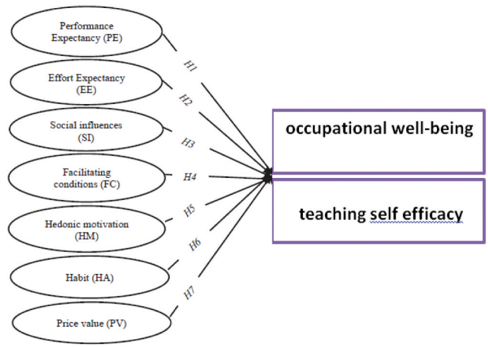
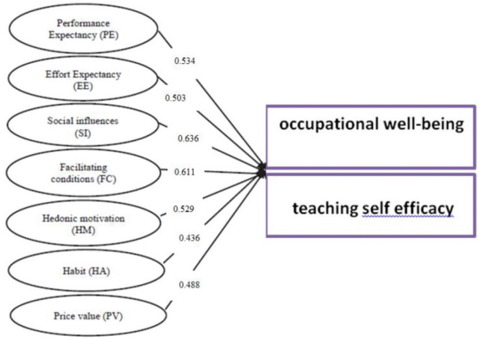
The purpose of the present study was to assess acceptance of Artificial Intelligence Application in the Post-covid Era and its impact of faculty members’ occupational well-being and teaching self efficacy using The UTAUT 2 Model. This study used a quantitative, non-experimental survey design to answer the research questions and study the relationships between the independent variables of performance expectancy, effort expectancy, social faculty members’ occupational well-being and teaching self efficacy. Faculty members from Umm AL-Qura University were targeted. An online questionnaire was used to collect data via Facebook and WhatsApp groups. I received a total of 350 questionnaire responses. They were 200 males(57.1%), and 150 females(42.9%). In confirmation of the research results, there is a significant positive relationship (p < .001) between occupational well-being (OWB)and teaching self efficacy(TSE) and performance expectancy (PE), effort expectancy (EE), social influence (SI), facilitating conditions (FC), price value (PV), and habit (HB), indicating that faculty members are influenced by the constructs established in the UTAUT2 model in the adoption of AI.
Overview
The claims and statistics of this paper haven’t been checked yet.
Run the check — free, no account needed. It reads the open-access text and checks the sources it cites.
Integrity signals
Registry
Cites
Statistics
Figures


Verification
Claims the paper makes
The claims and statistics of this paper haven’t been checked yet.
Run the check — free, no account needed. It reads the open-access text and checks the sources it cites.
Claims other papers make about this one
Each is checked against this paper’s own text: does it say what the citing paper says it does?
In the citing paper
“The study on 350 Saudi Arabian faculty members found a significant positive relationship between the constructs of the updated unified theory of acceptance and use of technology.”
From A systematic literature review of attitudes, intentions and behaviours of teaching academics pertaining to AI and generative AI (GenAI) in higher education: An analysis of GenAI adoption using the UTAUT framework (2024) · cites this paper as Alhwaiti et al., 2023
In the citing paper
“All three studies found a significant positive relationship between the constructs of UTAUT and AI adoption.”
In the citing paper
“Three AI studies (Ahmad et al., 2023; Alhwaiti, 2023; Al-Riyami et al., 2023) invoked the UTAUT framework developed by Venkatesh et al. (2003).”
In the citing paper
“Alhwaiti et al. (2023) used the updated UTAUT2 model, which also explores hedonic motivation, price value and habit.”
From A systematic literature review of attitudes, intentions and behaviours of teaching academics pertaining to AI and generative AI (GenAI) in higher education: An analysis of GenAI adoption using the UTAUT framework (2024) · cites this paper as Alhwaiti et al., 2023
Self-check
Percentages, sums and reported differences re-computed from the paper’s own numbers.
The self-check needs the paper’s full text.
Citations
Cites
User Acceptance of Information Technology: Toward A Unified View1
Venkatesh, V., Morris, M. G., Davis, G. B., & Davis, F. D. (2003) · MIS Quarterly · doi:10.2307/30036540 · Cited by 45,035
User Acceptance of Computer Technology: A Comparison of Two Theoretical Models
Davis, F. D., Bagozzi, R. P., & Warshaw, P. R. (1989) · Management Science · doi:10.1287/mnsc.35.8.982 · Cited by 25,709
Self-efficacy mechanism in human agency
Bandura, A. (1982) · American Psychologist · doi:10.1037/0003-066x.37.2.122 · Cited by 15,975
Venkatesh, V., Thong, J. Y. L., & Xu, X. (2012) · MIS Quarterly · doi:10.2307/41410412 · Cited by 15,756
Understanding digital transformation: A review and a research agenda
Vial, G. (2019) · The Journal of Strategic Information Systems · doi:10.1016/j.jsis.2019.01.003 · Cited by 7,337
Digital Transformation Strategies
Matt, C., Heß, T., & Benlian, A. (2015) · Business & Information Systems Engineering · doi:10.1007/s12599-015-0401-5 · Cited by 3,172
Negative Self-Efficacy and Goal Effects Revisited
Bandura, A., & Locke, E. A. (2003) · Journal of Applied Psychology · doi:10.1037/0021-9010.88.1.87 · Cited by 2,813
Park, S. Y. (2009) · Educational Technology & Society · Cited by 1,385
Loneliness and social isolation during the COVID-19 pandemic
Hwang, T.-J., Rabheru, K., Peisah, C., Reichman, W., & Ikeda, M. (2020) · International Psychogeriatrics · doi:10.1017/s1041610220000988 · Cited by 1,044 · cited 1×
“Recently, the educational community has recognized AI’s potential to facilitate learning in various contexts (Hwang et al. 2020).”
BackgroundChao, C.-M. (2019) · Frontiers in Psychology · doi:10.3389/fpsyg.2019.01652 · Cited by 1,041
Research works printed but not linked: 4
- Ekin, C. Ç. 2022. Eğitimde yapay zeka uygulamaları ve zeki öğretim sistemleri [Artificial intelligence applications and smart teaching systems in education]. Eğitimde Dijitalleşme ve Yeni Yaklaşımlar. Istanbul: Efe Akademi Puplication.
- 10.3926/jotse.1081 · DOI
- Shen, C., and H. Chuang. 2010. Exploring users’ attitudes and intentions toward the interactive whiteboard technology environment. International Review on Computers and Software 5:200–08.
- Sucu, İ. 2019. Yapay Zekânın toplum üzerindeki etkisi ve yapay zekâ (AI) filmi bağlamında yapay zekâya bakış [The effect of artifiticial intelligence on society and artificial intelligence the view of artificial intelligence in the context of film (I.A.)]. Uluslar Ders Kitapları Eğitim Materyalleri Derg 2 (2):203–15.
Cited by
Sorted by citations
ChatGPT in higher education learning: Acceptance and use
Habibi, A., Muhaimin, M., Danibao, B. K., Wibowo, Y. G., Wahyuni, S., & Octavia, A. (2023) · Computers and Education: Artificial Intelligence · doi:10.1016/j.caeai.2023.100190 · Cited by 214
Acosta-Enriquez, B. G., Arbulú Ballesteros, M. A., Huamaní Jordan, O., López Roca, C., & Saavedra Tirado, K. (2024) · BMC Psychology · doi:10.1186/s40359-024-01764-z · Cited by 164
Peláez‐Sánchez, I. C., Velarde-Camaqui, D., & Glasserman‐Morales, L. D. (2024) · Frontiers in Education · doi:10.3389/feduc.2024.1392091 · Cited by 219
Adoption of Artificial Intelligence in Education: A Systematic Literature Review
Al-Momani, A. M., & Ramayah, T. (2024) · Studies in computational intelligence · doi:10.1007/978-3-031-61463-7_7 · Cited by 151
Acosta-Enriquez, B. G., Ramos-Farroñán, E. V., Zapata, L. V. V., García, F. S. M., Rabanal-León, H. C., Angaspilco, J. E. M., & Bocanegra, J. C. S. (2024) · Heliyon · doi:10.1016/j.heliyon.2024.e38315 · Cited by 151
Metadata
- Authors
- Alhwaiti, M.
- Affiliations
- Umm al-Qura University (SA)
- Corresponding author
- Alhwaiti, Mohammed
- ORCID
- Alhwaiti, Mohammed
- Venue
- Applied Artificial Intelligence
- Publisher
- Informa UK Limited
- Published
- 2023-02-22
- Volume
- 37
- Issue
- 1
- ISSN
- 0883-9514 (ISSN-L)
- 1087-6545
- OpenAlex
- W4321494359
- Cited by
- 105
- References
- 59
- Citations by year
- 2026: 27 · 2025: 36 · 2024: 31 · 2023: 11
- FWCI
- 26.91
- Type
- journal article
- Language
- en
- Open access
- gold
- doi.org
- Licence
- Locations
- Applied Artificial Intelligence (publishedVersion, cc-by)
- DOAJ (DOAJ: Directory of Open Access Journals) (submittedVersion, cc-by-sa)
- Topics
- Social Sciences › Decision Sciences › Information Systems and Management › Technology Adoption and User Behaviour
- Social Sciences › Education › Artificial Intelligence in Education
- Social Sciences › Psychology › Social Psychology › Technostress in Professional Settings
- Keywords
- artificial intelligence adoption, technology acceptance, UTAUT2 model, employee well-being, teacher self-efficacy, university faculty, higher education, post-COVID era, performance expectancy, effort expectancy, social influence, facilitating conditions, price value, habit
About these checks
Registry, retraction, Cites and statistics results are computed, not judged, with one exception: a printed reference that no index lists is read once by a model before it counts as a citation error. Claims are extracted by a model and kept only when their quote appears verbatim in the text; each cited source is then checked, with a model’s help, for whether it says what the claim relies on. Those verdicts can be wrong — read the claim’s quote and the cited source before relying on one.
Statistics and arithmetic are recomputed, not judged.
Confidence bands are shown only for fields calibrated on our annotated test set. None is calibrated yet, so no band is shown.
What counts as a claim ›How we measure confidence ›How we check this ›
Are you an author, or do you see a problem with this page? Request a review
