

The DOI matches its Crossref record; 59 of the 59 references it cites were found in a registry or an index.
Acceptance of Artificial Intelligence Application in the Post-Covid Era and Its Impact on Faculty Members’ Occupational Well-being and Teaching Self Efficacy: A Path Analysis Using the UTAUT 2 Model
Open accessAbstract
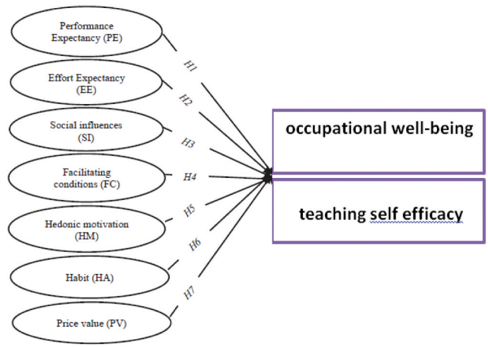
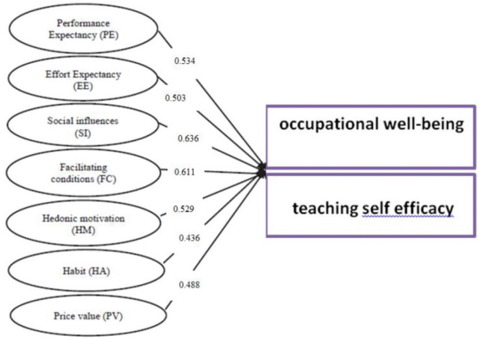
The purpose of the present study was to assess acceptance of Artificial Intelligence Application in the Post-covid Era and its impact of faculty members’ occupational well-being and teaching self efficacy using The UTAUT 2 Model. This study used a quantitative, non-experimental survey design to answer the research questions and study the relationships between the independent variables of performance expectancy, effort expectancy, social faculty members’ occupational well-being and teaching self efficacy. Faculty members from Umm AL-Qura University were targeted. An online questionnaire was used to collect data via Facebook and WhatsApp groups. I received a total of 350 questionnaire responses. They were 200 males(57.1%), and 150 females(42.9%). In confirmation of the research results, there is a significant positive relationship (p < .001) between occupational well-being (OWB)and teaching self efficacy(TSE) and performance expectancy (PE), effort expectancy (EE), social influence (SI), facilitating conditions (FC), price value (PV), and habit (HB), indicating that faculty members are influenced by the constructs established in the UTAUT2 model in the adoption of AI.
Overview
The claims and statistics of this paper haven’t been checked yet.
Run the check — free, no account needed. It reads the open-access text and checks the sources it cites.
Integrity signals
Registry
Cites
Statistics
Figures


Verification
Claims the paper makes
The claims and statistics of this paper haven’t been checked yet.
Run the check — free, no account needed. It reads the open-access text and checks the sources it cites.
Claims other papers make about this one
Each is checked against this paper’s own text: does it say what the citing paper says it does?
In the citing paper
“The study on 350 Saudi Arabian faculty members found a significant positive relationship between the constructs of the updated unified theory of acceptance and use of technology.”
From A systematic literature review of attitudes, intentions and behaviours of teaching academics pertaining to AI and generative AI (GenAI) in higher education: An analysis of GenAI adoption using the UTAUT framework (2024) · cites this paper as Alhwaiti et al., 2023
In the citing paper
“All three studies found a significant positive relationship between the constructs of UTAUT and AI adoption.”
In the citing paper
“Three AI studies (Ahmad et al., 2023; Alhwaiti, 2023; Al-Riyami et al., 2023) invoked the UTAUT framework developed by Venkatesh et al. (2003).”
In the citing paper
“Alhwaiti et al. (2023) used the updated UTAUT2 model, which also explores hedonic motivation, price value and habit.”
From A systematic literature review of attitudes, intentions and behaviours of teaching academics pertaining to AI and generative AI (GenAI) in higher education: An analysis of GenAI adoption using the UTAUT framework (2024) · cites this paper as Alhwaiti et al., 2023
Self-check
Percentages, sums and reported differences re-computed from the paper’s own numbers.
The self-check needs the paper’s full text.
Citations
Cites
User Acceptance of Information Technology: Toward A Unified View1
Venkatesh, V., Morris, M. G., Davis, G. B., & Davis, F. D. (2003) · MIS Quarterly · doi:10.2307/30036540 · Cited by 45,035
User Acceptance of Computer Technology: A Comparison of Two Theoretical Models
Davis, F. D., Bagozzi, R. P., & Warshaw, P. R. (1989) · Management Science · doi:10.1287/mnsc.35.8.982 · Cited by 25,709
Self-efficacy mechanism in human agency
Bandura, A. (1982) · American Psychologist · doi:10.1037/0003-066x.37.2.122 · Cited by 15,975
Venkatesh, V., Thong, J. Y. L., & Xu, X. (2012) · MIS Quarterly · doi:10.2307/41410412 · Cited by 15,756
Understanding digital transformation: A review and a research agenda
Vial, G. (2019) · The Journal of Strategic Information Systems · doi:10.1016/j.jsis.2019.01.003 · Cited by 7,337
Digital Transformation Strategies
Matt, C., Heß, T., & Benlian, A. (2015) · Business & Information Systems Engineering · doi:10.1007/s12599-015-0401-5 · Cited by 3,172
Negative Self-Efficacy and Goal Effects Revisited
Bandura, A., & Locke, E. A. (2003) · Journal of Applied Psychology · doi:10.1037/0021-9010.88.1.87 · Cited by 2,813
Park, S. Y. (2009) · Educational Technology & Society · Cited by 1,385
Loneliness and social isolation during the COVID-19 pandemic
Hwang, T.-J., Rabheru, K., Peisah, C., Reichman, W., & Ikeda, M. (2020) · International Psychogeriatrics · doi:10.1017/s1041610220000988 · Cited by 1,044 · cited 1×
“Recently, the educational community has recognized AI’s potential to facilitate learning in various contexts (Hwang et al. 2020).”
BackgroundChao, C.-M. (2019) · Frontiers in Psychology · doi:10.3389/fpsyg.2019.01652 · Cited by 1,041
Hair, J. F., Babin, B. J., & Krey, N. (2017) · Journal of Advertising · doi:10.1080/00913367.2017.1281777 · Cited by 837
From AI to digital transformation: The AI readiness framework
Holmström, J. (2021) · Business Horizons · doi:10.1016/j.bushor.2021.03.006 · Cited by 592
Kuleto, V., Ilić, M., Dumangiu, M., Ranković, M., Martins, O. M. D., Păun, D., & Mihoreanu, L. (2021) · Sustainability · doi:10.3390/su131810424 · Cited by 561
Challenges for digital transformation – towards a conceptual decision support guide for managers
Heavin, C., & Power, D. (2018) · Journal of Decision System · doi:10.1080/12460125.2018.1468697 · Cited by 457
Factors influencing students’ acceptance of m-learning: An investigation in higher education
Abu-Al-Aish, A., & Love, S. (2013) · The International Review of Research in Open and Distributed Learning · doi:10.19173/irrodl.v14i5.1631 · Cited by 402
Inteligencia artificial y sus implicaciones en la educación superior
Ocaña-Fernández, Y., Valenzuela-Fernández, L. A., & Garro-Aburto, L. L. (2019) · Propósitos y Representaciones · doi:10.20511/pyr2019.v7n2.274 · Cited by 358
Factors influencing students’ adoption of e-learning: a structural equation modeling approach
Tarhini, A., Masa’deh, R. M. T., Al‐Busaidi, K. A., Mohammed, A. B., & Maqableh, M. (2017) · Journal of International Education in Business · doi:10.1108/jieb-09-2016-0032 · Cited by 318
Chatterjee, S., Rana, N. P., Khorana, S., Mikalef, P., & Sharma, A. (2021) · Information Systems Frontiers · doi:10.1007/s10796-021-10181-1 · Cited by 266
Theorizing artificial intelligence acceptance and digital entrepreneurship model
Upadhyay, N., Upadhyay, S., & Dwivedi, Y. K. (2021) · International Journal of Entrepreneurial Behaviour & Research · doi:10.1108/ijebr-01-2021-0052 · Cited by 206
Nikolopoulou, K., Gialamas, V., & Lavidas, K. (2020) · Education and Information Technologies · doi:10.1007/s10639-020-10157-9 · Cited by 205
UTAUT2 Based Predictions of Factors Influencing the Technology Acceptance of Phablets by DNP
Huang, C.-Y., & Kao, Y.-S. (2015) · Mathematical Problems in Engineering · doi:10.1155/2015/603747 · Cited by 194
Bucea-Manea-Țoniş, R., Kuleto, V., Gudei, S. C. D., Lianu, C., Lianu, C., Ilić, M. P., & Păun, D. G. (2022) · Sustainability · doi:10.3390/su14105842 · Cited by 183
Moorthy, K., Yee, T. T., T’ing, L. C., & Kumaran, V. V. (2019) · Australasian Journal of Educational Technology · doi:10.14742/ajet.4432 · Cited by 168
Casey, T. W., & Wilson‐Evered, E. (2012) · Computers in Human Behavior · doi:10.1016/j.chb.2012.05.022 · Cited by 163
Uzir, M. U. H., Halbusi, H. A., Lim, R., Jerin, I., Hamid, A. B. A., Ramayah, T., & Haque, A. (2021) · Technology in Society · doi:10.1016/j.techsoc.2021.101780 · Cited by 155
Digital Transformation in Business
Ziyadin, S., Suieubayeva, S., & Утегенова, А. (2019) · Lecture notes in networks and systems · doi:10.1007/978-3-030-27015-5_49 · Cited by 150
Sukı, N. M., & Suki, N. M. (2017) · The International Journal of Management Education · doi:10.1016/j.ijme.2017.10.002 · Cited by 147
Assessing Artificial Intelligence Technology Acceptance in Managerial Accounting
Vărzaru, A. A. (2022) · Electronics · doi:10.3390/electronics11142256 · Cited by 101
Wang, T., Jung, C.-H., Kang, M.-H., & Chung, Y.-S. (2014) · Behaviour & Information Technology · doi:10.1080/0144929x.2013.781221 · Cited by 95
Sultana, J. (2019) · Education and Information Technologies · doi:10.1007/s10639-019-09969-1 · Cited by 88
Consumers’ adoption of information services
McKenna, B., Tuunanen, T., & Gardner, L. A. (2013) · Information & Management · doi:10.1016/j.im.2013.04.004 · Cited by 68
Acceptance and Use of Information System: E-Learning Based on Cloud Computing in Vietnam
Nguyen, T. D., Nguyen, D. T., & Cao, T. H. (2014) · Lecture notes in computer science · doi:10.1007/978-3-642-55032-4_14 · Cited by 63
Alkhwaldi, A. F., & Abdulmuhsin, A. A. (2021) · Journal of International Education in Business · doi:10.1108/jieb-01-2021-0001 · Cited by 61
From Digital Business Strategy to Digital Transformation - How
Brown, N., & Brown, I. (2019) · South African Institute of Computer Scientists and Information Technologists · doi:10.1145/3351108.3351122 · Cited by 57
Adoption, use and enhancement of virtual learning during COVID-19
Zhou, M., Dzingirai, C., Hove, K., Chitata, T., & Mugandani, R. (2022) · Education and Information Technologies · doi:10.1007/s10639-022-10985-x · Cited by 50
Why students use social networks for education: Extension of UTAUT2
Gharrah, A. A., & Aljaafreh, A. (2021) · Journal of Technology and Science Education · doi:10.3926/jotse.1081 · Cited by 43
The future of education utilizing artificial intelligence in Turkey
İçen, M. (2022) · Humanities and Social Sciences Communications · doi:10.1057/s41599-022-01284-4 · Cited by 39
Impact of software as a service (SaaS) on software acquisition process
Srinivasa Raghavan, R., Jayasimha, K. R., & Nargundkar, R. V. (2020) · Journal of Business and Industrial Marketing · doi:10.1108/jbim-12-2018-0382 · Cited by 38
Artificial intelligence, its impact on innovation, and the Google effect
Sikdar, S. K. (2017) · Clean Technologies and Environmental Policy · doi:10.1007/s10098-017-1478-y · Cited by 37
Fatimah, F., Rajiani, S. I., & Abbas, E. W. (2021) · Management Science Letters · doi:10.5267/j.msl.2020.9.032 · Cited by 36 · cited 1×
“For example, Fatimah, Rajiani, and Abbas (2021) the influence of culture and individual characteristics in the adoption of computer-based collaborative learning during the pandemic such as COVID-19 was carried out.”
BackgroundDetermining the Factors that Affect the Use of Virtual Classrooms: A Modification of the UTAUT Model
Alshammarı, S. H. (2021) · Journal of Information Technology Education Research · doi:10.28945/4709 · Cited by 36
What's Next in the Digital Transformation of Financial Industry?
Butler, T. (2020) · IT Professional · doi:10.1109/mitp.2019.2963490 · Cited by 34
Eimler, S. C., Krämer, N. C., & von der Pütten, A. M. (2011) · Applied Artificial Intelligence · doi:10.1080/08839514.2011.587154 · Cited by 26
Artificial Intelligence (Ai) - the Technology That Shapes the World
Dobrescu, E. M., & Dobrescu, E. (2018) · RePEc: Research Papers in Economics · Cited by 23
Altun, T., Akyıldız, S., Gülay, A., & Özdemir, C. (2021) · Psycho-Educational Research Reviews · Cited by 18
Xian, X. (2021) · 網際網路技術學刊 · Cited by 16
Fidan, N. K., & Yıldırım, N. (2022) · Psycho-Educational Research Reviews · doi:10.52963/perr_biruni_v11.n1.06 · Cited by 8
Acar, S. (2022) · Psycho-Educational Research Reviews · doi:10.52963/perr_biruni_v11.n1.15 · Cited by 6
TEACHERS’ METAPHORIC PERCEPTIONS OF COVID-19 AND SCHOOL IN THE PROCESS OF COVID-19
Ulaş, S. D., Kurt, H. İ., Bayındır, S., Cihan, Ö., Vural, Ö. F., & Başaran, M. (2021) · Psycho-Educational Research Reviews · doi:10.52963/perr_biruni_v10.n3.25 · Cited by 5
Çoban, C., & Yazıcı, D. (2022) · Psycho-Educational Research Reviews · doi:10.52963/perr_biruni_v11.n1.03 · Cited by 5
Arslan, A., & Karameşe, E. N. (2018) · International Journal of Psycho-Educational Sciences · Cited by 4
Gündoğdu, K., Dursun, F., & Saracaloğlu, A. S. (2020) · International Journal of Psycho-Educational Sciences · Cited by 4
Uyar, Ş., & Gübeş, N. Ö. (2022) · Psycho-Educational Research Reviews · doi:10.52963/perr_biruni_v11.n3.21 · Cited by 3
Human-Social Robot Interaction, Anthropomorphism And Ontological Boundary Problem In Education
Gültekin, M. (2022) · Psycho-Educational Research Reviews · doi:10.52963/perr_biruni_v11.n3.11 · Cited by 3
Factors Affecting Technology Acceptance During COVID-19 Crisis in Egyptian Higher Education
Aly, D. N. E. (2020) · المجلة العلمية للدراسات التجارية والبيئية · doi:10.21608/jces.2020.143630 · Cited by 3
Applications of Artificial Intelligence for Strategic Management of Organization
Duangekanong, S. (2022) · ABAC ODI JOURNAL Vision. Action. Outcome · doi:10.14456/abacodijournal.2022.13 · Cited by 3
The natural impact of artificial intelligence
Verma, P. K. (2018) · International Journal of Critical Infrastructure Protection · doi:10.1016/j.ijcip.2018.08.009 · Cited by 3
Mothers’ Involvement in Emergency Remote Education: A Case Study in the COVID-19 Pandemic Era
Sanal-Erginel, S. (2022) · Psycho-Educational Research Reviews · doi:10.52963/perr_biruni_v11.n2.14 · Cited by 2
Türk, E. D., & Yıldırım, G. (2022) · Psycho-Educational Research Reviews · doi:10.52963/perr_biruni_v11.n2.17 · Cited by 2
Research works printed but not linked: 4
- Ekin, C. Ç. 2022. Eğitimde yapay zeka uygulamaları ve zeki öğretim sistemleri [Artificial intelligence applications and smart teaching systems in education]. Eğitimde Dijitalleşme ve Yeni Yaklaşımlar. Istanbul: Efe Akademi Puplication.
- 10.3926/jotse.1081 · DOI
- Shen, C., and H. Chuang. 2010. Exploring users’ attitudes and intentions toward the interactive whiteboard technology environment. International Review on Computers and Software 5:200–08.
- Sucu, İ. 2019. Yapay Zekânın toplum üzerindeki etkisi ve yapay zekâ (AI) filmi bağlamında yapay zekâya bakış [The effect of artifiticial intelligence on society and artificial intelligence the view of artificial intelligence in the context of film (I.A.)]. Uluslar Ders Kitapları Eğitim Materyalleri Derg 2 (2):203–15.
Cited by
Sorted by citations
ChatGPT in higher education learning: Acceptance and use
Habibi, A., Muhaimin, M., Danibao, B. K., Wibowo, Y. G., Wahyuni, S., & Octavia, A. (2023) · Computers and Education: Artificial Intelligence · doi:10.1016/j.caeai.2023.100190 · Cited by 214
Acosta-Enriquez, B. G., Arbulú Ballesteros, M. A., Huamaní Jordan, O., López Roca, C., & Saavedra Tirado, K. (2024) · BMC Psychology · doi:10.1186/s40359-024-01764-z · Cited by 164
Peláez‐Sánchez, I. C., Velarde-Camaqui, D., & Glasserman‐Morales, L. D. (2024) · Frontiers in Education · doi:10.3389/feduc.2024.1392091 · Cited by 219
Adoption of Artificial Intelligence in Education: A Systematic Literature Review
Al-Momani, A. M., & Ramayah, T. (2024) · Studies in computational intelligence · doi:10.1007/978-3-031-61463-7_7 · Cited by 151
Acosta-Enriquez, B. G., Ramos-Farroñán, E. V., Zapata, L. V. V., García, F. S. M., Rabanal-León, H. C., Angaspilco, J. E. M., & Bocanegra, J. C. S. (2024) · Heliyon · doi:10.1016/j.heliyon.2024.e38315 · Cited by 151
Metadata
- Authors
- Alhwaiti, M.
- Affiliations
- Umm al-Qura University (SA)
- Corresponding author
- Alhwaiti, Mohammed
- ORCID
- Alhwaiti, Mohammed
- Venue
- Applied Artificial Intelligence
- Publisher
- Informa UK Limited
- Published
- 2023-02-22
- Volume
- 37
- Issue
- 1
- ISSN
- 0883-9514 (ISSN-L)
- 1087-6545
- OpenAlex
- W4321494359
- Cited by
- 105
- References
- 59
- Citations by year
- 2026: 27 · 2025: 36 · 2024: 31 · 2023: 11
- FWCI
- 26.91
- Type
- journal article
- Language
- en
- Open access
- gold
- doi.org
- Licence
- Locations
- Applied Artificial Intelligence (publishedVersion, cc-by)
- DOAJ (DOAJ: Directory of Open Access Journals) (submittedVersion, cc-by-sa)
- Topics
- Social Sciences › Decision Sciences › Information Systems and Management › Technology Adoption and User Behaviour
- Social Sciences › Education › Artificial Intelligence in Education
- Social Sciences › Psychology › Social Psychology › Technostress in Professional Settings
- Keywords
- artificial intelligence adoption, technology acceptance, UTAUT2 model, employee well-being, teacher self-efficacy, university faculty, higher education, post-COVID era, performance expectancy, effort expectancy, social influence, facilitating conditions, price value, habit
About these checks
Registry, retraction, Cites and statistics results are computed, not judged, with one exception: a printed reference that no index lists is read once by a model before it counts as a citation error. Claims are extracted by a model and kept only when their quote appears verbatim in the text; each cited source is then checked, with a model’s help, for whether it says what the claim relies on. Those verdicts can be wrong — read the claim’s quote and the cited source before relying on one.
Statistics and arithmetic are recomputed, not judged.
Confidence bands are shown only for fields calibrated on our annotated test set. None is calibrated yet, so no band is shown.
What counts as a claim ›How we measure confidence ›How we check this ›
Are you an author, or do you see a problem with this page? Request a review
