

The DOI matches its Crossref record; 34 of the 35 references it cites were found in a registry or an index.
Nose-to-brain delivery of temozolomide-loaded PLGA nanoparticles functionalized with anti-EPHA3 for glioblastoma targeting
Open accessAbstract
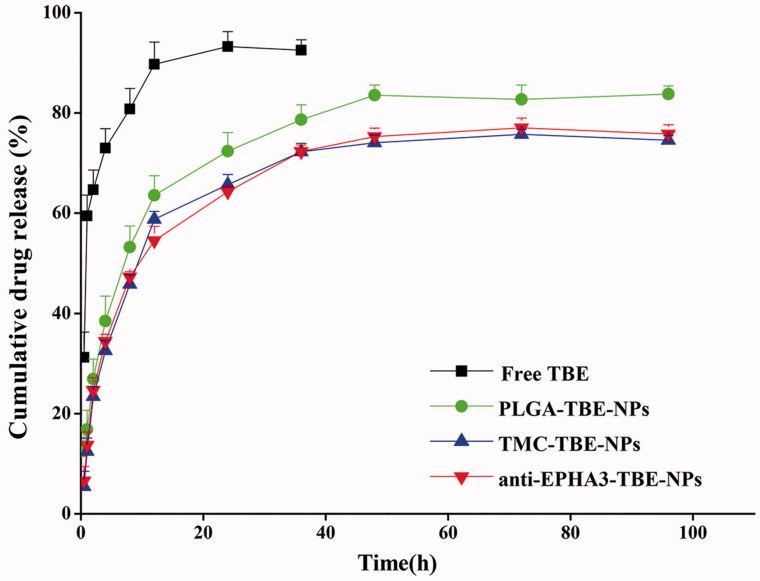
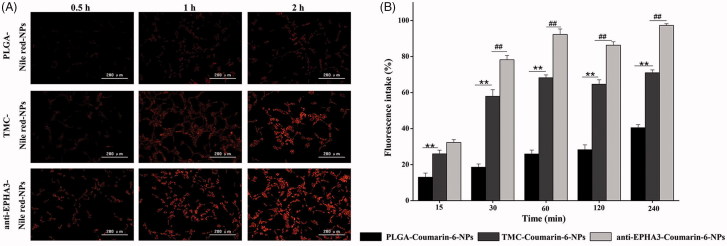
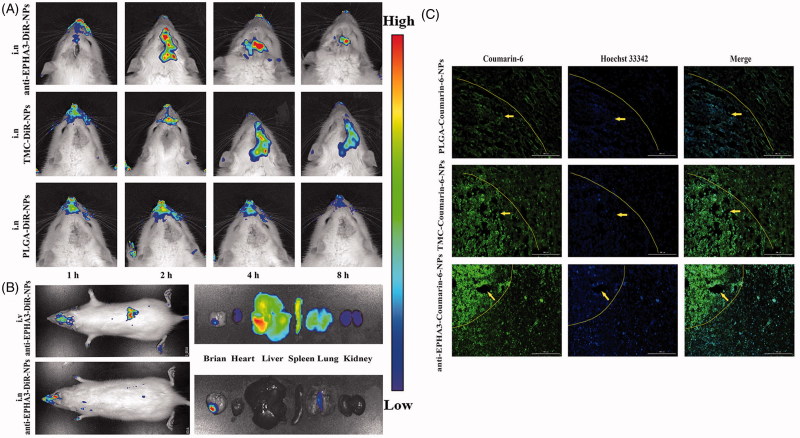
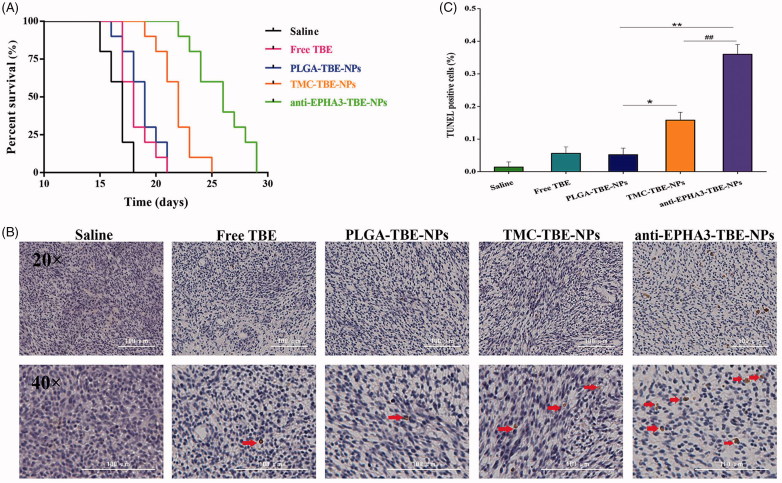
Glioblastoma is the most common malignant brain tumor. Efficient delivery of drugs targeting glioblastomas remains a challenge. Ephrin type-A receptor 3 (EPHA3) tyrosine kinase antibody-modified polylactide-co-glycolide (PLGA) nanoparticles (NPs) were developed to target glioblastoma via nose-to-brain delivery. Anti-EPHA3-modified, TBE-loaded NPs were prepared using an emulsion-solvent evaporation method, showed a sustained in vitro release profile up to 48 h and a mean particle size of 145.9 ± 8.7 nm. The cellular uptake of anti-EPHA3-modified NPs by C6 cells was significantly enhanced compared to that of nontargeting NPs (p < .01). In vivo imaging and distribution studies on the glioma-bearing rats showed that anti-EPHA3-modified NPs exhibited high fluorescence intensity in the brain and effectively accumulated to glioma tissues, indicating the targeting effect of anti-EPHA3. Glioma-bearing rats treated with anti-EPHA3-modified NPs resulted in significantly higher tumor cell apoptosis (p < .01) than that observed with other formulations and prolonged the median survival time of glioma-bearing rats to 26 days, which was 1.37-fold longer than that of PLGA NPs. The above results indicated that anti-EPHA3-modified NPs may potentially serve as a nose-to-brain drug carrier for the treatment of glioblastoma.
Overview
The claims and statistics of this paper haven’t been checked yet.
Run the check — free, no account needed. It reads the open-access text and checks the sources it cites.
Integrity signals
Registry
Cites
Statistics
Figures
Verification
Claims the paper makes
The claims and statistics of this paper haven’t been checked yet.
Run the check — free, no account needed. It reads the open-access text and checks the sources it cites.
Claims other papers make about this one
Each is checked against this paper’s own text: does it say what the citing paper says it does?
In the citing paper
“The uptake of anti-EPHA3 modified NPs in cells was significantly enhanced, and showed a higher distribution in the brain, indicating that anti-EPHA3 has a brain-targeting effect.210”
From Smart nanoparticles for cancer therapy (2023) · cites this paper as [210]
Self-check
Percentages, sums and reported differences re-computed from the paper’s own numbers.
The self-check needs the paper’s full text.
Citations
Cites
Yung, W. K. A., Albright, R. E., Olson, J., Fredericks, R., Fink, K., Prados, M. D., Brada, M., Spence, A., Hohl, R. J., Shapiro, W., et al. (2000) · British Journal of Cancer · doi:10.1054/bjoc.2000.1316 · Cited by 929 · cited 2×
“Food and Drug Administration for clinical use (Yung et al., 2000).”
BackgroundBrain drug delivery of small molecules using immunoliposomes
Huwyler, J., Wu, D., & Pardridge, W. M. (1996) · Proceedings of the National Academy of Sciences · doi:10.1073/pnas.93.24.14164 · Cited by 660
Nasal drug delivery devices: characteristics and performance in a clinical perspective—a review
Djupesland, P. G. (2013) · Drug Delivery and Translational Research · doi:10.1007/s13346-012-0108-9 · Cited by 563
Studies on the Internalization Mechanism of Cationic Cell-penetrating Peptides
Drin, G., Cottin, S. C., Blanc, E. M., Rees, A. R., & Temsamani, J. (2003) · Journal of Biological Chemistry · doi:10.1074/jbc.m303938200 · Cited by 530
Progress and perspectives on targeting nanoparticles for brain drug delivery
Gao, H. (2016) · Acta Pharmaceutica Sinica B · doi:10.1016/j.apsb.2016.05.013 · Cited by 507
Progress in brain targeting drug delivery system by nasal route
Khan, A. R., Liu, M., Khan, M. W., & Zhai, G. (2017) · Journal of Controlled Release · doi:10.1016/j.jconrel.2017.09.001 · Cited by 402
Ferritin Nanocarrier Traverses the Blood Brain Barrier and Kills Glioma
Fan, K., Jia, X., Zhou, M., Wang, K., Conde, J., He, J., Tian, J., & Yan, X. (2018) · ACS Nano · doi:10.1021/acsnano.7b06969 · Cited by 401
Self-citationRuan, S., Yuan, M., Zhang, L., Hu, G., Chen, J., Cun, X., Zhang, Q., Yang, Y., He, Q., & Gao, H. (2014) · Biomaterials · doi:10.1016/j.biomaterials.2014.10.007 · Cited by 333
Meng, Q., Wang, A., Hua, H., Jiang, Y. Y., Wang, Y., Mu, H., Wu, Z., & Sun, K. (2018) · International Journal of Nanomedicine · doi:10.2147/ijn.s151474 · Cited by 318
Self-citationAttenello, F. J., Mukherjee, D. R., Datoo, G., McGirt, M. J., Bohan, E. M., WEINGART, J. D., Olivi, A., Quiñones‐Hinojosa, A., & Brem, H. (2008) · Annals of Surgical Oncology · doi:10.1245/s10434-008-0048-2 · Cited by 245
Research works printed but not linked: 1
- Baker S, 1999, Clin Cancer Res, 5, 309
Cited by
Sorted by citations
Smart nanoparticles for cancer therapy
Sun, L., Liu, H., Ye, Y., Lei, Y., Islam, R., Tan, S., Tong, R., Miao, Y.-B., & Cai, L. (2023) · Signal Transduction and Targeted Therapy · doi:10.1038/s41392-023-01642-x · Cited by 1,073
Thirty Years of Cancer Nanomedicine: Success, Frustration, and Hope
Salvioni, L., Rizzuto, M. A., Bertolini, J. A., Pandolfi, L., Colombo, M., & Prosperi, D. (2019) · Cancers · doi:10.3390/cancers11121855 · Cited by 214
Ortíz, R., Perazzoli, G., Cabeza, L., Jiménez‐Luna, C., Luque, R., Prados, J. C., & Melguizo, C. (2020) · Current Neuropharmacology · doi:10.2174/1570159x18666200626204005 · Cited by 187
Nanotechnology-based drug delivery for central nervous system disorders
Nguyen, T. T., Nguyen, T. T. D., Vo, T. K., An, T. N. M., Nguyen, M. K., Toi, V. V., & Vo, G. V. (2021) · Biomedicine & Pharmacotherapy · doi:10.1016/j.biopha.2021.112117 · Cited by 182
Tang, S.-N., Wang, A.-P., Yan, X., Chu, L., Yang, X., Song, Y., Sun, K.-X., Yu, X., Liu, R.-X., Wu, Z., et al. (2019) · Drug Delivery · doi:10.1080/10717544.2019.1636420 · Cited by 144
Self-citation
Metadata
- Authors
- Chu, L., Wang, A., Ni, L., Yan, X., Song, Y., Zhao, M., Sun, K., Mu, H., Liu, S., Wu, Z., & Zhang, C.
- Affiliations
- Yantai University (CN)
- Luye Pharma (China) (CN)
- Corresponding author
- Wang, Aiping
- Sun, Kaoxiang
- Venue
- Drug Delivery
- Publisher
- Informa UK Limited
- Published
- 2018-01-01
- Volume
- 25
- Issue
- 1
- Pages
- 1634-1641
- ISSN
- 1071-7544 (ISSN-L)
- 1521-0464
- PMC
- PMC6127843
- OpenAlex
- W2889706401
- Cited by
- 127
- References
- 35
- Citations by year
- 2026: 5 · 2025: 16 · 2024: 20 · 2023: 14 · 2022: 25 · 2021: 27 · 2020: 10 · 2019: 10
- FWCI
- 3.81
- Type
- journal article
- Language
- en
- Open access
- gold
- doi.org
- Licence
- Locations
- Drug Delivery (publishedVersion, cc-by)
- Europe PMC (PubMed Central) (publishedVersion, cc-by)
- PubMed Central (publishedVersion, cc-by)
- PubMed (publishedVersion)
- DOAJ (DOAJ: Directory of Open Access Journals) (submittedVersion, cc-by-sa)
- ResearchSpace (University of Auckland) (submittedVersion, cc-by)
- Funders
- Natural Science Foundation of Shandong Province (LH076, HB58)
- Topics
- Physical Sciences › Materials Science › Biomaterials › Nanoparticle-Based Drug Delivery
- Life Sciences › Pharmacology, Toxicology and Pharmaceutics › Pharmaceutical Science › Advanced Drug Delivery Systems
- Health Sciences › Medicine › Oncology › Glioma Diagnosis and Treatment
- Keywords
- glioblastoma, nose-to-brain delivery, temozolomide, PLGA nanoparticles, targeted drug delivery, brain tumor therapy, tumor cell apoptosis
- MeSH terms
- Temozolomide, Animals, Antibodies, Monoclonal, Antineoplastic Agents, Brain Neoplasms, Drug Carriers, Glioblastoma, Humans, Male, Polyglactin 910, Rats, Sprague-Dawley, Receptor Protein-Tyrosine Kinases, Receptor, EphA3, Cell Line, Tumor, Rats, Nanoparticles, Molecular Targeted Therapy
About these checks
Registry, retraction, Cites and statistics results are computed, not judged, with one exception: a printed reference that no index lists is read once by a model before it counts as a citation error. Claims are extracted by a model and kept only when their quote appears verbatim in the text; each cited source is then checked, with a model’s help, for whether it says what the claim relies on. Those verdicts can be wrong — read the claim’s quote and the cited source before relying on one.
Statistics and arithmetic are recomputed, not judged.
Confidence bands are shown only for fields calibrated on our annotated test set. None is calibrated yet, so no band is shown.
What counts as a claim ›How we measure confidence ›How we check this ›
Are you an author, or do you see a problem with this page? Request a review
