

Antidiscrimination Insurance Pricing: Regulations, Fairness Criteria, and Models
Open accessThe DOI matches its Crossref record; 87 of the 89 references it cites were found in a registry or an index, and 2 are not checked yet; 9 of the 56 sources its claims cite were checked for support.
Abstract
On the issue of insurance discrimination, a grey area in regulation has resulted from the growing use of big data analytics by insurance companies: direct discrimination is prohibited, but indirect discrimination using proxies or more complex and opaque algorithms is not clearly specified or assessed.This phenomenon has recently attracted the attention of insurance regulators all over the world.Meanwhile, various fairness criteria have been proposed and flourished in the machine learning literature with the rapid growth of artificial intelligence (AI) in the past decade and have mostly focused on classification decisions.In this article, we introduce some fairness criteria that are potentially applicable to insurance pricing as a regression problem to the actuarial field, match them with different levels of potential and existing antidiscrimination regulations, and implement them into a series of existing and newly proposed antidiscrimination insurance pricing models, using both generalized linear models (GLMs) and Extreme Gradient Boosting (XGBoost).Our empirical analysis compares the outcome of different models via the fairness-accuracy trade-off and shows their impact on adverse selection and solidarity.
Verified 2026-11-25 · 2 references not checked yet
Overview
CoChat Summary
TL;DR
The paper links insurance antidiscrimination regulations to machine-learning fairness criteria and implements them in pricing models using GLMs and XGBoost. In a French motor insurance dataset, the full model had the best accuracy but worst group fairness, XGBoost generally outperformed GLM in accuracy, and MU/MDP/MCDP/MC satisfied the four-fifths rule across scenarios.
Key findings
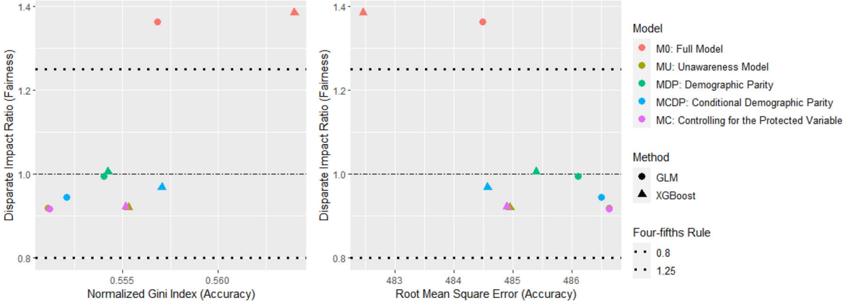
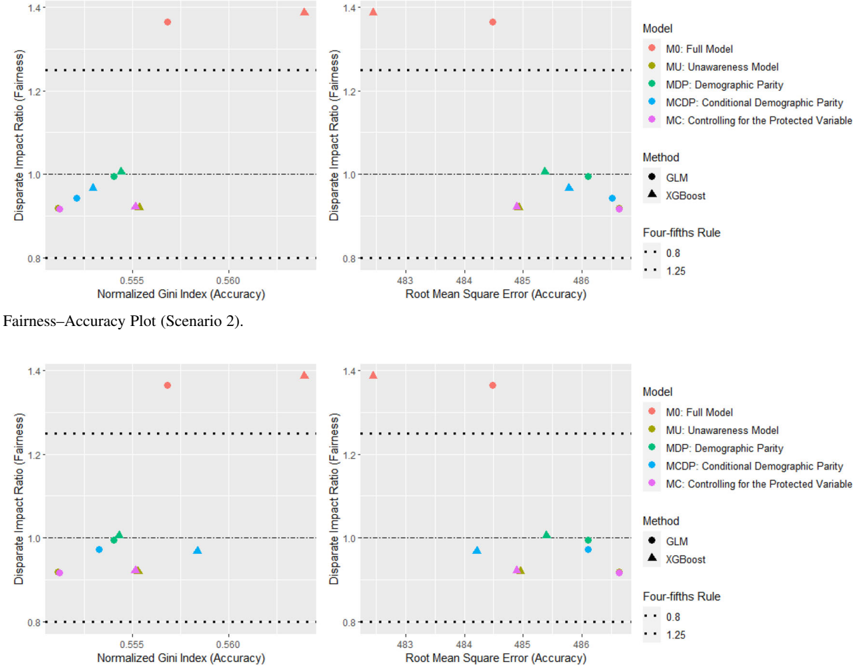
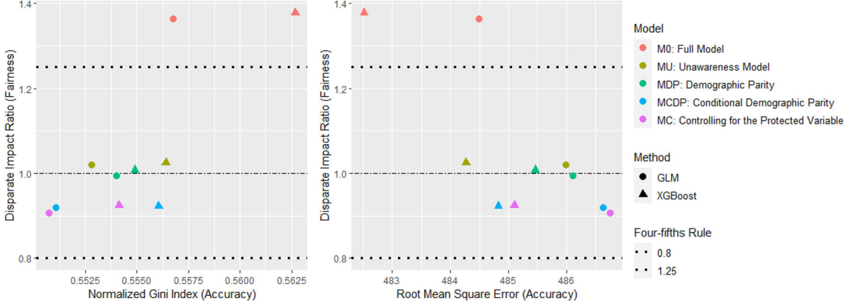
- M0 had the best prediction accuracy and worst group fairness in all scenarios, while XGBoost had better prediction accuracy than GLM. MU, MDP, MCDP, and MC all satisfied the four-fifths rule in all scenarios considered.
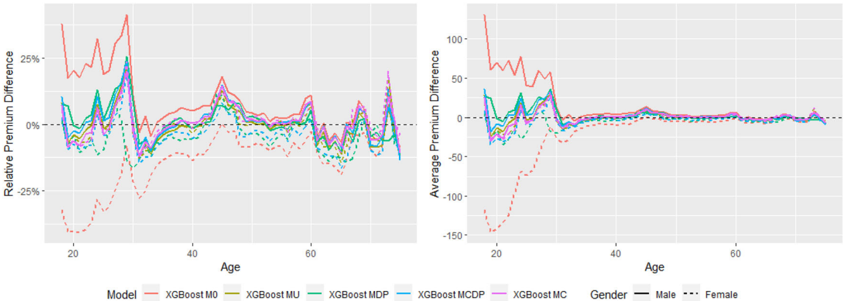
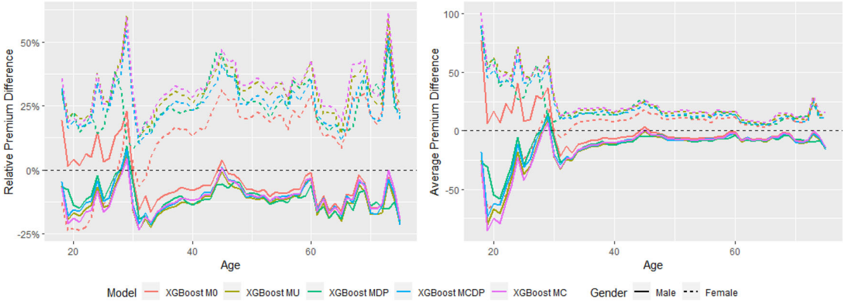
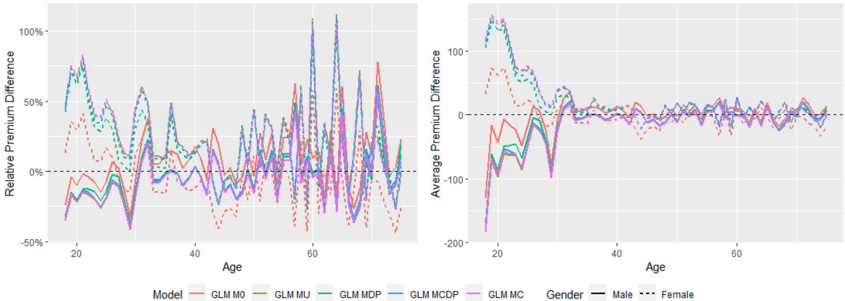
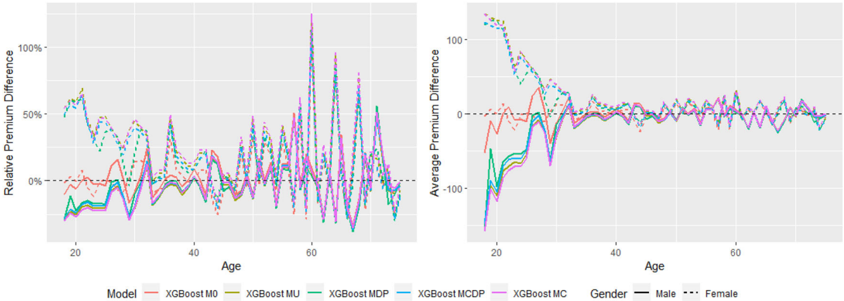
- Best fairness-accuracy trade-offs varied by scenario: XGBoost MCDP in Scenarios 1 and 3; XGBoost MU and MC in Scenario 2; XGBoost MU in Scenario 4.
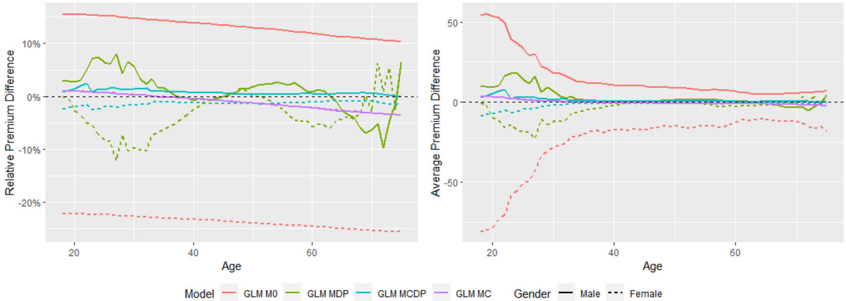
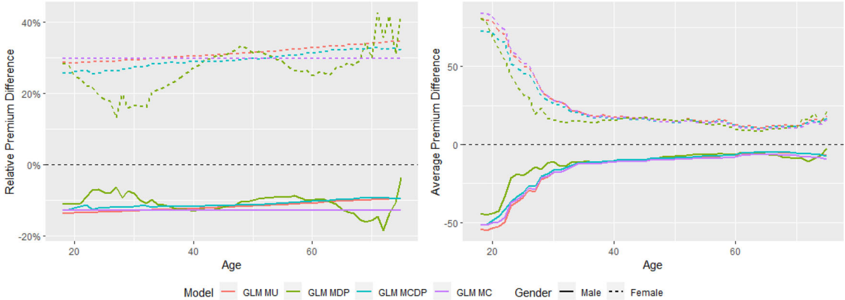
- Table 3 reports mean predicted pure premiums by gender: GLM M0 male 130.47 vs female 95.66; MU male 114.03 vs female 124.05; MDP male 117.38 vs female 118.23; MCDP male 115.26 vs female 121.90; MC male 113.95 vs female 124.18, with similar XGBoost patterns.
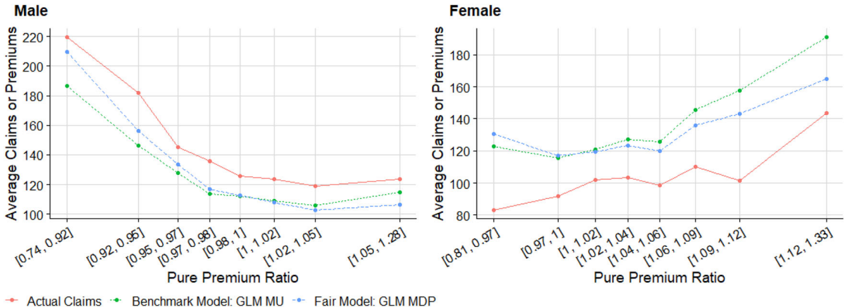
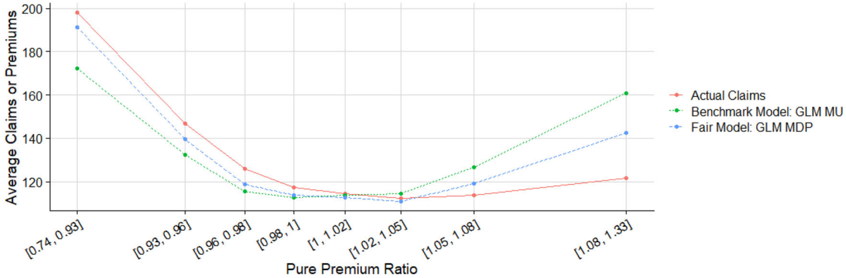
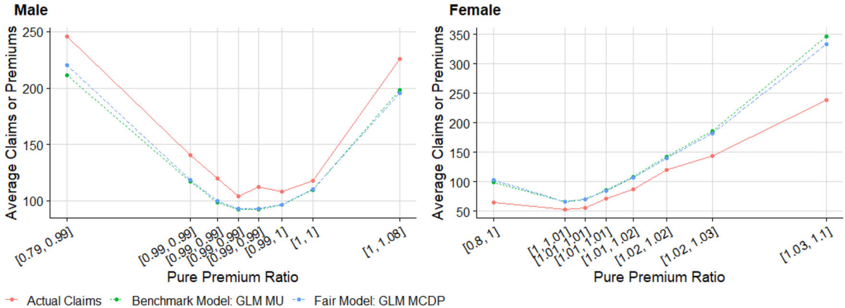
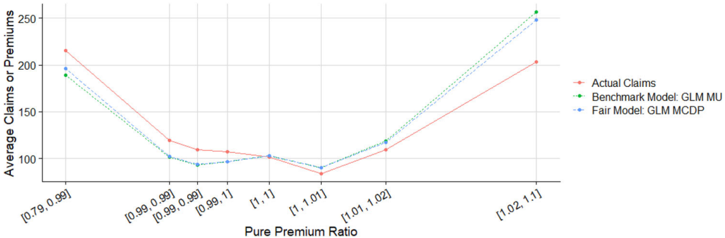
- Fairness was achieved mostly via subsidy from young females to young males when using actual claims cost as benchmark; insurers implementing a fair model generally lost relatively high-risk customers and gained low-risk customers, with limited adverse selection effects.
Methods
- The paper reviews and compares insurance antidiscrimination laws in the United States, European Union, and Australia, matches regulations to individual and group fairness criteria, and proposes or implements models M0, MU, MDP, MCDP, and MC.
- Empirical analysis uses the French private motor insurance dataset from the R package CASdatasets (pg15training), containing 100,000 third-party liability policies observed from 2009 to 2010; after removing 21 duplicate records, there are 50,000 policies each year. The study focuses on third-party material claims, uses gender as the protected variable, and uses Age, Bonus, Group1, Density, and Value as nonprotected variables, with an Insurance Score created from Type, Category, Occupation, Group2, and Age.
- Models are estimated with frequency-severity GLMs (Poisson for frequency, gamma for severity) and XGBoost (Poisson deviance for frequency, gamma deviance for severity), across four scenarios; evaluation uses RMSE, normalized Gini index, disparate impact ratio, and double lift charts.
Limitations
- Stated: the paper considers only cost modeling (technical pricing), not the entire insurance pricing process; it focuses primarily on general insurance; and practical difficulty remains in collecting protected policyholder information.
- Stated: MDP using the disparate impact remover is not feasible when the nonprotected variable is categorical; orthogonal predictors only remove linear correlation; MDP loses information and fails to remove interaction effects when considering multiple protected attributes; M0, MDP, and MCDP require protected variables in both training and prediction, while MC requires them only in training.
- Stated and evident: the empirical analysis uses one French motor dataset and an artificially created gender proxy, with gender as the only protected variable; the paper also notes observational fairness criteria have inherent limitations such as indistinguishability, and results may not generalize across lines of business or jurisdictions.
Model-written summary. Check it against the paper before relying on it.
Integrity signals
Registry
Cites
Statistics
Figures


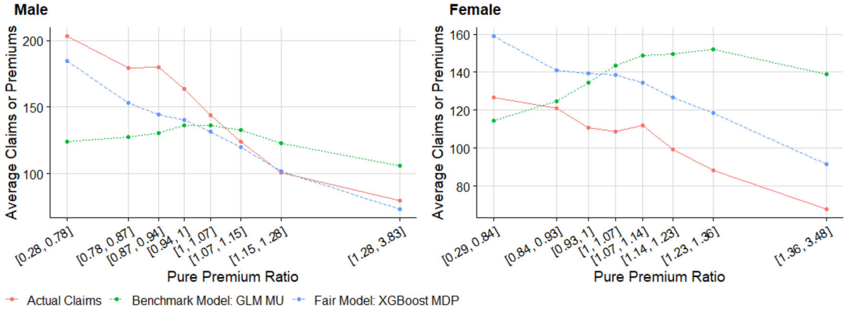
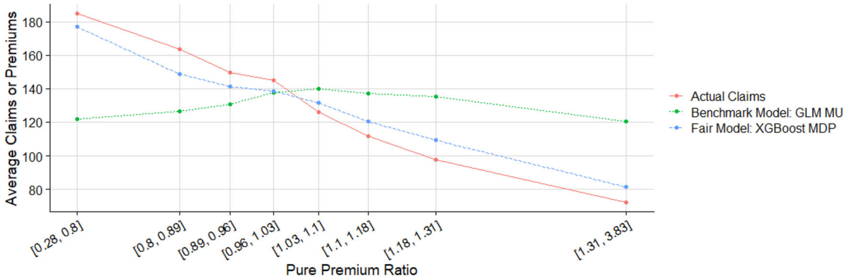
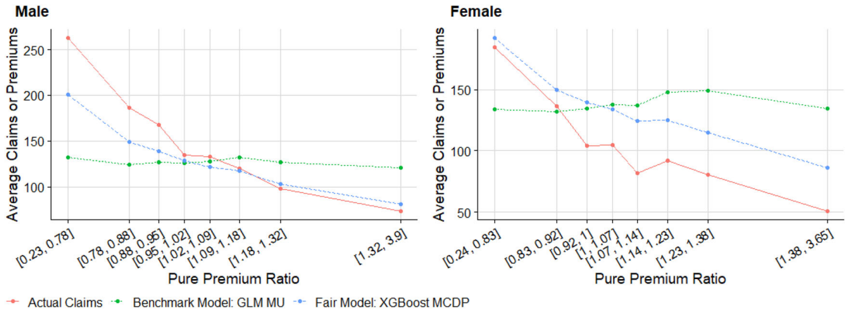
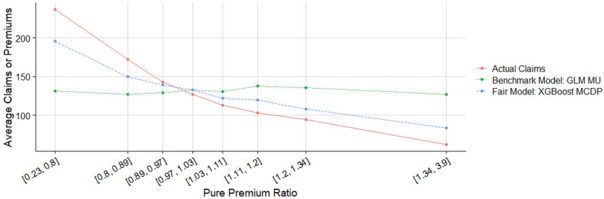
Verification
Claims the paper makes
7 Valid · 17 Not valid · 35 Not checked · 99 Own results and interpretations
The sources with a verdict support this claim; the rest weren’t checked yet, have no full text we could read, or their verdicts aren’t rated yet.
In the paper
“However, there is little research on insurance applications, particularly on insurance pricing as a regression problem; see Lindholm et al. (2022a), Araiza Iturria, Hardy, and Marriott (2022), and Grari et al. (2022) as examples of recent research in this area.”
What the sources say
- Not matchedcites Lindholm et al. (2022a)
More than one paper fits this citation.
- Not checked — no full text of the sourcecites Araiza Iturria, Hardy, and Marriott (2022) matched to “A Discrimination-Free Premium Under a Causal Framework” (2022) source
- Supportedcites Grari et al. (2022) matched to “A fair pricing model via adversarial learning” (2022) source
The citation presents Grari et al. as an example of recent research on insurance pricing, rather than as a source for a count of studies. The Abstract (p. 1) calls fairness in insurance pricing a relatively new topic, and §1.2 Motivation (p. 2) describes the paper’s model for predicting pure premiums in private car insurance. (LLM, conf=0.90)
plain- Asserted: passes — The authors put it forward as true.
- Checkable: passes — It can be checked against evidence.
- Load-bearing: passes — The paper’s conclusions depend on it.
- Based: passes — The paper gives a reason why it holds.
- Not matched
Every source the paper cites for this claim was checked and supports it.
In the paper
“Interestingly, if the protected attribute X P as a subset of X is also the parent (or direct cause) of random variables X j in X in a causal model and strong level 3 assumption in Kusner et al. (2017) is met, MDP further satisfies the counterfactual fairness criterion in Section 3.”
What the sources say
- Supportedcites Kusner et al. 2017 matched to “Counterfactual Fairness” (2017) source
Section 4.2 (p. 7) describes Level 3 as a fully deterministic causal model with latent variables, matching the assumption attributed to Kusner et al. Section 3 (p. 3) defines the counterfactual fairness criterion. The statement that MDP satisfies that criterion is the citing authors’ own conditional conclusion, not a result attributed to this source. (LLM, conf=0.88)
plainstates a cause- Asserted: passes — The authors put it forward as true.
- Checkable: passes — It can be checked against evidence.
- Load-bearing: passes — The paper’s conclusions depend on it.
- Based: passes — The paper gives a reason why it holds.
- Rests on 2 assumptions not shown here.
- Supported
A result the paper states — it cites no source for it, so there is none to check. The quote shows it is in the paper.
In the paper
“As a better alternative to MU that also focuses on individual fairness, MC performs similar to MU when there is no strong gender proxy in the training data.”
- Also stated in: § 5.3. Model Comparison 5.3.1. Model Comparison with the Effects of Gender Proxy · plain
“MC performs similar to MU when there is no strong gender proxy in the training data.”
plain- Asserted: passes — The authors put it forward as true.
- Checkable: passes — It can be checked against evidence.
- Load-bearing: unclear — It is unclear whether the paper’s conclusions depend on it.
- Based: passes — The paper gives a reason why it holds.
- Also stated in: § 5.3. Model Comparison 5.3.1. Model Comparison with the Effects of Gender Proxy · plain
A result the paper states — it cites no source for it, so there is none to check. The quote shows it is in the paper.
In the paper
“XGBoost MU and MC (MDP comes the third) achieve the best trade-off in Scenario 2.”
plainstates an association- Asserted: passes — The authors put it forward as true.
- Checkable: passes — It can be checked against evidence.
- Load-bearing: passes — The paper’s conclusions depend on it.
- Based: passes — The paper gives a reason why it holds.
A result the paper reports from its own data — it cites no other source for it, so there is none to check. The quote shows it is in the paper.
In the paper
“their model performance is different only when there is at least one moderate gender proxy in the training data”
plain- Asserted: passes — The authors put it forward as true.
- Checkable: passes — It can be checked against evidence.
- Load-bearing: unclear — It is unclear whether the paper’s conclusions depend on it.
- Based: passes — The paper gives a reason why it holds.
50 more claims
Create a free account to see all 158 claims and to verify the 4 references still open.
- Probably not a substantial claim. 74
- It may state two separate claims as one. 64
Self-check
Percentages, sums and reported differences re-computed from the paper’s own numbers.
Each contradiction between two passages listed here was confirmed by an independent check.
Rated minor: it would not touch a result — a value no result rests on, a p-value that stays on the same side of the significance level, or a conflict that is clerical, resolved elsewhere in the paper, or outside its own findings.
In the paper
§ 5.3.2. Scenario Analysis: Group Fairness and Prediction Accuracy
“a smaller value of the normalized Gini index represents a more accurate model.”
§ 5.3.2. Scenario Analysis: Group Fairness and Prediction Accuracy
“a larger normalized Gini index indicates better model predictions.”
Citations
Cites
XGBoost: A Scalable Tree Boosting System
Chen, T., & Guestrin, C. (2016) · Proceedings of the 22nd ACM SIGKDD International Conference on Knowledge Discovery and Data Mining · doi:10.1145/2939672.2939785 · Cited by 54,569 · cited 5×
“XGBoost was proposed by Chen and Guestrin (2016) as a novel gradient tree boosting method and has rapidly gained popularity because of its high efficiency in computational speed and predictive performance in applications in many fields.”
BackgroundMethodInfluentialAdvances in Neural Information Processing Systems 29
Teymur, O., Zygalakis, K., & Calderhead, B. (2016) · Cited by 13,887
Justice as Fairness: A Restatement
Rawls, J. (2001) · doi:10.2307/j.ctv31xf5v0 · Cited by 5,761
Rawls, J. (1958) · The Philosophical Review · doi:10.2307/2182612 · Cited by 5,565
Dwork, C., Hardt, M., Pitassi, T., Reingold, O., & Zemel, R. (2012) · Proceedings of the 3rd Innovations in Theoretical Computer Science Conference · doi:10.1145/2090236.2090255 · Cited by 3,501 · cited 6×
“In particular, we demonstrate the appealing potential of antidiscrimination pricing models for rate-making compared to common industry practice (fairness through unawareness; Dwork et al. 2012).”
BackgroundInfluentialBarocas, S., & Selbst, A. D. (2014) · doi:10.2139/ssrn.2477899 · Cited by 3,048 · cited 1×
“Barocas and Selbst (2016) analyzed the instances of discriminatory data mining under Title VII jurisprudence for employment discrimination taking into account both disparate treatment and disparate impact theories of liability and provided a bridge between computer science literature and existing…”
BackgroundEquality of Opportunity in Supervised Learning
Hardt, M., Price, E., & Srebro, N. (2016) · arXiv · doi:10.48550/arxiv.1610.02413 · Cited by 2,536 · cited 2×
“A major improvement in demographic parity is equalized odds proposed by Hardt, Price, and Srebro (2016; or separation criterion in Barocas, Hardt, and Narayanan 2019) requiring the predictor ^ Y and the protected attribute X P to be statistically independent conditional on Y .”
BackgroundFair prediction with disparate impact: a study of bias in recidivism prediction instruments
Chouldechova, A. (2017) · Big Data · doi:10.1089/big.2016.0047 · Cited by 2,159
xgboost: Extreme Gradient Boosting
Chen, T., He, T., Benesty, M., Khotilovich, V., Tang, Y., Cho, H., Chen, K., Mitchell, R., Cano, I., Zhou, T., et al. (2014) · CRAN: Contributed Packages · doi:10.32614/cran.package.xgboost · Cited by 2,025
Certifying and Removing Disparate Impact
Feldman, M., Friedler, S. A., Moeller, J., Scheidegger, C., & Venkatasubramanian, S. (2015) · Proceedings of the 21th ACM SIGKDD International Conference on Knowledge Discovery and Data Mining · doi:10.1145/2783258.2783311 · Cited by 1,827
Data preprocessing techniques for classification without discrimination
Kamiran, F., & Calders, T. (2012) · Knowledge and Information Systems · doi:10.1007/s10115-011-0463-8 · Cited by 1,305 · cited 1×
“Alternative methods to remove disparate impact include reweighting and resampling (Kamiran and Calders 2012).”
MethodAlgorithmic Decision Making and the Cost of Fairness
Corbett-Davies, S., Pierson, E., Feller, A., Goel, S., & Huq, A. (2017) · Proceedings of the 23rd ACM SIGKDD International Conference on Knowledge Discovery and Data Mining · doi:10.1145/3097983.3098095 · Cited by 1,149
(2013) · Cited by 1,126
Fairness definitions explained
Verma, S., & Rubin, J. (2018) · Proceedings of the International Workshop on Software Fairness · doi:10.1145/3194770.3194776 · Cited by 1,124
Kusner, M. J., Loftus, J. R., Russell, C., & Silva, R. (2017) · arXiv · doi:10.48550/arxiv.1703.06856 · Cited by 995 · cited 13×
“Following De Jong and Heller (2008) and Frees, Derrig, and Meyers (2014), the structure of GLMs is as follows: Let Y denote the response variable, x the explanatory variables, and l the expectation of Y , where its distribution is a member of the exponential family of distributions, and let g ð(cid:3)Þ denote the mono…”
BackgroundInfluentialFairness in Criminal Justice Risk Assessments: The State of the Art
Berk, R., Heidari, H., Jabbari, S., Kearns, M., & Roth, A. (2021) · Sociological Methods & Research · doi:10.1177/0049124118782533 · Cited by 988 · cited 2×
“Berk et al. (2018) integrated existing research in criminology, computer science, and statistics to address both fairness and accuracy for risk assessments in criminal justice settings.”
BackgroundInherent Trade-Offs in the Fair Determination of Risk Scores
Kleinberg, J., Mullainathan, S., & Raghavan, M. (2016) · arXiv · doi:10.48550/arxiv.1609.05807 · Cited by 941
Fairness in Machine Learning: Lessons from Political Philosophy
Binns, R. (2017) · arXiv · doi:10.48550/arxiv.1712.03586 · Cited by 676 · cited 1×
“Binns (2018) linked fair machine learning with extant literature in moral and political philosophy.”
BackgroundFairness in Machine Learning: A Survey
Caton, S., & Haas, C. (2020) · arXiv · doi:10.48550/arxiv.2010.04053 · Cited by 646
The Australian Human Rights Commission
Santow, E. (2019) · The Legal Protection of Rights in Australia · doi:10.5040/9781509919857.ch-007 · Cited by 592
Scaling of End-To-End Governance Risk Assessments for AI Systems (Practitioner Track)
Weimer, D., Gensch, A., & Koller, K. (2025) · OASIcs : OpenAccess Series in Informatics · doi:10.4230/oasics.saia.2024.4 · Cited by 390
Avoiding Discrimination through Causal Reasoning
Kilbertus, N., Rojas-Carulla, M., Parascandolo, G., Hardt, M., Janzing, D., & Schölkopf, B. (2017) · arXiv · doi:10.48550/arxiv.1706.02744 · Cited by 358
On the apparent conflict between individual and group fairness
Binns, R. (2020) · Proceedings of the 2020 Conference on Fairness, Accountability, and Transparency · doi:10.1145/3351095.3372864 · Cited by 312 · cited 1×
“An inevitable conflict may exist between group fairness and individual fairness; see also Binns (2020).”
Background50 Years of Test (Un)fairness: Lessons for Machine Learning
Hutchinson, B., & Mitchell, M. (2019) · Proceedings of the Conference on Fairness, Accountability, and Transparency · doi:10.1145/3287560.3287600 · Cited by 297
THORNDIKE, R. L. (1971) · Journal of Educational Measurement · doi:10.1111/j.1745-3984.1971.tb00907.x · Cited by 265 · cited 1×
“As early as the 1970s, research in other fields noted the conflict between individual fairness and group fairness; see Thorndike (1971) and Sawyer, Cole, and Cole (1976).”
BackgroundGeneralized Linear Models for Insurance Data
de Jong, P., & Heller, G. Z. (2008) · doi:10.1017/cbo9780511755408 · Cited by 263
Elliott, M. N., Morrison, P. A., Fremont, A., McCaffrey, D. F., Pantoja, P., & Lurie, N. (2009) · Health Services and Outcomes Research Methodology · doi:10.1007/s10742-009-0047-1 · Cited by 224 · cited 1×
“To overcome this practical difficulty, proxy methods have been proposed in other fields to impute the unobserved protected class information, such as the Bayesian Improved Surname Geocoding method (Elliott et al. 2009).”
MethodNational Association of Insurance Commissioners
Lloyd, J. (2016) · American Legal Encyclopedia · Cited by 208
A Convex Framework for Fair Regression
Berk, R., Heidari, H., Jabbari, S., Joseph, M., Kearns, M., Morgenstern, J., Neel, S., & Roth, A. (2017) · arXiv · doi:10.48550/arxiv.1706.02409 · Cited by 198 · cited 8×
“” Berk (2009) and Berk et al. (2018) comment on the drawbacks for the approach of residualizing all of the predictors (see Model 3 in Sections 4 and 5) including the problem that this approach fails to remove the information from interactions effects in A. Johndrow, Lum, and others (2019) propose a more complicated al…”
BackgroundInfluentialEncyclopedia of Industrial and Organizational Psychology
Rogelberg, S. (2007) · Sage eBooks · doi:10.4135/9781412952651 · Cited by 158 · cited 1×
“…context, race norming (i.e., “ the practice of converting individual test scores to percentile or standard scores within one ’ s racial group ” ; Rogelberg 2007), promoted by the U.S. Department of Labor, has been used since 1981 given the assumption (or observation) that raw test scores…”
Method(2020) · Iowa law review · Cited by 151
Johndrow, J. E., & Lum, K. (2019) · The Annals of Applied Statistics · doi:10.1214/18-aoas1201 · Cited by 141
The Use and Misuse of Counterfactuals in Ethical Machine Learning
Kasirzadeh, A., & Smart, A. (2021) · ACM Conference on Fairness, Accountability, and Transparency (FAccT) · doi:10.1145/3442188.3445886 · Cited by 140 · cited 1×
“Despite the popularity of counterfactual fairness as a promising technique since its proposal Kasirzadeh and Smart (2021, p. 228) argued that “ even though counterfac-tuals play an essential part in some causal inferences, their use for questions of algorithmic fairness and social explanations can…”
MethodOn statistical criteria of algorithmic fairness
Hedden, B. (2021) · Philosophy & Public Affairs · doi:10.1111/papa.12189 · Cited by 135
Predictive Modeling Applications in Actuarial Science
(2014) · Cambridge University Press eBooks · doi:10.1017/cbo9781139342674 · Cited by 121
Bias Mitigation Post-processing for Individual and Group Fairness
Lohia, P. K., Natesan Ramamurthy, K., Bhide, M., Saha, D., Varshney, K. R., & Puri, R. (2019) · ICASSP 2019 - 2019 IEEE International Conference on Acoustics, Speech and Signal Processing (ICASSP) · doi:10.1109/icassp.2019.8682620 · Cited by 120 · cited 1×
“…individual fairness is analogous to the idea of treating similar people similarly group fairness “ partitions a population into groups defined by protected attributes (such as gender, caste, or religion) and seeks for some statistical measure to be equal across groups ” (Lohia et al. 2019, p. 1).”
Background50 Years of Test (Un)fairness: Lessons for Machine Learning
Hutchinson, B., & Mitchell, M. (2018) · arXiv (Cornell University) · doi:10.48550/arxiv.1811.10104 · Cited by 118
Enacting Actuarial Fairness in Insurance: From Fair Discrimination to Behaviour-based Fairness
Meyers, G., & Hoyweghen, I. V. (2017) · Science as Culture · doi:10.1080/09505431.2017.1398223 · Cited by 115 · cited 1×
“Meyers and van Hoyweghen (2018) analyzes how actuarial fairness has been enacted in different ways in insurance practice over time, from traditional fair discrimination to contemporary behavioral-based fairness; the latter is based on the support of personalized data, such as personal driving style…”
BackgroundBoosting Insights in Insurance Tariff Plans with Tree-Based Machine Learning Methods
Henckaerts, R., Côté, M.-P., Antonio, K., & Verbelen, R. (2021) · North American Actuarial Journal · doi:10.1080/10920277.2020.1745656 · Cited by 109 · cited 2×
“Insurance products may seek an effective balance between customer segmentation and risk pooling (Henckaerts et al., 2021).”
BackgroundMethodCertifying and removing disparate impactPreprint
Feldman, M., Friedler, S. A., Moeller, J., Scheidegger, C., & Venkatasubramanian, S. (2014) · arXiv (Cornell University) · doi:10.48550/arxiv.1412.3756 · Cited by 106
Encyclopedia of industrial and organizational psychology
Rogelberg, S. G., & Publications, S. (2007) · Choice Reviews Online · doi:10.5860/choice.44-3641 · Cited by 103
Fairness Through Computationally-Bounded Awareness
Kim, M. P., Reingold, O., & Rothblum, G. N. (2018) · arXiv · doi:10.48550/arxiv.1803.03239 · Cited by 97
Assessing Algorithmic Fairness with Unobserved Protected Class Using Data Combination
Kallus, N., Mao, X., & Zhou, A. (2022) · Management Science · doi:10.1287/mnsc.2020.3850 · Cited by 93
Implementing Anti-discrimination Policies in Statistical Profiling Models
Pope, D. G., & Sydnor, J. R. (2011) · American Economic Journal: Economic Policy · doi:10.1257/pol.3.3.206 · Cited by 87 · cited 4×
“…where P (cid:4) ð x P Þ is defined on the same range as P ð x P Þ : Driven by concerns over the proxy effects of X NP on X P , CPV (or the procedure based on CPV) aims to decouple the protected attribute X P from nonprotected attributes X NP ; see Pope and Sydnor (2011) and Lindholm et al. (2022a).”
BackgroundMethodInfluentialNesting Classical Actuarial Models into Neural NetworksPreprint
Schelldorfer, J., & Wüthrich, M. V. (2019) · SSRN Electronic Journal · doi:10.2139/ssrn.3320525 · Cited by 83 · cited 1×
“…in our empirical analysis, and we use the following nonprotected explanatory variables X NP : Age (i.e., fit in a continuous function form in GLMs using the approach in Schelldorfer and Wuthrich 2019), Bonus, 10 Group1 (car group), Density (the density of inhabitants), and Value (car value).”
MethodThe accuracy of XGBoost for insurance claim prediction
Fauzan, M. A., & Murfi, H. (2018) · Cited by 76
The Forms and Limits of Insurance Solidarity
Lehtonen, T.-K., & Liukko, J. (2011) · Journal of Business Ethics · doi:10.1007/s10551-012-1221-x · Cited by 75
Counterfactual Fairness: Unidentification, Bound and Algorithm
Wu, Y., Zhang, L., & Wu, X. (2019) · Proceedings of the Twenty-Eighth International Joint Conference on Artificial Intelligence · doi:10.24963/ijcai.2019/199 · Cited by 69 · cited 2×
“…the real world is the same as that in the counterfactual world where the individual had belonged to a different demographic group ” (Kusner et al. 2017; Wu, Zhang, and Wu 2019, p. 1) or, mathematically, given that X ¼ x and X P ¼ a , for all y and for simplicity, X P has only two groups { a , b },…”
BackgroundHow Fair Is Actuarial Fairness?
Landes, X. (2015) · Journal of Business Ethics · doi:10.1007/s10551-014-2120-0 · Cited by 66
Fair Regression: Quantitative Definitions and Reduction-based Algorithms
Agarwal, A., Dudı́k, M., & Wu, Z. S. (2019) · arXiv (Cornell University) · doi:10.48550/arxiv.1905.12843 · Cited by 63 · cited 1×
“For regression, a similar definition of statistical parity was defined based on the cumulative distribution function in Agarwal, Dudik, and Wu (2019).”
MethodDiscrimination-Free Insurance Pricing
Lindholm, M., Richman, R., Tsanakas, A., & Wüthrich, M. V. (2022) · ASTIN Bulletin · doi:10.1017/asb.2021.23 · Cited by 60 · cited 1×
“Loi and Christen (2021) provided an ethical analysis of insurance discrimination in private insurance by relating philosophical moral arguments to the discussion of fair predictive algorithms in the machine learning field.”
BackgroundModeling the behavior of the 4/5ths rule for determining adverse impact: Reasons for caution.
Roth, P. L., Bobko, P., & Switzer, F. S. (2006) · Journal of Applied Psychology · doi:10.1037/0021-9010.91.3.507 · Cited by 58 · cited 1×
“Currently, the four-fifths rule is often used along with more sophisticated statistical methods, such as Fisher ’ s exact test or a chi-square test; see Roth, Bobko, and Switzer (2006).”
MethodThe Discriminating (Pricing) Actuary
Frees, E. W. (., & Huang, F. (2023) · North American Actuarial Journal · doi:10.1080/10920277.2021.1951296 · Cited by 56
Self-citationDwork, C., Hardt, M., Pitassi, T., Reingold, O., & Zemel, R. (2011) · arXiv · doi:10.48550/arxiv.1104.3913 · Cited by 55
Assessing algorithmic fairness with unobserved protected class using data combination
Kallus, N., Mao, X., & Zhou, A. (2020) · Proceedings of the 2020 Conference on Fairness, Accountability, and Transparency · doi:10.1145/3351095.3373154 · Cited by 54 · cited 1×
“Recently, several methods in the machine learning field have been proposed to deal with this issue; see Kallus, Mao, and Zhou (2021) and Wang et al. (2020).”
MethodUTILITIES AND THE ISSUE OF FAIRNESS IN A DECISION THEORETIC MODEL FOR SELECTION
SAWYER, R. L., COLE, N. S., & COLE, J. W. L. (1976) · Journal of Educational Measurement · doi:10.1111/j.1745-3984.1976.tb00182.x · Cited by 47
The Role of Race in Forecasts of Violent Crime
Berk, R. (2009) · Race and Social Problems · doi:10.1007/s12552-009-9017-z · Cited by 41
Predictive Modeling in Actuarial Science
Frees, E. W., Derrig, R. A., & Meyers, G. G. (2014) · Cambridge University Press eBooks · doi:10.1017/cbo9781139342674.001 · Cited by 39
Loi, M., & Christen, M. (2019) · Philosophy & Technology · doi:10.1007/s13347-021-00444-9 · Cited by 38 · cited 1×
“Loi and Christen (2021) provided an ethical analysis of insurance discrimination in private insurance by relating philosophical moral arguments to the discussion of fair predictive algorithms in the machine learning field.”
BackgroundRobust Optimization for Fairness with Noisy Protected Groups
Wang, S., Guo, W., Narasimhan, H., Cotter, A., Gupta, M. R., & Jordan, M. I. (2020) · arXiv (Cornell University) · doi:10.48550/arxiv.2002.09343 · Cited by 37
Understanding Insurance Anti-Discrimination Laws
Avraham, R., Logue, K. D., & Schwarcz, D. B. (2012) · eYLS (Yale Law School) · Cited by 35
Counterfactual fairness: removing direct effects through regularizationPreprint
Stefano, P. G. D., Hickey, J. M., & Vasileiou, V. (2020) · arXiv (Cornell University) · doi:10.48550/arxiv.2002.10774 · Cited by 31
Assessing Algorithmic Fairness with Unobserved Protected Class Using Data Combination
Kallus, N., Mao, X., & Zhou, A. (2019) · arXiv · doi:10.48550/arxiv.1906.00285 · Cited by 28 · cited 1×
“Recently, several methods in the machine learning field have been proposed to deal with this issue; see Kallus, Mao, and Zhou (2021) and Wang et al. (2020).”
MethodRace Sex and Genetic Discrimination in Insurance: What’s Fair
Gaulding, J. (1995) · Scholarship @ Cornell Law (Cornell University) · Cited by 27
Man Vs. Machine: An Investigation of Speeding Ticket Disparities Based on Gender and Race
Quintanar, S. M. (2017) · Journal of Applied Economics · doi:10.1016/s1514-0326(17)30001-6 · Cited by 27 · cited 1×
“For example, for auto insurance pricing, the number of auto thefts in the area where the car is located is a legitimate attribute, whereas the number of speeding tickets a person receives is an illegitimate attribute; see Quintanar (2017) and Dunn (2009).”
BackgroundBias Mitigation Post-processing for Individual and Group FairnessPreprint
Lohia, P., Ramamurthy, K. N., Bhide, M. A., Saha, D., Varshney, K. R., & Puri, R. (2018) · arXiv (Cornell University) · doi:10.48550/arxiv.1812.06135 · Cited by 25
Wiśniewski, J., & Biecek, P. (2022) · The R Journal · doi:10.32614/rj-2022-019 · Cited by 23 · cited 1×
“:3) sniewski and Biecek 2021).”
Non-risk price discrimination in insurance: Market outcomes and public policy
Guy Thomas, R. (2012) · The Geneva Papers on Risk and Insurance - Issues and Practice · doi:10.1057/gpp.2011.32 · Cited by 22
A Discrimination-Free Premium Under a Causal Framework
Araiza Iturria, C. A., Hardy, M., & Marriott, P. (2022) · doi:10.2139/ssrn.4079068 · Cited by 20
A discrimination-free premium under a causal framework
Araiza Iturria, C. A., Hardy, M., & Marriott, P. (2024) · North American Actuarial Journal · doi:10.1080/10920277.2023.2291524 · Cited by 20
Insurance Classification: Too Important to be Left to the Actuaries
Wortham, L. (2025) · University of Michigan Journal of Law Reform · doi:10.36646/mjlr.19.2.insurance · Cited by 19
Towards a Universal Framework for Insurance Anti-Discrimination Laws
Avraham, R., Logue, K. D., & Schwarcz, D. B. (2014) · eYLS (Yale Law School) · Cited by 17
Path-Specific Counterfactual Fairness
Chiappa, S. (2019) · Proceedings of the AAAI Conference on Artificial Intelligence · doi:10.1609/aaai.v33i01.33017801 · Cited by 16
Measuring Racial Disparities in Traffic Ticketing Within Large Urban Jurisdictions
Dunn, R. A. (2009) · Public Performance & Management Review · doi:10.2753/pmr1530-9576320403 · Cited by 14 · cited 1×
“For example, for auto insurance pricing, the number of auto thefts in the area where the car is located is a legitimate attribute, whereas the number of speeding tickets a person receives is an illegitimate attribute; see Quintanar (2017) and Dunn (2009).”
BackgroundA Discussion of Discrimination and Fairness in Insurance PricingPreprint
Lindholm, M., Richman, R., Tsanakas, A., et al. (2022) · SSRN Electronic Journal · doi:10.2139/ssrn.4207310 · Cited by 13 · cited 10×
“In the case where partial information on protected attributes is observable, Lindholm et al. (2022c) used a multi task neural network architecture to address this issue that can mitigate proxy discrimination based on partially protected information.”
BackgroundMethodInfluentialfairmodels: A Flexible Tool For Bias Detection, Visualization, And MitigationPreprint
Wiśniewski, J., & Biecek, P. (2021) · arXiv (Cornell University) · doi:10.48550/arxiv.2104.00507 · Cited by 13
A fair pricing model via adversarial learning
Grari, V., Charpentier, A., & Detyniecki, M. (2022) · arXiv · doi:10.48550/arxiv.2202.12008 · Cited by 10
A Multi-Task Network Approach for Calculating Discrimination-Free Insurance PricesPreprint
Lindholm, M., Richman, R., Tsanakas, A., & Wüthrich, M. V. (2022) · SSRN Electronic Journal · doi:10.2139/ssrn.4155585 · Cited by 9
The Economics of Insurance Classification: The Sound of One Invisible Hand Clapping
Wortham, L. (1986) · Scholarship at Catholic Law (Catholic University of America) · Cited by 7
Partial Rating Area Offering in the ACA Marketplaces: Facts, Theory and Evidence
Fang, H., & Ko, A. (2018) · National Bureau of Economic Research · doi:10.3386/w25154 · Cited by 7
fairmodels: Flexible Tool for Bias Detection, Visualization, and Mitigation
Wiśniewski, J., & Biecek, P. (2020) · doi:10.32614/cran.package.fairmodels · Cited by 5
Welfare Implications of Fairness and Accountability for Insurance Pricing
Shimao, H., & Huang, F. (2022) · SSRN Electronic Journal · doi:10.2139/ssrn.4225159 · Cited by 4 · cited 3×
“Another interesting area is to understand the ANTIDISCRIMINATION INSURANCE PRICING implications of different fairness criteria and regulations for stakeholders considering the entire pricing process; for example, see Shimao and Huang (2022).”
BackgroundInfluentialSelf-citationA Discussion of Discrimination and Fairness in Insurance Pricing
Lindholm, M., Richman, R., Tsanakas, A., et al. (2022) · City Research Online (City University London) · doi:10.48550/arxiv.2209.00858 · Cited by 3
Combining Predictions of Auto Insurance ClaimsPreprint
Ye, C., Zhang, L., Han, M., et al. (2018) · arXiv (Cornell University) · doi:10.48550/arxiv.1808.08982 · Cited by 3
A multi-task network approach for calculating discrimination-free insurance pricesPreprint
Lindholm, M., Richman, R., Tsanakas, A., & Wüthrich, M. V. (2022) · arXiv (Cornell University) · doi:10.48550/arxiv.2207.02799 · Cited by 3
American Bar Association Guide to Workplace Law
Fick, B. J. (1997) · Journal of legislation · Cited by 2
Generalized Linear Models for Insurance Data
de Jong, P., & Heller, G. Z. (2008) · doi:10.1017/cbo9780511755408.008 · Cited by 1
(2009)
Partial Rating Area Offering in the ACA Marketplaces: Facts, Theory and Evidence
Fang, H., & Ko, A. (2018) · doi:10.2139/ssrn.3261499
Research works printed but not linked: 14
- 2. Alexander v. sandoval (No. 99-1908; Vol. 532, p. 275). (2001). (Vol. 532). Supreme Court. https://www.supremecourt.gov/opinions/boundvolumes/532bv. pdf
- 3. AMERICAN INS. V. US DEPT. OF HOUSING AND URBAN (Civil Case No. 13-00966 (RJL); Vol. 74, p. 30). (2014). (Vol. 74). Dist. Court, Dist. of Columbia. https://ecf.dcd.uscourts.gov/cgi-bin/show_public_doc?2013cv0966-47
- 9. Avraham, R., K. D. Logue, and D. Schwarcz. 2014b. Understanding insurance antidiscrimination laws. Southern California Law Review 87 (2):195-274.
- 10. Barocas, S., M. Hardt, and A. Narayanan. 2019. Fairness and machine learning. fairmlbook.org.
- 40. Dolman, C., and D. Semenovich. 2019. Algorithmic fairness: Some practical considerations for actuaries. Paper presented at Actuaries Summit 2019, Sydney, New South Wales, Australia, June 3-4.
- 57. Griggs v. Duke Power Co. No. 124; Vol. 401, p. 424 (1971). Supreme Court. https://tile.loc.gov/storage-services/service/ll/usrep/usrep401/usrep401424/ usrep401424.pdf.
- 90. Ojo v. Farmers group, inc. (No. 10-0245; Vol. 356, p. 421). (2011). (Vol. 356). Tex: Supreme Court. https://www.txcourts.gov/media/819896/ OpinionsFY2011.pdf
- 91. Pearl, J. 2000. Models, reasoning and inference. Cambridge, UK: Cambridge University Press.
- 96. Ricci v. DeStefano (No. 07-1428; Vol. 557, p. 557). (2009). (Vol. 557). Supreme Court. https://www.supremecourt.gov/opinions/boundvolumes/557bv.pdf
- 102. Smith v. City of Jackson. No. 03-1160; Vol. 544, p. 228 (2005). Supreme Court. https://www.supremecourt.gov/opinions/boundvolumes/544bv.pdf.
- 103. Texas Department of Housing and Community Affairs v. Inclusive Communities Project, Inc. No. 13-1371; Vol. 576, p. 519 (2015). Supreme Court. https:// www.supremecourt.gov/opinions/boundvolumes/576BV.pdf.
- 111. Wards cove packing co. V. atonio (No. 87-1387; Vol. 490, p. 642). (1989). (Vol. 490). Supreme Court. https://tile.loc.gov/storage-services/service/ll/usrep/ usrep490/usrep490642/usrep490642.pdf
- 113. Willis, C. J., R. J. Andreano, and L. Sommerfield. 2021. President Biden issues executive order directing HUD to review fair housing act disparate impact rule. https://www.consumerfinancemonitor.com/2021/02/03/president-biden-issues-executiveorder-directing-hud-to-review-fair-housing-act-disparate-impact-rule/.
- 119. Xenidis, R., and L. Senden. 2019. EU non-discrimination law in the era of artificial intelligence: Mapping the challenges of algorithmic discrimination. In General principles of EU law and the EU digital order, eds. Ulf Bernitz, Xavier Groussot, Jaan Paju, Sybe Alexander de Vries, 151-82. Alphen aan den Rijn, NL: Kluwer Law International.
Cited by
Kuppan, K., Acharya, D. B., & Divya, B. (2024) · IEEE Access · doi:10.1109/access.2024.3509918 · Cited by 62
A multi-task network approach for calculating discrimination-free insurance prices
Lindholm, M., Richman, R., Tsanakas, A., & Wüthrich, M. V. (2023) · European Actuarial Journal · doi:10.1007/s13385-023-00367-z · Cited by 19
“, Frees–Huang [6] and Xin–Huang [16], or indirect discrimination, see Lindolm et al.”
BackgroundFrom bias to black boxes: understanding and managing the risks of AI – an actuarial perspective
du Preez, V., Bennet, S., Byrne, M., Couloumy, A., Das, A., Dessain, J., Galbraith, R., King, P., Mutanga, V., Schiller, F., et al. (2024) · British Actuarial Journal · doi:10.1017/s1357321724000060 · Cited by 15
A fair price to pay: Exploiting causal graphs for fairness in insurance
Côté, O., Côté, M., & Charpentier, A. (2025) · Journal of Risk & Insurance · doi:10.1111/jori.12503 · Cited by 24
From point to probabilistic gradient boosting for claim frequency and severity prediction
Chevalier, D., & Côté, M. (2025) · European Actuarial Journal · doi:10.1007/s13385-025-00428-5 · Cited by 20
Metadata
- Authors
- Xin, X., & Huang, F.
- Affiliations
- UNSW Sydney (AU)
- Corresponding author
- Huang, Fei
- ORCID
- Huang, Fei
- Venue
- North American Actuarial Journal
- Publisher
- Informa UK Limited
- Published
- 2023-06-08
- Volume
- 28
- Issue
- 2
- Pages
- 285-319
- ISSN
- 1092-0277 (ISSN-L)
- 2325-0453
- OpenAlex
- W4379928685
- Semantic Scholar
- ffeb90bdaf8a78250cd8b1288e0e83f362954213
- Cited by
- 43
- References
- 70
- Citations by year
- 2026: 15 · 2025: 9 · 2024: 11 · 2023: 5
- FWCI
- 9.99
- Type
- journal article
- Language
- en
- Open access
- hybrid
- doi.org
- Licence
- Locations
- North American Actuarial Journal (publishedVersion, cc-by)
- SSRN Electronic Journal (acceptedVersion)
- RePEc: Research Papers in Economics (submittedVersion)
- Topics
- Physical Sciences › Computer Science › Artificial Intelligence › Ethics and Social Impacts of AI
- Social Sciences › Economics, Econometrics and Finance › Economics and Econometrics › Insurance and Financial Risk Management
- Social Sciences › Law › Discrimination and Equality Law
- Keywords
- insurance pricing, anti-discrimination, indirect discrimination, big data analytics, algorithmic fairness, fairness criteria, insurance regulation, fairness-accuracy trade-off, adverse selection, solidarity, generalized linear models, XGBoost, actuarial science
About these checks
Registry, retraction, Cites and statistics results are computed, not judged, with one exception: a printed reference that no index lists is read once by a model before it counts as a citation error. Claims are extracted by a model and kept only when their quote appears verbatim in the text; each cited source is then checked, with a model’s help, for whether it says what the claim relies on. Those verdicts can be wrong — read the claim’s quote and the cited source before relying on one.
The claim verdicts this report counts are experimental: their accuracy is not yet measured.
A language model drew the claims from the paper on 2026-10-01, under version 3 of the claim definition (model deepseek-v4.1-flash, prompt extract-v3).
A second model labelled each claim on 2026-10-01 (model jev-1.13-20260917, definition revision gold-guideline-v0.2).
Cited sources are checked with a language model’s help (gpt-6-sol).
Statistics and arithmetic are recomputed, not judged.
Confidence bands are shown only for fields calibrated on our annotated test set. None is calibrated yet, so no band is shown.
What counts as a claim ›How we measure confidence ›How we check this ›
Are you an author, or do you see a problem with this page? Request a review
Data sources
Bibliographic data: Semantic Scholar, OpenAlex, Crossref.
Contains information from the Semantic Scholar Academic Graph Datasets, made available under the ODC Attribution License (ODC-BY 1.0).
Semantic Scholar’s data is described in: Kinney, R., et al. (2023). The Semantic Scholar Open Data Platform. arXiv:2301.10140.
