

The DOI matches its Crossref record; 7 of the 7 references it cites were found in a registry or an index.
Decentering technology in discourse on discrimination
Abstract
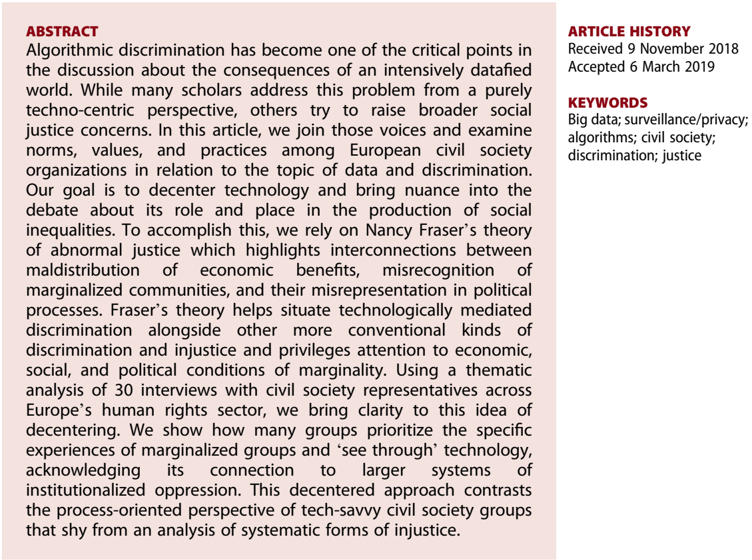
Algorithmic discrimination has become one of the critical points in the discussion about the consequences of an intensively datafied world. While many scholars address this problem from a purely techno-centric perspective, others try to raise broader social justice concerns. In this article, we join those voices and examine norms, values, and practices among European civil society organizations in relation to the topic of data and discrimination. Our goal is to decenter technology and bring nuance into the debate about its role and place in the production of social inequalities. To accomplish this, we rely on Nancy Fraser’s theory of abnormal justice which highlights interconnections between maldistribution of economic benefits, misrecognition of marginalized communities, and their misrepresentation in political processes. Fraser’s theory helps situate technologically mediated discrimination alongside other more conventional kinds of discrimination and injustice and privileges attention to economic, social, and political conditions of marginality. Using a thematic analysis of 30 interviews with civil society representatives across Europe’s human rights sector, we bring clarity to this idea of decentering. We show how many groups prioritize the specific experiences of marginalized groups and ‘see through’ technology, acknowledging its connection to larger systems of institutionalized oppression. This decentered approach contrasts the process-oriented perspective of tech-savvy civil society groups that shy from an analysis of systematic forms of injustice.
Overview
The claims and statistics of this paper haven’t been checked yet.
Free: it reads the open-access text and checks the first 5 claims that cite a source we can check. Create a free account to check every claim.
Integrity signals
Registry
Cites
Statistics
Figures



Verification
Claims the paper makes
The claims and statistics of this paper haven’t been checked yet.
Free: it reads the open-access text and checks the first 5 claims that cite a source we can check. Create a free account to check every claim.
Claims other papers make about this one
Each is checked against this paper’s own text: does it say what the citing paper says it does?
In the citing paper
“Indeed, Seeta Peña Gangadharan and Jędrzej Niklas (2019: 885) rightly state that "algorithmic discrimination and exclusionary automated systems represent one element of a larger ecosystem of discriminatory practices and procedures, and any diagnosis of problems or prescription for remedies would benefit from some measure of reflexivity in relation to this ecosystem."”
From Staring Back at the Surveillance Gaze: The Resistance of LGBTQ+ Users on Social Media (2026) · cites this paper as Gangadharan and Niklas 2019
Self-check
Percentages, sums and reported differences re-computed from the paper’s own numbers.
The self-check needs the paper’s full text.
Citations
Cites
Mapping the Margins: Intersectionality, Identity Politics, and Violence against Women of Color
Crenshaw, K. (1991) · Stanford Law Review · doi:10.2307/1229039 · Cited by 32,792
Algorithms of Oppression: How Search Engines Reinforce Racism
Noble, S. U. (2020) · doi:10.2307/j.ctt1pwt9w5 · Cited by 2,709
Friedman, B., & Nissenbaum, H. (1996) · ACM Transactions on Information Systems · doi:10.1145/230538.230561 · Cited by 1,203
What is data justice? The case for connecting digital rights and freedoms globally
Taylor, L. (2017) · Big Data & Society · doi:10.1177/2053951717736335 · Cited by 802
Discrimination-aware data mining
Pedreshi, D., Ruggieri, S., & Turini, F. (2008) · Proceedings of the 14th ACM SIGKDD international conference on Knowledge discovery and data mining · doi:10.1145/1401890.1401959 · Cited by 676
Fairness in Machine Learning: Lessons from Political Philosophy
Binns, R. (2017) · arXiv · doi:10.48550/arxiv.1712.03586 · Cited by 676
Berendt, B., & Preibusch, S. (2014) · Artificial Intelligence and Law · doi:10.1007/s10506-013-9152-0 · Cited by 44 · cited 1×
“…systems whose automated decisions lead to prejudice, unfair treatment, and negative and unlawful discrimination, computer scientists and engineers conceptualized and modeled ways to identify and avoid the risk of negative discrimination in automated decision systems (Berendt & Preibusch, 2014).”
Background
Research works printed but not linked: 37
- 10.1145/335191.335438 · DOI · Paper page
- 10.1177/146879410100100307 · DOI · Paper page
- Binns R., 2018, Proceedings of the 1st conference on fairness, accountability, and transparency, 81, 149
- Boyatzis R. E., 2009, Transforming qualitative information: Thematic analysis and code development
- Cyril M. A., 2005, The future of media: Resistance and reform in the 21st century, 97
- Cyril M. A., 2008, Alternatives on media content, journalism, and regulation, 55
- 10.1177/2053951716679678 · DOI · Paper page
- Dunn A., 2013, Training digital security trainers: A preliminary review of methods, needs, and challenges
- Dwork C., 2013, Stanford Law Review, 66, 35
- Fraser N., 2010, Scales of justice: Reimagining political space in a globalizing world
- Fraser N., 2006, Redistribution or recognition? A political-philosophical exchange
- 10.1016/j.erss.2015.08.004 · DOI · Paper page
- Gandy O. H., 1993, The panoptic sort: A political economy of personal information
- Gangadharan S. P., 2014, Communication rights and social justice, historical accounts of transnational mobilizations, 203
- Gangadharan S. P., 2018, Between antidiscrimination and data: Understanding human rights discourse on automated discrimination in Europe
- Gilliom J., 2001, Overseers of the poor: Surveillance, resistance and the limits of privacy
- Greenberg J., 2010, Columbia Law Review, 110, 919
- 10.1177/0163443716643006 · DOI
- 10.1017/S0020818300001442 · DOI · Paper page
- Hagman D. G., 1971, Utah Law Review, 46, 33
- 10.1177/0266666916678282 · DOI
- Hoffmann A. L., 2018, Medium
- 10.1007/s10676-014-9351-8 · DOI
- 10.1145/2879878 · DOI
- Lippert-Rasmussen K., 2014, Born free and equal? A philosophical inquiry into the nature of discrimination
- 10.1163/9789004217065 · doi:10.1163/9789004217065
- 10.24908/ss.v5i3.3421 · DOI
- Salamon L. M., 2003, Global civil society: An overview
- 10.1057/9781137355416 · doi:10.1057/9781137355416
- Sen A., 1980, The Tanner lectures on human values, 197
- Snorton R., 2010, International Journal of Communication, 2, 23
- 10.1068/d13031p · DOI
- Winner L., 1986, The whale and the reactor
- Young I. M., 1990, Justice and the politics of difference
- Young I. M., 1997, New Left Review, 222, 14
- 10.1093/0198297556.001.0001 · DOI · Paper page
- Zuboff S., 2019, The age of surveillance capitalism: The fight for a human future at the new frontier of power
Cited by
Sánchez-Monedero, J., Dencik, L., & Edwards, L. (2020) · Proceedings of the 2020 Conference on Fairness, Accountability, and Transparency · doi:10.1145/3351095.3372849 · Cited by 196
Problematic Machine Behavior: A Systematic Literature Review of Algorithm Audits
Bandy, J. (2021) · Proceedings of the ACM on Human-Computer Interaction · doi:10.1145/3449148 · Cited by 193
Toward situated interventions for algorithmic equity: lessons from the field
Katell, M., Young, M., Dailey, D., Herman, B., Guetler, V., Tam, A., Bintz, C., Raz, D., & Krafft, P. M. (2020) · Proceedings of the 2020 Conference on Fairness, Accountability, and Transparency · doi:10.1145/3351095.3372874 · Cited by 153
Rethinking Fairness: An Interdisciplinary Survey of Critiques of Hegemonic ML Fairness Approaches
Weinberg, L. (2022) · Journal of Artificial Intelligence Research · doi:10.1613/jair.1.13196 · Cited by 127
Datafied child welfare services: unpacking politics, economics and power
Redden, J., Dencik, L., & Warne, H. (2020) · Policy Studies · doi:10.1080/01442872.2020.1724928 · Cited by 89
Metadata
- Authors
- Peña Gangadharan, S., & Niklas, J.
- Affiliations
- Department of Media and Communications, London School of Economics and Political Science, London, United Kingdom
- Venue
- Information, Communication & Society
- Publisher
- Informa UK Limited
- Published
- 2019-05-13
- Volume
- 22
- Issue
- 7
- Pages
- 882-899
- ISSN
- 1369-118X
- 1468-4462
- Cited by
- 104
- References
- 7
- Language
- en
- Funders
- Open Society Foundations
About these checks
Registry, retraction, Cites and statistics results are computed, not judged, with one exception: a printed reference that no index lists is read once by a model before it counts as a citation error. Claims are extracted by a model and kept only when their quote appears verbatim in the text; each cited source is then checked, with a model’s help, for whether it says what the claim relies on. Those verdicts can be wrong — read the claim’s quote and the cited source before relying on one.
Statistics and arithmetic are recomputed, not judged.
Confidence bands are shown only for fields calibrated on our annotated test set. None is calibrated yet, so no band is shown.
What counts as a claim ›How we measure confidence ›How we check this ›
Are you an author, or do you see a problem with this page? Request a review
How to cite
Cite CoChat for the checks on this page, and the paper for its own findings.
- This page
- CoChat. (2026). Citation check: Decentering technology in discourse on discrimination. https://app.cochat.ai/papers/10.1080/1369118x.2019.1593484
- The paper
- Peña Gangadharan, S., & Niklas, J. (2019). Decentering technology in discourse on discrimination. Information, Communication & Society. https://doi.org/10.1080/1369118x.2019.1593484
Data sources
Bibliographic data: Semantic Scholar, OpenAlex, Crossref.
Contains information from the Semantic Scholar Academic Graph Datasets, made available under the ODC Attribution License (ODC-BY 1.0).
Semantic Scholar’s data is described in: Kinney, R., et al. (2023). The Semantic Scholar Open Data Platform. arXiv:2301.10140.
