

How African countries respond to fake news and hate speech
Open accessThe DOI matches its Crossref record; 58 of the 59 references it cites were found in a registry or an index.
Abstract
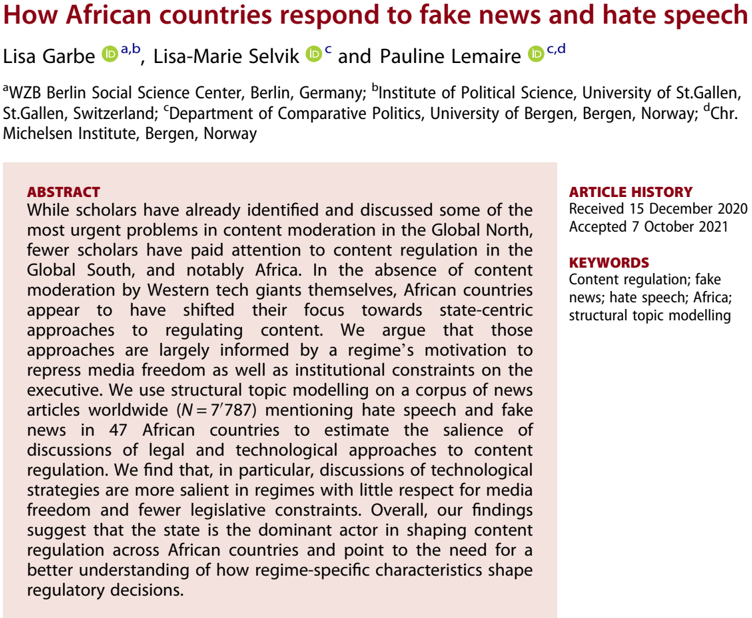
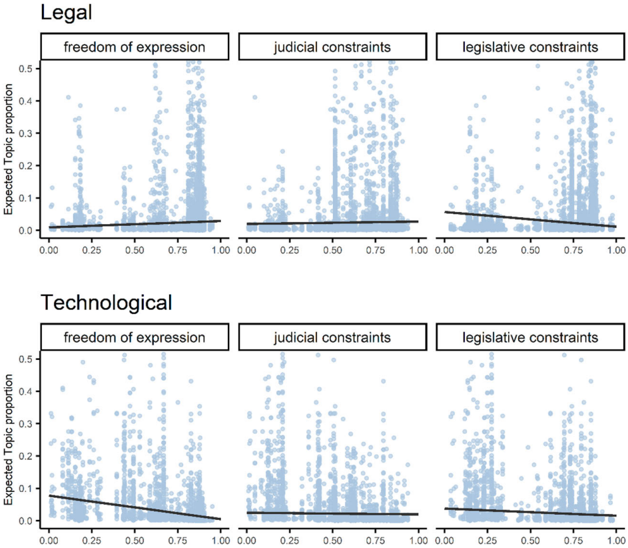
While scholars have already identified and discussed some of the most urgent problems in content moderation in the Global North, fewer scholars have paid attention to content regulation in the Global South, and notably Africa. In the absence of content moderation by Western tech giants themselves, African countries appear to have shifted their focus towards state-centric approaches to regulating content. We argue that those approaches are largely informed by a regime’s motivation to repress media freedom as well as institutional constraints on the executive. We use structural topic modelling on a corpus of news articles worldwide (N = 7′787) mentioning hate speech and fake news in 47 African countries to estimate the salience of discussions of legal and technological approaches to content regulation. We find that, in particular, discussions of technological strategies are more salient in regimes with little respect for media freedom and fewer legislative constraints. Overall, our findings suggest that the state is the dominant actor in shaping content regulation across African countries and point to the need for a better understanding of how regime-specific characteristics shape regulatory decisions.
Overview
The claims and statistics of this paper haven’t been checked yet.
Free: it reads the open-access text and checks the first 5 claims that cite a source we can check. Create a free account to check every claim.
Integrity signals
Registry
Cites
Statistics
Figures
Verification
Claims the paper makes
The claims and statistics of this paper haven’t been checked yet.
Free: it reads the open-access text and checks the first 5 claims that cite a source we can check. Create a free account to check every claim.
Claims other papers make about this one
Each is checked against this paper’s own text: does it say what the citing paper says it does?
The check wasn’t confident either way, so it gives no verdict — never disputed.
In the citing paper
“Critically, these technologies address one of the core dilemmas authoritarian rulers face: citizens' reluctance to share their true preferences, leaving the rulers uncertain about the actual level of support they have.25”
From The rise of authoritarian informationalism: escalating surveillance, manipulation, and control (2026) · cites this paper as [25]
Experimental — accuracy not yet measured
Self-check
Percentages, sums and reported differences re-computed from the paper’s own numbers.
The self-check needs the paper’s full text.
Citations
Cites
null (2016) · Philosophy Study · doi:10.17265/2159-5313/2016.09.003 · Cited by 28,317
Blei, D. M. (2012) · Communications of the ACM · doi:10.1145/2133806.2133826 · Cited by 5,516 · cited 1×
“Because the STM analysis relies on the probabilistic topic model technique Latent Dirichlet Allocation (see Blei, 2012), a technique which uses word counts and not the order of words, it is up to the researcher to infer meaning from the words and topics that appear, rather than assert it (Grimmer &…”
MethodJournal of Statistical Software
Leeuw, J. D. (2009) · WIREs Computational Statistics · doi:10.1002/wics.10 · Cited by 3,599
Text as Data: The Promise and Pitfalls of Automatic Content Analysis Methods for Political Texts
Grimmer, J., & Stewart, B. M. (2013) · Political Analysis · doi:10.1093/pan/mps028 · Cited by 3,297 · cited 1×
“…relies on the probabilistic topic model technique Latent Dirichlet Allocation (see Blei, 2012), a technique which uses word counts and not the order of words, it is up to the researcher to infer meaning from the words and topics that appear, rather than assert it (Grimmer & Stewart, 2013, p. 272).”
Method(1999) · Medical Entomology and Zoology · Cited by 3,259
Analyzing Linguistic Data: A Practical Introduction to Statistics using R
Baayen, R. H. (2008) · doi:10.1017/cbo9780511801686 · Cited by 3,253
THE LOGIC OF CONNECTIVE ACTION: Digital media and the personalization of contentious politics
Bennett, W. L., & Segerberg, A. (2012) · Information, Communication & Society · doi:10.1080/1369118x.2012.670661 · Cited by 3,116 · cited 1×
“In particular, they need to overcome the challenge posed by some of the decentralized and low-cost features of the internet that facilitate the organization of collective action without formal organization (Bennett & Segerberg, 2012).”
BackgroundThe University of Chicago Law Review
Rawls, J. (2017) · Justice · doi:10.4324/9781315193496-12 · Cited by 2,003 · cited 1×
“This may reflect the increasing importance of law-making as a political tool of power consolidation and illiberal practices, also known as ‘autocratic legalism’ (Scheppele, 2018, p. 548).”
BackgroundPolitical Institutions under Dictatorship
Gandhi, J. (2008) · doi:10.1017/cbo9780511510090 · Cited by 1,910 · cited 2×
“In many authoritarian regimes, institutions such as legislatures or courts serve as a way to co-opt the opposition rather than provide de facto oversight (Gandhi, 2008; Rakner & van de Walle, 2009; Shen-Bayh, 2018).”
BackgroundThe Logic of Connective Action: Digital Media and the Personalization of Contentious Politics
Bennett, W. L., & Segerberg, A. (2013) · Cambridge University Press eBooks · doi:10.1017/cbo9781139198752 · Cited by 1,862
stm : An R Package for Structural Topic Models
Roberts, M. E., Stewart, B. M., & Tingley, D. (2019) · Journal of Statistical Software · doi:10.18637/jss.v091.i02 · Cited by 1,714 · cited 5×
“In order to analyse how regulatory strategies are framed, and to test our hypotheses about how these frames are predicted by different regime characteristics, we apply structural topic modelling (STM) (Roberts et al., 2019).”
BackgroundMethodInfluentialDiscovering statistics using SPSS: (and sex and drugs and rock 'n' roll)
Field, A. P. (2009) · Cited by 1,647
Elections Without Democracy: The Menu of Manipulation
Schedler, A. (2002) · Journal of Democracy · doi:10.1353/jod.2002.0031 · Cited by 1,616 · cited 2×
“Most African regimes qualify as ‘electoral regimes’ (Schedler, 2002, p. 36), meaning they hold elections and tolerate some competition but also violate minimal democratic norms so severely and systematically that they cannot be classified as full-fledged democracies.”
Backgroundquanteda: An R package for the quantitative analysis of textual data
Benoit, K., Watanabe, K., Wang, H., Nulty, P., Obeng, A., Müller, S., & Matsuo, A. (2018) · Journal of Open Source Software · doi:10.21105/joss.00774 · Cited by 1,332 · cited 2×
“In preparing for the textual analysis, the body of textual data was properly pre-processed, white space, punctuation, and so-called ‘stopwords’ (the, is, are, etc.) were removed, as well as the search terms we used to delimit our body of texts (Benoit et al., 2018).”
MethodDiMaggio, P., Nag, M., & Blei, D. (2013) · Poetics · doi:10.1016/j.poetic.2013.08.004 · Cited by 1,145 · cited 2×
“In contrast to analysing actual regulatory advances, news reporting can provide a sense of debates surrounding regulatory strategies pursued by governments and may provide an indication of regulation even before a law has been formally adopted (DiMaggio et al., 2013).”
Background(2019) · doi:10.1080/1369118x.2019.1573914 · Cited by 719
(2018) · doi:10.7176/dcs · Cited by 582
The Global Disinformation Order: 2019 Global Inventory of Organised Social Media Manipulation
Bradshaw, S., & Howard, P. N. (2019) · Lincoln (University of Nebraska) · Cited by 300
Lindberg, S. (2009) · Johns Hopkins University Press eBooks · doi:10.56021/9780801893186 · Cited by 281
Social media and protest mobilization: evidence from the Tunisian revolution
Breuer, A., Landman, T., & Farquhar, D. (2015) · Democratization · doi:10.1080/13510347.2014.885505 · Cited by 263
Measuring Polyarchy Across the Globe, 1900–2017
Teorell, J., Coppedge, M., Lindberg, S., & Skaaning, S.-E. (2019) · Studies in Comparative International Development · doi:10.1007/s12116-018-9268-z · Cited by 227
Varieties of Democracy: Measuring Two Centuries of Political Change
Coppedge, M., Gerring, J., Glynn, A., Knutsen, C. H., Lindberg, S. I., Pemstein, D., Seim, B., Skaaning, S.-E., Teorell, J., Altman, D., et al. (2020) · UEA Digital Repository (University of East Anglia) · doi:10.1017/9781108347860 · Cited by 215 · cited 1×
“To predict the expected proportion of each topic, we use three different indicators from the Varieties of Democracy (V-Dem) project, version 10 (Coppedge et al., 2020).”
MethodDefunding Dissent: Restrictions on Aid to NGOs
Christensen, D., & Weinstein, J. M. (2013) · Journal of Democracy · doi:10.1353/jod.2013.0026 · Cited by 182 · cited 1×
“Traditionally, in order to control information and communication, authoritarian rulers rely on manipulation of public discourse through the control of media outlets (Kellam & Stein, 2016) or heavy restrictions on civil society (Christensen & Weinstein, 2013).”
BackgroundDemocracy and ‘grand’ corruption
Rose‐Ackerman, S. (1996) · International Social Science Journal · doi:10.1111/1468-2451.00038 · Cited by 173
Exit and voice in a digital age: Iran’s exiled activists and the authoritarian state
Michaelsen, M. (2018) · Globalizations · doi:10.1080/14747731.2016.1263078 · Cited by 156
Policy Diffusion: The Issue‐Definition Stage
Gilardi, F., Shipan, C. R., & Wüest, B. (2020) · American Journal of Political Science · doi:10.1111/ajps.12521 · Cited by 147
Democracy, autocracy and the news: the impact of regime type on media freedom
Stier, S. (2015) · Democratization · doi:10.1080/13510347.2014.964643 · Cited by 140 · cited 2×
“tion and hate speech might be scarce or biased in more authoritarian countries where news outlets are often owned by government authorities (Stier, 2015).”
BackgroundAccess granted: Facebook’s free basics in Africa
Nothias, T. (2020) · Media, Culture & Society · doi:10.1177/0163443719890530 · Cited by 140 · cited 1×
“The lack of content moderation in African countries seems particularly counterintuitive given the vast use of social media platforms, such as Facebook, on the African continent (e.g., Bosch et al., 2020; Nothias, 2020).”
BackgroundMedia Disruption and Revolutionary Unrest: Evidence From Mubarak's Quasi-Experiment
Hassanpour, N. (2014) · Political Communication · doi:10.1080/10584609.2012.737439 · Cited by 136 · cited 1×
“Recent scholarly efforts seek to understand determinants and effects of governments’ attempts to control online spaces using censorship (Hellmeier, 2016), internet shutdowns (Hassanpour, 2014; Freyburg & Garbe, 2018; Rydzak et al., 2020) or online surveillance (Michaelsen, 2018).”
BackgroundRising Above Misinformation or Fake News in Africa: Another Strategy to Control COVID-19 Spread
Ahinkorah, B. O., Ameyaw, E. K., Hagan, J. E., Seidu, A., & Schack, T. (2020) · Frontiers in Communication · doi:10.3389/fcomm.2020.00045 · Cited by 133 · cited 1×
“The enormous spread of misinformation related to the COVID-19 pandemic on Facebook in South Africa and Nigeria (Africa Check, 2020; Ahinkorah et al., 2020, p. 2) further underlines this trend.”
BackgroundHow Dictators Control the Internet: A Review Essay
Keremoğlu, E., & Weidmann, N. B. (2020) · Comparative Political Studies · doi:10.1177/0010414020912278 · Cited by 131 · cited 1×
“While theory has so far tended to either follow Lessig (1999, 2006) and focus on content regulation in democracies, or to focus on censorship in authoritarian regimes (Stoycheff et al., 2020; Keremoğlu & Weidmann, 2020), our analysis demonstrates that these issues cannot always be easily separated.”
BackgroundGoetz, A. M., & Jenkins, R. (2005) · Palgrave Macmillan UK eBooks · doi:10.1057/9780230500143 · Cited by 123
Silencing Critics: Why and How Presidents Restrict Media Freedom in Democracies
Kellam, M., & Stein, E. A. (2015) · Comparative Political Studies · doi:10.1177/0010414015592644 · Cited by 95
Authoritarian backsliding and the concentration of political power
Dresden, J. R., & Howard, M. M. (2015) · Democratization · doi:10.1080/13510347.2015.1045884 · Cited by 90 · cited 1×
“From a regulatory perspective, authoritarian regimes should hence be inclined to use preventive measures to keep civil society and media actors from putting pressure on the incumbent by using ICT for mobilization purposes (Dresden & Howard, 2015; Goetz & Jenkins, 2005, p. 20).”
BackgroundStrategies of Repression: Judicial and Extrajudicial Methods of Autocratic Survival
Shen-Bayh, F. (2018) · World Politics · doi:10.1017/s0043887118000047 · Cited by 90 · cited 1×
“In many authoritarian regimes, institutions such as legislatures or courts serve as a way to co-opt the opposition rather than provide de facto oversight (Gandhi, 2008; Rakner & van de Walle, 2009; Shen-Bayh, 2018).”
BackgroundNijzink, L., Mozaffar, S., & Azevedo, E. (2006) · Journal of Legislative Studies · doi:10.1080/13572330600875563 · Cited by 86 · cited 1×
“…‘assessing proposed legislation, drafting amendments, […] asking questions, attending committee and plenary meetings, participating in debates or voting’ (Nijzink et al., 2006, p. 315), all of which should be reflected in broader societal debates about different steps in the process of legislation.”
Background(2018) · Alexandria (UniSG) (University of St.Gallen) · Cited by 75
Self-citationThe disinformation landscape and the lockdown of social platforms
Walker, S., Mercea, D., & Bastos, M. (2019) · Information, Communication & Society · doi:10.1080/1369118x.2019.1648536 · Cited by 70 · cited 2×
“…blamed for poor efforts to moderate content in many instances around the world, failing to protect users from foreign influence during elections in the USA and France (Walker et al., 2019, p. 1532) or to adequately moderate hate speech in Ethiopia inciting violent ethnic protest (Gilbert, 2020).”
BackgroundThe Dictator's Digital Toolkit: Explaining Variation in Internet Filtering in Authoritarian Regimes
Hellmeier, S. (2016) · Politics & Policy · doi:10.1111/polp.12189 · Cited by 69 · cited 2×
“Recent scholarly efforts seek to understand determinants and effects of governments’ attempts to control online spaces using censorship (Hellmeier, 2016), internet shutdowns (Hassanpour, 2014; Freyburg & Garbe, 2018; Rydzak et al.”
BackgroundAfrica's Media Image in the 21st Century
(2016) · Routledge eBooks · doi:10.4324/9781315659510 · Cited by 67
The Problem of Judicial Control in Africa's Neopatrimonial Democracies: Malawi and Zambia
VonDoepp, P. (2005) · Political Science Quarterly · doi:10.1002/j.1538-165x.2005.tb00548.x · Cited by 65 · cited 1×
“Examples from Africa highlight their capacity to challenge even fundamental government decisions such as amendments to the constitution to overcome presidential term limits (Vondoepp, 2005).”
Background17 WEAVING THE AUTHORITARIAN WEB The Control of Internet Use in Nondemocratic Regimes
Boas, T. C. (2006) · How Revolutionary Was the Digital Revolution? · doi:10.1515/9781503625730-021 · Cited by 62 · cited 2×
“Theoretically, we build on Lessig (1999) and Boas (2006) framework of the regulation of code as well as recent scholarship on regime survival to explain how regime-specific characteristics shape the prevalence of legal and technological discussions about online content regulation.”
BackgroundMethodFacebook and politics in Africa: Zimbabwe and Kenya
Bosch, T. E., Mare, A., & Ncube, M. (2020) · Media Culture & Society · doi:10.1177/0163443719895194 · Cited by 60 · cited 1×
“The lack of content moderation in African countries seems particularly counterintuitive given the vast use of social media platforms, such as Facebook, on the African continent (e.g., Bosch et al., 2020; Nothias, 2020).”
BackgroundStoycheff, E., Burgess, G. S., & Martucci, M. C. (2020) · Information, Communication & Society · doi:10.1080/1369118x.2018.1518472 · Cited by 55 · cited 1×
“While theory has so far tended to either follow Lessig (1999, 2006) and focus on content regulation in democracies, or to focus on censorship in authoritarian regimes (Stoycheff et al., 2020; Keremoğlu & Weidmann, 2020), our analysis demonstrates that these issues cannot always be easily separated.”
BackgroundRegimes in the World (RIW): A Robust Regime Type Measure Based on V-DemPreprint
LLhrmann, A., & Tannenberg, M. (2017) · SSRN Electronic Journal · doi:10.2139/ssrn.2971869 · Cited by 50
Regulatory Responses to ‘Fake News’ and Freedom of Expression: Normative and Empirical Evaluation
Helm, R. K., & Nasu, H. (2020) · Human Rights Law Review · doi:10.1093/hrlr/ngaa060 · Cited by 50 · cited 3×
“While Helm and Nasu (2021) argue that criminal sanctions can be an effective way to counter hate speech, they underline that it is necessary to find an appropriate balance between censoring information and respecting freedom of expression.”
BackgroundInfluentialThe Accountability Sequence: from De-Jure to De-Facto Constraints on Governments
Mechkova, V., Lührmann, A., & Lindberg, S. I. (2019) · Studies in Comparative International Development · doi:10.1007/s12116-018-9262-5 · Cited by 46
Regulating the internet intermediaries in a post-truth world: Beyond media policy?
Iosifidis, P., & Andrews, L. (2019) · International Communication Gazette · doi:10.1177/1748048519828595 · Cited by 46
Analysis of Cognitive Radio Spectrum Sensing Techniques over Nakagami-m Fading Channel
Shaikh, M. S., & Khare, P. K. (2020) · International Journal of Communications · doi:10.46300/9107.2020.14.5 · Cited by 25
Freedom on the net 2015: privatizing censorship, eroding privacy
Kelly, S., Earp, M., Reed, L. K., Shahbaz, A., & Truong, M. (2015) · Cited by 15
Africa in the Australian press: Does distance matter?
Obijiofor, L., & MacKinnon, M. (2016) · African Journalism Studies · doi:10.1080/23743670.2016.1210017 · Cited by 15 · cited 1×
“The Dow Jones Factiva database is a digital archive of global news content which is frequently used by scholars analysing media reporting on African countries (e.g., Bunce, 2016; Obijiofor & MacKinnon, 2016).”
Background(2020) · International journal of communication · Cited by 15
Ex Ante Versus Ex Post Approaches to Network Neutrality: A Comparative Assessment
Frieden, R. (2015) · bepress Legal Repository · doi:10.15779/z386z81 · Cited by 13 · cited 2×
“argue that the main difference between technological and legal regulation is that technological strategies are an ex-ante approach to prevent the production of online content in the first place, while legal strategies are mostly ex-post, removing and/or punishing harmful content after it was produced or shared (Friede…”
BackgroundFreyburg, T., Garbe, L., & Wavre, V. (2023) · The Review of International Organizations · doi:10.1007/s11558-022-09483-z · Cited by 9 · cited 1×
“Here, data comes from the Telecommunications Ownership and Control Dataset (Freyburg et al., 2021).”
MethodSelf-citationEmerging Legislatures in Africa: Challenges and Opportunities
Bolarinwa, J. O. (2015) · Developing Country Studies · Cited by 7
Examining approaches to internet regulation in Ethiopia
Abraha, H. H. (2017) · Information & Communications Technology Law · doi:10.1080/13600834.2017.1374057 · Cited by 6
Herron, E. S., & Boyko, N. (2013) · Party Politics · doi:10.1177/1354068812472573 · Cited by 5
Civil Society in the Digital Age in Africa: Identifying Threats and Mounting Pushbacks
Dube, H., Simiyu, M. A., & Ilori, T. (2020) · Cited by 3
Research works printed but not linked: 5
- Coppedge, M., Gerring, J., Knutsen, C. H., Lindberg, S. I., Teorell, J., Altman, D., Bernhard, M., Steven Fish, M., Glynn, A., Hicken, A., Luhrmann, A., Marquardt, K. L., McMann, K., Paxton, P., Pemstein, D., Seim, B., Sigman, R., Skaaning, S.-E., Staton, J., … Ziblatt, D. (2020). V-Dem [country -year Dataset v10]. Varieties of Democracy (V-Dem) Project , https:// doi.org/10.23696/vdemds20 · DOI
- Eltantawy, N., & Wiest, J. B. (2011). Social media in the Egyptian revolution: Reconsidering resource mobilization theory. International Journal of Communication , 5 , 1207 -1224. https:// ijoc.org/index.php/ijoc/article/view/1242
- Field, A. (2009). Discovering statistics using SPSS: And sex drugs and rock ' n ' roll (2nd ed.). Sage. Freedom House. (2020). Freedom on the Net: The Pandemic ' s Digital Shadow .
- Lessig, L. (2006). Code. Version 2.0 . Basic Books.
- 10.17265/2159-5313/2016.09.003 · DOI · Paper page
Cited by
Birkenmaier, L., Lechner, C. M., & Wagner, C. (2023) · Communication Methods and Measures · doi:10.1080/19312458.2023.2285765 · Cited by 55
“Studies in our sample applied intrusive text detection for both human coders (Garbe et al., 2021; Rossiter, 2022) and CTAM themselves (Huang et al., 2020).”
Ma, R., Wang, X., & Yang, G.-R. (2025) · Technological Forecasting and Social Change · doi:10.1016/j.techfore.2025.124125 · Cited by 20
How practices of digital authoritarianism harm democracy
Maerz, S. F. (2025) · Democratization · doi:10.1080/13510347.2025.2553826 · Cited by 22
Content moderation and the digital transformations of gatekeeping
Schroeder, R. (2024) · Policy & Internet · doi:10.1002/poi3.425 · Cited by 26
The rise of authoritarian informationalism: escalating surveillance, manipulation, and control
Garbe, L., & Maerz, S. F. (2026) · Democratization · doi:10.1080/13510347.2025.2579105 · Cited by 11
Self-citation
Metadata
- Authors
- Garbe, L., Selvik, L.-M., & Lemaire, P.
- Affiliations
- University of St.Gallen (CH)
- University of Bergen (NO)
- Chr. Michelsen Institute (NO)
- Corresponding author
- Garbe, Lisa
- Venue
- Information, Communication & Society
- Publisher
- Informa UK Limited
- Published
- 2021-11-09
- Volume
- 26
- Issue
- 1
- Pages
- 86-103
- ISSN
- 1369-118X (ISSN-L)
- 1468-4462
- OpenAlex
- W3212036620
- Cited by
- 57
- References
- 59
- Citations by year
- 2026: 26 · 2025: 12 · 2024: 5 · 2023: 12 · 2022: 2
- FWCI
- 6.58
- Type
- journal article
- Language
- en
- Open access
- hybrid
- doi.org
- Licence
- Locations
- Information Communication & Society (publishedVersion, cc-by)
- Econstor (Econstor) (submittedVersion, cc-by)
- Social Science Open Access Repository (GESIS – Leibniz Institute for the Social Sciences) (submittedVersion, cc-by)
- Funders
- Norwegian Research Council (288489, 262862)
- Topics
- Social Sciences › Sociology and Political Science › Misinformation and Its Impacts
- Social Sciences › Law › Freedom of Expression and Defamation
- Social Sciences › Sociology and Political Science › Media Influence and Politics
- Keywords
- fake news, hate speech, content regulation, content moderation, government regulation, freedom of the press, executive constraints, regime typology, African countries, Global South, legislative constraints
About these checks
Registry, retraction, Cites and statistics results are computed, not judged, with one exception: a printed reference that no index lists is read once by a model before it counts as a citation error. Claims are extracted by a model and kept only when their quote appears verbatim in the text; each cited source is then checked, with a model’s help, for whether it says what the claim relies on. Those verdicts can be wrong — read the claim’s quote and the cited source before relying on one.
Statistics and arithmetic are recomputed, not judged.
Confidence bands are shown only for fields calibrated on our annotated test set. None is calibrated yet, so no band is shown.
What counts as a claim ›How we measure confidence ›How we check this ›
Are you an author, or do you see a problem with this page? Request a review
Data sources
Bibliographic data: Semantic Scholar, OpenAlex, Crossref.
Contains information from the Semantic Scholar Academic Graph Datasets, made available under the ODC Attribution License (ODC-BY 1.0).
Semantic Scholar’s data is described in: Kinney, R., et al. (2023). The Semantic Scholar Open Data Platform. arXiv:2301.10140.
