

The DOI matches its Crossref record; 53 of the 53 references it cites were found in a registry or an index.
New beginnings for mothers and babies in prison: a cluster randomized controlled trial.
Open accessAbstract
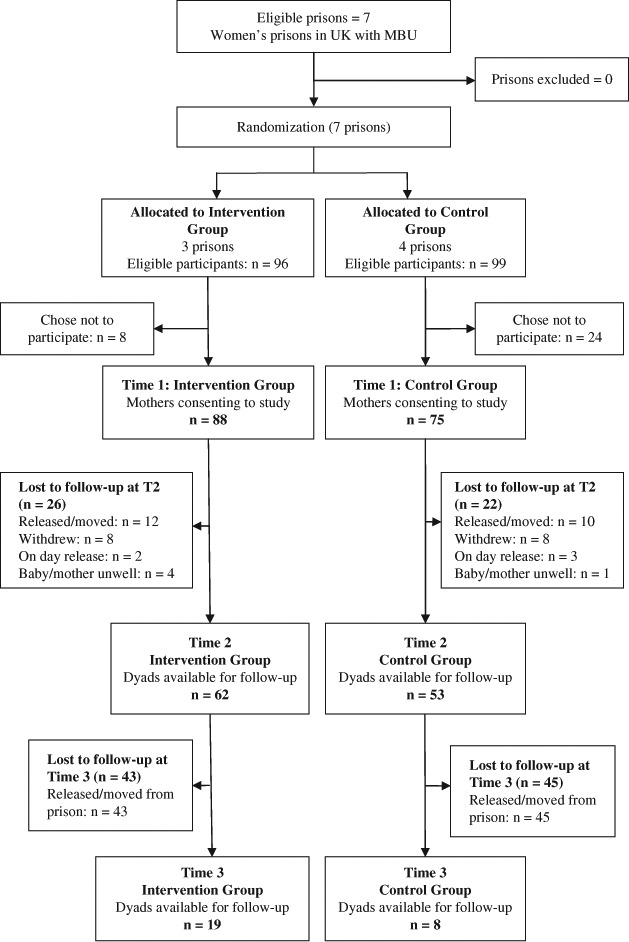
Mothers in prison represent a high-risk parenting population. New Beginnings is an attachment-based group intervention designed specifically for mothers and babies in prison. This cluster randomized trial examined the outcomes for 88 mothers and babies participating in the New Beginnings program and 75 dyads residing in prisons where the intervention did not take place. Outcomes were measured in terms of parental reflective functioning, the quality of parent-infant interaction, maternal depression, and maternal representations. Mothers in the control group deteriorated in their level of reflective functioning and behavioral interaction with their babies over time, whereas the mothers in the intervention group did not. There were no significant group effects on levels of maternal depression or mothers' self-reported representations of their babies over time. An attachment-based intervention may mitigate some of the risks to the quality of the parent-infant relationship for these dyads.
Overview
The claims and statistics of this paper haven’t been checked yet.
Run the check — free, no account needed. It reads the open-access text and checks the sources it cites.
Integrity signals
Registry
Cites
Statistics
Figures
Verification
Claims the paper makes
The claims and statistics of this paper haven’t been checked yet.
Run the check — free, no account needed. It reads the open-access text and checks the sources it cites.
Claims other papers make about this one
Each is checked against this paper’s own text: does it say what the citing paper says it does?
In the citing paper
“A following study (Sleed et al., 2013) used a cluster randomized controlled trial to test the efficacy of the New Beginnings; a group of mothers in prisons where group-intervention was provided was compared to a group of mothers residing in prisons where New Beginnings was not available.”
From Mentalizing makes parenting work: a review about parental reflective functioning and clinical interventions to improve it (2017) · cites this paper as Sleed et al., 2013
In the citing paper
“Results revealed that only mothers who took part in the group interventions showed a statistically significant improvement in reflective functioning, whereas mothers who did not receive the New Beginnings intervention showed a significant decrease in mentalizing both themselves as parents and their child.”
From Mentalizing makes parenting work: a review about parental reflective functioning and clinical interventions to improve it (2017) · cites this paper as Sleed et al., 2013
In the citing paper
“Mothers in the New Beginnings Program also showed some improvements in their interaction with the child, but the degree of change in reflective functioning did not significantly correlate with the degree of change in the mother-child interaction.”
From Mentalizing makes parenting work: a review about parental reflective functioning and clinical interventions to improve it (2017) · cites this paper as Sleed et al., 2013
Self-check
Percentages, sums and reported differences re-computed from the paper’s own numbers.
The self-check needs the paper’s full text.
Citations
Cites
Baron, R. M., & Kenny, D. A. (1986) · Journal of Personality and Social Psychology · doi:10.1037/0022-3514.51.6.1173 · Cited by 91,532
The CES-D Scale: A Self-Report Depression Scale for Research in the General Population
Radloff, L. S. (1977) · Applied Psychological Measurement · doi:10.1177/014662167700100306 · Cited by 53,267
Consort 2010 statement: extension to cluster randomised trials
Campbell, M. K., Piaggio, G., Elbourne, D. R., Altman, D. G., & for the CONSORT Group (2012) · BMJ · doi:10.1136/bmj.e5661 · Cited by 3,510
CONSORT statement: extension to cluster randomised trials
Campbell, M. K., Elbourne, D. R., & Altman, D. G. (2004) · BMJ · doi:10.1136/bmj.328.7441.702 · Cited by 2,557
Sensitivity and attachment: A meta-analysis on parental antecedents of infant attachment
De Wolff, M. S., & van Ijzendoorn, M. H. (1997) · Child Development · doi:10.1111/j.1467-8624.1997.tb04218.x · Cited by 2,526
Assessing depressive symptoms in five psychiatric populations: a validation study.
Weissman, M., Sholomskas, D., Pottenger, M., Prusoff, B., & Locke, B. Z. (1977) · American Journal of Epidemiology · doi:10.1093/oxfordjournals.aje.a112455 · Cited by 2,232
Maternal reflective functioning, attachment and the transmission gap: a preliminary study.
Slade, A., Grienenberger, J., Bernbach, E., Levy, D., & Locker, A. (2005) · Attachment & Human Development · doi:10.1080/14616730500245880 · Cited by 785
van den Boom, D. C. (1994) · Child Development · doi:10.1111/j.1467-8624.1994.tb00829.x · Cited by 613
Kelly, K., Slade, A., & Grienenberger, J. F. (2005) · Attachment & Human Development · doi:10.1080/14616730500245963 · Cited by 553
Sharp, C., & Fonagy, P. (2008) · Social Development · doi:10.1111/j.1467-9507.2007.00457.x · Cited by 480
Self-citation
Research works printed but not linked: 15
- Baradon T., 2006, New beginnings for mothers and babies in prison
- Danis I., 2005, Alkalmazott Pszichológia [Applied Psychology), 7, 27
- Feldman R., 1998, Coding Interactive Behaviour manual. Unpublished manuscript. Israel, Bar-llan University
- George C., 2008, Handbook of attachment: Theory, research, and clinical application
- HM Prison Service, 2008, Prison Service Order 4801: The management of mother and baby units
- Lyons-Ruth K., 1992, Rochester symposium on developmental psychopathology, 4, pp. 131
- Lyons-Ruth K., 2003, Journal of Infant, Child, and Adolescent Psychotherapy, 2, 105
- Milford R., 2009, Community Practitioner, 82, 30
- Ministry of Justice, 2010, Offender management caseload statistics 2009
- Murray J., 2008, Crime and justice: A review of research, 37, pp. 133
- Oates J., Mothers’ models of their infants
- Prison Reform Trust, 2012, Bromley Briefings Prison Factfile, June 2012
- Slade A., 2004, The parent development interview – Revised. Unpublished protocol. The City University of New York
- Sleed M., 2011, Mothers and babies in prison: Evaluation of the New Beginnings programme
- Walmsley R., 2012, World female imprisonment list
Cited by
Sorted by citations
Camoirano, A. (2017) · Frontiers in Psychology · doi:10.3389/fpsyg.2017.00014 · Cited by 356
Parental Reflective Functioning: Theory, Research, and Clinical Applications
Luyten, P., Nijssens, L., Fonagy, P., & Mayes, L. C. (2017) · The Psychoanalytic Study of the Child · doi:10.1080/00797308.2016.1277901 · Cited by 283
Slade, A., Holland, M. L., Ordway, M. R., Carlson, E. A., Jeon, S., Close, N., Mayes, L. C., & Sadler, L. S. (2020) · Development and Psychopathology · doi:10.1017/s0954579418001463 · Cited by 170
“Yet, the finding that the New Beginnings program, also mentalization based (Sleed et al., 2013), similarly had no significant effects on maternal depression, suggested that improving mentalization and attachment may not necessarily mitigate depression.”
BackgroundYoon, I. A., Slade, K., & Fazel, S. (2017) · Journal of Consulting and Clinical Psychology · doi:10.1037/ccp0000214 · Cited by 167
“…and ‘lock-downs’ (Messina et al., 2010), high attrition rates (Bradley & Follingstad, 2003; Gussak, 2009; Lanza et al., 2014; Loper & Tuerk, 2011; Sleed et al., 2013; Zlotnick, 2002) partly attributable to scheduling changes (Cole et al., 2007; Loper & Tuerk, 2011) and inmate infractions that…”
InfluentialFonagy, P., Sleed, M., & Baradon, T. (2016) · Infant Mental Health Journal · doi:10.1002/imhj.21553 · Cited by 124
“Thus, the RF measure may be insensitive to treatment change in samples of distressed mothers seeking emotional support, in contrast to high-risk samples of mothers who idealize their baby and the mother–infant relationship and tend to have very concrete representations (Sleed et al., 2013).”
Self-citation
Metadata
- Authors
- Sleed, M., Baradon, T., & Fonagy, P.
- Affiliations
- Anna Freud Centre (GB)
- Corresponding author
- Sleed, Michelle
- Venue
- Attachment & Human Development
- Publisher
- Informa UK Limited
- Published
- 2013-04-04
- Volume
- 15
- Issue
- 4
- Pages
- 349-367
- ISSN
- 1461-6734 (ISSN-L)
- 1469-2988
- PMC
- PMC4066926
- OpenAlex
- W1975890655
- Cited by
- 132
- References
- 53
- Citations by year
- 2026: 3 · 2025: 5 · 2024: 16 · 2023: 14 · 2022: 13 · 2021: 16 · 2020: 14 · 2019: 15 · 2018: 11 · 2017: 10 · 2016: 4 · 2015: 7 · 2014: 3
- FWCI
- 7.48
- Type
- journal article
- Language
- en
- Open access
- hybrid
- doi.org
- Licence
- cc-by
- Locations
- Attachment & Human Development (publishedVersion, cc-by)
- Europe PMC (PubMed Central) (publishedVersion, cc-by)
- PubMed Central (publishedVersion, cc-by)
- PubMed (publishedVersion)
- UCL Discovery (University College London) (submittedVersion)
- Funders
- National Institute for Health and Care Research (NF-SI-0510-10228)
- Topics
- Social Sciences › Psychology › Social Psychology › Attachment and Relationship Dynamics
- Social Sciences › Sociology and Political Science › Criminal Justice and Corrections Analysis
- Social Sciences › Psychology › Clinical Psychology › Psychoanalysis and Psychopathology Research
- Keywords
- incarcerated mothers, parent-infant relationship, attachment-based intervention, parental reflective functioning, parent-infant interaction, maternal depression, maternal representations, group intervention
- MeSH terms
- Adolescent, Adult, Female, United Kingdom, Humans, Infant, Infant, Newborn, Mother-Child Relations, Mothers, Object Attachment, Prisoners, Cluster Analysis, Qualitative Research, Young Adult
About these checks
Registry, retraction, Cites and statistics results are computed, not judged, with one exception: a printed reference that no index lists is read once by a model before it counts as a citation error. Claims are extracted by a model and kept only when their quote appears verbatim in the text; each cited source is then checked, with a model’s help, for whether it says what the claim relies on. Those verdicts can be wrong — read the claim’s quote and the cited source before relying on one.
Statistics and arithmetic are recomputed, not judged.
Confidence bands are shown only for fields calibrated on our annotated test set. None is calibrated yet, so no band is shown.
What counts as a claim ›How we measure confidence ›How we check this ›
Are you an author, or do you see a problem with this page? Request a review
