

The DOI matches its Crossref record; 53 of the 53 references it cites were found in a registry or an index.
New beginnings for mothers and babies in prison: a cluster randomized controlled trial.
Open accessAbstract
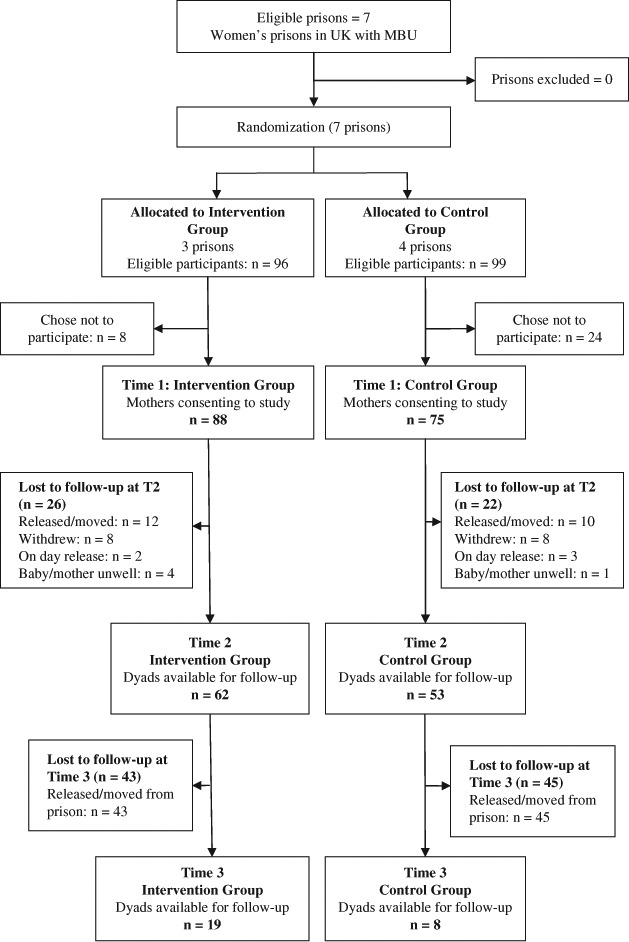
Mothers in prison represent a high-risk parenting population. New Beginnings is an attachment-based group intervention designed specifically for mothers and babies in prison. This cluster randomized trial examined the outcomes for 88 mothers and babies participating in the New Beginnings program and 75 dyads residing in prisons where the intervention did not take place. Outcomes were measured in terms of parental reflective functioning, the quality of parent-infant interaction, maternal depression, and maternal representations. Mothers in the control group deteriorated in their level of reflective functioning and behavioral interaction with their babies over time, whereas the mothers in the intervention group did not. There were no significant group effects on levels of maternal depression or mothers' self-reported representations of their babies over time. An attachment-based intervention may mitigate some of the risks to the quality of the parent-infant relationship for these dyads.
Overview
The claims and statistics of this paper haven’t been checked yet.
Run the check — free, no account needed. It reads the open-access text and checks the sources it cites.
Integrity signals
Registry
Cites
Statistics
Figures
Verification
Claims the paper makes
The claims and statistics of this paper haven’t been checked yet.
Run the check — free, no account needed. It reads the open-access text and checks the sources it cites.
Claims other papers make about this one
Each is checked against this paper’s own text: does it say what the citing paper says it does?
In the citing paper
“A following study (Sleed et al., 2013) used a cluster randomized controlled trial to test the efficacy of the New Beginnings; a group of mothers in prisons where group-intervention was provided was compared to a group of mothers residing in prisons where New Beginnings was not available.”
From Mentalizing makes parenting work: a review about parental reflective functioning and clinical interventions to improve it (2017) · cites this paper as Sleed et al., 2013
In the citing paper
“Results revealed that only mothers who took part in the group interventions showed a statistically significant improvement in reflective functioning, whereas mothers who did not receive the New Beginnings intervention showed a significant decrease in mentalizing both themselves as parents and their child.”
From Mentalizing makes parenting work: a review about parental reflective functioning and clinical interventions to improve it (2017) · cites this paper as Sleed et al., 2013
In the citing paper
“Mothers in the New Beginnings Program also showed some improvements in their interaction with the child, but the degree of change in reflective functioning did not significantly correlate with the degree of change in the mother-child interaction.”
From Mentalizing makes parenting work: a review about parental reflective functioning and clinical interventions to improve it (2017) · cites this paper as Sleed et al., 2013
Self-check
Percentages, sums and reported differences re-computed from the paper’s own numbers.
The self-check needs the paper’s full text.
Citations
Cites
Baron, R. M., & Kenny, D. A. (1986) · Journal of Personality and Social Psychology · doi:10.1037/0022-3514.51.6.1173 · Cited by 91,532
The CES-D Scale: A Self-Report Depression Scale for Research in the General Population
Radloff, L. S. (1977) · Applied Psychological Measurement · doi:10.1177/014662167700100306 · Cited by 53,267
Consort 2010 statement: extension to cluster randomised trials
Campbell, M. K., Piaggio, G., Elbourne, D. R., Altman, D. G., & for the CONSORT Group (2012) · BMJ · doi:10.1136/bmj.e5661 · Cited by 3,510
CONSORT statement: extension to cluster randomised trials
Campbell, M. K., Elbourne, D. R., & Altman, D. G. (2004) · BMJ · doi:10.1136/bmj.328.7441.702 · Cited by 2,557
Sensitivity and attachment: A meta-analysis on parental antecedents of infant attachment
De Wolff, M. S., & van Ijzendoorn, M. H. (1997) · Child Development · doi:10.1111/j.1467-8624.1997.tb04218.x · Cited by 2,526
Assessing depressive symptoms in five psychiatric populations: a validation study.
Weissman, M., Sholomskas, D., Pottenger, M., Prusoff, B., & Locke, B. Z. (1977) · American Journal of Epidemiology · doi:10.1093/oxfordjournals.aje.a112455 · Cited by 2,232
Maternal reflective functioning, attachment and the transmission gap: a preliminary study.
Slade, A., Grienenberger, J., Bernbach, E., Levy, D., & Locker, A. (2005) · Attachment & Human Development · doi:10.1080/14616730500245880 · Cited by 785
van den Boom, D. C. (1994) · Child Development · doi:10.1111/j.1467-8624.1994.tb00829.x · Cited by 613
Kelly, K., Slade, A., & Grienenberger, J. F. (2005) · Attachment & Human Development · doi:10.1080/14616730500245963 · Cited by 553
Sharp, C., & Fonagy, P. (2008) · Social Development · doi:10.1111/j.1467-9507.2007.00457.x · Cited by 480
Self-citation
Research works printed but not linked: 15
- Baradon T., 2006, New beginnings for mothers and babies in prison
- Danis I., 2005, Alkalmazott Pszichológia [Applied Psychology), 7, 27
- Feldman R., 1998, Coding Interactive Behaviour manual. Unpublished manuscript. Israel, Bar-llan University
- George C., 2008, Handbook of attachment: Theory, research, and clinical application
- HM Prison Service, 2008, Prison Service Order 4801: The management of mother and baby units
- Lyons-Ruth K., 1992, Rochester symposium on developmental psychopathology, 4, pp. 131
- Lyons-Ruth K., 2003, Journal of Infant, Child, and Adolescent Psychotherapy, 2, 105
- Milford R., 2009, Community Practitioner, 82, 30
- Ministry of Justice, 2010, Offender management caseload statistics 2009
- Murray J., 2008, Crime and justice: A review of research, 37, pp. 133
- Oates J., Mothers’ models of their infants
- Prison Reform Trust, 2012, Bromley Briefings Prison Factfile, June 2012
- Slade A., 2004, The parent development interview – Revised. Unpublished protocol. The City University of New York
- Sleed M., 2011, Mothers and babies in prison: Evaluation of the New Beginnings programme
- Walmsley R., 2012, World female imprisonment list
Cited by
Sorted by citations
Camoirano, A. (2017) · Frontiers in Psychology · doi:10.3389/fpsyg.2017.00014 · Cited by 356
Parental Reflective Functioning: Theory, Research, and Clinical Applications
Luyten, P., Nijssens, L., Fonagy, P., & Mayes, L. C. (2017) · The Psychoanalytic Study of the Child · doi:10.1080/00797308.2016.1277901 · Cited by 283
Slade, A., Holland, M. L., Ordway, M. R., Carlson, E. A., Jeon, S., Close, N., Mayes, L. C., & Sadler, L. S. (2020) · Development and Psychopathology · doi:10.1017/s0954579418001463 · Cited by 170
“Yet, the finding that the New Beginnings program, also mentalization based (Sleed et al., 2013), similarly had no significant effects on maternal depression, suggested that improving mentalization and attachment may not necessarily mitigate depression.”
BackgroundYoon, I. A., Slade, K., & Fazel, S. (2017) · Journal of Consulting and Clinical Psychology · doi:10.1037/ccp0000214 · Cited by 167
“…and ‘lock-downs’ (Messina et al., 2010), high attrition rates (Bradley & Follingstad, 2003; Gussak, 2009; Lanza et al., 2014; Loper & Tuerk, 2011; Sleed et al., 2013; Zlotnick, 2002) partly attributable to scheduling changes (Cole et al., 2007; Loper & Tuerk, 2011) and inmate infractions that…”
InfluentialFonagy, P., Sleed, M., & Baradon, T. (2016) · Infant Mental Health Journal · doi:10.1002/imhj.21553 · Cited by 124
“Thus, the RF measure may be insensitive to treatment change in samples of distressed mothers seeking emotional support, in contrast to high-risk samples of mothers who idealize their baby and the mother–infant relationship and tend to have very concrete representations (Sleed et al., 2013).”
Self-citationKouyoumdjian, F. G., McIsaac, K. E., Liauw, J., Green, S., Karachiwalla, F., Siu, W., Burkholder, K., Binswanger, I. A., Kiefer, L., Kinner, S. A., et al. (2015) · American Journal of Public Health · doi:10.2105/ajph.2014.302498 · Cited by 130
“An attachment-based group intervention with mother and baby dyads did not affect maternal depression.(64) Pharmacological interventions during imprisonment.”
BackgroundAssociations between Emotion Regulation and Parental Reflective Functioning
Schultheis, A., Mayes, L. C., & Rutherford, H. J. V. (2019) · Journal of Child and Family Studies · doi:10.1007/s10826-018-01326-z · Cited by 124
Parent-infant psychotherapy for improving parental and infant mental health
Barlow, J., Bennett, C., Midgley, N., Larkin, S. K., & Wei, Y. (2015) · Cochrane Database of Systematic Reviews · doi:10.1002/14651858.cd010534.pub2 · Cited by 126
Huber, A., McMahon, C. A., & Sweller, N. (2015) · Infant Mental Health Journal · doi:10.1002/imhj.21540 · Cited by 88
“Although two shorter interventions have had some positive effects on parents’ RF (Sleed et al., 2013, Suchman et al., 2010), treatment dosage also may be important (Suchman et al., 2010).”
BackgroundStuhrmann, L. Y., Göbel, A., Bindt, C., & Mudra, S. (2022) · Frontiers in Psychology · doi:10.3389/fpsyg.2022.765312 · Cited by 104
Anis, L., Perez, G., Benzies, K., Ewashen, C., Hart, M. J., & Letourneau, N. L. (2020) · Frontiers in Psychology · doi:10.3389/fpsyg.2020.574719 · Cited by 87
“Furthermore, parental RF focused intervention demonstrated improvement in maternal RF in a sample of incarcerated women with custody retention issues (Baradon et al., 2008; Sleed et al., 2013).”
BackgroundNijssens, L., Bleys, D., Casalin, S., Vliegen, N., & Luyten, P. (2018) · Journal of Child and Family Studies · doi:10.1007/s10826-018-1029-0 · Cited by 87
Mentalization-based treatments with children and families: A systematic review of the literature
Byrne, G., Murphy, S., & Connon, G. (2020) · Clinical Child Psychology and Psychiatry · doi:10.1177/1359104520920689 · Cited by 82
“Sleed et al. (2013) noted that parents in the intervention group demonstrated significantly higher RF at follow-up compared to those in the control group.”
Armstrong, E., Eggins, E., Reid, N., Harnett, P. H., & Dawe, S. (2017) · Journal of Experimental Criminology · doi:10.1007/s11292-017-9290-6 · Cited by 80
“…parents’ attitudes towards, or perceptions of, parenting practices (Cox 2009; Eddy et al. 2013; Harris and Landreth 1997; Harrison 1997; Henderson 1990; Landreth and Lobaugh 1998; Moore and Clement 1998; Robbers 2005; Sandifer 2003; Scudder et al. 2014; Shortt et al. 2014; Sleed et al. 2013).”
InfluentialSleed, M., Slade, A., & Fonagy, P. (2018) · Attachment & Human Development · doi:10.1080/14616734.2018.1555603 · Cited by 77
“The prevalence of mental health problems, histories of violence and abuse, substance misuse, and broken attachment relationships for mothers in mother-baby units in prisons are high (Baradon, Fonagy, Bland, Lénárd, & Sleed, 2008; Birmingham, Coulson, Mullee, Kamal, & Gregoire, 2006; Black, Payne, Lansdown, & Gregoire,…”
BackgroundInfluentialBarlow, J., Sleed, M., & Midgley, N. (2020) · Infant Mental Health Journal · doi:10.1002/imhj.21896 · Cited by 80
“Three studies used the Coding Interactive Behaviour (CIB) coding (Feldman, 1998) (Fonagy et al., 2016; Sleed et al., 2013; Suchman et al., 2017); one study used the Nursing Child Assessment Teaching Scale (NCAST; Bernard & Eyers, 1979; (Suchman et al., 2010); and two studies used the Atypical…”
BackgroundMethodInfluentialThe Effectiveness of Parenting Programs for Incarcerated Mothers: A Systematic Review
Tremblay, M. D., & Sutherland, J. E. (2017) · Journal of Child and Family Studies · doi:10.1007/s10826-017-0900-8 · Cited by 68
Steele, H., Murphy, A., Bonuck, K., Meissner, P., & Steele, M. (2019) · Development and Psychopathology · doi:10.1017/s0954579418001621 · Cited by 65
Adkins, T., Reisz, S., Hasdemir, D., & Fonagy, P. (2022) · Development and Psychopathology · doi:10.1017/s095457942000214x · Cited by 60
Self-citationZimmer‐Gembeck, M. J., Kerin, J., Webb, H. J., Gardner, A. A., Campbell, S. M., Swan, K., & Timmer, S. G. (2018) · Behavior Therapy · doi:10.1016/j.beth.2018.07.002 · Cited by 59
Lo, C. K. M., & Wong, S. Y. (2020) · Attachment & Human Development · doi:10.1080/14616734.2020.1844247 · Cited by 58
“Three studies investigated New Beginnings parenting programs (Baradon, 2010) for homeless mothers (Bain, 2014) and mothers in prison (Baradon et al., 2008; Sleed et al., 2013).”
BackgroundHeron-Delaney, M., Kenardy, J. A., Brown, E. A., Jardine, C., Bogossian, F., Neuman, L., de Dassel, T., & Pritchard, M. (2016) · Journal of Pediatric Psychology · doi:10.1093/jpepsy/jsv169 · Cited by 52
“Results demonstrate that RF capacity post-intervention increased for the intervention group, relative to the controls, who typically declined in RF capacity over time (Sleed et al., 2013).”
Menashe‐Grinberg, A., Shneor, S., Meiri, G., & Atzaba‐Poria, N. (2021) · Attachment & Human Development · doi:10.1080/14616734.2021.1919159 · Cited by 46
“The following approaches are well-known PRF-based approaches: ShortTerm Mentalization and Relational Therapy (SMART; [Fearon et al., 2006]); Minding the Baby (Sadler et al., 2013); Mindful Parenting (Reynolds, 2003); The New Beginning Program (Sleed et al., 2013); Mentalization-Based Therapeutic Interventions for Fami…”
BackgroundMethodHuang, R., Yang, D., Lei, B., Yan, C., Tian, Y., Huang, X., & Lei, J. (2019) · Journal of Affective Disorders · doi:10.1016/j.jad.2019.09.056 · Cited by 46
Roo, M. D., Wong, G., Rempel, G. R., & Fraser, S. N. (2019) · JMIR Pediatrics and Parenting · doi:10.2196/11561 · Cited by 43
“The application of PRF measures has expanded to different contexts such as drug use disorders [25], mothers with childhood maltreatment [26,27], infant distress [28], and parenting programs [12,29-33].”
BackgroundShaw, J., Downe, S. M., & Kingdon, C. (2015) · Journal of Advanced Nursing · doi:10.1111/jan.12605 · Cited by 37
Parental reflective functioning: analysis and promotion of the concept for paediatric nursing
Ordway, M. R., Sadler, L. S., Dixon, J. K., & Slade, A. (2014) · Journal of Clinical Nursing · doi:10.1111/jocn.12600 · Cited by 39
“parental RF decreased over time among the control group mothers and not among the intervention mothers (Sleed et al. 2013).”
The Realities of Pregnancy and Mothering While Incarcerated.
Friedman, S. H., Kaempf, A., & Kauffman, S. (2020) · PubMed · doi:10.29158/jaapl.003924-20 · Cited by 35
“Compared with women from similar social backgrounds who are not incarcerated, women in prison experience forced sobriety, regular nutrition, regular prenatal care, a lack of partner violence, and no homelessness.(28,41) A recent examination of pregnancy outcomes of 1,396 women incarcerated in U.”
BackgroundBarlow, J., Bennett, C., Midgley, N., Larkin, S. K., & Wei, Y. (2016) · Journal of Reproductive and Infant Psychology · doi:10.1080/02646838.2016.1222357 · Cited by 37
“…studies contributed data to the PIP versus alternative treatment analyses (Cicchetti et al., 2006; Cohen et al., 1999; robert-Tissot et al., 1996; Sleed et al., 2013) producing 15 meta-analyses measuring parent mental health (depression); parent–infant interaction (maternal sensitivity); infant…”
Disseminating a Parenting Intervention in the Community: Experiences from a Multi-Site Evaluation
Maupin, A. N., Samuel, E. E., Nappi, S. M., Heath, J. M., & Smith, M. V. (2017) · Journal of Child and Family Studies · doi:10.1007/s10826-017-0804-7 · Cited by 35
Stacks, A. M., Jester, J. M., Wong, K., Huth‐Bocks, A. C., Brophy‐Herb, H. E., Lawler, J. M., Riggs, J. L., Ribaudo, J., Muzik, M., & Rosenblum, K. L. (2021) · Attachment & Human Development · doi:10.1080/14616734.2020.1865606 · Cited by 27
Volkert, J., Georg, A. K., Hauschild, S., Herpertz, S. C., Neukel, C., Byrne, G., & Taubner, S. (2019) · Praxis der Kinderpsychologie und Kinderpsychiatrie · doi:10.13109/prkk.2019.68.1.27 · Cited by 26
Perinatal interventions for mothers and fathers who are survivors of childhood sexual abuse
Stephenson, L., Beck, K., Busuulwa, P., Rosan, C., Pariante, C. M., Pawlby, S. J., & Sethna, V. (2018) · Child Abuse & Neglect · doi:10.1016/j.chiabu.2018.03.018 · Cited by 29
“The 9 interventions that were excluded from further evaluation were : Mother and Toddlers’ Programme (Suchman, et al., 2010; Suchman, Decoste, McMahon, Rounsaville, & Mayes, 2011), New Beginnings (Sleed, Baradon, & Fonagy, 2013), Nurse Family Partnership (Olds, 2002), Early Start (Fergusson, Grant, Horwood, & Ridder,…”
Lavender, S. R., Waters, C. S., & Hobson, C. W. (2022) · Clinical Child Psychology and Psychiatry · doi:10.1177/13591045221113392 · Cited by 30
“In contrast, other studies of the New Beginnings intervention reported significant improvements in PRF following the interventions (Baradon et al., 2008; Sleed et al., 2013).”
InfluentialSleed, M., Li, E. T., Vainieri, I., & Midgley, N. (2023) · Journal of Infant Child and Adolescent Psychotherapy · doi:10.1080/15289168.2023.2223739 · Cited by 30
“For example, parenting groups which are facilitated by experienced parent-infant psychotherapists have been developed for parents living in homeless hostels (Bain, 2014; Sleed et al., 2013a) and in mother-baby units in prisons (Sleed et al., 2013b).”
BackgroundHuynh, T., Kerr, M. L., Kim, C. N., Fourianalistyawati, E., Chang, V. Y., & Duncan, L. G. (2024) · Mindfulness · doi:10.1007/s12671-024-02379-6 · Cited by 38
Mattheß, J., Eckert, M., Richter, K., Koch, G., Reinhold, T., Vienhues, P., Berghöfer, A., Roll, S., Keil, T. O. P., Schlensog‐Schuster, F., et al. (2020) · Trials · doi:10.1186/s13063-020-04443-7 · Cited by 22
“PIP in inpatient psychiatric departments has not been in the focus of controlled trials so far, and the present study differs to previous ones in that no particular risk samples are examined (like social adverse samples [1] or imprisoned mothers [25]) but diagnosed mothers with mental disorders in the postpartum perio…”
InfluentialPaynter, M. J., Jefferies, K., McKibbon, S., Martin‐Misener, R., Iftene, A., & Murphy, G. T. (2020) · Nursing leadership · doi:10.12927/cjnl.2020.26189 · Cited by 21
Anis, L., Letourneau, N. L., Benzies, K., Ewashen, C., & Hart, M. J. (2020) · Canadian Journal of Nursing Research · doi:10.1177/0844562119899004 · Cited by 20
“Sleed, Baradon, and Fonagy (2013) also reported some improvements in parenting quality following New Beginnings intervention.”
BackgroundStacks, A. M., Barron, C. C., & Wong, K. (2019) · Infant Mental Health Journal · doi:10.1002/imhj.21785 · Cited by 20
Gervinskaitė-Paulaitienė, L., Ruggiero, M., Taubner, S., Volkert, J., & Barkauskienė, R. (2023) · Clinical Child Psychology and Psychiatry · doi:10.1177/13591045231220965 · Cited by 20
“The few follow-up studies of MBT parenting interventions appear to show that improvements in mentalization are maintained (Salo et al., 2019; Sleed et al., 2013).”
BackgroundMothering at a Distance: what incarcerated mothers value about a parenting programme
Rossiter, C., Power, T., Fowler, C., Jackson, D. W., Hyslop, D., & Dawson, A. J. (2015) · Contemporary Nurse · doi:10.1080/10376178.2015.1105108 · Cited by 18
Parenting Programs for Incarcerated Fathers and Mothers: Current Research and New Directions
Loper, A. B., Clarke, C. N., & Dallaire, D. H. (2019) · Springer eBooks · doi:10.1007/978-3-030-16707-3_13 · Cited by 17
Zayde, A., Derella, O. J., & Kilbride, A. (2023) · Infant Mental Health Journal · doi:10.1002/imhj.22042 · Cited by 21
MacBeth, A. M., Christie, H., Golds, L., Morales, F., Raouna, A., Sawrikar, V., & Gillespie‐Smith, K. (2023) · Psychology and Psychotherapy Theory Research and Practice · doi:10.1111/papt.12483 · Cited by 20
Early Relational Health: Infants’ Experiences Living with Their Incarcerated Mothers
Condon, M. (2016) · Smith College Studies in Social Work · doi:10.1080/00377317.2017.1246218 · Cited by 17
Developing art therapy practice within perinatal parent-infant mental health
Bruce, D., & Hackett, S. (2020) · International Journal of Art Therapy · doi:10.1080/17454832.2020.1801784 · Cited by 17
Neukel, C., Bermpohl, F., Kaess, M., Taubner, S., Boedeker, K., Williams, K., Dempfle, A., Herpertz, S. C., Herpertz, S. C., Neukel, C., et al. (2021) · Trials · doi:10.1186/s13063-021-05653-3 · Cited by 20
“Via own literature search, we found eleven different prevention programs that aim to enhance mentalizing in mothers with MI [16–21], in prison [22] or at other risk, such as teenage mothers [23], as well as in families [24, 25] and in caregivers of inpatient psychiatric children [26].”
BackgroundCooke, S. A., Cooke, D., & Hauck, Y. L. (2023) · Infant Mental Health Journal · doi:10.1002/imhj.22080 · Cited by 19
Sprengeler, M. K., Mattheß, J., Eckert, M., Richter, K., Koch, G., Reinhold, T., Vienhues, P., Berghöfer, A., Fricke, J., Roll, S., et al. (2021) · BMC Psychiatry · doi:10.1186/s12888-021-03112-6 · Cited by 15
Suchman, N., Berg, A., Abrahams, L., Abrahams, T., Adams, A., Cowley, B., Decoste, C., Hawa, W., Lachman, A., Mpinda, B., et al. (2020) · Development and Psychopathology · doi:10.1017/s0954579418001451 · Cited by 16
Sleed, M., Isosävi, S., & Fonagy, P. (2021) · Infant Mental Health Journal · doi:10.1002/imhj.21932 · Cited by 17
“Indeed, other studies with incarcerated mothers and their children have reported similar biases in mother-report questionnaires (Goshin, 2010; Sleed et al., 2013).”
Thomson, G., Mortimer, R., Baybutt, M., & Whittaker, K. A. (2022) · International Journal of Prisoner Health · doi:10.1108/ijph-09-2021-0099 · Cited by 13
Anis, L., Ross, K. M., Ntanda, H. N., Hart, M. J., & Letourneau, N. L. (2022) · International Journal of Environmental Research and Public Health · doi:10.3390/ijerph19148425 · Cited by 13
“Breastfeeding in public” for incarcerated women: the baby-friendly steps
Paynter, M. J., & Snelgrove‐Clarke, E. (2019) · International Breastfeeding Journal · doi:10.1186/s13006-019-0211-3 · Cited by 13
Eckert, M., Richter, K., Mattheß, J., Koch, G., Reinhold, T., Vienhues, P., Berghöfer, A., Roll, S., Keil, T. O. P., Schlensog‐Schuster, F., et al. (2020) · Bundesgesundheitsblatt - Gesundheitsforschung - Gesundheitsschutz · doi:10.1007/s00103-020-03242-4 · Cited by 12
Alismail, F., Stacks, A. M., Wong, K., Brown, S., Beeghly, M., & Thomason, M. E. (2021) · Infant Mental Health Journal · doi:10.1002/imhj.21951 · Cited by 12
Parent-infant Psychotherapy for Improving Parental and Infant Mental Health: A Systematic Review
Barlow, J., Bennett, C., Midgley, N., Larkin, S. K., & Wei, Y. (2015) · Campbell Systematic Reviews · doi:10.4073/csr.2015.6 · Cited by 12
Menashe‐Grinberg, A., & Atzaba‐Poria, N. (2022) · Development and Psychopathology · doi:10.1017/s0954579422000566 · Cited by 14
Letourneau, N. L., Anis, L., Novick, J., Pohl, C., Ntanda, H. N., & Hart, M. J. (2023) · International Journal of Environmental Research and Public Health · doi:10.3390/ijerph20043078 · Cited by 13
Wittkowski, A., Crompton, C., & Wan, M. W. (2024) · Clinical Child and Family Psychology Review · doi:10.1007/s10567-024-00497-0 · Cited by 18
“Caregiver perceptions of the relationship with the infant were evaluated in one study ( New Beginnings : Sleed et al., 2013), using the stand-ardised Mothers Object Relations Scale (Milford & Oates, 2009).”
InfluentialMulay, A. L., Kelly, E., & Cain, N. M. (2017) · Psychodynamic Psychiatry · doi:10.1521/pdps.2017.45.2.143 · Cited by 13
From Interactive Regulation in Infancy to Relationship-Focused Interventions
Reck, C., Hagl, M., Ohlrich, R., & Zietlow, A. (2022) · Psychopathology · doi:10.1159/000525679 · Cited by 10
Stover, C. S., Farren, A. R., Campbell, R. J., Day, M. J., & Sernyak, Z. (2023) · Infant Mental Health Journal · doi:10.1002/imhj.22044 · Cited by 10
Claire, P., Ciclitira, K., & Marzano, L. (2017) · Journal of Forensic Psychiatry and Psychology · doi:10.1080/14789949.2017.1324580 · Cited by 9
“…(plus one book). of the process in MBUs is pointed out: For example, some mothers on the MBU’s will be separated from their infants later on and, without adequate preparation, may become gradually less engaged with their baby as the time of separation draws nearer (Sleed et al., 2013:13).”
BackgroundMentalization-based Families First Group Intervention for First-Time Parents: Parents’ Perspective
Sourander, J., Laakso, M., & Kalland, M. (2021) · Journal of Infant Child and Adolescent Psychotherapy · doi:10.1080/15289168.2021.1872148 · Cited by 25
“…for example, for adoptive and foster parents (Adkins et al., 2018; Bammens, Adkins & Badger, 2015), mothers in prison with their babies (Sleed et al., 2013), parents of infants, toddlers, and preschoolers (Goyette-Ewing et al., 2002; Slade, 2005), first-time mothers and fathers…”
BackgroundMattheß, J., Eckert, M., Becker, O., Ludwig‐Körner, C., & Kuchinke, L. (2021) · Pilot and Feasibility Studies · doi:10.1186/s40814-021-00946-5 · Cited by 9
“At first, living in the mother child homes with 24/7 care may improve maternal confidence and reduce feelings of isolation [27].”
BackgroundKerr, M. L., Charles, P., Massoglia, M., Jensen, S., Wirth, J., Fanning, K. A., Holden, K., & Poehlmann, J. (2022) · Children of incarcerated parents · doi:10.1007/978-3-030-84713-5_7 · Cited by 9
Borelli, J. L., Kazmierski, K. F. M., Gaskin, G. E., Kerr, M. L., Smiley, P. A., & Rasmussen, H. F. (2023) · Infant Mental Health Journal · doi:10.1002/imhj.22038 · Cited by 12
Blanchard, A., Bebin, L., Leroux, S., Roussey, M., Horel, M.-A., Desforges, M., Page, I., Bidet, Y., & Balençon, M. (2017) · Archives de Pédiatrie · doi:10.1016/j.arcped.2017.11.016 · Cited by 7
Staying together: mothers and babies in prison
Mulligan, C. (2019) · British Journal of Midwifery · doi:10.12968/bjom.2019.27.7.436 · Cited by 7
Reflective Functioning of Refugee Mothers with Children Born of Conflict-Related Sexual Violence
Anderson, K., & van Ee, E. (2020) · International Journal of Environmental Research and Public Health · doi:10.3390/ijerph17082873 · Cited by 7
“These findings could also be related to a reversal of roles that has been observed in other vulnerable mother–child dyads [30], where it is the child who increasingly provides the mother with emotional support.”
BackgroundMother-Infant Group Intervention on Maternal Depression and Bonding: A Quasi-Experimental Study
Shieh, P.-L., Cheng, L.-Y., Hsu, W.-S., & Li, R.-H. (2023) · Maternal and Child Health Journal · doi:10.1007/s10995-023-03654-z · Cited by 7
An occupational perspective on infants behind bars
van Schalkwyk, M., Cronje, C., Thompson, K., Steyn, T., Griessel, I., Outram, M., Pretorius, C., & Faywers, S. (2019) · Journal of Occupational Science · doi:10.1080/14427591.2019.1617926 · Cited by 6
“Many authors researching the phenomenon of infants behind bars have argued that the formation of a secure attachment style serves as a protective factor and provides increased positive developmental outcomes in this population (Elmalak, 2015; Goshin et al., 2014; Mazoue, 2012; Sleed et al., 2013).”
BackgroundDoes the evidence support parent-infant psychotherapy?
Lumsden, V. (2017) · BJPsych Advances · doi:10.1192/apt.bp.117.017244 · Cited by 6
Infants and Young Children with Incarcerated Parents
Burnson, C., & Weymouth, L. (2019) · Springer eBooks · doi:10.1007/978-3-030-16707-3_7 · Cited by 6
Lavallée, A., Pang, L., Warmingham, J. M., Atwood, G. D., Ahmed, I., Lanoff, M. R., Finkel, M. A., Xu, R., Arduin, E., Hamer, K. K., et al. (2022) · medRxiv · doi:10.1101/2022.10.29.22281681 · Cited by 7
Taylor, J. A. T., Majeed, T., Rémond, M., Bagade, T., Edwards, L. M., & Sullivan, E. (2024) · EClinicalMedicine · doi:10.1016/j.eclinm.2024.102496 · Cited by 5
“27,28,30,58 Of the eight publications that described evaluations of M&Cs 27,28,30,36,42,45,54,65 only one study was from a non-OECD country.”
BackgroundInfluentialİşcanoğlu, Z., & Uçanok, Z. (2021) · Attachment & Human Development · doi:10.1080/14616734.2021.1976446 · Cited by 5
“Furthermore, Sleed et al. (2013) did not evaluate children’s attachment in their study.”
BackgroundAllman, M. E., Kulesz, P. A., Marais, L., & Sharp, C. (2023) · Journal of Infant Child and Adolescent Psychotherapy · doi:10.1080/15289168.2023.2275230 · Cited by 4
“These interventions have demonstrated positive treatment effects on attachment outcomes (Baradon et al., 2008; Sleed et al., 2013; Suchman et al., 2008; Suchman, DeCoste, Castiglioni, et al., 2010; Suchman et al., 2012), parental mentalizing operationalized as parental reflective function (Slade et…”
BackgroundA Review of Reentry Programs and Their Inclusion of Families
Eddy, J. M., Pak, H.-M., Reino, C., & Reino, A. (2022) · Children of incarcerated parents · doi:10.1007/978-3-030-84713-5_8 · Cited by 5
Леонидовна, М. Т., Kulakova, S. V., Евгеньевич, С. Ю., & Samoylova, A. A. (2018) · Russian Journal of Criminology · doi:10.17150/2500-4255.2018.12(4).525-530 · Cited by 4
Imprisoned Women and Children in Turkey: Human Rights Violations Under the State of Emergency
Gergerlioğlu, Ö. F. (2020) · Philosophy and politics · doi:10.1007/978-3-030-57476-5_18 · Cited by 4
The Assessment of Relational Risk in Early Parent-Infant Relationships
Sleed, M. (2014) · UCL Discovery (University College London) · Cited by 4
Linde-Krieger, L. B., & Williams, L. R. (2025) · Attachment & Human Development · doi:10.1080/14616734.2025.2480066 · Cited by 3
“Therapies to enhance PRF have also proven effective in samples of adult mothers and their infants (Bakermans-Kranenburg et al., 2003; Byrne et al., 2020; Camoirano, 2017; Sleed et al., 2013; Suchman et al., 2017), indicating that PRF is modifiable through intervention.”
Georg, A. K., Holl, J., Taubner, S., & Volkert, J. (2024) · BMJ Open · doi:10.1136/bmjopen-2023-078548 · Cited by 3
“17 There is a considerable evidence base for mentalisation-based treatments (MBT) working with adults, 18 and in the past 15 years, research evaluating MBT for parents and families has also increased (eg, 19 20 ).”
BackgroundIncarcerated Mothers and Their Children: Implications for Policy and Practice
Poehlmann, J., & Dallaire, D. H. (2021) · SpringerBriefs in psychology · doi:10.1007/978-3-030-67599-8_8 · Cited by 4
Une intervention pour promouvoir des relations optimales et la santé des parents et des enfants
Letourneau, N. L., Kurbatfinski, S., Ross, K. M., Anis, L., Cole, S., & Hart, M. J. (2024) · Devenir · doi:10.3917/dev.242.0114 · Cited by 4
Kerr, M. L., Charles, P., Pritzl, K., Jensen, S., Krishnan, C. A., Ylizaliturri, V., & Poehlmann, J. (2024) · Mindfulness · doi:10.1007/s12671-024-02415-5 · Cited by 3
“However, few previous studies implemented randomized controlled trials, and only one similar intervention (New Beginnings; Sleed et al., 2013) has been tested in carceral facilities, suggesting a need for further research (Lo & Wong, 2022).”
Prison Deprivation in the Infant and Early Childhood: Problem Statement
Muzychuk, T., Ponomarev, S. B., Бурт, А. А., & Спасенников, Б. (2019) · Baikal Research Journal · doi:10.17150/2411-6262.2019.10(1).10 · Cited by 3
Kuchinke, L., Mattheß, J., Eckert, M., Richter, K., Koch, G., Bindt, C., Schweitzer, J., Krauskopf, K., Rummel‐Kluge, C., Theil, M. K., et al. (2026) · Child and Adolescent Psychiatry and Mental Health · doi:10.1186/s13034-025-01013-0 · Cited by 2
“…with a comparable numbers of sessions also failed to find any group differences regarding attachment security [17, 43, 57], although there is some evidence of improved dyadic attunement [58] and more positive socio-emotional development [59] as indirect indicators of secure attachment development.”
dos Santos, D. S. S., de Camargo, C. L., & Bispo, T. C. F. (2021) · Brazilian Journal of Health Review · doi:10.34119/bjhrv4n2-028 · Cited by 2
Dabrowski, V., & Milne, E. (2022) · Criminology & Criminal Justice · doi:10.1177/17488958221117925 · Cited by 3
“…et al., 2008); how women’s health and wellbeing will impact the child (Codd, 2012; North, n.d.); breastfeeding outcomes (Abbott and Scott, 2017; Tremarco et al., 2020); or to evaluate programmes designed to ‘teach’ women how to be ‘better’ mothers (Baradon et al., 2008; Sleed et al., 2013).”
BackgroundPitfield, C., Binley, J., Soni, S., Pontvert, C., & Callender, M. (2023) · Journal of Forensic Psychiatry and Psychology · doi:10.1080/14789949.2023.2212657 · Cited by 2
Psychodynamic Approaches to Treating Violent Offenders in Psychiatric Wards and Clinics
Mea, E., Nappi, G., & Latorre, V. (2023) · Springer eBooks · doi:10.1007/978-3-031-31547-3_185 · Cited by 2
Taylor, J. A. T., Majeed, T., Rémond, M., Bagade, T., Edwards, L. M., Austin, K., Smith, E., Howard, M., & Sullivan, E. A. (2024) · BMJ Global Health · doi:10.1136/bmjgh-2023-012979 · Cited by 3
Complexities of midwifery care delivered to perinatal women in prison: A qualitative study
Cahalin, K., Clews, C., Pendleton, J., & Callender, M. (2024) · Midwifery · doi:10.1016/j.midw.2024.104099 · Cited by 2
Raouna, A., Girard, L., & MacBeth, A. M. (2024) · Journal of Affective Disorders · doi:10.1016/j.jad.2024.10.096 · Cited by 4
Pretorius, I., Batiste-Harel, D., & Martin, P. (2018) · Infant Observation · doi:10.1080/13698036.2018.1553684 · Cited by 2
Latysheva, L., Muzychuk, T., & Spasennikova, M. (2020) · Russian Journal of Criminology · doi:10.17150/2500-4255.2020.14(1).67-75 · Cited by 2
Metadata
- Authors
- Sleed, M., Baradon, T., & Fonagy, P.
- Affiliations
- Anna Freud Centre (GB)
- Corresponding author
- Sleed, Michelle
- Venue
- Attachment & Human Development
- Publisher
- Informa UK Limited
- Published
- 2013-04-04
- Volume
- 15
- Issue
- 4
- Pages
- 349-367
- ISSN
- 1461-6734 (ISSN-L)
- 1469-2988
- PMC
- PMC4066926
- OpenAlex
- W1975890655
- Cited by
- 132
- References
- 53
- Citations by year
- 2026: 3 · 2025: 5 · 2024: 16 · 2023: 14 · 2022: 13 · 2021: 16 · 2020: 14 · 2019: 15 · 2018: 11 · 2017: 10 · 2016: 4 · 2015: 7 · 2014: 3
- FWCI
- 7.48
- Type
- journal article
- Language
- en
- Open access
- hybrid
- doi.org
- Licence
- cc-by
- Locations
- Attachment & Human Development (publishedVersion, cc-by)
- Europe PMC (PubMed Central) (publishedVersion, cc-by)
- PubMed Central (publishedVersion, cc-by)
- PubMed (publishedVersion)
- UCL Discovery (University College London) (submittedVersion)
- Funders
- National Institute for Health and Care Research (NF-SI-0510-10228)
- Topics
- Social Sciences › Psychology › Social Psychology › Attachment and Relationship Dynamics
- Social Sciences › Sociology and Political Science › Criminal Justice and Corrections Analysis
- Social Sciences › Psychology › Clinical Psychology › Psychoanalysis and Psychopathology Research
- Keywords
- incarcerated mothers, parent-infant relationship, attachment-based intervention, parental reflective functioning, parent-infant interaction, maternal depression, maternal representations, group intervention
- MeSH terms
- Adolescent, Adult, Female, United Kingdom, Humans, Infant, Infant, Newborn, Mother-Child Relations, Mothers, Object Attachment, Prisoners, Cluster Analysis, Qualitative Research, Young Adult
About these checks
Registry, retraction, Cites and statistics results are computed, not judged, with one exception: a printed reference that no index lists is read once by a model before it counts as a citation error. Claims are extracted by a model and kept only when their quote appears verbatim in the text; each cited source is then checked, with a model’s help, for whether it says what the claim relies on. Those verdicts can be wrong — read the claim’s quote and the cited source before relying on one.
Statistics and arithmetic are recomputed, not judged.
Confidence bands are shown only for fields calibrated on our annotated test set. None is calibrated yet, so no band is shown.
What counts as a claim ›How we measure confidence ›How we check this ›
Are you an author, or do you see a problem with this page? Request a review
