

The DOI matches its Crossref record; 45 of the 45 references it cites were found in a registry or an index.
Placental mitochondrial methylation and exposure to airborne particulate matter in the early life environment: An ENVIR ON AGE birth cohort study
Open accessAbstract
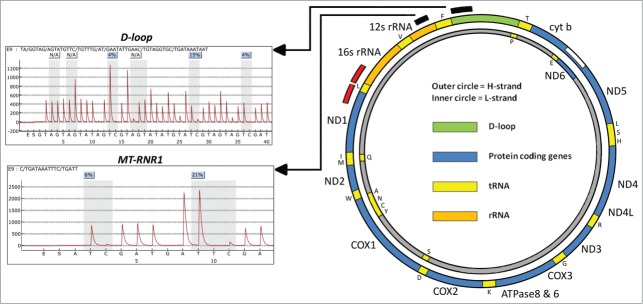
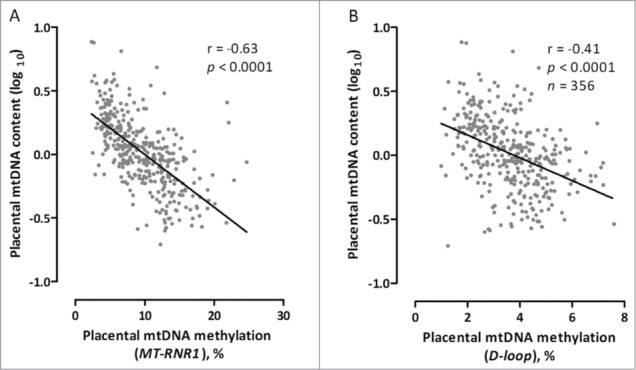
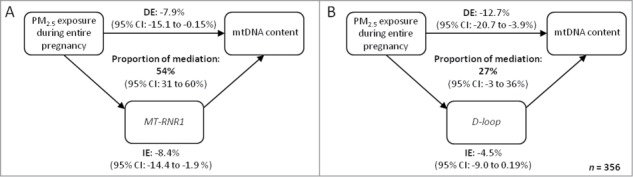
Most research to date has focused on epigenetic modifications in the nuclear genome, with little attention devoted to mitochondrial DNA (mtDNA). Placental mtDNA content has been shown to respond to environmental exposures that induce oxidative stress, including airborne particulate matter (PM). Damaged or non-functioning mitochondria are specifically degraded through mitophagy, exemplified by lower mtDNA content, and could be primed by epigenetic modifications in the mtDNA. We studied placental mtDNA methylation in the context of the early life exposome. We investigated placental tissue from 381 mother-newborn pairs that were enrolled in the ENVIRONAGE birth cohort. We determined mtDNA methylation by bisulfite-pyrosequencing in 2 regions, i.e., the D-loop control region and 12S rRNA (MT-RNR1), and measured mtDNA content by qPCR. PM2.5 exposure was calculated for each participant's home address using a dispersion model. An interquartile range (IQR) increment in PM2.5 exposure over the entire pregnancy was positively associated with mtDNA methylation (MT-RNR1: +0.91%, P = 0.01 and D-loop: +0.21%, P = 0.05) and inversely associated with mtDNA content (relative change of -15.60%, P = 0.001) in placental tissue. mtDNA methylation was estimated to mediate 54% [P = 0.01 (MT-RNR1)] and 27% [P = 0.06 (D-loop)] of the inverse association between PM2.5 exposure and mtDNA content. This study provides new insight into the mechanisms of altered mitochondrial function in the early life environment. Epigenetic modifications in the mitochondrial genome, especially in the MT-RNR1 region, substantially mediate the association between PM2.5 exposure during gestation and placental mtDNA content, which could reflect signs of mitophagy and mitochondrial death.
Overview
The claims and statistics of this paper haven’t been checked yet.
Run the check — free, no account needed. It reads the open-access text and checks the sources it cites.
Integrity signals
Registry
Cites
Statistics
Figures
Verification
Claims the paper makes
The claims and statistics of this paper haven’t been checked yet.
Run the check — free, no account needed. It reads the open-access text and checks the sources it cites.
Claims other papers make about this one
Each is checked against this paper’s own text: does it say what the citing paper says it does?
The source backs part of the claim, not all of it — or backs it for a different population, condition or comparison.
In the citing paper
“Furthermore, mtDNA methylation is disturbed by environmental and other factors, such as traffic-derived elemental carbon105, maternal smoking106, endogenous metabolites107, cell senescence108 and ageing109.”
From Mitochondrial and metabolic dysfunction in ageing and age-related diseases (2022) · cites this paper as [105]
Experimental — accuracy not yet measuredThe source backs part of the claim, not all of it — or backs it for a different population, condition or comparison.
In the citing paper
“Janssen et al. [192] reported in utero exposure to PM2.5 led to lower mtDNA content (as described in the section on oxidative stress), as well as modified the methylation level in the MT-RNR1 region.”
From Air pollution and children’s health—a review of adverse effects associated with prenatal exposure from fine to ultrafine particulate matter (2021) · cites this paper as [192]
Experimental — accuracy not yet measuredThe cited source says what the claim attributes to it.
In the citing paper
“Last, epigenetic modifications in placental mtDNA have been correlated with PM2.5 exposure.”
From Air pollution and children’s health—a review of adverse effects associated with prenatal exposure from fine to ultrafine particulate matter (2021) · cites this paper as [192]
Self-check
Percentages, sums and reported differences re-computed from the paper’s own numbers.
The self-check needs the paper’s full text.
Citations
Cites
Hellemans, J., Mortier, G., De Paepe, A., Speleman, F., & Vandesompele, J. (2007) · Genome Biology · doi:10.1186/gb-2007-8-2-r19 · Cited by 4,023
Valeri, L., & VanderWeele, T. J. (2013) · Psychological Methods · doi:10.1037/a0031034 · Cited by 2,132
Telomere dysfunction induces metabolic and mitochondrial compromise
Sahin, E., Colla, S., Liesa, M., Moslehi, J., Müller, F. L., Guo, M., Cooper, M., Kotton, D., Fabian, A. J., Walkey, C., et al. (2011) · Nature · doi:10.1038/nature09787 · Cited by 1,319
Placental-specific IGF-II is a major modulator of placental and fetal growth
Constância, M., Hemberger, M., Hughes, J., Dean, W., Ferguson-Smith, A., Fundele, R., Stewart, F., Kelsey, G., Fowden, A., Sibley, C., et al. (2002) · Nature · doi:10.1038/nature00819 · Cited by 1,054
Mitophagy: mechanisms, pathophysiological roles, and analysis
Ding, W.-X., & Yin, X.-M. (2012) · bchm · doi:10.1515/hsz-2012-0119 · Cited by 1,032
Autophagy and lysosomal dysfunction as emerging mechanisms of nanomaterial toxicity
Stern, S. T., Adiseshaiah, P. P., & Crist, R. M. (2012) · Particle and Fibre Toxicology · doi:10.1186/1743-8977-9-20 · Cited by 865
Ambient Air Pollution and Pregnancy Outcomes: A Review of the Literature
Šrám, R. J., Binková, B., Dejmek, J., & Bobák, M. (2005) · Environmental Health Perspectives · doi:10.1289/ehp.6362 · Cited by 685
Mitochondrial DNA mutations in disease and aging
Wallace, D. C. (2010) · Environmental and Molecular Mutagenesis · doi:10.1002/em.20586 · Cited by 622
Mitochondria as a Target of Environmental Toxicants
Meyer, J. N., Leung, M. C. K., Rooney, J. P., Sendoel, A., Hengartner, M. O., Kisby, G. E., & Bess, A. S. (2013) · Toxicological Sciences · doi:10.1093/toxsci/kft102 · Cited by 587
Shock, L. S., Thakkar, P. V., Peterson, E. J., Moran, R. G., & Taylor, S. M. (2011) · Proceedings of the National Academy of Sciences · doi:10.1073/pnas.1012311108 · Cited by 555
Research works printed but not linked: 2
- Chistiakov DA, 2014, BioMed Res Int, 2014, Article ID 2384
- Feng S, 2012, Mol Med Rep, 6, 125
Cited by
Sorted by citations
Mitochondrial and metabolic dysfunction in ageing and age-related diseases
Amorim, J. A., Coppotelli, G., Rolo, A. P., Palmeira, C. M., Ross, J. M., & Sinclair, D. A. (2022) · Nature Reviews Endocrinology · doi:10.1038/s41574-021-00626-7 · Cited by 990
Environmental Influences on the Epigenome: Exposure- Associated DNA Methylation in Human Populations
Martin, E. M., & Fry, R. C. (2018) · Annual Review of Public Health · doi:10.1146/annurev-publhealth-040617-014629 · Cited by 658
Li, X., Huang, S., Jiao, A., Yang, X., Yun, J., Wang, Y., Xue, X., Chu, Y., Liu, F., Liu, Y., et al. (2017) · Environmental Pollution · doi:10.1016/j.envpol.2017.03.055 · Cited by 409
Johnson, N. M., Hoffmann, A. R., Behlen, J. C., Lau, C., Pendleton, D., Harvey, N., Shore, R., Li, Y., Chen, J., Tian, Y., et al. (2021) · Environmental Health and Preventive Medicine · doi:10.1186/s12199-021-00995-5 · Cited by 339
“[192] reported in utero exposure to PM2.”
Klepac, P., Locatelli, I., Korošec, S., Künzli, N., & Kukec, A. (2018) · Environmental Research · doi:10.1016/j.envres.2018.07.008 · Cited by 358
Metadata
- Authors
- Janssen, B. G., Byun, H.-M., Gyselaers, W., Lefebvre, W., Baccarelli, A. A., & Nawrot, T. S.
- Affiliations
- Hasselt University (BE)
- Harvard University (US)
- Ziekenhuis Oost-Limburg (BE)
- Flemish Institute for Technological Research (BE)
- Corresponding author
- Nawrot, Tim S
- ORCID
- Venue
- Epigenetics
- Publisher
- Informa UK Limited
- Published
- 2015-05-21
- Volume
- 10
- Issue
- 6
- Pages
- 536-544
- ISSN
- 1559-2294 (ISSN-L)
- 1559-2308
- PMC
- PMC4623402
- OpenAlex
- W1828742533
- Cited by
- 187
- References
- 45
- Citations by year
- 2026: 7 · 2025: 11 · 2024: 17 · 2023: 13 · 2022: 23 · 2021: 18 · 2020: 18 · 2019: 15 · 2018: 23 · 2017: 25 · 2016: 15 · 2015: 2
- FWCI
- 9.40
- Type
- journal article
- Language
- en
- Open access
- hybrid
- doi.org
- Licence
- cc-by-nc
- Locations
- Epigenetics (publishedVersion, cc-by-nc)
- PubMed Central (publishedVersion, cc-by-nc)
- PubMed (publishedVersion)
- Digital Access to Scholarship at Harvard (DASH) (Harvard University) (submittedVersion, cc-by)
- Document Server@UHasselt (UHasselt) (submittedVersion, cc-by-nc)
- Lirias (submittedVersion)
- Funders
- National Institute of Environmental Health Sciences (R21ES022694, R01ES021733, R01ES021357)
- Topics
- Life Sciences › Biochemistry, Genetics and Molecular Biology › Molecular Biology › Epigenetics and DNA Methylation
- Physical Sciences › Environmental Science › Health, Toxicology and Mutagenesis › Air Quality and Health Impacts
- Physical Sciences › Environmental Science › Health, Toxicology and Mutagenesis › Health, Environment, Cognitive Aging
- Keywords
- PM2.5 exposure, airborne particulate matter, mtDNA content, mitophagy, MT-RNR1, D-loop, oxidative stress, ENVIRONAGE birth cohort, mediation analysis
- MeSH terms
- Environmental Exposure, Female, Humans, Infant, Newborn, Male, Mitochondria, Placenta, Pregnancy, RNA, Ribosomal, Oxidative Stress, DNA Methylation, Epigenesis, Genetic, Particulate Matter, Genome, Mitochondrial
About these checks
Registry, retraction, Cites and statistics results are computed, not judged, with one exception: a printed reference that no index lists is read once by a model before it counts as a citation error. Claims are extracted by a model and kept only when their quote appears verbatim in the text; each cited source is then checked, with a model’s help, for whether it says what the claim relies on. Those verdicts can be wrong — read the claim’s quote and the cited source before relying on one.
Statistics and arithmetic are recomputed, not judged.
Confidence bands are shown only for fields calibrated on our annotated test set. None is calibrated yet, so no band is shown.
What counts as a claim ›How we measure confidence ›How we check this ›
Are you an author, or do you see a problem with this page? Request a review
